Her dad drops into a bar
to wet his whistle with beer.
Penina waits in the big car,
on her cheek, a salty tear.
“I won’t last last, my lass,”
he laughs.
“Take the helm,
and give it a little gas.”
Alone at the wheel, she sees
the bar door swing free.
She falls asleep while he
flirts and stills the floozies.
Smelling of smoke and beer,
he slams the door,
pulls the choke.
She tastes a touch of joy,
a wet kiss, a small toy,
a pink umbrella.
The beer has made him warm
in a way she could not.
And she meets a perfumed Bella,
her father’s friend.
She sleeps the night in
the front seat of the car,
in a lot down by the beach,
while her dad explains to Bella
what to do with a drunken sailor.
From “Penina’s Letters,” 2016, pg 87,
with a few minor changes here.
Tag: Writing
-
Alone at the Wheel
-
Song Stuff
Dolly Parton has written over 3,000 songs. We used to say we “made up” a song, since we didn’t write anything down, notes or lyrics. We made up our songs guitar in hand. It would take about 150 hours to play 3,000 songs, or you could play the same song on repeat for a week, which you might if you thought you had a hit. If you draw your song subjects from the lives of your intended audience, you’ll probably gather some listeners, if not reach the top 40. Dolly, born and raised in the Great Smoky Mountains, no doubt heard as a child ballads that originated in the British Isles. These ballads came from an oral tradition, told stories, the setting often changed to fit a new environment. The accompaniment might drone wearily to an exaggerated wintery fiddle pathos. On the other hand, songs of spring might jump, jig, and reel. Ballads are folk songs, and while anything can be a song subject, songs of love and hate, war and peace, life and death, faith and betrayal – those subjects are ever popular. Songs are made using all kinds of rhetorical devices. We might think of songs as meant primarily for entertainment, but songs can teach, preach, tickle, and scratch. A good musician can make a bad song sound good, and a bad musician can make a good song sound bad. The Psalms are songs. What’s good is what’s real, even if it’s bad.
I was perusing Greil Marcus’s updated “Mystery Train: Images of America in Rock ‘N’ Roll Music.” This sixth revised edition (2015) contains “Notes and Discographies” that run over 200 pages. But Dolly’s only mentioned twice, once in the original section, in the Elvis chapter: “Listen to Dolly Parton’s downtown hooker yearning for her Blue Ridge mountain boy; listen to the loss of an America you may never have known” (129), and again in the notes section under “Cameos: From Charlie Rich to ‘Louie Louie’” (360-363), where “A Real Live Dolly Parton” (1970) is said to include her song “‘Bloody Bones,’ a ditty about orphans who burn down their orphanage.” But while that Dolly album does contain a piece called “Bloody Bones,” it’s not a song but a story she tells, and it’s not about orphans but about her family growing up and how they all went to bed at the same time, and mostly in the same bed, there were 12 kids in a little country house, and they stayed in bed afraid of the boogie man and such tales their Mom shared. Well, Dolly’s not rock n roll, so maybe Marcus hurried through it. That’s likely going to be a problem for your discographers if you go around putting out 3,000 songs. The prolific Bob Dylan has only written about 600 songs. Anyway, Dolly did write a song about kids cooped up under some sort of evil matron, and they do burn the place down, sort of Matilda style. It’s titled “Evening Shade,” and it’s on the album “My Blue Ridge Mountain Boy” (1969).
So I’ll take this opportunity now to lighten the load for my future discographers and say I’ve written (made up) only around 6 songs, with lyrics, that I keep in my active repertoire, another 8 or so instrumentals.
With lyrics: “Bury My Heart in the Muddy Mississippi” (1978); “Pretty Vacant and We Don’t Care” (1985); “Goodbye, Joe” (1995); “Two Riders Were Approaching” (2021); “Down by the Bay” (2022); “I Talk to Myself” (2023). Dates I’m just guessing, plus revisions are always ongoing. There is no right or wrong but how you feel at the moment. When you get stuck, improvise your way out of it.
Instrumentals: no dates shown – been playing and improvising most of these for years, but I’ll list them in approximate order, beginning with the oldest, from around 1970, which contains a riff an Army sergeant showed me. I just title them to remind myself of the idea and where it came from: “Sergeant Oliphant’s Blues;” “Saddle Up and Go;” “Double D;” “Em Surf;” “Good to Go;” “Patio #1;” “Patio #2;” “Blues for Tommy.”
You can hear versions of my made up songs on my Live at 5 Instagram channel. Live at 5 was a Pandemic exercise that brought the extended family and friends together almost nightly for songs and comments and sharing while we were all hiding out from the virus.
-
Notes on Kingsley Amis and “Lucky Jim”
War leaves everyone destitute, champs as well as losers. At least that seems the case in some quarters in England following its WWII victory. But out of the drained sensibilities comes Lucky Jim, whose primary motive is to avoid being chumped. His new arms are not mod Joyce’s “silence, exile and cunning,” but scoff, erosion, and contumely. He finds himself immersed in a milieu devoid of usefulness, stupefied:
It wasn’t the double-exposure effect of the last half-minute’s talk that had dumfounded him, for such incidents formed the staple material of Welch [Jim’s mentor] colloquies; it was the prospect of reciting the title of the article he’d written. It was the perfect title, in that it crystallized the article’s niggling mindlessness, its funereal parade of yawn-enforcing facts, the pseudo-light it threw upon non-problems. Dixon had read, or begun to read, dozens like it, but his own seemed worse than most in its air of being convinced of its own usefulness and significance. ‘In considering this strangely neglected topic,’ it began. This what neglected topic? This strangely what topic? This strangely neglected what? His thinking all this without having defiled and set fire to the typescript only made him appear to himself as more of a hypocrite and fool. ‘Let’s see,’ he echoed Welch in a pretended effort of memory: ‘oh yes; The Economic Influence of the Developments in Shipbuilding Techniques, 1450 to 1485. After all, that’s what it’s…’
Page 9 of “Lucky Jim,” by Kingsley Amis, first published in 1954; New York Review Books Classics 2012 with an Introduction by Keith Gessen.Jim’s problem (to date still unresolved for so many in galleries of classrooms) is simply what to do, and while Beckett is now back in Paris resolving “Nothing to be done,” Jim Dixon is back in England, having made his way through a back door into contemporary academia, which doesn’t necessarily equate to a decent job:
‘Well, you know, Jim. You can see the Authorities’ point in a way. “We pay for John Smith to enter College here and now you tell us, after seven years, that he’ll never get a degree. You’re wasting our money.” If we institute an entrance exam to keep out the ones who can’t read or write, the entry goes down by half, and half of us lose our jobs. And then the other demand: “We want two hundred teachers this year and we mean to have them.” All right, we’ll lower the pass mark to twenty per cent and give you the quantity you want, but for God’s sake don’t start complaining in two years’ time that your schools are full of teachers who couldn’t pass the General Certificate themselves, let alone teach anyone else to pass it. It’s a wonderful position, isn’t it?’
177Some guys will do anything to avoid working on commission:
Dixon agreed rather than disagreed with Beesley, but he didn’t feel interested enough to say so. It was one of those days when he felt quite convinced of his impending expulsion from academic life. What would he do afterwards? Teach in a school? Oh dear no. Go to London and get a job in an office. What job? Whose office? Shut up.
177-178But why would office life, in sickness or in health, not be preferable to the games teachers play, particularly the major league players:
Amis and Larkin graduated into a literary world still dominated by the modernism of Eliot and Pound, and haunted by the shadow of William Butler Yeats. Though Larkin went through a long apprenticeship to Yeat’s poetry, both men eventually came to think that the modernists had made English-language poetry vague, pretentious, and verbose…Chelsea represented the artsy crowd, the modernist crowd, the posh crowd that had taken English literature too far into the realm of abstraction, had turned it into an elite pursuit. Not that the rest of contemporary literature was any better.
Page x-xi of Keith Gessen’s Introduction.While much of today’s poetry remains “vague, pretentious, and verbose,” some reaches further into the pit of the common reader’s hand reaching out for not meaning but significance lately lost thanks largely to poetry being conquered in academia by the philistinism of the sociologists and psychologists, not to mention the political polemicists. Yet, as Keith Gessen points out in his “Lucky Jim” NYRB Introduction: “But of course then as now the world was filled with young college graduates convinced of the sheer absolute idiocy of everyone, living or dead” (xiii). But how accurate is that statement? Not to say that everything is not idiotic, but that everyone thinks that everything is idiotic. And anyway, anyone can feel that way. It doesn’t take a college degree. And it might be true for high-schoolers these days, or high school dropouts, or college graduates in search of a job in their area of obsolete, irrelevant, or antiquated study, or retirees from any number of careers or pseudo careers. If everything is idiocy, one can at least prefer one’s own.
The problem is not only what to do but how to do it and how to think about what to do and how to think about doing it and to feel about all of it and how to remain free in spite of all of it, if one can even keep track of what is meant by it. And all without undo influence from the idiots one once might have admired but have now come to scorn but not enough to ignore. Gessen puts hate as the great motivator for both Amis and his pal Larkin. But hate is far too strong a word to describe what they were all about, or what Jim is about. To be unable to achieve satisfaction is not to hate the losing streak, the white shirts, the wrong cigarettes, the useless information, the starved imagination. One might though hate that one still feels one wants to be a part of it, even if that part entails making fun of it. If you live a life of pure loathing, what’s left you in the end to loathe but yourself?
And “Lucky Jim” is a comic novel, not one of fear and loathing, and with literary precursors. If Jim (or Amis) makes fun of “The Canterbury Tales,” it’s in their being removed from life and buried in a classroom. Given his tastes and dislike of the phony and the mannered, it’s understood he values Chaucer’s use of flatulence to create lasting, well digested literature. He doesn’t hide the compost. He loves it. And he’s not angry about it. And if Jim “hates” Welch’s son, Bertrand, his evil nemesis, it’s for good reason. Bertrand makes an excellent foil character. One feels an author’s love for his Iago, Lady Macbeth, Polonius. In any case, Henry Miller had already written his Tropics, and they’re not about graduate school. Ginsberg is working on Howl, but neither are the Beats angry young men. They are bent on living. They will eschew an air-conditioned nightmare, thank you.
And an elderly Jim would no doubt prefer self-loathing to schadenfreude. Smug and complacent, he is not. And he’s not falsely self-deprecating. He doesn’t insult himself as bait for what he might fear an otherwise hostile audience. He’s not self-satisfied. He recognizes his faults but doesn’t take credit for them.
An interesting companion reading to “Lucky Jim” might be Barbara Pym’s “Excellent Women,” published two years earlier, or her “Jane and Prudence,” a year earlier, or “Less than Angels,” a year later. It hardly seems the same world, but it is. One might find Pym’s heroines rescued from the arms of a horned and horny but hardly hating Kingsley Amis.
-
Write with Calmness
Recently, I’ve been writing on WordPress using the Jetpack application installed on my cell phone and tablet, deprived of a real keyboard and downsized to essentials, but able to pull out the tool and continue playing around with a post throughout the day, adding, subtracting, dividing, etc., on the go (to the extent I ever am on the go these days, where go might look very much like stop). Writing is a disappearing act.
The laptop, my usual tool for developing and publishing posts, as get up and go as the laptop is, is not as flexible and doesn’t travel as easily as the phone or tablet (for one thing, the laptop batteries are down to a trickle, and it must be left plugged in to work). I thought the recent posts from the cell and tablet were displaying wysiwyg (what you see is what you get), but a couple of faithful readers let me know not so. Yesterday’s post, for example, a short poem titled “A Bout,” apparently appeared on their reading devices in a pale white font on a fog colored background, difficult, but not quite impossible, to read. By Jove, I thought, that format (if that’s what it’s called) accurately describes the theme of the poem, but it was unintentional. And the pale white font on fog colored paper was an improvement – posts previous to that one had not appeared at all, those same readers had informed me; under the title, on their devices, the post was blank.
I assumed the problem was user error, and set out to discover how I’d messed things up so, and in the process found (under a three dot dropdown menu at the far top right of the WordPress screen) “Options,” one of which is labeled “Distraction free: write with calmness.” In other words, we have a choice: write, and consider yourself a writer, or fall down the convoluted rabbit hole of blocks, styles, editor this and that, and things Jetpack related – a dichotomy that is of course distorted, unfair, and entirely inaccurate. Well, maybe not entirely. Like the guitarist who trades in the acoustic classical guitar for an electric guitar and a panel of guitar pedals, the writer who incorporates a full spectrum of technological gimmicks or tools, as opposed, say, to simply using pencil on paper – um, one senses a loss of calmness. And yes, I know I just split an infinitive, but I do so in perfect calmness. It’s impossible to split an infinitive in Latin, which is where the absurd rule comes from, but this isn’t Latin class. Well, maybe that last bit is not so calm, after all.
And the point of writing is to becalm. If you find writing does not invite calmness, you may not be actually writing, but are engaged in some other method of spending time – not to say any one way has more value than another. Writing usually has some purpose, which is to say occasion, argument, intended audience, none of which would seem to invite calmness. Still, the act of writing, if one is to find the sweet spot, is a path toward calmness, invites calmness – because once under way, all else falls off. One becomes, indeed, free from distraction.
Swā, this post is being written on the laptop, as an experiment to see if the problems don’t correct themselves on the readers’ devices, thus isolating the cause to Jetpack on the cell and tablet. Let me know in comments below, if you’d like, what you see, or don’t see. But remain clam. I mean, calm.
-

Only the Lonely
Dr. Vivek H. Murthy, the United States Surgeon General, has declared loneliness a national health crisis. It’s as if the Pope questioned the doctrine of transubstantiation. The pioneer spirit feels a needle puncturing its balloon. It reads like a headline in the Onion, a bad joke.
Loneliness is epidemic, Murthy says, crosses and affects all sociodemographic boundaries and classes. There are no distinctions. The loneliness virus can infect anyone. Murthy recently traveled around the country, and everywhere he went, he talked to folks who questioned their self-worth, their connections to family and friends, the value of their very existence.
We might jump to an explanation, our personal predispositions and assumptions slipping into gear. Apparently, a trip to Walmart to stock up on beer and chips for the big game on TV is not enough to fill the void, but then neither is driving to Rodeo Drive in your Rolls Royce for a new dress. In church, one feels pewed-in, and the kiss of peace lacks true touch. And the more Mega, Meta, or MAGA one gets, the worse the symptoms of loneliness.
Loneliness looks and feels much like depression and anxiety, a lost in the world feeling, made worse by the vast numbers of people surrounding, none of whom one might talk to. One’s old drinking buddy is on the wagon. One’s ex (spouse, friend, religion, school, job) is full of the need for schadenfreude gotchas. One’s pronoun choices come up short. One feels a need to be a verb, as Buckminster Fuller said, only to have one’s grammar or usage corrected. And in one’s own home, one might feel like a direct object, put upon by a subject, or a noun without a verb.
I’m sorry I don’t have a cure, but Murthy has proposed a plan. Might be worth Googling (or see link below). Meantime, I’m reminded of the old Roy Orbison song:
Only the lonely
Know the way I feel tonight
Only the lonely
Know this feeling ain’t righthttps://www.hhs.gov/surgeongeneral/priorities/connection/index.html
-
Loomings & Readings
“High time to get to sea,” Melville’s Ishmael says, feeling weary and wornout, petulant and putout. I’m with Ishy these days, but like Camus, find myself far from the sea – too, too far, not close by at all.
So it came to me, unable to put in with my surfboard at 42nd in El Porto as I might have were it somehow still 1969, to start a bookclub. Talk about absurd! Where’s Camus when you need him?
In any case, I find myself these days growing closer to music, away with words, music without words, instrumentals I guess their called in popular lingo. So I’m already ditching the idea for a bookclub, and thinking of a garage band. We’d do train songs (with a few words), maybe in homage to my grandfather who was an engineer on the Louisville Nashville Line, though I never met him.
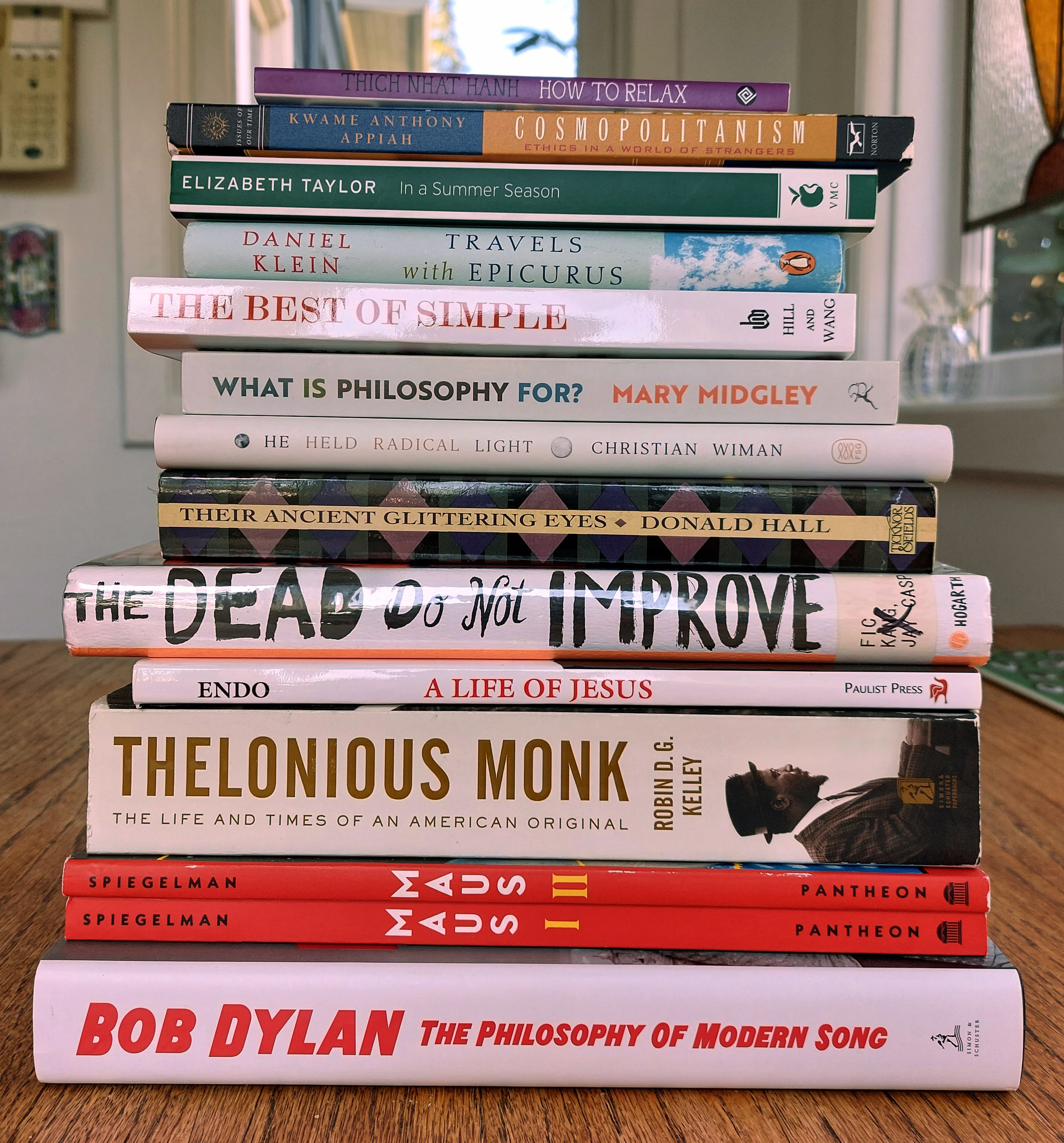
Where did the idea for a bookclub come from? My stack of recently read books is about to topple over. This set began with Art Spiegelman’s “Maus: A Survivor’s Tale,” which he worked on through the 1980’s and won a Pulitzer in 1992. It’s a graphic novel in two parts about his father’s life in Germany during World War II and later living postwar in New York. Its ghostly and maniacal scenes are not quiet surreal, but leave a similar feeling – for it is, after all, predicated on the cartoon. It’s a comic book. The irony of that is so penetrating. It’s told in first person that shifts between his father’s recounting and Art’s narrative coming of age the son of survivors. It’s a masterpiece. And I don’t know how anyone could read it without wanting to share it. But who wants to relive it? The secret sharer puts it in a blog few read. Never mind the book club.
But speaking of music, I also recently read Robin G. Kelley’s biography “Thelonious Monk, The Life and Times of an American Original” (Free Press, 2010). Monk’s mistreatments (self-inflicted or at the hands of others) are legendary; for example, the noted jazz critic Leonard Feather did more than criticize Monk – he attacked him for not being what Feather wanted him to be: “He has written a few attractive tunes, but his lack of technique and continuity prevented him from accomplishing much as a pianist,” Feather said (150). To be an original (in technique, continuity, or otherwise) is not necessarily to be accepted; on the contrary. Kelley’s book includes a good amount of history, Monk’s 20th Century environments: the causes and outcomes of the race riots of New York neighborhoods; the difficulties of surviving in the music industry; the difficulties for families of musicians who must travel to make a living; the prevalence of drugs in American cities, and the changes over time of police response; war, economic collapse, building and rebuilding, travel. Kelley gives us 600 pages, any one of which we might turn down a different street for readings to learn more about those subjects – again, the idea of a bookclub. But repeatedly we find Monk’s music dismissed by many of his contemporaries for its difficulties – difficulties which entertain rather than perplex today’s ears. Interestingly, the Beats and their poets found partnership in clubs that helped Monk finally flourish.
Bob Dylan’s “The Philosophy of Modern Song” (2022) would make a good bookclub paring with Kelley’s Monk book. Dylan is another American Original, and his writing might strike many ears with difficulties similar to Monk’s piano. I’m almost never disappointed with Dylan, and this latest warrants reading and re-reading and listening. I put together a YouTube playlist of the 66 songs Dylan explicates in his book. Many of them have been recorded by more than one artist, so the trick is to get the version that most coveys the feeling of its mystery – that being how something so simple as a popular song can both create and evoke an entire era or single day in the life of an American coming of age in the age of “modern song.” And for those readers turned off by philosophy, not to worry, there’s not much philosophy to sing about here – the philosophy, like music theory, remains in the background.
Speaking of philosophy, somewhere recently I noticed a new Mary Midgley book out, and quickly got a copy and read it. And, as it turns out, it’s her last one (Bloomsbury, 2018). Imagine living to 99 and the title of your last book? “What is Philosophy For?” Indefatigable, indomitable, Mary (look her up on YouTube and tune in to one of her conversations) defeats Dawkins and his ilk with real philosophy – that is to say, thought without propaganda.
Shusaku Endo’s “A Life of Jesus” (Paulist Press, 1973) is a strange book. I like strange books. It’s about the Gospels, how they came to be first talked then written. The environments and people described are different from what we might come away with from the Bible versions. Here, for example, we get a fuller picture of John the Baptist, where he came from and what he wore, what he ate, what he said and did. Life can be strange in the desert. Essentially, we get closer to Jesus in the sense that the time itself comes alive. There is no question but that Jesus was a real person; he lived, in a real place, in a real time. The question of his divinity and why it has to remain such a mystery, almost a game, Endo does not quite answer, though it’s clear that he is a believer. It’s strange even to try to put this into words. I really like Endo’s book, and will read it again. It reminded me in some ways of Pasolini’s “The Gospel According to Saint Matthew” (film, 1964).
A couple of books recently read did produce some disappointment: Christian Wiman’s “He Held Radical Light” (FSG, 2018) and Donald Hall’s “Their Ancient Glittering Eyes” (Ticknor and Fields, 1992). Don’t get me wrong; I liked both books. I even sent the Wiman to one of my sisters, thinking it would be to her liking also. These are both books about poetry, about poets, about poems and how and when they might be read and their purpose and import, their meanings, and the poetry and surrounding discussion I did enjoy. What I found disappointing was the emergence of an ego, a manic wanting on the part of both Wiman and Hall to write the poem to end all poems. Silly, that. It’s easy to see why and how poetry fails to live up to any kind of popular status in the marketplace – except for what we might find in popular song, in the philosophy of popular song, a philosophy that is lived but rarely talked about.
I also read and enjoyed Jay Caspian Kang’s “The Dead Do Not Improve” (Hogarth, 2012). I had read that it was about surfers in San Francisco, so of course was interested. It’s not too much about surfing though. It’s a mystery, and accomplishes what it sets out to do. It’s entertaining, provoking, somewhat in the classic noir tradition, its characters representative of types of a kind, also of that noir setup. The dialog is fresh and accurate, the scenes clearly drawn, you get the smell and the feel of the place. The plot is convoluted, a bit like a shuffled deck of cards, and then reshuffled.
That pretty much concludes my daytime recent book readings. To bed (to read) I’ve been taking Elizabeth Taylor lately (not the movie star). Reading now her “In A Summer Season.”
In the end, writing about writing is rarely as interesting as the writing one is writing about, but there are exceptions, and those exceptions I’m always on the lookout for. Meantime, I’m still working on the guitar. I’ve been playing guitar almost as long as I’ve been reading. Have no intention of giving up either, but talking about reading, like talking about music, is a different pastime than writing or playing original pieces.
-
One Night on the South Bay Strand
I walk past Willy’s Wine Bar, its surf blue
umbrellas hung over the wall, pointing
to the water, patio piano
jazz diminished by the incoming tide.
The noise crashes, a wave through pilings.Mabel, the waitress, I used to know her,
does not say hello, busy with cheese plates,
her white apron purple stained thin cotton,
her silver hair held behind her long ears.
Years younger the torched sommelier tattooedhead to toe oranges and lemon yellows
over a bed of ivory azure.
Happy she looks even joyful against
brave Mabel’s bluejeans rustling all night long
amongst the grape aficionados.A line for a table, fifty dollar
cover charge, and Komos, a cruel bouncer,
pushes me along to keep clear the Strand,
where people still adhere to atmosphere
of theatrical scenery, puttingoff the real ocean as it floods the set,
rising up the old dunes to the green palms,
centurions on display bend and sway,
the Sergeant of Police, “Tarantara”!
recalls the popular air of pirates.The ocean recedes and Mabel soon swoons,
soldiers in pirate costume sing cadence:
“Tarantara!” When danger is afar
leaves its deepest scar and never comes close
to the body but the mind’s eye closes. -
A Talk Story
We recently purchased a used copy of the 2001 Modern Library Paperback Edition of “The Fun of It: Stories from The Talk of the Town,” edited and with a preface by Lillian Ross, who wrote for The New Yorker for some 70 years. Her “Portrait of Hemingway” appeared in the 13 May 1950 issue, and is still read today as a classic first example of literary journalism.
The earliest “Talk Stories,” in the 1920s, didn’t have bylines (the group of stories were signed “The New Yorkers” at the bottom of the “Notes and Comment” section) and their style was intended to entertain while educating with facts. Harold Ross, the first New Yorker editor, no relation to Lillian, “didn’t like bylines,” she tells us in her editor’s preface to “The Fun of It.”
“He wanted the stories in The Talk of the Town to sound as though they’d been written by a single person, and he wanted that person to have what he called ‘the male point of view.’ ‘We’ was always supposed to be male.” In spite of those constrictions, Lillian Ross went on to write “hundreds of Talk stories,” with “the singular challenge of creating these stories pure fun for all of us who do them.”
Harold Ross himself contributed Talk Stories, also anonymously, so it’s possible he was responsible for the August 12, 1927 Talk piece titled “Fence Buster,” about the new New York Yankees baseball player Lou Gehrig. The piece includes the staples of the Talk Story: “By the late twenties,” Lillian Ross says, “the department usually featured a ‘fact’ piece plus a ‘personality’ piece plus a ‘visit’ piece; the mix became traditional.”
Thus we learn, in about the required length of around 1,000 words, that the young Gehrig’s father was a “janitor and grass-cutter” at Columbia University, and that Lou looked up to Babe Ruth, though unlike the Babe, he did “not drink, smoke, or gamble.” Lou enjoyed fishing for eels, which his mother pickled. And in 1927, at the age of twenty-four, he made “about $10,000 a year.”
$10,000 a year is double what I made in my first teaching job around 50 years later. Of course, I had the summer off, while Lou Gehrig had to work. I suppose we could say now that I taught for the fun of it.
-
El Porto at Night
Out of ocean back to sun
slow purple tide drifts down
darkness like a tidal wave
floods and a dark fog falls.Strand partygoers barefoot
swimsuit prance in sandals
streets car-lined seldom trees
dwellings cliche toe crammed.Sleep cans built on sand hills
swept of seawrack the breeze
the moon in her habit prays
and down rains grace gently.Each drop 15% ABV the lifeguard
says and turns on your nightlight
what a concept and flies away
into south Santa Monica Bay.In the distance the bass bob bloom
of close-in closed out hollow waves
like artillery shells down the line
hear water mewling through shingle.In the morning late for the school
bus stops for you up on Highland
you forget now why all those tears
on a lovely morning such as this. -
For a New Year
Happy new year
one at a time
Happy new ears
ones that can hear.Happy new shears
to cut the old hair
Happy new crown
for the frown clown.Weary old year
falls into compost
Happy the earthworms
bring a new day.Now in the rains
the ground soaked
the basement wet
the table settled.Blessed the unsung
who hear buoy bells
Blessed the obscure
quilting deep poems.In the New Year
may clear water
be your cheer
light your walk.May you talk happily
quietly so hear poetry
may your words work
magic in the new year.
 The Coming of the Toads