I first picked up a guitar when I was around 12 years old. A late blooming prodigy? No, simply one of hundreds of thousands of kids directly or indirectly influenced by the rise of popular music through the 1950s and 60s. To pick up the guitar was an essentially existential post WWII experience. Guitar know-how had traditionally been handed down informally and orally, self-taught or augmented by mixing one way with another, a folk working class pastime, played for small get together often sit-out entertainment, and that’s how I began, with a guitar gifted to me by one of the neighbor boys, who had gone off to a minor seminary where he’d joined a band with some dormmates. He came home for the summer with an electric guitar and passed on his old acoustic to me. He taught me to play “Washington Square” and “The Green Leaves of Summer.” A year later, after my girlfriend at the time landed on the guitar jumping off the top bunk, I purchased another acoustic used from an ad in the South Bay Daily Breeze.
A guitar wasn’t always a cheap instrument. The industrial revolution and mass production changed the guitar from a hand crafted parlor instrument to, some might still argue, an adulterated version, easily purchased, or scrap apple made. If living in a rural area in the late 19th or early 20th century, you could buy a guitar through mail order, via a Sears or Montgomery Ward mail catalog. Today you can buy a playable guitar (one that holds its tuning and is easy on the fingers) for around $200.00. That’s roughly the same price (proportionately) a similar guitar would have cost in the 1960’s or the 1920’s or in 1900. A good example today is the Gretsch Jim Dandy model, available via mail order from Sweetwater for $189.00, more for an electric or solid top version, but that 189’ll work fine.
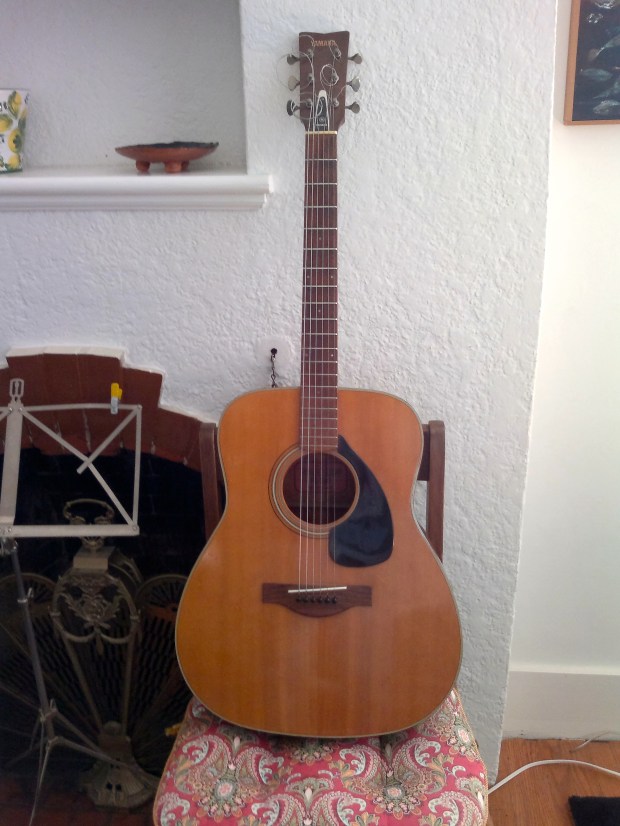
The Gretsch Streamliner I played in the previous post I bought via mail order from Sweetwater during the pandemic for $500.00. The Fender amp was another $120.00. My Yamaha Red Label FG180 is the first new guitar I bought, for $100 in 1970, when I got home from active duty. That Yamaha was a Martin dreadnought knockoff. It looked, and arguably sounded like, a custom made and more expensive Martin guitar. My Yamaha still does, after years of sitting quietly set aside while I played other guitars, the Yamaha resting long after the abuse it suffered as a member of the 140th Engineers motor pool. But unlike the Martin I might have purchased in 1970, the Yamaha FG180’s value has not increased much. It’s probably still worth around $100, there’s a hairline crack in the headstock, otherwise, maybe $300; doesn’t matter, it’s not for sale, nor is it likely to go on loan to a museum.
There is some evidence and certainly rumor of music groups playing Yamaha guitars while on tour in the 1970s – to protect and save their more expensive Martins and other collectibles from potential damage or theft given the rough travel they had to experience while on the road. In the 90’s, Martin created a practical line, called “Road Series,” guitars made for touring, made tough and cheaper than their custom lines. Can anybody hear the difference? Aficionados or snobbish critics may argue so, and maybe you can in a recording sound booth with machine listening aid, but in an auditorium or outdoor venue, at a stadium concert, through the hum and hee-haw of a crowd? Doubtful. Back in the 70’s, Yamaha had developed a more expensive line than the FG’s, which stood for Folk Guitar, called the L Series, where the L signalled Luxury.
Is the brouhaha over vintage instruments warranted – where the provenance (who played it and where) is worth more than the materials, the labor, or the sound of the actual guitar? Some guitars are better than others, but how much better? Ornate decorative designs don’t make a guitar sound better. Some features will attract one player but not another. How a guitar fits, how it feels in the hands or on the lap, its weight, its fretboard width and length, are all arguably more important than the guitar’s aesthetic appeals.
Then there are the Picasso guitars, 1912 to 1914, on display on-line at MoMA. Hard to think of anyone actually playing any of those designs, according to the MoMA introduction notes, “Cobbled together from cardboard, paper, string, and wire, materials that he cut, folded, threaded, and glued.”
Back in May, Nick Paumgarten, in The New Yorker, wrote about a huge but unknown collection of vintage guitars that was about to become an unprecedented Metropolitan Museum of Art exhibit. The previously eschewed low class industrial made and played guitar was about to go live, or dead, depending on your point of view. As Dylan sang in “Visions of Johanna”: “Inside the museums, infinity goes up on trial.” In any case, there does seem to be some strange kind of commodification happening when the value of an object is magnified by who touches it, and some might feel a guitar being inside the museum ironically betrays the guitar’s meaning. Paumgarten quotes The Met curator:
“Except the guitars exhibit a higher art and artistry themselves—first, as objects. There’s high-quality craftsmanship, but it’s different. The guitar is the object of the people. We always talk about it as ‘the people’s instrument.’ American music is bottom-up. So many art forms are top-down. It’s different from the rest of our instruments collection, which is often for the élite.”
“You shouldn’t let other people get your kicks for you,” Bob Dylan sang in “Like a Rolling Stone.” Nor should you spend more than necessary for a guitar if you want to sound like Bob Dylan. Or the Stones, or Metallica. And if you want to sound like The Ramones, well, Johnny Ramone bought his Mosrite guitar used in 1974 for around $50. It might be worth a bit more than that today, about a million dollars more, but its value today has nothing to do with the sound it might make.
Gear changes (swapping out pickups, for example) players or their techs make to factory models, and modifications made to recordings in the studio by sound techs, make a guitar difficult or impossible to reconstruct or imitate, no matter how much you pay for the guitar. Amplifiers, pedals, and other sound changing devices further complicate guitar provenance if what you’re looking for is an original sound not your own. `A player needs to make things their own. There’s little point in trying to sound exactly like your guitar hero, whether it’s Segovia or Django. Guitar value is enhanced by the provenance of its player and the venues and recordings where it was played, but players need to create their own space. A guitar needs to sit out, always accessible, or it won’t get played. The more you pay for a guitar, the less likely it will be allowed to sit out. And sitting out is what it’s all about, if you want to be essentially existentially experienced.
Looking over readings related to The Met exhibit, I’m reminded of the scene in Antonioni’s film “Blow Up” (1966), where the main character, Thomas, played by David Hemmings, wrestles for the guitar neck thrown into the crowd by Yardbird player Jeff Beck, only to toss it onto the sidewalk upon running out of the venue. That’s the same Jeff Beck who donated equipment to The Met and provided a congratulatory statement used in their press release upon the opening of their guitar exhibit. And Antonioni doubled down on the irony at the end of what is now referred to as The Yardbird Scene when a curious passerby picks up the guitar neck, looks it over, and tosses it back down onto the sidewalk. It was just a prop; it’s not in The Met exhibit.
~~~
Readings:
“A Secret Trove of Guitars Heads to the Met,” Nick Paumgarten, The New Yorker, May 19, 2025.
“The Met Receives Landmark Gift of More than 500 of the Finest Guitars from the Golden Age of American Guitar Making,” May 19, 2025, The Met Press Release, retrieved 10 Aug 2025.
“Picasso: Guitars 1912 – 1914,” Feb 13 – Jun 6, 2011, MoMA.
“Road Series,” Martin Guitar Website, retrieved 10 Aug 2025.
“L Series,” Yamaha Guitar Website, retrieved 10 Aug 2025.
“Former Rolling Stones Musician Mick Taylor Claims His Stolen Guitar is at The Met,” Smithsonian Magazine on-line, 4 Aug 2025.
~~~
 The Coming of the Toads