Tag: Traveling Sprinkler

  • Sprinkler Music

    More rain. More “Traveling Sprinkler.” Paul Chowder hasn’t been playing his new guitar much, though. Instead, the former bassoonist has found an interest in electronic music, and he’s bent on creating jingles and jangles and hums and beats and calls it dance music.

    “I worked for several hours today on a new song called ‘Honk for Assistance.’ I saw the sign at a convenience store, near the ice machine, and I thought, Now that is a dance song, in the tradition of Midnight Star. I sampled a few honks from my Kia’s horn and set up a beat and fingered up some harmony using an instrument I hadn’t tried before, the Gospel Organ, which has a slightly percussive sound in the attack phase of each note. I added more chords on a Mark II keyboard and some homegrown handclaps and some rhymes made with the Funk Boogie Kit” (190).

    Where is music, today? Where was it in Claude Debussy’s day? I’m listening now, suggested by Paul Chowder, our narrator of “Traveling Sprinkler,” to Debussy’s “Preludes,” via YouTube Music on my Chromebook. I don’t have my hearing aids in, and the Chromebook speaker is not exactly a Marshall Super Lead 100 Watt amplifier stacked with two humongous speaker cabinets towering overhead, so maybe I can’t really say I’m listening to Debussy’s “Preludes,” anymore than I can say I’m in the kitchen nook typing while getting wet from the drizzle outside.

    Around page 128, Paul spends ample time discussing the benefits of stereo versus mono. What he does not mention is asymmetrical hearing loss, a condition where you hear less volume in one ear than the other. You’re sometimes unsure which direction a sound is coming from, and it can make you a bit paranoid as you navigate your way around town. You have to be extra careful crossing the street, particularly if there are electric vehicles in the neighborhood. And bicyclists and joggers coming up behind you and passing full of assumptions and presuppositions about their position startle the shite out of you.

    “I put the headphones on, and I lowered the needle on Zubin Mehta conducting The Rite of Spring, and suddenly I was there, enclosed in the oxygenated spatial spread of stereophonic sound. I was there with the panicked piccolo, and the bass clarinet was a few feet away, and the timpani surged over to the left, mallets going so fast you couldn’t see them. I couldn’t believe how big a world it was – how much bigger and better stereo was than mono….You need two ears” (129).

    Or three, or four. One day, back home, I rode my bike down the Strand to Mike Mahon’s place in Hermosa, carrying with me Archie Shepp’s “Fire Music,” on the Impulse label, from 1965, still new and noisy around the early 70s. Mike was a classically trained pianist, although like Paul Chowder, had decided he wasn’t good enough to make a career of it, and went back to school for a PhD in English Literature, specializing in Yeats and Joyce and company, but still Mike was an audiophile, and had the latest equipment. He took my album and ran it through an electronic vinyl record cleaning machine he had, then we listened to some of it on his impressive and expressive and expensive sound system. Then he pulled from his album collection a copy of Stravinsky’s “The Firebird,” and we listened to the “Infernal Dance” piece. Talk about “attack phase.”

    I played a bit of “The Firebird” just now, switching off the Debussy. I’m immediately reminded of Poe’s “The Bells”:

    Hear the loud alarum bells—
                     Brazen bells!
    What tale of terror, now, their turbulency tells!
           In the startled ear of night
           How they scream out their affright!
             Too much horrified to speak,
             They can only shriek, shriek,
                      Out of tune,
    In a clamorous appealing to the mercy of the fire,
    In a mad expostulation with the deaf and frantic fire,
                Leaping higher, higher, higher,
                With a desperate desire,
             And a resolute endeavor
             Now—now to sit or never,
           By the side of the pale-faced moon.

    I can only handle a minute or two of “The Firebird” this morning (or Poe) before switching over to Segovia playing Bach on his acoustic guitar, from Andrés Segovia: Bach – Gavotte from 4th Lute Suite for guitar, Allegro Films.

    In butterfly mode, Paul Chowder continues, in “Traveling Sprinkler,” from acoustic guitar to electro sounds to his girlfriend Roz and his neighbor Nan, parking his car here and there to get some writing done, in other words, in and out and back in again, listening to every day sounds and how they wrap around the cans and cannots of one’s thoughts. But Chowder keeps mentioning songs and music I’ve never heard of. Where have I been? And I asked myself again when and how and why it was I got Nicholson Baker’s “U & I,” and “Traveling Sprinkler” to begin with. So I looked them up. I thought I had purchased (and said in a previous post) “Traveling Sprinkler” used from Alibris. Not so. I purchased it new from Amazon in June of 2023 (though it was not sold by Amazon – a bit confusing all of that, how Amazon works sometimes). And just now, about two years later, I’m getting around to reading it, “Traveling Sprinkler” (though I had given it a try a couple of times before), while “U & I,” I got used on Alibris in February of 2019, also giving it a couple of tries, but unable to fall into it, yet.

    Anyway, it’s all old stuff, the books, the references, the music, not to mention the many political digressions, arguments with backing but often rants of a sort, Paul Chowder takes off on. He’s a pacificist, who, as I mentioned, attends meetings, though he’s not a full member, but which is why I thought the acoustic guitar was a good fit, him being a pacificist. But it depends on how you hear sounds. Last night late (after watching the Dodgers beat the Athletics in a record-breaking score of 19 to 2) before bed I played through a few of the Leo Brouwer “Etudes Simples” pieces, as I do almost every night, on my 1977 acoustic Takamine C132S. Number 1 is not all that pacific sounding, but Number 2 is lovely, particularly setting the tone for sleep.

    The political arguments, by the way, though now aged, just over a decade away, are effective today, without stirring up too much dust. I’m increasingly finding I’d rather listen to decade old or older music too. Timeless music. Anyway, thinking back to that business about stereo and mono, I’m reminded of the Jimi Hendrix album “Axis: Bold as Love.” The first piece, titled, “Exp,” is an amazing example of stereo at play. It’s very short: 1:56. You can give it a listen here.
  • A Googol of Rain

    Rain. Inside still reading “Traveling Sprinkler” while outside rain falls, sprinkles, showers. Yesterday briefly it rained hard, but mostly (and the forecast is now calling for ten more days of this) a light, light to moderate rain, periods of partial clouds amid dashes of partial sun. But it’s beautiful, the multi-blue-grey cruisers and destroyers, heavy-hefty frigates idling by, littoral patrol boats, submarines up in the sky. Loose Cs strolling by. Anyway, I reached page 160 in Nicholson Baker’s “Traveling Sprinkler,” beginning the day at page 92, so close to 70 pages for the rainy day. When I left you yesterday, I might have sounded a bit worked up about his getting the Best Buy guitar. And later, I even looked it up, and sure enough, there it was, for $40, at Best Buy, a Gibson acoustic, but out of stock.

    Back at the first paragraph of Chapter Four, Paul Chowder, the first person narrator of “Traveling Sprinkler,” opens with:

    “I’m out in the garden, Maud, and the very fine clouds have, without my noticing, moved across the moon and collected around it like the soft gray dust in the dryer. I want to scoop the gray clouds away and see the moon naked like a white hole in the sky again, but it isn’t going to happen” (29).

    Why does he call it dust, the dryer lint? Because dust sounds better than lint coming just before dryer, and the st gives off the flavor of the stuff.

    I took numerous breaks from “Traveling Sprinker” yesterday, one to play The New York Times “Spelling Bee” game with Susan. We’ve been playing it together nearly every day. We sit next to one another on the love seat and prop my tablet against a pillow between us and use our stylus pens to enter words, making mistakes as we go, talking about the words. Coco, for example, which we’ve seen before, not acceptable (“not in word list”), not to be confused with cacao or cocoa, both acceptable. Sometimes the rules seem a bit illogical. Yesterday, the middle letter was O, and the other six letters were G, L, A, I, C, and Z, the other letters arranged in a circle around the O, and I saw emerging like a photograph being developed, zoological, and so we started with the day’s only pangram.

    But we ended up getting stuck a few words away from a Queen Bee finish, found a couple more, but then couldn’t find our last word, a 6 letter GO word. We took a break to stretch and cut an apple into slices and came back to the couch lightheartedly determined to reach Queen Bee for the day, only one word away. In 179 Spelling Bee game-puzzles, we’ve reached Queen Bee only 19 times. I decided to ask AI (Artificial Intelligence) for some help, explaining to Susan the difference between cheating and getting some help. I asked Gemini, and this is the answer I got:

    “Let’s see… using only the letters G, O, L, Z, A, I, and C, and starting with GO, a six-letter word we can make is GOLGI.”

    Do you see the problem with that answer? So much for getting some help.

    I was reminded of a recent post over at Ashen’s blog, “Course of Mirrors.” The post is titled …Thoughts on AI and ChatGPT …, and in it, Ashen creatively questions the implications of Artificial Intelligence. She quotes a 70s poem by Wislawa Szymborska – here are a couple of lines: “The Tree of Understanding, dazzling straight and simple,/ sprouts by the spring called Now I Get It.” And I am reminded of the Richard Brautigan poem, “All Watched Over by Machines of Loving Grace.” Machines, who, like all parents, it would seem to be developing, make mistakes.

    I woke up this morning thinking of rain and W. Somerset Maugham’s short story titled “Rain.” The story is about restraint and strain and torrential tropical rain. But what I was thinking about was what we mean when we say, “It’s raining.” What’s the it? I wasn’t fully awake yet when I thought later I’d ask Gemini to explain. I just now asked, and here is Gemini’s answer:

    “Ah, that’s a fun little linguistic puzzle! The “it” in the sentence “It is raining” is what we call a dummy pronoun or an expletive pronoun.

    Think of it this way: the “it” doesn’t actually refer to any specific thing. It’s a grammatical placeholder that we use because English sentence structure generally requires a subject. In this case, there isn’t a real subject doing the raining. Rain is a weather phenomenon, not an action performed by a particular entity.

    So, the “it” is just there to make the sentence grammatically correct. We use similar dummy pronouns in other impersonal constructions, like:

    • It is cold outside.”
    • It seems like a good idea.”
    • It‘s important to be on time.”

    In these sentences, the “it” doesn’t point to anything concrete; it simply fills the subject slot.

    Isn’t language fascinating? We have these little grammatical tools that help our sentences flow even when there isn’t a literal subject performing an action.”

    Not a bad answer. I wasn’t expecting that bit of editorializing at the end. And now I’m thinking back to the short story “Rain”:

    “If he remonstrated or sought to put his meaning into an intelligible phrase, Walker would fly into a passion and cry: ‘What the hell do I care about grammar? That’s what I want to say and that’s how I want to say it.’”

    But back to yesterday. While I was chatting it up on my phone with Gemini, Susan said, “Look at the [tablet] screen.” And there it was, the page that appears when you’ve reached Queen Bee! Susan had come up with the missing word: Googol.

  • Reading “Traveling Sprinkler” by Nicholson Baker

    Over the weekend, I read two articles somewhat related to one another: “How Much Are We Paying for Newsletters” (apparently some subscribers are losing track) in The New York Times, and “Is the Next Great American Novel Being Published on Substack?” (If a tree falls in the forest?) in The New Yorker. Too many subscriptions, paid or free, and the emails begin to pile up like old zines on a rusty rack in an empty barbershop, and come to be treated like spam and deleted, at issue, at bottom, simply this: more than we have resources to profitably or efficiently manage. Millions of miles of Substack track and only one effort is nominated. And part of the success formula is still will you get picked up by a traditional publisher. But there are great novels precursors to Substack serials: Dickens, George Eliot, Trollope. Maybe serializing your novel no one hears on Substack is the theme of the Great American Novel.

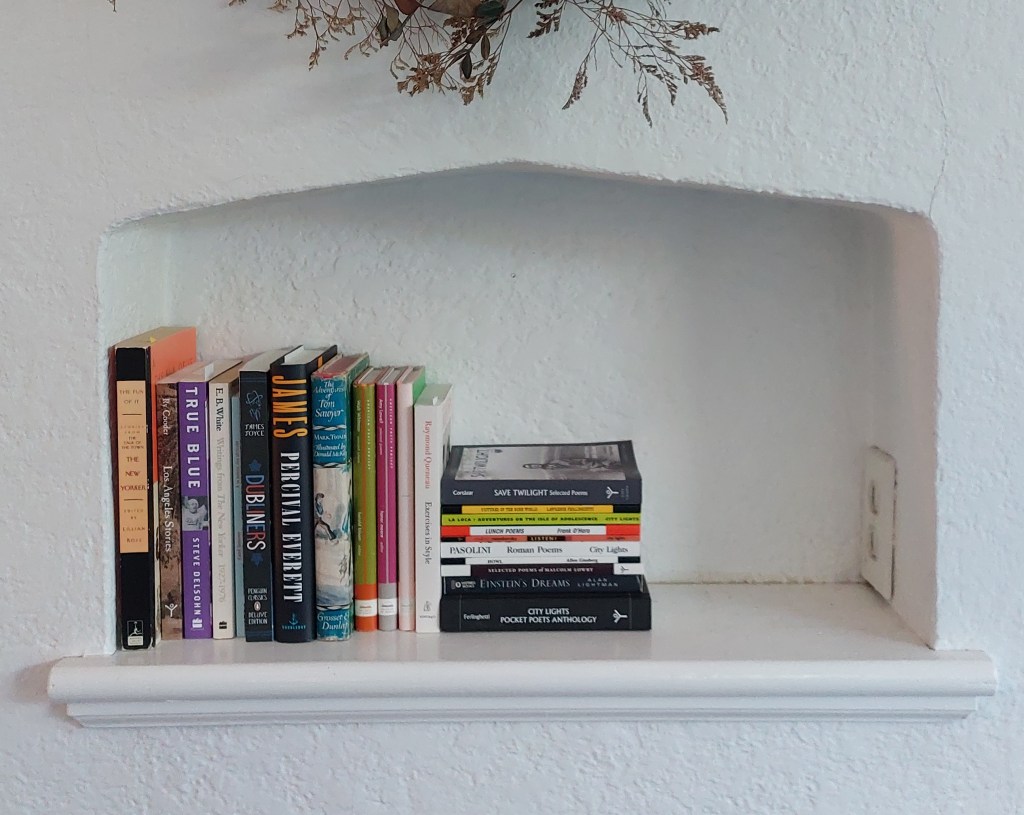
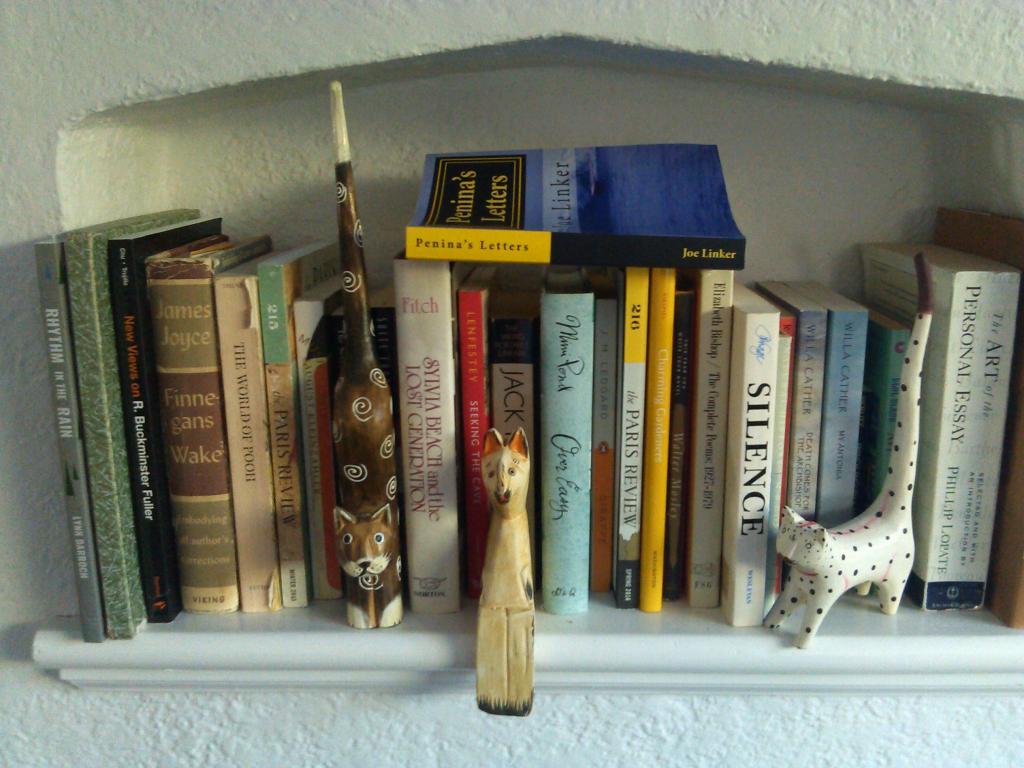
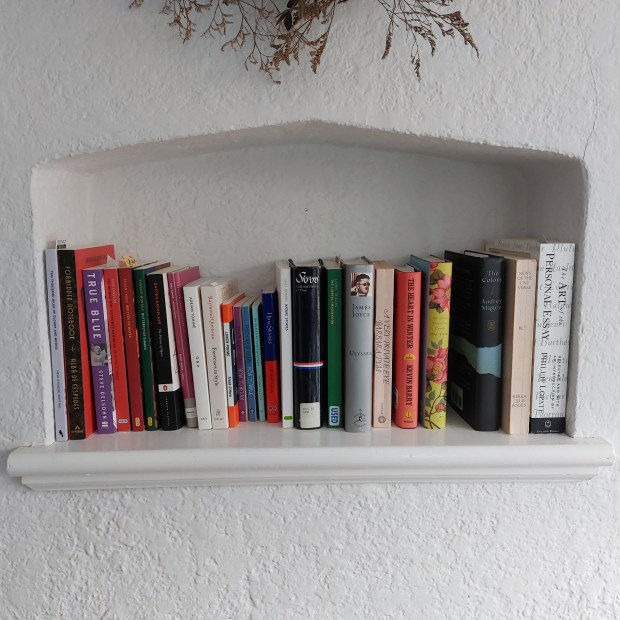
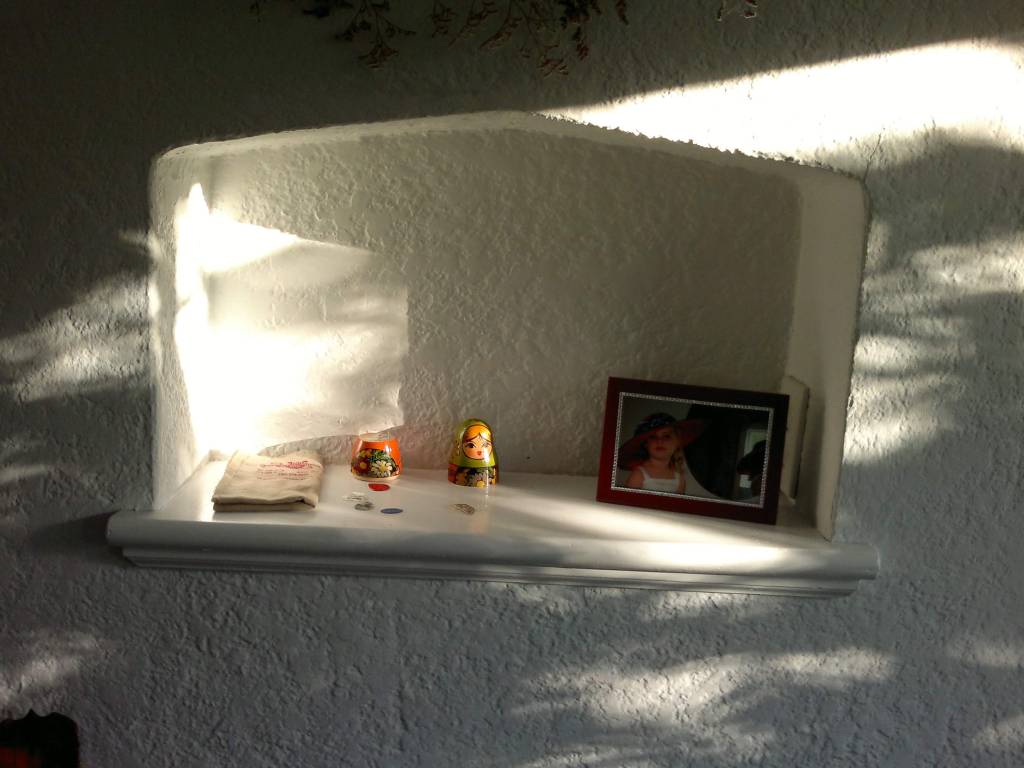
    Having finished “The Paris Library,” and in long pause from Substack, I perused my small shelf (24 and 1/2 inches, to be exact) usually full of still barely opened or half read or unread books, but also some to-read-again books (as over the last few years I seem more inclined to reread something I particularly liked in a previous reading life rather than risk something new to me that might leave a bad taste or go permanently unfinished, a yucky slice of green pizza). Today, I counted 25 books on the to-read shelf. I feel no urgency about reading from the shelf. Every so often (periodically, but without a period), I wipe it clean and replace the books with a little vase of a freshly cut sprig or two.

    About that phrase above, “to be exact.” Am I the type of guy who says things like “to be exact”? I don’t want to be. I knew a guy who habitually talked about other guys, and he frequently introduced his comments or opinions using the phrase, “He’s the type of guy….” He was the type of guy who used the phrase, “He’s the type of guy.” Well, there you have it. And even if he didn’t use the phrase, you felt categorized nonetheless. You got typed, along with the other guy, for you are either the type or not the type, and if you’re not that type, you’re some other type. So, to correct matters, it’s best to avoid any such shorthand phrases, for they are cliched and unnecessary, like most comments or opinions, I hasten to add, this one included. In fact, and in any case, the shorthand ends up making things longer, as I think I’m in the process of showing here. Of course, once you start to strike through stuff, you might end up with nothing. Hang out the shingle, “No Post Today.”

    From the shelf of the unread, I picked “Traveling Sprinkler” (Penguin, 2013) by Nicholson Baker. I like Nicholson Baker, though I’ve only read one of his novels, “The Anthologist” (2009), which I enjoyed. But I’ve read most if not all of his New Yorker pieces (but I’ve not seen him there in awhile). I purchased “Traveling Sprinkler” used from Alibris some time ago. It’s a sequel to “The Anthologist.” It must have got wiped from the to-read shelf, not sure when, because it was just a few weeks ago I discovered it on another shelf and moved it back to the unread shelf. It had been sitting next to Baker’s “U and I: A True Story,” which twice I’ve tried to break into, both times unsuccessfully. “U and I” sat on the to-read shelf for weeks before I consigned it to a distant shelf. But I’ll get back to it, sooner or later, maybe.

    Anyway, I like Nicholson Baker for several reasons. First, I very much enjoyed “The Anthologist.” I even did a bit of research, the basis for a fun post titled “Nicholson Baker, Nicholas Carr, and Googling Clothespins.” Second, Nicholson seems like a nice guy. For example, he seems to be one of the few fairly well known writers who if you follow them, on Instagram, for example, they’ll follow you back. Not that they actually check you out ever, but still, it’s nice to get followed back once in a while. I’ve not conducted a study on this, but I’m willing to guess that more than, say, 99 followers or following, assuming regular postings from either, and keeping up becomes an impossible challenge.

    Baker’s latest appearances on Instagram tracked his efforts to draw, and then he came out with a new book, “Finding a Likeness: How I Got Somewhat Better at Art” (April, 2024). I’ve not read it, nor am I likely to add it to the to-read shelf anytime soon. Speaking of his wife, who’s an artist, Baker says: “She also draws with colored pencils and weaves fabric. She doesn’t make a big deal of it, she just does it.” I like that, not making “a big deal of it.” I saw it in the “Read sample” of “Finding a Likeness” at Amazon. Anyway, “Finding a Likeness” looks like a cool book, but I’m already out of room on the to-read shelf. Not that I have to self-limit to the 24 and 1/2 inches, but really, enough is enough.

    And I’m enjoying “Traveling Sprinkler.” I’m only about a third of the way through it, through page 109, which ends Chapter 12, to be exact, so I probably shouldn’t try saying too much about it, until I finish it. It’s about the type of guy that’s largely unsuccessful in his career, though he doesn’t seem to have put that much into a career. In fact, I’m not exactly sure what his career is. He’s a poet of some sort, but I don’t think being a poet qualifies as a career. One reason you become a poet is to avoid a career, or to hide what you really care about from a career. Although there’s not much need to hide anything in a poem, given the unlikelihood anyone’s going to read it anyway, or if they do, understand it. He, Paul Chowder is his name, the narrator, started off as a musician, playing the bassoon. He gave up on the bassoon because he didn’t think he’d ever be good enough to make a fixed go of it. He sold his bassoon, a gift to him from his grandparents, for $10,000. I didn’t know bassoons cost that much. And that’s old dollars, before a tariff or two. He had a Heckel bassoon. He comes to regret having sold it. A major regret. I looked up bassoons just now. You can get a Moosman bassoon today for around ten grand. And if you don’t have that kind of dough (or a well endowed grandfolk) to blow on a bassoon, you now have two words to juxtapose in a poem. But what Paul wants now, and, in fact, has purchased, at Best Buy, no less, is a cheap acoustic guitar.

    I didn’t know Best Buy sold guitars. Best Buy is where I bought the Chromebook I’m now typing on. I’m pretty sure I didn’t see any guitars in the Best Buy where I purchased this laptop. And Paul wants to ditch poems for songs. You might begin to understand why I said I like Nicholson Baker and “Traveling Sprinkler.” You learn a lot of footnote worthy stuff reading Nicholson Baker, that the poet Archibald MacLeish was a founder of the CIA, for example (105-107). And Baker himself played the bassoon. So is Paul a stand-in for Baker? No, I don’t think so. It doesn’t work like that. That’s too easy. All I wanted to suggest is that what Paul says about bassoons is probably reliable. He says Debussy was a fan of the bassoon, but then anyone could look up something like that.

    Paul reads a lot, and attends Quaker meetings, though he’s not a full member. When he was younger (he’s on his 55th birthday as the book opens), he wanted to be a composer. He listens carefully to popular music now, but he divulges he’s never really heard or paid attention to lyrics, but he does now. I’ve made a note of a few of the songs he mentions, that I’ve never heard of, thinking I might look for them on YouTube. Kind of funny, looking a song up now, since the book is now 12 years old, and I’ve never heard of the songs he mentions, and most popular songs don’t have a very long shelf life. But then why would I have heard of his songs? And even if I had, I don’t hear lyrics either, unless it’s a Patti Page or Hank Williams song. In most rock songs, the voice is just another instrument, part of the noise. So he goes on about songs and poems, and Paul gives us the good lines from some poems, so we don’t have to waste time reading the whole poem. There’s much so far, in the first 109 pages, that I relate to. Not that you need to relate to everything you read, or anything you read. It might be better if you don’t relate. Develop new tastes. I wish I’d have discovered Penelope Fitzgerald, Barbara Pym, Elizabeth Taylor, Elizabeth Bowen, and Henry Green earlier, but sometimes you have to wait until you’re ready for something.

    Paul clarifies the difference between the oboe and the bassoon, and I was reminded of the jazz appreciation class I took in college, and the instructor told the class the oboe was not played in jazz, no jazz oboe players, and I raised my hand and corrected her, pointing out that Yusef Lateef played jazz oboe. Turned out, she didn’t know that much about jazz, lectured from notes, said I was wrong about Lateef and jazz oboe. Yusef Lateef also played the bassoon. Paul probably knows that, or Nicholson Baker does, but they haven’t mentioned it yet, through page 109 of “Traveling Sprinkler.”

    And so Paul buys the cheap guitar, takes a lesson, though it doesn’t sound like the lesson was much help, but he’s enthusiastic about making up some songs:

    “Everything’s different when you write a song. The rhymes sound different and they happen naturally, and the chords don’t sound like the same chords played on a piano. Your fingers make choices for you. The guitar is your friend, helping you find chords you’d never have found on your own, and then these chords help you find tunes you’d never have thought to sing. It’s such a simple and glorious collaboration” (104-105).

    That’s a perfect rebuttal to the academic’s put down of popular song lyrics when compared to poetry.