Tag: travel

  • A Place of Gifts: On Foot from the Beach to Home

    We two boys stood at the edge of the road at the top of 45th high above the beach, where the slow moving two lane Highland (lined with spots we ignored as kids: vista apartments and curio shops, corner cigarettes and beer market, breakfast cafe and evening bar), turns into Vista del Mar and curves down to Grand, only about a mile away, but still we stuck our thumbs out to hitch a ride. We were on our way home from Junior Lifeguards, which was held on the beach near Marine, down from the big tower. We never caught rides thumbing, so we were surprised when some sporty car with jaunty driver pulled over coming to a stop some twenty yards past us and we ran to hop in but the car revved up and sped off wheels spinning in sandy grit just as we got close.

    I’ve been reading “A Time of Gifts,” by Patrick Leigh Fermor (subtitled “On Foot to Constantinople: From the Hook of Holland to the Middle Danube”). First published in 1977, when Fermor was sixty-two, it recounts the time in 1933, when Fermor, then just eighteen, left England for a wintry continent, outfitted with greatcoat, hobnailed boots, and commodious rucksack:

    “During the last days, my outfit assembled fast. Most of it came from Millet’s army surplus store in The Strand: an old Army greatcoat, different layers of jersey, grey flannel shirts, a couple of white linen ones for best, a soft leather windbreaker, puttees, nailed boots, a sleeping bag (to be lost within a month and neither missed nor replaced); notebooks and drawing blocks, rubbers, an aluminium cylinder full of Venus and Golden Sovereign pencils; an Oxford Book of English Verse. (Lost likewise, and, to my surprise – it had been a sort of Bible – not missed much more than the sleeping bag.)

    In the mornings, when the first-shift lifeguards opened their towers, the beach was grey-white foggy and cool-damp and the yellow sand stuck to your feet, the water dark-grey and the waves glassy and small and the blue of old fruit jars. At my parents’ house, 2 miles inland, walked in under an hour if you took the Devil’s Path shortcut and didn’t dawdle, the morning was open and clear and the air fresh and warm. The town was hilly and you had to cross the dunes to get down to the beach, which meant you had to climb back over them to get home, up the long Grand Avenue hill, but the afternoon breeze would be onshore and pushing as you walked before the wind.

    Travel descriptions can be confusing to read, to see the images as they develop on the page. One key to travel writing must be movement – in time and place. Still, how does the reader see the scene unfolding? I’m finding it helpful to pull up the places Fermor talks about in Google Maps, but of course consulting a map is not travel, nor does the map help bring forth the local. Maybe we’ve become too saturated with photographs to understand prose pictures. And while Fermor’s story takes place in 1933, the images I see seem older. I was reminded of scenes like the following, from Penelope Fitzgerald’s “The Blue Flower,” but which takes place in the late 1700s, and concerns Friedrich von Hardenberg, later known as Novalis:

    “From the age of seventeen he had been in almost perpetual motion, or the Gaul’s unhurried version of it, back and forth, though not over a wide area. His life was lived in the ‘golden hollow’ in the Holy Roman Empire, bounded by the Harz Mountains and the deep forest, crossed by rivers – the Saale, the Unstrut, the Helme, the Elster, the Wipper – proceeding in gracious though seemingly quite unnecessary bends and sweeps past mine-workings, salt-houses, timber-mills, waterside inns where the customers sat placidly hour after hour, waiting for the fish to be caught from the river and broiled. Scores of miles of rolling country, uncomplainingly bringing forth potatoes and turnips and the great whiteheart pickling cabbages which had to be sliced with a saw, lay between hometown and hometown, each with its ownness, but also its welcome likeness to the last one. The hometowns were reassuring to the traveller, who fixed his sights from a distance on the wooden roof of the old church, the cupola of the new one, and came at length to the streets of small houses drawn up in order, each with its pig sty, its prune oven and bread oven and sometimes its wooden garden-house, where the master, in the cool of the evening, sat smoking in total blankness of mind under a carved motto: ALL HAPPINESS IS HERE or CONTENTMENT IS WEALTH. Sometimes, though not often, a woman, also, found time to sit in the garden-house.” 57

    That prose was first published in 1995, when Penelope was seventy-nine, so around 200 years after the scene takes place. And in Patrick Fermor’s “A Time of Gifts” we see this:

    “I was plodding across open fields with snow and the night both falling fast. My new goal was a light which soon turned out to be the window of a farmhouse by the edge of a wood. A dog had started barking. When I reached the door a man’s silhouette appeared in the threshold and told the dog to be quiet and shouted: “Wer ist da?” Concluding that I was harmless, he let me in.” 73

    That traveller was Fermor, in 1933, writing in the 1970s, but could have been Novalis in 1795, described by Penelope in the early 1990s. And many travellers wanting to save their day’s journey in writing may have shared something like the following experience, here described by Fermor:

    “This was the moment I longed for every day. Settling at a heavy inn-table, thawing and tingling, with wine, bread, and cheese handy and my papers, books and diary all laid out; writing up the day’s doings, hunting for words in the dictionary, drawing, struggling with verses, or merely subsiding in a vacuous and contented trance while the snow thawed off my boots.” 66

    The title of Fermor’s book comes from a Louis MacNeice poem, “Twelfth Night”. From the last of four stanzas:

    “For now the time of gifts is gone –
    O boys that grow, O snows that melt,
    O bathos that the years must fill –
    Here is dull earth to build up on
    Undecorated; we have reached
    Twelfth Night or what you will . . . you will.”

    I haven’t reached the Abbey of Melk yet, which in Jan Morris’s introduction to “A Time of Gifts” we are told is the “central point of the narrative.” So more on Fermor’s travel’s in a later post. Meantime, I harken back to the time and place of the two boys walking home from the beach. They don’t have maps, nothing to denote, “You are here.” They really haven’t much idea where they are in time or place, nor can they fully grasp the gifts of either.

    Richard Henry Dana Jr, in his memoir, “Two Years Before the Mast” (1840), found at least the California weather a gift, and the beaches and waves. The following is from the “First Landing in California” chapter:

    “It was a beautiful day, and so warm that we had on straw hats, duck trousers, and all the summer gear; and as this was midwinter, it spoke well for the climate; and we afterwards found that the thermometer never fell to the freezing-point throughout the winter, and that there was very little difference between the seasons, except that during a long period of rainy and south-easterly weather thick clothes were not uncomfortable.”

    “I shall never forget the impression which our first landing on the beach of California made upon me. The sun had just gone down; it was getting dusky; the damp night-wind was beginning to blow, and the heavy swell of the Pacific was setting in, and breaking in loud and high ‘combers’ up on the beach.”

    And where was that place? And is it still there today? The Grand Avenue Beach Jetty (it’s now called El Segundo Beach) is located in the middle of Santa Monica Bay. It’s about 10 miles north from the jetty to Sunset Beach (not counting getting around the Marina), where Sunset Boulevard winds down out of the hills to the coast road, and it’s about 10 miles south from the jetty to Malaga Cove, on the north side of Palos Verdes, the cove part of the Haggerty’s surf spots. Santa Monica Bay, the flat Los Angeles Basin surrounded by hills, Palos Verdes to the south and Malibu and the canyons to the north, the beach cities in the south, oceanic stupendous views or at least close enough to the ocean to smell and feel the salt and surf in the air, breach the storms and storm surf, wander down to the beach the day after a “south-easter.” But the South Bay is also full of industry, and all along and up from the beaches from Marina del Rey to El Porto, the dunes are supplanted by pipes and tanks and asphalt grounds surrounded by chain link fences: the airport, the Hyperion sewage treatment plant, the steam plant, the oil refinery, the power plant. It’s a different kind of desolation than what Dana saw when he wrote of Los Angeles:

    “I also learned, to my surprise, that the desolate looking place we were in was the best place on the whole coast for hides. It was the only port for a distance of eighty miles, and about thirty miles in the interior was a fine plane country, filled with herds of cattle, in the centre of which was the Pueblo de los Angelos — the largest town in California — and several of the wealthiest missions, to all which San Pedro was the seaport.”

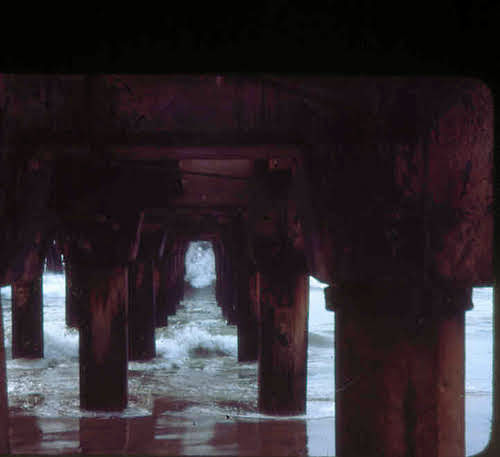
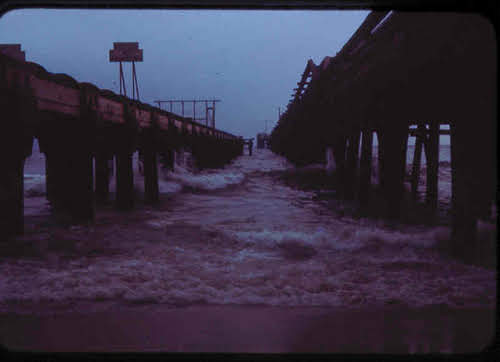
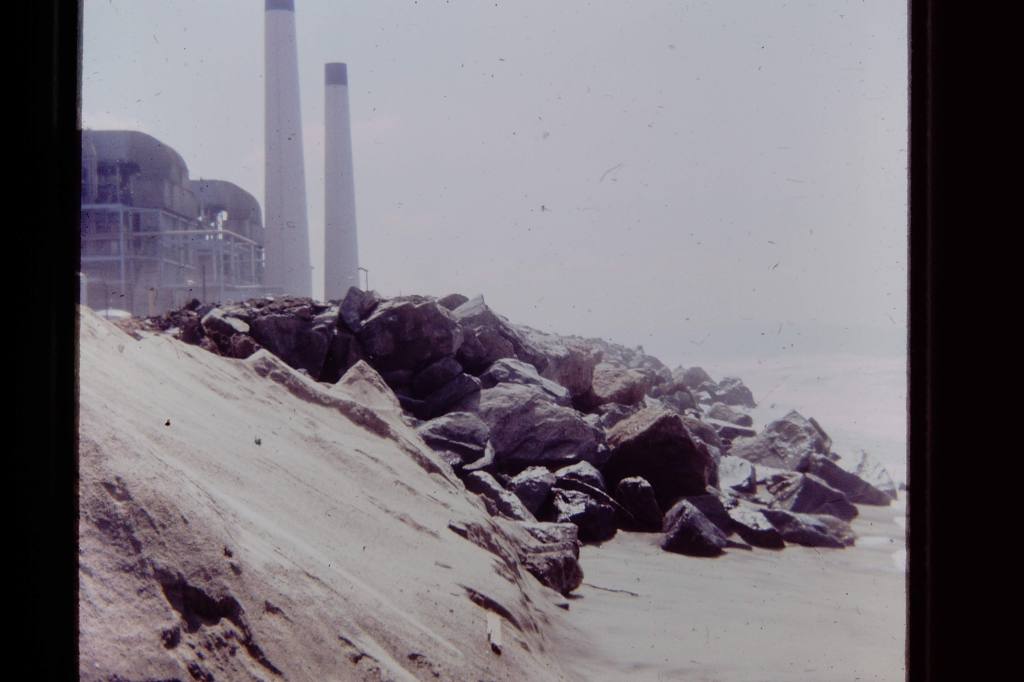
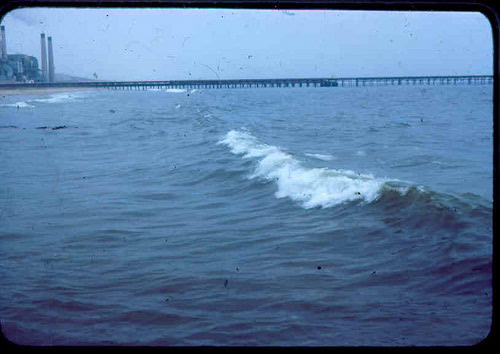
    After being tricked by the off and running car, we two boys put our thumbs in our pockets and walked back down 45th to the beach. Just up Highland a few doors, we could see the apartment my oldest sister would rent about eight years into the future, while my future wife lived a block over and down on 44th. At the bottom of 45th, we turned north and walked along the beach at the water’s edge beneath the power and steam plants, all industrial now, the beach path, north of 45th, prime real estate denied the developers, but we didn’t mind that, for here we were in a short stretch of beach able to avoid the tourist crowds and catch a few empty waves on our own. We reached the Standard Oil Pier and crossed under the big pipes and wood beams, kicking through the surf. I was still a year or two from my high school reading of “Two Years Before the Mast.”

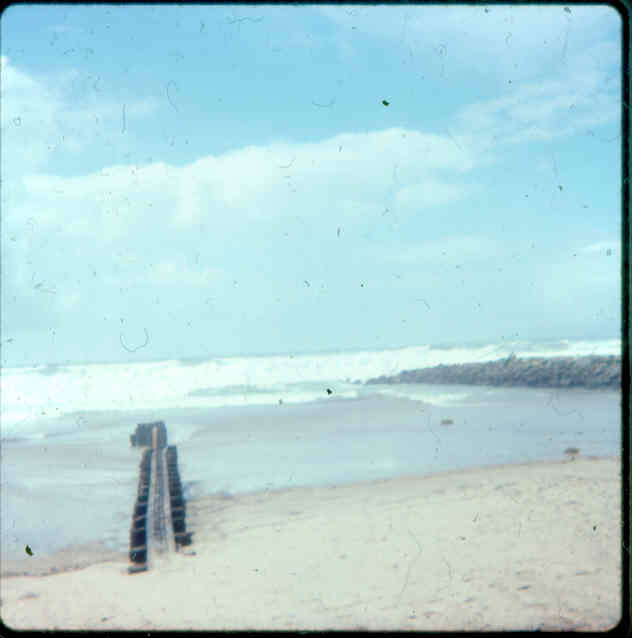
    From the pier we walked to the jetty at Grand and then up the long hill past the steam plant and ice plant hillside that borders the refinery. We parted ways at Loma Vista and I continued down Grand across Main to the old railroad station then followed the tracks up and through Devil’s Pass to home, where I would find my mom making a watery spaghetti and sauce dinner, having found no time, no doubt, to sit happily in the yard in any place for any length of time.
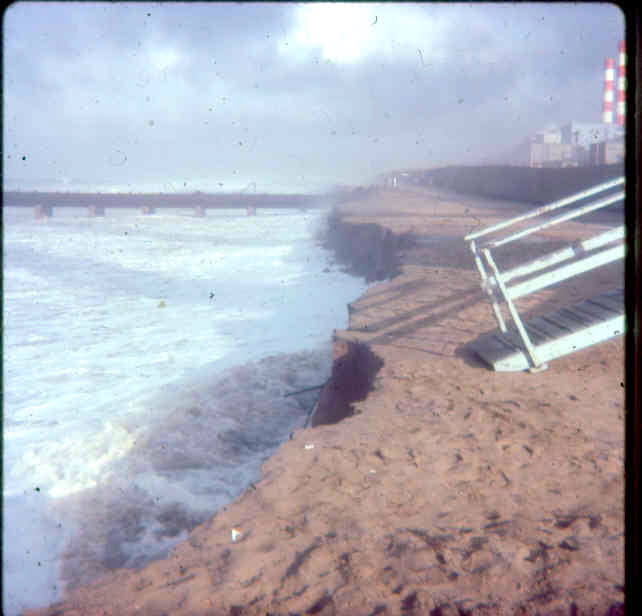
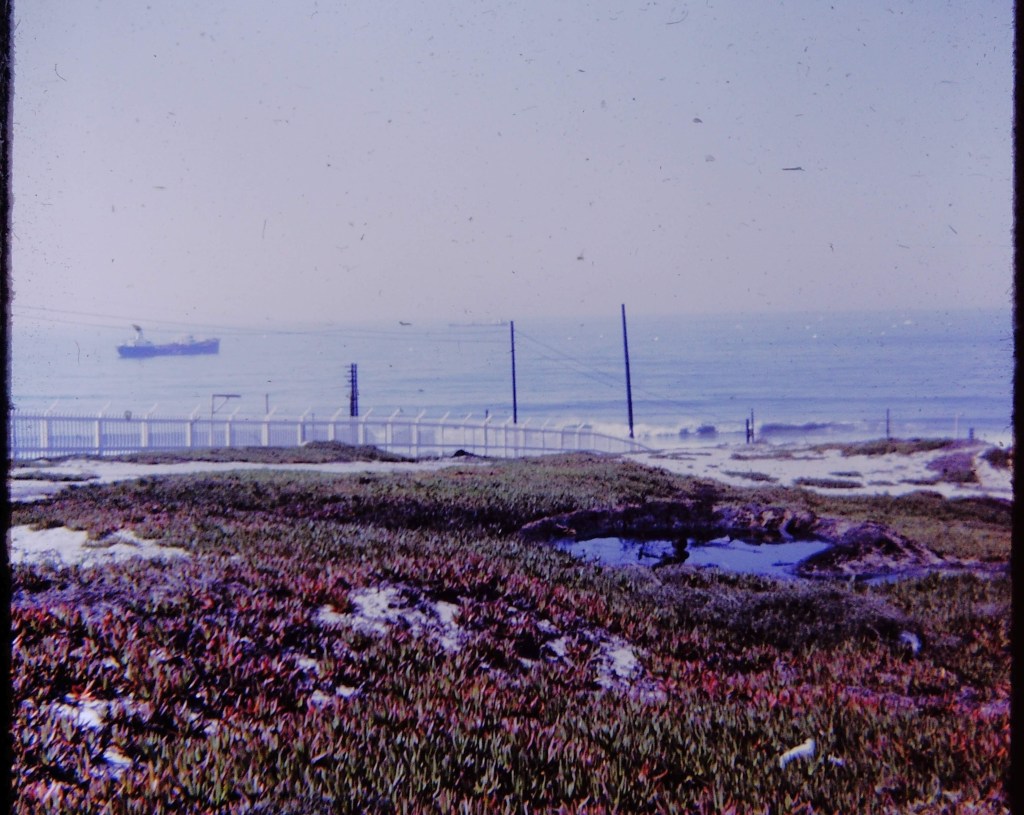
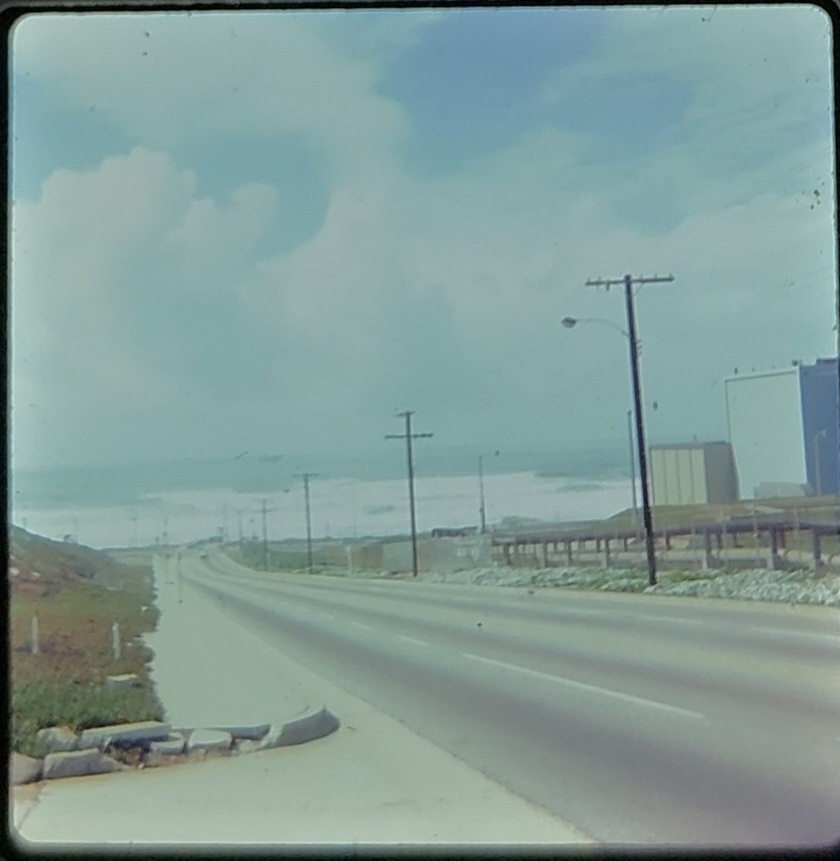
    Above photos taken with my Exakta 500 I used at the time. The exact dates on some of the slides are sometimes so faded I can’t say for sure when they were taken, but likely from 1968, when I purchased the camera used from a camera shop on Main Street, into the mid 70’s, maybe as late as 1977 or 1978 (thinking too of a box of slides most of which are not shown here). The Standard Oil Pier has since been taken out, the pipe now underground, underwater. The pier was located between 45th, the last residential street in El Porto, and Grand, which comes down to Vista del Mar from El Segundo. I’ve posted some of these pics before at The Toads, but in a different context.

    Books referenced above include New York Review Books copy of Fermor’s “A Time of Gifts,” 1977, introduction 2005 by Jan Morris; and Second Mariner Books edition, 2014, of Penelope Fitzgerald’s “The Blue Flower” (1995). “Two Years Before the Mast” was published in 1840, just a few years after Dana had made the voyage described in his book.
  • So It Goes

    Those who travel back and forth through time, to and fro, up and down, in and out, with the tides, over and under the swells, stopping now and then to visit. They were here, now they’re gone, return to sender. Sisters, first, then brothers, then ten of us, thoughts like tinnitus that echo like a whiffle ball others can’t hear, sounds won’t leave us alone, to night us, all ten nights of us, Knights of Tinnitus, while these guitars gently sleep, and surfboards drift. A banjo plays brightly, its tabor head a full blue moon, up on the beach. So it goes.

    But how does it go?

    Ah, but ask the winged burds!

    We look before and after,
    And pine for what is not:
    Our sincerest laughter
    With some pain is fraught;
    Our sweetest songs are those that tell of saddest thought.

    But what did they bring along, if not knotty pine – oak or peonies?

    They brought along their come-a-longs, and along the river they walked, while in the wet reeds the wee birds nested and rested. There were peonies and pizza aplenty.

    And along the river, did they sing songs?

    Of chords they sang songs, serious songs, silly songs, songs of love and despair. Cover songs and under cover songs. Songs with no words.

    What songs did they sing?

    So it goes, so it goes. They sang so it goes.

    But where did it go?

    I don’t know. “While we look not at the things which are seen, but at the things which are not seen: for the things which are seen are temporal; but the things which are not seen are eternal.”

    And what did they take back?

    Don’t look back, but they took back a weighty tome, a mighty book, a reference book, a history book, a look into our times, past times, out of time, a book of songs.

    And did they play it as surfers or hodads?

    They played it both dolce or metalico, as the moon prevailed.

    Why did they leave so soon?

    “Blue moon of Kentucky, keep on shinin’. Shine on the one that’s gone and said, ‘Goodbye.’” So it goes.

    So it went?

    So it goes.

  • On Going

    Going somewhere this 4th of July weekend? Traveling? Here’s an article to take with you, read along the way: “The Case Against Travel,” in which the contemporary philosopher Agnes Callard strikes out to strike out travel. She begins citing surprising testimonies on travel hate from Chesterton, Emerson, Socrates, Kant, Samuel Johnson; but the best is this, from Fernando Pessoa:

    “I abhor new ways of life and unfamiliar places. . . . The idea of travelling nauseates me. . . . Ah, let those who don’t exist travel! . . . Travel is for those who cannot feel. . . . Only extreme poverty of the imagination justifies having to move around to feel.”

    The Weekend Essay: “The Case Against Travel”
    “It turns us into the worst version of ourselves while convincing us that we’re at our best.”
    By Agnes Callard
    June 24, 2023 The New Yorker

    Of course, we must ask what is meant by “travel.” Callard is not talking about having to leave town for another to attend a wedding or funeral, attend a family reunion, or interview for a job. She’s talking mainly about tourism, travel for the sake of travel. Going somewhere. And thinking that getting there somehow improves our nature. It doesn’t, Callard argues, convincingly for this homebody, anyway.

    Why folks still want to go somewhere puzzles me. The recent pandemic, still simmering on the back-burners of an overheated health care system, combined with the now certain and overwhelming and ongoing effects of global warming and climate changes, the social and economic unrest like swarms of yellow jackets infesting our cities, ongoing world wide war and immigration and refugee catastrophes – you would think folks would be content hiding out at home. Could it be people are unhappy at home? Unable to relax? Can’t get no satisfaction?

    What to do? But of all the game changing events just listed, the pandemic possibly is most responsible for changing habits across the board of socio-demographic freedom of movement choice. And, surprise and silver lining, we find improvement in the move away from normal: working from home, on-line shopping, neighborhood garage band, do-it-yourself cultural improvement. Eschewing the downtown or suburban mall crowds and visiting the local thrift store to satisfy one’s shopping urges. Church in the park.

    And we might wonder what Artificial Intelligence and Virtual Reality technologies have in store for us down the road. Case in point? The Google Arts & Culture app, where you can take a virtual tour of the Lincoln Memorial, play games in nature, explore the art in Barcelona; play with words with music, fonts, and video; take a hike along The Camino de Santiago; explore Iconic Indian Monuments; discover and discuss The Lomellini Family; do crosswords, artwork, writing.

    Of course, on the other hand, as Jean-Jacques Rousseau said:

    “I can only meditate when I am walking, when I stop I cease to think; my mind only works with my legs.”

    Rousseau quote taken from the Callard article; I don’t know the original source.

    Hard to imagine Rousseau on a 14 hour flight somewhere, legs bent as if in shackles, thinking, I could walk at home, where a study of physics might show me I’ve not even begun to discover the miracles of existence close at hand. What are those miracles? I don’t know, but I’m happy to stay put this summer and smell them out.

  • Out of the Heart

    Out of the heart they climb in trunks
    into cold sweeps of wind and ocean
    rain waves hearing for the first time
    trains pausing at the rotting depot.

    The silence catches our attention
    creates expectation who will get
    off who will go away who has come
    home to stay surfboard on hip.

    Some succulent and juicy tales
    and coffee of the road cafes
    the strands swept with sand
    the cold duffle bags for beds.

    Nothing much at home has changed
    the cat has slowed to a crying crawl
    Mom wears her frayed shawl all day
    long and Dad looks like he hears

    a screaming coming across the sky
    the strain of the streets texted
    into the ether a cartoon masks
    his bowl of nuts cracked shells.

    His heart opens like a walnut
    two halves and one have not
    together all three squirrels come
    to rest and stay the cold season.

  • Restless Nights

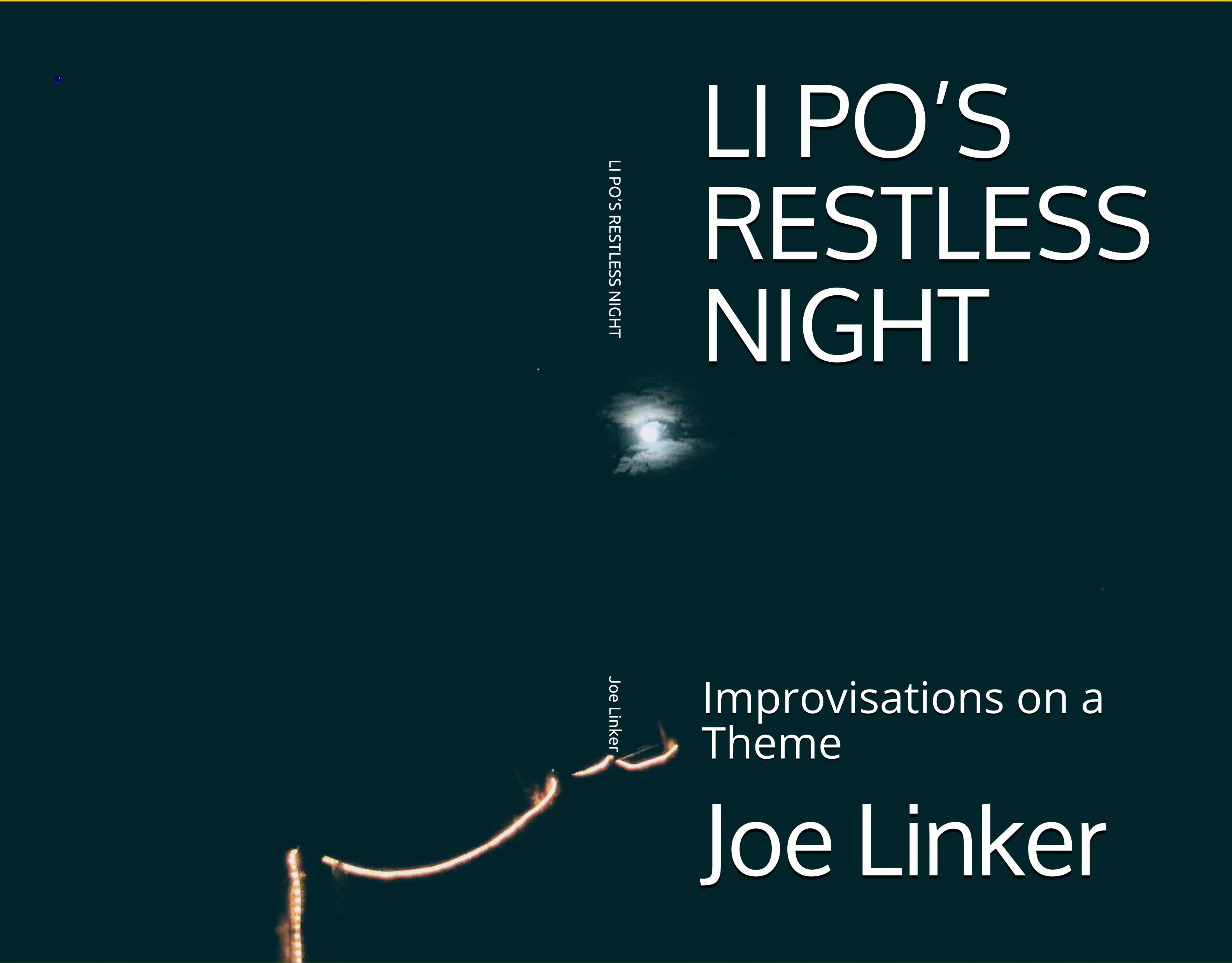
    “Li Po’s Restless Night: Improvisations on a Theme” is now available in e-Book and paperback formats. Ideal reading for those with restless nights in quarantine, “Li Po’s Restless Night” includes 101 original variations on a theme of Chinese poet Li Po, with an explanatory personal essay, “Florence and Li Po,” though the essay may make better daytime reading. There was a time when I was able to close my eyes and not open them again for eight hours. Then the moon rose.

  • Pip Pip at the Pub

    Toedeloe to the floor of the Vespa scooter, I cruised north up Hwy 1, the Pacific Coast Highway, in real time, present time, though I wasn’t always sure what week I was in or even what day it was, and guessed the time of day from the position of the sun in the sky and its shadows on the ground. I had no plans, no expectations, great or small. I had no doubt the locals I passed along the way had some, if only to make it to and from work without going stark staring bonkers, mad as hatters, excited as the March hares, gaga and crackers, freaked out. I wondered how it all held together, the daily commutes, full of horrible honks and screeching brakes, from the kid who was off walking and whistling to school homework in disrepair but excuse at the ready, to the CEO rolling off in his Rolls to explain to his Board of Directors the various whistleblower reasons for the latest decline in stock value, still revising his business plan, the new crew hired yesterday to be let go tomorrow. The buses jostling stop to stop, the big box ambulances curling their way noisily through a mess of traffic, the delivery trucks, 18 wheelers, pickup trucks, station wagons, hot rods, muscle cars, convertibles, vans, bicycles, skateboarders, walkers, and scooters all sharing the same roads. But unlike a schoolyard where the chaos of recess empties like a beer bucket with a bell the yard quickly returning to the quiet of pigeons descending from classroom roofs to snap up the crumbs of snacks, the kids all back inside heads on desks for a rest, their teacher reading aloud a short story, or his head too on his desk for a rest, and all is quiet – unlike the school yard, the road never fully empties, all day long, every day, vehicular traffic moving like the tides, in and out, up and back, to and fro, stop and go, this way and that, all manner of folk crisscrossing at the crossroads. Back in the 1950s, hitchhiking was more prevalent than today, and a military uniform and duffle bag in hand almost guaranteed a quick ride. In the 1960s and early 70s cardboard signs signifying destination were popular with travellers on street corners seeking long rides: Los Angeles, Santa Barbara, San Francisco, Portland. So I was surprised when I rounded the Long Beach Traffic Circle on Hwy 1, on my way to Redondo Beach, and I saw a bald man in a Franciscan robe holding a sign saying El Segundo / Mission San Buenaventura. I glanced at him and shrugged my shoulders, as if to say no room on the scooter. But I was even more surprised when, a few hours later, having cruised leisurely through the beach cities on a solid gold weekday, and again stopping at Wormy’s Orange Tiki Room in El Segundo, where I planned to spend a few nights out back, working some maintenance to pay for my stay, Wormy planning a weekend long Pip Pip at the Pup in celebration of a local annual surf festival, and who should be there standing in his brown robe at the Orange Tiki Room bar, but the Franciscan I’d seen back at the Traffic Circle. You made it, I said. Pip pip, he replied, picking up his beer and taking a long gulping drink. Ah, he said, that’s the ticket to the pip pip. Wormy came in and introduced me to the monk, a Brother Juniper, a regular, apparently, who never failed to make Wormy’s annual fundraising Pip Pip at the Pub, this weekend being the 12th year in a row, all proceeds going to help fund the surf festival. Late afternoon now, evening glassoff in the offing, but I sat with Juniper in a corner of the bar where we both relaxed after our harrowing commutes from down south through the beach cities up to El Segundo. Wormy’s place gradually filled with pip pippers, a three piece country swing band showed up, a dart tournament grew some serious competitors, and out back a dunk tank was busy with dollar a throw chances to dunk a few local celebrities. The sun went down and the tiki torches came on and the festival was going, the street blocked off, the band now playing some straight ahead surf riffs. Out in the street a travelling carnival with rides for the kids started up. Face paintings. Balloons. Arts and crafts tables. Booths for local businesses and churches to pitch their stories. A police car parked at each end of the block.

    “Pip Pip at the Pub” is episode 49 of Inventories, a Novel in Progress in Serial Format at The Coming of the Toads.

  • On the Coast Starlight

    On the Coast Starlight

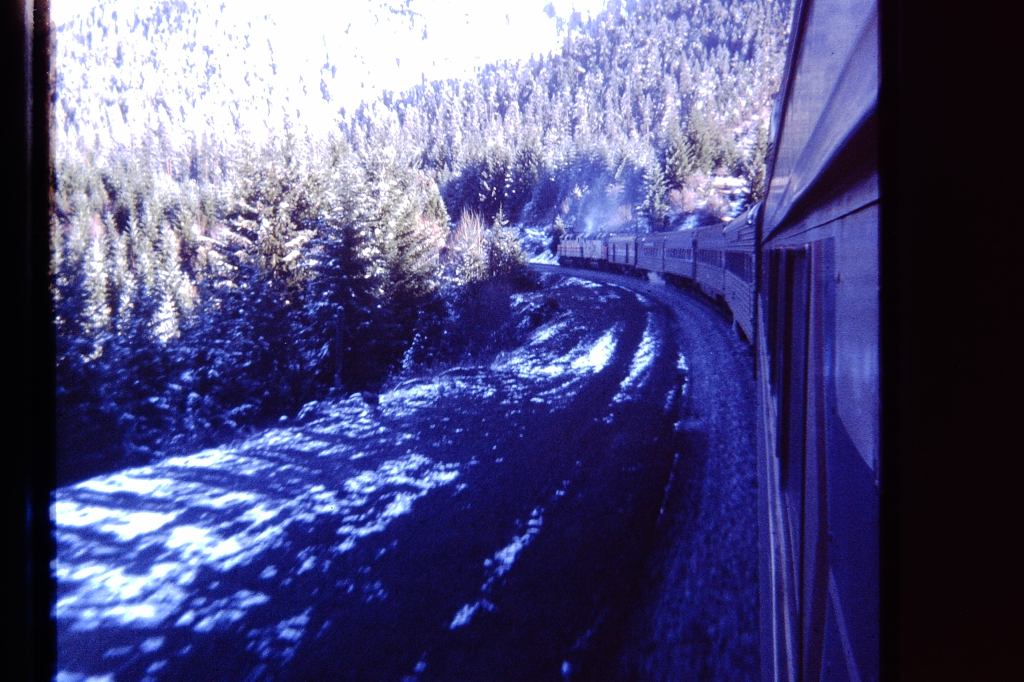
    We climbed aboard the Coast Starlight in Portland, bound for Los Angeles, 24 train-ride hours away, but we stopped unexpectedly somewhere up in the Cascades southeast of Eugene. Snow was falling. In those days, you could walk between the cars and open the top of the dutch door for some fresh air. The air was raw and cold, the woods dark, and the smell as strong as a cigar of pine sap. The tracks followed rivers, valleys, passes, built along paths of least resistance. It’s possible now to consider the railroad a naive form of travel.

    When we speak of losing our train of thought, we are comparing thinking to a train, I suppose to indicate how one thought after another coupled together are all headed in the same direction, or should be, if the logic holds water, but thought does not move like a train, the engine a thesis statement, the coal car fuel of claims, the cars one example after another, all following the same track of thought, the dining car full of opposing arguments, the caboose a bright red conclusion.

    News travelled slowly on trains in those days. Long and longer minutes passed without anyone new coming into our car. Our conductor reappeared and explained we were stopped because a freight train ahead of us had derailed. At first, it wasn’t clear how long we would be delayed. Equipment to reposition the freight train was en route to the wreck. Minutes, as it turned out, became, as they always do, hours. The conductor came through our car again to announce we would all be treated to a free dinner in the dining car. There was also a club car where we could hang out while waiting.

    Thought, if it moves at all, is more like the flight of a bird. But Thomas Hobbes, in his 1651 book, “Leviathan”, put us on the track of thinking of thought as a train, to wit:

    “Of the Consequence or TRAYNE of Imaginations. BY Consequence, or TRAYNE of Thoughts, I understand that succession of one Thought to another, which is called (to distinguish it from Discourse in words) Mentall Discourse. When a man thinketh on any thing whatsoever, His next Thought after, is not altogether so casuall as it seems to be. Not every Thought to every Thought sueceeds indifferently. But as wee have no Imagination, whereof we have not formerly had Sense, in whole, or in parts; so we have no Transition from one Imagination to another, whereof we never had the like before in our Senses. The reason whereof is this. All Fancies are Motions within us, reliques of those made in the Sense: And those motions that immediately succeeded one another in the sense, continue also together after Sense: In so much as the former comming again to take place, and be predominant, the later followeth, by coherence of the matter moved, in such manner, as water upon a plain Table is drawn which way any one part of it is guided by the finger. But because in sense, to one and the same thing perceived, sometimes one thing, some times another succeedeth, it comes to passe in time, thatjn the Imagining of any thing, there is no certainty what we shall Imagine next; Onely this is certain, it shall be something that succeeded the same before, at one time or another.”

    I ordered a salmon steak and a glass of red wine. I don’t remember what Susan ordered, but since she dislikes fish, I suppose she might have had a filet mignon with a glass of white wine. We were not in a hurry. Had we been in a hurry, we would not have taken the train in the first place.

    By the time we pulled into the station at Santa Barbara, the train was five hours behind schedule. Another, new conductor had come aboard in San Louis Obispo. A group of passengers who had been on board even longer than us, having boarded in Seattle, were told to wait at the door at the end of our car. It was noted this door had not previously been used at any of our stops; nevertheless, our new conductor insisted the group wait at this door. An anxious wait ensued. The door did  not open. The train began to move. The group would have to travel with us all the way to Los Angeles, where Amtrak would put them on a bus which would drive them back to Santa Barbara.