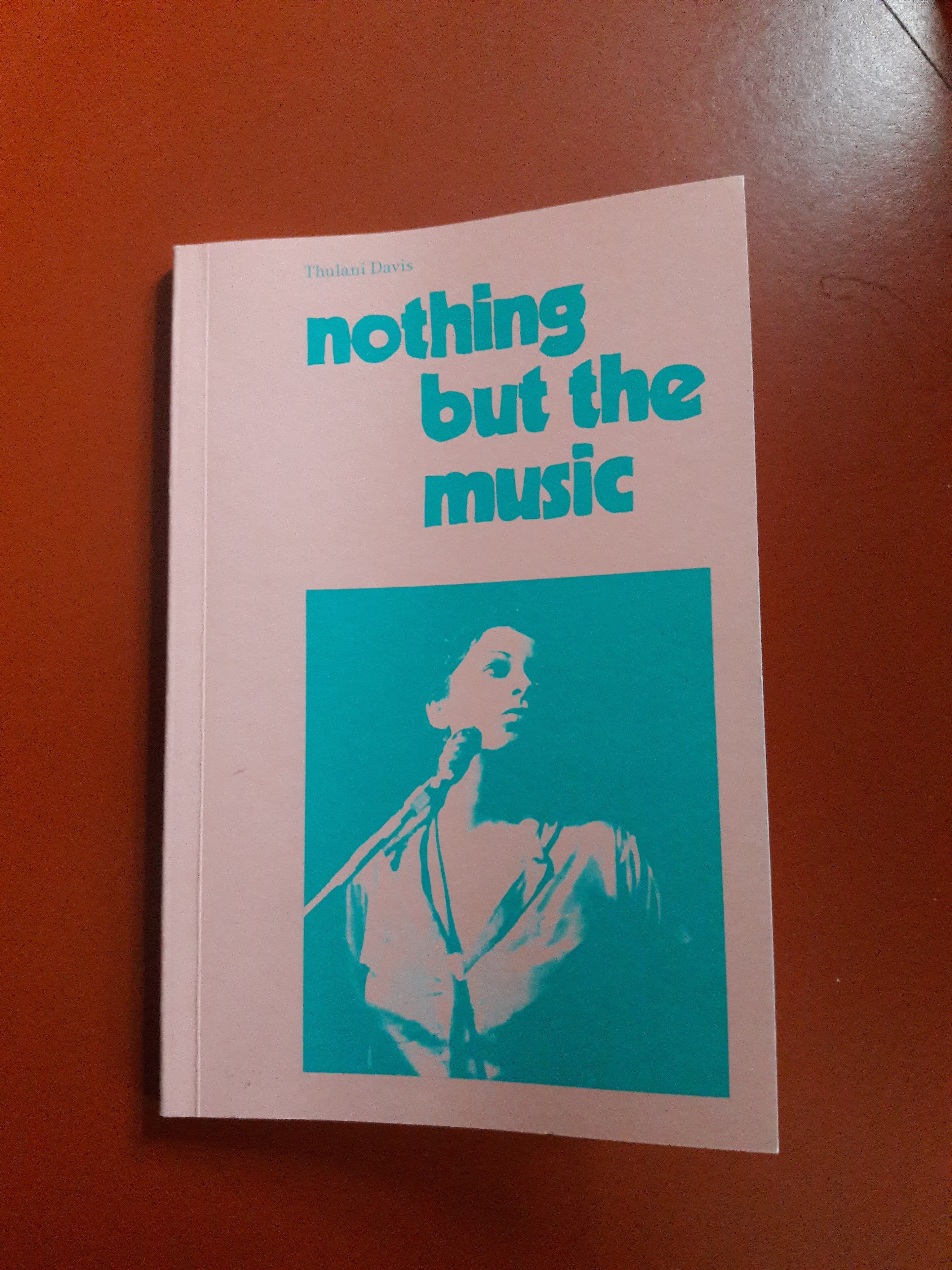
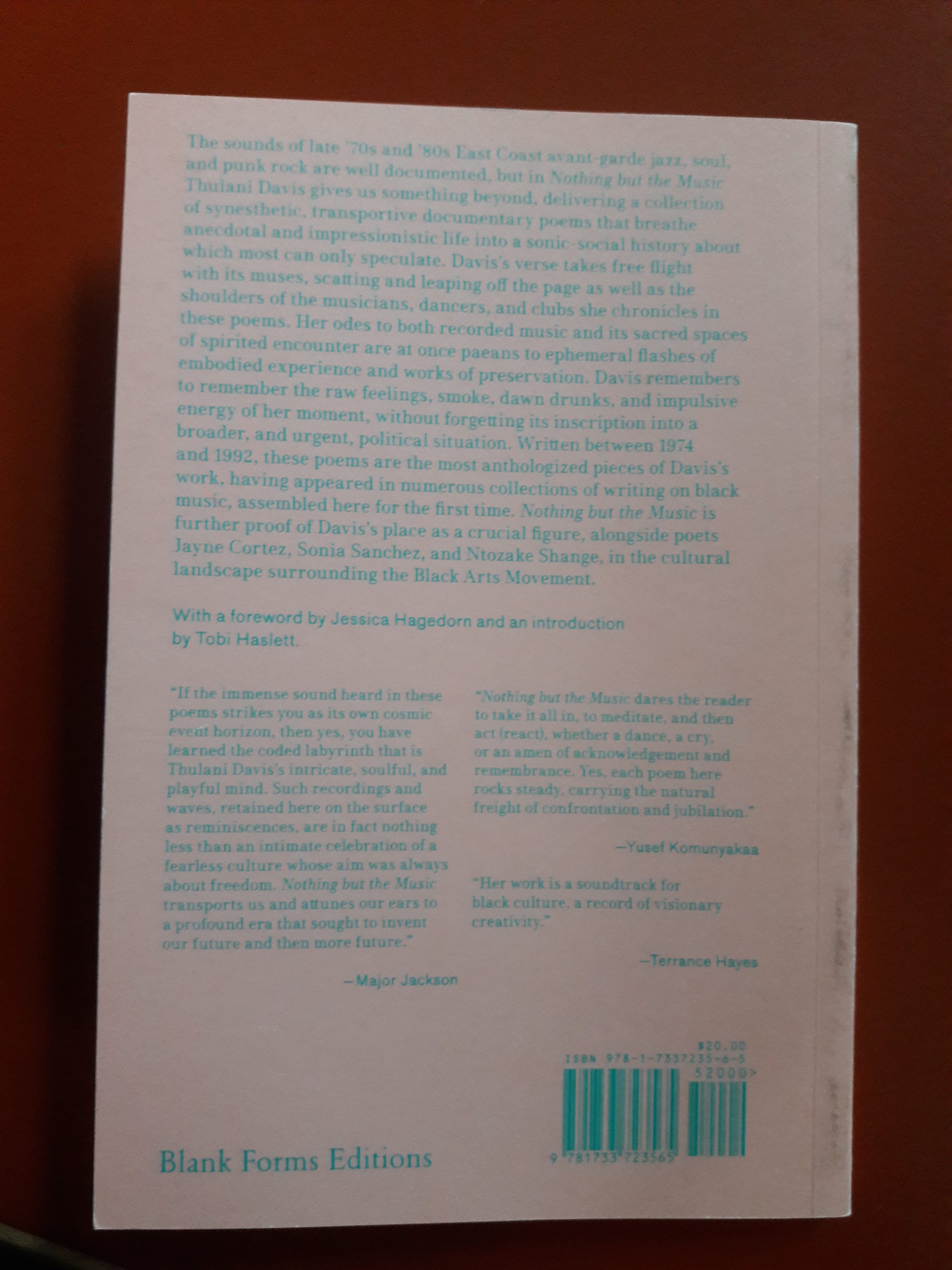
“nothing but the music” (2020, Blank Forms Editions, Brooklyn) is a kind of compilation, a box set, of pieces composed by Thulani Davis over the years 1974 to 1992, lines written while listening to live music or reflecting on the experience of an avant garde art form as it’s happening, and before it might be neutered by mainstream commercialization too influenced by those with control of the means of production. Most of the Davis pieces appeared in poetic form in alternative press issues over the years and some were set to music. The scores are informed, and may be read with reference to, performance and theatre, jazz and punk, R&B, and mixed forms or art form synesthesia, the courage and risks found in the places music is born, but the rewards too of achievement, however much that success may appear to some as failure. The music’s codification (its reliability, approvals, its aesthetic argument) might be seen in the cost for a ticket to get in: $20 – for a 63 page paperback, made possible in part by support from the Robert Rauschenberg Foundation and the Andy Warhol Foundation for the Visual Arts.
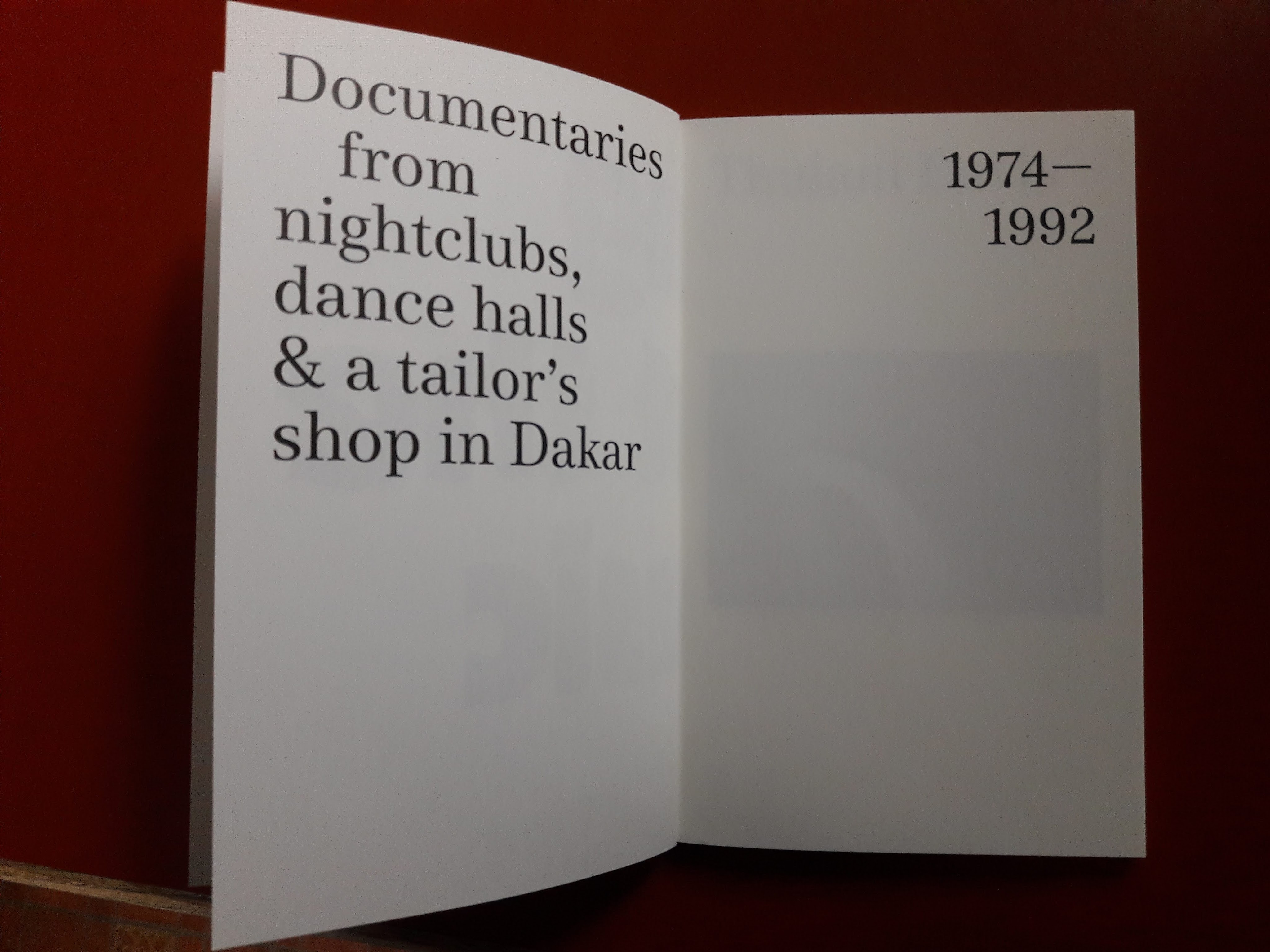
Is the music now artifact? The oral argument, written or recorded, becomes a document. What the music feels like, in words, what it stands for, and stands against. The importance of the work, these pieces, these entries, is found in the subtitle: “Documentaries from nightclubs, dance halls & a tailor’s shop in Dakar.” Or, in the words of the book’s epigraph:
“to the artists
& dharma guides
who coax us
minute by minute
from retold pasts
& possible futures
ever
to the present
moment”
Each piece is sourced at its end with a date and location and often the names of the musicians. For example: “1982, CBGB, New York”; “April 27, 1977, The Rogue & Jar, Washington, DC. The players: David Murray, Hamiet Bluiett, Charles “Bobo” Shaw, Fred Hopkins. The poet: Ntozake Shange”; “April 15, 1975. Five Spot, New York. The Cecil Taylor Unit: Cecil Taylor, Jimmy Lyons, Andrew Cyrille.” That last piece just cited, “C. T. At The Five Spot,” begins:
“this is not about romance & dream
it’s about a terrible command performance of the facts
of time & space & air”…and moves on:
“ripple stamp & beat/ripple peddlin’
stomps taps of feet slick poundin’ out
tonal distinctions between/keys & sticks”…and ends:
“I have heard this music
(22-23)
ever since I can remember/I have heard this music”
If music is a cultural argument, an aesthetic fight, it must come complete with a thesis statement about which some will disagree, backed with claims with examples, illustrations, supported with evidence and sources. It’s not enough to dress the part and go punk for an evening; one must want to be hardcore punk, and harder still. The wall does not give way so easily. It’s not enough to listen to the radio or buy the recording; one must enter the mosh pit. Who can survive it?
“the punks jumped on the stage
and dove into their friends
let their chains beat their thighs
the crowd thought death
in two-minute intervals
heavy metal duos and creaming murderthe band of twelve year-old rockers
from “Bad Brains: A Band”: 1982, CBGB, New York
wished they could do it
come like that on the refuse
of somebody else’s youth”
We find, in “nothing but the music,” in addition to the music itself, criticism, analysis, reaction, conclusions, as well as questions for further research. What happens when the avant garde becomes tradition?
“Not just history not just Trane
from “T-Monius”: February 17, 1982, 122nd Street, New York (50-51).
No not what we heard about
What we heard
Just what we hear
It always being night
We’ll still be there
Dancing the dissonant logic
The loneness
Just playing music
He speaking to himself
Really paying us no rabbitass mind
Digging what himself was doing
T-monius and ‘al-reet’”
In a life of disenfranchisement, art may be the only place to find certain freedoms: of expression and voice, enjoyment and creativity, play and work coming together in a spirit of desire and interests, not of servitude or boredom, and where one may object to a status quo in a statement with examples of new possibilities. And beauty, where beauty may come to rest, looking tired and worn out, where she can mix with the crowd and feel at home and dig the music. And truth hangs out in the rhythm section. Some hep young cat might ask, “What was it like?” And the answer is important, how we answer, what we say, what we hold back. We are old now, and passing, older than we ever imagined. You can’t breakdance at 70 like you could at 17, Cornel West said in his ten minute section of Astra Taylor’s Examined Life: “Time is real.” Yes, and you can find it in the music:
“giving a spring to the dance
X-75-Vol. 1, Henry Threadgill “Side B (Air Song/Fe Fi Fo Fum)” (31-32).
of who we are/unexpected beauty
beauty we have known ourselves to be
like reaching old age & infancy in a breath
of this is the music
knowing we can’t be us
& be afraid of who we are”
 The Coming of the Toads