Human imagination is part of nature, turning light into food, like photosynthesis in plants. Imagination is a natural process that needs no teacher or school, theory or method. Thus poetry should not become a profession, nor should a poem profess anything, nor should poets become professors. Most formal education activity turns subjects into sports and competition. Imagination is not competitive.
We might see that William Blake, in his “The Marriage of Heaven and Hell” (1790), explains the imagination as a natural means of protecting the human from an onslaught of reality:
“1. Man has no Body distinct from his Soul. For that called Body is a portion of Soul discerned by the five senses, the chief inlets of Soul in this age.
2. Energy is the only life, and is from the Body; and Reason is the bound or outward circumference of Energy.
3. Energy is Eternal Delight.”
William Carlos Williams associated the season of Spring with the imagination. It’s in his short book titled “Spring and All” that we find his now famous poem called “The Red Wheelbarrow.” But we’ve been reading that short piece sort of “à la carte,” or slightly out of context. It appears in “Spring and All” as a numbered poem in a series of poems interrupted in several places by Williams’s prose discussion about what he is doing and why in the way of poetry. There are a total of 27 poems in “Spring and All,” and “The Red Wheelbarrow” is number:
XXII
so much depends upon
a red wheel barrow
glazed with rain water
beside the white chickens
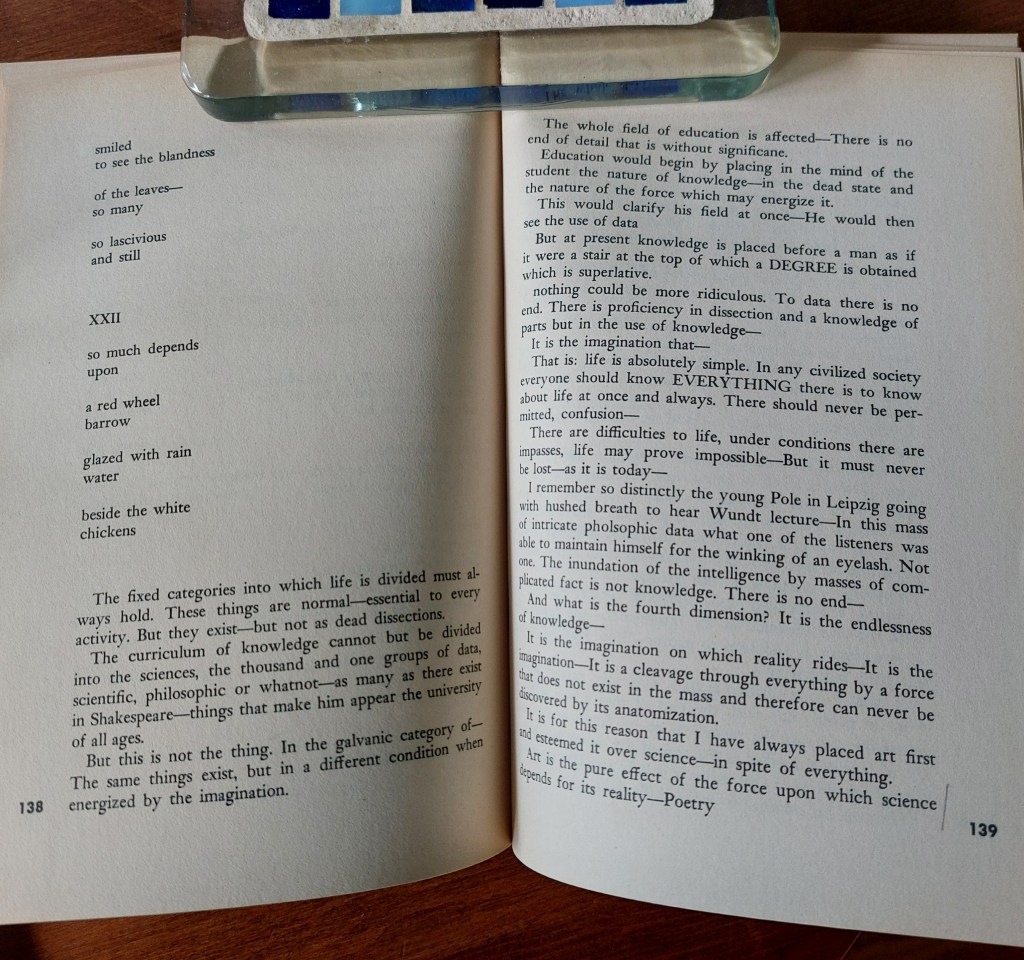
“The Red Wheelbarrow” appears in “Spring and All” on page 138 (Part II: pp 88:151) of my copy of Imaginations (New Directions Paperbook 329, 1971):
pp. 138-139 from “Spring and All” (1923) in Imaginations (NDP329, 1971)
Reading “The Red Wheelbarrow” in the context of “Spring and All” we begin to see how Williams invites the reader’s imagination to absorb the image. It is a well-lit poem. A painting is suggested, and the imagination creates the image (food) from the juxtapositions of color and light and things placed as if by hands (red, white, wheelbarrow, water, chickens, glaze), but will the chickens sit still? Probably not.
 The Coming of the Toads