Tag: T. S. Eliot

  • Signs of Spring and All

    A few mornings ago, I walked into the kitchen, set about making coffee, and noticed a line of tiny ants climbing up and down a corner edge, starting from a small gap behind a molding where the wall meets the floor, and when the ants reached the countertop, they went meandering to and fro, around the toaster and coffee maker and compost bucket. And two nights ago, out walking, we came across a nest of what appeared to be the same ant species emerging from a crack in the sidewalk, a line of scouts working their way into a neighboring yard. And early yesterday, the weather still clement, in spite of thunderstorms and tornadoes forecasted for the later afternoon hours, I had taken a morning break with my coffee outside in the fine Spring morning, and when I swung the door open to come back in, a fly the size of Rodan nearly knocked me over as she flew into the house and proceeded to spin around and around near the ceilings, cavorting from room to room.

    Spring begins with a pile of chores, and one recalls T. S. Eliot’s seemingly anti-intuitive start to his disillusionist poem titled “The Waste Land”:

    “April is the cruellest month, breeding
    Lilacs out of the dead land, mixing
    Memory and desire, stirring
    Dull roots with spring rain.”

    Not to mention the appearance of ants awaking from their winter diapause.

    “Winter kept us warm, covering
    Earth in forgetful snow, feeding
    A little life with dried tubers.”

    Soon April, and signs of spring are breeding and mixing in the kitchen and in the air, inside and out. Across the grass, dandelions are sprouting and even flowering already, and the turf at the edge of the sidewalk needs edging. The list goes on, but never mind – I discovered this week Ruth Stout, whose practice of gardening is summed up in the titles to her mid-century books, notably: “Gardening Without Work: For the Aging, the Busy & the Indolent” (1963); and “The Ruth Stout No-Work Garden Book: Secrets of the year-round mulch method” (1971); and her first, “How to have a Green Thumb without an Aching Back: A New Method of Mulch Gardening” (1955).

    It was in a New Yorker article of March 17 that I discovered Ruth Stout, sister, as I learned, of the famous detective fiction writer Rex Stout, best known for his protagonist Nero Wolfe. The subtitle to Jill Lepore’s article tells all: “Ruth Stout didn’t plow, dig, water, or weed.” Suddenly, Spring seemed a happier time than how T. S. Eliot described it.

    Still, I had ants in the kitchen to deal with, for I learned to my dismay they had nested inside the coffee maker. I surrounded the coffee maker with a moat of vinegar, and when the ants appeared between the moat and the coffee maker, I knew they had to be coming from within the coffee maker, where they must have set up a new nest. Never one to rush for the can of spray that “kills bugs dead” (ad line attributed to Beat poet Lew Welch, by the way), after a bit of research, I decided to try Dr. Bronner’s peppermint soap, having read that ants don’t like peppermint oil. The soap certainly stops ants on contact, and it seems to slow new scouts from returning to the scene.

    Meantime, our kitchen counter is cleaner than ever before. I had to retire the electronic coffee maker. I read ants like water and warmth (who doesn’t?), and they can also detect electric currents, including vibes from computers and cell phones and such – so we won’t be able to charge our devices on the kitchen counter anymore, for fear of ants. Imagine ants in your Chromebook, crawling in and out of the keyboard. And we’ve returned to a French press coffee maker, and while it takes a bit longer with more steps to brew, the coffee is robust. And immediately employing the Ruth Stout method, the yard work is quickly done, leaving more time for writing pieces, well, like this one.

    But what of the fly the size of Rodan, the deep reader will be wondering? Advocating a catch and release policy toward all living but unwelcome things, I grabbed the fly catcher and went dancing around the house with the fly. I trapped it in the bathroom, where it had landed on the window screen. To catch a fly with the fly catcher, you have to wait until it lands, approach quickly but stealthily, cover it with the catch door open, then slide the catch door closed with the fly inside the trap. Might sound easy, but it’s often a cat and mouse game as the fly inevitably flickers away at the last second. After several attempts banging around the small bathroom, I caught the fly, then released it into Spring and all wilderness where all Earth life mingles half awake and half asleep.
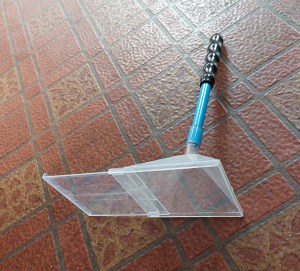
    Catch and Release Fly Catcher
  • Befogged

    Not Alfred Prufrock’s fog, the little yellow neighborhood cat come smelling, touching, and arching once, wags, then slinks furtively off and licks herself to sleep, the house warm and safe in her arms. But the fog that falls from a hairball night, wet and thick, as sleazy as the backuped drains running up the gutters down on skidrow. A light that illuminates nothing. And the only sound one hears is the tinkle of a bell like the carriage return signal on a fin de siè·cle typewriter, the kind T. S. Eliot might have used.

  • The Lavish Land

    “April is the cruelest month,” Eliot told
    Pound all about it, Easter tide out,
    but why brood on our days
    unless we are made
    of dry wood and worry,
    each ring a memory of rain?
    Does any month feel pity?

    You called her a primrose,
    your spiral spring shell.
    The land tired of playing possum
    opened in lavish blossom.
    Meantime, you go from a funeral
    to a game of chess?
    No wonder you’re so depressed.

    Hurry up! Indeed, it is time,
    and there is no more time
    for revisions of decisions and such.
    Spit it out, that tooth that broke
    on the hardtack bread.

    Yes, the river, its currency
    seems to bother you,
    crossing the rough bar
    in your tipsy canoe,
    sipping sweet wine from a shoe.

    Why do you drift so? Maybe
    it’s time to seize the falling
    yellow forsythia, catch and bundle
    the candied pink camellia calling
    a day a day alack-a-day day.

    No, I won’t say we’re wasting time,
    working up a dry thirst over an old city,
    lamenting the past. We might have called
    Big Dada and asked for a blessing,
    a holy water sprinkling, and asked,
    “Dada, how’s Nana?”
    “Dada! Dada! Dada!”

    Maybe we’ll see you in May.
    Hopefully you’ll be feeling better,
    and we can all spend a day
    going a Maying,
    if Corinna comes to town, everyone
    looking forward to ordinary time,
    the grassy bed spread with garlic greens.

  • Notes on the Difficulty of Reading a New Poem

    Poem WalkingWhat happens when we encounter a new poem? New poems can seem impenetrable. But maybe the idea is not to penetrate. If the poem is new, the reading experience is also new, unfamiliar, foreign to our eyes and ears, to our sensibilities. What happens when we read a poem?

    In the darkroom, the developer slides the photographic paper into the chemical bath. Slowly, an image emerges. Reading a new poem is a similar process in as much as the full picture does not immediately reveal itself. But that’s as far as that analogy might go. A poem is not a photograph.

    The poem as montage, as mosaic, the narrative line pieced together stitch by stitch. Begin anywhere.

    Poems are made with words, usually, and words have two basic kinds of meaning, denotative and connotative. With regard to connotative meaning, words suggest, have associative meanings, colloquial twists, and personal meanings. We have our favorite words, and words we find distasteful. “Are you going to eat those adverbs?” “No. I got sick on an adverb once, in grammar school.” Cultural, contextual meanings. We can’t control language.

    When encountering a new poem, we ask the traditional questions: who is speaking, with what voice, and what is the intended audience, remembering not to confuse the speaker with the author, the audience for ourselves. What’s the speaker doing, talking about? What the diction, what the tone, what the setting, what the irony?

    Here’s the poem under question: “Foxxcan Suicide (Stylish Boys in the Riot),” by Russell Bennetts (the editor of Berfrois). We look for help. Suicide we know. Painless, as the song says, though we doubt that, and that song is not about suicide. A soldier’s choices are limited. Are a reader’s choices similarly limited? Does “Foxxcan” suggest Foxconn, the so-called Foxconn suicides?

    I recognize Starnbergersee, from T. S. Eliot’s The Waste Land, but is a single word enough to create an association? Why not? Eliot’s poem is fragmentary. “Foxxcan Suicide” is fragmentary, or so it seems. What if picking up on an Eliot reference is wrong? We could ask the author. No. What can the author know of the reader’s experience? Words are out of control once they hit the paper. The poem is a reading experience. And something more than Starnbergersee reminds me of Eliot: the many references, obscure to this reader, though I know who Axl Rose is, sort of, but I can’t say I know him, though he’s from my home town, big town. And the Roses had a label: UZI Suicide. So? Threads, though, links. And I know who Legacy Russell is, though not well enough to get the three asterisks at the end of that line, asterisks that point to no footnote.

    Still, I like the new poem. I like the fragmented narrative. I like it for its changes in diction and speech, its orality, its lyrical last stanza, or paragraph, the socio-economic comment it ends on. I like the almost hidden poetic characteristics, the rhyme, for example, of “Legacy,” “easy,” and “please me.” Gradually, more of the picture seems to emerge: the teen spirit (Nirvana). Maybe it’s language that has become suicidal. The poem casts this reader as a kind of outsider, beyond the pale. Maybe I just don’t get it. “Well, how does it feel?”

    Some time ago, in a workshop with David Biespiel, we used a kind of shorthand response technique as a way of quickly getting at new reading experiences. David called the technique, “What I See.” You had to tell it, what you saw, in 25 words or less, or so. Kenneth Koch taught a similar kind of technique, an attempt to get at the poem’s “idea.” What’s the idea, Koch asks, of Blake’s poem “The Tyger”? The speaker is asking questions of the wild animal, but of course the Tyger does not respond. The questions the speaker asks seem to have something to do with who made the Tyger, the maker’s character. Blake uses images of a blacksmith to try to picture the Tyger’s maker. For Blake, the blacksmith would still have been a powerful and practical individual, a maker of things useful, but his work was being subsumed at the same time by larger manufacturing forces that would come to be known as the Industrial Revolution. And that revolution would give way to more: “Stylish Boys in the Riot.”

    What happens when we read a poem? From the Paris Review Interviews, this one with August Kleinzahler:

    INTERVIEWER: Recently Poetry posed a question about the social utility of poetry. Does that interest you?
    KLEINZAHLER: No. I agree with Auden that “poetry makes nothing happen.” Nothing else needs to be said about it.

  • Prufrock’s Cat

    In the failing fog the Prufrocked cat froms and froes,
    lurking catatonically,
    catcher of mice and men,
    leaving not a trace of trance or dance
    with which we were once familiar,
    catabolic feline with contractible claws.

    A hiss as from a match declares this driven cat with drawn claws.
    This hideous hipstress wears no frown.
    Nevermind, nevermore, familiar
    tuna must suffice; in fact,
    I’m opening the can as fast as I can.
    Fiend, your mane is mean!

    Man knows not your true menace,
    the deceitful pale rose of your delicate claws
    clinking ice to a theremin dance,
    an idle locomotive meowing to and fro,
    the moves of this domestic cat’s
    imagery eerily familiar.

    In what lonely lair was sired this queen of liars?
    Did He who made thee amid mice make men?
    How came you back from the cataclysm?
    Did I hear you in the catacombs caterwauling?
    Yet now you come in dress frolicsome,
    singing, “Do you wanna dance….”

    Though the salty leap gives rise to a contra dance,
    the caryatid looks familiar,
    a choreography of calligraphy, dancing to and fro,
    a sweating menagerie.
    Mind those mendacious claws.
    This mendicant needs no frilly silly cat

    messmate out to act
    some tunahall cancan.
    I too should have been a pair of claws,
    a crawling cat on the lam,
    whose unreadable bedlam mien
    strikes mayhem then saunters off to and fro.

    One more clause regarding this catachresis:
    Whether to or fro on this floor dancing,
    Prufrock’s cat is the cat of a family man.

  • Leslie Fiedler and the Either/Or Fallacy of Poetic Criticism

    Perhaps there are only two kinds of poetry, still only two kinds of poems. Dichotomy makes for easy argument by eliminating all other possible alternatives. We often hear there are two schools of thought, and any ambiguity is quickly brushed away. The one poetry might be represented by T. S. Eliot, and is characterized by recondite allusion, objects removed to libraries for safe keeping, the other poetry represented by William Carlos Williams, and characterized by everyday objects close at hand, the red wheelbarrow, the icebox. How quickly though this argument ignores the actual words, as we forget Eliot’s elusive but simple, figurative cat hidden in the fog of Prufrock’s meandering thoughts, and we forget too Williams’s “The Yachts,” a poem that discourages an easy swim.

    Leslie Fiedler, in his essay for Liberations (1971), “The Children’s Hour: or, The Return of the Vanishing Longfellow: Some Reflections of the Future of Poetry,” argues that there are two kinds of poetry, or poetics, identified by the poems we sing and get by heart, and the poems we must read and read again to recall, for the latter can exist only on a page, poems that Fiedler says are “…dictated by typography…; for it is a truly post-Gutenberg poetry, a kind of verse not merely reproduced but in some sense produced by movable type” (150). These poems are contrasted with popular song lyrics, automatically memorized, that simply don’t work when typed on a page. To illustrate, one goes to a poetry reading, where the poet himself appears not to have his poems by heart, since he must read them from pages; or one goes to a Bob Dylan concert, where the wandering minstrel still has all the words by heart. But Dylan Thomas, reciting from memory, singing unaccompanied, disposes the either/or fallacy of the poetry reading/pop-concert argument.

    Speaking of either/or, last night’s snow, still a surprise this morning, has us thinking of our south Santa Monica Bay home again, where we were surprised and nostalgically saddened on a visit to Hermosa some time ago to find the old Either/Or bookstore closed. But then again, not surprised, for the either/or fallacy often leaves too much unresolved, fails to reach the heart of any poem, fails to hear the coming of the end of one song, and the beginning of another. The bookstore was now a clothing store; apparently someone fell into the old either/or fallacy of either books or clothes, but not both.