Tag: sound

  • Sprinkler Music

    More rain. More “Traveling Sprinkler.” Paul Chowder hasn’t been playing his new guitar much, though. Instead, the former bassoonist has found an interest in electronic music, and he’s bent on creating jingles and jangles and hums and beats and calls it dance music.

    “I worked for several hours today on a new song called ‘Honk for Assistance.’ I saw the sign at a convenience store, near the ice machine, and I thought, Now that is a dance song, in the tradition of Midnight Star. I sampled a few honks from my Kia’s horn and set up a beat and fingered up some harmony using an instrument I hadn’t tried before, the Gospel Organ, which has a slightly percussive sound in the attack phase of each note. I added more chords on a Mark II keyboard and some homegrown handclaps and some rhymes made with the Funk Boogie Kit” (190).

    Where is music, today? Where was it in Claude Debussy’s day? I’m listening now, suggested by Paul Chowder, our narrator of “Traveling Sprinkler,” to Debussy’s “Preludes,” via YouTube Music on my Chromebook. I don’t have my hearing aids in, and the Chromebook speaker is not exactly a Marshall Super Lead 100 Watt amplifier stacked with two humongous speaker cabinets towering overhead, so maybe I can’t really say I’m listening to Debussy’s “Preludes,” anymore than I can say I’m in the kitchen nook typing while getting wet from the drizzle outside.

    Around page 128, Paul spends ample time discussing the benefits of stereo versus mono. What he does not mention is asymmetrical hearing loss, a condition where you hear less volume in one ear than the other. You’re sometimes unsure which direction a sound is coming from, and it can make you a bit paranoid as you navigate your way around town. You have to be extra careful crossing the street, particularly if there are electric vehicles in the neighborhood. And bicyclists and joggers coming up behind you and passing full of assumptions and presuppositions about their position startle the shite out of you.

    “I put the headphones on, and I lowered the needle on Zubin Mehta conducting The Rite of Spring, and suddenly I was there, enclosed in the oxygenated spatial spread of stereophonic sound. I was there with the panicked piccolo, and the bass clarinet was a few feet away, and the timpani surged over to the left, mallets going so fast you couldn’t see them. I couldn’t believe how big a world it was – how much bigger and better stereo was than mono….You need two ears” (129).

    Or three, or four. One day, back home, I rode my bike down the Strand to Mike Mahon’s place in Hermosa, carrying with me Archie Shepp’s “Fire Music,” on the Impulse label, from 1965, still new and noisy around the early 70s. Mike was a classically trained pianist, although like Paul Chowder, had decided he wasn’t good enough to make a career of it, and went back to school for a PhD in English Literature, specializing in Yeats and Joyce and company, but still Mike was an audiophile, and had the latest equipment. He took my album and ran it through an electronic vinyl record cleaning machine he had, then we listened to some of it on his impressive and expressive and expensive sound system. Then he pulled from his album collection a copy of Stravinsky’s “The Firebird,” and we listened to the “Infernal Dance” piece. Talk about “attack phase.”

    I played a bit of “The Firebird” just now, switching off the Debussy. I’m immediately reminded of Poe’s “The Bells”:

    Hear the loud alarum bells—
                     Brazen bells!
    What tale of terror, now, their turbulency tells!
           In the startled ear of night
           How they scream out their affright!
             Too much horrified to speak,
             They can only shriek, shriek,
                      Out of tune,
    In a clamorous appealing to the mercy of the fire,
    In a mad expostulation with the deaf and frantic fire,
                Leaping higher, higher, higher,
                With a desperate desire,
             And a resolute endeavor
             Now—now to sit or never,
           By the side of the pale-faced moon.

    I can only handle a minute or two of “The Firebird” this morning (or Poe) before switching over to Segovia playing Bach on his acoustic guitar, from Andrés Segovia: Bach – Gavotte from 4th Lute Suite for guitar, Allegro Films.

    In butterfly mode, Paul Chowder continues, in “Traveling Sprinkler,” from acoustic guitar to electro sounds to his girlfriend Roz and his neighbor Nan, parking his car here and there to get some writing done, in other words, in and out and back in again, listening to every day sounds and how they wrap around the cans and cannots of one’s thoughts. But Chowder keeps mentioning songs and music I’ve never heard of. Where have I been? And I asked myself again when and how and why it was I got Nicholson Baker’s “U & I,” and “Traveling Sprinkler” to begin with. So I looked them up. I thought I had purchased (and said in a previous post) “Traveling Sprinkler” used from Alibris. Not so. I purchased it new from Amazon in June of 2023 (though it was not sold by Amazon – a bit confusing all of that, how Amazon works sometimes). And just now, about two years later, I’m getting around to reading it, “Traveling Sprinkler” (though I had given it a try a couple of times before), while “U & I,” I got used on Alibris in February of 2019, also giving it a couple of tries, but unable to fall into it, yet.

    Anyway, it’s all old stuff, the books, the references, the music, not to mention the many political digressions, arguments with backing but often rants of a sort, Paul Chowder takes off on. He’s a pacificist, who, as I mentioned, attends meetings, though he’s not a full member, but which is why I thought the acoustic guitar was a good fit, him being a pacificist. But it depends on how you hear sounds. Last night late (after watching the Dodgers beat the Athletics in a record-breaking score of 19 to 2) before bed I played through a few of the Leo Brouwer “Etudes Simples” pieces, as I do almost every night, on my 1977 acoustic Takamine C132S. Number 1 is not all that pacific sounding, but Number 2 is lovely, particularly setting the tone for sleep.

    The political arguments, by the way, though now aged, just over a decade away, are effective today, without stirring up too much dust. I’m increasingly finding I’d rather listen to decade old or older music too. Timeless music. Anyway, thinking back to that business about stereo and mono, I’m reminded of the Jimi Hendrix album “Axis: Bold as Love.” The first piece, titled, “Exp,” is an amazing example of stereo at play. It’s very short: 1:56. You can give it a listen here.

  • Pronunciation Checker

    What do you do when you hear a snobbish correction of someone’s pronunciation, and of a word you know both pronunciations in question to be acceptable in standard usage? You don’t want to snub the snob, yourself becoming a snob, but neither do you want any damage to go unrepaired. Worse, the situation where the corrector pretends not to recognize the thing the mispronounced word refers to. What can be more pretentious?

    As we age, do we grow less tolerant of one another’s foibles, and chop for the weakest part of their blade to snap in half?

    There’s the person who when a youngster carries a mean streak. As they age, they may sublimate that mean desire into some other equally strained habit, like correcting malapropisms or mispronunciations every chance they get, pretending to be helpful when actually drawing the shame sword from its sheath.

    I readily admit, and anyway the prescient reader will already suspect, that my own articulations, enunciations, and right pronunciations often run afoul of the standards of others.

    So much so, in fact, that I was encouraged and felt all is not lost when I saw the following quote from the poet Diane Suess, a finalist for the 2024 National Book award for poetry:

    “You have to be willing to self-educate at a moment’s notice, and to be caught in your ignorance by people who will use it against you. You will mispronounce words in front of a crowd. It cannot be avoided.”

    “My Education,” from “Modern Poetry,” 2024, by Diane Suess.

    The first thing we do when we’re not sure of a right pronunciation is to break down the syllables and pronounce them phonetically. But that doesn’t always work. I once pronounced, to a professor no less, the poet Arthur Rimbaud’s name wrong. I said rim bawd, instead of ram boh. The professor pretended not to know the poet I was referring to. She even later repeated in an anecdote form my mistake in front of the whole class. I’ve never forgotten the lesson.

    Neither do I know how to pronounce the poet Diane Seuss’s last name. Is it Seus like Zeus, my first guess, or is it Zoice, rhyming with Voice, or Soice, a variant of Sauce – as the story goes, apparently most everyone mispronounced the famed Dr. Seuss’s name, so often that the mispronunciation became the right pronunciation, and if you pronounce it correctly, you’ll likely be corrected.

    My father was, as he put it, “hard on hearing.” When he was three years old, he came down with scarlet fever, which caused sensorineural hearing loss. His ears drained a thick and slimy yellow-greenish kind of phlegm or mucus, filling the ear canal and dripping down the lobules. His teachers often consigned him to the back of the room, where of course he couldn’t hear anything. He developed a stutter, which magnified his mispronunciations. Later in life, after ear surgery, his stutter disappeared. Meantime, he had learned to read lips, and he was good at selective hearing. He was also a good talker, could talk to anyone, and did. He used to cup his palm around his ear and bend it forward making an ear trumpet to amplify voices, but it usually doesn’t help to yell at the hearing impaired. It’s often lack of sound clarity that’s the problem. It’s the sound frequency that must change.

    Loss of hearing is not loss of sound, as victims of tinnitus know. When the ears don’t work right, the brain fills in the blanks. It’s that internal sound no one else can hear that’s called tinnitus, a symptom of something wrong with one’s hearing. Tinnitus, we were informed last summer, is pronounced ti·nuh·tuhs, not, as we were saying it, ti.night.iss. Of course, the correct pronunciation is the one the listener hears without issue and lets the conversation move on. And what’s the point of being right when no one else is?

    A truly miscreant corrector like the one referenced in paragraph one above might then ask the poor pronouncer to spell the thing in question, thus pulling out a dagger of humiliation to accompany the sword of shame, but even a correct spelling will do little to clarify or solve what is to begin with a faked miscommunication.

    I’m not an expert speller, either, by the way, but we’ll save that issue for another day.

    Sounds can be errie, and we build our exotic or occult vocabularies in aeries at the tops of cliffs and the tallest of trees. Our vocabularies become nests of familiarity, even if no one else espies them. But there’s a difference between hearing and listening, and if I’m a poor pronouncer of words, I don’t think I can blame it on my hearing. But pronunciation is, I think, physical, and not mental in any intellectual sense. Or is being smart (if accurate pronunciation is indeed a sign of smartness) actually a physical thing? I don’t know. Maybe it is. You might have trouble pronouncing a word correctly like you have trouble rubbing your stomach while patting your head simultaneously. In any case, we have to hear something correctly before we can repeat it correctly – does that sound right?

  • Heavy Metal

    Sounds industrial, like the noises in a factory made repetitive by machines, the floor covered with curling steel shavings. And a kind of marching music, an industrial march, urban with trams and busses, honks and trucking heaves. Heavy Metal is the four piece rock band’s alternative to the symphonic orchestra. The full brass and woodwinds, operatic vocals, orchestral percussion – all accomplished with guitars and drumkit, pedals, and amplifiers. Heavy Metal music can sound like lead stretched thin as wire, or walking on the Earth’s crust with steel spiked boots, the band poised like the Levitated Mass over an arena crowd.

    Our latest guitar quest (Live at 5 now already seems as old as the Ed Sullivan Show) has moved to YouTube where in partnership with metal expert CB we record short videos of original pieces or answers to various musical challenges, about one to three minutes, CB taking Metal Monday while I have Telecaster Tuesday (Washboard Wednesday still open). I posted a couple of Telecaster Tuesday short videos here at the Toads – as I continue to find myself drifting further and farther from words, but I’m not sure the blog is the best place for music activity. For one thing, videos are space hogs, while links to anything outside the blog can wind up for the reader like getting on a wrong bus to the zoo.

    I’m not sure it has anything to do with hearing impairment, though it might, but I’ve often had trouble hearing lyrics clearly, the vocals sounding like another instrument, which of course they are, but without sharp definition – in my ears. Maybe that’s why I’ve steered away from loud rock, but any type of music can be played loud, or too loud. But you don’t have to play music loud to feel it. At a Red Hot Chili Peppers concert some years back, I could literally feel the sound in my chest – that’s a bit too much, though I get that it might be necessary if one wants the full effect. But often one wants to hear the breeze over the “The Eolian harp” sitting on an open window sill. Still, as evidenced in some of CB’s videos, the loudness has passed, and now rings like a train rounding a corner in the distance, its ringing still vibrating on the track:

  • Fender Squire Telecaster

    All sound is distortion which produces sensation. I play mostly acoustic these days, unplugged, and eschew loud noises from any source. Is sound an idea, an intangible? The Telecaster, for the player, is more than sound – its industrial look, its substantive weight on the lap (you can feel the sustain vibrate through the solid wood body and hardwood neck even unplugged), its smooth playing fretboard, its difficult crackling pods and cranky switch (which remind one of both the guitar’s and one’s own age), all bring it home I should play the Tele more often.

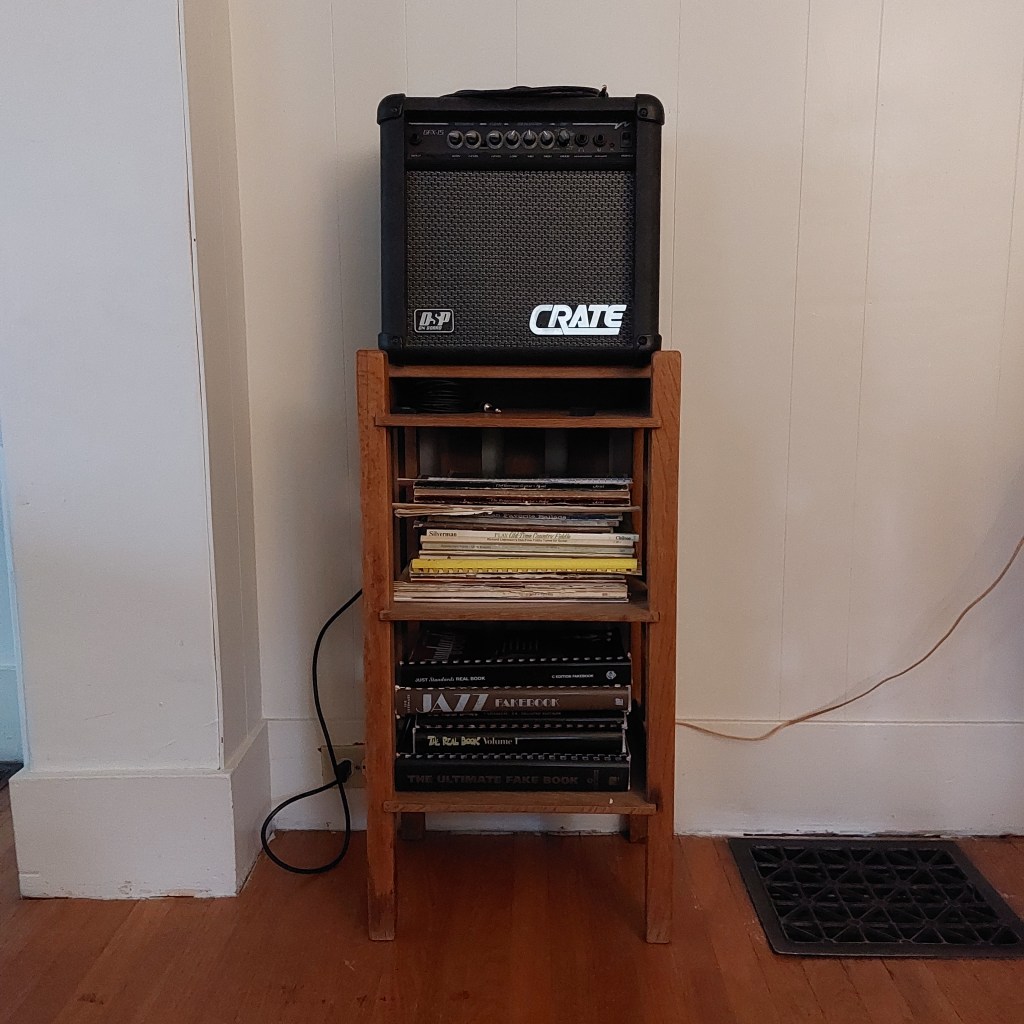
    In the YouTube video below, I’m using the simplest of setups, my cell phone sitting on the edge of a Crate (GFX 15, circa 1990s) small room size amp, the mode set to Reverb 2. With regard to cost of guitar and amp, suffice to say you don’t have to spend a bunch of bucks to get a cool sound. The Squires are storied guitars, particularly the older ones, the first ones built when Fender opened a factory in Japan in 1982.

    My Telecaster guitar I got used in 1985, from a guy I worked with, who had purchased the guitar new at Ace Music in Santa Monica, had switched out the original pickups with Dean Markley and Seymour Duncan pickups, and also switched the polarity to produce an extremely bright Nashville sound, too screechingly violin-like for me, so I had it switched back. I now use flat wound strings on the Tele, which softens the tone and gives it more range (D’Addario ECG24 XL Chromes Flatwound Electric Guitar Strings – .011-.050 Jazz Light). Telecaster guitars over the years have not been noted for their use in jazz, with notable exceptions though, including Ed Bickert and Bill Frisell, and a few others, though often with after market adjustments and other electronic enhancements used.

    In the video, I play through three brief guitar ideas: the first, some country sounding chords and phrases, the second a kind of Gypsy jazz piece I’ve been working on, and the third what’s intended to sound like surf guitar.

    Plugged In
  • Hard On Hearing

    What do we hear
    when we are hard
    on hearing

    sounds far and near
    sharp metallic birds
    hummingly trill

    the sorrow of the song
    sparrow’s syllables
    feed me

    and chick-a-dee-dee
    quaver and buzz
    flute whistles

    nautical vibrations
    ding dongs
    and foggy toots

    warnings and come-ons
    calls for help
    turn-ons and turn-offs.