Tag: sidewalk cafe

  • Around the Block

    The two story building on the corner down from us houses an expensive French restaurant we’ve never eaten dinner at and a small grocery where on rare occasion, usually when someone is visiting, we’ll get a coffee and sit inside and chat, or sit out at one of the sidewalk tables, or carry a cup home, sipping up the hill. The reason we’ve never had dinner at the restaurant isn’t that we don’t like French cooking; it’s the maximum costly flair, yet it’s very popular, as evidenced by its reservations only habit. It’s a small place, the tables close together and the chairs uncomfortable looking (for years the space was a dry cleaners). Or you can sit at the bar. Maybe we’ll have an excuse to dine out with a visitor or two come some warm summer evening, on the sidewalk under the amber bulbs, partaking in the Parisian mood of a sensory rich urban terrace, imagining ourselves Jake and Lady Brett and just as lost.

    We’ve been walking around the block daily lately, about as far as we can go in the cold, winter’s cold now requiring a T-shirt, a sweatshirt, long sleeved flannel shirt, vest, jacket, raincoat, a watch cap pulled down over the ears, thick jeans, wool socks, and waterproof boots. At a quick cold clip, it takes about ten minutes to walk around the long route. A shortcut route through the alley takes only four or five minutes, still a long walk if the east wind is blowing through your multi-layered clothes and turning walkers into icicles after only a few cold steps. The word of the week is the Mpemba effect, the term given to hot water freezing more quickly than cold – under certain conditions; but in our experience walking around the block we have confirmed the effect: the hotter we are upon leaving the cozy pad, the quicker we seem to freeze up walking.

    She likes to stop and go through the neighborhood library book box on the next corner, at the edge of the vacant lot, just before the bus stop bench. No matter how cold it is. He does not like to stop at the book box in winter. Summer yes, winter no. The bus rumbles by, no riders.

    Sometimes there are cats slinking along the way, sidling up to our legs, arching their backs, meowing, wanting petting and stroking, their waggling tails sending threads of conflicting messages. Not too many warm cats in the cold winter though, not too often are they out and about. And last week one came into the house, the orange tabby, cold and in a hurry, the door open as monsieur reached for the mail, but scurried back out and down the sidewalk, looking for some French cafe miettes and no doubt sensing she wouldn’t find any at our place.

    After the book box and around the bus stop corner comes the lovely hedge of lavender bushes atop a stone wall, and in keeping loosely with the French theme an essential part of the walk to rub a sprig between the fingers to release the scent, aggravate the fragrance, stir the stained memory of odor. Alas, again it is winter, any memory of summer smells weak and thin.

    Now we must decide to take the long hill or switchback and walk past the apples and raspberries and mints and roses. What a surprise this week to see a rose in winter. And a white Christmas camellia in bloom. The wind hurls up the east-west streets. Better to take the long hill north to the top, warming up for the turn east again and again wind-chill freezing, now five hundred feet high and facing the open Gorge winds as free as any breeze on an open sea. Then turn south again now descending and if it’s a Thursday afternoon hearing the jazz band up in the big green house, thumping and brittling in turns with frowns and smiles.

    If you’ve read this far, we’re still on the walk, and your read time was 4 to 5 minutes, just over 700 words, maybe only half as many steps, we’ve not been counting, probably we’re still at the book box, maybe just past the lavender. The post seems to have taken the shortcut. Or it seems one reads faster than one walks, a surprise in winter.
  • En Plein Air

    An urban photographer idling along on foot
    found a plein air painter her portable kit
    easel, small canvas, box of luscious bright wet
    paints open and with one brush loose and light
    all the motion in her wrist at the edge of the street
    like frosting a cake her subject the poet
    scribbling on a napkin at a sidewalk cafe table
    sitting cool under an umbrella saturated scarlet
    his poem about a live oil painter out and about
    creeped up on cautiously for the stolen
    image no one likely would object.


  • Sidewalk Cafe Table Paper Napkin Poems

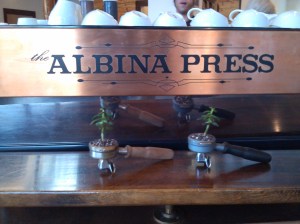
    img_20161109_144329Afternoon walk close in and find a cafe with sidewalk tables to sit out with an espresso, on watch and wait.
    Wait for some light that might soon start to seep through a cracked world.

    World War II and the Nazi army advances on Paris. You can hear artillery fluster the banlieues. Do you try for a train or run the roads south with distraught families or take a table on the sidewalk of some tree hidden rue (for you are on the streets where all is rue) and order an espresso and write a poem on a napkin:

    And the poem on the paper tablecloth is perhaps as typical of the way Prevert got around in France in the min-Forties as it is of his poetry itself – a poetry (his worst critics will tell you) which is perfectly suited to paper tablecloths, and existing always on as fine a line between sentiment and sentimentality as any that Charlie Chaplin ever teetered on.¹

    When I was inducted into my Guard unit, the 140th Engineer Company, in 1969, they were still packing the M1 Garand rifle. Before firing, we learned to disassemble and reassemble the eleven part trigger housing group. The M1 was a fine weapon, as Woody Allen’s Hemingway character in “Midnight in Paris” might have said, but of course didn’t – that was Paris of the 1920s. The M1 was heavier than its successor the M14, which I was introduced to at Fort Bliss, but you fired them both like rifles, sighting in and taking aim, adjusting elevation and windage. The M16 seemed a light, plastic toy in comparison; you pointed it and sprayed. Even as a kid I was attentive and sensitive to words, but it wasn’t until Basic Combat Training that I realized the unique place nomenclature played from certain perspectives – the naming of things, the naming of parts, in particular, and how, in certain circumstances, you couldn’t simply go to a thesaurus for synonyms as variable substitutes. You had to find the real right word.

    Henry Reed’s poem “The Naming of Parts,” from “Lessons of the War,” illustrates the uses of proper nomenclature, and of paying attention:

    Today we have naming of parts. Yesterday,
    We had daily cleaning. And tomorrow morning,
    We shall have what to do after firing. But today,
    Today we have naming of parts. Japonica
    Glistens like coral in all of the neighboring gardens,
    And today we have naming of parts.

    This is the lower sling swivel. And this
    Is the upper sling swivel, whose use you will see,
    When you are given your slings. And this is the piling swivel,
    Which in your case you have not got. The branches
    Hold in the gardens their silent, eloquent gestures,
    Which in our case we have not got.

    This is the safety-catch, which is always released
    With an easy flick of the thumb. And please do not let me
    See anyone using his finger. You can do it quite easy
    If you have any strength in your thumb. The blossoms
    Are fragile and motionless, never letting anyone see
    Any of them using their finger.

    And this you can see is the bolt. The purpose of this
    Is to open the breech, as you see. We can slide it
    Rapidly backwards and forwards: we call this
    Easing the spring. And rapidly backwards and forwards
    The early bees are assaulting and fumbling the flowers
    They call it easing the Spring.

    They call it easing the Spring: it is perfectly easy
    If you have any strength in your thumb: like the bolt,
    And the breech, and the cocking-piece, and the point of balance,
    Which in our case we have not got; and the almond-blossom
    Silent in all of the gardens and the bees going backwards and forwards,
    For today we have naming of parts.²

    Whatever you happened to be holding at Fort Bliss in the fall of that year, M1, M14, M16, the proper nomenclature called for but one word: weapon. Call it a gun, and you got down with it for 20 or 30 pushups, kissing its butt and calling out, “One, Drill Sergeant; Two, Drill Sergeant”; etc. If you dropped it, you got down with it again. If you set it aside or missed-placed it, you were accused of having a taste for self-abuse, and got down with it again.

    Help Wanted: Poet – Must be good at naming things

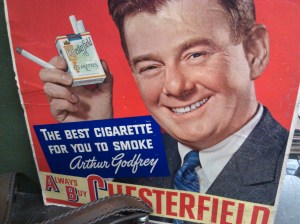
    img_20161111_121309In his November 14, 2016 Financial Page article for The New Yorker, “What’s in a Brand Name?,” a one-page gem, James Surowiecki anecdotally mentions the time Ford asked the poet Marianne Moore to come up with a name for one of its new cars. She came up with a bunch, all rejected. Sometimes, the key to naming something successfully is found in the action word sublimate. But it is called advertising. Advertisements are arguments in which attempts are made to persuade us to do something that probably won’t be good for us. So we might, for example, get Arthur Godfrey telling us what kind of cigarette is best for us. Borrowing someone’s credibility to pitch your argument is a tricky business. Scholars describe it as a means of persuasion called ethos; others may call it a slang profanity, remain unpersuaded, and know it’s best to choose your own cigarette.
    “They are playing a game,” R. D. Laing opens the first knot of his Knots:

    They are playing at not
    playing a game. If I show them I see they are, I
    shall break the rules and they will punish me.
    I must play their game, of not seeing I see the game.³

    img_20161110_145049It’s fall, and soon winter will come in, and most of the cafes locally will move their sidewalk tables and chairs indoors, and it will be harder walking and wandering to find a place to sit out with an espresso in what might remain of the afternoon light (in the Northwest, the world is also cracked, but in winter, that’s how the water gets in). A certain discomfort is a necessary good for some kinds of writing.

    Over the past week or so we visited several cafes for an afternoon espresso at a sidewalk table in the waning light of fall, hoping for some inspiration from the general rue for a paper napkin poem. Alas, we got no paper napkin poems. But we got some sidewalk espresso music, and enjoyed a few clean, well-lit places, and took a few pics we offer here in lieu of napkin poems.

    ¹ From “Translator’s Note” (1964) Lawrence Ferlinghetti’s introduction to City Lights Books The Pocket Poets Series: Number Nine, “Selections from Paroles,” by Jacques Prevert, San Francisco, July 1958, Sixth Printing February 1968.

    ² Reed, Henry. “Naming of Parts.” New Statesman and Nation 24, no. 598 (8 August 1942): 92 (.pdf).

    ³ “Knots,” by R. D. Laing, Vintage Books edition, April 1972, page 1. Originally published by Pantheon Books in 1971.