Tag: self-knowledge

  • Notes on “How to Know a Person” by David Brooks

    David Brooks’s latest book, “How to Know a Person: The Art of Seeing Others Deeply and Being Deeply Seen,” in the tradition of how-to books, suggests a panacea – it’s about how to cure social ills caused by failures toward wisdom, wisdom being the ability to know and see others. Of course everyone knows and sees others. But deeply is a metaphor that Brooks uses to mean wisely. This is where the wise guy gets wise and sheds the skin of the old self. Brooks suggests if one examines one’s life, as Socrates explained is the ticket to a life worth living, a good place to start is to examine the life of someone else. To know oneself means to cut through the fog of one’s birth situation and predicament, and, in the existential meaning of existence precedes essence, define for oneself what one’s existence amounts to, while simultaneously to know oneself means to understand the limitations and privileges handed down by the many hands of one’s cultural birth and upbringing and accept that view as true and unassailable. The ability to handle this apparent contradiction is necessary if one wants to be wise. The symbiotic relationship between one’s self and others is necessary for those who would wise up. You can’t be wise alone. You can’t know yourself without knowing another, and you can’t know another without knowing yourself.

    The Brooks book is a compilation of research in the fields of biography, psychology, philosophy, sociology, as well as neuroscience and field work, with ample anecdotal evidence and life experience examples that add support for claims and provide for reading enjoyment. There are seeming contradictions. Brooks eschews stereotypes, for example, but spends significant time categorizing personality types and other shorthand ways of talking about and seeing people. But at the same time he discards old ways of thinking and suggests better ways to experience one’s self and others. The naming of others and things is problematic. For example, we call a person an extrovert or introvert. What does this tell us about that person? There is a chapter titled “How Not to See a Person.” Brooks introduces new terms: Illuminator and accompaniment. He suggests there are wrong questions to ask – not, for example, what do you do (for a living), but, “What crossroads are you at?” Brooks acknowledges discouragement, but his book is positive and optimistic. He wants to be an illuminator, one who is wise, who knows others, sees and is seen. The book is not all that hard to understand. The challenge is to grow away from either the torment of self-doubt, of self-criticism, or the curmudgeonly habit of naming people to put them in their place, of holding people to rules that you yourself are not required to follow. Are you at peace or have you regrets that make you despair?

    “Despair involves bitterness, ruminating over past mistakes, feeling unproductive. People often evade and externalize their regret. They become mad at the world, intent on displacing their disappointment about themselves into anger about how everything is going to hell.”

    207

    Brooks distinguishes between smart and wise. And what is wisdom?

    “Wisdom at this stage of life [at the crossroads of peace, integrity, and despair] is the ability to see the connections between things. It’s the ability to hold opposite truths – contradictions and paradoxes – in the mind at the same time, without wrestling to impose some linear order. It’s the ability to see things from multiple perspectives.”

    207

    The wise don’t impose or regulate and tell you what to do. They listen. They are experts at listening:

    “Wisdom isn’t knowing about physics or geography. Wisdom is knowing about people. Wisdom is the ability to see deeply into who people are and how they should move in the complex situations of life. That’s the great gift illuminators share with those around them.”

    248

    There are identities we create, names we name ourselves, and narratives we stick to (or revise, as circumstances evolve), even as the plots don’t make any sense, one event not rationally leading to the next, like a walk through a circus. Like clowns, we “prepare a face to meet the faces,” as Eliot’s Prufrock said. Whereas, we might say simply, as Brooks summarizes:

    I had some early blessing. I saw the suffering of others. I realized my moral purpose. I endured periods of suffering. I grew from my pain. I’m looking toward a beautiful future. If you’re talking with an American and you want to get a sense of who they are, find out if their life story falls into this pattern, and if not, why not.”

    223

    Or we could sing a simple song. This is not in the Brooks book; I just thought it might be a fun way to end these notes:

    “Getting to know you,
    Getting to feel free and easy
    When I am with you,
    Getting to know what to say

    Haven’t you noticed
    Suddenly I’m bright and breezy?
    Because of all the beautiful and new
    Things I’m learning about you
    Day by day.”

    “Getting to Know You” is a song from the Rodgers and Hammerstein musical The King and I (1951). The song itself is “free and easy” and “bright and breezy.” That there is an underlying irony in the history behind the play it’s from may or may not say something about getting to know people:

    “In 1861, Mongkut wrote to his Singapore agent, Tan Kim Ching, asking him to find a British lady to be governess to the royal children. At the time, the British community in Singapore was small, and the choice fell on a recent arrival there, Anna Leonowens (1831–1915), who was running a small nursery school in the colony. Leonowens was the Anglo-Indian daughter of an Indian Army soldier and the widow of Thomas Owens, a clerk and hotel keeper. She had arrived in Singapore two years previously, claiming to be the genteel widow of an officer and explaining her dark complexion by stating that she was Welsh by birth. Her deception was not detected until long after her death, and had still not come to light when The King and I was written.”

    Wikipedia, The King and I, Retrieved 11 Nov 23

    Persons
  • F/Z 2: Doubt & Surety

    In part 3 of his encounter with Zizek’s “A European Manifesto,” Jeremy Fernando returns to the question of the picture we have of another’s picture of us that is not the same picture we have of us. In other words, the question of art, tinged with doubt, the opposite of faith (62). We all have a particular picture of ourselves, more than one, perhaps, but, in any case, seldom the same picture others have of us. This is of primary concern to the artist who realizes his lack of vision inhibits the transparency that informs nature (i. e. the primordial picture). The painter of the still life bowl of peaches fails to see the molecules drifting off the rotting fruit, but captures the glossy black fly attending to the rusting red peaches with verisimilitude the critic who likes this sort of thing calls ultra-realism. Of course it’s hardly real at all. It’s a painting, oils that never completely dry.

    To have put down yesterday a few of my thoughts on Fernando’s recent book (S/Z Jeremy Fernando: A European Manifesto Slavoj Zizek, 2022, Delere Press), this morning, upon reflection, causes me to pick up the book again and open to:

    “…one cannot be sure not only if one has mis-read, over-read, or under-read, one cannot be certain if one has even read.”

    63.

    An “illegitimate” (63) reading, then. Well, after all, this is a blog:

    Thus we can only impress upon our readers (all dozen or so of them, if we are a best-teller) our impression of what we’ve read. My impression is that we’ve no need to fear the monster. And to keep in mind always that the monster is precisely not Frankenstein. All art is science fiction. In fact, all science is science fiction. What do we think we are seeing when we look at these new photographs of scenes taking place in far far away space?

    “Where what << Europe >> is, might be, could be, might well already be, is both from yonder, perhaps even beyond the pale, but at the same time – since it is named such – within its possibilities. Where, in response to ‘Was heibt Europa?’ [What is Europe?] one might posit, un pas au-dela [a step beyond].”

    39.

    The artist (the surety, the guarantor) assumes the responsibility for the debt of the reader who brings suit (calling upon his solicitor – i. e. the critic), as he surely must, for he can never get to the bottom of it on his own, yonder his own limits, beyond the pale, outside any jurisdiction. For the artist, who stands alone, is both surety and principal, the one who performs the obligation and the one who guarantees the performance, and the one who defaults, all three parties to the contract. What became of the reader? Lost in space.

    To be clear: Frankenstein is the artist; the book is the monster.

    Thus, while Fernando starts part three with questions about the artist, he quickly moves to a discussion of Adam and Eve and the question of the tree of knowledge, of good and evil, and wonders how either (Adam or Eve) could have possibly made an informed decision to eat of the forbidden fruit, since before that act they had no knowledge – they didn’t know what they were doing; as innocents, they could not make an informed decision – they had not reached the age of reason: thus their plea of nolo contendere. And they plea guilty to a lesser charge, that of being human.

  • Things to Do in the Twenty-First Century

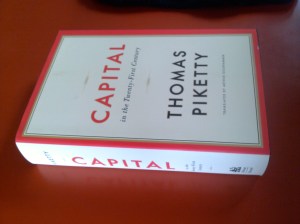
    CapitalI had thought Thomas Piketty’s “Capital in the Twenty-First Century” would be one of those books I would continue to read about but would probably not read first-hand. At 685 pages, its great strength data, its cost new $39.95 (speaking of wealth and distribution), the French economist’s thick tome was not on my list of books to keep an eye out for, let alone add to one of the several stacks of books to read already piled about the house. Piketty’s book is a stack of its own.

    In an Isaac Chotiner interview with Piketty at the New Republic , Piketty himself speaks to to the difficulty of reading such books:

    IC: Can you talk a little bit about the effect of Marx on your thinking and how you came to start reading him?

    TP: Marx?

    IC: Yeah.

    TP: I never managed really to read it. I mean I don’t know if you’ve tried to read it. Have you tried?

    IC: Some of his essays, but not the economics work.

    TP:The Communist Manifesto of 1848 is a short and strong piece. Das Kapital, I think, is very difficult to read and for me it was not very influential.

    IC: Because your book, obviously with the title, it seemed like you were tipping your hat to him in some ways.

    TP: No not at all, not at all! The big difference is that my book is a book about the history of capital. In the books of Marx there’s no data.

    But I was wrong. First, fortune brought “Capital” my way. I was walking down to a distant mailbox (like newspapers disappearing, so too are the neighborhood mailboxes). On my way, I looked into our local library box. Only about five or six books. The Believer magazines I’d dropped off the other night were gone. But there at the end of the top shelf in the library box was Piketty’s “Capital.” I picked it up. Looked unread, brand new. Weighed about five pounds. Would it still be there in the box when I got back from dropping off my mail? I glanced through it. Couldn’t take that chance. Not with this kind of fortune. So I walked away with it, feeling a bit guilty though because I knew I might not actually read it, those stacks of unread books about the house already weighing upon me like a seven course meal when you’re not really all that hungry to begin with.

    But I was wrong. Second, the book is not all that hard a read. While it probably won’t make anyone’s top ten common reader list, Piketty’s book is clearly written, concise, with well-wrought sentences, and full of remarkable insights and surprises. Consider this paragraph, the subject of which (experiential, anecdotal, or empirical data) revitalizes the current humanities in crisis folderol. Piketty says,

    Intellectual and political debate about the distribution of wealth has long been based on an abundance of prejudice and a paucity of fact.

    To be sure, it would be a mistake to underestimate the importance of the intuitive knowledge that everyone acquires about contemporary wealth and income levels, even in the absence of any theoretical framework or statistical analysis. Film and literature, nineteenth-century novels especially, are full of detailed information about the relative wealth and living standards of different social groups, and especially about the deep structure of inequality, the way it is justified, and its impact on individual lives. Indeed, the novels of Jane Austen and Honore de Balzac paint striking portraits of the distribution of wealth in Britain and France between 1790 and 1830. Both novelists were intimately acquainted with the hierarchy of wealth in their respective societies. They grasped the hidden contours of wealth and its inevitable implications for the lives of men and women, including their marital strategies and personal hopes and disappointments. These and other novelists depicted the effects of inequality with a verisimilitude and evocative power that no statistical or theoretical analysis can match.

    Indeed, the distribution of wealth is too important an issue to be left to economists, sociologists, historians, and philosophers. It is of interest to everyone, and that is a good thing (p. 2, Introduction, A Debate without Data?).

    And we learn on page 24 of Piketty’s book (Figure I.I) that income inequality in the United States (1919-2010) was at its lowest between the years 1950 to 1980. From 1980 to today, income inequality in the US has grown steadily, and is now higher than it was during the Great Depression years. Those 30 years of comparative stability (1950-1980) allowed for a sharing of accumulation of capital and knowledge unprecedented and not seen since. The US working class achieved a remarkable degree of middle class provisions, its children went to college in unprecedented numbers, without incurring today’s debt for education, but today nearing or in retirement may be returning to its roots.

     Today’s library box held only three books, none of which I picked up: “A Nun on the Bus”; “Jesus for President”; and “Bernie Sanders: an Outsider in the White House.”

  • The I Ching (Book of Changes); or, where one should not try to be all-knowing

    In harmony with the Book of Changes, the 3,000 year old Chinese pursuit of wisdom, I chanced across a copy (3rd ed., 21st printing, 1985), for $2, at a garage sale this past weekend. It’s the Bollingen hard copy, in fair condition, with dust jacket, for which Jung wrote the original foreword, not as worried, he explains of his inability to explain the I Ching to what he calls, in 1949, the “Western mind,” a mind that might best be described by Hexagram 29, “Bound with cords and ropes,” because he was then in his “eighth decade, and the changing opinions of men scarcely impress me any more.” Not only that, but, continuing Hexagram 29, “If you are sincere, you have success in your heart, And whatever you do succeeds.”

    The I Ching provided Jung with a practical field of study for his concept of synchronicity, the theory that effects don’t always have measureable causes – or, at least, when we turn our attention away from causality (as John Cage did in his works involving indeterminacy), we seem to form a more perfect union with nature – by which Jung meant, in his foreword to the I Ching, physics.

    Yet it’s not clear whether today’s physicists agree or not – that a truly exceptionally simple theory of everything (one that satisfies Richard Wilhelm’s desire to “…[make] the I Ching intelligible to the lay reader”) might be held in the random throw of three coins. In any case, globalization may have already made the Western mind boundary-less, ubiquitous on the planet, but the I Ching is still out there, waiting to be discovered. Like the gospels, the I Ching has, since Jung wrote his foreword, been “pinched and poked,” as e. e. cummings said in “O sweet spontaneous,” by the “doting fingers of prurient philosophers.” Yet, Jung says, “security, certitude, and peace do not lead to discoveries.” In this regard, at least, if in no other, the I Ching would still appear appropriate for “thoughtful and reflective people who like to think about what they do and what happens to them…,” and like to think beyond “reason and pedagogy [which] often lack charm and grace.” Of course, who wants to hear that today’s answer is the same one offered 3,000 years ago? Might make winning the research grant a bit more difficult.

    Jung argued that the I Ching is best suited to questions of self-knowledge. That the I Ching has changed over time, been abused, cast aside, like the gospels, should not, with regard to its use toward self-knowledge, Jung seems to be saying, in his foreword, dissuade contemporary readers, for “often our relations depend almost exclusively on our own attitudes, though we may be quite unaware of this fact.” Why would anyone consult the I Ching today? Because, as Jung says, “The I Ching insists upon self-knowledge throughout. The method by which this is to be achieved is open to every kind of misuse, and is therefore not for the frivolous-minded and immature; nor is it for intellectualists and rationalists.” But it is, in other words, the perfect fit for our ideal, general interest reader.

    Jung acknowledges that “to one person its spirit appears as clear as day; to another, shadowy as twilight; to a third, dark as night. He who is not pleased by it does not have to use it, and he who is against it is not obliged to find it true. Let it go forth into the world for the benefit of those who can discern its meaning.” So Jung asked “Why not venture a dialogue with an ancient book that purports to be animated?” In an age when neuroscientists like Jonah Lehrer argue that “the mind is really just a piece of meat,” it would not seem that such a dialog as Jung suggests having with the ancient book can do any harm. But if I put the question to the I Ching, is the mind really just a piece of meat, I’d better be ready for the answer: Hexagram 36, “Darkening of the Light,” “…one should not try to be all-knowing.” Not only that, but, Jung adds: “The less one thinks about the theory of the I Ching, the more soundly one sleeps.”