Tag: science

  • Old Haunts

    Old Haunts, all with current links, focused on core subjects: art, technology, music, science, and literature, but first, a brief explanation:

    Moving continuously toward more minimalist formats (which if not stopped could result in disappearance altogether), blogs may risk losing some appeal, particularly to readers who enjoy liking, commenting, and linking or sharing – in short, conversing – as well as indulging in pingbacks and reblogging, and who enjoy perusing sidebars, widgets, clicks and plays, slide shows, and sharing up and down the crowded street of social media sites and apps. An example of such minimalist drift, here at the The Coming of the Toads, might be the removal, some time ago now, of listings and links of followed blogs and favorite sites, what I called in the sidebar heading over the list of links: “Back Roads to Far Places,” the title from Ferlinghetti’s book.

    I use the WordPress Reader to subscribe to sites, and currently I’m subscribed to 146 – but not many of which post frequently or are still active at all, which sparks the idea behind this post, which might have been subtitled: and Other Broken Links. While I don’t currently post a widget of followed blogs or sites, I do manage my subscribed sites in the WordPress Reader, and I also maintain the “Links” feature in the WordPress Dashboard for my own use. There are currently 33 links. But links don’t always stay current or active, while others click to surprise, a site grown or morphed into other projects or disappeared (Page Not Found), and still others remain useful resources or pleasant places to visit, like old friends. Or the link simply breaks and you get sent who knows where and who knows what’s happened. Sites often change over time, and it can be hard and takes time keeping up with the changes.

    Anyway, I thought I’d share an update of just a few of the sites that do continue to work well and that I try to follow and that offer pleasant visits and are creative and resourceful:

    Marginalia and Gracia and Louise I first discovered in “High Up in the Trees,” a blog by the Australian artist Gracia Haby. It’s now called “Marginalia.” I like everything about it – font work, photography, text content, collage and other art work, the work Gracia and Louise do with animals. And there’s another site they maintain, called Gracia and Louise, full of things to see and wonder at. The sites probably work best on desktop, but the creativity in doing more with the drop-down necessities of on-line viewing is unparalleled (of that, here is a specific example, called Reel).

    McLuhan Galaxy always produces a profoundly puzzling experience in that there seems no end to his ideas and the ramifications of effects of media on society and culture – and yet here we go, linking and following, but where? The Blogroll will keep you occupied for hours of intellectual fun.

    I don’t have John Cage ears, but I’ve always enjoyed his writing, and much of his music I do enjoy. Kuhn’s Blog is not often updated, but the site resources remain available and loads of fun, with several interactive features (try Indeterminacy, for example). The John Cage Personal Library is itself a phenomenal work.

    The Buckminster Fuller Institute shares hope for the world from a worldwide perspective. The site may provide a new awareness for what’s going on worldwide to improve conditions, predicaments, problems – near and far. If your not familiar with Bucky, here’s a good place to start: Big Ideas.

    Words Without Borders features world wide writing in a variety of formats. Browse by country, theme, or genre.

    Old Haunts, all with current links, focused on core subjects: art, technology, music, science, and literature.
  • Moonglow

    It must have been moonglow
    drop these words down to me
    must have been moonglow
    I’m up in the old oak tree.

    Your supermassive hug
    your stellar eyes of blue
    I can’t get out and away
    I’m disappearing into you.

    It must have been moonglow
    high up in the old oak tree
    that night you said those words
    and held me so close to you.

  • At the Intersection of Above and Below Ground

    At the Intersection of Above and Below Ground

    Geomicrobiologists now claim life underground exceeds in size, diversity, and span life above ground. What is life? It might be easier to simply say Earth is alive, all of it, including the rocks. And does extraterrestrial life exist? Well, we exist, we think. It now appears planets are living beings. Universe is alive. And that’s not counting the ghosts.

    According to scientist Karen Lloyd, quoted in The Guardian: “The strangest thing for me is that some organisms can exist for millennia. They are metabolically active but in stasis, with less energy than we thought possible of supporting life.” That describes a teacher I had in high school.

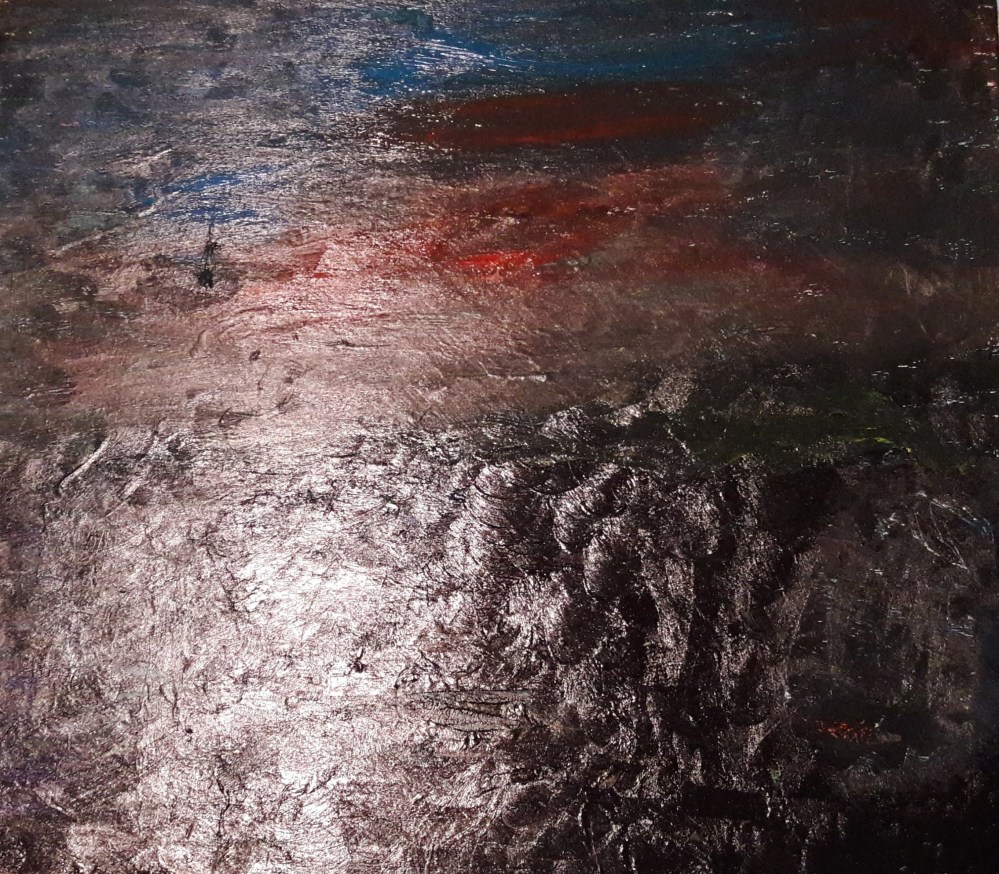
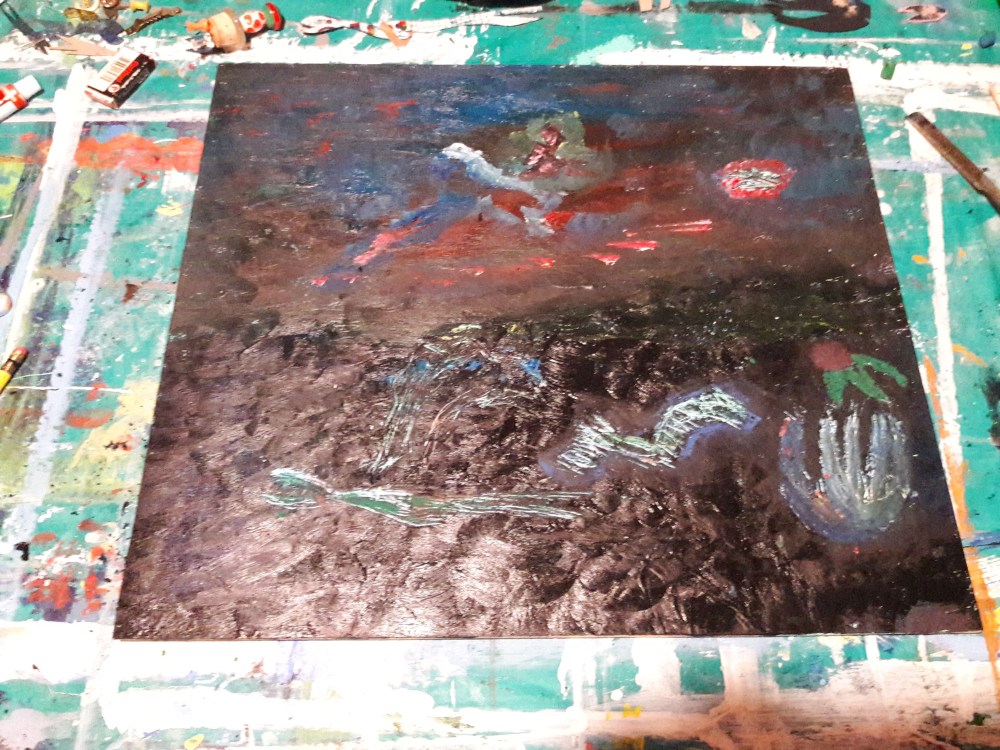
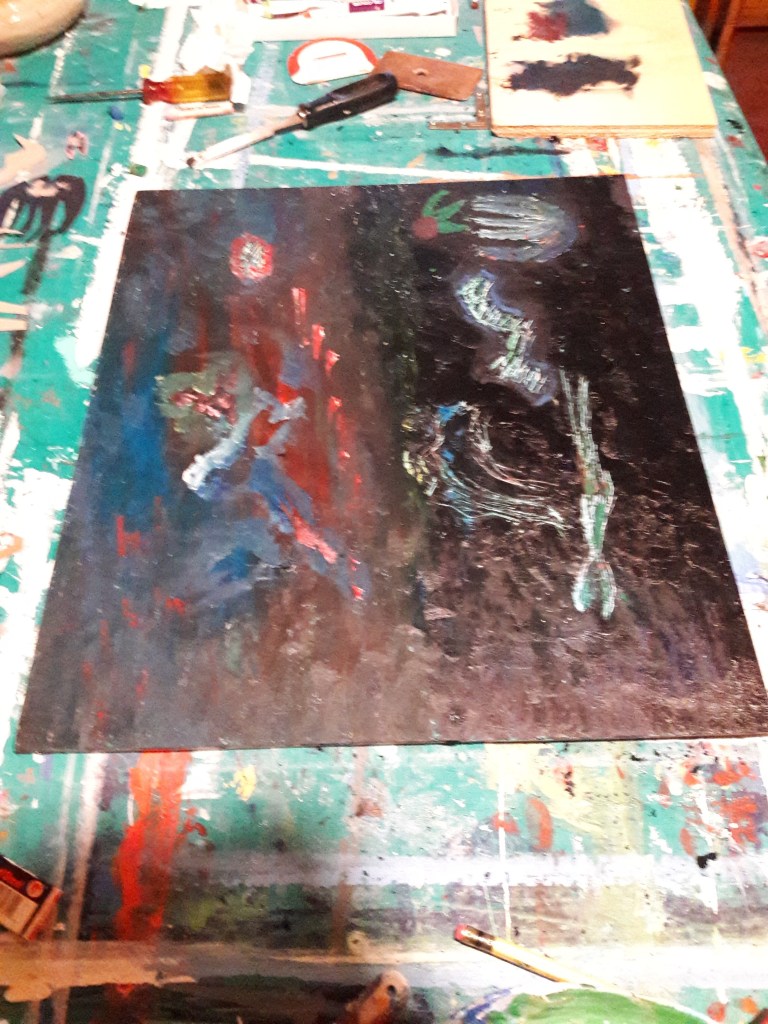
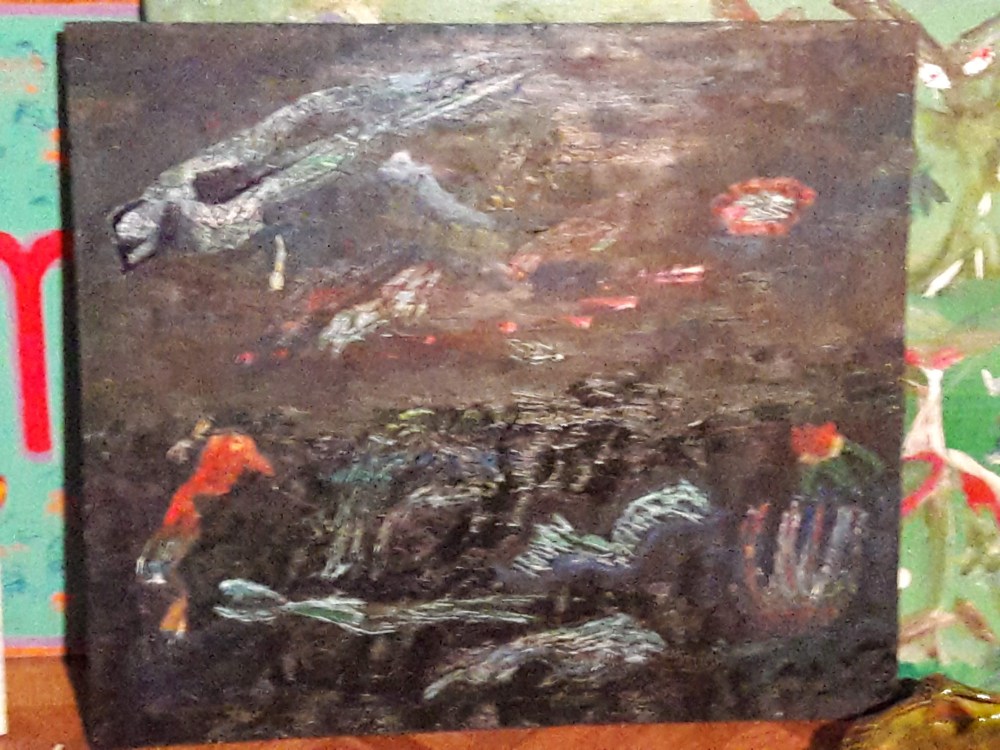
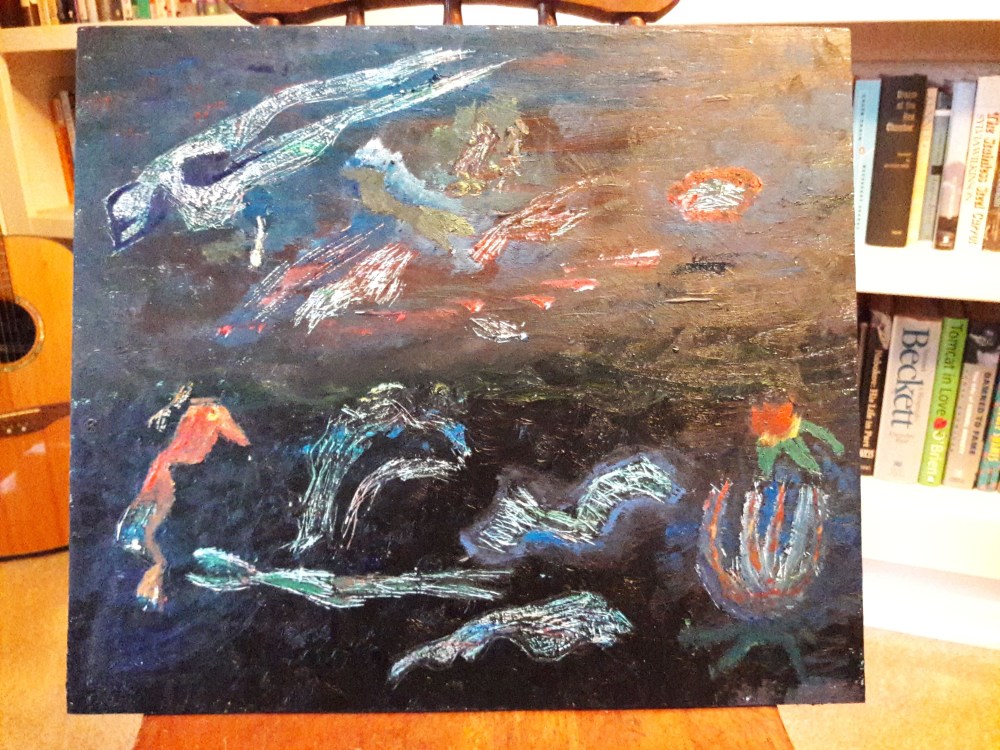
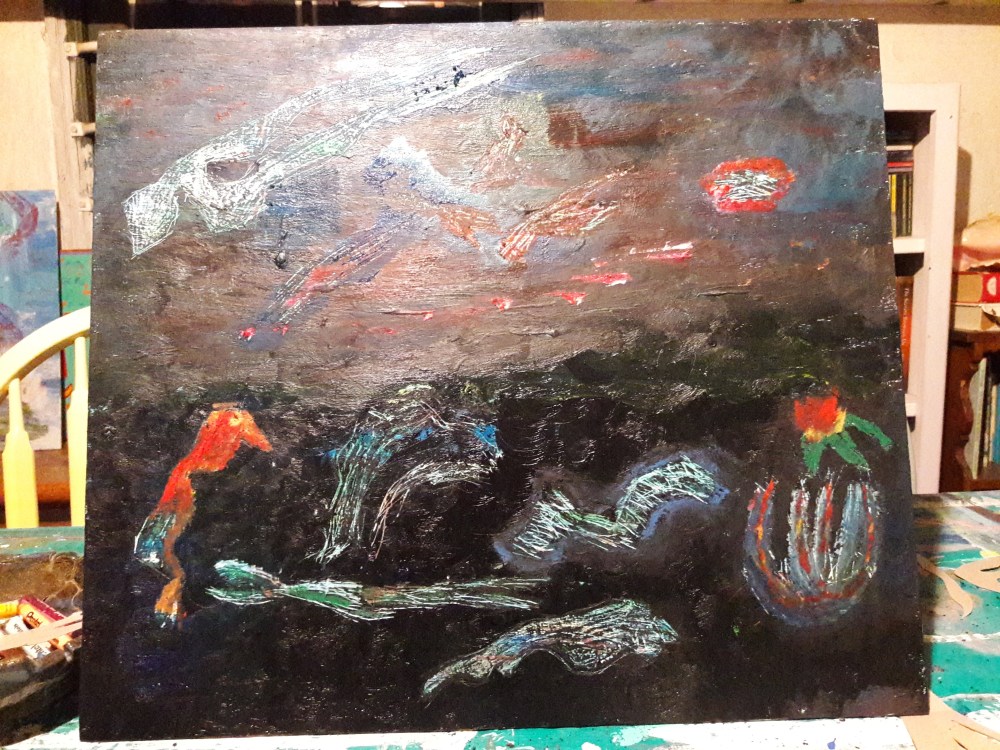
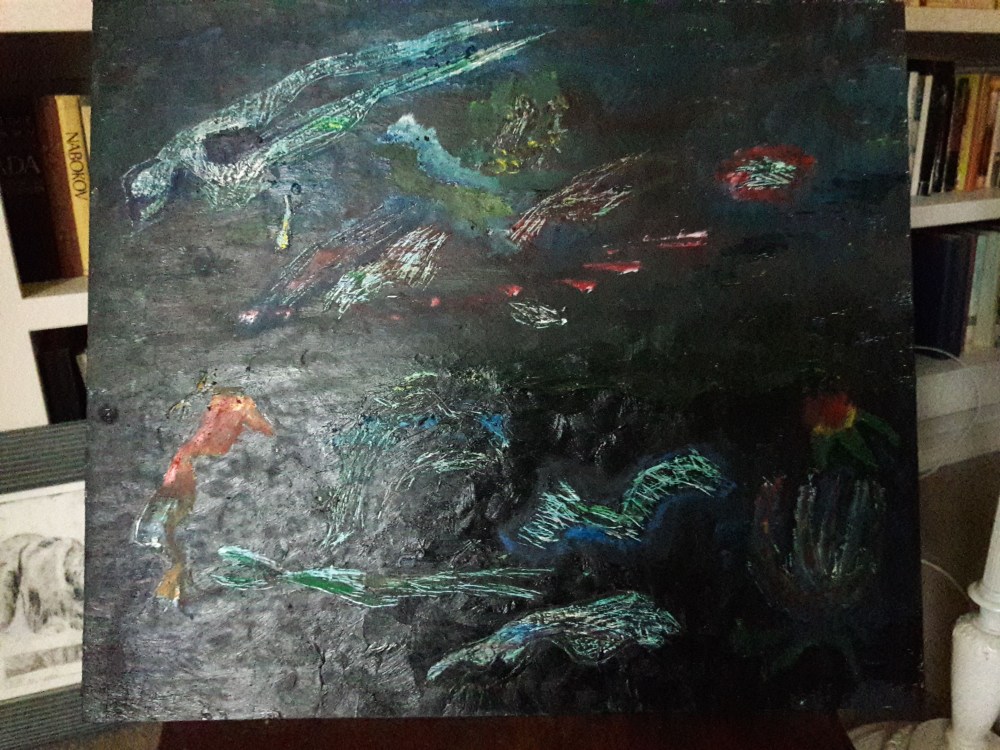
    Meanwhile, in the basement studio, located at the intersection of above and below ground, I’ve continued to work on cutout paintings. The photos below detail the evolution of a recent graffito work:

  • Involving “Involution,” a book by Philippa Rees

    For years, science was an argument that believed nothing on faith. These days, anything might be believed, as long as adequate funding materializes. Matthew Arnold’s receding “Sea of Faith” may be replenished with research dollars. What the sea might be replenished with is up in the air, and anyone’s guess.

    In “Spooked: What do we learn about science from a controversy in physics?,” Adam Gopnik (30 Nov New Yorker) explains: “The seemingly neutral order of the natural world becomes the sounding board for every passionate feeling the physicist possesses.” The subject is non-locality, or locality, depending on your point of view: the idea that we might eschew working at home and go into the office but without a commute. Gopnik is reviewing George Musser’s “Spooky Action at a Distance.” “One of Musser’s themes,” Gopnik says, “is that the boundary between inexplicable-seeming magical actions and explicable physical phenomena is a fuzzy one.” Gopnik looks at two other books, David Wootton’s “The Invention of Science,” and Thomas Levenson’s “The Hunt for Vulcan,” and concludes that scientists who suggest nature is wilder than we ever imagined “widen our respect for what we might be capable of imagining.”

    Imagining extreme life made possible by large doses of alien DNA, for example, such as the recent genome sequencing of the tardigrade makes apparent. Or of imagining a thinking both qualitatively and quantitatively different than Dickens’s Thomas Gradgrind’s facts based knowledge. In a delightful essay test-like answer, Mary Midgley said, “The Enlightenment has done a magnificent job of increasing our knowledge. The further job – which its original prophets glimpsed very clearly – of putting that knowledge in its wider context hasn’t been done so well. It is not a job for science but for wisdom. It needs more work” (“You may now turn over your papers,” 24 Sep 2010, Guardian). If you doubt that it needs more work or that funding must be involved, consider this, from Sabine Hossenfelder’s “Does the Scientific Method Need Revision?”: “I cringe every time a string theorist starts talking about beauty and elegance. Whatever made them think that the human sense for beauty has any relevance for the fundamental laws of nature?” Not that I’m a fan of string theory. As I said in a prior post, if Christo were a physicist, he would have enough string theory to wrap the universe. Beauty and elegance point to metaphor; what does physics point to? Without some extra-dose of alien DNA, it seems we’re trapped in the human.

    Imagining more work for the imagination is the lure of Philippa Rees’s erudite tome, “Involution: An Odyssey Reconciling Science to God.” “Creation has paid a high price for science’s limited certainties,” Rees says in her Introduction. Like Mary Midgley, Rees challenges Dawkins, who, Rees surmises, would call her work “bad poetry,” where metaphor is the culprit. And the Gradgrind school of physicists like Hossenfelder might also ask metaphor to leave the room. Can metaphor be tested? Is beauty falsifiable?

    The electronic copy of “Involution” is 947 pages, cover to cover, including copious notes, scholarly references, introduction, appendix, and afterword that bookend nine long cantos of free verse. If you’re looking for the gift that keeps on giving for someone who likes to read, consider P. A. Rees’s “Involution.” The paperback copy is only 444 pages (CollaborArt Books, 4 Jul 2013), but with the many references and notes, the e-copy might be a better choice because it’s efficient and effective to navigate.

    A synopsis of “Involution,” or a paraphrase of its argument, for purposes of this blog post, might best be substituted with Rees’s opening quote: “We are not human beings having a spiritual experience; we are spiritual beings having a human experience” (attributed to Père Teilhard de Chardin). The stylistic treatment of such themes often results in alternatives to standard forms of non-fiction. This is true of McLuhan’s “The Gutenberg Galaxy: The Making of Typographic Man”; of Norman O. Brown’s “Love’s Body”; and of much of Joseph Campbell’s work; and of Bachelard’s “The Poetics of Space.” These are works replete with references, written in a mosaic form, non-lineal. Their form challenges the status quo as much as their content. The poetry is not what makes “Involution” difficult. Involution’s poetry is not a post-modern puzzle. In many places we find a piece of the mosaic that alone is worth the price of entry:

    “It was all I had to bring
    For words must pull against the grain
    Shackled to their past
    Employed in other houses, poorly trained…
    Blacking scuttles, shining brass…
    All marred like aprons with old stains
    Or rigid in a tail and bow.
    Unable to use a common tongue…”

    But “Involution” is not an easy read. The seemingly protean nature of its narrator, moving in and out of italics; the mosaic history of science where each new discovery does little to complete the mosaic; the ambiguity of both protagonist and antagonist; the encyclopedic setting; the essential mystical nature of poetry; the science specialties – these all point to a work that is not meant simply to be read but to be lived with. At the same time, the book is carefully constructed, the layout accessible, the erudition softened in accessible notes and explanations. I remain perplexed by most of the figures, but they are helpful in the sense of being contributions to a new language form. I was initially a bit put off by the title, feeling no particular need or want for any kind of reconciliation, too cynical, I guess, but the title is true to the content; still, it gives little clue to the enjoyment of the reading experience.

    Sometimes, books are discovered by an unintended audience. How we say something is every bit as important as what we say, maybe more important. And it takes a staunch realist to speak to every audience in the same voice. Likewise, we should read difficult books. I’ve been working on Joyce’s “Finnegan’s Wake” forever, and he cunningly made it a circle, so I’ll never be able to finish it. The occasion of reading is also important, as important as the occasion of writing. The occasion of “Involution” may be now for both Philippa Rees and her reader: “From whence comes this recognition of beauty, economy, and elegance if not from our internal experience of being part of it?” (“Involution,” e-copy, p. 492).

  • Update on the Universe; or, Where we “canst not tell whence it cometh, and whither it goeth”

    Box seat holders at the Toads know that periodically we like to drop in on the physicists to see how the universe is progressing. Though it may be some 14 billion years old, fans will be happy to know that the universe is still in its early innings. Time for a hot dog and a bottle of that dark matter earthlings call beer.

    But why can’t we enjoy the universe without the polemic diatribes of the scientists who must wear their atheist merit badges on their sleeves? In the most recent example, Lawrence Krauss’s A Universe from Nothing: Why There Is Something Rather than Nothing, Richard Dawkins comes out of the bullpen to write the afterword, and we find ourselves trying to stay afloat in some deep, dark matter, but it’s not beer.

    “Over the course of the history of our galaxy,” Krauss writes, “about 200 million stars have exploded. These myriad stars sacrificed themselves, if you wish, so that one day you could be born. I suppose that qualifies them as much as anything else for the role of saviors.” But is Jesus about being born, or about the existential possibility of being reborn?* To get this, one must imagine a universe without shame. It doesn’t matter where you come from, who your parents were, the color of your collar. The universe does not come into play. Krauss has hit a foul ball.

    Why the scientists can’t stick to scientific writing is one of the mysteries of the universe that neither Krauss nor Dawkins unravel. Consider, for example, Dawkins’s afterward. After a couple hundred pages of Krauss blowing winds and cracking cheeks in which he attempts to explain that King Lear was wrong when he said “nothing will come of nothing,” we find that indeed nothing has come of nothing, but that it may amount to the same thing as something coming from nothing, or the other way around. In any case, as early as 14 billion years ago, which is to say, in his preface, Krauss has already admitted, “we simply don’t know” and probably never will. As it turns out, the universe is really about funding.

    We’ve never doubted, here at the Toads, that something can come from nothing (witness the 1969 Mets); neither have we doubted the reverse, that nothing can come from something. We’re going back to casting out 9’s, dividing the universe into 9 inning segments.

    “We may not understand quantum theory,” Dawkins writes in his afterward, but then says, parenthetically and inexplicably religiously, “[heaven knows, I don’t] but a theory that predicts the world to ten decimal places cannot in any straightforward sense be wrong. Theology not only lacks decimal places: it lacks even the smallest hint of connection with the real world.” Yes, but why “heaven knows”? Is Dawkins kidding here? Or is this a slip of the atheist pen? And what about those ten decimal places? In a universe as old and big as Krauss has described, ten decimal places hardly seems significant at all. The assumptions of the argument lose their scientific credibility the moment its purpose is revealed to be conversion: it’s an argument of conversion, and it’s trying and tiring.

    Note: For information about the universe, the Toads still recommends Robert B. Laughlin’s A Different Universe.

    *“Marvel not that I said unto thee, Ye must be born again. The wind bloweth where it listeth, and thou hearest the sound thereof, but canst not tell whence it cometh, and whither it goeth: so is every one that is born of the Spirit” (John 3:7-8, KJV).

    Related:

    David Albert’s New York Times book review of Krauss’s A Universe from Nothing.

    Sea Monsters in A. C. Grayling’s Secular Bible; or, Humanity’s Greatest Endeavor

    Progress Report: Our Disappearing World