And of course it goes without saying but like good poets we’ll say it twice anyway:
We didn’t write anything with purpose to change the lines of global affairs
or even local trists and by that we mean right here now of course in this sadly redundant poem
written while sitting out in the morning cool air when poems part ways
part of the world’s course as off course as all things of course as if a course exists.
But here comes the sun today the temp 101 to be I say of course
It’s still summer of course and we’re on course to break another course.
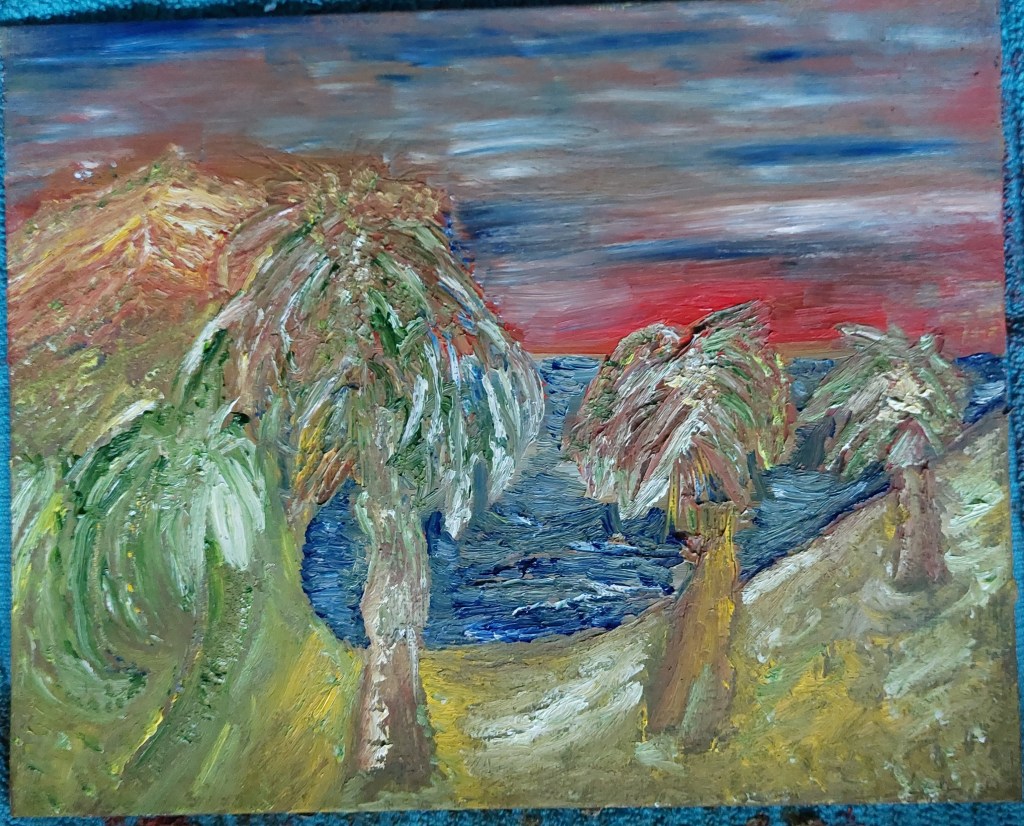
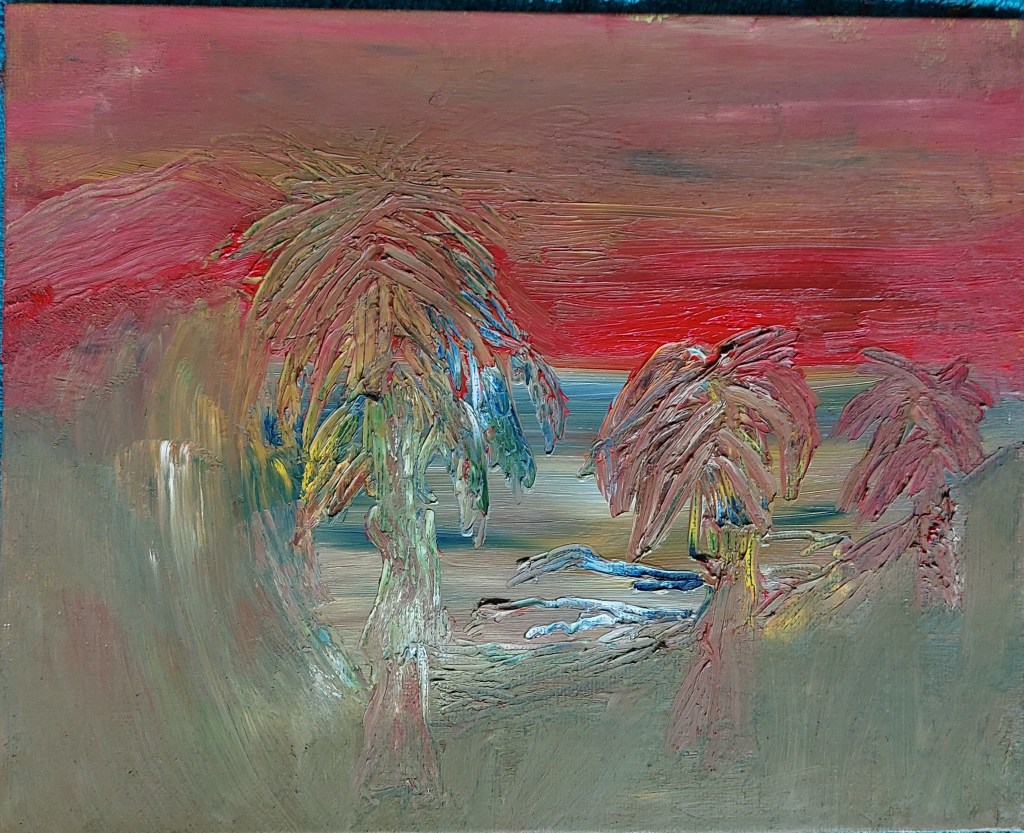
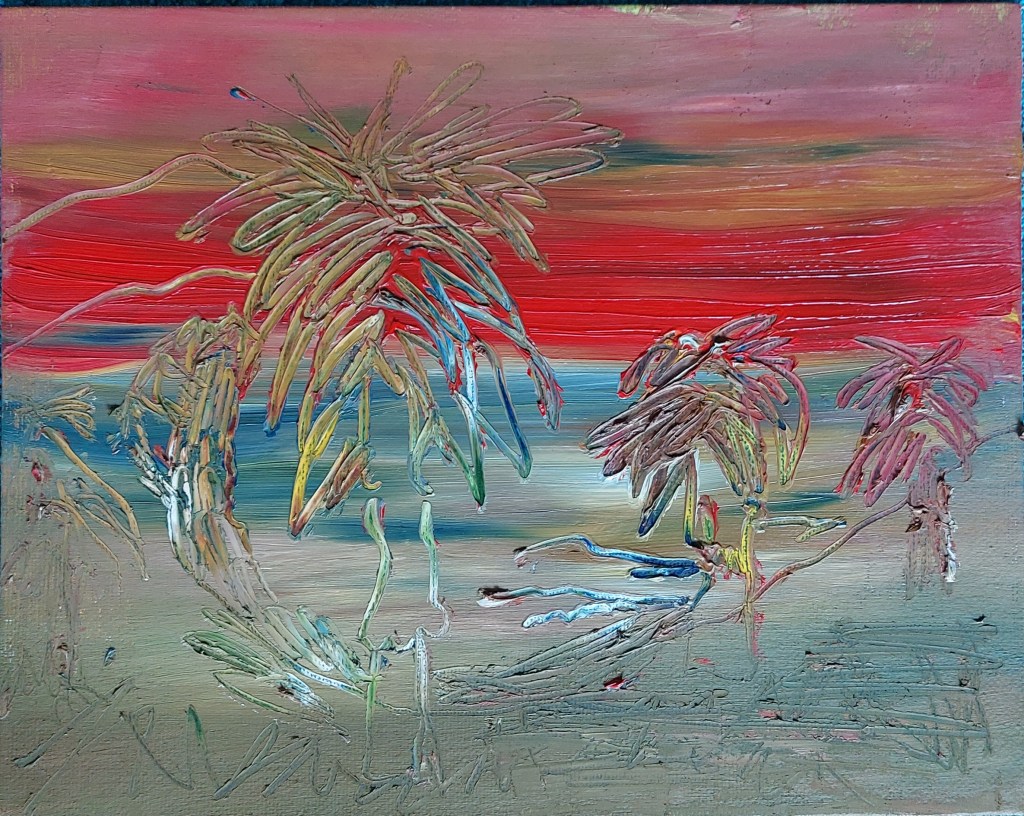
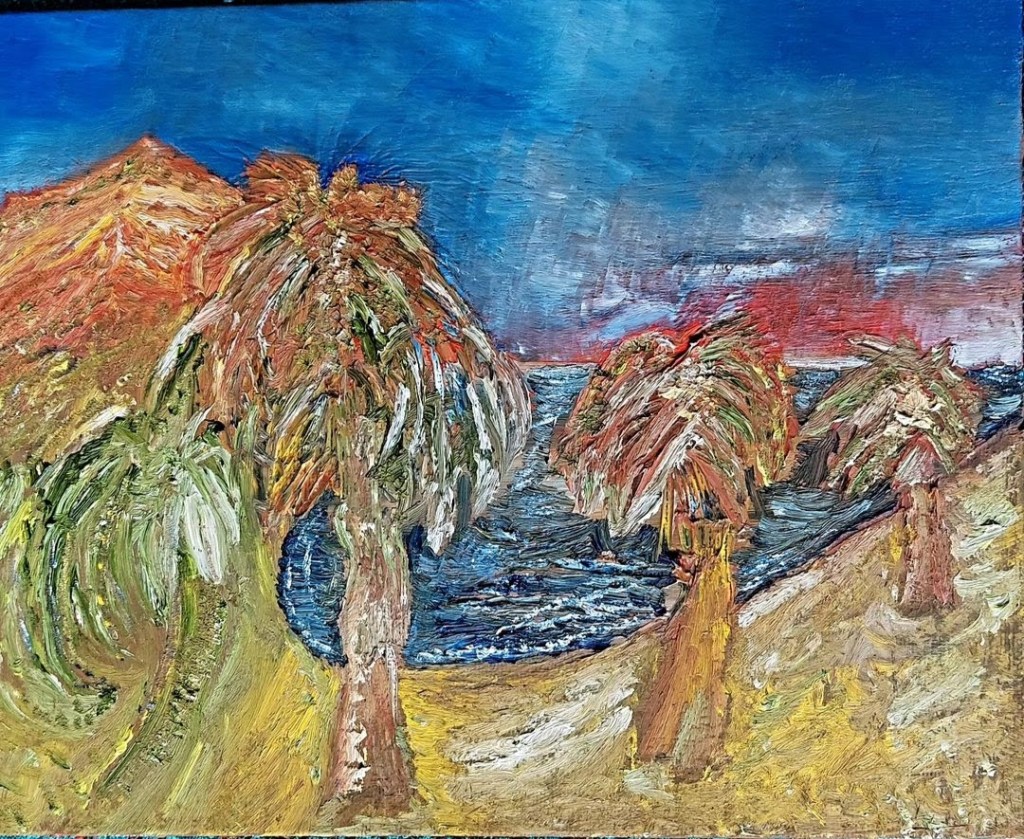
Palm Trees at Refugio
Note: My title, “Someone Told Me,” is the first line from a poem by Patrizia Cavalli. It’s from her first book, “My Poems Won’t Change the World” (1974). Her poem is untitled and only six lines long. I have it in a copy of her selected poems edited by Gini Alhadeff (FS&G 2013), also titled “My Poems Won’t Change the World.”
Thinking back to my earlier days of blogging, when it now sometimes seems writers then often wrote with different purpose, as in sharing a conversation with themselves to which others might be invited to listen in and, if need be, comment. Have we stopped talking to ourselves? Some days these days I’m nearly the only person I talk to, so if I do talk to someone else, some random Q & A with a passerby or on a visit to the grocery, I’m likely to mull over what was said with playback on repeat. Too often I find myself looking for meaning in a bucket of refuse, wanting to rebuff the debris, worried I might have not given someone or something my full attention, mired in muddled memory. Of course my interlocutor is long gone and remembers none of it and would be surprised to know I have it on mental-virtual video. Talking to ourselves is where conversations begin. Where can they end? I suppose many prepare a speech or lecture or opinion or anecdote, or spurn the prep and just go for it, though most rarely press it, but one might in conversation attempt to lecture or tell a story of something that once happened and for some reason the links still work, but not all of them, or the links take you places unexpected, but what’s the purpose of a lecture, a one way conversation, or an anecdote impossible to research? Do casual conversations have purpose, or are they simply a template for one’s personality, a way of spraying one’s mental territory? After a decade and more, a blog full of broken links, difficult to refresh. And we lose purpose, or misplace it, or deleted it by accident.
Olivia Manning’s writing is full of conversations. Characters come and go and return and you feel like you know not so much what they are going to say but how they are going to say it, and after a time there’s no difference. If the conversation contains nothing new, how something is said takes on more importance than what is said. But since it’s fiction, or selective memoir, everything that’s said must have some meaning, some purpose in the whole. Some reason for being said:
“The evening was one of the few that they had spent in their living-room with its comfortless, functional furniture. The electric light was dim. Shut inside by the black-out curtains, Harriet mended clothes while Guy sat over his books, contemplating a lecture on the thesis: ‘A work of art must contain in itself the reason why it is so, and not otherwise.’”
“Who said that?” Harriet asked.
“Coleridge.”
“Does life contain in itself the reason why it is so, and not otherwise?”
“If it doesn’t, nothing does.”
“Fortunes of War: The Balkan Trilogy.” NYRB 2010. Page 872.
But is life a work of art?
Critics have called Manning’s work somehow less than art. A blurb by Howard Moss on the back cover of my NYRB copy says,
“One of those combinations of soap opera and literature that are so rare you’d think it would meet the conditions of two kinds of audiences: those after what the trade calls ‘a good read,’ and those who want something more.”
You’d think that’s what a good conversation ought to purpose for. Why isn’t soap opera considered literature? It is, but one without an end – like a blog. Critics don’t like something that doesn’t come to an end. Someone that goes on and on and on is not considered a good conversationalist. But having enjoyed “The Balkan Trilogy” so much, I’m now on to the second of Manning’s trilogies, “The Levant Trilogy.” I’m only about 50 pages in, but already I think I can say it’s another good read mix of soap and lit. Though I’m not bothered by soap alone. Hemingway is full of soap. Soap and sap. Though the soap is rarely used for its purpose. The blurb was taken from a review of Manning’s Balkan and Levant trilogies Moss wrote for The New York Review, April 25, 1985, titled “Spoils of War.” Moss liked the books, almost in spite of his taste, it seems:
“The way this past world comes to the surface is un-Proustian and non-metaphorical; the thrust of the whole rarely has time to stop for digressions. Manning, who avoids elevations of style as if an ascent were a bog, also evades sentimentality, and although she can handle atmosphere, her main interests are those two staples of realistic fiction, character and action.”
But we do find digressions in the Manning books, mostly in the form of colorful sensory and physical descriptions of the weather and its effects on the streets, parks and gardens, the mountains and valleys and the trains traversing under the sky above and above the people below. But while these descriptions are placed here and there frequently it’s true they are short and appear almost as doilies or tchotchkes arranged to create atmosphere. But in the end, for Howard Moss, the trilogies lack poetry. But a poetry of war might create illusions, and what would be its purpose? Moss has already said of Manning:
“An enemy of illusions, she does not quite see how crucial they are both in love and in war.”
Was it on purpose Manning avoided metaphor and poetry? We can take purpose too seriously, forgetting that mostly what’s said is said in jest, to fill the spaces of silence, or to scratch common itches. We usually proceed without purpose. In Alice, on purpose, we find:
“They were obliged to have him with them,” the Mock Turtle said: “no wise fish would go anywhere without a porpoise.”
“Wouldn’t it really?” said Alice in a tone of great surprise.
“Of course not,” said the Mock Turtle: “why, if a fish came to me, and told me he was going a journey, I should say ‘With what porpoise?’”
“Don’t you mean ‘purpose’?” said Alice.
“I mean what I say,” the Mock Turtle replied in an offended tone. And the Gryphon added “Come, let’s hear some of your adventures.”
“I could tell you my adventures—beginning from this morning,” said Alice a little timidly: “but it’s no use going back to yesterday, because I was a different person then.”
“Explain all that,” said the Mock Turtle.
“No, no! The adventures first,” said the Gryphon in an impatient tone: “explanations take such a dreadful time.”
Indeed they do. Such might be to blog, or to write an epic trilogy or two, but while some explanations seem to require a long form, others can be riffed off in a tweet or two.
We say “on purpose” to explain some experience wasn’t “by accident.” But purpose is confounded by all those imperatives upon us that determine how we feel and experience but are not within our control, like the medulla oblongata stuff. We might try to proceed with purpose to do something purposeful with our day, or at least with our writing, or our blog, but to what purpose other than to show what happened and how our feelings may have changed over time and what ideas if any might accrue from those changes. But if all we can show is pettiness, narrow-minded cheap anecdotes, or soap operatic epic-intended purpose or explanations that go nowhere, why bother wading through the bog of a blog or a trilogy of books, all of which can never ascend but only descend, down as the page rises and disappears, one post after another, more often than not style and sense on repeat, poetry or not? Speak Memory, Nabokov said, while others might say, “Shut up!” Memory is like an upstairs neighbor pounding on the floor.
Memory is the editor-in-chief of experience:
“The Dormouse had closed its eyes by this time, and was going off into a doze; but, on being pinched by the Hatter, it woke up again with a little shriek, and went on: “—that begins with an M, such as mouse-traps, and the moon, and memory, and muchness—you know you say things are ‘much of a muchness’—did you ever see such a thing as a drawing of a muchness?”
Memory is an example of a muchness at work (or play).
“That’s the effect of living backwards,” the Queen said kindly: “it always makes one a little giddy at first—”
“Living backwards!” Alice repeated in great astonishment. “I never heard of such a thing!”
“—but there’s one great advantage in it, that one’s memory works both ways.”
“I’m sure mine only works one way,” Alice remarked. “I can’t remember things before they happen.”
“It’s a poor sort of memory that only works backwards,” the Queen remarked.
If memory only works backwards, what do we call the facility by which we look ahead? Can we imagine a future different from anything that’s contained in our memory? Imagination is muchness at work (and play). But character and action need a place to unfold, and Manning describes dwellings and rooms, bars and cafes, parks and walkways and trails. You can have a conversation anywhere. And her writing while sparse of metaphor is not devoid of poetry:
“The lawn was set with citrus trees that stood about in solitary poses like dancers waiting to open a ballet (695).
The landscape is part of the weather:
“As they rounded the house and came in sight of the sea, the clouds were split by streaks of pink. The sun was setting in a refulgence hidden from human eye. For an instant, the garden was touched with an autumnal glow, then the clouds closed and there was nothing but wintry twilight (695).
For all indents and excursuses, we have run out of purposes, if we ever had any, having relied on the feeling that we might as we sometimes do find our purpose in the act of going forth, but there’s never a guarantee.
Most writing begins in Purpose, a very crowded city, with directions out unclear amid contradictory signs. North of Purpose is Poetry, South is Prose. East is essay. West is Uncharted Territory. It doesn’t matter which direction you choose; Purpose is surrounded by ocean. The easiest and most travelled conveyance out of Purpose uses words. Words come from Language, some say the oldest of cities. But not all languages use words, semaphore, for example. Other examples of language without words might include body language, talking drums, whistling, smoke signals, music. We might say that those languages are not written, but music is written, and without words.
But I do use words, and because I’m only an average speller, poor pronouncer, mostly monolingual, and usually lost in Purpose, I keep a dictionary open while I write, but also because individual words are like recipes; I want to know what’s in them. Sometimes I spend so much time in a dictionary nothing gets written. One easily gets sidetracked in Genealogy and never reaches far from Purpose.
That one uses words doesn’t necessarily mean that one writes. One might talk, achieve one’s purpose, no need for pen and paper. Others might commit what someone said to memory, and repeat it themselves for a ticket out of Purpose. Talking is not writing, but it is a kind of writing.
And I don’t always use words. I draw cartoons. But if the cartoon is an argument, it is at least a kind of writing.
Sometimes it’s enough to ramble around Purpose, maybe with a camera in hand, walking through the neighborhoods, down to the industrial section, out to the ballpark.
If writing were a sport, it might be baseball. The outfielders adept at prose. At third base and first, essayists. At shortstop and second base, poets. The battery of pitcher and catcher a thesaurus of pitches: location, intent, speed, deceit. Readers may want to put the Shift on here.
We might say our purpose is to entertain, so we give our writing twists and shouts, a preacher’s sermon. The purpose of most writing is argument, an attempt to persuade. Purpose should not be confused with occasion. The occasion of writing is an assignment: a query, a synopsis, a critique or analysis. And occasion should not be confused with form. A postcard (from Purpose) is form, not content, but we begin to see how one shapes the other: “Wish you were here!” “You should have come!” “Can’t wait to get home!” “Not coming home, ever!”
In short, how we write is not quite the same thing as what we write or why we write. When we write is not important, nor where.
But it’s very hard to get out of Purpose. You never know when you’ll be stopped by the Authorities and asked to present your papers. Documents, photographs, identifications, QR Codes. They might even want to draw blood or have you pee into a bottle.
Purpose can be a mean place, a town without pity.
So I mostly try to avoid Purpose, and that’s how I write, or try to.
 The Coming of the Toads