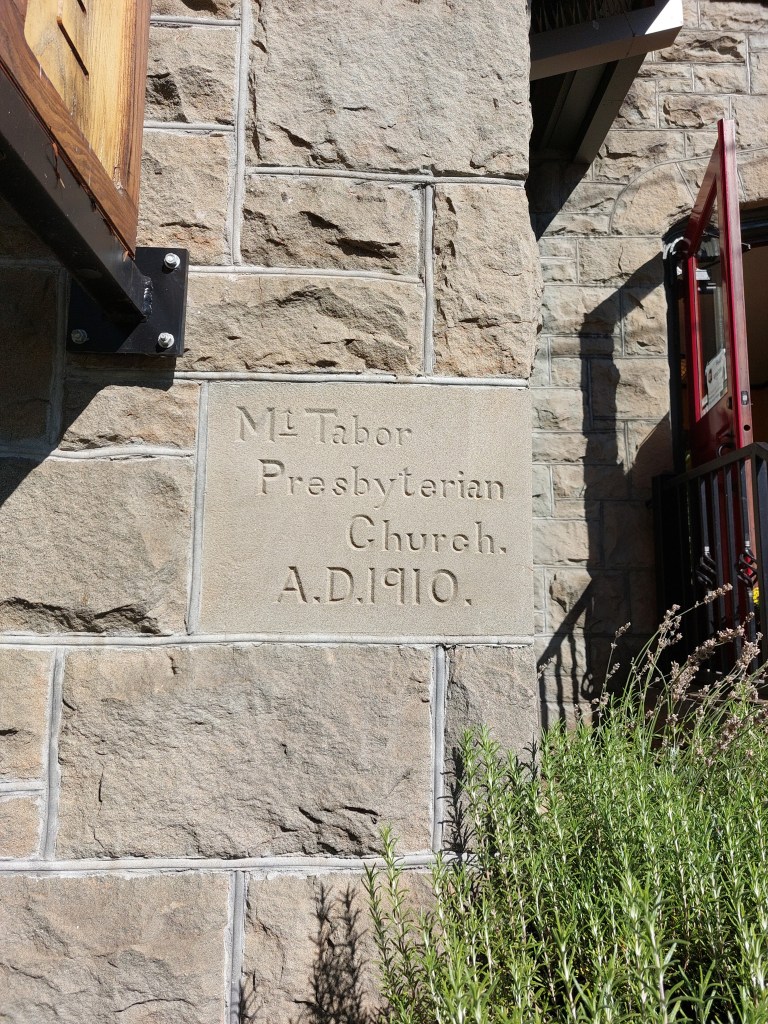
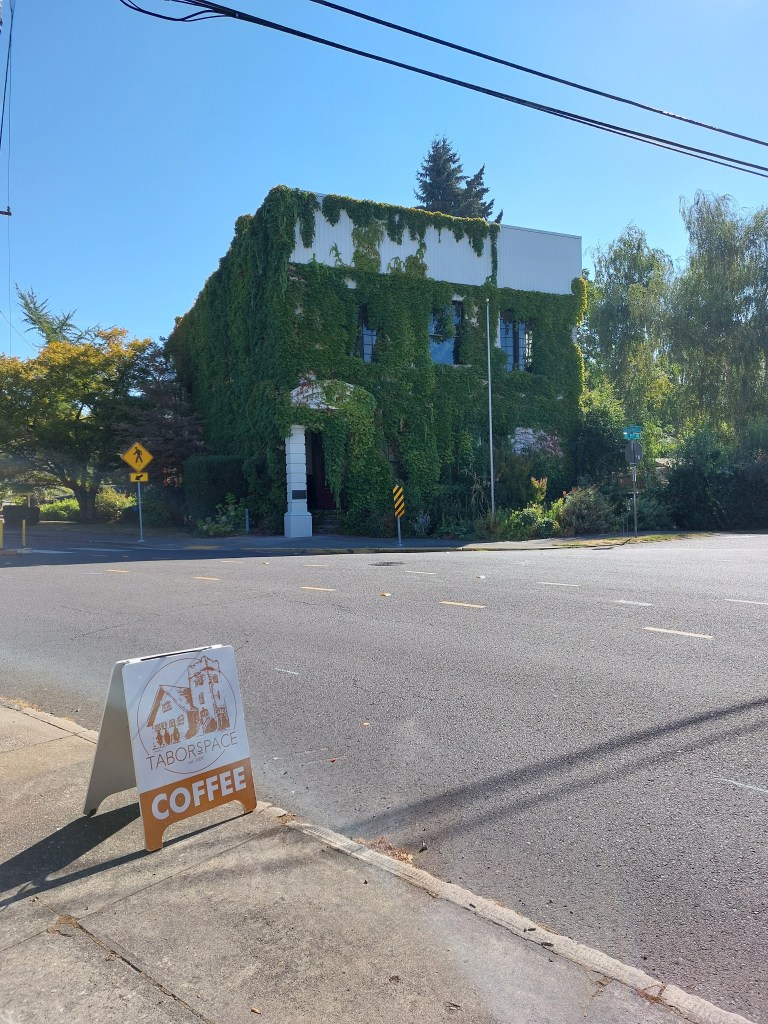
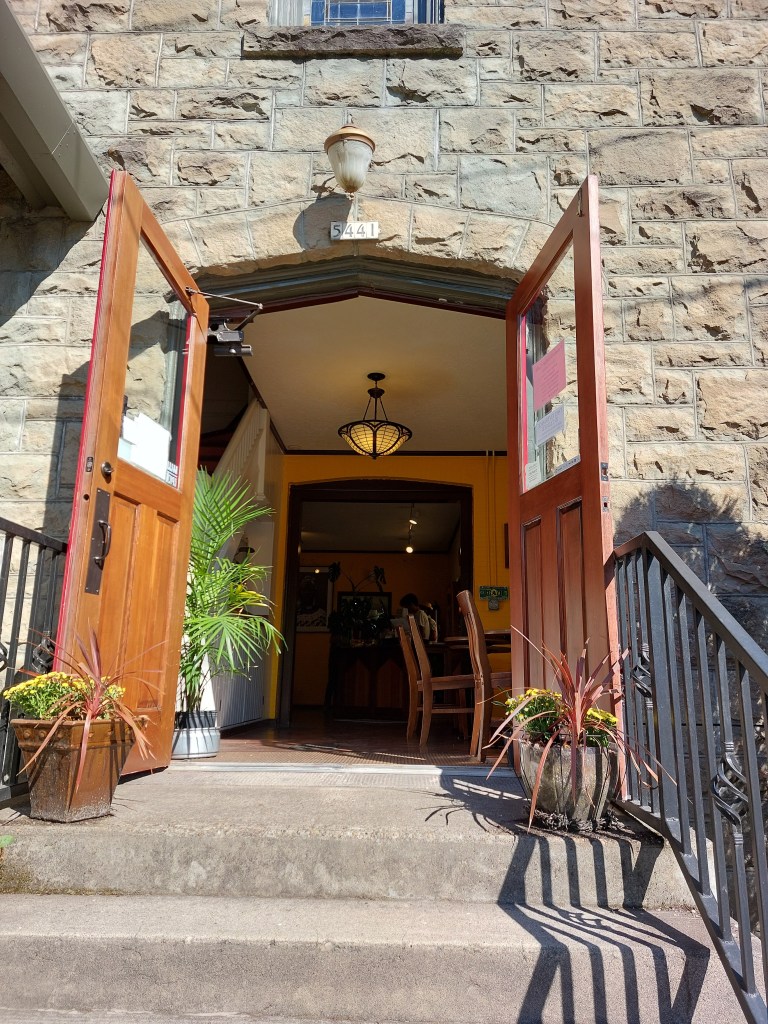
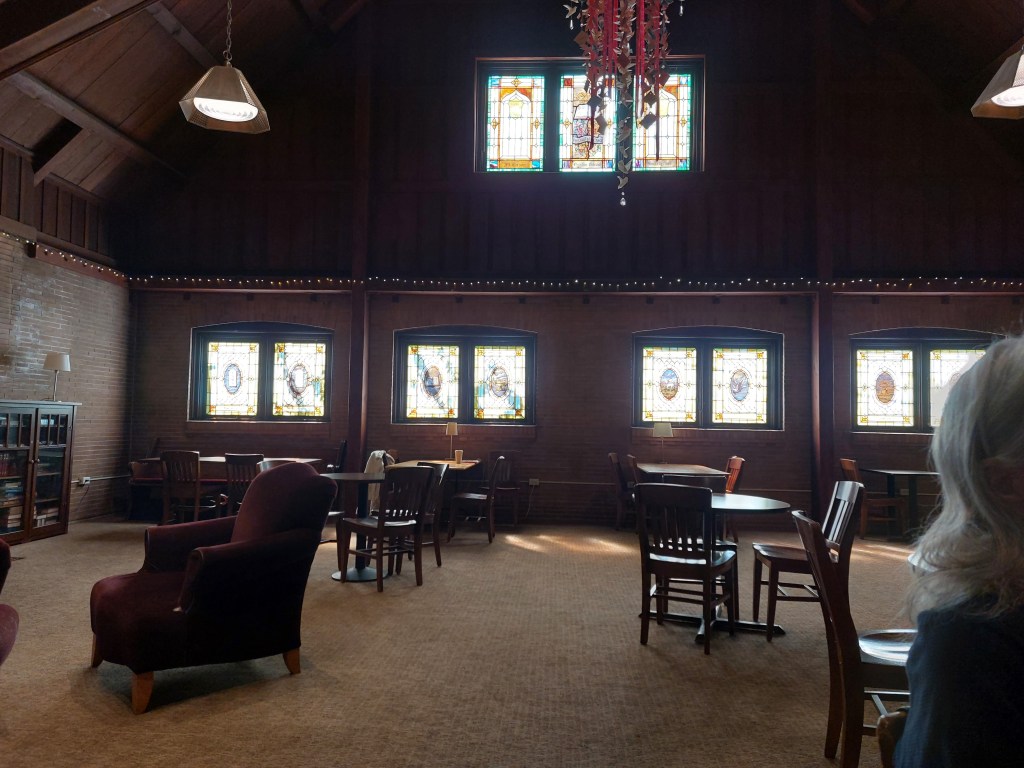
At the bottom of the bell tower you poured yourself a coffee, put a contribution into the jar, and through the big doors entered the space, a two story high ceiling of 100 year old wood, brick walls with stained glass windows, a few stuffed chairs by the Brobdingnagian fireplace, tables and chairs spread out in the space, a lending library bookshelf, a kids’ play area, and the floor to ceiling folding sliding doors hiding the dark cool nave of empty pews. I would sit in a stuffed chair or at a table and read papers or doodle in my notebook, sitting on the big couch in the far corner. Young moms with children came and went, small group meetings held at the larger tables, couples hooked up for a coffee & snack talk. It was mostly volunteer, then went commercial, then closed as the virus swept through so many spaces, closing doors and attitudes.
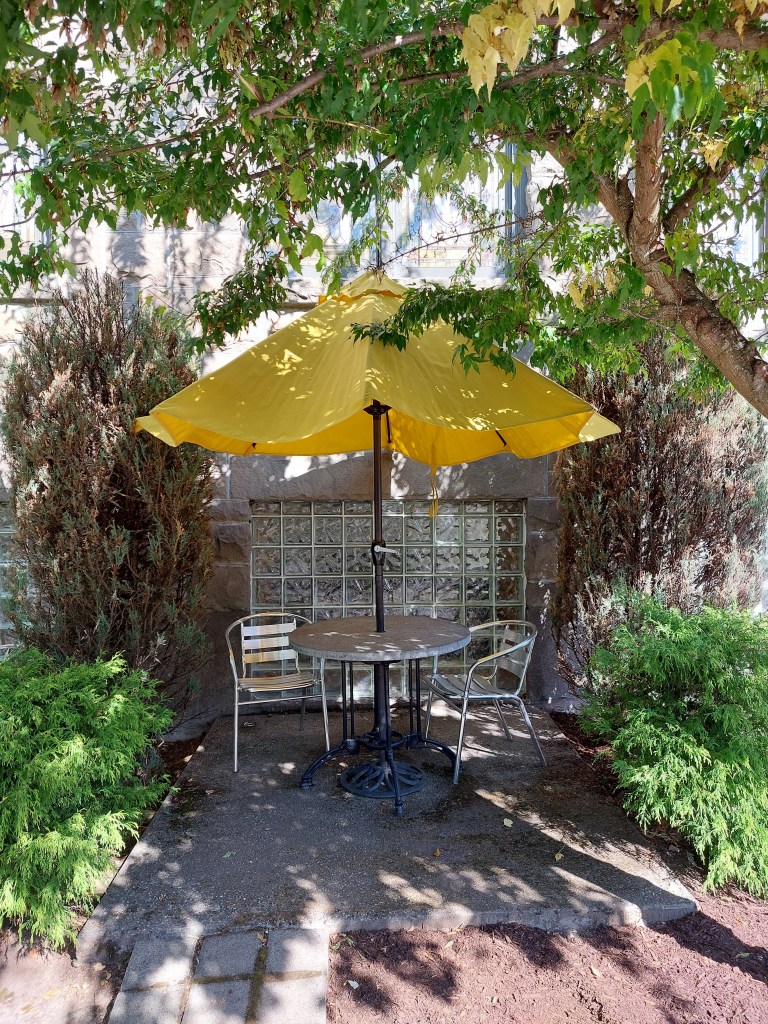
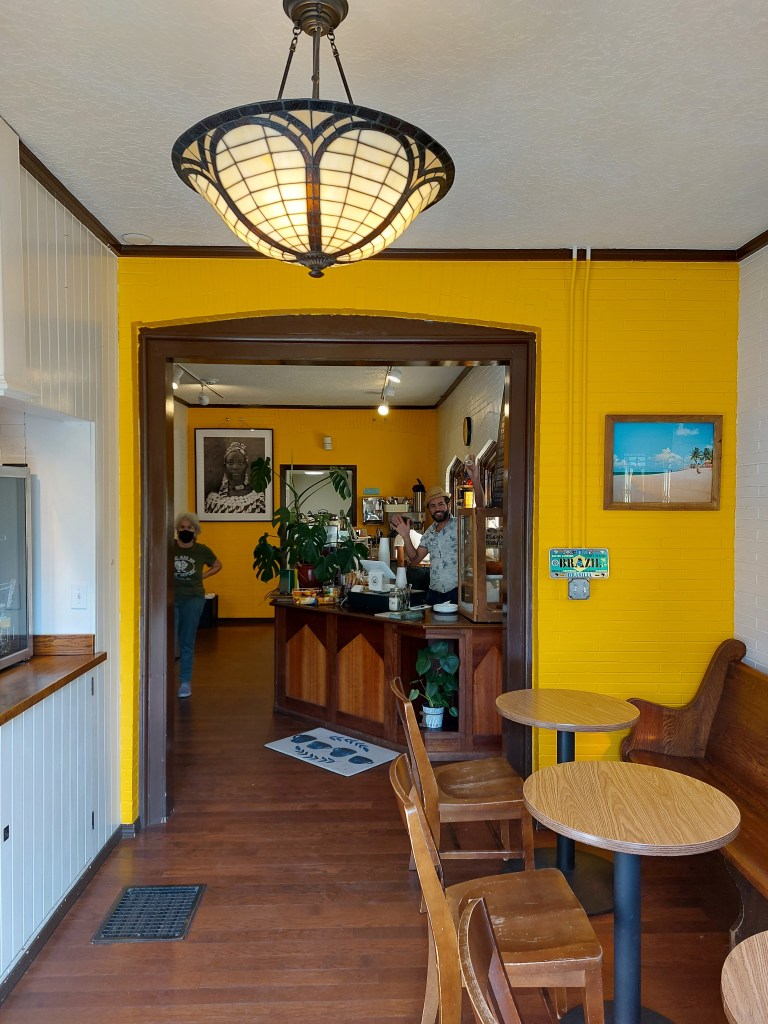
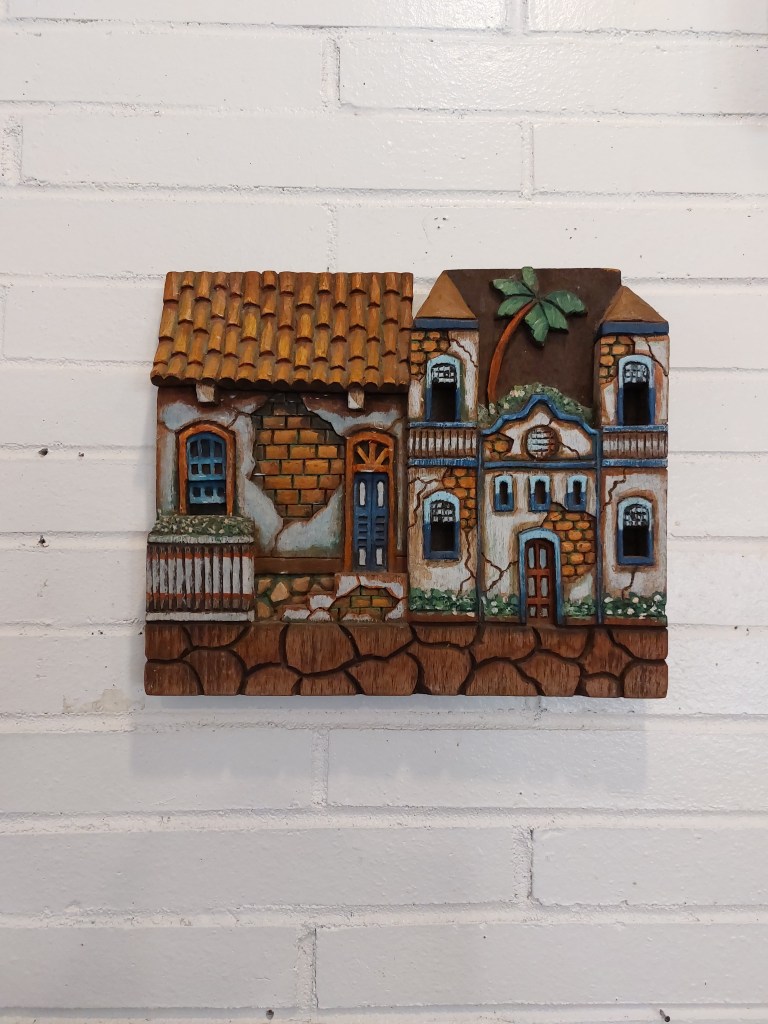
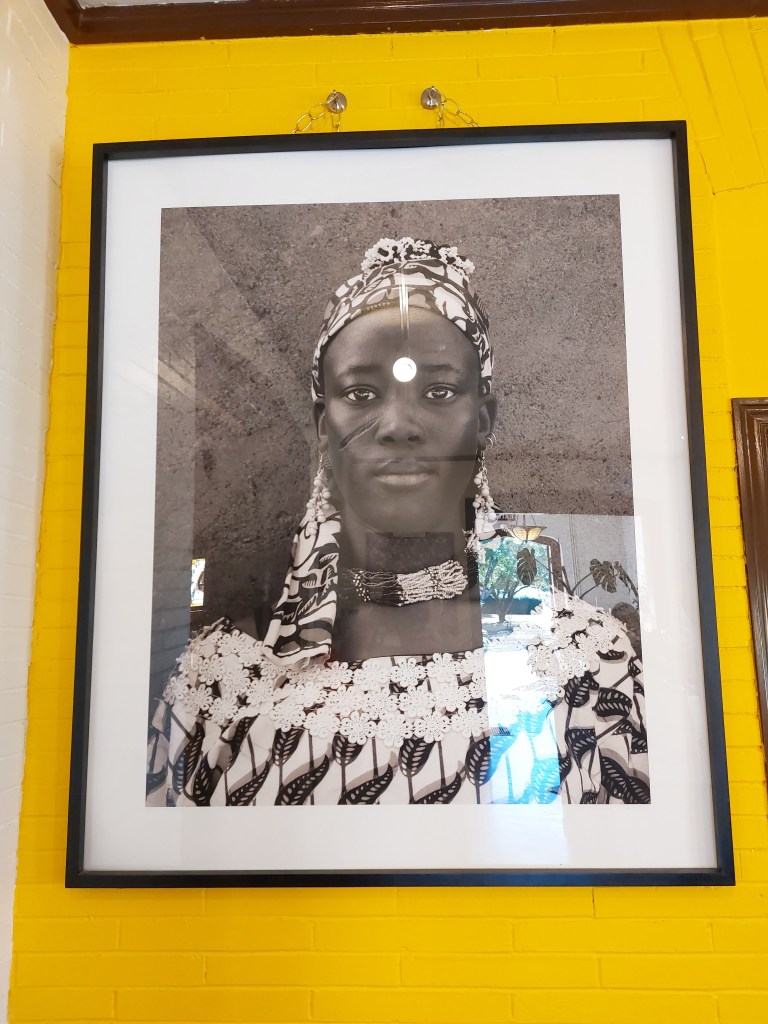
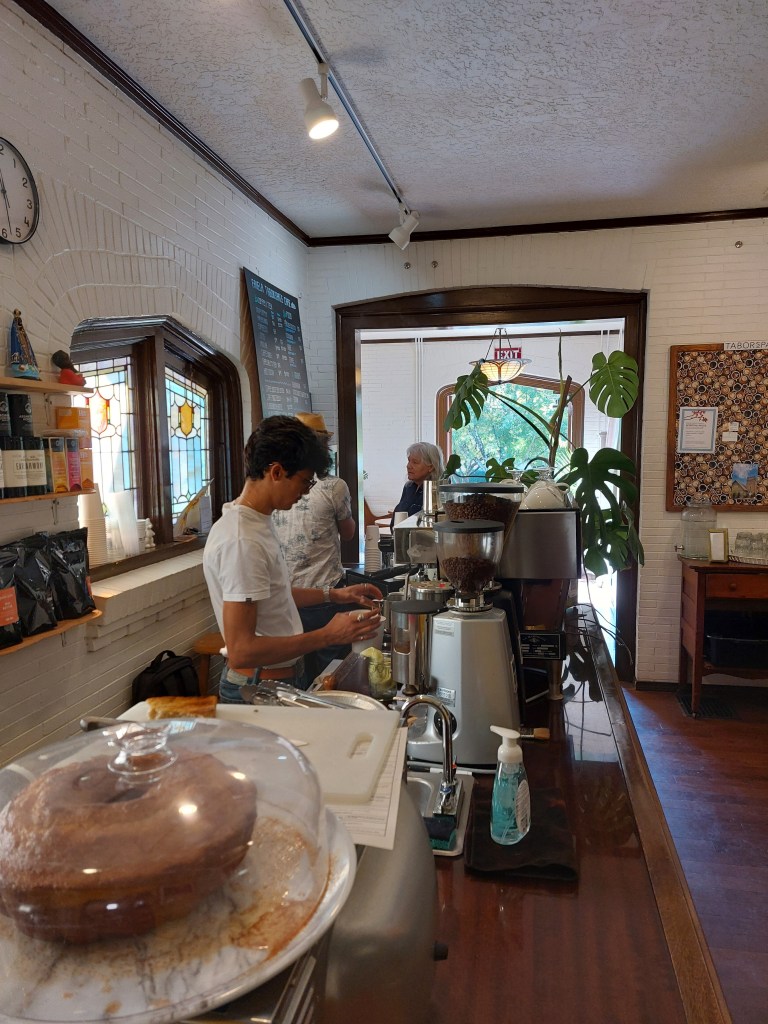
Anyway, Tabor Space has now reopened, a second location for Favela Brazilian Cafe, and we visited yesterday, chatted with the Brazilian baristas, and we sat with a coffee and we looked around and I took a few pics, and we’re glad the space has reopened:
Everywhere I look I see signs of the cross in telephone poles at the busy intersection of the homeless and the morning commuters in the brow of the woman wearing the human billboard advertising her three kids and out of work husband a veteran and a nice guy trying to get back on his feet after stepping on a landmine at the bottom of the cross and I don’t doubt it and wonder if she’ll take the afternoon off and drop the double sawbuck just handed her all in one place.
I am tempted but the cross at the local church remains hidden behind a giant plastic boastful Jesus his coiffed hair combed and sprayed by the altar ladies with their flowers holy water and broken nails who come and go they have come and gone and still they come and go and carry their crosses quietly and secretly and do not advertise their own club afflictions and anyhow don’t allow admittance of my cross.
Every Friday at three in the afternoon the altar ladies take down the real Jesus and put up the plastic one and Sunday after masses they hang the original back.
Meantime at the bottom of the telephone pole at the crossroads the homeless gather to disperse the day’s take and affirm nothing is finished the kingdom never comes but the will is always done daily bread is not hard to come by not nearly so hard as forgiveness of debts and trespasses or deliverance from evil.
Whorled weary for this world’s woes worsened by winter’s whistling wicked wishes as worrying as this watch of one’s web life ebb, and if that’s not maudlin enough, sick of this car’s cough, too, its needy changes and fillings, its overheated tantrums, leaks, stalls, and traffic jams, the orange cones and potholes and all ways waged in fees and duns and one’s fief windblown like the shabby tatty cat hunkered for the night in the trash can gust opened. Some correlation perhaps: unhappiness and the automobile, for there is nothing mobile that is unwitting.
Accidental and aleatoric lines alienate awareness precisely where we desire to go reading off the water listening listing cant in this sham breeze what would an alien see? Earthlings have wheels, their eyes light up at night, and there are these other creatures that wash them, feed them, and care for them. There appears to be a symbiotic relationship between the metal boxes and the asphalt lines. More study is needed to ascertain how the Earth benefits.
Weary then of the keen privilege to sound dog-tired exhausted old hat hack comes to an end sidetrack dismantle yard all you need is love sang John I’m sick of love replied Dylan in Love Sick on Time Out of Mind full of walking and waiting.
Turn off, tune out, drop in drop in sometime and say hi live within walls if you must but keep the doors open the windows loosely lighted. Get on now and move about nothing just motion one purpose one motion transforming breathing energy fizz of life. This is work, let us not automate our own motion.
Words were never so simple as we were taught to believe. Tricksters of the trade make things look like all the chess moves were preordained. And if we are reading second hand, through the prism of translation, so much the better for our lack of understanding!
“You said, ‘”and I quote…’”
Words are not to understand, but to experience, to share, the ordinary daily world we work so hard at from being cornered.
The face prepared to meet the faces.
Do we understand the invisible string of musical notes? What do they mean? Already heard and gone, and where did they go, these industrial sounds?
Tenement
Words work within their industry, economy, structures.
Performance
Dust particles, falling, drifting, piling up, the tongue the only rule, the teeth, lips, mouth.
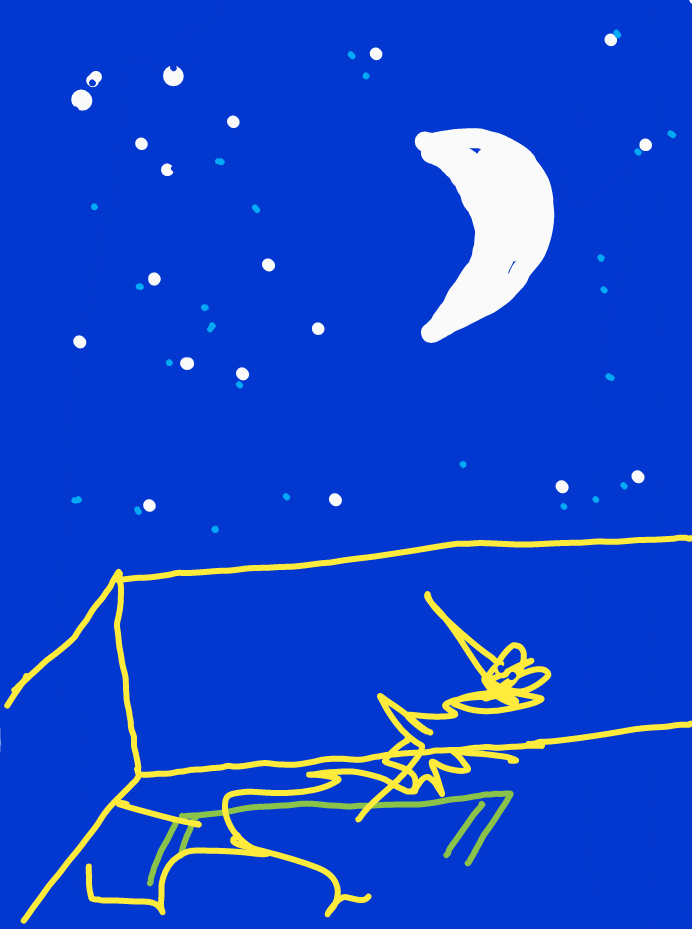
The moon looked like a banana.
The poem is an old thing, some kind of tool, maybe, an implement, but what was it used for?
Eye floater.
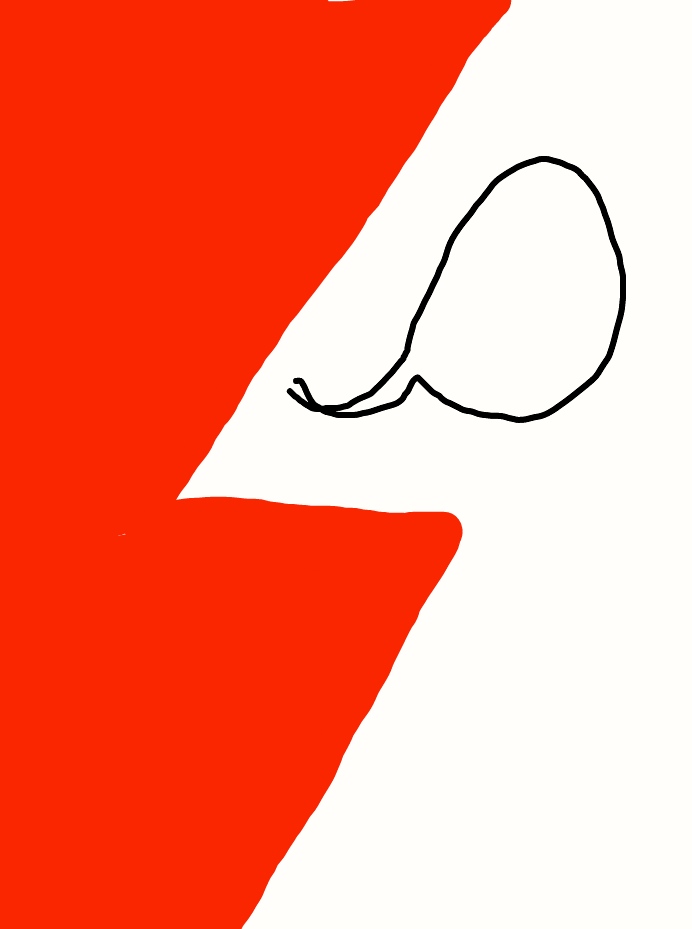
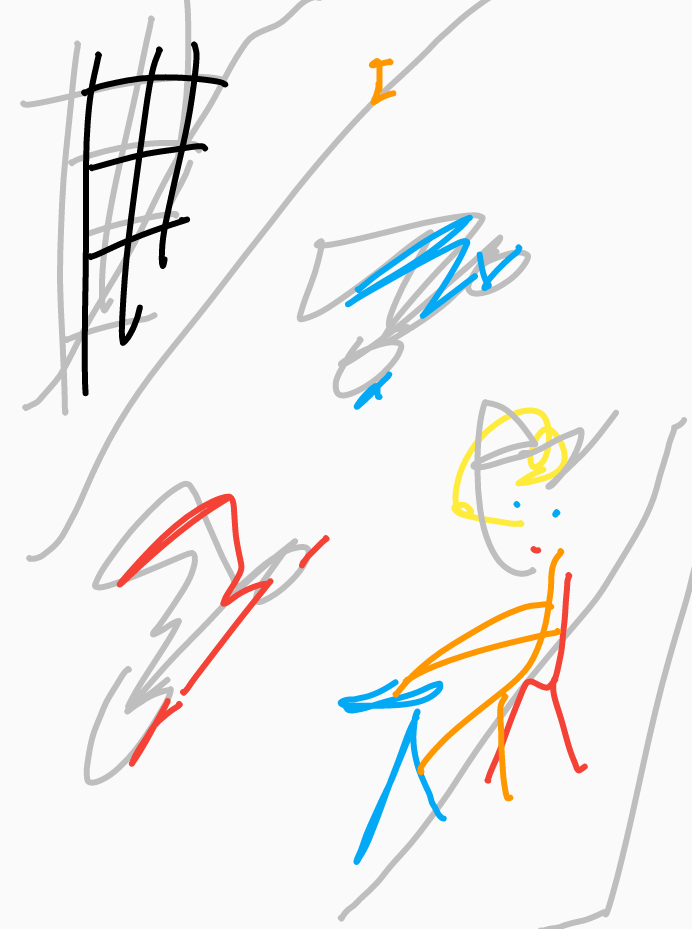
He started off so serious, as if he were out to save something, someone. But first he had to persuade there was some danger. These comics, by the way, these unsophisticated, small-scale drawings, are made with fingers on the simplest of phone apps, with just a few basic colors, and no tricks.
Daylight Savings
The moon looked like a pearl. He heard a familiar voice: “Did you remember to carry the garbage can to the curb?”
Untitled
He slept all day and at night drew cartoons.
Modes.
But mostly at night, in the middle of the night, when sleeplessness becomes comical.
A solo Mission at the Ranger Station before group poetry night, hoping
for a good napkin poem. When we read like police we make a criminal[ii]
shot with red pencil corrections, the poet apprehended, booked.
Pull over the rotting rhymester! Handcuff this conceptualist clown.
Arrest that academic asshole. Ticket the doggerel running off-leash.
Slipknot a sleeping surrealist. Deny the pop songwriter his award.
We might read like Mother Theresa[iii] anointing the sores of lepers,
becoming the other for the time saving takes then letting go.
The poverty of poets paves the way to the cornucopia of poetry.
Line 14 stops and a pretty woman[iv] hops off in bright orange shorts.
She’s poetry in motion[v], no idea of me, and could not care less
what I’ve done to this napkin. For her, a perfect reader, I must error not.
What would Roland Barthes have said about the snippets of poetry published among the ad displays, public service announcements, and caution notes headlining the interior of local bus Line 15?
The poetry placards please riders through a program called, somewhat fancifully, Poetry in Motion, though the poems move relative only to someone off the bus. For the rider/reader, the poems move at the same speed as everything else on the bus, with the exception of the rider just boarding, stumbling down the aisle in the opposite direction of the bus lurching forward. It’s a good idea to wait until seated before trying to read the poetry. In any case, why not call the poems, simply, “Bus Poems”?
But what’s remarkable is the number of riders and therefore potential readers of the poetry, “reaching an estimated 15 million daily [countrywide],” according to the Tri-Met site. Poetry never had it so good.
Readers may be reminded of Johnny Tillotson’s 1961 hit song “Poetry in Motion.” The refrain of Tillotson’s song seems particularly apt to the riders on Line 15: “…For all the world to see.
A random search adds to the randomness of the entire enterprise with this from Charles Bukowski, the bard of beer, on poetry and motion– locomotively, as Bukowski is seen displaying his full critical license (not for the poetically squeamish). We’ve not seen any Bukowski poems on the bus – though there are times on the bus when we feel we are in his company.
Which brings us back to Barthes, who found deconstructing poetry difficult, since the pieces already cover the floor in various stages of disassembly: “…what is attempted [in modern poetry] is to eliminate the intention to establish relationships and to produce instead an explosion of words…since…modern poetry…destroys the spontaneously functional nature of language, and leaves standing only its lexical basis” (p. 46). This sounds like a bus ride. “The Hunger of the Word, common to the whole of modern poetry, makes poetic speech terrible and inhuman. It initiates a discourse full of gaps and full of lights, filled with absences and over-nourishing signs, without foresight or stability of intention, and thereby so opposed to the social function of language…” (p. 48). “…modern poetry destroyed relationships in language and reduced discourse to words as static things” (p. 49). Maybe that’s why they decided to put some on the buses.
The audience on the Line 15 bus shifts slightly at every stop, and every bus ride is already a poem in motion, riders hopping on, hopping off, each a word, or a line, some a full verse, the bus curtsying occasionally, its caution bell bleeping, as it leans down to pick up a rider unable to hop, poems and riders waiting patiently motionless, the big scurrilous bus a measure of notes transpiring.
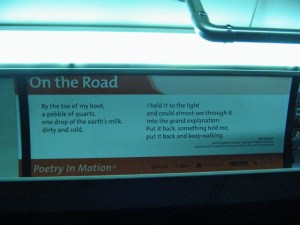
“On the Road,” a Bus Poem by Ted Kooser on Line 15



 The Coming of the Toads