Tag: Philosophy

  • Happy Misfortune

    Why do some derive pleasure from some other’s misfortune, a strange joy often described as schadenfreude? The English version is epicaricacy. Now there’s a good word, suggesting epic caricature. A form of sadism, maybe. It’s not one of the seven deadly sins, though it could be related to wrath or envy. Or moral desert.

    Is it a weakness not to feel happy at a bad person’s misfortune? Is it impossible for a bad person to experience misfortune? Is misfortune a precursor to happiness? Can we even recognize true misfortune? What appears to be divine retribution may turn out to be a blessing in disguise. Likewise, do we know luck when we find it? Trina wins a lottery in Frank Norris’s novel “McTeague.” She ends up sleeping on the coins, literally, a bed of coins.

    The blessing in disguise is of course impossible to know. We can’t know what does not happen, only imagine it. But we’re good at imagining things. And our predispositions and assumptions often make no sense. We don’t believe in God, but we think people get what they deserve. We stick to the belief that good deeds are rewarded while bad acts get punished even as the headlines are proof of an alternative reality. Pride, greed, and envy are well-dressed floats in our celebration parades.

    We scan the headlines for signs of redress: the writer whose best seller is found to be plagiarized; the preacher who kept a mistress; the scholar who misspells, mispronounces, misses tenure; the sports hero hooked on drugs; the politician prosecuted. But the schadenfreude feelings these misfortunes stir up are no substitute for kindness and humility. What we seem really to be looking for is vengeance. But our code of disbelief has already struck down any possibility of such a judge.

    We are given then to randoms. We don’t know why things happen the way they do. And no event seems final. The so-called extinction of the dinosaurs is belied by the hummingbird and crocodile. I’ve been thinking of the dinosaurs recently, the ones we once thought now fill the gas tanks of our cars, but that’s a myth. Life doesn’t pass so much as alter – allegro non troppo: fast, but not so fast we can’t see or feel it go; and for the most part happy, though not permeating or permanently so. In any case, and as Slavoj Zizek points out in his segment of the Astra Taylor film “Examined Life,” the catastrophe of one species may be the good fortune of another.

    Is happy misfortune a universal truth, like the constant speed of light or theories of relativity? In the absence of proof of life elsewhere in the universe, is life on Earth a happy misfortune? Or is life elsewhere already over, ended, and not so happily? And would we feel a sense of schadenfreude to find out?

  • On the Chicken and the Egg

    An old friend I’d not heard from for some time recently wrote to say she was sitting on something big. Apparently, Amazon would provide the answer. She had placed an order for a chicken and an egg.

    She was conducting an experiment, and, handled correctly, she wrote, she would not be surprised at an eventual Nobel nomination.

    It took a bit for me to figure out where she might go with her hypothesis formulation, for there didn’t seem to be a prediction one way or the other. Subsequent emails clarified, but, alas, the experiment ran awry, as must often be the case, the non-scientist can only speculate, happens all the time.

    The experiment seemed cartoonishly simple: place the order, wait and see, and record the results. Meantime, I wrote back to tell her she might have easily bought a dozen chickens and fifty eggs on her next trip to Costco. No, no, no, she said, I didn’t get it.

    In any case, the first signs of the experiment going amiss came with the delivery alerts, an email for each stage of the order, shipping, and delivery: a thread of emails for the chicken, another thread for the egg. There was tracking to be done. A few days passed. Still no chicken, nor egg.

    End of the line emails suggested a fox had got the chicken, a crow the egg. It came as no surprise that the email delivery updates, the so-called alerts, included little detail. Ignoring this, she argued for spontaneous singularity – the chicken might have come with the egg, appearing, as Amazon deliveries often apparently do, from out of nowhere. Or maybe the chicken and egg weren’t really, in actuality, separate entities, so the question of which came first was null out of the gate. Same box. Or maybe you stick the egg into a chicken like you would a battery into a toy. Would the egg come enveloped in bubble wrap?

    I might mention that one of my own observations is that often people suffer from a surplus of thought. This leads to an imbalance between the mind and body and may make simple and clear communication with others difficult. Exercise is the solution. I mentioned to my friend that Plutarch and Aristotle before him – they both a long time ago satisfied the question of the chicken or the egg. But it’s not as simple as what came first, the very concept of first being itself subject to argument. But Aristotle said, “In our discussion of substance everything which is generated is generated from something and by something; and by something formally identical with itself.” Yes, that’s fine, returned my chicken and egg Nobel-bound interlocutor, but what substance a posteriori is he talking about?

    A what?

  • Bob Dylan’s “The Philosophy of Modern Song”: Playlists: Part Two

    Bob Dylan has a new book out, titled “The Philosophy of Modern Song,” in which he proffers nonlinear essays of original and freewheeling exegesis of sixty-six mostly 20th century songs. The book is a mosaic of writing and photographs, the pics spread thematically throughout the pages (many from Stock or Getty; tracking them all down to their original source would be a mountainous research climb). There is a table of contents, showing the titles of the songs, but no index. There are no footnotes.

    The book should be read aloud. If you’ve heard any of Dylan’s introductions featured in his now defunct Theme Time Radio Hour, you’ll know how the orality of the work is so important to its content. I’m reading the book aloud with Susan evenings this Fall. And I created a playlist on my YouTube Music channel of the sixty-six songs, so that we can listen to each song as we read the Dylan essay on it from the book.

    Dylan’s sixty-six songs don’t amount to a best-of list. Each song is approached with a creative reading and listening analysis and appreciation. But why the song was selected, made the list, fished up out of the overstocked pond of popular songs – well, I don’t know. The underlying philosophy might be that any song has a story behind the story, an environment it came out of, that warrants description and understanding and an in depth discursive discussion of its time and place, and some songs lend themselves to this kind of analysis more than others. There is a kind of, not formula, but song archetype that’s uncovered, that might teach us how better to listen.

    Here’s the playlist. Give it a listen, and get the book.

    The 66 songs from The Philosophy of Modern Song, Bob Dylan, Simon & Schuster, 1 Nov 2022.
  • What to do

    “Nothing to be done,” Didi and Gogo bicker, essentially about what to do, like an old couple of a long suffering, loving marriage. Nature is no refuge; the one tree in their world seems sick. They can’t go anywhere, for fear of missing their appointment with Godot. They hang out and talk, express various physical complaints, visit the past, ask questions they can’t answer.

    The play, Samuel Beckett’s “Waiting for Godot,” is famously about nothing. Nothing fills the stage, informs the dialog. If they carried cell phones, their batteries would surely be dead. In any case, they’ve no one to call, and no one to call them.

    The two (often described as tramps, bums, or hoboes of some kind, clowns of some sort, lost from their circus, or stripped to being human without diversion down-and-outs) might be among the last few of a pandemic, or simply retired, their pensions just enough to enable them to do nothing but talk freely, which is everything in a world of nothing.

    It’s not easy – doing nothing. Even contemplating nothing can be a nerve-racking business, fraught with anxiety. Consider, for example, what nothing is. Nothing is what is not. In the beginning – well, just before the beginning, all was nought, and from naught came all.

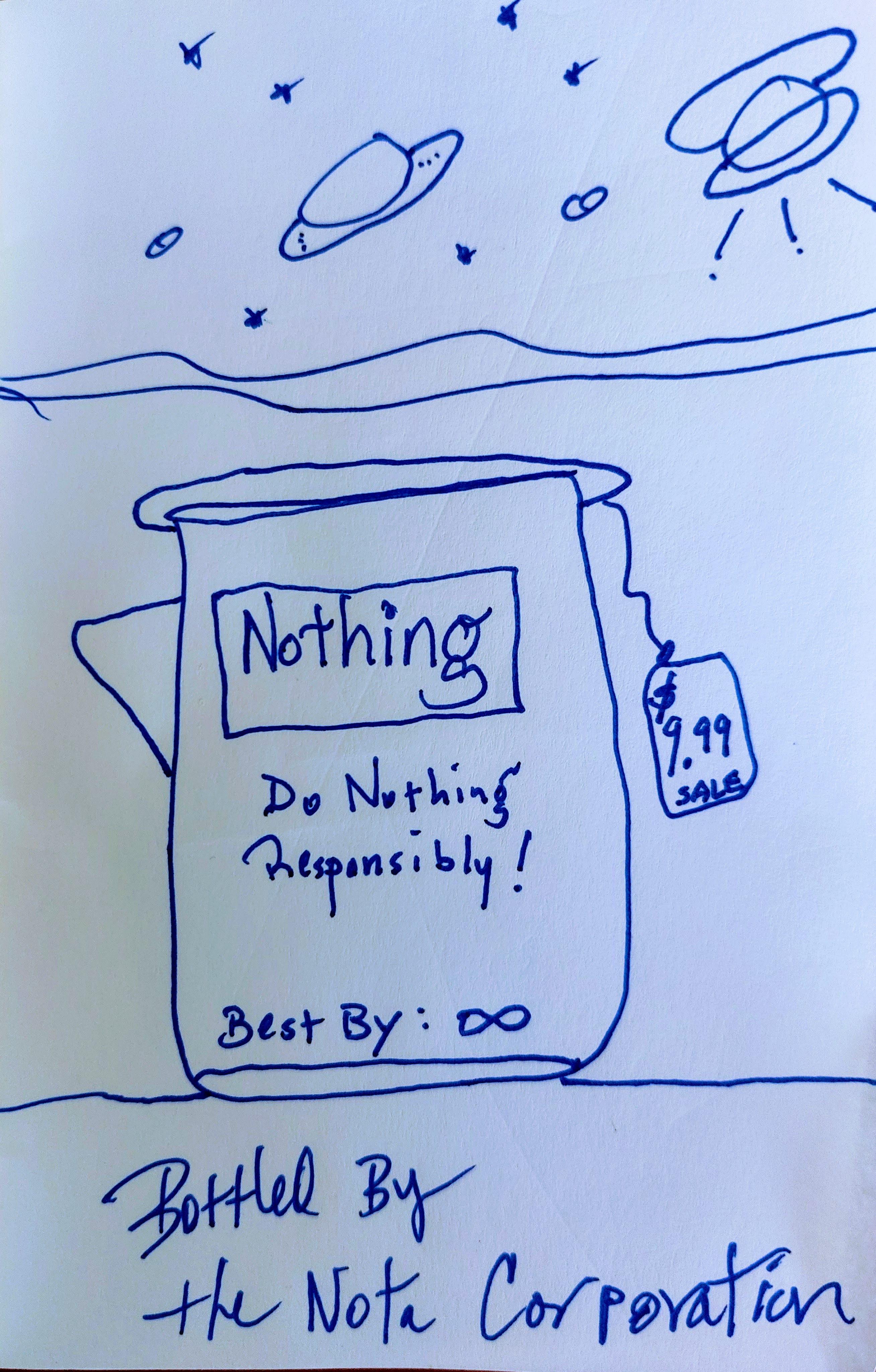
    And it’s not easy doing nothing responsibly. nān thing. And yet, if you make a practice of it, you are called a do nothing. But there is no such thing as nothing. Nature overkills. If the universe is infinite, and the universe is composed of things, there can be nothing within, and nothing without.

    Consider a bottle out of which you suck everything, leaving nothing, and you cap it, a bottle of nothing. Would it be dark in there? Like dark matter? For if everything is taken out, light too must be absent. If scarcity creates value, what could be more precious than nothing? And Didi and Gogo are its brokers.

  • Precepts

    The faster you go, the more time you waste.

    The quicker to dicker, the sooner to yearn.

    To talk is to argue.

    To identify is to accuse.

    Music is buried in the piano.

    To hold a grudge is to jackhammer water.

    If you’ve read one poem, you’ve read them all.

    Art is not art.

    We always have enough for now.

  • An Approach to Stylelessness

    Language, the dress of thought,
    words its buttons.
    What are we trying to cover?
    Nothing.

    The dress interprets
    the body,
    its own reveal, skin and hair,
    apparently lacking

    something necessary
    to complete the ensemble,
    where sound means
    stylelessly.

    Dress, the body licensed
    for use, the slow decay
    its words describe,
    its missing buttons.

  • Excerpt from a Conversation with Jean-Paul Sartre and B. F. Skinner

    BFS: “Man is perhaps unique in being a moral animal, but not in the sense that he possesses morality; he has constructed a social environment in which he behaves with respect to himself and others in moral ways.”

    JPS: “I can bring moral judgment to bear.”

    BFS: “The essential issue is autonomy. Is man in control of his own destiny or is he not?”

    JPS: “Man makes himself. He isn’t ready made at the start. Before you come alive, life is nothing; it’s up to you to give it a meaning, and value is nothing else but the meaning that you choose. In that way, you see, there is a possibility of creating a human community.”

    BFS: “Behaviorism does not reduce morality to certain features of the social environment; it simply insists that those features have always been responsible for moral behavior. Man continues to build machines which dehumanize him. He can remedy these mistakes and build a world in which he will feel freer than ever before and achieve greater things.”

    JPS: “We do not believe in progress. Man is always the same. I am responsible for myself and for everyone else.”

    BFS: “Why do people behave as they do? It became a matter of understanding and explaining behavior. It could always be reduced to a question about causes.”

    JPS: “It’s all quite simple. He can’t start making excuses for himself. There is no determinism, man is free, man is freedom. We have no excuse behind us, nor justification before us. We are alone, with no excuses. Man is condemned to be free. There are no omens in the world. No general ethics can show you what is to be done. This theory is the only one which gives man dignity.”

    BFS: “Control is another matter. Refusing to look at causes exacts its price. The behaviorist has a simpler answer. What has evolved is an organism, part of the behavior of which has been tentatively explained by the invention of the concept of mind. No special evolutionary process is needed when the facts are considered in their own right.”

    JPS: “There is no human nature. Man is nothing else but what he makes of himself. Man is responsible for what he is. And when we say that a man is responsible for himself, we do not only mean that he is responsible for his own individuality, but that he is responsible for all men. It is impossible for man to transcend human subjectivity.”

    BFS: “A scientific analysis of behavior must assume that a person’s behavior is controlled by his genetic and environmental histories rather than by the person himself as an initiating, creative agent.”

    JPS: “In order to get any truth about myself, I must have contact with another person. There does exist a universal human condition.”

    BFS: “We often overlook the fact that human behavior is also a form of control. No mystic or ascetic has ever ceased to control the world around him; he controls it in order to control himself. We cannot choose a way of life in which there is no control.”

    JPS: “Existentialism isn’t so atheistic that it wears itself out showing that God doesn’t exist. Rather, it declares that even if God did exist, that would change nothing. What complicates matters is that there are two kinds of existentialist; first, those who are Christian, and on the other hand the atheistic existentialists, and then the French existentialists and myself. What they have in common is that they think that existence precedes essence, or, if you prefer, that subjectivity must be the starting point.”

    BFS: “The major difficulties are practical. In any case we seem to be no worse off for ignoring philosophical problems.”

    (This invented converstation was created with quotes blended from Sartre’s “Existentialism is a Humanism” with Skinner’s “About Behaviorism.”)