Tag: Penelope Fitzgerald

  • A Place of Gifts: On Foot from the Beach to Home

    We two boys stood at the edge of the road at the top of 45th high above the beach, where the slow moving two lane Highland (lined with spots we ignored as kids: vista apartments and curio shops, corner cigarettes and beer market, breakfast cafe and evening bar), turns into Vista del Mar and curves down to Grand, only about a mile away, but still we stuck our thumbs out to hitch a ride. We were on our way home from Junior Lifeguards, which was held on the beach near Marine, down from the big tower. We never caught rides thumbing, so we were surprised when some sporty car with jaunty driver pulled over coming to a stop some twenty yards past us and we ran to hop in but the car revved up and sped off wheels spinning in sandy grit just as we got close.

    I’ve been reading “A Time of Gifts,” by Patrick Leigh Fermor (subtitled “On Foot to Constantinople: From the Hook of Holland to the Middle Danube”). First published in 1977, when Fermor was sixty-two, it recounts the time in 1933, when Fermor, then just eighteen, left England for a wintry continent, outfitted with greatcoat, hobnailed boots, and commodious rucksack:

    “During the last days, my outfit assembled fast. Most of it came from Millet’s army surplus store in The Strand: an old Army greatcoat, different layers of jersey, grey flannel shirts, a couple of white linen ones for best, a soft leather windbreaker, puttees, nailed boots, a sleeping bag (to be lost within a month and neither missed nor replaced); notebooks and drawing blocks, rubbers, an aluminium cylinder full of Venus and Golden Sovereign pencils; an Oxford Book of English Verse. (Lost likewise, and, to my surprise – it had been a sort of Bible – not missed much more than the sleeping bag.)

    In the mornings, when the first-shift lifeguards opened their towers, the beach was grey-white foggy and cool-damp and the yellow sand stuck to your feet, the water dark-grey and the waves glassy and small and the blue of old fruit jars. At my parents’ house, 2 miles inland, walked in under an hour if you took the Devil’s Path shortcut and didn’t dawdle, the morning was open and clear and the air fresh and warm. The town was hilly and you had to cross the dunes to get down to the beach, which meant you had to climb back over them to get home, up the long Grand Avenue hill, but the afternoon breeze would be onshore and pushing as you walked before the wind.

    Travel descriptions can be confusing to read, to see the images as they develop on the page. One key to travel writing must be movement – in time and place. Still, how does the reader see the scene unfolding? I’m finding it helpful to pull up the places Fermor talks about in Google Maps, but of course consulting a map is not travel, nor does the map help bring forth the local. Maybe we’ve become too saturated with photographs to understand prose pictures. And while Fermor’s story takes place in 1933, the images I see seem older. I was reminded of scenes like the following, from Penelope Fitzgerald’s “The Blue Flower,” but which takes place in the late 1700s, and concerns Friedrich von Hardenberg, later known as Novalis:

    “From the age of seventeen he had been in almost perpetual motion, or the Gaul’s unhurried version of it, back and forth, though not over a wide area. His life was lived in the ‘golden hollow’ in the Holy Roman Empire, bounded by the Harz Mountains and the deep forest, crossed by rivers – the Saale, the Unstrut, the Helme, the Elster, the Wipper – proceeding in gracious though seemingly quite unnecessary bends and sweeps past mine-workings, salt-houses, timber-mills, waterside inns where the customers sat placidly hour after hour, waiting for the fish to be caught from the river and broiled. Scores of miles of rolling country, uncomplainingly bringing forth potatoes and turnips and the great whiteheart pickling cabbages which had to be sliced with a saw, lay between hometown and hometown, each with its ownness, but also its welcome likeness to the last one. The hometowns were reassuring to the traveller, who fixed his sights from a distance on the wooden roof of the old church, the cupola of the new one, and came at length to the streets of small houses drawn up in order, each with its pig sty, its prune oven and bread oven and sometimes its wooden garden-house, where the master, in the cool of the evening, sat smoking in total blankness of mind under a carved motto: ALL HAPPINESS IS HERE or CONTENTMENT IS WEALTH. Sometimes, though not often, a woman, also, found time to sit in the garden-house.” 57

    That prose was first published in 1995, when Penelope was seventy-nine, so around 200 years after the scene takes place. And in Patrick Fermor’s “A Time of Gifts” we see this:

    “I was plodding across open fields with snow and the night both falling fast. My new goal was a light which soon turned out to be the window of a farmhouse by the edge of a wood. A dog had started barking. When I reached the door a man’s silhouette appeared in the threshold and told the dog to be quiet and shouted: “Wer ist da?” Concluding that I was harmless, he let me in.” 73

    That traveller was Fermor, in 1933, writing in the 1970s, but could have been Novalis in 1795, described by Penelope in the early 1990s. And many travellers wanting to save their day’s journey in writing may have shared something like the following experience, here described by Fermor:

    “This was the moment I longed for every day. Settling at a heavy inn-table, thawing and tingling, with wine, bread, and cheese handy and my papers, books and diary all laid out; writing up the day’s doings, hunting for words in the dictionary, drawing, struggling with verses, or merely subsiding in a vacuous and contented trance while the snow thawed off my boots.” 66

    The title of Fermor’s book comes from a Louis MacNeice poem, “Twelfth Night”. From the last of four stanzas:

    “For now the time of gifts is gone –
    O boys that grow, O snows that melt,
    O bathos that the years must fill –
    Here is dull earth to build up on
    Undecorated; we have reached
    Twelfth Night or what you will . . . you will.”

    I haven’t reached the Abbey of Melk yet, which in Jan Morris’s introduction to “A Time of Gifts” we are told is the “central point of the narrative.” So more on Fermor’s travel’s in a later post. Meantime, I harken back to the time and place of the two boys walking home from the beach. They don’t have maps, nothing to denote, “You are here.” They really haven’t much idea where they are in time or place, nor can they fully grasp the gifts of either.

    Richard Henry Dana Jr, in his memoir, “Two Years Before the Mast” (1840), found at least the California weather a gift, and the beaches and waves. The following is from the “First Landing in California” chapter:

    “It was a beautiful day, and so warm that we had on straw hats, duck trousers, and all the summer gear; and as this was midwinter, it spoke well for the climate; and we afterwards found that the thermometer never fell to the freezing-point throughout the winter, and that there was very little difference between the seasons, except that during a long period of rainy and south-easterly weather thick clothes were not uncomfortable.”

    “I shall never forget the impression which our first landing on the beach of California made upon me. The sun had just gone down; it was getting dusky; the damp night-wind was beginning to blow, and the heavy swell of the Pacific was setting in, and breaking in loud and high ‘combers’ up on the beach.”

    And where was that place? And is it still there today? The Grand Avenue Beach Jetty (it’s now called El Segundo Beach) is located in the middle of Santa Monica Bay. It’s about 10 miles north from the jetty to Sunset Beach (not counting getting around the Marina), where Sunset Boulevard winds down out of the hills to the coast road, and it’s about 10 miles south from the jetty to Malaga Cove, on the north side of Palos Verdes, the cove part of the Haggerty’s surf spots. Santa Monica Bay, the flat Los Angeles Basin surrounded by hills, Palos Verdes to the south and Malibu and the canyons to the north, the beach cities in the south, oceanic stupendous views or at least close enough to the ocean to smell and feel the salt and surf in the air, breach the storms and storm surf, wander down to the beach the day after a “south-easter.” But the South Bay is also full of industry, and all along and up from the beaches from Marina del Rey to El Porto, the dunes are supplanted by pipes and tanks and asphalt grounds surrounded by chain link fences: the airport, the Hyperion sewage treatment plant, the steam plant, the oil refinery, the power plant. It’s a different kind of desolation than what Dana saw when he wrote of Los Angeles:

    “I also learned, to my surprise, that the desolate looking place we were in was the best place on the whole coast for hides. It was the only port for a distance of eighty miles, and about thirty miles in the interior was a fine plane country, filled with herds of cattle, in the centre of which was the Pueblo de los Angelos — the largest town in California — and several of the wealthiest missions, to all which San Pedro was the seaport.”

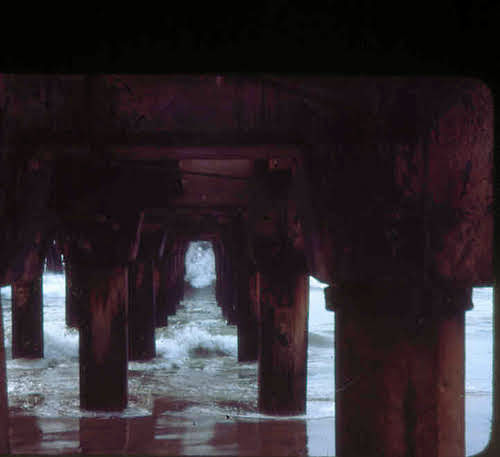
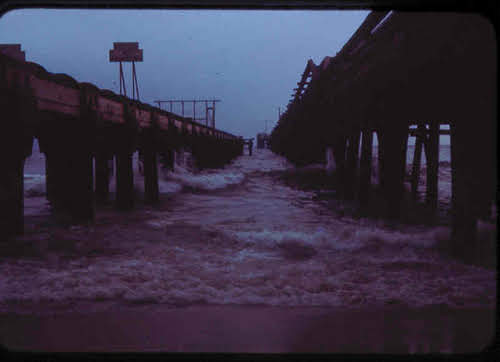
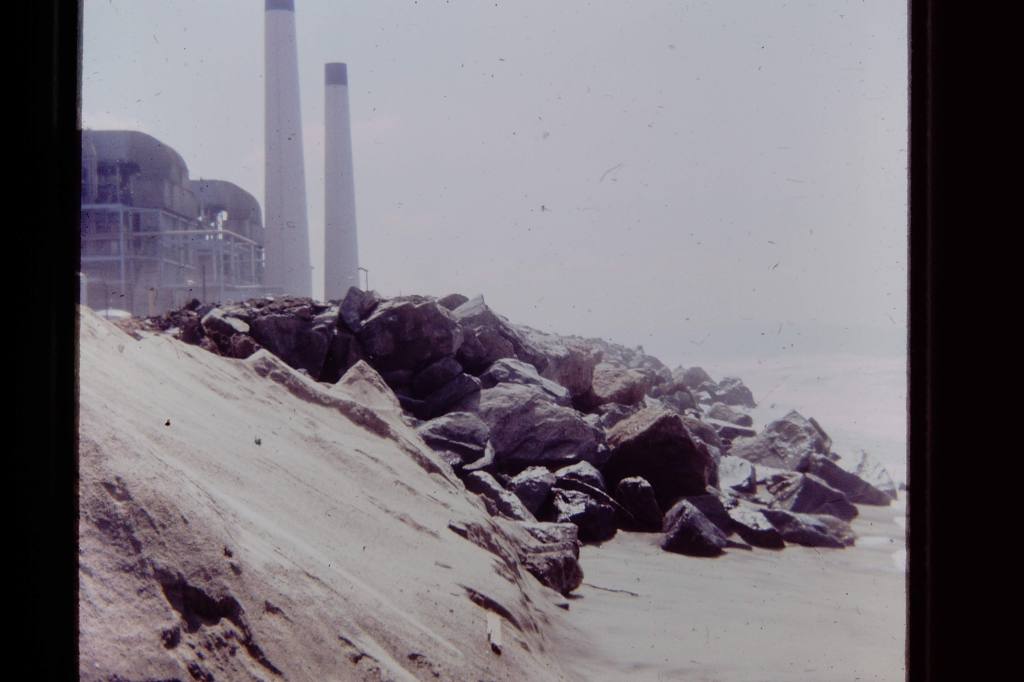
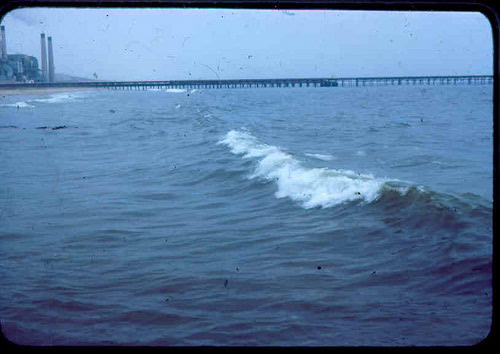
    After being tricked by the off and running car, we two boys put our thumbs in our pockets and walked back down 45th to the beach. Just up Highland a few doors, we could see the apartment my oldest sister would rent about eight years into the future, while my future wife lived a block over and down on 44th. At the bottom of 45th, we turned north and walked along the beach at the water’s edge beneath the power and steam plants, all industrial now, the beach path, north of 45th, prime real estate denied the developers, but we didn’t mind that, for here we were in a short stretch of beach able to avoid the tourist crowds and catch a few empty waves on our own. We reached the Standard Oil Pier and crossed under the big pipes and wood beams, kicking through the surf. I was still a year or two from my high school reading of “Two Years Before the Mast.”

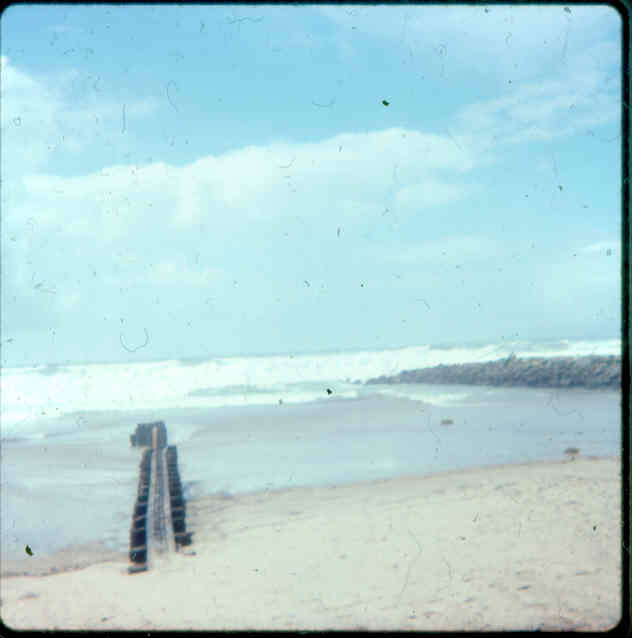
    From the pier we walked to the jetty at Grand and then up the long hill past the steam plant and ice plant hillside that borders the refinery. We parted ways at Loma Vista and I continued down Grand across Main to the old railroad station then followed the tracks up and through Devil’s Pass to home, where I would find my mom making a watery spaghetti and sauce dinner, having found no time, no doubt, to sit happily in the yard in any place for any length of time.
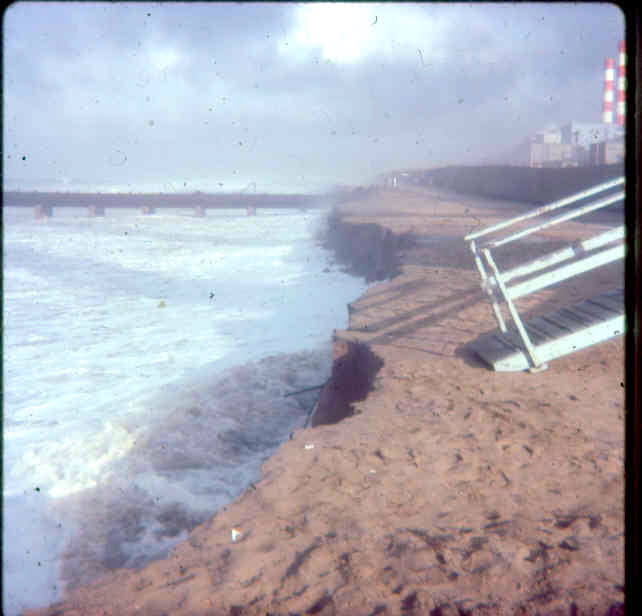
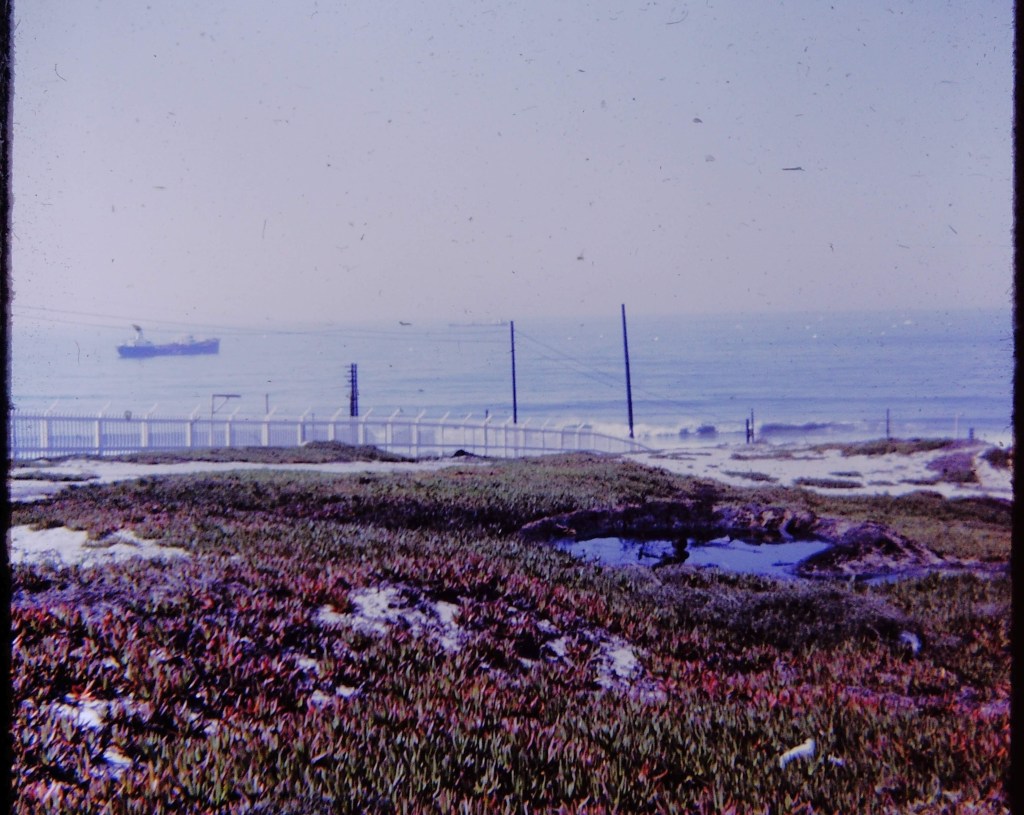
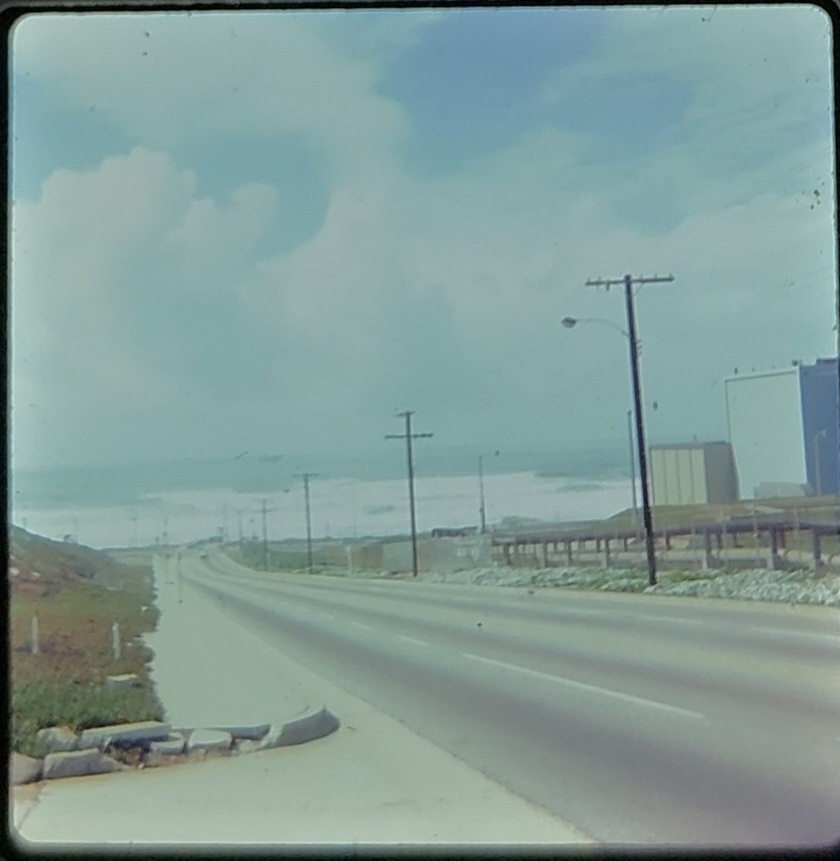
    Above photos taken with my Exakta 500 I used at the time. The exact dates on some of the slides are sometimes so faded I can’t say for sure when they were taken, but likely from 1968, when I purchased the camera used from a camera shop on Main Street, into the mid 70’s, maybe as late as 1977 or 1978 (thinking too of a box of slides most of which are not shown here). The Standard Oil Pier has since been taken out, the pipe now underground, underwater. The pier was located between 45th, the last residential street in El Porto, and Grand, which comes down to Vista del Mar from El Segundo. I’ve posted some of these pics before at The Toads, but in a different context.

    Books referenced above include New York Review Books copy of Fermor’s “A Time of Gifts,” 1977, introduction 2005 by Jan Morris; and Second Mariner Books edition, 2014, of Penelope Fitzgerald’s “The Blue Flower” (1995). “Two Years Before the Mast” was published in 1840, just a few years after Dana had made the voyage described in his book.

  • Relaxing Reads

    Barbara Pym’s novels are relaxing reads. I found her while reading and following Penelope Fitzgerald, Elizabeth Taylor, Elizabeth Bowen – other 20th-century British female writers I’ve been reading and have grown to appreciate and like and want to share. I finished the Hermione Lee biography of Penelope some time ago. Writers, like the rest of us, don’t always lead exceptional or excellent lives. And a biographer needs tools and supplies to work with. I recently read Susan Cheever’s biography of e. e. cummings – much material for a biographer to work with there: Harvard and its takes and mistakes; both World Wars and post-war worlds; the Great Depression; the eccentric poet at work and play; the effects of criticism and changing popular and academic tastes on a writer’s occasions for work; notes and diaries; interviews; and correspondence. But readers interested in 20th Century British history and literature will find good reference and enjoyable works among these women writers: Bowen was born in 1899, Taylor in 1912, Pym in 1913, and Fitzgerald in 1916. They are not modernists in the sense of James Joyce or Samuel Beckett or Virginia Woolf or Gertrude Stein, even if they constitute a newer generation. Their novels are characterized by realistic prose and dialog, and as for history, the settings are often domestic, about family and relationships, work, church as social community place (think jumble sale, what here we call rummage sale), not so much about historical events as about the effects of the great tides on individuals in society, but of the person in an outlier sense. Consider Nenna in “Offshore,” living on the barge Grace on Battersea Reach on the Thames with her two young girls, estranged from her strange husband who in a final desperate argument-ending-blow, yells at her, “You’re not a woman!”

    I ordered a copy of Paula Byrne’s Pym biography, “The Adventures of Miss Barbara Pym” (2021, William Collins, London). I’m on page 179 of the close to 700 page tome. I started out reading the inside cover blurb on the author, Paula Byrne, which mentions, “She is founder and lead practitioner of ReLit, the charity for literature and mental health.” Having never heard of ReLit, I looked it up and found a site illustrating a small organization’s devotion to using literature to assist those struggling to handle the slings and arrows of daily life, whether king, knight, or knave. From ReLit’s About page:

    “ReLit is the Foundation for bibliotherapy: the complementary treatment of stress, anxiety and other conditions through slow reading of great literature, especially poetry. We believe in the power of words to restore and relight the human mind.”

    Apt words have power to assuage / The tumors of a troubled mind / And are as balm to festered wounds (John Milton, Samson Agonistes)

    ReLit: reading for wellbeing, retrieved 7 Feb 24

    I discovered on the ReLit site, and ordered from Alibris a used copy, a book titled “Stressed, Unstressed: classic poems to ease the mind” (2016, William Collins, London). The poems are indeed for the most part classic, the youngest poet included born in 1952, Linton Kwesi Johnson. The book is divided into 12 chapters devoted to themes related to dealing with stress, for example, “meditating,” “feeling alone,” “living with uncertainty,” “positive thinking.” (Stressed, unstressed also of course about the forms of poetic syllabication and lines.) Each chapter is introduced by a short explanatory essay on the given theme. The book is not an escape portal, though. The poems may or may not help the afflicted in a time of need. But as Jonathan Bate says in his introduction: “If words can do the work of drugs, what is to lose by putting them in our mental health first aid kit? There is nothing to lose and everything to gain.” Of course there are many different kinds of poetry and poetic definitions. The book “Stressed, Unstressed” uses the Wordsworth definitions: “the spontaneous overflow of powerful feelings” or “emotion recollected in tranquility.” Further into the book, we find mindfulness strategies discussed, and I was reminded of the Thich Nhat Hanh “how to books” (e.g. “How to Relax”), which focus on calm breathing and attentiveness to the moment.

    I think I might prefer, to the poetry as a means toward relaxation, the novels of Barbara Pym as well as Penelope Fitzgerald, Elizabeth Taylor, and Elizabeth Bowen. Too often, for me, poetry, like the classic country western song, often plays upon the emotions in the way of pathos, stirring the emotions rather than calming them. In any case, all of the subject of this post has me wondering if readers here at The Coming of the Toads find for the most part relaxing reads or stuff that gets the dander up. My hope is for the former, the relaxed, the three breaths you take while waiting for the page to change.

  • Awash in Baroque

    How do we recall a past occurring prior to our visit to the planet? The physicists are busy trying to recall the origin of the universe, and beyond. Meantime, I’ve been busy visiting the Baroque era of the 17th and 18th Centuries. We discover timelines to be arbitrarily drawn. Borges explains in his Kafka and his Precursors, arguing how Kafka influenced Shakespeare, for example. And J. S. Bach, even when played on so called period instruments in a cold church in Saxony, continues to be influenced by Thelonious Monk. It’s best to keep the algorithms confused, guessing.

    For some time, Penelope Fitzgerald’s novel The Blue Flower sat buried in the to-be-read stack, even as all her other novels were read, some more than once: The Bookshop, At Freddie’s, Offshore. The problem seemed to rest in the tag historical novel. But couldn’t Offshore also be considered a so-called historical novel? In any case, it was Eric Siblin’s The Cello Suites: J. S. Bach, Pablo Casals, and the Search for a Baroque Masterpiece, thoroughly enjoyed, that brought about a reconsideration of The Blue Flower, bringing it to the top of the stack, opened, and listened to.

    Here is an example of how Penelope influences the Baroque era of Saxony:

    “‘I am not sure about that,’ said Fritz. ‘Luck has its rules, if you can understand them, and then it is scarcely luck.’
    ‘Yes, but every evening at dinner, to sit there while these important people amused themselves by giving you too much to drink, to have your glass filled up again and again with fine wines, I don’t know what…What did they talk about?’
    ‘Nature-philosophy, galvanism, animal magnetism and freemasonry,’ said Fritz.
    ‘I don’t believe it. You drink wine to forget things like that. And then at night, when the pretty women come creaking on tiptoe up the stairs to find the young innocent, and tap at your door, T R I U M P H !’
    ‘There are no women,’ Fritz told him, ‘I think perhaps my uncle did not invite any.’
    ‘No women!’ cried Erasmus. ‘Who then did the washing?’”

    The Blue Flower, 1995, Penelope Fitzgerald, page 30 in the Second Mariner Books edition 2014.

    It’s that bit of who does the washing, to cite but one example, which begins her 20th Century novel and remains a motif throughout where Penelope influences the Baroque era that is her setting.

  • Penelope Fitzgerald

    Susan, post El Porto
    Susan, post El Porto

    Hermione Lee’s recent Penelope Fitzgerald: A Life occasioned a number of reviews in the usual places. Most touched on the questions of how did Penelope do it (the uncanny way she cleans up the mess by throwing out the novelistic clutter extraneous to her enriched needs, leaving almost every sentient sentence embering in its own mystery), and when did Penelope do it (she did not write and publish her first novel until around age 60). Writing and publishing a novel are two different activities. Writing one at any age seems unremarkable; publishing one, at any age, may be. Readers often gawk and might wonder if Penelope was a so-called “late bloomer.” But the flower seduced into blooming too early may come to regret a late frost. In any case, there is little evidence that Penelope was a late bloomer. Her writing seems set in her past. The novels are reflections, reconsiderations of experience, of a life rooted in the mutation and gestation of failure. Failure, like slapstick, can be funny in a way success can never be, but only a writer bloomed wise (rather than, say, embittered) from omission will get this. Slapstick, too, is found where the waves of success (swells that break in a timely manner) dissipate on the strand of a listless audience.

    The narrator of a Penelope novel, always in third person, tells only what she wants to when she’s good and ready, often slipping very close to first person in what James Wood calls “free indirect style,” but might pull back and mention a year, not all that useful a piece of information, actually, considering 1960 aboard a barge on the Thames hardly suggests an environment the same as 1960 up from the Strand at El Porto, except that later it might help explain a question of whether or not television was invented yet or were the characters too poor or too bohemian to own one, and one begins to see the ship of one’s own home going down in a domestic storm just as easily on 44th in El Porto as on the Thames in London. Domestic themes are at once both universal and local; what matters is both what is said and how it is said. One doesn’t navigate one’s way through domestic turmoil following some staid rubric or outline; one lives through the hullabaloo and just maybe survives alone to tell the tale. And you must tell it as it happened, full of confusion and doubt about what might come next, wind always full in the sails, or might have happened, if someone, anyone, had their hand, even once in a while, on the tiller.

    Of the reviews of Lee’s Life I reviewed, I’ll only mention a few: Caleb Crain in Harpers, “Her Struggle: The reticence of Penelope Fitzgerald” (which I saw note of on his blog but had to renew my lapsed subscription to Harpers to see, only to be thwarted by a six week delay before my first issue arrived, which by then was the next month’s; no matter, by then, impatient, I was able to read Caleb’s review on-line, having gained re-admittance via subscription to go behind the Harper’s pay wall – you need a hand stamp); James Wood in The New Yorker, “Late Bloom”; Alexander Chee in Slate, “The Lady Vanished”; and Levi Stahl, on I’ve Been Reading Lately, “Penelope Fitzgerald’s notebooks.” I mention Caleb’s review because he waited until 46 to write and publish his first novel (following a novella published in n+1 and a number of non-fiction works, including articles, book, and blog); is Caleb a late bloomer? Of course not, but it’s interesting that the setting of Caleb’s Necessary Errors, like most of Penelope’s, occurs decades ahead of its writing and publication. Doesn’t wine aged twenty years taste different from the day it was bottled? Some writers are everblooming. Alexander Chee mentions not just the idea of the late bloomer but recounts the actual critical reaction to Penelope’s success that at the time combined skepticism with derision, as if to have arrived late and wearing a housedress provided adequate support for the claim unprolific oldster can’t write or she would have by now. And Levi Stahl’s review is interesting because it references an earlier review he wrote of Penelope’s The Afterlife, a collection of her non-fiction articles, and on the strength of his review, I picked up a copy and quickly saw that this whole late blooming explanation of anything is a dodge. The clue to understanding Penelope might have something to do with knowledge of patience, as this comment, from Bridget Read’s Paris Review “How She Knows,” explains:

    “It is vital to emphasize that Fitzgerald’s novels were not achieved in spite of her domestic life; they were borne directly out of it. Her work is radical in that it suggests that, in fact, a feminine experience, a liminal experience, might be better equipped than a male one to address the contradictions of human existence taken up by the greatest literature.”

    Levi Stahl’s review was of Penelope’s notebooks, and he quotes Penelope saying:

    “I am drawn to people who seem to have been born defeated or, even, profoundly lost.”

    It’s possible that Penelope’s testimony, expressed in her novels, belies even her most perceptive reviewers: did she not feel herself, during all those years of veritable single motherhood and low rung jobs thanks in large part to the miscreant missing husband – did she never feel neither beat nor no direction home?

    I am reminded here of Daisy from Penelope’s The Gate of Angels. Maybe Daisy wasn’t born defeated, but loss came nevertheless, which perhaps makes things even worse, for if one is not born defeated, one may not have the skills necessary for sane survival (wit and sense of humor, irony, empathy, honesty, ability to pack quickly and travel light) yet Daisy, in so many ways, never seems either defeated or lost. Even when she is actually lost, as in without a map, she manages to find a way out of that lostness. And of course the lone woman going astray into the for-males-only cloistered arena of Fred’s college is hilarious with irony. Daisy, for her obvious suffering, is existentially happy, the most telling characteristic of her personality, upon her like a birthmark, that she finds it easier to give than to take, to provide for than to ask from.

    This sense of being born lost, though, surely is gender neutral, but to find oneself lost with children in tow is a condition most often reserved for women. Reading Penelope, I am reminded of both Stevie Smith and Clarice Lispector, Stevie for humor, Clarice for a style of omission, and both for a hold on the occult. While I was reading The Bookshop, which employs a poltergeist, coincidentally Susan informed me a squirrel had taken up residence in an eve recently slightly opened by ice damage to a fascia board of our old house. I argued, since we had not actually seen the squirrel, that it could be a poltergeist. But Susan said, no, because the squirrel only made noise in the early morning, just before dawn, whereas a poltergeist prefers the hour just after you’ve fallen asleep.

    What else characterizes the style of Penelope’s short novels? The narrator often comments on the behavior of characters as if there are three parties at play at once: the character, the narrator, and the author. While to some readers, this may seem like a loose grip on point of view, it’s actually a way of condensing and rotating observation, like with a kaleidoscope. The action is close in, the distant details of world news obviously irrelevant. The focus is on detail – if things seem vague, it’s not for lack of detail, description, or dialog that reveals character. Character as Chaplinesque cog, subject to naturalistic randomness. Free indirect style, with the narrator making evaluative, reflective, and analytical comments, as if claims made may indeed be challenged, though of course there will be no reply. Still, almost everything continually on the go, or on the move, coming, as it were, as surprise. But isn’t that the nature of the domestic, which cannot be domesticated?

    So, I’ve read so far, of Penelope novels, in this order, as they came up in library queue: Offshore, my favorite I suppose for its setting of water and boats and mix of characters major and minor as well as the unexpected turns; At Freddie’s, again, a mix of young and old characters, age sometimes having little to do with maturity, and Freddie’s is how all schools should work; The Bookshop, atmosphere so strong you can smell the water and the books and hear the poltergeist and the cash machine; The Golden Child, bit of a mystery this one, though they all contain something of that genre; The Gate of Angels, again, while the plot is dated in a specific time zone, it hardly seems relevant in the sense the characters and their predicaments could be playing out even as we read. And I’m opened now to Human Voices. Now, in the interest of full disclosure, I started Innocence, but did not finish it. I had read about a third of it when I nonetheless had to admit that I couldn’t get my ear around it. I think something of the “historical novel” angle and too much of the fairy tale got in my way. Maybe I’ll go back to it some day. It’s often I pick up an old favorite book and wonder, how did I ever find this enjoyable? Likewise, I might pick up a book I long ago was unable to get into, and wonder, how could I not have appreciated this? Maybe I’ll have to wait until I turn 60, a late blooming reader. Meantime, I’ve also put Hermione Lee’s biography of Penelope Fitzgerald in the queue.