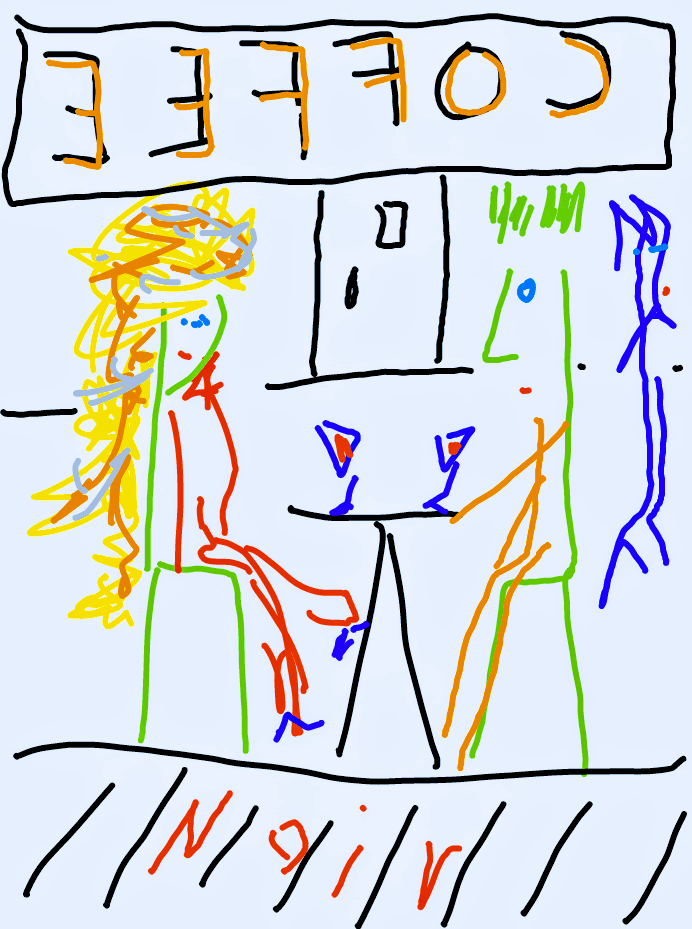
Patrick Modiano’s novella “In the Cafe of Lost Youth” opens with an epigraph attributed to the French philosopher Guy Debord:
“At the halfway point of the journey making up real life, we were surrounded by a gloomy melancholy, one expressed by so very many derisive and sorrowful words in the cafe of the lost youth.”
I was unable to track down the source of the quote. It’s possible it comes from a memoir or some throwaway magazine article. But it reminded me of the opening to Dante’s “Inferno”:
“Midway in our life’s journey, I went astray
from the straight road and woke to find myself
alone in a dark wood.” John Ciardi translation, 1954.
Dante is comparing having lost his purpose or direction in life in middle age, 35 or so, to getting lost in a wilderness where one has wandered off a steadfast, well-worn path. He’s unable to locate himself on some reputable and credible map, either from an external or internal viewpoint. Why doesn’t he back up, retrace his steps? Instead, he forges on in the dark on a crooked path. At that point, a step forward could just as well be a step backward.
Dante both forges purposefully ahead and rambles on, caught in the web of the woods, presses on like some point man cut off from his platoon, tracking deliberately with some goal of trying to map a new way out. Though he lacks an immediate target, he’s not aimless.
“I placed the typewriter on the small pitch-pine table in my room. I already had the opening sentence in my mind: ‘Neutral zones have at least one advantage: They are only a starting point and we always leave them sooner or later.’ I was aware that once I sat down in front of the typewriter, everything would be much less straightforward.” (89-90, “In the Cafe of Lost Youth,” Patrick Modiano, 2007 Editions Gallimard, 2016 NYRB, 118 pages).
Modiano was the recipient of the 2014 Nobel Prize in Literature. The only other book of his I’ve read is “Young Once” (1981 Editions Gallimard, 2016 NYRB, 156 pages):
“Does life ever start over at thirty-five? A serious question, which made her smile. She would have to ask Louis. She had the feeling that the answer was no. You reach a zone of total calm and the paddle boat glides all by itself across a lake like the one stretching out before her. And the children grow up. They leave you.” (5).
Both novels are sepia-tinged with the kind of suggestive noir one begins to associate with normal life, which is to say there is no normal, but everyone you meet is obsessed, or ought to be, with their past and future but are actually caught up in the web of their now, hopelessly trying to live in the moment but forced to move on, like Dante, or Beckett, in spite of having lost track of where they are in the moment. Even trying to move back is another futile move forward. Yet at some point, maybe that middle age point, one is given pause, a kind of grace – to reflect, to look back, to sense forward, lost in that very stillness:
“They did not know that this was their last walk through Paris. They did not yet exist as individuals at all; they were blended together with the facades and the sidewalks. In macadam roads, the stones, patched together like an old cloth, have dates written on them to indicate when the successive layers of tar have been poured, but perhaps also recording births, encounters, deaths. Later, when they remembered this period in their life, they would see these intersections and building entryways again. They had registered every last ray of light coming off of them, every reflection. They themselves had been nothing but bubbles, iridescent with the city’s colors: gray and black.” (154)
 The Coming of the Toads