Eugenio Montale, who won the Nobel Prize for Literature in 1975 (for his poetry), would have made a great blogger. In 1946, he started writing for a newspaper, a form ill-suited to his poetic writing style, and for his articles created a new form, based on the characteristics of the personal essay:
“To write about those silly and trivial things which are at the same time important” (Montale, quoted in Introduction, p. x)1.
And since the blogger doesn’t write for today’s formal critic (who eschews the amateur writer), or for the reader of tomorrow (who delights in the undiscovered), but for today’s casual scroller (who has no patience for the esoteric), Montale could knock out his pieces on demand:
“I write the articles in two hours, with no trouble,”
(Sounds about right, given this blogger’s experience; what flows easily for one writer may trouble another, but either way, one should still carefully select from one’s personal Library of Babel)
“but when I’m out of ideas (and it happens often) I feel lost” (xi).
How could you ever run out of ideas when your subject is everyday life? To write, maybe it’s best to first be lost.
“If I was not a born storyteller, so much the better, if the space at my disposal was limited, better still. This forced me to write in great haste. To cater for the taste of the general public, which is little accustomed to the allusive and succinct technique of the petit poeme en prose, created no problem” (x).
And what are those characteristics of the personal essay one might find in Montale’s “sketches”?
“…humor, irony, self-irony, and a ready supply of nostalgia, across fictional vignettes, memoir, literary and cultural opinion, travel writing, and music criticism” (xi – Galassi, Introduction).
The sketch form (which is neither news nor opinion), to get it right, must be written askance or on a slant less it become straightforward autobiography, which by definition most will find boring, for readers must be able to find themselves in the writing, even if the picture they find might not be particularly flattering.
To give some idea of the length of the sketches, Montale’s newspaper pieces, there are 195 pages of them in the NYRB book I’m quoting from, which is divided into four parts that total 50 pieces, so an average 4 pages in length. The longest are 7 pages, of which there are only 2, and the shortest are 2 pages, of which there are 7.
The titles of the “Butterfly of Dinard” pieces don’t always give much of a clue as to the topic. Take for example, “Success,” which turns out to be a music experience piece which includes a consideration of “claqueurs,” who were a kind of precursor to the canned laughter of television sitcoms, and the piece turns out to be not about success at all but about its opposite, failure; fair enough, since the early sitcoms and soap operas, one might theorize, did borrow from the classical melodramas, and in terms of art consideration, fit the bill. Of course the soaps lived without laughter of any kind, unless the audience had cried itself silly.
I’ve often thought John Cage, Marshall McLuhan, and Buckminster Fuller each would have made efficient and excellent bloggers. I was reminded of Cage when reading Montale’s “Success” piece. Montale is recruited by his barber (and vocalist who would then become Montale’s bel canto teacher) to join “his team of claquers” for a night to applaud a musician, Jose Rebillo, who could not “read notes but nonetheless he composed music for the pianola by cutting and punching holes in cardboard rolls with scissors and awls.” (There are 73 “Translator’s Notes”: #26 explains that Rebillo is based on the real composer Alfredo Berisso). Of course Cage could read notes, but still, the method described evokes Cage. And not only the method; Montale says, “Music such as that of Signor Rebillo, all dissonance and screeching, had never been heard before” (50).
Other titles include “The Bat,” about a couple in a hotel room invaded by a bat. The woman freaks out while the man must find a way to evict the bat. And “Poetry Does Not Exist,” about a visit Montale receives from a German Sergeant during the war-winter of ’44, a would-be poet himself and a fan of Montale’s poetry. During the visit, Montale is hiding two compatriots in an adjoining room. And the title piece, “Butterfly of Dinard,” which may or may not have been real.
The four sections of the book align somewhat with Montale’s chronological history, explained in the Introduction, which itself includes 8 footnotes. Each piece is a self-contained reading experience that points in two directions, one outward, the other inward, and the reader may take either path. In the title and end piece, “Butterfly of Dinard,” the narrator tells of a cafe and a waitress, who may or may not be the butterfly of the piece, which is only about 500 words long, a single page. Was the butterfly real or a figment of the imagination is the unanswerable question.
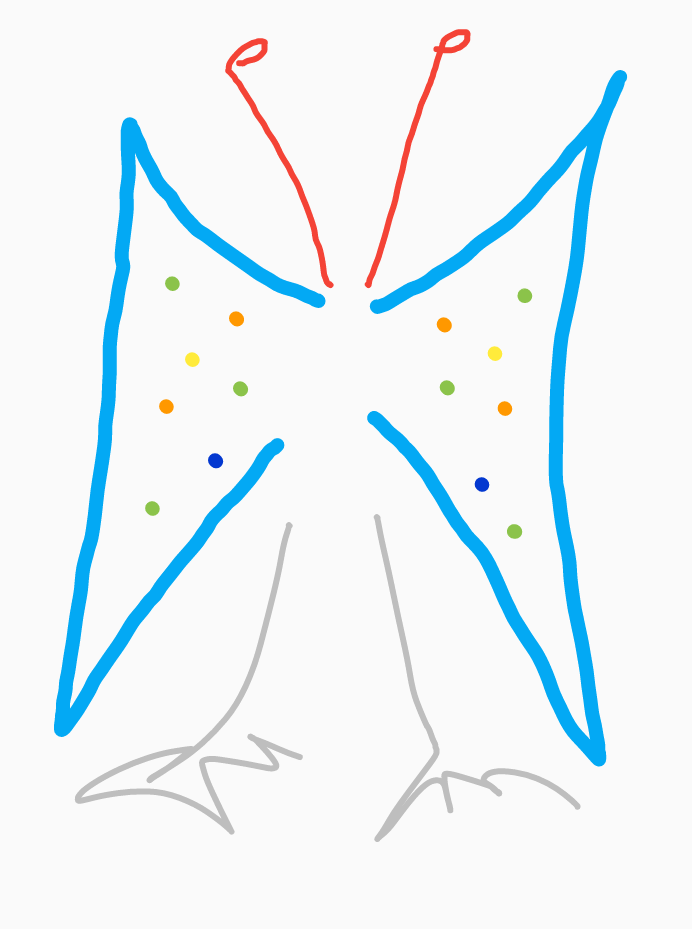
- Butterfly of Dinard, by Eugenio Montale, Translated from Italian by Marla Moffa and Oonagh Stransky, Introduction by Jonathan Galassi, New York Review Books, 2024, Originally published in Italian as Farfalla di Dinard, 1960. ↩︎
 I’ve been looking to read more Henry Green for some time. New York Review Books is in the process of reissuing a collection, introductions to the minimalist titled works by a few of today’s influential critics – Daniel Mendelsohn, James Wood, Francine Prose, and others. Originally published in 1945, Loving was Green’s fifth book. Other Green titles in the NYRB series, a few more forthcoming in 2017, include the abrupt titles:
 The Coming of the Toads