Tag: Novel

  • Notes on Julian Gallo’s “The Penguin and The Bird”

    Notes on Julian Gallo’s “The Penguin and The Bird”

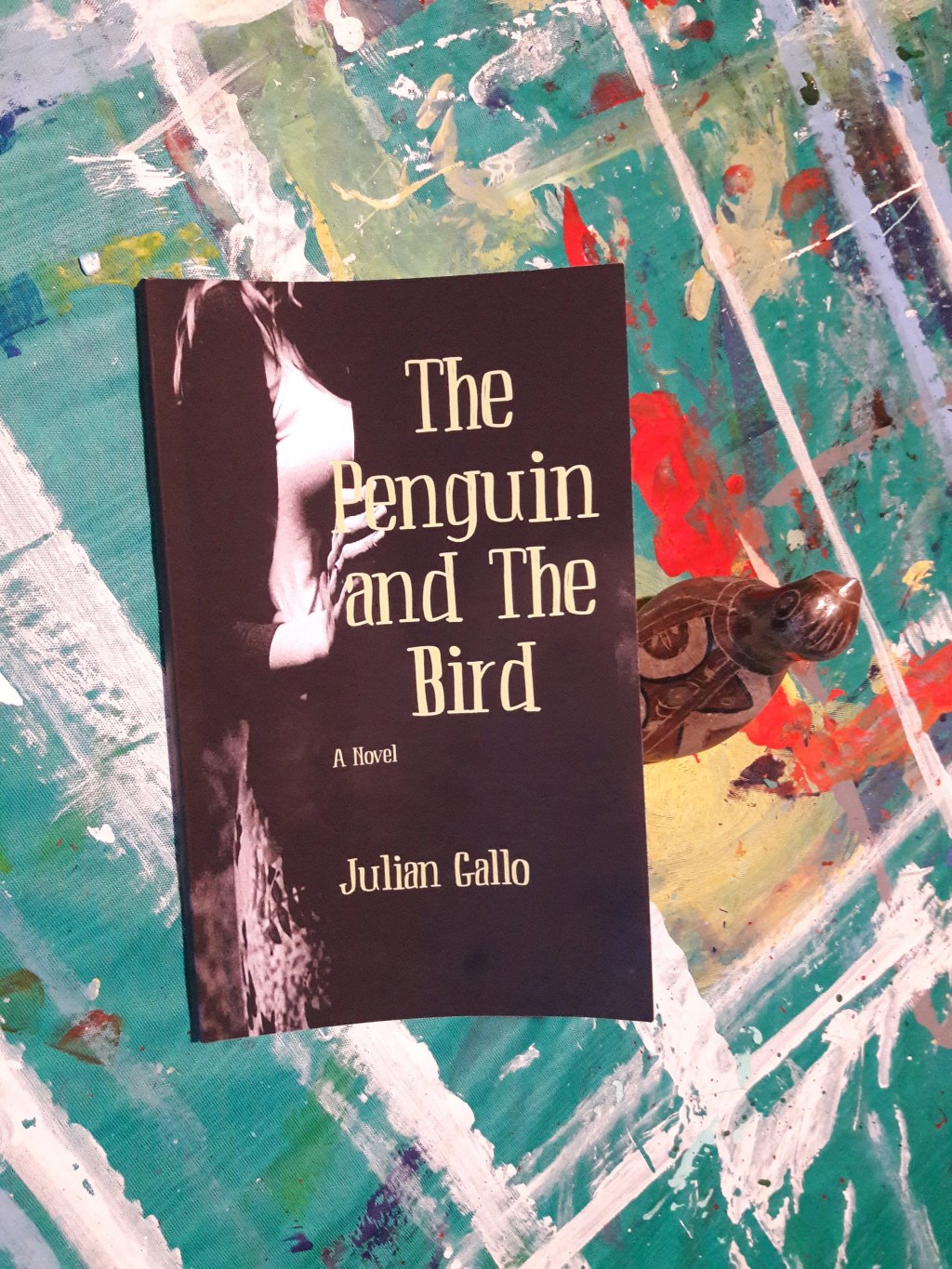
    Julian Gallo’s “The Penguin and The Bird” (2018, New Horizons Editions) is an impressionistic work. It functions as a graphic novel, but one without the drawings. There are 72 short chapters spread across 122 pages of text. The chapters are organized into four parts: “Her Mother’s Violin Early Autumn, 1979,” which concludes with Chapter 13, subtitled “New York City, Ten Years Later”; the second part is titled “Diamond Street, Brooklyn New York Mid Spring 1989”; the third part is titled “Under Black Light Late Spring-Late Winter, 1990″; and the fourth and final part is titled “The Penguin and The Bird Early Spring, 1991.” These named parts allow for a traditional structure to an otherwise experimental form. Narration shifts from third person omniscient to a second person who seems to be talking both to himself and to someone else, and taken together sometimes seem to merge briefly into a third person plural. Each short chapter functions as a kind of graphic novel thought balloon, but again, without the mechanical drawing. Other characteristics of traditional genres are employed, including plot and character development, the protagonist a dynamic character who changes significantly from beginning to end, and there are traces of noir and mystery genres, Bildungsroman, minimalism, and a kind of anti-writing, a writing that both discovers and develops itself in an improvisational jazz style while at the same time destroying the very expectations it creates, and in that sense the writing is realistic. But the impressions created while reading last, and the novel must be read from an appropriate distance: too close, and the strokes won’t properly merge to create the impressions; too distant, and a reader’s preconceived ideas of what a novel should be will interfere.

    The chapters in part one transition in turns from the protagonist, at the time a 13 year old boy trying to write and draw comics, to the antagonist, a Polish immigrant we will come to know as Nadja. They are sixteen years apart in age. They don’t know one another, but they will meet. The narration withholds information; or, rather, the information necessary to follow the plot unfolds to the reader as it does to the protagonist. The opening juxtaposition of the boy’s and Nadja’s situations, their predicaments, reflect the theme we will later see resolved in the last part of the novel, in Chapter 67, where Nadja tells the story about the penguin and the bird, which offers up a traditional meaning for readers who might be in need, while adding another layer to the form’s structure.

    Other techniques creating symmetry are employed, and the novel takes on a sophisticated, well-structured form. The language follows the form, beginning with the short, staccato-like sentences of the boy in the beginning, followed by the visceral, sour, and surreal hallucinations of the boy’s, now 23 years old, unrequited, unparalleled, and phantasmagorical fantasies of love and sex in the “Black Light” section. Nadja may be seen as moody, but the temperament of the young man, irrational and even non-rational, his complaints, editorial asides, and tortuous though short monologues, become increasingly angry, fearful, bitter, cynical. At times, the reader may feel like the episodes are being written from Desolation Row. But the writing appears to reflect the costs or risks involved for these characters. These middle chapters are written in a kind of diarist form, self-castigating, accusing, questioning, exploring, wanting, rejecting. This is not a superficial book; its aim is discovery and honesty.

    The novel ends in Flushing, New York, the style of the writing returning from the Poe-like intensity of some of the middle chapters to a settling and sober epiphany that is calm and even tender in its resolution, language, and tone. Certain scenes from other parts of the novel are repeated, but with more information now at the disposal of the reader (and protagonist).

    The novel’s atmosphere is noir and nouvelle vague. There is a romantic ending, but not of the Hollywood type. While the controlling theme throughout might be love, the love theme also contains naiveté awoken and the coming of age discoveries that dispel fantasy, or at least mixes it with frustration. We see a love turn to rage as love’s perfection is seen as unattainable, unrequited, even viewed as abuse. Metaphor is used throughout to create these impressions. Because of the aphoristic style of the many short chapters, the reader begins to realize the creation of an overall rhetorical device, where one is reminded of details that did not seem all that detailed to begin with. This is another technique that adds to the impressions. Included in the setting is the Poland background history of Nadja and Lena (a foil character if there ever was one). Repetition is another rhetorical device effectively used throughout the novel, in places both in terms of plot presentation and in sentence structure. The language always follows the feeling.

    There is an air of intellectualism that blows lightly over parts of the novel, exhibited by often obscure literary and popular references, and the primary characters are made interesting in part by their intellectual pursuits of, or involvement in, culture, but they are not academic intellectuals, which makes them even more interesting. They may not be even necessarily accurate in every reference, but their predicaments are alive with feeling and emotion, with comprehension coupled with lack of understanding that results in a realistic depiction of the human in love and in fear. That depiction also gives them a realistic bohemian character, an avant-garde spirit often it seems forced upon the immigrant. They have lived as well as read about their literary adventure. That life contains so much irony is another of the novel’s themes. There is also much that is witty and sarcastic, sharp and soft, in the writing. Nadja’s meeting the parents after the tryst is an example of such a scene. Though they may all maintain their “little secrets,” it’s hard to keep private in a novel.

    Julian Gallo is a prolific writer, but this is the first of his twelve novels I’ve read. I’ve read a few of his shorter pieces online. “The Penguin and The Bird” is a well-designed paperback, its format of short chapters natural and contemporary for today’s online habituated readers. The mix of literary and popular culture also seems a strategic choice for marketing a novel these days. There are references to The Kinks and to The Sundays. The many references to other writers will provide readers potential reading and listening lists, Vonnegut, for example, though when our hero meets Lena, he seems to have been a bit distracted from his Mr. Rosewater, or maybe I missed a gender bender jab there? In any case, the novel may be said to borrow its short chapter format from some Vonnegut examples, also its distancing, and there’s mention of Konwicki, and Cortazar, not to mention the French Sinatra, Aznavour.

    I very much enjoyed reading Julian Gallo’s “The Penguin and The Bird.” Its range is wide, from what might be called the sentimental to the gritty and uncompromising.

    For more on Julian Gallo, readers may refer to his website at www.juliangalloo66.blogspot.com
     

  • Notes on Jessica Sequeira’s “A Furious Oyster”

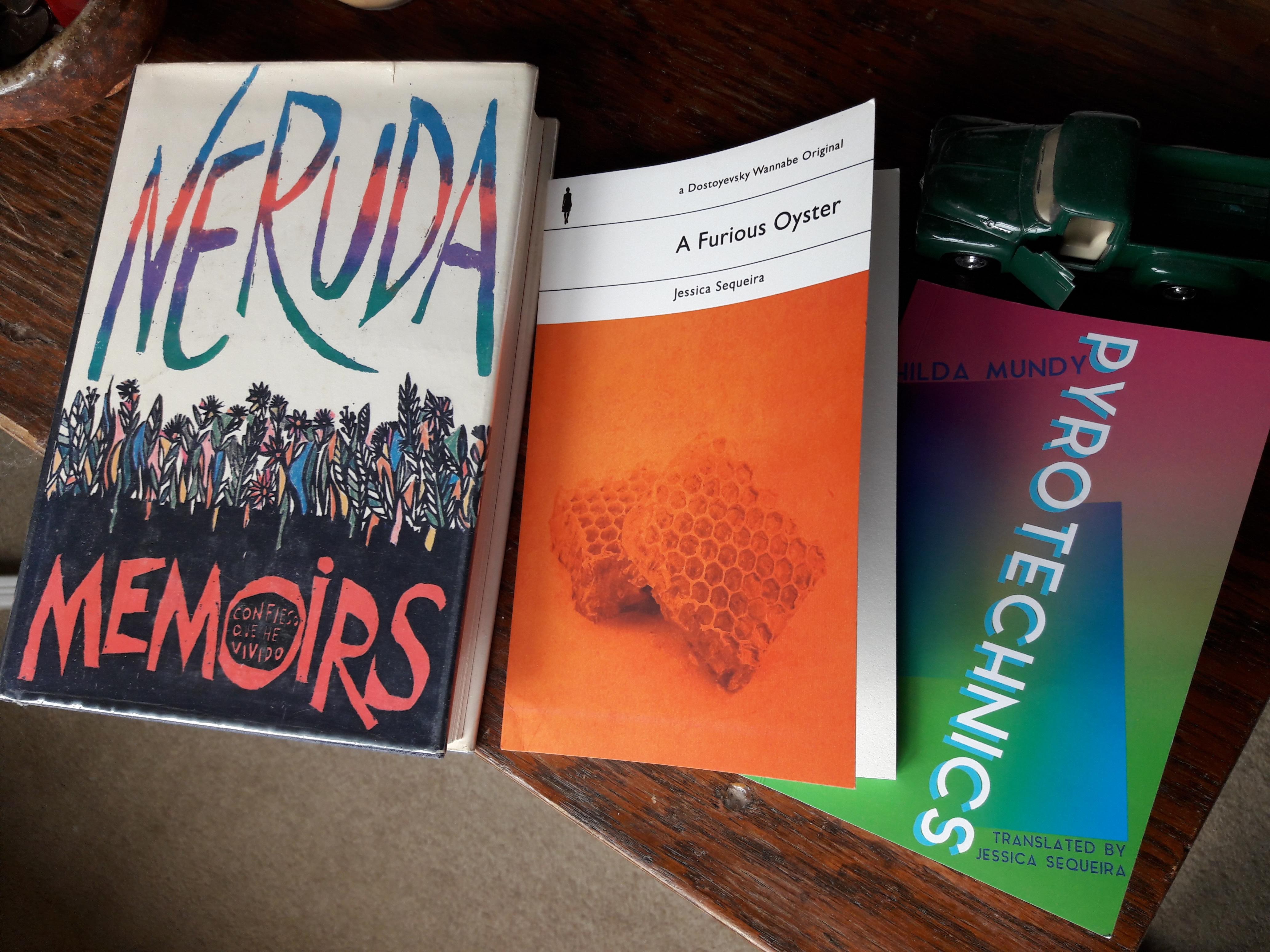
    20180916_100653I was reading Jessica Sequeira’s debut novel, “A Furious Oyster” (Dostoyevsky Wannabe, 2018), when the 30 August London Review of Books arrived in the day’s mail. A book review should reveal something unexpected, but to do that the book under consideration must be heard in a whisper.
    I turned to the review of Zadie Smith’s latest collection of essays; the LRB reviewer, Thomas Chatterton Williams, quotes from Zadie’s foreword:

    “‘I have no real qualifications to write as I do. Not a philosopher or sociologist, not a real professor of literature or film, not a political scientist, professional music critic or trained journalist … My evidence – such as it is – is almost always intimate. I feel this – do you? I’m struck by this thought – are you?’”

    Later in the review, we might recall that quote and think Zadie is telling us something more, but on the slant, that where she comes from, who she is, who her parents were, the various markings often used for identity, also don’t necessarily serve as “real qualifications”:

    “‘Who am I to speak of this painting? I am a laywoman, a casual appreciator of painting, a dilettante novelist, a non-expert – not to mention a woman of lower birth than the personage here depicted … I am still the type of person who will tend, if I am in a public gallery, to whisper as I stand in front of the art.’”

    That ‘whisper’ is often precisely both unexpected and unheard. The whisper follows no code of style. The whisper comes after the existence of the writer, and describes her essence, her choices, her existential leanings, what she has decided to follow. The whisper is the writer’s breath. The whisper might also be how something is said, and is often paradoxical. The whisper breaks the piece, ruins the lecture, calls from the pit, stops the show. The whisper might be a prayer of praise or a heckle in time with popular opinions.

    There’s something else, too, about the whisper; it’s what most of us do who have no real qualifications. And out of all those whispers (the all but silent blogs, the self-published and distributed broadside, the furious but funny poem in the on-line lit-wall), which ones should we home in on? And why would someone whisper when already no one’s listening?

    Sometimes, of course, the whisper “goes viral,” bounces and echoes off walls, scampers up trees, drifts through subway tunnels. But who or what is the host for that sometimes poison, at times the scent of lavender? And it’s well known, though often not accepted, the virus does not respond to antibiotics, the stubborn use of which weakens the resistance.

    All noise dissipates into whisper, so it should not surprise us that John Cage’s 4’ 33’’ goes briefly viral upon each new discovery. We realize even the Big Bang was a silent singularity. Not only might the world end not with a bang but a whisper, as Eliot almost said in “The Hollow Men,” but the world probably began with a whisper.

    A whisper is not a whimper. A whimper is what comes out of a giant mouth at the end of a rant. A whisper is a careful timing of breath, a largo escape, patient. The whisper goes easy and around.

    “Although that isn’t quite right either: how to describe something like the voice of a person just out of sight?” (A Furious Oyster, 92).

    Hilda Mundy’s voice was far out of sight when Jessica Sequeira brought it back: “I don’t want them to punish me with comments” (Mundy, Pyrotechnics, trans. Sequeira, We Heard You Like Books, 2017, 17). “Them,” the “three-dozen readers laughing at the pages of my failure” (17).

    The whisper never fails: “I began to hear people whispering things to help me, advice. I don’t know whether those voices were really there or not, but they brought me serenity. They helped talk me through my situation, suggesting new paths, pointing out what I needed to do” (A Furious Oyster, 92).

    “I have great respect, in contrast, for the metaphor. This is that” (118). So when we are told Pablo Neruda has ridden a wave of energy from an earthquake or the ocean or some great storm to enter the realm of the living, we believe. “This is my body.” This voice, this word. The metaphor transfigures.

    Sequeira’s “A Furious Oyster” is diary, memoir, investigation, document, thesis, mystery, love story. Let’s “be clear,” there are “other realities” (55). The reality of the metaphor, for example. “Strong wills work even in the shadows of the afterlife” (Mundy, Pyrotechnics, 29). Does every word contain its erotic origin? “How pleasant and suggestive a couple in love is!” (Mundy, 34). “Would I want to live forever in this particular moment, this precise patch of time?…Her kisses alternate, soft and hard. I wrap my arms around her, but already her shoulders feel less firm; our time is nearly up. We must go back now, I know, I know. I know, and how I wish I did not” (A Furious Oyster, 38).

    “A Furious Oyster” is a story of two famous poets in Chile, Pablo Neruda and Pablo de Rokha, literary adversaries, it seems, but both driven by the sufferings and loves of the people of a place, a land, a geography, a structure, to reach out, to reach. The geography of Sequeira’s book reveals her interests in shapes: “Sometimes at night, I dreamed of these theoretical shapes – the rhombuses, the ovals, the diamonds, the ellipses of sub-arguments within the prose. I kept only one notebook, and the diary of my personal life merged smoothly into the most abstract of notes on these Chilean poets, here and gone before my time” (55). “A Furious Oyster” is also the story of a writer researching, composing, working, in a relationship, watching, listening. And it’s the story of a place, Santiago de Chile.

    Sequeira possesses that most unique of minds, the one able ambidextrously to move easily from the hard academic to the soft poet (or is it the soft academic to the hard poet?) within the same shape. The flow of “A Furious Oyster,” its style, is redolent of the Duras of the “Four Novels,” or Lispector’s way of creating mystery while unveiling surprises. I also thought of the modernism of Djuna Barnes and Anais Nin. Jessica Sequeira is a translator, a scholar, a writer. She both understands and comprehends literature. For those of us who can only comprehend, but feel we are indeed also “struck with this thought,” we can only whisper in her shadow that you really should read “A Furious Oyster.”

  • Out of the Blue Review of Alma Lolloon

    Out of the Blue Review of Alma Lolloon

    A fun and generous review of Alma Lolloon has appeared on Amazon. Here is a link, and I’ve pasted the review below:

    by, Rucker Trill


    July 4, 2018

    Format: Paperback|Verified Purchase
    Dear Miss Lolloon – You are no doubt by now growing weary of fan mail after the publication of your eponymous novel, Alma Lolloon, but I just finished reading it, so I must write to tell you how much I liked it.

    Right off the bat I thought, hmmm, this is new and unusual given the absence of most punctuation not to mention quote marks so that I knew I was in uncharted waters here, or maybe a better metaphor (I learned that word from the book)would be along the line of separating skeins of different colored yarn after the kittens have been in the knitting basket. But soon enough I got my stride and realized that this is the way things happen in real life – there are no quotation marks there, now are there. And it seems like that’s the way this book unrolls, just like life with the unexpected hidden just around the corner, under the everyday. (Though given your five husbands I wonder if anything about your life is “everyday”.)

    I’m no writer myself, but one of the things I liked was how you and your friends talk about the book right there in the book while they’re supposedly hearing the book! I mean whoa! What’s that about? It was like falling into a hall of mirrors or something. I asked a professor who lives down the block about it, and she said you were “meta-texting” and after I showed her a few pages she said you were doing it very humorously, and I confess I laughed way more than once. But like I said, I’m no writer, so who knows.

    Now, I don’t knit but I’d love to join you and Curly, Hattie, and Rufa some day for coffee and scones and we could talk more about your book. I could even bring the scones. Maybe some time in August? I plan to be up your way then.

    Anyway, I’ve run on too long and I know you’re busy on your next book. I hope it’s a mystery, I really like the mystery part of the book with Jack Rack. (I think you should have married him!)

    Best regards, Rucker


  • Gerard Reve: “The Evenings”

    The Evenings Day job workers share in common evenings. Time off, free time, leisure time, time-wasting, occupy the evenings. What to do? The question often haunts office and factory workers (workers clutching daytimer calendars are bothered by another version of the question). The evening absorbs the question of what to do like a fountain swallows wish thrown coins. The equity of time off beggars everyone. Free time hours can’t be saved, must be spent. On what?
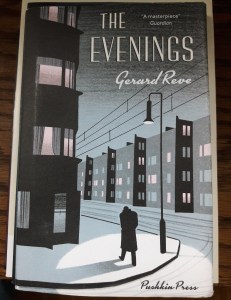
    Frits van Egters, the main character of Gerard Reve’s “The Evenings” (first published in Dutch in 1947), works an office day job he considers so boring he barely mentions it. His attention is focused on his evenings, how they might be spent, how they pass, what he might do with his free time, and what he does do. Frits lives with his parents when in December of 1946 we are invited to spend his evenings with him as they pass from around Christmas thru the new year. He talks to himself, has bad dreams, tells horrible jokes, thinks about the evening hours passing, goes out and about, visits friends, is condescending toward his parents, alienated, sarcastic, cynical. It’s freezing outside. Inside there’s the coal stove, a radio with a classical music and a news station, books, food, his bedroom. One night he goes out and drinks too much and gets sick. By the next evening he’s recovered enough to be able to go out again. He sees a film, rides a tram, crosses canals, walks along a river. He owns a bicycle, but it breaks.

    The layout is dense, the dialog embedded in paragraphs, and the book is meant to pass as slow as an evening might, and to mean the same thing, which is nothing, which is to say, everything. Often, Fritz’s thoughts during a conversation are spoken to himself and interwoven with what he actually says and hears. His dreams are related in a similar way, so that the reader may not immediately realize when a dream, or the memory of a dream, has begun or ended. The writing is clear, though, the descriptions appealing to every sense. The home meals, the food, for example, are described with local, specific detail – texture, smell, look, feel, taste. You can even hear the meal cooking, eaten. The clothes, weather, walks also all described with realistic detail, a pleasure to read. There is no television, no devices to distract or synch. “The Evenings” is a book, a perfect way to pass an evening.

    The Evenings: A Winter’s Tale, Gerard Reve, translated from the Dutch by Sam Garrett, Pushkin Press, London, 2016.

  • Alma Lolloon

    Alma Lolloon


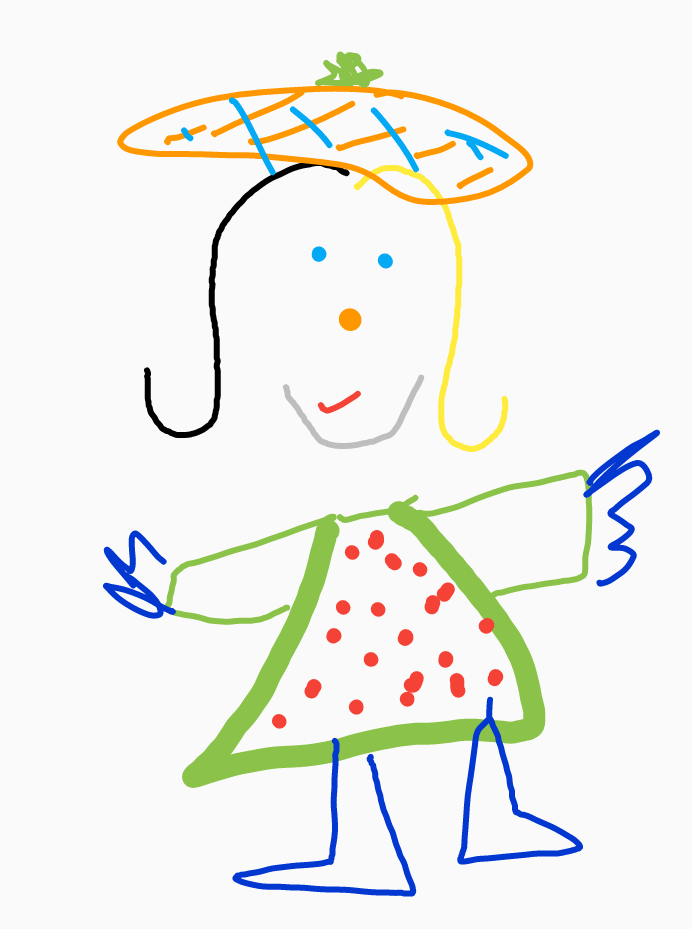
    Alma Lolloon cartoon drawing
    “How long do I have to pose like this?”
  • Alma Lolloon: 5th Installment of Work in Progress – Epigraphs

    The novel “Alma Lolloon” opens with two epigraphs, both of which serve the ordinary purpose of the epigraph but are also part of the fiction being created. In each, the original is given, followed by an “interpretive translation” by the narrator of “Alma Lolloon,” who is Alma Lolloon:

    Experience, though noon auctoritee
    Were in this world, is right ynogh for me
    To speke of wo that is in marriage…
    But yet I praye to al this compaignye,
    If that I speke after my fantasye,
    As taketh not agrief of that I seye,
    For myn entente nys but for to pleye.

    from Chaucer’s The Prologe
    of the Wyves Tale of Bathe

    What atrocity this insult of experience
    As if somehow right for me and all
    Wode talk woe of the marriage camp.
    But complain not in present company,
    For all tales told in pitiful woe
    Tell not a whole story
    If want is not to please.

    from interpretive translation of Chaucer,
    by Alma Lolloon, 1966

    Die Erste Elegie

    Wer, wenn ich schriee, hörte mich denn aus der Engel Ordnungen? und gesetzt selbst, es nähme einer mich plötzlich ans Herz: ich verginge von seinem stärkeren Dasein.

    from Duineser Elegien by Rainer Maria Rilke

    The First Elegy

    Who, if I cracked my little mouth, would listen to me in the din of rules of angels? And quickly so near his heart home of pounding hammers, sparkling nails, and gargantuan waves, I would fade in the muscle of his gaze, or in the back seat of his dark ride.

    from Duino Elegies, interpretive translation of Rilke,
    by Alma Lolloon, 1996.

    I’m still working on editing and proofing and design.

  • Alma Lolloon: 4th Installment of Work in Progress

    Alma Lolloon: 4th Installment of Work in Progress

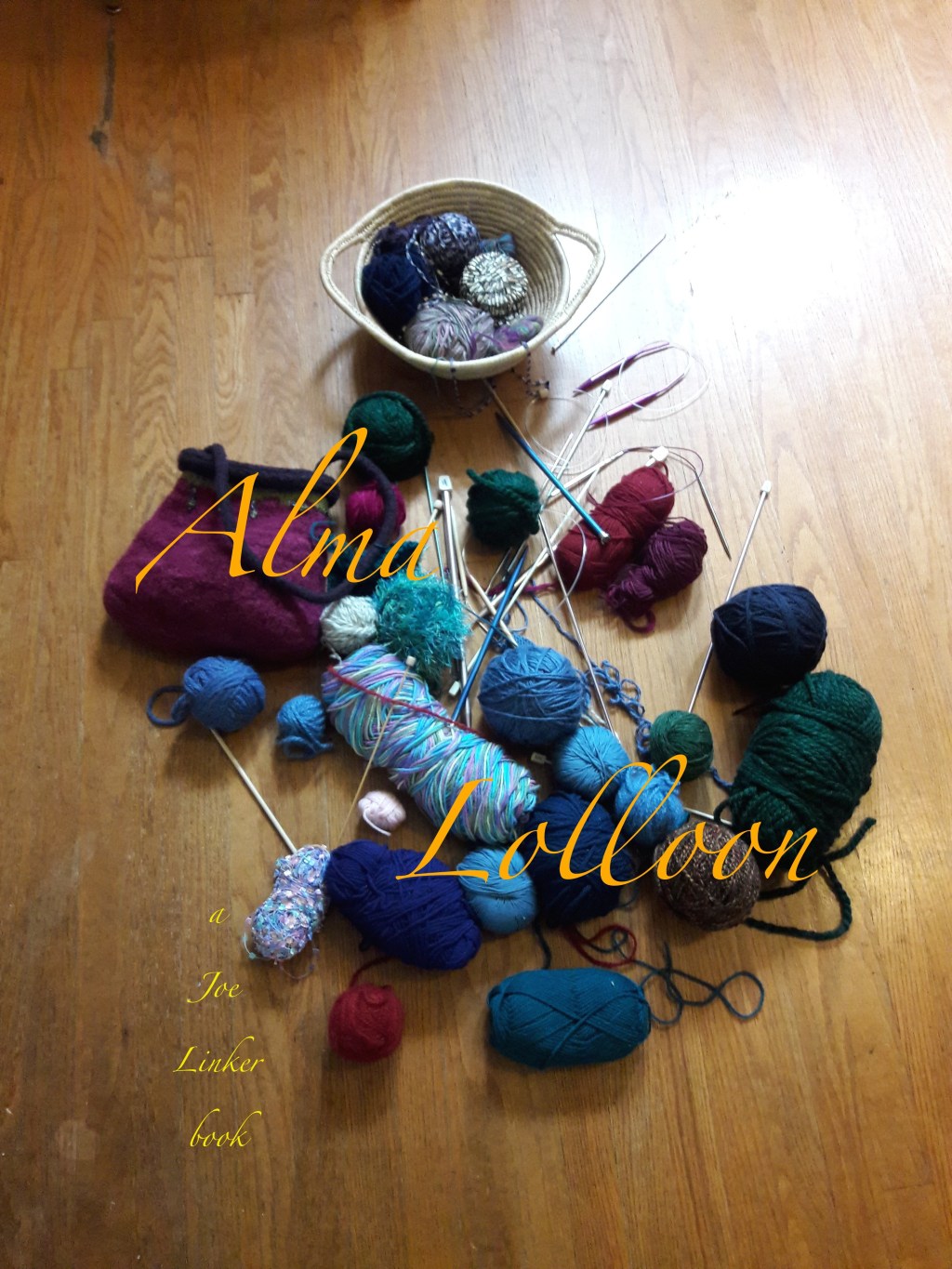
    Awaiting new hardcopy to proof. Meantime, here is another installment of the forthcoming novel, Alma Lolloon. (Alma has told her knitting group she is writing a book. The book is to be about her five husbands, and the knitters agree to hear Alma reading from her book in installments at their Saturday knitting sits.)

    Well, Hattie, I said, but I was talking to all of them again, of all genres, I like fiction most. What a gas! I like novels for their mystery, the dialogue, the atmosphere, the unfolding of the story, like opening a table cloth and when you get it spread out all across the table there’s a wonderful pattern you had not expected to see. There’s that moment when preparing dinner, not sure how it’s going to come out, and it’s time to set the table, and the cloth is unfurled, and the table and the light in the room is clean and soft and hopeful. This is picking up a book. And around the table sit a dozen characters you don’t recognize chatting away, one prim, another slurping, one passing notes under the table, a couple playing footsie no doubt. I like books you don’t have to necessarily understand to enjoy or comprehend. And it doesn’t bother me when writers split your attention. I like a style that breaks or belies or betrays convention, just wants of some fixed eyeballs you want to push rolling. I like when I see something my eye did not expect to see. I like other kinds of reading as well, books on music and the mind, children’s books, comic books, graphic novels. I like talking about things I like more than talking about things I don’t like. I liked each of my five husbands, each in his own way. What did you expect me to say, I loved them? Please. What is love? Perhaps that will be my argument, Hattie.

    Speaking of love, Curly said, what about these raspberry scones Starky has buttered up for us?

    Love, love, love! Rufa declared.

    I’m taking a couple home for Angel.


    I come from a long line of circuit riders that ends in the dust bowl years, and we rode as hillbillies and Okies, carnies or enlisted men and women, or kept to the road as musicians and tinkers. My dad was a handyman, a plumber and carpenter and electrician and mechanic, and a sign painter and had a talent with brush painting and wound up out west where he got on with the studios painting backdrops for majestic movie scenes, a kind of scenic artist. He also did sketch portraits. He often spent Sunday afternoons down near the beach on the walkway where he’d set up an easel and for a quarter or fifty cents or a buck would draw character portraits for passing tourists. And of course he was a drunkard and left us early on, came back, and left us again. My mother was one of those wives who seemed like she was just along for the ride while she was really the differential gear. She knew how to do all kinds of things. She could cook, sew, knit, quilt, garden, herbal doctor and nurse, dance, sing, play guitar and piano, work carpentry and plumbing and tinker with cars. I suppose I have kinfolk spread like dandelions and poppies across the countryside and up and down city streets and out in the suburbs and up in the mountains and all around the coastlines, but I don’t know them, or I’m not close to any of them, and I was an only child, my folks are long gone, and I’m pretty much on my own these days but for the three kids left me by my first three husbands, one each, dandelions, all of us. I have grandchildren, and Freddy has a daughter, Marylu, who has a toddler, Molly, and they live nearby and sometimes come over for tea or for me to babysit for a spell and we walk to the park and play in the sun. Freddy was my first child, Mary and Gabriel’s son, my roommate and the boy she met and hooked up with my failed college year.


    But so you had five husbands, Annie said, what of it? Life with one husband might make an even more gruesome tale.

    She didn’t say gruesome, did she? Curly said.

    A life with no husband the one I might have wished for to write about, Rufa said, and we all looked at Hattie.

    Oh, sorry, Hattie.

    And not for the first time we saw Hattie nonplussed by something Rufa said seemed packed full of meaning but no way out.

    ~~~

  • Alma Lolloon: 3rd Installment of Work in Progress

    Alma Lolloon: 3rd Installment of Work in Progress

    I’m still proofing and editing my new novel, Alma Lolloon. I hope to have it out by December. Meantime, I’m posting installments Saturdays here on the blog. Here is the third installment.

    (Alma has told her knitting group she is writing a book. The book is to be about her five husbands, and the knitters agree to hear Alma reading from her book in installments at their Saturday knitting sits.)

    3rd Installment of Alma Lolloon:

    I simply would like to have someone to talk to, someone who actually listens to me. Is that too much to ask? So even though I don’t know you, and you might not be listening anyway, I’m talking to you, and I’m going to share everything. That’s not a trigger warning. Simply a goal. You might safely skip parts, your attention wandering. I’ve already skipped a few beginnings. But I want you to get your money’s worth. Even if you’re reading on-line for free or something, or you picked up this abused paperback copy you’re holding in the neighborhood library box. Go on, take it, read it on the bus. It takes time to read, and most of us value time. The thing is to sit down and relax. Breathe. Smell the paper and the ink, or whatever it is they print words on and with these days. Pour yourself a cup of coffee or tea, a glass of wine, or pop a can of beer, or pour a juice or a clean clear glass of fresh water. Feel my hands kneading your shoulders. You carry tension there. I know. Let it go. Drop the shoulders. I know you have your own story. Let that go, too, for now.

    We must have ritual. Ritual is what stops the crazy traffic on the bridge so the tall lovely ship can slip quietly by. Make some space in your day for reading as a kind of ritual. Nothing serious, of course, on the contrary, just a few quiet moments to yourself, for some peace and silence, to get away from your scares for a few moments, those voices in your head that won’t shut the hell up, or to find yourself, or to forget yourself, or to remember something you maybe should have never forgotten and is such a joy to find again. I’m well aware you could be reading something else, something more dramatic, sexy, literary, trashy, or some delightful ichor with goor and geer from some silly battle zone somewhere, or some soapy sap television shows are often stuck together with, if that’s what you like. Sure, and you’ll find soap here. I’ve eaten plenty of soap in my lifetime. My mouth is clean. Or non-fiction, some people prefer because it’s supposedly true. Nothing like getting one’s facts straight. We all need ritual, but we should not consider ritual what is merely compulsive.

  • Alma Lolloon – Work in Progress

    Alma Lolloon – Work in Progress

    Continuing from last Saturday’s installment, from chapter one of my work in progress titled “Alma Lolloon,” the first chapter titled “Casting On.” The book is finished, but I’m still proofing and editing. I hope to have it out in December. Meantime, I plan to continue putting up excerpts here on Saturdays:

    from chapter one of the novel “Alma Lolloon”:

    My first marriage was annulled within a couple of months. I never saw Mary or Gabriel again. We all signed complex legal documents sealing the moment. My second marriage was to a draftee. Joe wasn’t so much love or even a decision or a choice. But he adored Freddy and was a fun guy who made Freddy and me laugh and when we were together my bad thoughts vanished. Joe was a high school dropout, but he had a car, a 1953 Chevy, two toned, cream over turquoise blue. Joe walked off to boot camp, marched home and we married, and off he flew to Vietnam where he was fried up in napalm, his squad a straw basket of squids. Leaving me pregnant with Sally and a fragment of a family. My third husband drowned in a fishing accident, the sun that hot August day scalding, not a single blade of shade, the sand boiling, not a breath of breeze, and the rocks seething with seaweed and foam, Murphy’s body trapped in the eddies below the cliff, finally coming to rest atop a barnacled rock perch, the waves running on and on the tide coming in they couldn’t reach him and the water lifted him up and floated his body flotsam out to sea. My fourth husband took his own life. How could so many neurotic demons occupy one man’s mind? His head was an ant farm, ants like tiny cars digging tunnels through the clay. Wags was possessed by his corporate gig and rig and regalia and risk. He stuck a hose in the tail pipe in the garage, the other end through a wind wing, the car windows and doors all shut up, and Wags turned fifty shades of bluefish-purple. My fifth husband was shot and killed by a private eye, who mistook him for a wise guy at a poker game, shot him coming out of an outhouse between hands. Well, Jack was a bit of a joker, but not the kind the dick was thinking. Jack was a wild card.

    Yes, and I told the knitting ladies I am writing a book, and they laughed. Rufa called to ask why I missed Saturday knitting group three weeks in a row and did I need a noise session. I told her I was writing a book. I went down to Lards Coffee to sit with them again, and they asked what I was up to, and I told them I was writing a book, and they all laughed. Why did they laugh? I’m not sure. Maybe they think I don’t have a story or a voice to tell it with. Or maybe they think no one reads books anymore, at least not one written by an old woman who has never traveled much, never finished college, never finished a marriage, a career part time waitress. But I’ve read a few books over the years, some over and over, the ones I really like.

    But just because you can climb into a dress and maybe even look good in it, doesn’t mean you have any idea how to cut and sew a pattern together, Hattie said.

    Hattie’s in a book club, Rufa said, so she reads books, presumably. I don’t recall her ever talking much in knitting group about the books her club reads. Do you think the rest of us can’t read, then, Hattie?

    Who’s to say who should talk and who should keep quiet? Who should try their hand at a book or grow flowers, swing a bat, or go after the dogs and beer? Curly said.

    Why are you writing this book? Hattie said. Do you not realize how difficult it is to publish anything these days? There’s a reading crisis in this country, newspapers disappearing, book shops closing up, kids born with a cell phone stitched into their palm, though there’s still a chance of some success with a children’s book, they say. So what are you writing, Alma, your memoir with all these husbands of yours? But I still don’t understand why. What do you get out of writing? Isn’t writing rather boring, actually, sitting, sitting, sitting? Oh, shit, I dropped a stitch. I never imagined you one with the imagination for it, anyway. So what is it? Memoir? Or some science fiction horror fantasy about these five husbands you’ve been through? And at that they all had another good laugh.

    But why don’t you read it to us, Rufa said, on the installment plan? Saturday mornings with Alma.

    Hattie laughed barkedly at that. Annie and Curly didn’t seem to get it.

  • Alma Lolloon – Work in Progress

    Alma Lolloon – Work in Progress

    “Alma Lolloon” is the title of my next novel, which is in the final proofreading and editing stages. I’m using the same publishing platform (CreateSpace) as I used for “Penina’s Letters” and “Coconut Oil,” but I’ve decided to roll chapter one onto the Toads blog to introduce the new work and to spark interest. I hope to have completed hard copies ready in December. Meantime, I’ll be posting excerpts here on the blog.

    From Chapter One of the novel “Alma Lolloon”: Casting On

    “Words is just sounds,” I heard Annie was saying, coming back from the lanterloo to rejoin them on the stuffed couches in the picture window at Lard’s Coffee they were Saturday morning, the knitting ladies.

    “Words are noise,” Rufa nodded.

    “Ah, fiddlesticks, I left my notebook in the loo,” and when I came back again they hushed like people do when they’ve been talking about you and suddenly you appear in their midst and there’s that pregnant pause.

    “So you’re writing a book, then, are you, Alma,” Annie breaks the water of that wait and you could feel the rupture spill and spread across the hardwood floor.

    “How long does one give labor to a book before quitting?” Hattie said with her know better than you ever will crooked smile.

    “But what do you possibly have to fill a book with, Alma?” Rufa said.

    “But I married five times, didn’t I, one selfish boy and four hapless men? Surely that ought to hold enough to fill a few chapters.”

    “Ah, but what is good, what is marriage, what is a boy or a man? There must be some argument,” said Hattie.

    “And what, pray leave me, is a wife?” Hattie went on, as is her wont, questioning everything but leaving no time for an answer before moving on to another question. Times she could be such the rhetorical bitch, and always jumping to the supposed hidden meaning of something when you hadn’t even discussed what was actually happening yet. But that Hattie was the book club hostess. The knitting Hattie was rarely so contrary. But the idea of my doing a book seems stuck in her professorial craw and she’s having trouble swallowing it.

    “And I never divorced a one of my hopeless helpmates, wouldn’t you like to know?” I said, amplifying my voice a bit to hold the floor while I got something all out.

  • Ashen Venema’s Course of Mirrors: An Odyssey

    As we begin our trip with Ana, leaving her teens and moving from a self-renounced medieval privilege to her own renaissance, we get the feeling she has no interest in becoming the subject of some troubadour’s love song or any knight’s lady waiting in a fortified manor house for her man to come home with the meat and mead. She’s interested in neither shame nor honor. The holy grail of “Course of Mirrors: An Odyssey” is a story of one’s own. This is not your mom’s fairy tale.

    A medieval mystery play, a miracle play, directed by an evil Preacher, brings Ana a quick and unwanted celebrity. But the Preacher is a vaudevillian, the sacrifice, like the Catholic mass, intended to be bloodless. Fine, Ana wonders, but what was his plan for her if she was not to die? And something about the Preacher, his looks, his bearing, his power to pander, attracts Ana. We don’t always want what’s good for us.

    We are on a rogue adventure in a picaresque tale where disguise and subterfuge are necessary and ordinary. Ana dresses as a boy, learns to live off herbs and small animals from her mentor Rheine, and, in the course of their travels and travails, embraces a realism rooted in the fairy tale. For example, now hiding from her mother now searching for her girl disguised as a boy, in the hold of a boat where,

    “Far too many horses, mules, sheep, goats, fowl and pets were cramped together with hardly any ventilation. The sickening stench of urine and droppings eventually defeated me. At daybreak I retched and escaped onto the first deck. Bent with pain, I was violently sick over the railing, onto the oars below.” Also realistic is the humor; Rheine says, “I’d an inkling your night would be disagreeable.”

    The miracle play motif is picked up by a traveling theater troupe: “Rheine had squeezed my hand on occasions. The irreverence brought to the miracle made us simultaneously cry and laugh with the audience. Humour softened my bitter memory. I told myself that the saint business was a mob dream.”

    But we are as quickly brought from a saving humor to a murderous reality: “People and animals thrashed in the water or floated lifeless in the wake of the burning…The men pulled three bodies into their boat and attacked the rest with oars. They pushed the living underwater to their deaths.”

    In the space of a few episodes, then, we are caught in our runaway’s fallopian fall from innocence to experience, pushed by a stubborn insistence on an existential rebirthing, from parental expectations to a daughter’s commitment to freedom. The contemporary allegory may have its roots in the counter culture movement of the 1960’s, when costume and disguise, stage renaissance fair updated with hallucinogenic lighting, pretend sacrifice, and children on the run from the neurotic, war damaged psyches of their parents figured out new ways to live and tell the old stories.

    In any case, the future is never far behind, where our decisions have consequences. This is time travel, in the form of foil character Cara’s journal: “A handful of us are perched on the flat roof of a skyscraper; I can’t see the faces of the people with me, they are strangers. The tower sways like a ship tossed about in an ocean, climbing a rising wave, only to plummet. The tower tilts. I slide and cling to the leaded rim of the flat roof. There is a sudden lurch.” Cara’s time altered mirrored narrative within a narrative both clarifies and complicates Ana’s predicament as the plot unfolds like a house of falling playing cards. The story’s movement is metallic, its setting competing communes, its joy food and drink, its darkness plague and plundering and penury, beggary and politics. Its themes include independence, movement and flow, archetypal psychological imprints: the quest, journey, river, the map; loveless marriage and surrogate parental forces and mystery births; instinct and intuition, magic, alternates – including love and sex and the confusions one brings to the other.

    The writing style moves with the themes. Some of the descriptions are like Hieronymus Bosch paintings, people burning in fires, drowning, children screaming, animals too, faces hiding in the brush. As our heroine prepares for her first kiss, though, the writing changes to the lavender prose of a teen romance novel. An entire chapter is given to what becomes the disappointing epiphany, where the “peeling” of one’s clothes reveals a plush orange that screams when split. She gets used to it, but then the prose turns to the stark realism of relationships: “Naivety is a curse. Crushed like a rose and tossed into the pale remains of a fire, I was of no use, not even as fuel for kindling. I should have asked the river to take me when it offered to.”

    There is an economy to the writing that is expedient, efficient. A history of a people and a land must be told, but so must a personal diary be explained. The narration moves from first person to third person without any introduction or worry. The switch is simply necessary to keep the story moving. And our first person has other ways of knowing, of omniscience. Sentience appears as a kind of hallucinogen usually hidden within things. Perception pulls life force from stone, going forth as well as taking in.

    How serious is all this? First, it’s great fun. And shouldn’t writing, particularly the writing of a novel, bring pleasure to both the writer and the reader? The risk is a flatness, two dimensional characterizations, an animated film, the artistry of which undercuts its own reality. Myth when expanded usually fills with irony. Second, there are borrowings of form from myth and fairy tale that legitimize the atmosphere of magic and fantasy. But it takes a great leap of imagination to enter an invented world open eyed, to pretend even after all pretense has been lost. But this is the writer’s explanation of things, of life, of a life, anyway, this book. In some purviews, every thing must be explained. So the mechanical pencil might come to explain safe sex.

    Of course sex is not to be mistaken for love, or the prostitute would be out of business, but does the withholding of sex from one’s willing marriage partner signify un-love? Ana is consumed by the adults in her life, ignored or suffocated, and suffers from the only child curse, which requires the fantasy playmate so she’s somebody to talk to. From the pretend playmate the child learns mimicry. The playmate passes on the talisman. There is a kind of shorthand to the method that results, again, in a two dimensional telling, even though the attempt is a mimesis of the whole. When does the whole break into parts of sentimentalism, and from there to irony? “My poetry, he [Lionel] said, is devoted to the feminine spirit.” Ana responds, a severe critic: “They were bad poems, overly sentimental.” And this only a few pages from sharing Cara’s poem the reader may find sentimental in its longing to find some meaning in the “void.” Later, Professor Ruskin will fill in the blanks. We must remind ourselves the sacrifice was staged. But even a staged sacrifice has consequences. That’s where the repetition comes from. “It breaks my heart that the feud of brothers should repeat itself into another generation. It’s like a curse.” No, it’s not “like a curse”; it is a curse. The curse is metaphor, allegory – but even the language of the physicists can’t adequately explain what we either see or don’t see. All of creation is just that – an artist’s rendition, a depiction, a deduction.

    But the epiphany does come, or comes down, and “she will compose her own song.” A song of one’s own. A myth of one’s own. “I could no longer strangle my voice.” She composes her own poem:

    “I’ll kick your ghost
    out of here – I’ll make no more
    bargains with your fear…”

    But have we instead cut a deal with our therapy? The troupe now performs a parody of the miracle, as if we need reminding it wasn’t a real miracle to begin with. “In the shadow of each mask lies desire.” Desire for what? Power? Or to be used by some mad man’s “mad ambitions?” And what’s the ambition, the obsession, all about? We’re back to teen romance, now darkened with a certain amount of experience: “Unsure whether to laugh or cry, I cancelled my response, flattening my lover’s pleasure.” As if he cares, which might be part of the attraction. By the time we get to Batin’s place, we’re ready for the details of the dark side. We come across “Cults of Ecstasy” and the “pit” of “correction.” Are these bridges to the real world?

    We continue to meet new characters, travel, encounter new adventures. The book is divided into 29 numbered chapters, each divided into smaller, titled sections. There is a prologue and a short epilogue, and useful lists of characters, and a map and a list of places. The lists contain short descriptions of character and place. Time moves back and forth, like eddies in a river. We fall deeper into the encyclopedic epic. We are not out of trouble yet, as the short section “Cockroaches in the hellhole” makes clear. Ana is saved from a “sickening concoction of smells – rancid fat, stale urine, sweat and rum,” and “broken teeth.” Little Snake is a welcomed if late well-developed character. Cassia appears. We discover what “dissolves a curse,” and what it’s like to make love “truly naked.”

    What gives shape to a life drifts off with words. We close the book, glance up, and there we are, again, leaving, looking for something new. Myth is individual experience repeated, over and over again, until it becomes universal and a story everyone understands. Myth is not false news. It’s a way of telling a story.

    Course of Mirrors: An Odyssey, by Ashen Venema; 2017, Matador, 377 pages.