Tag: nothing

  • Post on Nothing

    Wanting for a word of good fit, I’ll ramble through a dictionary, in etymological pursuit. For example, just now I looked up the word pursuit and found that in a physiology context pursuit means what the eyes do, for example, when following the flight of a bird. I then looked up physiology, when what I had started looking up to begin with wasn’t pursuit at all but post. And it occurs to me that readers are like birds, flocks of readers: whodunit white-eared night herons; bibliophile bowerbirds; book-bosomed doves; frizzle-brood chickens; shelved-book house finches. Genres of readers flocked in clubs like a quarrel of sparrows, an asylum of cuckoos, a booby of nuthatches, a conspiracy of ravens, and this old couple who still perform the walk-on-water-dance of the grebes. But I can’t now seem to find the connection between post and pursuit, but perhaps it’s obvious. Even familiar words have family history and we don’t know half the story as we rush to tell.

    To post on a blog is to post in effect on nothing, the original posts one might post to being a mile marker, a signboard, road sign, doorpost, or a telephone pole, for example, on which one stuck a note giving notice, information or invitation or direction, or entertainment or argument, to passers-by, readers at random, on display in a public place. Such posts usually have (though not always obvious) some purpose, unlike graffiti, say, which usually is gratuitous. So far so good, a blog post is just that, what folks used to affix to a physical post, but there is no such real post to a blog post, unless one considers this open space where we seem to be (the internet, the web, the cloud, the blogosphere, the device – whatever it’s called) a post, but not a post like a milled fir 4 x 4, a tree shorn of its branches, returned into the ground, where to post something we might need a fashioned sign and a hammer and a nail.

                          "I have nothing to say

    and I am saying it and that is

    poetry as I need it ."

    And post it. But this, this post, to return to it, is not poetry; this is a blog post, a post on a blog. About nothing. But what is nothing, if not something? Cage also prepared something called “Lecture on Something,” but the above quote is from Cage’s “Lecture on Nothing,” from page 109 in Silence (1961). But then again I hesitate to call this (thing that I write on, post to) a blog. A blog is a form as a poem or a song or an advertisement is a form. What is a form? We grow so weary of nothing (unless we are one of the cognoscenti of relaxation). Nothing to do. Nothing to say. Nothing to eat. Nothing to drink. Nothing in the kitty.

    So we create and tend to forms. To blog is to write, but not quite, since some blog posts are devoted exclusively to the posting of pics, often posted without referent rhyme or reason. Content without form. How is that even possible? Anyway, aren’t there enough pics posted already? Yes, and words too. Is a pic a word? If you look up pic, you’ll probably see it’s classified as informal. It does not wear a cummerbund or a gown. But of course a picture is worth a thousand words. And where does that come from, that saying? We can look it up, and do. From advertising, apparently. The ads on the sides of trolley cars, which, passing as they do, a Clanging of Birdsong, provide for a moving post on which to post in pic form enough to imprint on the random viewer in passing a brand, a product, and a suggested desire or want, to follow up on later. Soap, cigarettes, auto parts, perfumes, hats, guitar picks. Are pictures worth more than words? Something called Picture Superiority Effect, from Wiki:

    The advantage of pictures over words is only evident when visual similarity is a reliable cue; because it takes longer to understand pictures than words (Snodgrass & McCullough, 1986[15]). Pictures are only superior to words for list learning because differentiation is easier for pictures (Dominowski & Gadlin, 1968[16]). In reverse picture superiority it was observed that learning was much slower when the responses were pictures (Postman, 1978[17]). Words produced a faster response than pictures and pictures did not have an advantages [sic] of having easier access to semantic memory or superior effect over words for dual-coding theory (Amrhein, McDaniel & Waddill 2002[18]). Similarly, studies where response time deadlines have been implemented, the reverse superiority effect was reported. This is related to the dual-process model of familiarity and recollection. When deadlines for the response were short, the process of familiarity was present, along with an increased tendency to recall words over pictures. When response deadlines were longer, the process of recollection was being utilized, and a strong picture superiority effect was present.[19] In addition, equivalent response time was reported for pictures and words for intelligence comparison (Paivio & Marschark, 1980[20]). Contrary to the assumption that pictures have faster access to the same semantic code than words do; all semantic information is stored in a single system. The only difference is that pictures and words access different features of the semantic code (te Linde, 1982[21]).

    With regard, then, to pics and words, as used in posts on blogs, one (pics) probably is not inherently, or intrinsically, worth more than the other (words). But what’s being measured in terms of worth is the value of advertising. Where pictures meet advertising in a meld (as in to announce, where the announcement and messenger are the same) is Instagram. Originally a place to post pics for folks with a hankering for photography, Instagram has become a wake of buzzards, a commotion of coots, a swatting of flycatchers. It’s an elevator of advertisements, the etymology of advertisement including a statement calling attention to itself and at the same time a warning. An advertisement is a solicitation, to be solicited, the more notoriously so, the better. Advertisement is a form.

    That music is   simple to make   comes from   one's willingness to ac-
    cept the limitations of structure Structure is
    simple be-cause it can be thought out, figured out,
    measured . (111)

    In Cage’s “Lecture on Something” entire pages are left blank. “Let no one imagine that in owning a recording he has the music,” Cage said (128). Nor, if we own a book, do we necessarily have the poetry. Cage often left sections of music blank, too, the better to hear, presumably, the truck passing through the street below the window within a piece. If Cage had had a blog, he might have expressed issues of frustration regarding the “limitations of structure.” And it’s amazing to see what he accomplished with a typewriter. Here on WordPress, poetry, modern poems, often difficult to arrange on a blog page or post, are given, in the so-called “block” format used to make the WordPress page, somewhat easily to the functional white needs of poetry. WordPress predicates the paragraph as the primary foundation (block) of writing. Maybe for prose, but not so much for poetry, and probably not at all for the writing of music or tablature. That said, I’m not an expert at WordPress styles and options. I want to write, not do computer programming, so maybe I’m missing formatting possibilities, but the WordPress Preformatted and Verse blocks seem to work flexibly enough to attempt some creative forms. But the block is self-contained – I don’t see the possibility of a block within a block, where, for example, the typography of one word might change in size relative to the typography of another word in the same line or block, or of letters to letters in the same word.

         writing      verse (unblocked words)     on  WordPress 
    is as simple as writing
    music
    if one accepts the
    limitations (rules)
    of structure
    the structure of limits (that which can't be measured)
    nothing has no limits

    What limitations was I talking about again? And anyway, doesn’t verse have all the limits it needs, without bringing WordPress into the discussion? Even a piece of doggerel has its limits, its boundaries. But notice Cage said “make” music, not write music, not compose music. One can make music if one has access to any kind of sound making device. To make silence is probably the most difficult challenge. If we take a pic of this post, we’ll find a picture is not worth a thousand words, since we can’t fit a thousand words into the pic, a post of 1,453 words, 8 minutes read time.
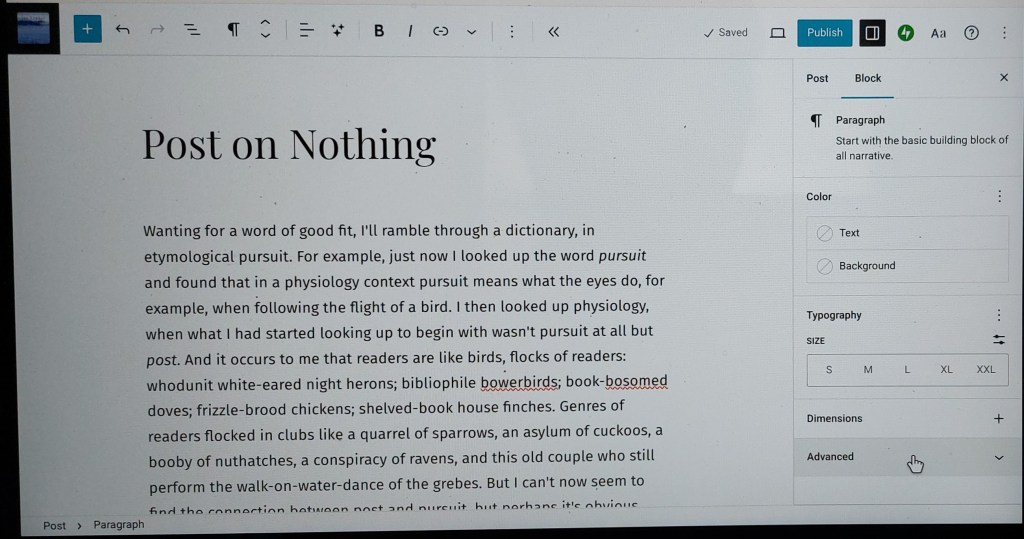
    Pic of Post
  • Nothing to be done

    Where Joyce tried writing everything in, Beckett tried leaving everything out. For Joyce, writing was a process of addition; for Beckett, one of subtraction. In Waiting for Godot, the phrase “Nothing to be done” becomes a kind of mantra. But it’s just an opinion, as Vlad says, even as he considers giving in to it:

    Estragon (giving up on his boot) 
    
    - Nothing to be done.
    
    Vladimir
     
    - I'm beginning to come round to that opinion. All my life I've tried to put it from me, saying, Vladimir, be reasonable, you haven't yet tried everything. 

    “Waiting for Godot,” Samuel Beckett, 1953

    Beckett’s characters often seem to have nothing to do. Most modern distractions are taken out, life’s experience parboiled to essentials. There are not many spices on Beckett’s kitchen shelf. Estragon and Vladimir don’t have cell phones. No books, no television, no newspaper. The game is not on. The team is not in town. The ballpark is empty. The surf is flat. While they consider what to do when there is nothing to be done, they can’t sit still. They talk. They have one another.

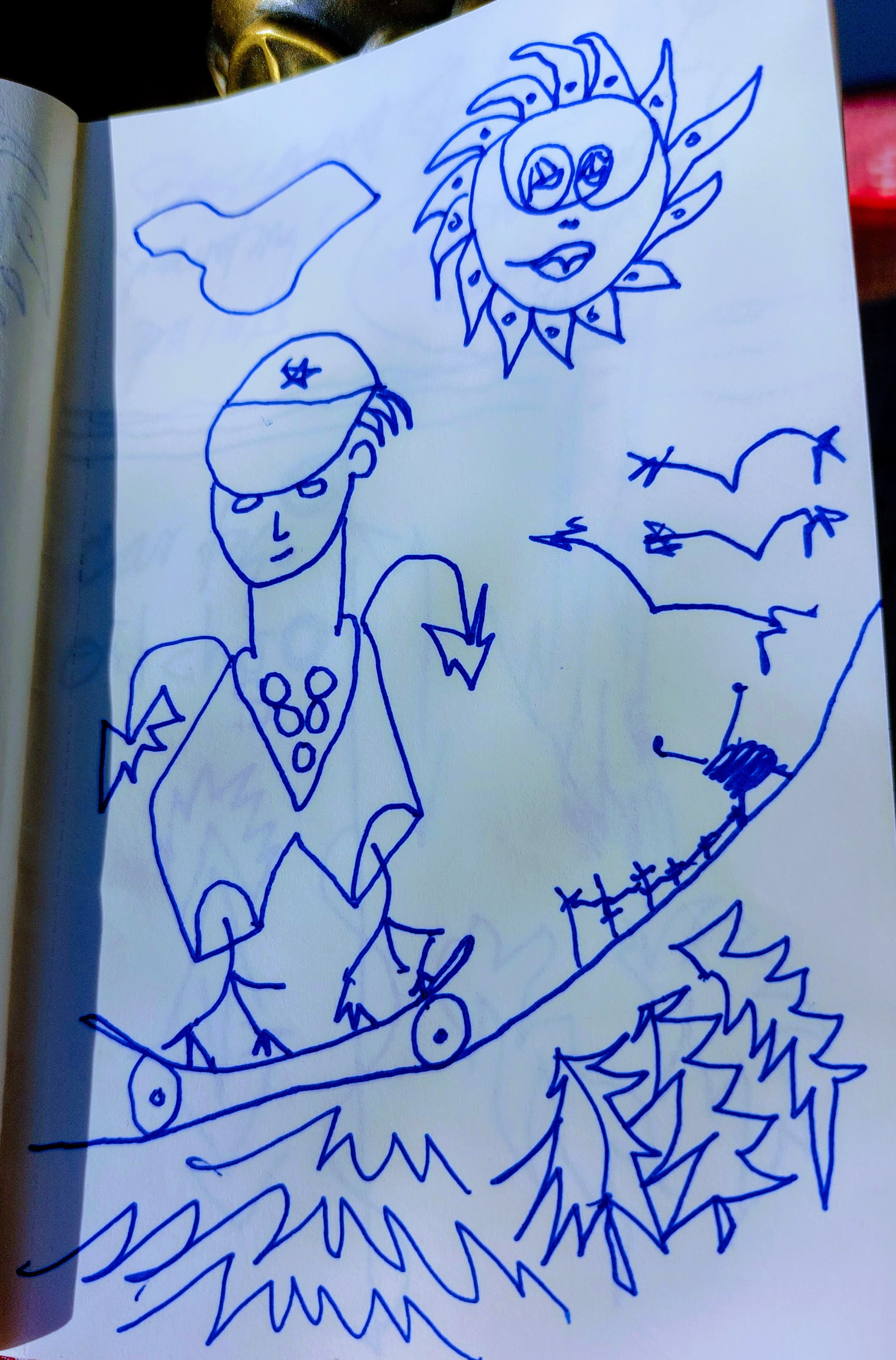
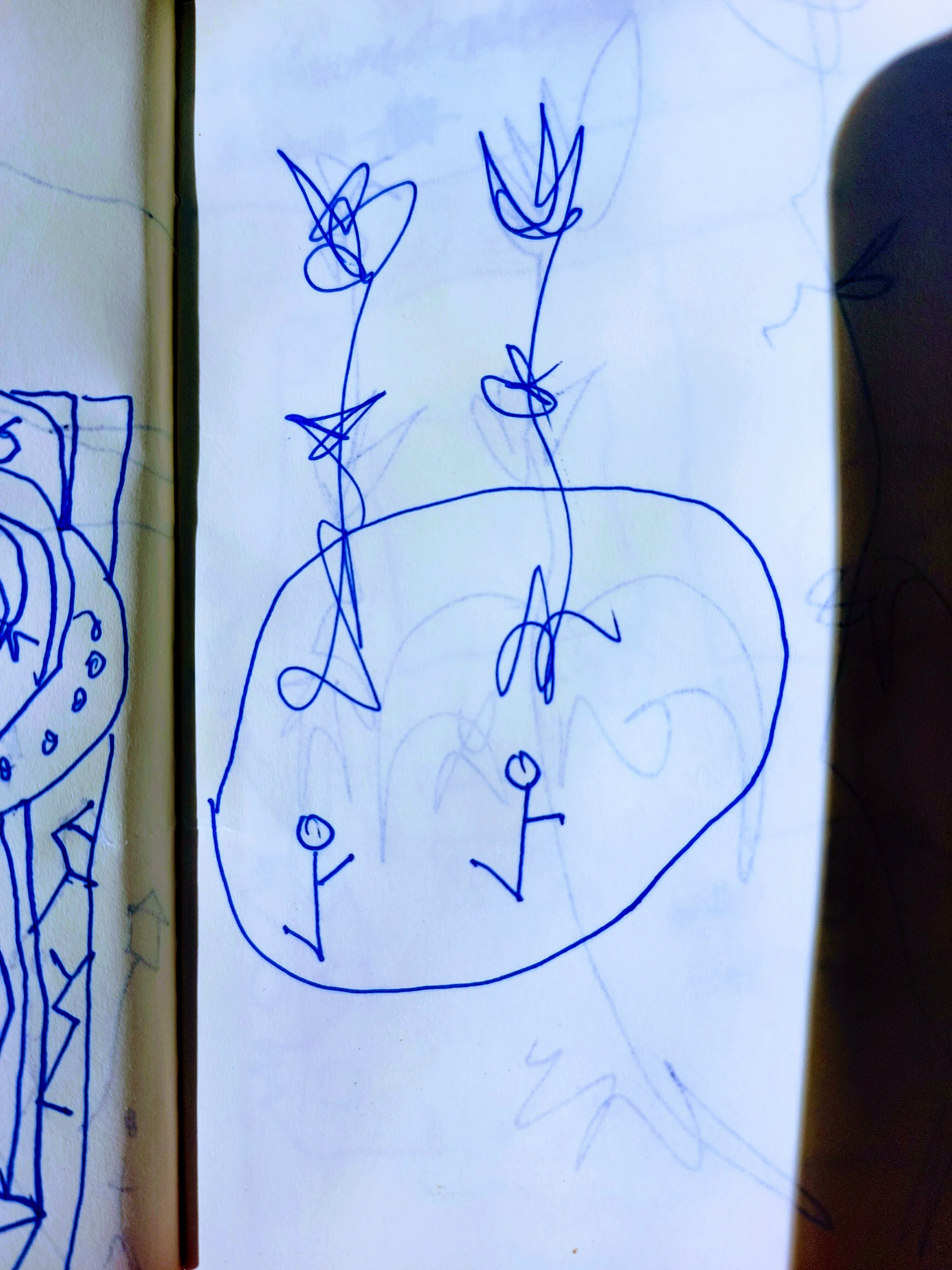
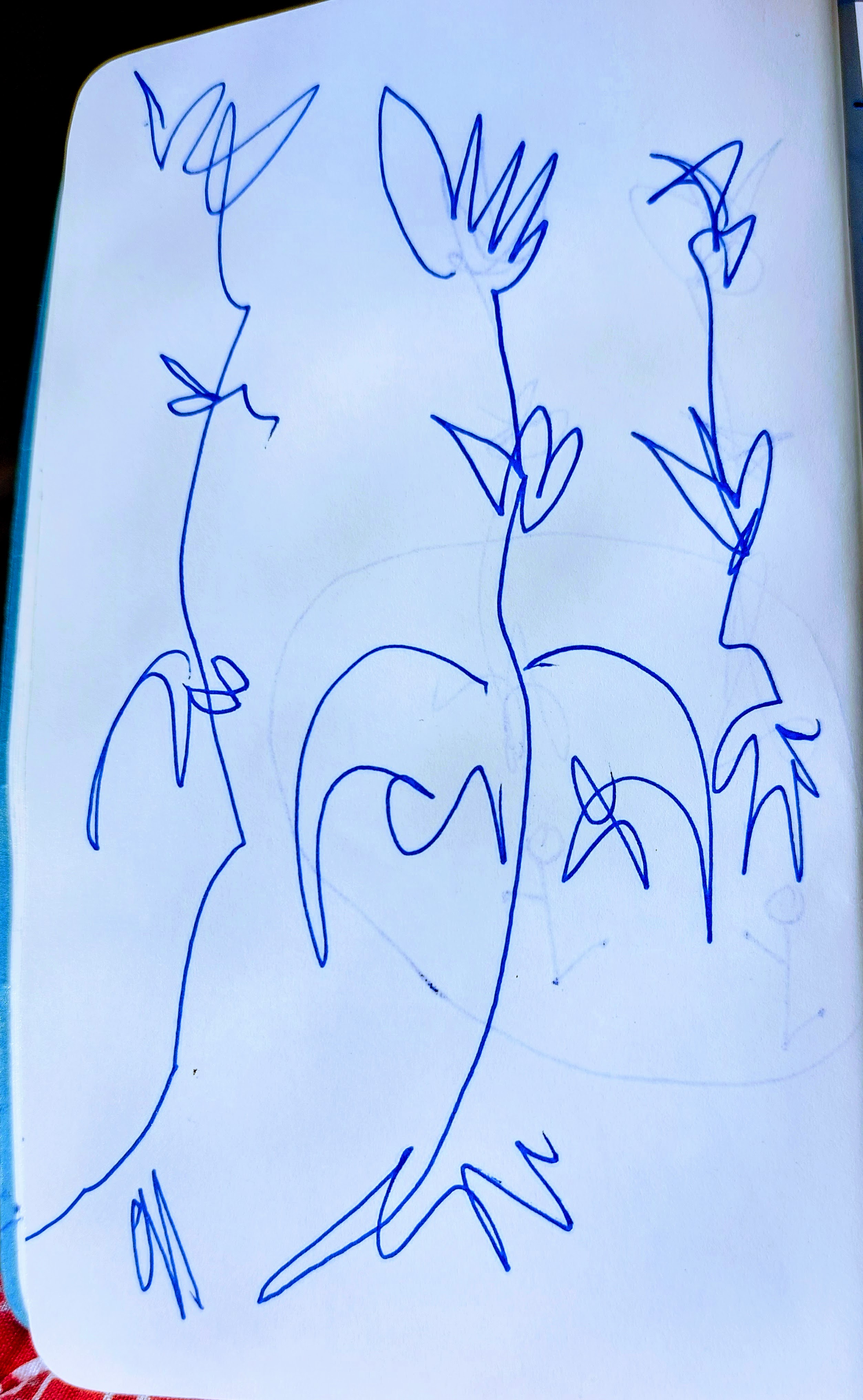
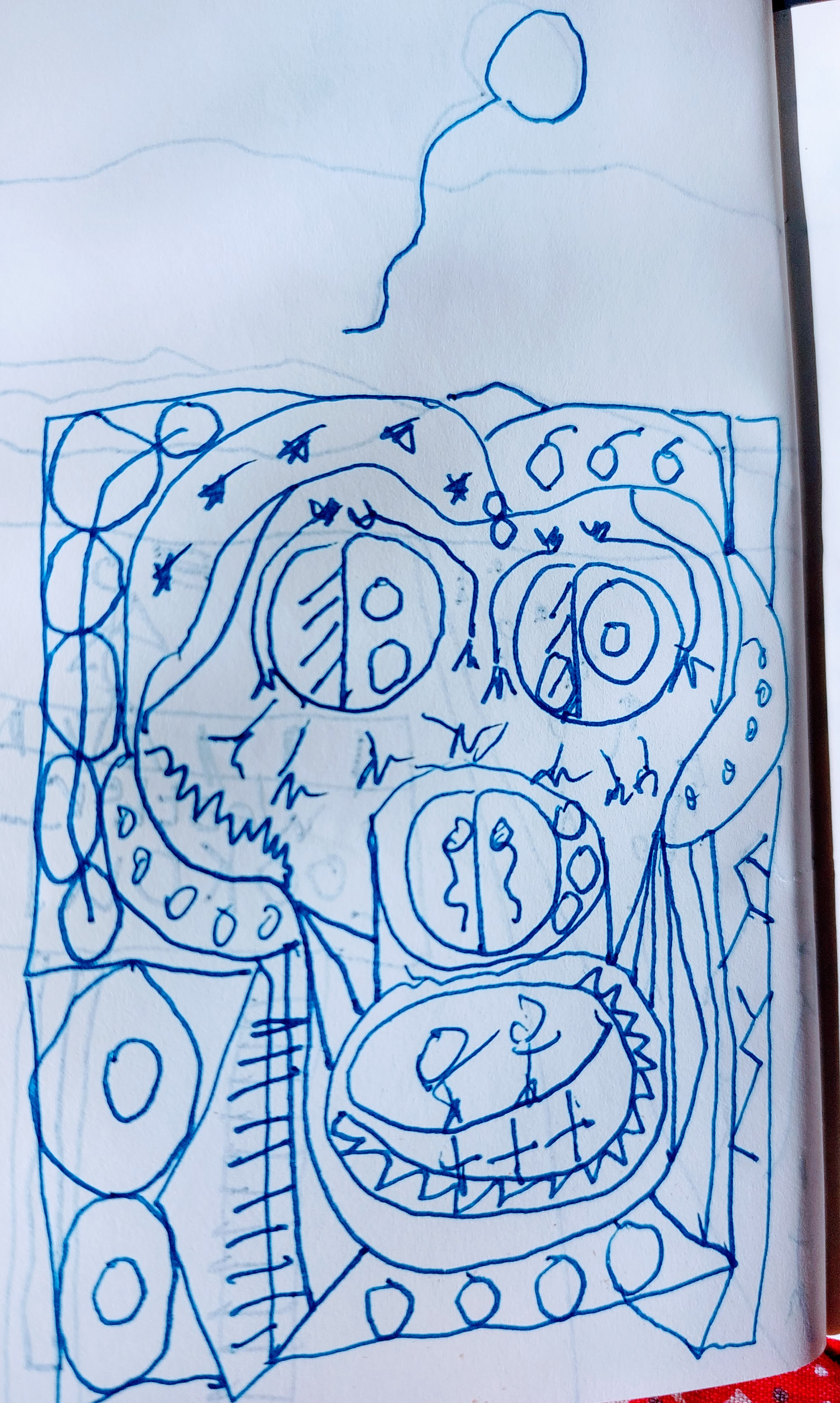
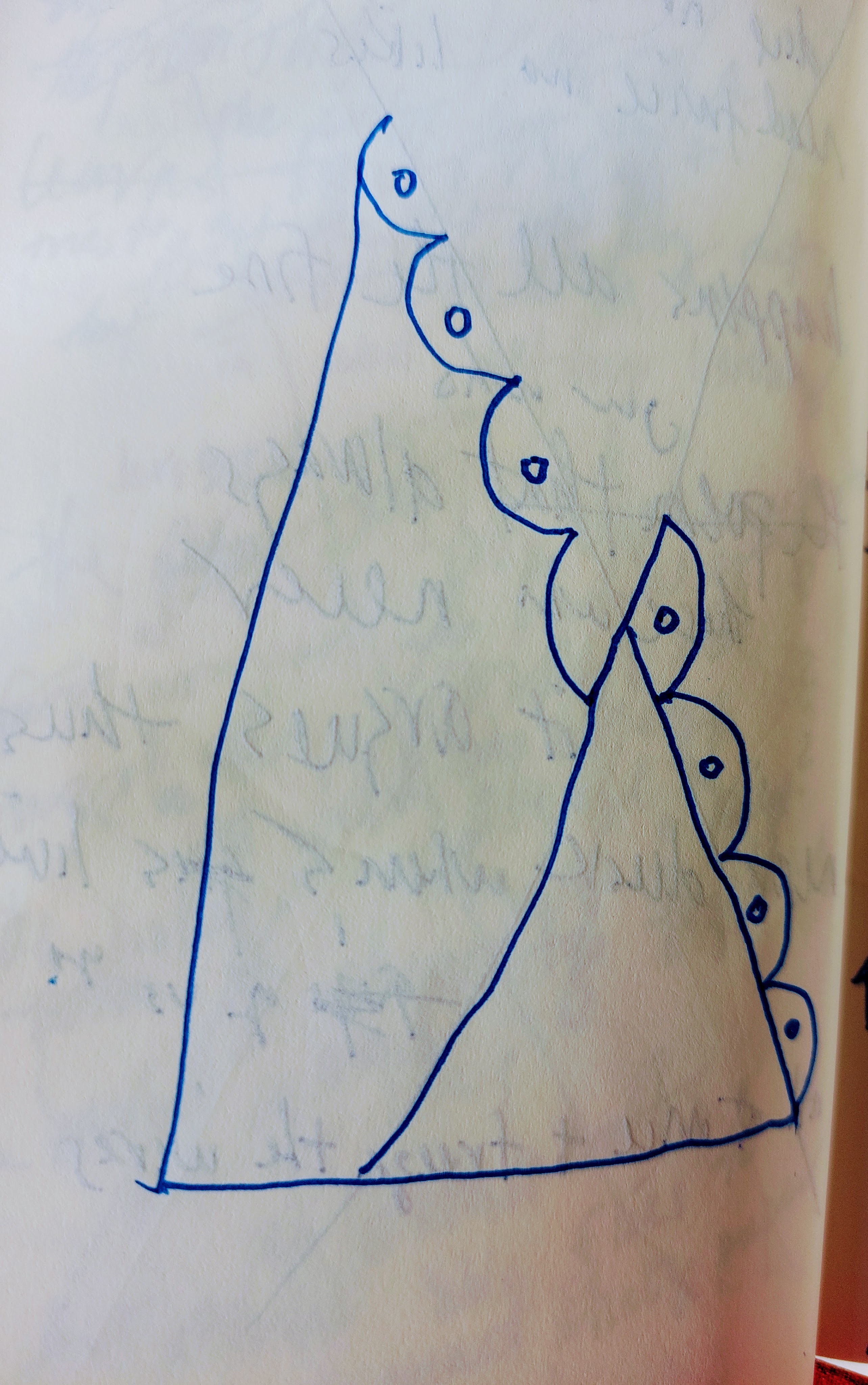
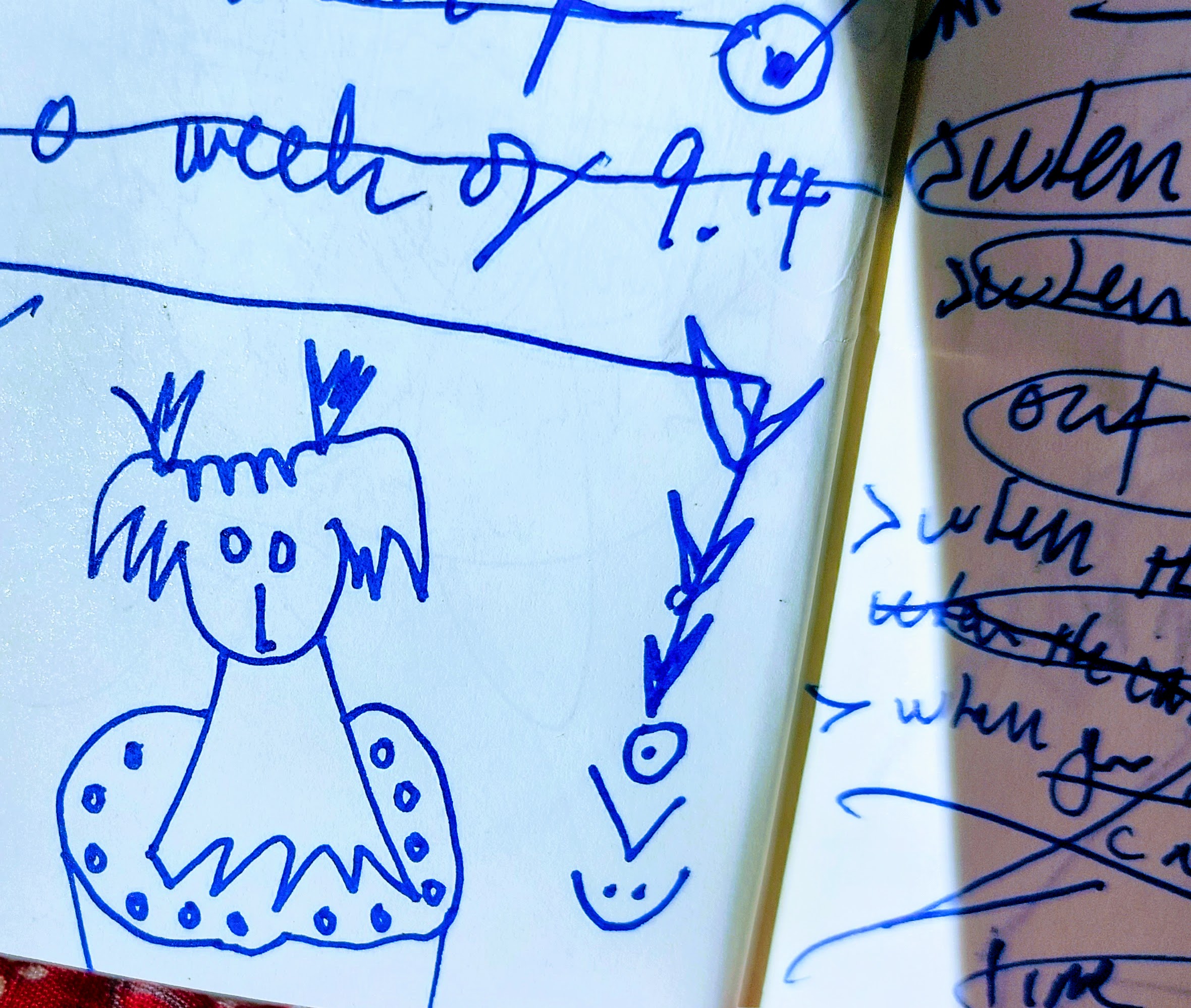
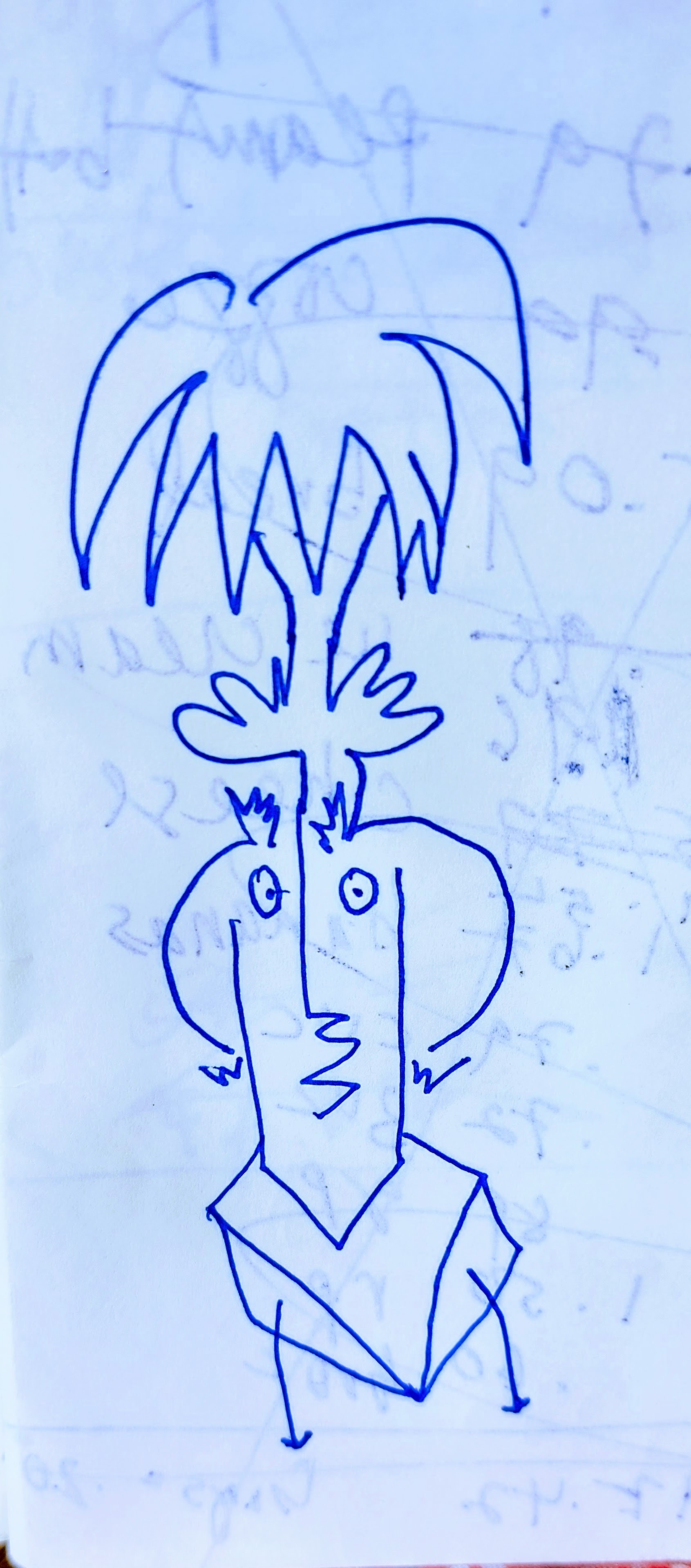
    If they had pen and notebook, maybe they’d doodle:

    If they had a laptop, maybe they’d blog.

  • Nothing in its Proper Place

    Nothing is the proper place of poetry
    the nothing that is and the nothing
    that is not, to slightly misquote Wallace
    Stevens, now nothing but a book on a shelf.

    Things seem round, but close reading
    show oblong, egg shaped, ellipsoid,
    particularly in the topological poem,
    where nothing expands and retracts.

    The universe is a closed knot
    the poet tries to unknot
    to pull his shoe on without
    twisting his tongue.

    Think pretzel, which is non-trivial,
    while the poem is a wild knot,
    unable to untie itself,
    non-rational, but linked within.

    What a mess, and I can’t find
    the beginning of the thread,
    nor the ending, for that matter,
    but incomprehensible I am not.

  • Nothing, Cont.

    Speaking of nothing, Henry Green wrote a novel titled “Nothing” (1950). “Nothing” shares some of the characteristics of the early radio and television soap operas. It’s nearly all dialog; one can’t see the narrator, but the storyteller sees the reader. “Nothing” is about the nothing that is the something at the center of human activity. One forgets the narrator is watching one’s every move. From dialog only the characters are drawn, succinctly and diversely, such is the clarity of their voices – that they talk mostly of nothing is nothing. It only matters what one says. By nothing is not meant something insignificant; on the contrary – it is only through the direct encounter of nothing, where the characters are stripped of all their lies and workarounds, diversions and investments, that the essence of true life is revealed.

    Yet it’s 1948, and these “Nothing” characters don’t seem as affected by the recent war as Barbara Pym’s characters in similar settings. “Nothing’s” John, knowing his daughter Mary “was to be out of London the next forty-eight hours on some trip in connection with her Government job” (133) – but we find out little to nothing about that job or what the connection is. The war of course was an unpleasant affair, its results mostly visible in the everyday details of work-a-day life: the difficulty of finding a suitable flat or flatmate, parsing wardrobes, the reopening of restaurants as places of interest, the local church the center of social, cultural, familial life (think jumble sales, lectures, and clubs of all sorts), and the shortage of marriageable men or men with the proper attitude toward marriage. Thus stripped of diversion and meaningful advertisement these folks on the edge of nothing seem a peculiar precursor to our time when commercialism and popular culture, and the adulation of the famous for being famous and nothing more, seem to reckon yet another coming.

  • What to do

    “Nothing to be done,” Didi and Gogo bicker, essentially about what to do, like an old couple of a long suffering, loving marriage. Nature is no refuge; the one tree in their world seems sick. They can’t go anywhere, for fear of missing their appointment with Godot. They hang out and talk, express various physical complaints, visit the past, ask questions they can’t answer.

    The play, Samuel Beckett’s “Waiting for Godot,” is famously about nothing. Nothing fills the stage, informs the dialog. If they carried cell phones, their batteries would surely be dead. In any case, they’ve no one to call, and no one to call them.

    The two (often described as tramps, bums, or hoboes of some kind, clowns of some sort, lost from their circus, or stripped to being human without diversion down-and-outs) might be among the last few of a pandemic, or simply retired, their pensions just enough to enable them to do nothing but talk freely, which is everything in a world of nothing.

    It’s not easy – doing nothing. Even contemplating nothing can be a nerve-racking business, fraught with anxiety. Consider, for example, what nothing is. Nothing is what is not. In the beginning – well, just before the beginning, all was nought, and from naught came all.

    And it’s not easy doing nothing responsibly. nān thing. And yet, if you make a practice of it, you are called a do nothing. But there is no such thing as nothing. Nature overkills. If the universe is infinite, and the universe is composed of things, there can be nothing within, and nothing without.

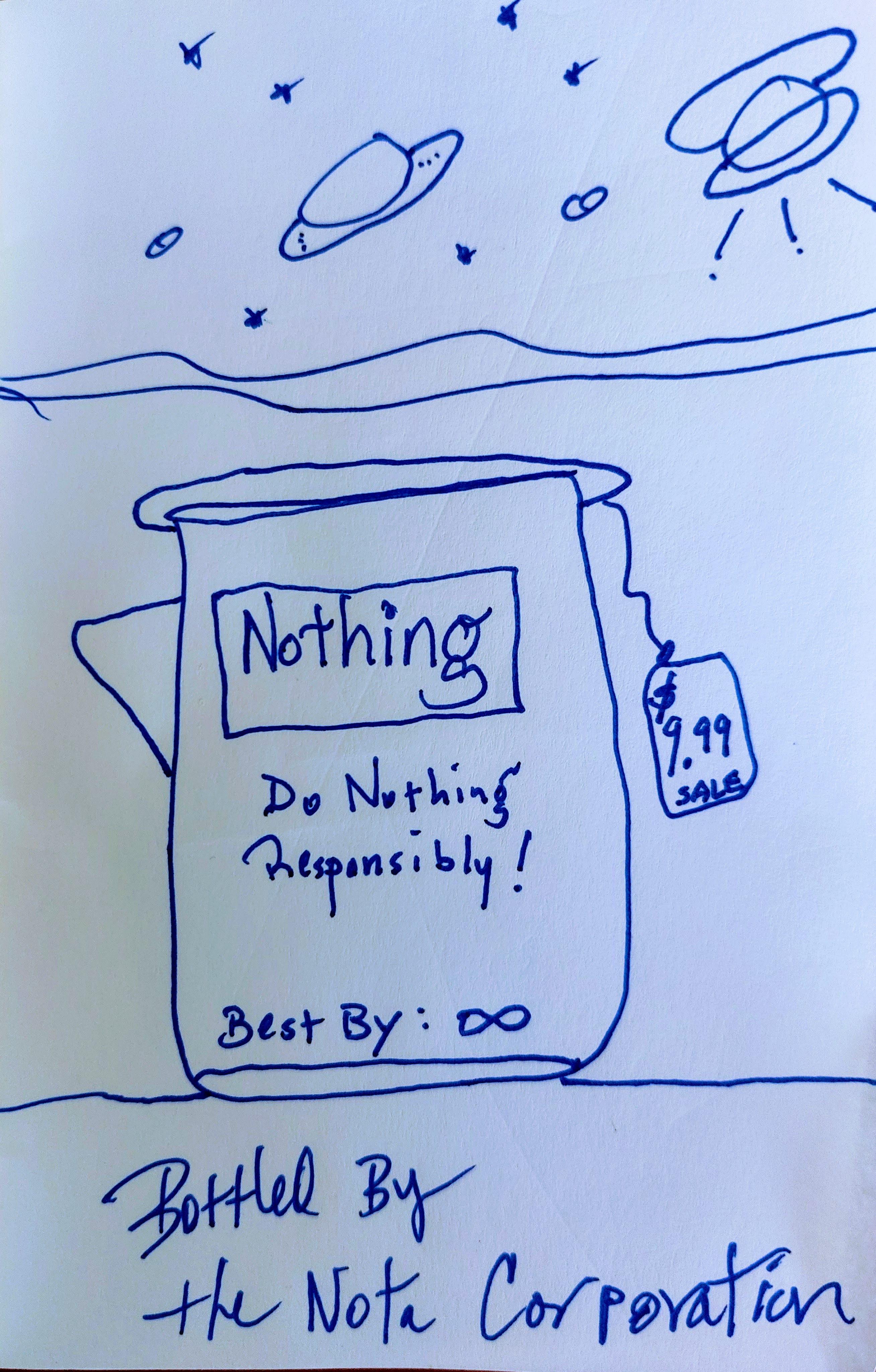
    Consider a bottle out of which you suck everything, leaving nothing, and you cap it, a bottle of nothing. Would it be dark in there? Like dark matter? For if everything is taken out, light too must be absent. If scarcity creates value, what could be more precious than nothing? And Didi and Gogo are its brokers.

  • Alternate Endings

    No end will suffice, not fire nor ice. In the beginning, things started off with a bang, a big one at that, after a night of fitful sleep, though how one measures big in the face of nothing surrounding seems insolvable. In any event, life, what is (the distinction between organic and disparate proven fallacious), now looks to have been without beginning, so a world without end seems fitting. Nevertheless, we begin anew, if not afresh, at the diurnal clarion call. To awake is irreversible, at least for a few hours. Always some remains. And while the Big Pop was the most considerable in several hours, having sunk deeper than one can remember, nothing but whimpering since, awake with the bends. But it won’t finish with a whimper. No end and no exit and no exit and no end: how’s that for the unknotting?

    Up and about, wandering now bottom of bole (trunkus, luggage compartment, the part of a tree above the roots and below the branches). Think Beckett’s “Krapp’s Last Tape,” evening in the future, looking backward. Distribution. Retail branches, manufacturing roots.

    All brick and mortar retail closed, malls emptied – or might as well be, old habits dropped. The only jobs are those deemed essential. Who deems? The Great Deemer. People waiting in long lines to enter the one remaining store where the shelves are empty, just to look around, shopping it’s called, nothing much needed. Staples delivered. The only rigs on the roads these days those doing deliveries. Still, going shopping, something to do. But the shops are all closed, boarded up, a wilderness for the pigeons, cats, possums, racoons, peacocks, squirrels. Even the meek seem to have abdicated.

    The cafes closed, bars banned or pubs perished (though one suspects the Speakeasy may be making a comeback), theatres imploded, churches clapped shut. Schools closed forever. Tested and corporations bid accordingly and draft as needed according to five year plans and instead of schooling what one gets is on the job training: slated for a professional sport, a career in medicine, or a space program. But no one is forced to work. Work is not even considered work, but a fulfillment of a combination of want and need. Consider, if you like, the lilies of the field. There are of course those dirty jobs few look forward to, plumbing and such – but still, “Fair is foul and foul is fair.” What’s to be done? Nothing to be done. But that we do it well, or at least try to.

  • Fit to be Tied

    Some writers, it seems, hard to read, struggle to get a piece going unless they have something to talk about, but something to talk about doesn’t come from the same reservoir as having something to say. Some of our most interesting and arresting writers have written profoundly, enjoyably, articulately, about, by all appearances, nothing. Others wait until fit to be tied with a topic under the acrimonious assumption readers are awaiting their latest culled diatribe.

    Men’s neckties provide rich fodder for topic matter. The tie is a remarkable piece of nothing. The necktie reached a new height with Annie Hall, who looked and moved like she was taking cues from Charlie Chaplin. After Annie Hall, the necktie could only be pastiche and kitsch and irony. But Annie, or Woody, wasn’t the first out of Hollywood to use the tie to say something at once both memorable and forgettable. W. C. Fields, the Marx Brothers, Charlie Chaplin, Buster Keaton – all sported neckties as part of their costume, part of their act. Rodney Dangerfield mastered the wearing of a loose tie, and of using the tie as an expressive prop for his hands. Rodney rarely appeared without a tie, usually wore a red one, and he wasn’t as funny tieless, open-collared. Only with his tie on could he reach the proper level of fit to be tied where his humor worked.

    Donning a tie of course is no guarantee to successful stand-up, won’t necessarily make you funny. On the contrary, ties usually suggest a portent, a serious person. White collar workers wore ties because their work was often so unintelligible and without obvious skill that they needed something to enhance their heft in society. Without a necktie, the white collar worker could easily be mistaken for a bum, someone characteristically out of work. To go on a bummer is to loaf about with no clear or obvious purpose, a near perfect description of the average white collar worker. At the same time, a loose tie, particularly when worn toward the late afternoon, may suggest one has been hard at work. Either that or the office air conditioner is on the fritz.

    The opposite of wearing a tie, if one is out and about, is wearing only an undershirt. The t-shirt was invented to be worn inside, an undergarment, worn under an overshirt, not to be seen. Originally titled “The Poker Night,” Tennessee Williams’s play “A Streetcar Named Desire,” dresses Stanley Kowalski in a t-shirt, hot and sweaty on a humid August Southern night, drinking and smoking, worked up and fit to be tied. Stanley enters, “roughly dressed in blue denim work clothes. Stanley carries his bowling jacket and a red-stained package from a butcher’s.” Tennessee Williams might have dressed Stanley in a tie, had he known more about office workers.

    But it turns out Stanley does wear a tie, has a collection of three. Or maybe we’re confusing the play with the happier ending movie. In any case, it just goes to show anyone can wear a tie, and it means nothing.

  • Too Much of Nothing

    You say too much
    too much you lose
    the way and the
    universe seems
    too much for you.

    Not to make too much
    of this to make much
    of time, of hot,
    of cold, like a year
    in Chicago.

    Say you see
    her eyes move
    like stars way
    too slow and too
    much of nothing.

    20180709_161602