Going about without making any noise is perhaps the most difficult task of our day. If we try to make sense of the noise, we discover music.
I was thinking the blog was a silent activity, but then I began hearing my fingers striking the keyboard, padded notes, which, if given time, could be organized into a piece of music.
The quieter we try to be, the more noise we hear.
We might think of silent noise, tinnitus, for example, an apparent oxymoron, a noise but silent because it’s not really a sound, but simply the perception of sound, hearing a sound that has no outside source. Others can’t hear it, no matter how hard they listen. But they have their own silent noise playlists.
The keyboard went quiet as I reread the above paragraphs. I’m in real time for the moment, but my reader, if there is one, will not be in the same time. Thus the blog is like a recording, but the reader will not be able to hear the keyboard as I type, or as I typed, unless I made a recording.
There are 24 time zones around the globe. They allow for music to occur internationally. But not everyone pays strict attention to the time zones. In China, for example, everyone uses the same time, all the time, regardless of which of the five geographically separated time zones they might be in. What time is it becomes an interesting question, since sunrises and sunsets can occur hours apart, depending on where you are at the time. In other words, to awake at sunrise for one person, could be sleeping in for another, not getting up until noon! For some reason, we try to match our time with the position of the sun. But most people work inside, unlike our ancestors, so what does the sun have to do with it? Circadian rhythms. We can’t hide from the sun.
I’m making a recording now of the keyboard, using my cell phone. Note the pauses, as I try to figure out what to say. The spaces between the notes create music, because they are separated in time (duration). But is there rhythm? The recording has now gone on for just over one minute.
A default has given the keyboard recording the title “Voice 0061.” I’ve tried to upload the recording to this blog post, so readers can follow along, hearing the typing as they are reading the paragraph, but I received a message saying I’m unable to upload the file, to wit: “Sorry, you are not allowed to upload this file type.” Thus we discover that learning to play an instrument is harder than we might think. Undaunted, I’ll now try a video, using the keyboard and my cell phone.
I’ve set the phone against the screen, and I can’t see what I’m typing now, feeling much like the player in a jazz band. But I type on, being video-recorded. I don’t feel much like continuing the experiment, but having pushed on this far, I keep typing. As Cage said, “What we re-quire is silence; but what silence requires is that I go on talking.”1 Similarly, what music requires is that I go on typing. Many mistakes in this typed paragraph, like playing the worong [sic] notes on the guitar or piano, but I’ve gone back and corrected the text, but the mistakes, as recorded, sound just like all the other notes, no problem.
Now I have the video recording on my phone. Because I set the phone so close to my screen, the video is a white grey cloud, but the viewer can hear the keyboard. Now I have to figure out how to get the video from my phone into this blog post, so readers can listen to it as they read along. Alas, I try to email it to myself, but get a Gmail message saying it’s too big a file. Yet it’s only 1:33 minutes.
But you can perform your own keyboard music. All you have to do is type and listen. You don’t even have to type real words, but that should probably be the subject of a different blog post.
John Cage, “Lecture on Nothing” (1959), from “Silence” (First printing 1961. Wesleyan Paperback, 1973). ↩︎
My Heavy Metal brother was here: “… It’s a long, long road, from which there is no return, while we’re on the way to there, why not share?” (Lyrics from “He Ain’t Heavy, He’s My Brother,” by Scott and Russell, and a 1969 soft rock hit by The Hollies). And share we do, for example the “Live at 5” pandemic concerts we played weekly on Instagram Live; by the way, Instagram now limits “live” streaming to Instagramers who have at least 1,000 followers, creating a perceived scarcity – as if anyone watches anything to its end anyway, attention spans diminished as they are these days. So now we record short videos and post them as pre-recorded videos to Insta but also to our YouTube channels.
Anyway, while CB was here, he wanted to do a cover of “Stray Cat Strut,” the 1981 hit by the rockabilly group “Stray Cats.” Mainly, he wanted to try out my Gretsch1, which is good for playing in the rockabilly guitar style. It’s interesting that once again the British brought back a defunct American song style. Rockabilly was a 1950s sound originating in the South by players like Carl Perkins (“Blue Suede Shoes, 1956), Gene Vincent (“Be-Bop-A-Lula,” 1956), Buddy Holly (“Midnight Shift,” 1956), and Eddie Cochran (“Summertime Blues,” 1958). Rockabilly, the word, comes from a combination of the rock in rock ‘n’ roll, and the billy in hillbilly music, a description of mountain folk music, which evolved into country western, but which is still played in its original forms where it’s usually called old-time music.
Though his preferred guitar sound is heavy metal, CB is more of a perfectionist than I am on the guitar or with vocals. He also knows more than I ever will about guitar electronics, pedals, influences, and songs and players of the Metal sound. But I do like a raw sound, and a simple format. The original Buddy Holly and the Crickets, for example, was a simple trio of electric guitar, drums, and a stand up bass, and in those early recordings, you can hear the instruments individually, and it’s not a wall of sound coming at you like an electronic tsunami. Even when the rhythm guitar was added, the sound was still clear and concise. Meantime, volume has reached a reducio ad absurdum in some musical venues and recordings. Ironically, that loudness is often subdued by streaming platforms using loudness normalization.
After CB left, I decided to give “Stray Cat Strut” a go, but after a short while gave up on it, but as I studied it, I found both its lyrics and chord progressions interesting. The cat is a cool cat indeed, and I ended up taking the idea a couple of steps further, into the arena of the absurd, with an anthropomorphic pickup truck the main character. I satisfied myself with a short imperfect recording in a kind of country style, though others may of course have a different view of it. I made two recordings, one with vocal (with the 1970 Yamaha Red Label FG180), the other instrumental (with the Gretsch). Song chords and lyrics below, and link to YouTube instrumental recording at bottom.
Pickup Truck Strut

G7                                      E7
Sitting in a lot watching the lights go by
A7                                   D7
Gas tank on empty, tires pretty much flat
G7                                  E7
Surfboard sticking fin up out of my bed
       A7                     D7     G
I'm an old pickup truck and I got no strut

C7                  B7
Stray cats climbing into my cab
E7                      A7
Kids stealing all of my mooncaps
C7                      B7
I don't take off chasing Chevys in town
E7                     D7
I rumble away from the big city crowd

G7                        E7
Surf guitar playing on my radio
A7                          D7
Stand up bass, high hat and snare
G7                   E7
No red Corvette candy apple chic
      A7                          D7
I got tools and a surfboard in my bed

G7                            E7
Sitting in a lot watching the lights tonight
      A7                D7           G
I'm a used pickup and I ain't got no strut
The Gretsch is a G2420 Streamliner Hollowbody Electric Guitar with Chromatic II Tailpiece – “Village Amber” finish. Year 2021: with Maple Top, Back, and Sides, Nato Neck, Laurel Fingerboard, and 2 Humbucking Pickups. ↩︎
What is sound? Tinnitus, from the Latin for ring or tinkle, we hear in our ears, but its source is not external sound. My own tinnitus is louder in my left ear, and if I try to pay attention to it, there are at least two sounds audible, as if an electronic musical duo is playing in my head. The ringing is enveloped under an umbrella of an engine or fan, or the electric rush of a motor, an incessant susurrus, which is balanced between the ears. The quieter my environment, the louder the tinnitus. Tinnitus is noise that is not sound, and it is a common ailment for those with hearing loss.
My hearing loss, in both ears, worse in the left, probably originating from operating the motor pool compressor truck with jackhammers and other pneumatic tools and from firing weapons without adequate ear protection during my Army days and probably made worse playing music too loud over the years, is now augmented through hearing aids. The current pair are state of the art and include Bluetooth capability, which means I can stream an electronic sound source (radio, TV, computer, phone) directly into the hearing aids. But the sound is not quite natural. I hear it in my head, not in the ears, and not precisely where the tinnitus sounds, but when streaming, the tinnitus seems to turn off. It’s a bit like wearing headphones. It can be somewhat disconcerting.
Often, when I think of sound sans sense, I think of John Cage. Cage was a musician and writer. Piano was his instrument, but he became involved in electronic sound and electronic music – experimental music. Cage’s music might sound like tinnitus to some listeners. But any instrument can grate or creak or be made to scream or moan or laugh or guffaw. Some of the early film cartoons used modern music innovations and techniques. “Modern” music is often characterized as atonal or dissonant, and as technology developed as electronically enhanced. An evocation of emotional turmoil. Turbulence and tohubohu is often the sound it conveys, or that I hear, which of course are two different things. In any case, what I’m still calling modern here is actually now quiet old.
What are the differences between noise and music? What is the relationship between sound and hearing? We might spend a few big bucks on music sound reproducing equipment (stereo, speakers, etc.) for home or car. The louder, it seems, the better. But when heard live at a concert, the sound may seem radically altered. And the listener in a front row seat hears a different concert than the listener in the back row, upper level, even if they’re in the same hall at the same time for the same music. In music and in conversation clarity is probably the most important attribute to one hard on hearing. It’s not that I can’t hear, but often that I don’t hear clearly. Increasing volume doesn’t necessarily add clarity. It just adds noise. Cage might say, what difference does it make? Listen to what you hear and disregard the rest. And music is not words.
“Music as discourse (jazz) doesn’t work,” Cage said. “If you’re going to have a discussion, have it and use words. (Dialogue is another matter.)”
John Cage, A Year From Monday, Wesleyan, 1969, page 12, from Cage’s ongoing “Diary: How to Improve the World (You will only Make Matters Worse)” 1965, which was taken from the magazine Joglars (Vol. 1, No. 3, 1966), where it was presented as: “a mosaic of ideas, statements, words, and stories. It is also a diary.”
What did Cage mean by distinguishing dialogue from discourse? Dialogue is conversation, conversational. Discourse is debate, to run away from. Dialogue is theater. Discourse is lecture. Discussion is an investigation. We are using words; no help, no matter how loud.
Some sounds are empty. What does that sound like? Jazz guitarists speak of getting a hollow sound or tone. One of the John Cage books is titled “Empty Words” (Wesleyan, 1981). “Most of the material in this volume has previously appeared elsewhere,” the listener is told. Where? Sound is ubiquitous, everywhere:
“Wherever we are, what we hear is mostly noise. When we ignore it, it disturbs us. When we listen to it, we find it fascinating. The sound of a truck at fifty miles per hour. Static between the stations. Rain. We want to capture and control these sounds, to use them not as sound effects but as musical instruments.”
“The Future of Music: Credo,” from Silence, John Cage, p. 3, Wesleyan 1961, 1973.
Capture this, from the opening section to Thomas Pynchon’s novel Gravity’s Rainbow (Viking, 1973):
“A screaming comes across the sky…He won’t hear the thing come in. It travels faster than the speed of sound. The first news you get of it is the blast. Then, if you’re still around, you hear the sound of it coming in.”
page 3, then 7
The reader is in London where the German V2 rockets, travelling faster than the speed of sound, hit the ground and explode before anyone hears them coming. Before Pynchon’s novel begins, then, an explosion has occurred. Or not, maybe one lands a dud.
In Coleridge’s poem “The Eolian Harp” (1795), the instrument sits on an open window ledge, where an incoming breeze stirs over the strings, making music. How improvised is that! One would need super sensitive ears to pick up such wispy sounds.
…the world so hush’d! The stilly murmur of the distant Sea Tells us of silence.
…Where the breeze warbles, and the mute still air Is Music slumbering on her instrument.
The wind as guitar pick.
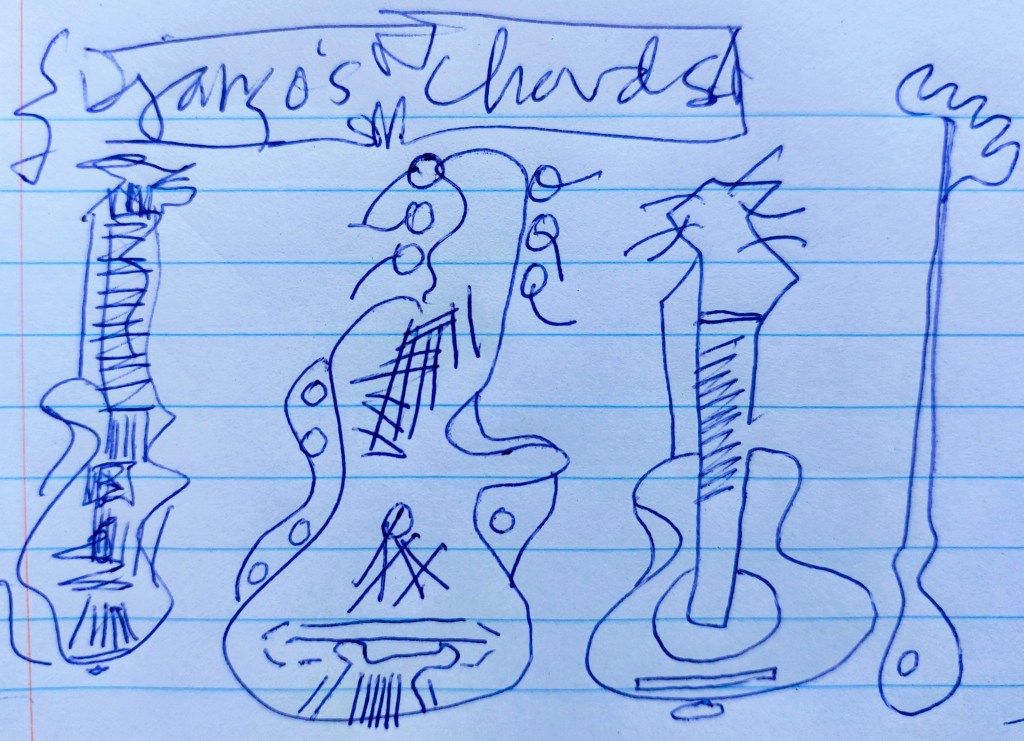
I’ve been playing Gypsy-Jazz guitar lately, by which is usually understood playing in the style created or formalized by Django Reinhardt and his peers and followers. The style is characterized by the use of a different kind of guitar from the classical guitar popularized by guitarists like Andrea Segovia and Julian Bream. They played on a 12 fret neck fitted with catgut and then nylon strings in the treble and silk then nylon wound with metal in the bass. Other differences might include a shorter but wider neck, a smaller box, different woods and internal bracing techniques. Different from what? Basically from the all metal, louder string guitars developed later – what has come to be known as the western or folk guitar, and is used in blues, bluegrass, folk, country. But the Gypsy-Jazz guitar is a different instrument still.
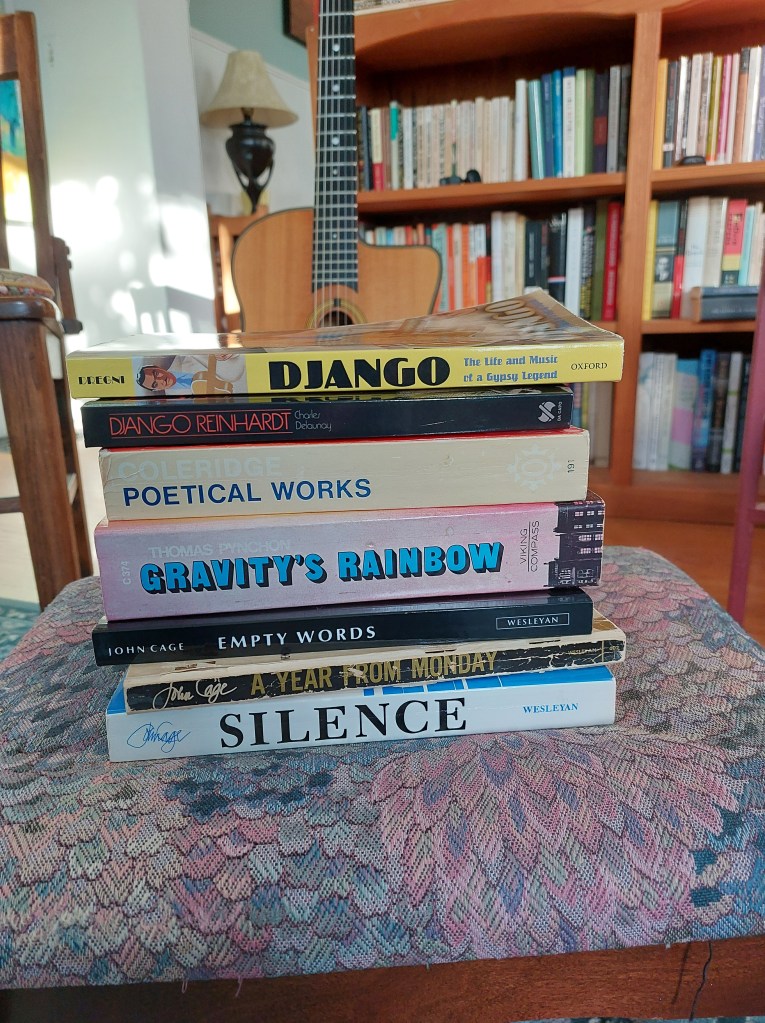
The Gypsy-Jazz (also “jazz manouche”) guitar is louder, played with a guitar pick rather than the fingers with fingernails, has a longer neck, so a longer scale length, and all metal strings. Most importantly, it’s not a solo instrument. It’s designed to be played in a small combo, usually consisting of at minimum two guitars, and often with stand up acoustic bass, violin, clarinet, accordion, and vocalist. Django played in noisy dance clubs before the advent of amplifiers and electric guitars. He needed an acoustic guitar that would project over the racket and clatter and sound in sync with the other instruments. Readers interested in learning more about Django and his music might read Django Reinhardt, by Charles Delaunay, 1961, Da Capo Press, and Django: The Life and Music of a Gypsy Legend, by Michael Dregni, Oxford, 2004. Briefly, it’s told that Django, born in poverty and coming of age without any kind of formal education, learned to play violin, banjo, banjo-guitar, and guitar. By the time he was 18, he was playing in bands in Paris and making money. Then he burnt his left hand badly in a fire in the caravan. Recovering, he taught himself to play the guitar anew, using mainly just two fingers from his left hand to fret the notes and chords, developing an entirely new technique. Thus began a new style of playing guitar that has influenced just about every guitarist of all genres since and still begs to be mastered even by those with all their fingers playable.
When asked if he admired Django Reinhardt, Julian Bream said:
“Oh sure. And I played plectrum guitar up to the age of 21, I played frequently in a dance band in the Army. And, yes, I loved playing jazz guitar, but not as a profession, just for fun. You can’t mix the two. I can remember playing steel-string guitar for dances, and it just ruined the sensitivity of your left hand. And I was playing rhythm guitar with big six-string chords all night long. It was a knucklebender!”
“50 Years on the Planks: Julian Bream Talks About His Life and Work,” Classical Guitar October 1996. Retrieved 4 Mar 24.
I’ve been working to play Gypsy-Jazz style without a plectrum (guitar pick), so fingerstyle, with fingers and fingernails, which some say is not only unorthodox but impossible – to play in the Gypsy-Jazz style of Django. I use a thick gauge string on a Saga Gitane DG-250M model, which I purchased used not long before the pandemic broke out and then had to quit the group workshops I’d been attending. The thicker strings compensate for the lack of pick. I’ve just always played with my fingers, hardly ever flatpicking. And I’m not playing dance halls these days, more like a lute in an open window.
Gitane DG-250MConcert ReadyAmerican GothicDjango’s ChordsGuitar LandBooks referenced in this post.
When sound is noise that murmurs gurgle and talk crabbed rambles and gabbles When susurrus of water shuts off clang bang and no breeze blows blossoms and all fall long leaves crisp prematurely dull and grey When thoughts are crickets in a dark repeat and inanimate objects won’t cooperate When strings stretch and snap out of tune and ears fill full of hardened yellow wax Then it’s time here for a nap or a blue beer for there’s been a near miss missio dear.
A house down around the block is getting a new roof, hammers echoing like giant flickers. Since the big virus outbreak the neighborhood seems quieter, fewer cars speeding up the bumpless street, the park above closed to the outdoor concerts, though a few bicycle races and random music groups have come and gone. We frequently hear music though, through the trees, over the roofs, through the backyard fences, but can’t always be sure of where the sound is coming from. No fireworks this year. Not a single yard sale. But some noise seems louder, the trash trucks on their weekly binge, the mailman at the mailbox, the yapping yellow dog behind and a yard over, skateboards, our tinnitus.
A loss of sound seems paradoxically to quicken our sense of hearing. That is dynamics, change in pressure and temperature, frequency and consistency. Some sounds we don’t hear until they go silent. Sound can baffle, bounce around dancingly. If you’re uncertain where a sound, particularly a voice, is coming from, the disorienting distraction bewilders. Just because you don’t hear a sound doesn’t mean you can’t feel it, its pressure in your ears, resounding around your head. Likewise, you might hear voices, but the words lack clarity, and you can’t make out what’s being said.
Some sounds are tight, other loose fitting. A flash flood of sound leaves a wake of mud. The beginning of rain drips into the ears, like its relative petrichor, that newly wet earthy scent in the nose, a slow awakening to something that’s been asleep for a long time and is now looking for a new bed to spend the night, one of your ears unfolding asymmetrically.
The past is not enough to live on
to make ends meet.
what test passed avoids stays
to wheedle this incessant urge
past the tinnitus still sings proof
below like wave bounce go easy
under the sheer cliff and around
the mossy point to the bay
where the dolphins play
but the past is not enough to live on
you say and you say things like
anyway the sea is calm tonight
and you need to calm down
and relax we are past all that
pother the rigmarole accoutrements
impedimenta odds and ends
ins and outs no you need
to cool off i’m sorry if you are
disappointed but you see
how tranquil this palaver
becomes us as we unbend
and are made drowsy
not dreary but like
drizzle after a wave breaks.
John Cage dedicated his lectures and writing collected in Silence “To Whom It May Concern.” As it turns out, it concerns everyone, though most of us do our utmost to ignore it. Yet Silence is still in print, and the amorphous, variable audience Cage invoked in his dedication continues to grow. But if we can’t ask anything specific about Cage’s intended audience, can we at least ask, what is it that may concern us? When asked what Cage’s Silence is about, I usually say it’s about composition, the way we arrange things.
A recent neighborhood atlas project by students in the CAGE Lab (no relationship to John) contains a noise map of San Francisco neighborhoods. The atlas is a form of composition, an arrangement of nouns and verbs and objects, labeled to “tell different stories.” A map is a composition. Noise is usually heard symmetrically, but some in the audience may hear asymmetrically; concentric noise, proceeding in wave-circles, gets confused, as sound bounces and ricochets (gives and takes), pouring into one ear, squeezing into another. Composition is dynamic; silence is static. Sound is not linear (line-ear).
jOhN cAGE was born in 1912, and there’s much ado about his 100th birthday year at the John Cage site.



 The Coming of the Toads