Sketches from the edges of notebooks, nine images under a thematic title.
This week’s theme, cafes, is taken from Hemingway’s short story titled “A Clean, Well-Lighted Place,” in which two waiters, one younger and complaining, the other older and empathetic, wait to go home while a lone customer, an old man, lingers on, drinking.
Click anywhere in the gallery for scroll and captions.
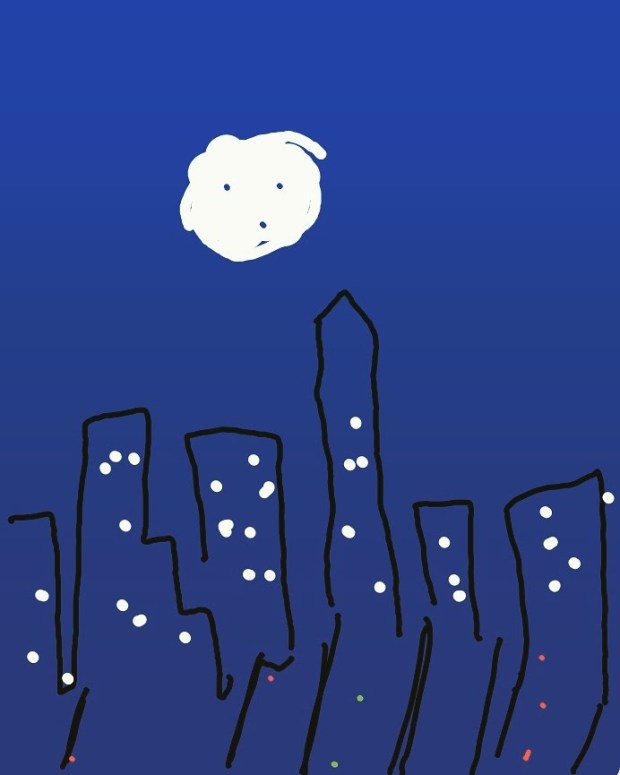
There’s a full moon this week, the daytime temps near 100, so we’ve been out walking late, out for some cooler air, the house so hot. A while back I made a playlist of songs with the word moon in the title:
It’s Only a Paper Moon, Moonlight in Vermont, Moon River, Fly Me to the Moon, Moonglow, Paper Moon, Moondance, Moonlight in Vermont, Havanna Moon, Blue Moon of Kentucky, Blue Moon, Polka Dots and Moonbeams, The Moon Song, By the Light of the Silvery Moon, Moonlight Serendade, Moonlight Becomes You, No Moon at All, Oh You Crazy Moon, Shame on the Moon, Walking on the Moon, How High the Moon, When My Moon Turns to Gold Again, Au Clair de la lune, The Stars the Night the Moon, Shine on Harvest Moon, Harvest Moon, Moonlight (Claro de Luna).
When we got back from our walk I played a few of the moon songs on the acoustic guitar. Still later, still unable to sleep, I got out of bed and from the open window took a photo of the moon. There’s nothing special about that photo, taken with my cell phone, of the moon over the fir trees over the old they say extinct volcano in the city.
“Ah, they’ll never ever reach the moon, at least not the one we’re after,” sang Leonard Cohen, in “Sing Another Song, Boys” (1971), which doesn’t have the word moon in its title, so it didn’t make the playlist.
Things appear different at night, are different. There are so many distractions during the day, chores, reels, but it’s different at night.
“It’s easy to be hard-boiled about everything in the daytime, but at night it is another thing,” says Hemingway’s Jake Barnes, in “The Sun Also Rises,” from 1926.
But a full moon can take the edge off of things at night, soften the heat. Draws you up. And besides, unlike Hemingway’s Jake, lately I’ve been looking forward to the night, a book waiting on the nightstand, moonlight streaming through the open window, lucky to have Susan by my side, not having Jake’s problem, my playlist of songs with moon in the title streaming in the kitchen earlier while I put together something cold for dinner, playing in my memory. Memories of the Moon. Moon Momentoes.
And you don’t want to go getting too literal about it, so-called science of the thing, the light of the silvery moon, how it’s dead, and it doesn’t really have its own light, but is simply reflecting the sun. The mechanics of the thing. There you go again. See, you’ve ruined another night. The moon is a cartoon.
Midnight likes to hang out all night long with a puss in boots on every block flight finally comes home climbs the fire escape out back: good morning, Midnight.
There’s a noisy argument over in Flat 3 Midnight’s up reading “The Life and Adventures of a Cat” (1760) about some tomfool caterwauling tom-tom tomcat.
Now in the Cat, there appears the utmoſt auſterity, with the greateſt levity. ‘ A rake and a ſenator are moſt wonderfully com pounded. Who can analize theſe differing ingredients, fo demure a puritan on ſudden, verted into the moſt abfolute de bauche ? One time ſitting for four or five hours in the attitude of ſo lemnity, and then on a ſudden break out into the moſt diffolute feſtivity . Theſe qualities, ſo diffonant, ſo ve ry oppoſite to each other, muſt in dicate ſomething ſuperior in the animal, whoſe hiſtory wewe are at preſent writing, and we think we have proved this ſuperiority of the Cat.
THE LIFE AND ADVENTURES OF A CAT. LONDON: Printed for WILLOUGHBY MYNORS, in Middle- Row, Holborn. M DCC LX.
Just so, we find ourself at odds with our other selves at times as docile as the doe in the meadow the morning dews and sunup
rough-hews the tousled covers the well worn silver curls one dare not come near at this late hour the abode dark and quiet.
Then again after a rest resumes the sounds that do attract the rooster in the cat to come closer claws retracted mewing.
Thus we speak of night and day and the contraries of our natures the desire to lose ourselves we so deliciously have cultivated.
Day ends with a walk to sleep, ends again in the sober reality of celestial shade, one awakes in the dark and quiet, too early to get out of bed, too late to start some new episode on the television or telephone, and this is when one turns to paper and words seep out shy and uncertain fearful like little furry animals searching the brambles for food and drink day’s fire now cool ashen, and while certainly somewhere in the city of night madness drones on, an asocial tinnitus, here in the paper we find we can hear the pencil’s breeze and feel the bluish-gray lead lighten.


 The Coming of the Toads