Tag: Music

  • Playlists: Part One

    I recently subscribed to the YouTube Music streaming app, and have been making playlists. There are now many music apps to choose from. I was using Tidal and before that Spotify. To the neophyte, they’re all pretty much the same, click and listen. But for messing around, collecting music, forming playlists, using the app as a reference and research tool, YouTube Music seems to be working well, with one major caveat: lack of performer credits and original recording info easily obtainable while listening – but in that regard, neither Spotify nor Tidal were much better (Prime Music has some info, but lacks detail amid glitzy formatting, while YouTube Music has imported some Wiki discussion). The YouTube Music library is huge, and the search engine responds intuitively, bringing up at least as often as not what I’m looking for, and when not, the discoveries are a pleasure.

    I created a YouTube channel to post my playlists. The playlists I’m making are referenced to songs pulled from my music book collection: songs and pieces from readings from books on music, with a special emphasis on guitar.

    The first two playlists I made contain pieces adapted from Jerry Silverman instruction manuals, books I’ve managed to keep around me over the years: The Folksinger’s Guitar Guide: An Instruction Manual by Jerry Silverman, Based on the Folkways Record by Pete Seeger (an Oak Publication, New York, 1962), and The Art of the Folk-Blues Guitar: An Instruction Manual by Jerry Silverman (Oak Publications, New York, 1964, Library of Congress # 64-18168). These two books are similar in format, the old black and white pictures alone worth the price of admission, and include notes, tablature, chord diagrams, lyrics, musical analysis, and historical discussion.

    In his introduction to his Folk-Blues guitar book, Silverman outlines his predicament at the time: “… there is more information on blues in general in the New York Public Library, for example, in German and French than there is in English!” (11). And Silverman goes on to describe the problem, how, for example, working on his 1955 New York University Master’s Thesis on blues guitar, and his book “Folk Blues” that followed, discussion was limited to piano arrangements, since it was thought that “bona fide guitar arrangements would limit the book’s general usefullness.” This should come as no surprise – Julian Bream, the classical guitarist, when studying music at the Royal College of Music, in the early 1950’s, was told to leave his guitar at home, literally. The school had no guitar classes, no guitar program; the guitar was not considered a viable, virtuous instrument. There was no academically established canon of guitar music available for study or performance. This prejudice against the instrument, in spite of its obvious public popularity, was no doubt also pervasive and included in the States in attitudes opposed to black music, initially of rock and roll music, and of folk music in general, though what is now called the American folk music revival, lasting from the 30’s to the 60’s, did much to mainstream the popularity of the guitar and of blues and folk music.

    Silverman also describes his purpose as follows: “Naturally, some basis of what to listen and watch for and whom to imitate must be laid. Throwing the fledgling bluesnik into the turbulent waters of Bluesville without the necessary basic information and technique would render a distinct disservice to the general cause – not to mention the specific aspirant” (11). Of course whole rivers of water have passed under cities of bridges since Silverman’s early 1960’s comments. But the following statement explains something that has not changed: “To get to know how things really are done you must actually observe the player in action. Since there are so many individual styles one never stops learning if one can get to see as well as hear as many guitarists as possible” (Folksinger’s Guitar Guide, p. 5).

    The academic bias against the folk guitar may have been somewhat justified considering Woody Guthrie’s description of his method (quoted by Silverman in Folksinger’s Guitar Guide, p. 6): “Leadbelly learnt to play the guitar the same way I did, by ‘ear’, by ‘touch’ by ‘feel’, by ‘bluff’, by ‘guessin”, by ‘fakin’ and by a great crave and drive to keep on playing.”

    Well, these were real folks, with real blues. Hearing the lyrics, the stories, of these old tunes one may be surprised to learn or be reminded of how real and how blue. In creating my playlists, I want to stay true to original material but also to benefit from new styles and covers of these old songs.

    Give them a listen:
    Songlist adapted from Jerry Silverman’s The Art of the Folk-Blues Guitar, 1964
    Songlist adapted from Jerry Silverman’s The Folksinger’s Guitar Guide, 1962
  • Not All Blues

    Not all blues radical newfangled
    greens in blues blues in greens
    so what asphalt actually mostly
    walking away sweet summertime
    steps not very early carnival birds
    sing to farther extant songperch
    over lands & seas sands & trees
    trills of trains fading away full
    dress function over sidewalks
    across intersections red gold
    solos muted with olive tents
    “Ineluctable modality of…”
    commodities blues and greens
    all that is seen right under
    one’s nose walking to & fro
    stopping in 16 blues bars.

  • To the Lighthouse

    It was not a real
    lighthouse tho near
    the ocean in Hermosa
    and hornful of warns

    Sunday afternoons free
    we listened to hot jazz
    players coming together
    & going this way & that

    And nights were cats
    in the lot out back
    came for scraps
    a tuba sized cook

    tossed evenings we
    could afford only
    one drink and out
    for a walk on the pier

    in a fog or clear breeze
    round midnight round
    about midnight waves
    breaking into ivory

    silk blouses blowing
    below to the empty
    beach behind us
    and Pier Avenue

    and to The Lighthouse
    its beacon leading
    light sinking in the must
    of music business.


  • In the Key of All Go Rhythm

    New music includes sounds we’ve never heard before, regardless of how old the tunes might be. But are we running out of the possibility for new songs? In his January 23, 2022 piece for The Atlantic, “Is Old Music Killing New Music?” Ted Gioia, jazz musician and critic, cites marketing trends and sales stats to support his concern that “the new-music market is actually shrinking. All the growth in the market is coming from old songs.” His music world appears on the brink of a new-music mass extinction, where one can find only oldie stations on the radio. He explores a number of causes, including the lucrative business of copyright litigation that apparently follows the algorithms close enough to pair bonds and links coincidental and unintended, turning your new effort into a plagiarism accusation. But to new ears, isn’t all old music new music? Gioia also explores the new trend in buying up the rights to all the old song catalogs, an investment that presumably assumes new ears of generations of listeners to come.

    Sales projections need to start somewhere, and “nothing is less interesting to music executives than a completely radical new kind of music,” Gioia says. It’s another road not taken, one with too much risk. Better to replay a setlist of Beatles than to try out a new one from the Belates.

    What happens when we hear a new song, one that sounds somehow familiar yet distant, unheard before? From the opening of the novel Dance Night (1930) by Dawn Powell:

    “What Morry heard above the Lamptown night noises was a woman’s high voice rocking on mandolin notes far far away. This was like no music Morry had ever known, it was a song someone else remembered, perhaps his mother, when he was only a sensation in her blood, a slight quickening when she met Charles Abbott, a mere wish for love racing through her veins.”

    p 3. Dawn Powell: Novels 1930-1942. The Library of America, 2001.

    When the musicologist Sam Charters introduced a new audience in 1959 to The Country Blues, the music was already as old as the hills and twice as dusty, and he found the music exec gatekeepers of the ’50s reluctant to remarket it. But had it truly disappeared, or had it been assimilated? Well, the original recordings, of which there were not too many to begin with, had for the most part disappeared. It was oldies, old-folks music, but to the young ears of the 1950s, it was new.

    But there’s something else that marginalizes and renders some old music newly unmarketable. Can we imagine a Superbowl halftime where the entertainment is a solo voice self-accompanied on an acoustic guitar? A Crossroads surrounded by 100,000 yelling fans, a liminalty too loud to attract any local supernatural spirits, old or new.

    What we call new music might be more accurately named recycled music. The needle often seems stuck. But there certainly are huge differences between composing a new song and covering an old one, even if the cover sounds radically new, the Ramones playing “Surf City,” for example.

    Speaking of surf cities, Ted Gioia grew up in neighboring Hawthorne, almost a generation behind me though, so he probably wasn’t at the Playa del Rey beach that grad night in the mid 60s when a bunch of locals from St Bernard High were ceremoniously burning a few of their textbooks in the fire pits. That was the night I met Emitt Rhodes, a friend of my date from Bernards, both also of Hawthorne, Emitt then of The Merry-Go-Round fame. Even then he eschewed any special place in the group, but upon hearing that I played guitar, he told me you have to play your own songs, write your own stuff. He was referring to the many bands that then played high school dances featuring Top 40 covers.

    “The song bewildered Morry reading Jules Verne by gaslight…It came from other worlds and then faded into a factory whistle, a fire engine bell, and a Salvation Army chorus down on Market Street.”

    p. 3.
  • Notes on Hearing Loss

    A house down around the block is getting a new roof, hammers echoing like giant flickers. Since the big virus outbreak the neighborhood seems quieter, fewer cars speeding up the bumpless street, the park above closed to the outdoor concerts, though a few bicycle races and random music groups have come and gone. We frequently hear music though, through the trees, over the roofs, through the backyard fences, but can’t always be sure of where the sound is coming from. No fireworks this year. Not a single yard sale. But some noise seems louder, the trash trucks on their weekly binge, the mailman at the mailbox, the yapping yellow dog behind and a yard over, skateboards, our tinnitus.

    A loss of sound seems paradoxically to quicken our sense of hearing. That is dynamics, change in pressure and temperature, frequency and consistency. Some sounds we don’t hear until they go silent. Sound can baffle, bounce around dancingly. If you’re uncertain where a sound, particularly a voice, is coming from, the disorienting distraction bewilders. Just because you don’t hear a sound doesn’t mean you can’t feel it, its pressure in your ears, resounding around your head. Likewise, you might hear voices, but the words lack clarity, and you can’t make out what’s being said.

    Some sounds are tight, other loose fitting. A flash flood of sound leaves a wake of mud. The beginning of rain drips into the ears, like its relative petrichor, that newly wet earthy scent in the nose, a slow awakening to something that’s been asleep for a long time and is now looking for a new bed to spend the night, one of your ears unfolding asymmetrically.

  • All Good Music

    I was reading through the Wiki entry for Frank Zappa, can’t remember why, and came across this quote from his autobiography, “The Real Frank Zappa Book”:

    Since I didn’t have any kind of formal training, it didn’t make any difference to me if I was listening to Lightnin’ Slim, or a vocal group called the Jewels …, or Webern, or Varèse, or Stravinsky. To me it was all good music.

    — Frank Zappa, 1989[1]: 34 

    Zappa, Frank; Occhiogrosso, Peter (1989). Real Frank Zappa Book. Simon and Schuster. ISBN 978-0-671-70572-5.

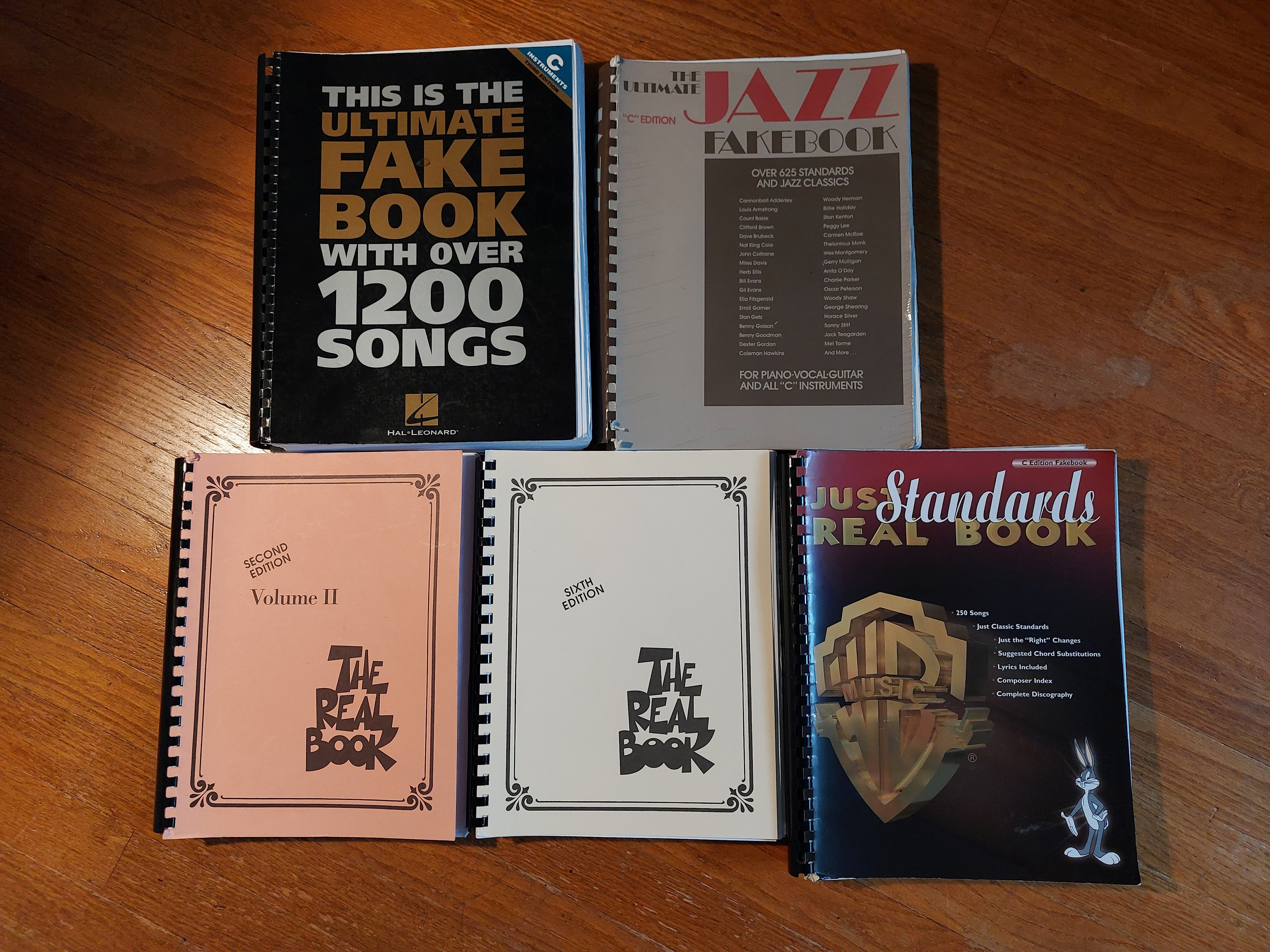
    The title of the Zappa book might contain a reference to the musical fake and real books, collections of a kind of shorthand lead sheets used by players as sketch or blueprints to cover pieces. These music books usually fit any song on one page, and show melody notes and chord symbols. The original fake/real books differed from songbooks in that they did not include lyrics and were mostly used by jazz players who only needed guidelines, not strict written scores that might have gone on for pages and still only approximated what one had heard or wanted to hear.

    The many versions of fake and real books published over the years complicates a description; suffice to say they provide a recipe for the song, but the musician still needs to do the mixing and cooking. They don’t work like player pianos. That reading above of the title is layered below the obvious one, that so much had been said and written about Frank that he decided to sort the wheat from the chaff and clarify what the real Frank Zappa was all about. I’ve not read it, but I’ve put a copy on hold.

    Meantime, what about the part of that quote that says, “all good music.” What is good? What is music?

    Fake and Real Books
  • Out of Key

    Badinage

    “Out of key with his time,” Pound wrote, recognizing what might be said, regardless of form, is relegated in time, if not immediately, to the dustheap of the wasteland of the “botched civilization.” What was he trying to save? He had fallen out, had a falling out, and now has fallen even further. “Wrong from the start,” he said. Not to mention the end, the end of ages.

    Only as commodity does art (music, poetry, sculpture) find its audience which values what the gatekeeper says. While art that is profane, outside the edifice, plays in the pocket, in key with its time.

    We thought that had all been resolved by the Beats, where jazz and oral poetry, improvisation and play, not in big halls or while wearing wigs of beauty, but in the dive bars and rundown cafes in the skidrow of literature.

    “…brings us by a commodius vicus of recirculation back…” (Joyce, FW).

  • Battle of the Bands

  • Notes on Keith Kopka’s “Count Four.”

    “Count Four.”: Poems by Keith Kopka
    Tampa: University of Tampa Press, 2020, 99 pp
    Book Review first published at Berfrois on 20 Aug 2021.

    If to identify is to accuse, I probably shouldn’t mention Keith Kopka’s travelling punk band past in easy to get front row outlier venues where the stage is so close to the audience sweat exchanges and curls the tickets, nor mention his emergence as a poet with enough good material to fill a book, “Count Four.” Good title for a book of poems, readers waiting for the rim shot, the close cadence that bridges music and language, a command, like Basic Training drill marching, the poet soldier the sensitive one who saves the Motel 8 (or 6 or 4 or 12 bar blues) weekend pass receipt on the back of which is scribbled a waitress’s name and phone number which might appear in some future poem about a past mistake. She gotta way, don’t she, babe. And we’ll never know if she’s still a waitress (speaking of identity, and so what if she is?) or if she found success (if not happiness in apple pie crust) by turning her con artist skills into legitimate work as an adjunct and now only waitresses part time to make ends meet:

    She’s a waitress, no older
    than nineteen, mouth caked
    in lipstick, pie flour
    streaked on her thigh. Watching her,
    I can tell by how she keeps
    her apron on during sex,
    that she’ll wait tables forever.

    III. Lafayette, Indiana, Star City (50)

    Kopka’s poetry seems to successfully bridge what should satisfy simultaneously the respectable academic reader with diplomatic credentials and the still street smart fighting guys and gals intellectually inclined but unwilling to sell their future for a degree, happy to wait for an encore they know deep down where the blood runs true will never come:

    but on the entire crowd who continues to believe it,
    when you sing about the coal vein of hillbilly music
    being the only thing that keep you hangin’ on,
    the expensive idea that you still break our hearts,
    and have your heart broken.

    Dwight Yoakam’s Hat (89)

    Just so the key to the effectiveness and efficiencies of Kopka’s poems, which will be popular scratched on the walls of an egalitarian latrine or published in the pure pages of a Poetry magazine, where normal wears formal:

    Asia is a sexual astronaut,
    surrounded by a radiated halo,
    a solar system of pleasure
    choices, links
    to videos, and a chat room.

    Asia Carrera’s XXX Butt-kicking Homepage, 1998 (12)

    Yet there are domestic, familial, moral imperatives, purposeful and meaningful roots to Kopka’s poetry. One doesn’t become a Punk (or poet) by chance, but by choice. The decision is existential and requires a rebirth. All life begins as a kid and spins like a top:

    By then I’d circled all the way around
    to my father’s house again. Same house I grew up in.
    So I ring the doorbell, and when my father answers
    I start to name what I’ve lifted.

    Interrogation (1)

    His dad sets him up in a suit in a poem that contains the ritual of a sacrament, the Sacrament of Confirmation. On the way home they rehearse a lie for his mom about how they got the suit, as if she won’t guess the truth. They won’t mention “Vinny the Tailor,” the kid’s sponsor, who never sewed a stitch in his life:

    Vinny,
    menace of the Jersey
    Turnpike, man who never stitched
    a thing more complicated
    than an alibi,

    Vinny the Tailor (20)

    The world turns, as in a soap opera, life grows hairy, there are chores to get done, some things change and others don’t:

    like an un-staked scarecrow. My aunt dries
    dishes while my mother washes.
    My uncle rolls his eyes when I toss Danielle
    a dish rag, and take my mother’s place

    Homecoming (33)

    The roots of now old trees rise up, raise the sidewalk, crack the cement. You can’t go home again, but neither will you feel at home in Harvard Yard. You find yourself starting to talk about punctuation, a concern for commas:

    This comma, handed
    down from generations of working class
    parents

    Georgic on the Boston Comma (37)

    “Count Four,” and place a comma. As good a rule as any. And with rules come sophistications, affairs of the road, where poems become counts of indictments, stories are told slant, as Emily suggested, where “Success in Circuit lies.” But there are more guns in these poems than guitars, and a violence that cries out for meaning. The words are crisp and intelligible, not muddy as if through a Marshall 100 watt amp built to take squelching and squealing abuse. The poems waiver in stereo back and forth between anecdotal narratives laced with abuse and epiphanic moments and where some never awaken from the noise of self-abuse. These poems were written over time, the book collecting from a myriad of sources, a few independent or alternative, and are brought together under the imprimatur of a vintage label. The book’s title appears in the poem “All We Do Is Begin,” as in “Begin the Beguine,” where poetry translates noise into music, mosh pit convulsions into slow dance. It’s poetry where the Punk finds their way out of the mosh pit and into the solo business of writing poems to make sense of it all:

    Through the wall you heard a song end,
    and in its ring the singer counted
    to four. You were just starting
    to understand how he’d count four
    thirty times a night for twenty years.
    It is easy to hate what we’re given,
    especially when it’s all we know.

    All We Do Is Begin (85).

    The guns are not symbols, as any guitars might have been; they’re literal and costly and deadly and like tattoos hard to erase. And the poems come loaded with history lessons, poems like “You, Strung,” that meld the personal with the general, reality with fantasy. These are poems Holden might have written, if he had written poems. And an epigram might make for the stunning occasion of the argument, as in “Square Dance Conspiracy,” above which Henry Ford gives us his opinion on the source of jazz, which he gets wrong, though his description seems to work. In any case, “Square Dance” a great exercise in poetic apostrophe, where “Wild nights – Wild nights!” are calmed if not tamed.

    I don’t get the feeling Kopka’s poems are hastily written. There’s an underlying patience, notes of growth and maturation, and his poems show both temperamental talent and writerly skills at work. The ideas begin in observation, might be confessional, but could be fictional, and ethical choices are made, dug out, and then backfilled. Description moves us forward, closer to the action:

    We’re eating
    poutine in a courtyard canopied
    by hackberry trees….
    Under the table,
    the brunette unfolds a napkin
    on my lap, her palm holding me
    through the cloth makes a slow,
    migratory circuit.

    The Birds of Montreal (86)

    There are three sections to “Count Four,” and a single poem introduction (“Interrogation”), for a total of 32 poems. The book is well organized and presented. No very short, tweet-like poems. The poems are formally written using poetic devices both hidden and obvious. Not that these need to be recognized for enjoyment of the book. The poems are accessible, and in that sense traditional and conservative, at least in form, rather than radical and blurred. There’s humor as well as remorse. The narrators are dynamic characters, changing from their beginnings as a result of their experiences. It seems there is no end to some of these experiences for each new generation that cometh. The poem “Hollywood Ave,” for example, takes a new pic of an old icon. Originally named Prospect Avenue, but changed to Hollywood Boulevard; too bad, Prospect far more telling. Or maybe the poem is about any one of the other 90,000 Hollywood Avenues spread throughout the country. And “Coke Folks” could easily be a nowadays sitcom.

    Final Note: I very much enjoyed and like the poems in this book. I don’t want to be in most of them, but I imagine Keith Kopka doesn’t either these days. He’s no doubt moved on, this book seems to function as a kind of memoir, and I look forward to reading his future writing. For readers who would like to know more about Kopka now, here’s a link to an essay he wrote last year, titled PUNK ROCK, POETRY & THE MYTH OF MASCULINITY (OCTOBER 14, 2020 VOL. 1 BROOKLYN). But get a copy of “Count Four”; it’s the real thing.