Tag: Music

  • Guitar finger coordination exercises of Manuel Lopez Ramos

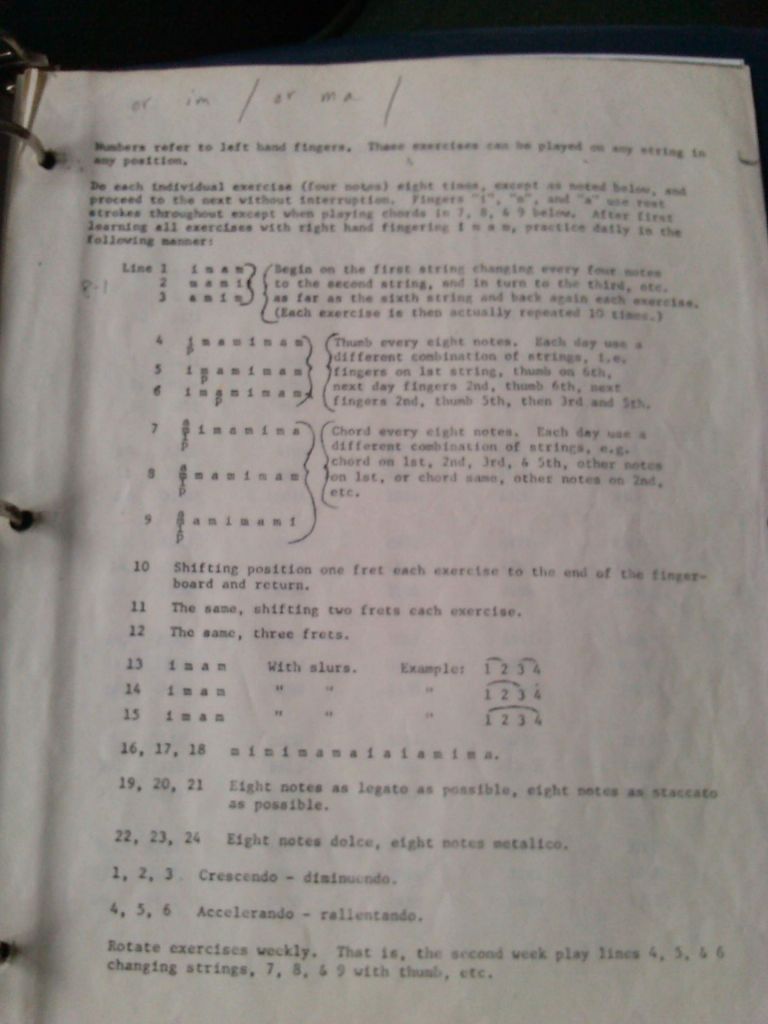
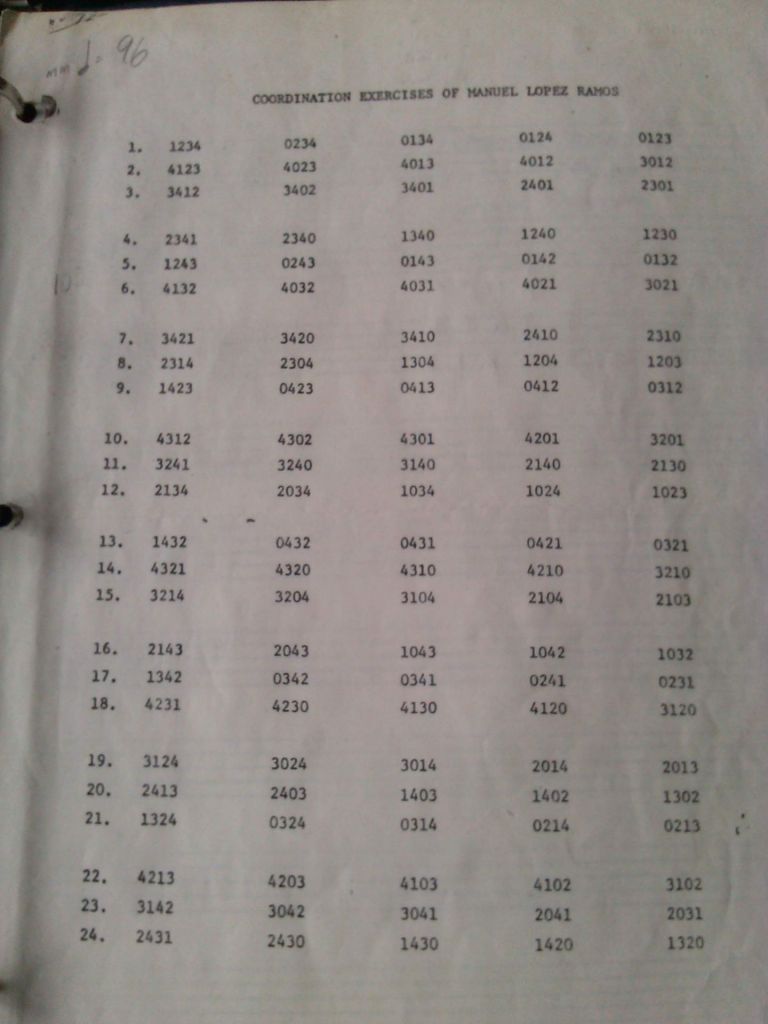
    I was given the exercises to practice by my first classical guitar instructor. After many years of carrying them around in my three-ring binder guitar workbook, I’ve taken photos of the two pages, from which I’ve copied below, adding just a few edits and a short glossary of terms. In addition to being useful developmental exercises, the lines can be used for warmup in any setting. While the exercises were written with classical guitar in mind, they work for any guitar genre. The basic idea is that you don’t want your fingers to simply remember riffs, because then they fall into forced habits, often limiting and hard to change, but the exercises encourage a flexible, ambidextrous capability, each finger able to move independent of the others.

    EXERCISES (1 thru 24 - see Instructions below Line 24):

    1.1234 0234 0134 0124 0123

    2.4123 4023 4013 4012 3012

    3.3412 3402 3401 2401 2301

    4.2341 2340 1340 1240 1230

    5.1243 0243 0143 0142 0132

    6.4132 4032 4031 4021 3021

    7.3421 3420 3410 2410 2310

    8.2314 2304 1304 1204 1203

    9.1423 0423 0413 0412 0312

    10.4312 4302 4301 4201 3201

    11.3241 3240 3140 2140 2130

    12.2134 2034 1034 1024 1023

    13.1432 0432 0431 0421 0321

    14.4321 4320 4310 4210 3210

    15.3214 3204 3104 2104 2103

    16.2143 2043 1043 1042 1032

    17.1342 0342 0341 0241 0231

    18.4231 4230 4130 4120 3120

    19.3124 3024 3014 2014 2013

    20.2413 2403 1403 1402 1302

    21.1324 0324 0314 0214 0213

    22.4213 4203 4103 4102 3102

    23.3142 3042 3041 2041 2031

    24.2431 2430 1430 1420 1320

    Instructions

    Numbers refer to left hand fingers (index is 1, middle 2, ring 3, little 4). The exercises can be played on any string in any position (i. e. beginning at any fret). An “0” in lines above, e.g. 1320, means play string open (un-fretted).

    Do each individual exercise (four notes) eight times, except as noted below, and proceed to the next without interruption. Fingers “i”, “m”, and “a” use rest strokes1 throughout except when playing chords in 7, 8, 9 below. After first learning all exercises with right hand fingering i m a m, practice daily in the following manner:

    Begin on the first string changing every four notes to the second string, and in turn to the third, etc. as far as the sixth string and back again each exercise. Each exercise is then actually repeated 10 times. The “Lines” below refer to the rows or exercises in the section above.

    Line 1: i m a m
    Line 2: m a m i
    Line 3: a m i m

    Thumb (indicated with p) every eight notes. Each day use a different combination of strings, i. e. fingers on 1st string, thumb on 6th, next day fingers 2nd, thumb 6th, next fingers 2nd, thumb 5th, then 3rd and 5th.

    Line 4: i&p m a m i m a m
    Line 5: i m&p a m i m a m
    Line 6: i m a&p m i m a m

    Chord (a&m&i&p) every eight notes. Each day use a different combination of strings, e.g. chord on 1st, 2nd, 3rd, & 5th, other notes on 1st, or chord same, other notes on 2nd, etc.

    Line 7: a&m&i&p i m a m i m a
    Line 8: a&m&i&p m a m i m a m
    Line 9: a&m&i&p a m i m a m i

    Line 10: Shifting position one fret each exercise to the end of the finger-board and return.

    Line 11: The same, shifting two frets each exercise.

    Line 12: The same, three frets.

    Line 13: i m a m – With slurs2. Example: 1~2 3~4
    Line 14: i m a m – With slurs. Example: 1~3 2~4
    Line 15: i m a m – With slurs. Example: 1~4 2~3

    Lines 16, 17, 18: m i m i m a m a i a i a m i m a

    Lines 19, 20, 21: Eight notes as legato3 as possible, eight notes as staccato as possible.

    Lines 22, 23, 24: Eight notes dolce4, eight notes metalico.

    Lines 1, 2, 3: Crescendo5 – diminuendo.

    Lines 4, 5, 6: Accelerando, rallentando.

    Rotate exercises weekly. That is, the second week play lines 4, 5, & 6 changing strings, 7, 8, & 9 with thumb, etc.
    1. The finger of a rest stroke, or apoyando, after plucking a string, comes to rest on the string above it, thus allowing for a more controlled stroke that can produce more volume. While the instructions call for all rest strokes, the player may prefer also practicing with free strokes (where the finger does not come to rest but plays through). ↩︎
    2. There are two kinds of slurs, the hammer-on and the pull-off. In each, the note is sounded with the left hand finger by hitting a higher fret on the same string after a stroke (ascending slur) or pulling quickly off a string to an lower fret of the same string (descending slur). ↩︎
    3. Legato is playing smoothly and continuously from one note to another; staccato is playing each note with a stop between notes. ↩︎
    4. Dolce is soft or hollow; metalico is bright or electric. To play dolce, move the right hand forward of the sound hole; to play metalico, move the right hand back toward the bridge. ↩︎
    5. Crescendo gradually increases loudness; diminuendo decreases loudness. Accelerando speeds up, while rallentando slows down. ↩︎
  • Susanna Oh Susanna

    “Susanna Oh Susanna”
    (Original song with lyrics, chords, and video below)

    C Mornings when we wake up
    on the deep blue sea
    G7 Afternoons sleeping
    under a green palm tree

    E7 Evenings when you call me
    A7 Come out wherever you are
    D7 On the radio playing
    G Patty and Ray

    C Susanna oh Susanna
    I can’t even say your name
    G7 And all I have for you is
    more of the same

    E7 Hiding in the evening
    A7 When you call my name
    D7 On the radio playing
    G Patty and Ray

    C Days falling down
    like waves on the beach
    G7 Every night you drift
    farther out of reach

    E7 Evenings when I call you
    A7 Come over here my love
    D7 On the radio playing
    G Patty and Ray

    “Susanna Oh Susanna,” recorded on cell phone and played on a Gretsch G2420. D’Addario XL Chromes Flatwound Electric Guitar Strings (.011-.050). Fender Champion 20 amplifier. Simple one take setup. Watch video here or on YouTube.

  • Two Riders Were Approaching

    Bob Dylan’s “John Wesley Harding” album (Dec 1967) came after the years (61 to 65) covered in the new film “A Complete Unknown.” Dylan’s “going electric,” handled portentously at the time and since and in the film, split genre on the “Bringing it All Back Home” album (Mar 65), including both acoustic and electric backing, and flung wide open in “Highway 61 Revisited” (Aug 65), was not all that new to Dylan, who has always followed John Cage’s sage advice to get out of whatever cage you might find yourself in. As a kid, Dylan listened to radio, and what did he hear there? The Golden Age of Radio.

    Off the “John Wesley Harding” album Jimi Hendrix created a cover hit with Dylan’s “All Along the Watchtower.” At the end of that song, we find “two riders were approaching,” but where do they go, and what do they do when they get there? I tried to answer that question in my song “Two Riders Were Approaching.” Here’s a new recording by an old player below:

    “Two Riders Were Approaching”

    Chords and Lyrics

    G Two riders were approaching
    C7 On hogs and wearing leathers
    G Stopped into a tavern
    D7 For a cool glass of beer

    Break G C7 D7 C7 G D7

    G Two pints for us my friend
    C7 The day is warm and grim
    G The dust has found its corner
    D7 The dogs want shade and water

    Break G C7 D7 C7 G D7

    G We are the two riders who were approaching
    C7 Said one fellow to the other
    G Let’s stop here for a cool drinking beer
    D7 Night time is drawing near

    Break G C7 D7 C7 G D7

    G Yippie-yi-yo
    C7 Yippie-ki-yay
    G We’re gonna go
    D7 Our own way

    G Yippie-yi-yo
    C7 Yippie-ki-yay
    G We’re gonna go
    D7 Our own way [G]

    “Two Riders Were Approaching,” lyrics and music by Joe Linker. Find an alt-version with the title first explained on The Coming of the Toads blog here.

  • Heavy Metal

    Sounds industrial, like the noises in a factory made repetitive by machines, the floor covered with curling steel shavings. And a kind of marching music, an industrial march, urban with trams and busses, honks and trucking heaves. Heavy Metal is the four piece rock band’s alternative to the symphonic orchestra. The full brass and woodwinds, operatic vocals, orchestral percussion – all accomplished with guitars and drumkit, pedals, and amplifiers. Heavy Metal music can sound like lead stretched thin as wire, or walking on the Earth’s crust with steel spiked boots, the band poised like the Levitated Mass over an arena crowd.

    Our latest guitar quest (Live at 5 now already seems as old as the Ed Sullivan Show) has moved to YouTube where in partnership with metal expert CB we record short videos of original pieces or answers to various musical challenges, about one to three minutes, CB taking Metal Monday while I have Telecaster Tuesday (Washboard Wednesday still open). I posted a couple of Telecaster Tuesday short videos here at the Toads – as I continue to find myself drifting further and farther from words, but I’m not sure the blog is the best place for music activity. For one thing, videos are space hogs, while links to anything outside the blog can wind up for the reader like getting on a wrong bus to the zoo.

    I’m not sure it has anything to do with hearing impairment, though it might, but I’ve often had trouble hearing lyrics clearly, the vocals sounding like another instrument, which of course they are, but without sharp definition – in my ears. Maybe that’s why I’ve steered away from loud rock, but any type of music can be played loud, or too loud. But you don’t have to play music loud to feel it. At a Red Hot Chili Peppers concert some years back, I could literally feel the sound in my chest – that’s a bit too much, though I get that it might be necessary if one wants the full effect. But often one wants to hear the breeze over the “The Eolian harp” sitting on an open window sill. Still, as evidenced in some of CB’s videos, the loudness has passed, and now rings like a train rounding a corner in the distance, its ringing still vibrating on the track:

  • Telecaster Tuesday

    “Good to Go,” a Bb Blues played not too fast, some thick chord shapes, and notes meant to be a bit Bebopish, for this week’s “Telecaster Tuesday.” You can watch and listen here on WordPress or go to the YouTube channel. Short video, about a minute and a half.

  • Fender Squire Telecaster

    All sound is distortion which produces sensation. I play mostly acoustic these days, unplugged, and eschew loud noises from any source. Is sound an idea, an intangible? The Telecaster, for the player, is more than sound – its industrial look, its substantive weight on the lap (you can feel the sustain vibrate through the solid wood body and hardwood neck even unplugged), its smooth playing fretboard, its difficult crackling pods and cranky switch (which remind one of both the guitar’s and one’s own age), all bring it home I should play the Tele more often.

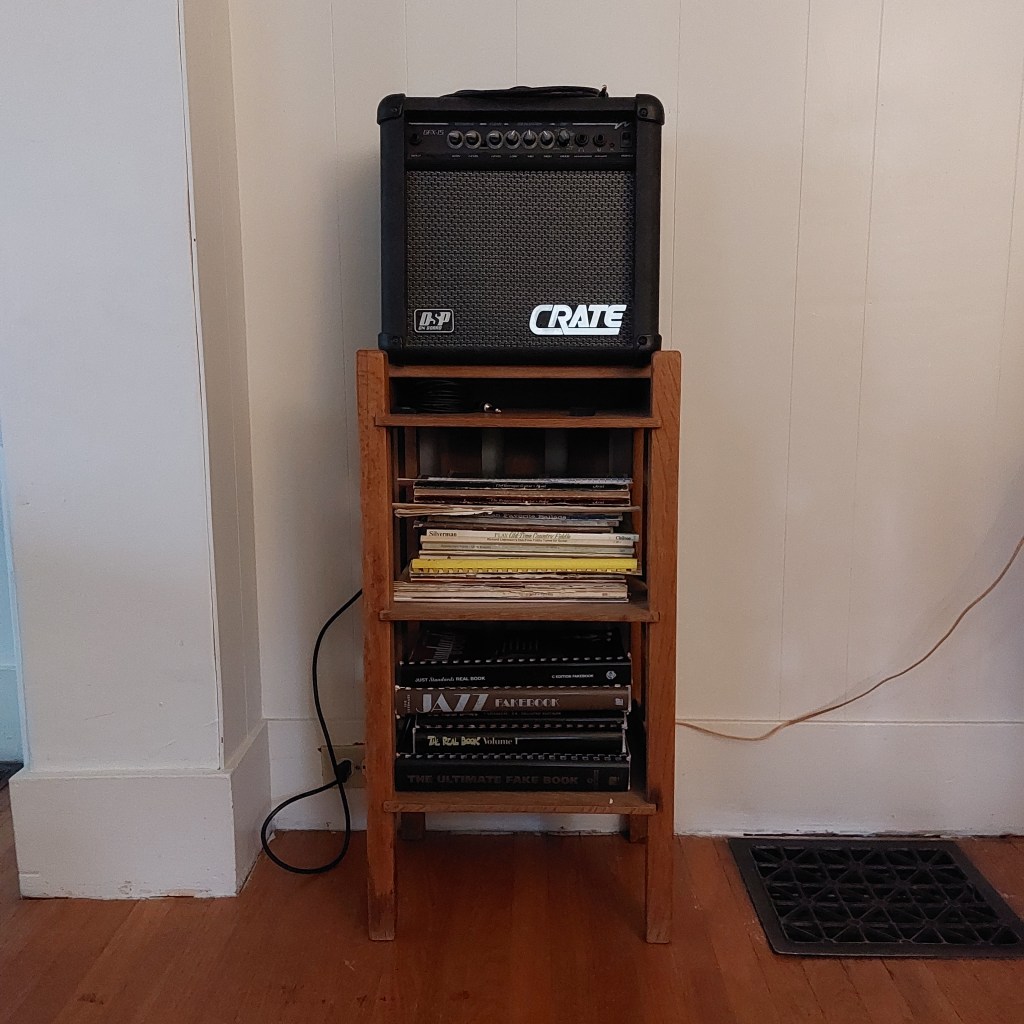
    In the YouTube video below, I’m using the simplest of setups, my cell phone sitting on the edge of a Crate (GFX 15, circa 1990s) small room size amp, the mode set to Reverb 2. With regard to cost of guitar and amp, suffice to say you don’t have to spend a bunch of bucks to get a cool sound. The Squires are storied guitars, particularly the older ones, the first ones built when Fender opened a factory in Japan in 1982.

    My Telecaster guitar I got used in 1985, from a guy I worked with, who had purchased the guitar new at Ace Music in Santa Monica, had switched out the original pickups with Dean Markley and Seymour Duncan pickups, and also switched the polarity to produce an extremely bright Nashville sound, too screechingly violin-like for me, so I had it switched back. I now use flat wound strings on the Tele, which softens the tone and gives it more range (D’Addario ECG24 XL Chromes Flatwound Electric Guitar Strings – .011-.050 Jazz Light). Telecaster guitars over the years have not been noted for their use in jazz, with notable exceptions though, including Ed Bickert and Bill Frisell, and a few others, though often with after market adjustments and other electronic enhancements used.

    In the video, I play through three brief guitar ideas: the first, some country sounding chords and phrases, the second a kind of Gypsy jazz piece I’ve been working on, and the third what’s intended to sound like surf guitar.

    Plugged In
  • A Few Notes on the Guitar

    Studying a new guitar genre is almost like learning a new language, or at least a new dialect. By guitar genre I mean a type of music: Blues or Jazz, Folk, Rock, Gypsy Jazz, or Classical. Those genres all make use of the same notes and chords and even often use the same music and songs – what changes from one genre to another is technique, how you play the instrument, including how the player sits or stands, holds the instrument, plucks the strings with fingernails or plectrum. The difference in genre is not limited to the music played, but the type of guitar used and how you play it, which is known as technique. Over time, the changing build of guitars has enhanced an emphasis on genre specialization, so it’s hard if not impossible, for example, to transfer a screaming metal solo played on a Flying V over a huge amplifier to a nylon string Classical instrument played without amplification. I’ve little to say about which genre is “better.” They are simply different and call for different approaches, for both playing and listening, and at the same time share similarities.

    A studied focus on the Classical guitar will reveal the history of the guitar and guitar music in a way the other genres might miss. As an example, I’ll share an online resource for learning and enjoying the Classical guitar. You don’t have to be a guitarist to enjoy this: The resource is This is Classical Guitar, by Bradford Werner, guitarist, guitar instructor, and music publisher. There are free lessons available, linked to the This is Classical Guitar YouTube channel, including performance and discussion notes and sheet music. But the site is full of resources and information and designed for all levels and interests. One feature I’ve enjoyed via Bradford’s newsletter is the featured artist selection, which amounts to a curated listening experience – in other words, rather than randomly searching around for vital links, the listener benefits from Bradford’s expertise in selecting and presenting what’s usually of special interest.

    My first Classical guitar instructor was a mild mannered player named James. You had to take your shoes off to enter his house. To this day I prefer playing with my shoes on. But James taught me some good stuff. At the first lesson he asked why I wanted to study Classical guitar, and I said I wanted to learn to read music and understand theory and to play beautifully. He said you won’t learn much about theory; theory is what the composer is responsible for. As for playing beautifully, you can do that now. He also advised I get a better guitar. One day, out of character, he chided me for playing too quietly. We used the Aaron Shearer Book One and the Frederick Noad books and also the Leo Brouwer etudes (1972, Estudios Sencillos Nos. 1–10), which were my favorite pieces to study and play. I learned the positioning and fingering of the Diatonic Major and Minor Scales by Andres Segovia (1953, Columbia Music). And we also practiced the fingering exercises of Manuel Lopez Ramos, the idea there to avoid having the fingers default to any kind of set pattern, each finger independent of the others. One day, I told James I enjoyed playing the exercises more than working on the music, to which he voiced disapproval. James moved away and passed me on to another instructor, Marshall, who used to say when I played a new piece, “Well, you found all the notes.” I was on my third instructor, Brian, when I got a new job and could no longer afford the time for lessons and practice. I still have the “better” guitar James encouraged, found for me by Marshall, which I purchased used, a Takemine C132S, built in 1977.

    Of course the best guitar is the one that gets played. You need to leave it out where you can pick it up anytime you walk by, and not worry about nicks and dings and such. Not leave it cased up in the closet or under a bed.

    Classical style guitar might require the most exacting technique. The music written for Classical guitar is often technically difficult. In other words, it’s hard to play. But when James said I could play beautifully now, he meant the music doesn’t have to be complex to be beautiful, it can be simple, and if I paid attention to what I was doing, I could express the music with beautiful tone and grace. A few notes is all you need. An example of a simple piece is found in the Noad book “Solo Guitar Playing I” (my copy is 1976, Schirmer Books). The piece is titled “Lagrima,” and is by Francisco Tarrega. Everyone plays it these days. It’s sort of the “Stairway to Heaven” for beginning Classical players. But it’s the first piece that I could play that I could also hear an expert play. It was on a Julian Bream vinyl record I had at the time. Julian Bream did as much as Andres Segovia to popularize the Classical guitar and its music. When Julian went to music school, guitar was not taught, indeed was frowned upon. One of the problems with Classical guitar is it’s quiet compared to other instruments and difficult to hear in an ensemble.

    I picked up a used copy of Studi Per Chitarra by Dionisio Aguado (1972, Suvini Zerboni, Intro. by Ruggero Chiesa) and showed it to James. He picked out just five of the 51 pieces and said to work on those. I memorized Number 1 and still play it almost daily, straight or improvising freely. It’s a very simple piece and easy to play. James recommended a book on the history of the guitar. I checked it out from the library. Alas, I forget now its title. But I remember reading in it a passage on a typical day for Andres Segovia. He was said to begin his day reading manuscripts and notating works. Then he played and attended to business. Taught and went about his day. But what I remember most is that he was said to end every day in the evening just before bed playing a piece just for himself. At one, I imagined, with his guitar, an at-one-ness most of us never quiet attain with our guitars, wrestling as we do with our chairs and footstools and strings and cracked fingernails and music too difficult for our technical abilities. And it’s then we might remind ourselves the guitar is a folk instrument.

  • Old Haunts

    Old Haunts, all with current links, focused on core subjects: art, technology, music, science, and literature, but first, a brief explanation:

    Moving continuously toward more minimalist formats (which if not stopped could result in disappearance altogether), blogs may risk losing some appeal, particularly to readers who enjoy liking, commenting, and linking or sharing – in short, conversing – as well as indulging in pingbacks and reblogging, and who enjoy perusing sidebars, widgets, clicks and plays, slide shows, and sharing up and down the crowded street of social media sites and apps. An example of such minimalist drift, here at the The Coming of the Toads, might be the removal, some time ago now, of listings and links of followed blogs and favorite sites, what I called in the sidebar heading over the list of links: “Back Roads to Far Places,” the title from Ferlinghetti’s book.

    I use the WordPress Reader to subscribe to sites, and currently I’m subscribed to 146 – but not many of which post frequently or are still active at all, which sparks the idea behind this post, which might have been subtitled: and Other Broken Links. While I don’t currently post a widget of followed blogs or sites, I do manage my subscribed sites in the WordPress Reader, and I also maintain the “Links” feature in the WordPress Dashboard for my own use. There are currently 33 links. But links don’t always stay current or active, while others click to surprise, a site grown or morphed into other projects or disappeared (Page Not Found), and still others remain useful resources or pleasant places to visit, like old friends. Or the link simply breaks and you get sent who knows where and who knows what’s happened. Sites often change over time, and it can be hard and takes time keeping up with the changes.

    Anyway, I thought I’d share an update of just a few of the sites that do continue to work well and that I try to follow and that offer pleasant visits and are creative and resourceful:

    Marginalia and Gracia and Louise I first discovered in “High Up in the Trees,” a blog by the Australian artist Gracia Haby. It’s now called “Marginalia.” I like everything about it – font work, photography, text content, collage and other art work, the work Gracia and Louise do with animals. And there’s another site they maintain, called Gracia and Louise, full of things to see and wonder at. The sites probably work best on desktop, but the creativity in doing more with the drop-down necessities of on-line viewing is unparalleled (of that, here is a specific example, called Reel).

    McLuhan Galaxy always produces a profoundly puzzling experience in that there seems no end to his ideas and the ramifications of effects of media on society and culture – and yet here we go, linking and following, but where? The Blogroll will keep you occupied for hours of intellectual fun.

    I don’t have John Cage ears, but I’ve always enjoyed his writing, and much of his music I do enjoy. Kuhn’s Blog is not often updated, but the site resources remain available and loads of fun, with several interactive features (try Indeterminacy, for example). The John Cage Personal Library is itself a phenomenal work.

    The Buckminster Fuller Institute shares hope for the world from a worldwide perspective. The site may provide a new awareness for what’s going on worldwide to improve conditions, predicaments, problems – near and far. If your not familiar with Bucky, here’s a good place to start: Big Ideas.

    Words Without Borders features world wide writing in a variety of formats. Browse by country, theme, or genre.

    Old Haunts, all with current links, focused on core subjects: art, technology, music, science, and literature.

  • So It Goes

    Those who travel back and forth through time, to and fro, up and down, in and out, with the tides, over and under the swells, stopping now and then to visit. They were here, now they’re gone, return to sender. Sisters, first, then brothers, then ten of us, thoughts like tinnitus that echo like a whiffle ball others can’t hear, sounds won’t leave us alone, to night us, all ten nights of us, Knights of Tinnitus, while these guitars gently sleep, and surfboards drift. A banjo plays brightly, its tabor head a full blue moon, up on the beach. So it goes.

    But how does it go?

    Ah, but ask the winged burds!

    We look before and after,
    And pine for what is not:
    Our sincerest laughter
    With some pain is fraught;
    Our sweetest songs are those that tell of saddest thought.

    But what did they bring along, if not knotty pine – oak or peonies?

    They brought along their come-a-longs, and along the river they walked, while in the wet reeds the wee birds nested and rested. There were peonies and pizza aplenty.

    And along the river, did they sing songs?

    Of chords they sang songs, serious songs, silly songs, songs of love and despair. Cover songs and under cover songs. Songs with no words.

    What songs did they sing?

    So it goes, so it goes. They sang so it goes.

    But where did it go?

    I don’t know. “While we look not at the things which are seen, but at the things which are not seen: for the things which are seen are temporal; but the things which are not seen are eternal.”

    And what did they take back?

    Don’t look back, but they took back a weighty tome, a mighty book, a reference book, a history book, a look into our times, past times, out of time, a book of songs.

    And did they play it as surfers or hodads?

    They played it both dolce or metalico, as the moon prevailed.

    Why did they leave so soon?

    “Blue moon of Kentucky, keep on shinin’. Shine on the one that’s gone and said, ‘Goodbye.’” So it goes.

    So it went?

    So it goes.

  • Notes on Sound, Noise, Music, and Hearing

    What is sound? Tinnitus, from the Latin for ring or tinkle, we hear in our ears, but its source is not external sound. My own tinnitus is louder in my left ear, and if I try to pay attention to it, there are at least two sounds audible, as if an electronic musical duo is playing in my head. The ringing is enveloped under an umbrella of an engine or fan, or the electric rush of a motor, an incessant susurrus, which is balanced between the ears. The quieter my environment, the louder the tinnitus. Tinnitus is noise that is not sound, and it is a common ailment for those with hearing loss.

    My hearing loss, in both ears, worse in the left, probably originating from operating the motor pool compressor truck with jackhammers and other pneumatic tools and from firing weapons without adequate ear protection during my Army days and probably made worse playing music too loud over the years, is now augmented through hearing aids. The current pair are state of the art and include Bluetooth capability, which means I can stream an electronic sound source (radio, TV, computer, phone) directly into the hearing aids. But the sound is not quite natural. I hear it in my head, not in the ears, and not precisely where the tinnitus sounds, but when streaming, the tinnitus seems to turn off. It’s a bit like wearing headphones. It can be somewhat disconcerting.

    Often, when I think of sound sans sense, I think of John Cage. Cage was a musician and writer. Piano was his instrument, but he became involved in electronic sound and electronic music – experimental music. Cage’s music might sound like tinnitus to some listeners. But any instrument can grate or creak or be made to scream or moan or laugh or guffaw. Some of the early film cartoons used modern music innovations and techniques. “Modern” music is often characterized as atonal or dissonant, and as technology developed as electronically enhanced. An evocation of emotional turmoil. Turbulence and tohubohu is often the sound it conveys, or that I hear, which of course are two different things. In any case, what I’m still calling modern here is actually now quiet old.

    What are the differences between noise and music? What is the relationship between sound and hearing? We might spend a few big bucks on music sound reproducing equipment (stereo, speakers, etc.) for home or car. The louder, it seems, the better. But when heard live at a concert, the sound may seem radically altered. And the listener in a front row seat hears a different concert than the listener in the back row, upper level, even if they’re in the same hall at the same time for the same music. In music and in conversation clarity is probably the most important attribute to one hard on hearing. It’s not that I can’t hear, but often that I don’t hear clearly. Increasing volume doesn’t necessarily add clarity. It just adds noise. Cage might say, what difference does it make? Listen to what you hear and disregard the rest. And music is not words.

    “Music as discourse (jazz) doesn’t work,” Cage said. “If you’re going to have a discussion, have it and use words. (Dialogue is another matter.)”

    John Cage, A Year From Monday, Wesleyan, 1969, page 12, from Cage’s ongoing “Diary: How to Improve the World (You will only Make Matters Worse)” 1965, which was taken from the magazine Joglars (Vol. 1, No. 3, 1966), where it was presented as: “a mosaic of ideas, statements, words, and stories. It is also a diary.”

    What did Cage mean by distinguishing dialogue from discourse? Dialogue is conversation, conversational. Discourse is debate, to run away from. Dialogue is theater. Discourse is lecture. Discussion is an investigation. We are using words; no help, no matter how loud.

    Some sounds are empty. What does that sound like? Jazz guitarists speak of getting a hollow sound or tone. One of the John Cage books is titled “Empty Words” (Wesleyan, 1981). “Most of the material in this volume has previously appeared elsewhere,” the listener is told. Where? Sound is ubiquitous, everywhere:

    “Wherever we are, what we hear is mostly noise. When we ignore it, it disturbs us. When we listen to it, we find it fascinating. The sound of a truck at fifty miles per hour. Static between the stations. Rain. We want to capture and control these sounds, to use them not as sound effects but as musical instruments.”

    “The Future of Music: Credo,” from Silence, John Cage, p. 3, Wesleyan 1961, 1973.

    Capture this, from the opening section to Thomas Pynchon’s novel Gravity’s Rainbow (Viking, 1973):

    “A screaming comes across the sky…He won’t hear the thing come in. It travels faster than the speed of sound. The first news you get of it is the blast. Then, if you’re still around, you hear the sound of it coming in.”

    page 3, then 7

    The reader is in London where the German V2 rockets, travelling faster than the speed of sound, hit the ground and explode before anyone hears them coming. Before Pynchon’s novel begins, then, an explosion has occurred. Or not, maybe one lands a dud.

    In Coleridge’s poem “The Eolian Harp” (1795), the instrument sits on an open window ledge, where an incoming breeze stirs over the strings, making music. How improvised is that! One would need super sensitive ears to pick up such wispy sounds.

    …the world so hush’d!
    The stilly murmur of the distant Sea
    Tells us of silence.

    …Where the breeze warbles, and the mute still air
    Is Music slumbering on her instrument.

    The wind as guitar pick.

    I’ve been playing Gypsy-Jazz guitar lately, by which is usually understood playing in the style created or formalized by Django Reinhardt and his peers and followers. The style is characterized by the use of a different kind of guitar from the classical guitar popularized by guitarists like Andrea Segovia and Julian Bream. They played on a 12 fret neck fitted with catgut and then nylon strings in the treble and silk then nylon wound with metal in the bass. Other differences might include a shorter but wider neck, a smaller box, different woods and internal bracing techniques. Different from what? Basically from the all metal, louder string guitars developed later – what has come to be known as the western or folk guitar, and is used in blues, bluegrass, folk, country. But the Gypsy-Jazz guitar is a different instrument still.

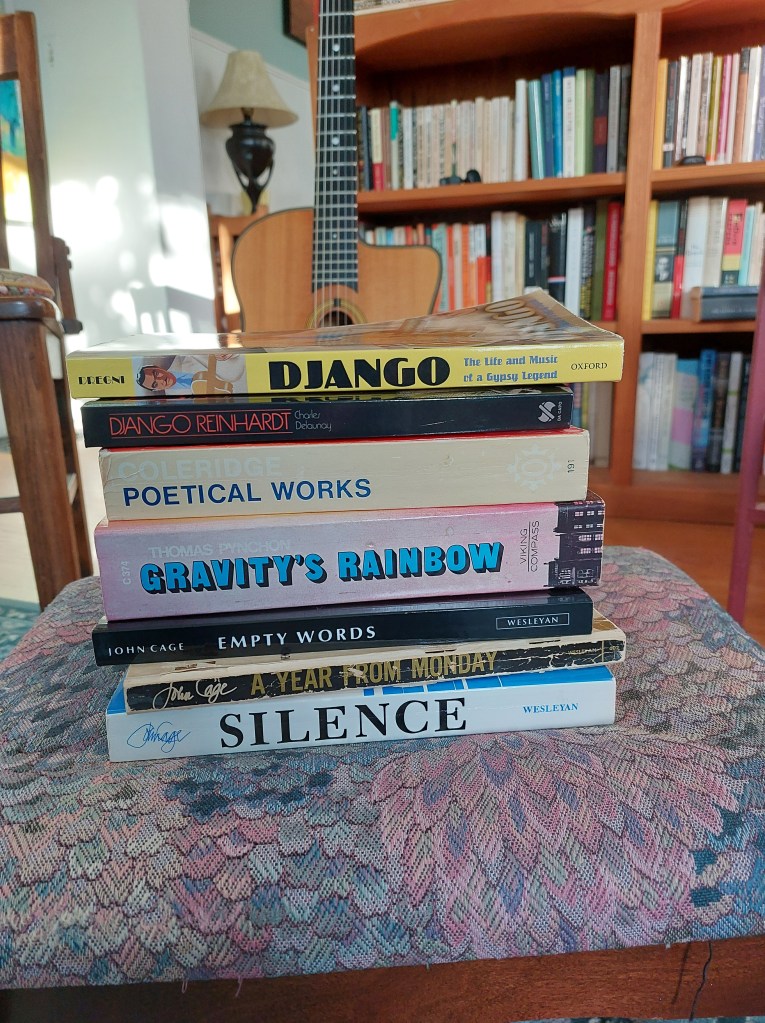
    The Gypsy-Jazz (also “jazz manouche”) guitar is louder, played with a guitar pick rather than the fingers with fingernails, has a longer neck, so a longer scale length, and all metal strings. Most importantly, it’s not a solo instrument. It’s designed to be played in a small combo, usually consisting of at minimum two guitars, and often with stand up acoustic bass, violin, clarinet, accordion, and vocalist. Django played in noisy dance clubs before the advent of amplifiers and electric guitars. He needed an acoustic guitar that would project over the racket and clatter and sound in sync with the other instruments. Readers interested in learning more about Django and his music might read Django Reinhardt, by Charles Delaunay, 1961, Da Capo Press, and Django: The Life and Music of a Gypsy Legend, by Michael Dregni, Oxford, 2004. Briefly, it’s told that Django, born in poverty and coming of age without any kind of formal education, learned to play violin, banjo, banjo-guitar, and guitar. By the time he was 18, he was playing in bands in Paris and making money. Then he burnt his left hand badly in a fire in the caravan. Recovering, he taught himself to play the guitar anew, using mainly just two fingers from his left hand to fret the notes and chords, developing an entirely new technique. Thus began a new style of playing guitar that has influenced just about every guitarist of all genres since and still begs to be mastered even by those with all their fingers playable.

    When asked if he admired Django Reinhardt, Julian Bream said:

    “Oh sure. And I played plectrum guitar up to the age of 21, I played frequently in a dance band in the Army. And, yes, I loved playing jazz guitar, but not as a profession, just for fun. You can’t mix the two. I can remember playing steel-string guitar for dances, and it just ruined the sensitivity of your left hand. And I was playing rhythm guitar with big six-string chords all night long. It was a knucklebender!”

    “50 Years on the Planks: Julian Bream Talks About His Life and Work,” Classical Guitar October 1996. Retrieved 4 Mar 24.

    I’ve been working to play Gypsy-Jazz style without a plectrum (guitar pick), so fingerstyle, with fingers and fingernails, which some say is not only unorthodox but impossible – to play in the Gypsy-Jazz style of Django. I use a thick gauge string on a Saga Gitane DG-250M model, which I purchased used not long before the pandemic broke out and then had to quit the group workshops I’d been attending. The thicker strings compensate for the lack of pick. I’ve just always played with my fingers, hardly ever flatpicking. And I’m not playing dance halls these days, more like a lute in an open window.

  • Endgame

    For some time now, I’ve been playing chess using Lichess, an open source app that is free, sans ads, and full of chess activities, including live games, coaching, analysis, and community. I’ve limited my involvement to the chess puzzles and “play with the computer” games, where I select a game timed at 10 minutes, and where I usually win only about 1 in 10 games – playing standard variant, Stockfish level 3 (of 8). I usually play using the app on my cell phone, while waiting for an appointment, the pasta to finish boiling, in between chores. But I’m quitting chess.

    The games can be relaxing, but they also can create a bit of unwanted tension, particularly when the game is timed. Chess reference is full of analysis of personality types of players, pros and cons of involvement, history of chess and chess players. Not too long ago, I read “Eve’s Hollywood,” by Eve Babitz (1972, NYRB Classics 2015), the entertaining stories of a Hollywood High girl coming of age in the 60’s. Anyone with an interest in Hollywood, Los Angeles, the 60’s, will enjoy Eve’s accounting. Eve wound up being famous, or infamous, depending on your coastal view, for a number of what today might be called gone-viral moments, including posing nude while playing chess with Marcel Duchamp. But she was a good writer. She could be defensive about her Hollywood: “I think Nathanael West was a creep. Assuring his friends back at Dartmouth that even though he’d gone to Hollywood, he had not gone Hollywood” (189). “Eve’s Hollywood” is a kind of “Los Angeles: The Architecture of Four Ecologies” (1971, UC Press 2009), where we might substitute Cultures for Ecologies.

    Anyway, I’m quitting chess. Not because it’s the Lenten Season. And it’s not the 9 out of 10 losses, since really it’s impossible to beat the computer (I can’t explain how I win one when I do). The online version is, like most activities app-related, addictive. There are of course addictions that are recommended as being good for you, though one should always consider who’s doing the recommending, and what they’re suggesting in place of. And chess proves, at least the 10 minute timed version might prove, it is possible to live in the moment. And it’s probably better than maladaptive daydreaming or even the lesser automaticity when what our purpose really calls for is paying attention. In any case, I just think I’d rather spend my time on music than on chess. In fact, music is chess, though chess is not music.