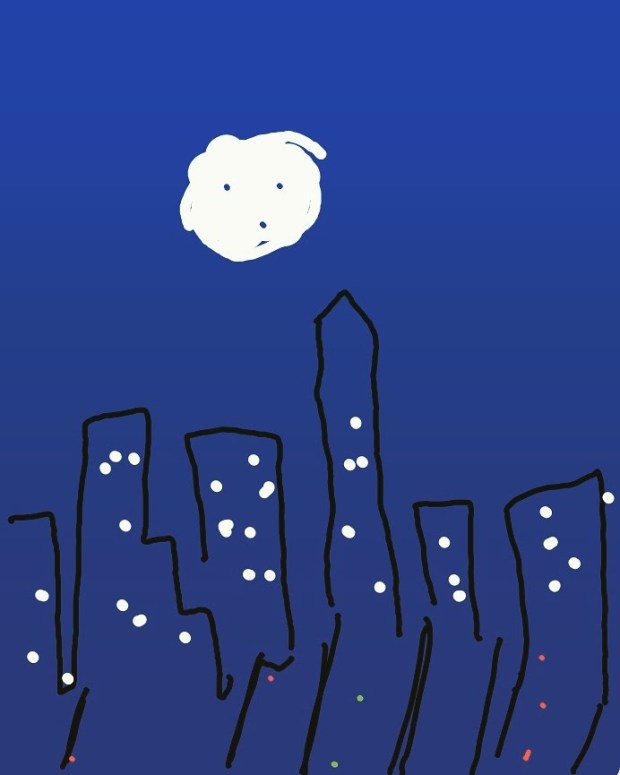
There’s a full moon this week, the daytime temps near 100, so we’ve been out walking late, out for some cooler air, the house so hot. A while back I made a playlist of songs with the word moon in the title:
It’s Only a Paper Moon, Moonlight in Vermont, Moon River, Fly Me to the Moon, Moonglow, Paper Moon, Moondance, Moonlight in Vermont, Havanna Moon, Blue Moon of Kentucky, Blue Moon, Polka Dots and Moonbeams, The Moon Song, By the Light of the Silvery Moon, Moonlight Serendade, Moonlight Becomes You, No Moon at All, Oh You Crazy Moon, Shame on the Moon, Walking on the Moon, How High the Moon, When My Moon Turns to Gold Again, Au Clair de la lune, The Stars the Night the Moon, Shine on Harvest Moon, Harvest Moon, Moonlight (Claro de Luna).
When we got back from our walk I played a few of the moon songs on the acoustic guitar. Still later, still unable to sleep, I got out of bed and from the open window took a photo of the moon. There’s nothing special about that photo, taken with my cell phone, of the moon over the fir trees over the old they say extinct volcano in the city.
“Ah, they’ll never ever reach the moon, at least not the one we’re after,” sang Leonard Cohen, in “Sing Another Song, Boys” (1971), which doesn’t have the word moon in its title, so it didn’t make the playlist.
Things appear different at night, are different. There are so many distractions during the day, chores, reels, but it’s different at night.
“It’s easy to be hard-boiled about everything in the daytime, but at night it is another thing,” says Hemingway’s Jake Barnes, in “The Sun Also Rises,” from 1926.
But a full moon can take the edge off of things at night, soften the heat. Draws you up. And besides, unlike Hemingway’s Jake, lately I’ve been looking forward to the night, a book waiting on the nightstand, moonlight streaming through the open window, lucky to have Susan by my side, not having Jake’s problem, my playlist of songs with moon in the title streaming in the kitchen earlier while I put together something cold for dinner, playing in my memory. Memories of the Moon. Moon Momentoes.
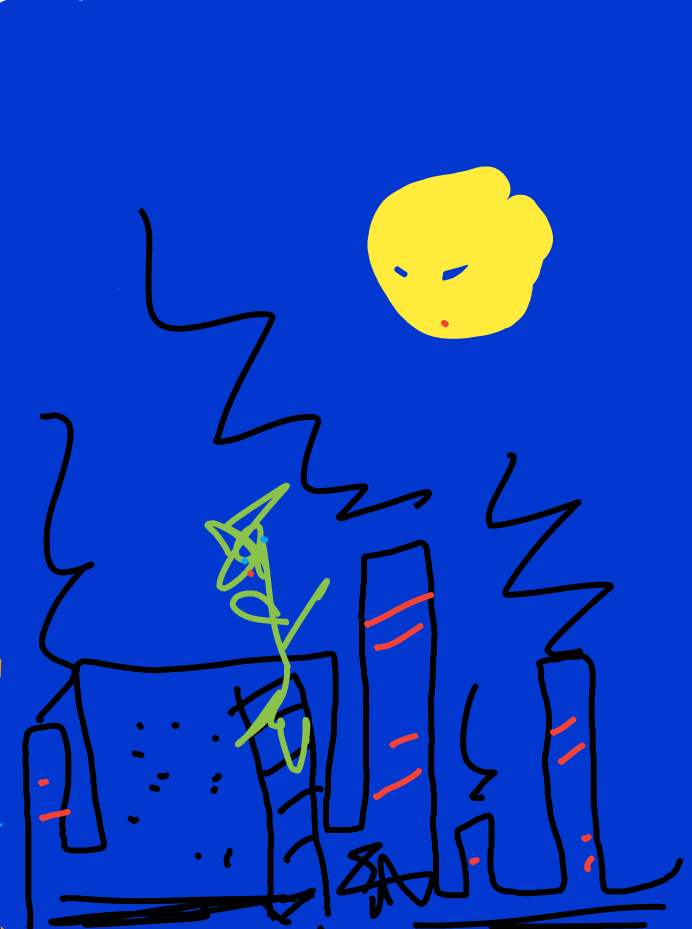
And you don’t want to go getting too literal about it, so-called science of the thing, the light of the silvery moon, how it’s dead, and it doesn’t really have its own light, but is simply reflecting the sun. The mechanics of the thing. There you go again. See, you’ve ruined another night. The moon is a cartoon.
I first picked up a guitar when I was around 12 years old. A late blooming prodigy? No, simply one of hundreds of thousands of kids directly or indirectly influenced by the rise of popular music through the 1950s and 60s. To pick up the guitar was an essentially existential post WWII experience. Guitar know-how had traditionally been handed down informally and orally, self-taught or augmented by mixing one way with another, a folk working class pastime, played for small get together often sit-out entertainment, and that’s how I began, with a guitar gifted to me by one of the neighbor boys, who had gone off to a minor seminary where he’d joined a band with some dormmates. He came home for the summer with an electric guitar and passed on his old acoustic to me. He taught me to play “Washington Square” and “The Green Leaves of Summer.” A year later, after my girlfriend at the time landed on the guitar jumping off the top bunk, I purchased another acoustic used from an ad in the South Bay Daily Breeze.
A guitar wasn’t always a cheap instrument. The industrial revolution and mass production changed the guitar from a hand crafted parlor instrument to, some might still argue, an adulterated version, easily purchased, or scrap apple made. If living in a rural area in the late 19th or early 20th century, you could buy a guitar through mail order, via a Sears or Montgomery Ward mail catalog. Today you can buy a playable guitar (one that holds its tuning and is easy on the fingers) for around $200.00. That’s roughly the same price (proportionately) a similar guitar would have cost in the 1960’s or the 1920’s or in 1900. A good example today is the Gretsch Jim Dandy model, available via mail order from Sweetwater for $189.00, more for an electric or solid top version, but that 189’ll work fine.
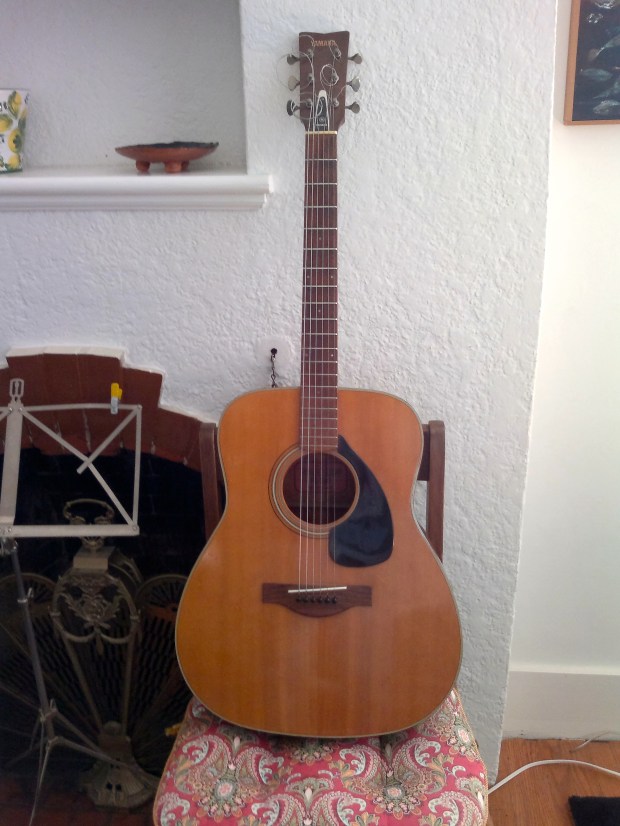
The Gretsch Streamliner I played in the previous post I bought via mail order from Sweetwater during the pandemic for $500.00. The Fender amp was another $120.00. My Yamaha Red Label FG180 is the first new guitar I bought, for $100 in 1970, when I got home from active duty. That Yamaha was a Martin dreadnought knockoff. It looked, and arguably sounded like, a custom made and more expensive Martin guitar. My Yamaha still does, after years of sitting quietly set aside while I played other guitars, the Yamaha resting long after the abuse it suffered as a member of the 140th Engineers motor pool. But unlike the Martin I might have purchased in 1970, the Yamaha FG180’s value has not increased much. It’s probably still worth around $100, there’s a hairline crack in the headstock, otherwise, maybe $300; doesn’t matter, it’s not for sale, nor is it likely to go on loan to a museum.
There is some evidence and certainly rumor of music groups playing Yamaha guitars while on tour in the 1970s – to protect and save their more expensive Martins and other collectibles from potential damage or theft given the rough travel they had to experience while on the road. In the 90’s, Martin created a practical line, called “Road Series,” guitars made for touring, made tough and cheaper than their custom lines. Can anybody hear the difference? Aficionados or snobbish critics may argue so, and maybe you can in a recording sound booth with machine listening aid, but in an auditorium or outdoor venue, at a stadium concert, through the hum and hee-haw of a crowd? Doubtful. Back in the 70’s, Yamaha had developed a more expensive line than the FG’s, which stood for Folk Guitar, called the L Series, where the L signalled Luxury.
Is the brouhaha over vintage instruments warranted – where the provenance (who played it and where) is worth more than the materials, the labor, or the sound of the actual guitar? Some guitars are better than others, but how much better? Ornate decorative designs don’t make a guitar sound better. Some features will attract one player but not another. How a guitar fits, how it feels in the hands or on the lap, its weight, its fretboard width and length, are all arguably more important than the guitar’s aesthetic appeals.
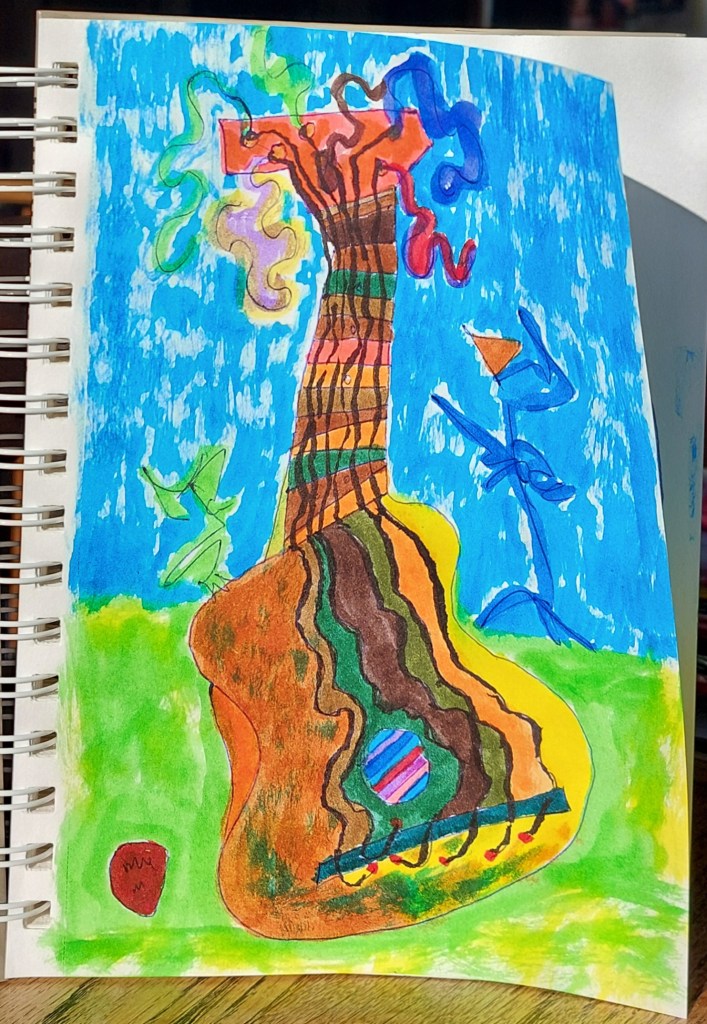
Then there are the Picasso guitars, 1912 to 1914, on display on-line at MoMA. Hard to think of anyone actually playing any of those designs, according to the MoMA introduction notes, “Cobbled together from cardboard, paper, string, and wire, materials that he cut, folded, threaded, and glued.”
Back in May, Nick Paumgarten, in The New Yorker, wrote about a huge but unknown collection of vintage guitars that was about to become an unprecedented Metropolitan Museum of Art exhibit. The previously eschewed low class industrial made and played guitar was about to go live, or dead, depending on your point of view. As Dylan sang in “Visions of Johanna”: “Inside the museums, infinity goes up on trial.” In any case, there does seem to be some strange kind of commodification happening when the value of an object is magnified by who touches it, and some might feel a guitar being inside the museum ironically betrays the guitar’s meaning. Paumgarten quotes The Met curator:
“Except the guitars exhibit a higher art and artistry themselves—first, as objects. There’s high-quality craftsmanship, but it’s different. The guitar is the object of the people. We always talk about it as ‘the people’s instrument.’ American music is bottom-up. So many art forms are top-down. It’s different from the rest of our instruments collection, which is often for the élite.”
“You shouldn’t let other people get your kicks for you,” Bob Dylan sang in “Like a Rolling Stone.” Nor should you spend more than necessary for a guitar if you want to sound like Bob Dylan. Or the Stones, or Metallica. And if you want to sound like The Ramones, well, Johnny Ramone bought his Mosrite guitar used in 1974 for around $50. It might be worth a bit more than that today, about a million dollars more, but its value today has nothing to do with the sound it might make.
Gear changes (swapping out pickups, for example) players or their techs make to factory models, and modifications made to recordings in the studio by sound techs, make a guitar difficult or impossible to reconstruct or imitate, no matter how much you pay for the guitar. Amplifiers, pedals, and other sound changing devices further complicate guitar provenance if what you’re looking for is an original sound not your own. `A player needs to make things their own. There’s little point in trying to sound exactly like your guitar hero, whether it’s Segovia or Django. Guitar value is enhanced by the provenance of its player and the venues and recordings where it was played, but players need to create their own space. A guitar needs to sit out, always accessible, or it won’t get played. The more you pay for a guitar, the less likely it will be allowed to sit out. And sitting out is what it’s all about, if you want to be essentially existentially experienced.
Looking over readings related to The Met exhibit, I’m reminded of the scene in Antonioni’s film “Blow Up” (1966), where the main character, Thomas, played by David Hemmings, wrestles for the guitar neck thrown into the crowd by Yardbird player Jeff Beck, only to toss it onto the sidewalk upon running out of the venue. That’s the same Jeff Beck who donated equipment to The Met and provided a congratulatory statement used in their press release upon the opening of their guitar exhibit. And Antonioni doubled down on the irony at the end of what is now referred to as The Yardbird Scene when a curious passerby picks up the guitar neck, looks it over, and tosses it back down onto the sidewalk. It was just a prop; it’s not in The Met exhibit.
“The Met Receives Landmark Gift of More than 500 of the Finest Guitars from the Golden Age of American Guitar Making,” May 19, 2025, The Met Press Release, retrieved 10 Aug 2025.
“Country Afternoon in the City,” a mellow piece played on the Gretsch G2420 Streamliner Hollowbody Electric Guitar with Chromatic II Tailpiece (year 2021: with Maple Top, Back, and Sides, Nato Neck, Laurel Fingerboard, and 2 Humbucking Pickups. “Village Amber” finish). Strings are D’Addario Chromes Flatwound Jazz Light. Fender Champion 20 amplifier set to: Voice = 02 Tweed Deluxe (Green) and FX = 10 Delay+Reverb (Orange). Gain, Volume, Treble, Bass, and FX Levels all set to 5. Filmed with cell phone, 3 mins 14 secs.
“Tele Piece #1” is the title finally settled on for the first of a planned series of short pieces played on the Telecaster Squier guitar.
Squier not to be confused with Squire, as in Chaucer’s “The Squire’s Tale.” I considered titling the piece “The Squire’s Tele.” Chaucer’s tale for the squire is characterized by a bit of rambling, seemingly planned for a long piece, if planned at all, but interrupted by the Franklin, who might be in terms of social class considered subservient to the up and coming squire. And the Telecaster Squier guitar is often considered subordinant to the Fender American made Telecaster. Fender acquired the name Squier when it bought the Squier brand, a family name, in 1965. The V. C. Squier Company out of Battle Creek, Michigan began in 1890 and made strings for violins, banjos, and guitars.
But the early Telecaster Squier is now considered a classic in its own right. In short, it’s a good guitar. Close to 20 years ago now, I was playing my Tele on Thursday evenings at a local wine bar, which closed almost as soon as it opened, victim of The Great Recession. I wasn’t up front or on a stage. I set up with a small room amp (Crate GFX-15) in a corner and played background instrumental pieces, mostly impromptu and rambling, or taking off on standards and going often I wasn’t sure where. Anyway, one night a family of four with some time to spend before their movie started across the street stopped in for a drink. They seemed inordinately interested in what I was doing. Most patrons just ignored me. Then the son, in his twenties, came over to chat. He and his father played guitar, and from where they were sitting he said they couldn’t tell if I was playing what he called a real Telecaster or a Squier.
One of the first guitars out of the new Fender factory opened in Japan in 1982, this one is fitted with aftermarket Dean Markley and Seymour Duncan pickups, and it’s strung with D’Addario ECG24 XL Chromes Flatwound Electric Guitar Strings .011-.050 Jazz Light.
The amplifier used in “Tele Piece #1” is a Fender Champion 20, with the Voice knob set to 02 Tweed Deluxe, and the FX knob set to 03 Reverb Hall. This combination gives a bit of mild amped style without too much distortion or fancy effects taking over. Filmed with a cell phone leaning against the bottom of the amplifier.
I was browsing through my old stack of Frederick M. Noad guitar books, acquired when taking classical lessons back in the early 80s. In “Solo Guitar Playing II,” published in 19771, Noad’s comments are witty and engaging, critical and evaluative. He emphasizes an incremental and developmental approach to learning the instrument, the idea being to “master one level before moving to another” (13), but I’ve never met anyone who learned the instrument that way. I’m not even sure what a “level” is when it comes to actually playing, but levels may be more evident and necessary in instruction books than in sitting down on your own and discovering the instrument in your own hands. In any case, crawling is not a prerequisite to walking, and all beginning walkers are amateurs:
“I have written this book primarily for the amateur, since of the enormous number of people who fall under the spell of the guitar only a handful become professionals, and those not always the best players” (13).
In his introduction to “Lesson Nine, Style and Ornament: The Baroque Period,” including music from the years 1610 through 1750, since the 1950s in popular resurgence, Noad brought his students up to date on audience expectations, employing an ornamental writing style suitable to a discussion of the Baroque:
“Although much genuine understanding has emerged from this revival, so has much specious academicism. The first wave of enthusiasts tended to be pedantic and unyielding in their opinions, giving rise to heated controversy and a surfeit of pettifoggery” (129).
We may notice today that kind of expert or rule-bound performance insistence in other musical forms, including folk music concerts where the audience must pretend they are in a church where everyone can hear the pin drop. And as Noad wrote in 1977:
“The result of this was that fine musical performances were often dismissed by the new cognoscenti on some technical ground, more often than not based on the execution of ornaments.”
As if Django himself had ever reached a level where no further experiment was permissible if the music was still to be called Gypsy Jazz, where naming something supercedes the essence of the sound.
But Noad goes on to say the rule-bearing aficionados had relented a bit:
“Today a calmer approach reigns with the passing of what Louis Crowder2 has called ‘the panic period of Baroque interpretation,’ and we find with relief that Bach need not, or should not, be played with the regularity of a sewing machine” (129).
Martin Messier has created music for the sewing machine, and Les Sewing Sisters have created music featuring sewing machines as musical instruments:
I’ve never learned to sew, but I took typing lessons in high school, though I don’t recall typing much outside of class. The typing lessons were definitely developmental, jjjj ffff, etc., with bells going off all around the room, and keystrokes clicking and carriages returning at varying tempi. The classroom was an orchestra pit. What style each student brought to their instrument was a function of muscle strength and restraint, clarity of touch, rhythm and self-expression, each sitting with appropriate posture and attempting a graceful carriage as instructed, as if playing a guitar.
The composer Leroy Anderson wrote a piece featuring a typewriter as a musical instrument in 1950. First performed in 1953, it’s often directed with humor, as if it’s not to be taken too seriously, but apart from the typewriter, the music in Anderson’s short piece sounds traditional, unlike, say, what a piece featuring a typewriter might sound like if written by John Cage. Two examples of the Anderson piece, titled “The Typewriter,” follow, the first directed seriously, the second with jocularity.
Solo Guitar Playing, Book 2, An introduction to technique and repertoire for the intermediate guitarist, Frederick M. Noad, Schirmer Books, A Division of Macmillan Publishing Co., Inc. 1977. ↩︎
Noad footnotes the Crowder: “See Crowder’s introduction to Denes Agay’s piano anthology, The Baroque Period (New York: Yorktown Music Press, 1971).” ↩︎
More rain. More “Traveling Sprinkler.” Paul Chowder hasn’t been playing his new guitar much, though. Instead, the former bassoonist has found an interest in electronic music, and he’s bent on creating jingles and jangles and hums and beats and calls it dance music.
“I worked for several hours today on a new song called ‘Honk for Assistance.’ I saw the sign at a convenience store, near the ice machine, and I thought, Now that is a dance song, in the tradition of Midnight Star. I sampled a few honks from my Kia’s horn and set up a beat and fingered up some harmony using an instrument I hadn’t tried before, the Gospel Organ, which has a slightly percussive sound in the attack phase of each note. I added more chords on a Mark II keyboard and some homegrown handclaps and some rhymes made with the Funk Boogie Kit” (190).
Where is music, today? Where was it in Claude Debussy’s day? I’m listening now, suggested by Paul Chowder, our narrator of “Traveling Sprinkler,” to Debussy’s “Preludes,” via YouTube Music on my Chromebook. I don’t have my hearing aids in, and the Chromebook speaker is not exactly a Marshall Super Lead 100 Watt amplifier stacked with two humongous speaker cabinets towering overhead, so maybe I can’t really say I’m listening to Debussy’s “Preludes,” anymore than I can say I’m in the kitchen nook typing while getting wet from the drizzle outside.
Around page 128, Paul spends ample time discussing the benefits of stereo versus mono. What he does not mention is asymmetrical hearing loss, a condition where you hear less volume in one ear than the other. You’re sometimes unsure which direction a sound is coming from, and it can make you a bit paranoid as you navigate your way around town. You have to be extra careful crossing the street, particularly if there are electric vehicles in the neighborhood. And bicyclists and joggers coming up behind you and passing full of assumptions and presuppositions about their position startle the shite out of you.
“I put the headphones on, and I lowered the needle on Zubin Mehta conducting The Rite of Spring, and suddenly I was there, enclosed in the oxygenated spatial spread of stereophonic sound. I was there with the panicked piccolo, and the bass clarinet was a few feet away, and the timpani surged over to the left, mallets going so fast you couldn’t see them. I couldn’t believe how big a world it was – how much bigger and better stereo was than mono….You need two ears” (129).
Or three, or four. One day, back home, I rode my bike down the Strand to Mike Mahon’s place in Hermosa, carrying with me Archie Shepp’s “Fire Music,” on the Impulse label, from 1965, still new and noisy around the early 70s. Mike was a classically trained pianist, although like Paul Chowder, had decided he wasn’t good enough to make a career of it, and went back to school for a PhD in English Literature, specializing in Yeats and Joyce and company, but still Mike was an audiophile, and had the latest equipment. He took my album and ran it through an electronic vinyl record cleaning machine he had, then we listened to some of it on his impressive and expressive and expensive sound system. Then he pulled from his album collection a copy of Stravinsky’s “The Firebird,” and we listened to the “Infernal Dance” piece. Talk about “attack phase.”
I played a bit of “The Firebird” just now, switching off the Debussy. I’m immediately reminded of Poe’s “The Bells”:
Hear the loud alarum bells— Brazen bells! What tale of terror, now, their turbulency tells! In the startled ear of night How they scream out their affright! Too much horrified to speak, They can only shriek, shriek, Out of tune, In a clamorous appealing to the mercy of the fire, In a mad expostulation with the deaf and frantic fire, Leaping higher, higher, higher, With a desperate desire, And a resolute endeavor Now—now to sit or never, By the side of the pale-faced moon.
I can only handle a minute or two of “The Firebird” this morning (or Poe) before switching over to Segovia playing Bach on his acoustic guitar, from Andrés Segovia: Bach – Gavotte from 4th Lute Suite for guitar, Allegro Films.
In butterfly mode, Paul Chowder continues, in “Traveling Sprinkler,” from acoustic guitar to electro sounds to his girlfriend Roz and his neighbor Nan, parking his car here and there to get some writing done, in other words, in and out and back in again, listening to every day sounds and how they wrap around the cans and cannots of one’s thoughts. But Chowder keeps mentioning songs and music I’ve never heard of. Where have I been? And I asked myself again when and how and why it was I got Nicholson Baker’s “U & I,” and “Traveling Sprinkler” to begin with. So I looked them up. I thought I had purchased (and said in a previous post) “Traveling Sprinkler” used from Alibris. Not so. I purchased it new from Amazon in June of 2023 (though it was not sold by Amazon – a bit confusing all of that, how Amazon works sometimes). And just now, about two years later, I’m getting around to reading it, “Traveling Sprinkler” (though I had given it a try a couple of times before), while “U & I,” I got used on Alibris in February of 2019, also giving it a couple of tries, but unable to fall into it, yet.
Anyway, it’s all old stuff, the books, the references, the music, not to mention the many political digressions, arguments with backing but often rants of a sort, Paul Chowder takes off on. He’s a pacificist, who, as I mentioned, attends meetings, though he’s not a full member, but which is why I thought the acoustic guitar was a good fit, him being a pacificist. But it depends on how you hear sounds. Last night late (after watching the Dodgers beat the Athletics in a record-breaking score of 19 to 2) before bed I played through a few of the Leo Brouwer “Etudes Simples” pieces, as I do almost every night, on my 1977 acoustic Takamine C132S. Number 1 is not all that pacific sounding, but Number 2 is lovely, particularly setting the tone for sleep.
The political arguments, by the way, though now aged, just over a decade away, are effective today, without stirring up too much dust. I’m increasingly finding I’d rather listen to decade old or older music too. Timeless music. Anyway, thinking back to that business about stereo and mono, I’m reminded of the Jimi Hendrix album “Axis: Bold as Love.” The first piece, titled, “Exp,” is an amazing example of stereo at play. It’s very short: 1:56. You can give it a listen here.
This is the fourth blog post in a row about playing the guitar, inspired by one of my sisters, who has asked me for some ideas to further her own playing. The guitar is a folk instrument, by which we mean knowledge of the instrument and techniques for playing it are passed along to others usually orally and informally. When the great guitarist Julian Bream attended the Royal College of Music in the late 1940s, the guitar was not admitted, being considered, well, a folk instrument, and not suitable for classical music study. Bream did much throughout his career to change the reputational plight of the guitar in the conservatoire, as did Segovia. Frederick Noad in the 1960s was another guitar teacher who did much to popularize methods for formal study without losing the folk flavors.
By method, we mean an incremental or developmental approach to learning that follows a purposeful outline. But most people pick up a guitar and learn a riff or two, a chord or three, and try to imitate what they’ve heard on some recording. If they chance to perform, in the living room or garage, the problem of sounding like that recording is overwhelming. If someone requests, for example, “Stairway to Heaven,” you might be able to pull off the first part on your used acoustic Silvertone, but you’ll soon realize you need either to make the song your own or invest in a mountain of electronic and drum equipment to attempt a sound like what folks hear on the radio and would have you replicate in your garage or bedroom.
The guitar for some time now has had the reputation of being the easiest of instruments to play poorly and the most difficult of instruments to play well (a perspective attributed to Segovia). Having not attempted the oboe or French horn, bagpipes or pipe organ, kazoo or spoons, we’re not sure, but about the guitar we know enough to say it’s easy to get to a certain point of technical frustration. When that happens, it’s often useful to, as Thoreau said, “Simplify, simplify, simplify.” Then again, Thoreau didn’t play the guitar. He played the flute.
One way to simplify guitar is to play a melody. Keeping within the C scale of notes will also keep things simple (no sharps or flats). Take, for example, the opening notes to the song “Over the Rainbow.” Position your hand over frets 5 through 8, and play the melody from C (3rd string, 5th fret) to C an octave up (1st string, 8th fret). The next note you’ll find one fret down, a B (1st string, 7th fret). Then a G (2nd string, 8th fret). Then A (1st string, 5th fret), B (1st string, 7th fret), and C again (1st string, 8th fret). See if you can figure out the rest of the melody. You’ll be learning to play the guitar.
We saw that the C Major Scale of notes is useful because it has no sharps or flats. We’ll find that it’s particularly useful in other ways for the guitarist.
Let’s review the C Major Scale of Notes. C to C gives us an octave. We can number the notes. We’ll use the numbers to build chords:
Numeric Note
1
2
3
4
5
6
7
8
Letter Note
C
D
E
F
G
A
B
C
A major chord is built stacking the 1st, 3rd, and 5th of a scale. We can build a chord that begins with each letter of the C Major Scale. When finished, we’ll have the C Major Harmonized Scale of chords:
Chord #
I
ii
iii
IV
V
vi
vii
Name
CM
dm
em
FM
GM
am
b-dim
Notes
5
G
A
B
C
D
E
F
3
E
F
G
A
B
C
D
1
C
D
E
F
G
A
B
The C Major chord (I, or CM in the table above) contains the notes C, E, and G, the 1st, 3rd, and 5th steps of the C Major scale of notes. The D minor chord (ii, or dm in the table above) contains the notes D, F, and A. Why is it a minor chord? A minor chord is built also using the 1st, 3rd, and 5th steps of a scale, but the 3rd is flatted, moved a half step down, which, on the guitar, is one fret down. I thought you said there were no flats or sharps. Here’s where things get a bit tricky.
Let’s take a look at the C Chromatic scale of notes. This is a scale that shows all the notes, including the flats and sharps. A sharp is indicated with a # sign, and flats are indicated with a b. Note that a C# and a Db is the same note, called a flat when moving down and a sharp when moving up):
1
1#2b
2
2#3b
3
4
4#5b
5
5#6b
6
6#7b
7
8
C
C#Db
D
D#Eb
E
F
F#Gb
G
G#Ab
A
A#Bb
B
C
The C Major scale of notes uses just 7 of the notes of the Chromatic scale above. As we have seen, those notes include: C D E F G A and B. What happened to the sharps and flats? We skipped over them. How do we know where to skip? That’s a given. To build a major scale, we skip over the 1#2b and the 2#3b, but notice there is no 3# or 4b, and there is no 7# or 8b. So we have notes that skip like this:
1 (skip) 2 (skip) 3 4 (skip) 5 (skip) 6 (skip) 7 8 C (skip) D (skip) E F (skip) G (skip) A (skip) B C
In other words, there is no 3# or 4b and there is no 7# or 8b. There is no E sharp or F flat and there is no B# or Cb in the C Major scale. If we want to flat the F, we get E. If we want to flat the C, we get B.
It might be useful now to take a look at the whole guitar fretboard (depending on your device, you should be able to slide right to see all the columns):
Open Strings
1st Fret
2nd Fret
3rd Fret
4th Fret
5th Fret
6th Fret
7th Fret
8th Fret
9th Fret
10th Fret
11th Fret
12th Fret
13th Fret
e
f
g
a
b
c
d
e
f
b
c
d
e
f
g
a
b
c
g
a
b
c
d
e
f
g
d
e
f
g
a
b
c
d
a
b
c
d
e
f
g
a
e
f
g
a
b
c
d
e
f
And here are the same notes using corresponding numbers:
Open Strings
1st Fret
2nd Fret
3rd Fret
4th Fret
5th Fret
6th Fret
7th Fret
8th Fret
9th Fret
10th Fret
11th Fret
12th Fret
13th Fret
3
4
5
6
7
1
2
3
4
7
1
2
3
4
5
6
7
1
5
6
7
1
2
3
4
5
2
3
4
5
6
7
1
2
6
7
1
2
3
4
5
6
3
4
5
6
7
1
2
3
4
Notice the 1 skips a fret to 2, but the 3 does not skip a fret to 4. Same for 7 to 1. The 1 corresponds to C, the 2 to D, etc.
If we start a major scale on D and use the skipping method of counting through the Chromatic scale, we get:
1
2
3
4
5
6
7
8
9
1
2#3b
3
4
4#5b
5
5#6b
6
6#7b
D
D#Eb
E
F
F#Gb
G
G#Ab
A
A#Bb
If we build the D Major chord using the 1, 3, and 5 of the scale in the table above, we get a chord with the notes D (1), E (3), and F# (5). The D Major chord is built using the notes D, E, and F#. Taking the D Major chord of D, E, and F# but flatting the F#, we get D, E, F. The chord is now a 1, flat 3, 5 chord, or, a minor chord.
Now, back to the C Major Harmonized scale, which is built with the chords C Major, D Minor, E Minor, F Major, G Major, A Minor, and B Diminished. The chords are shown in the table as
I
ii
iii
IV
V
vi
vii
CM
dm
em
F
G
am
b-dim
It’s a bit tricky to say all of the chords contain no sharps or flats, since we saw that the D minor chord has a flatted third. But the flatted third of a D chord, as we’ve seen, gives us an F note, not an F#. You can work it out for the E minor and A minor, as well as the B diminished (which flats both the 3rd and the 5th notes of a scale). What you’ll find is that the chords as expressed in the C Major Harmonized scale appear to have no sharps or flats. They are built with “natural” notes, meaning not sharped or flatted notes.
Chord #
I
ii
iii
IV
V
vi
vii
Name
CM
dm
em
FM
GM
am
b-dim
Notes
5
G
A
B
C
D
E
F
3
E
F
G
A
B
C
D
1
C
D
E
F
G
A
B
Here are some suggestions for practical application:
Play chord progressions using chords from the C Major Harmonized scale. For example, play ii (dm), V (GM), I (CM), or play I (CM), vi (am), ii (dm), V (GM). Play I, IV, V.
Memorize all of the C notes on the guitar fretboard. Be able to jump from one to the other, in any order.
Play the C Major scale of notes on the fretboard beginning (ascending and descending) with each of the C notes you found in 2 above.
Play all of the chords in the C Major Harmonized scale in the first position of the fretboard (frets 1 thru 3). Play them in order, ascending and descending.
A good way to learn the notes on the guitar fretboard is to begin with the notes in the C Major scale, which has no sharps or flats1. The C Major scale, using letters to signify notes, goes like this:
C D E F G A B C.
To begin, play the scale, one note at a time, using the open strings and fingering the notes on the 1st, 2nd, and 3rd frets, beginning and ending on the C note, forward (ascending) and backward (descending), memorizing each note in its open or fretted position.
Use your 3rd (ring) finger on the 3rd fret, 2nd finger (middle) on the 2nd fret, and 1st finger (index) on the first fret. If you want to finger-pick, alternate index with middle fingers of your right hand, or use your thumb throughout. The table below shows the 6th (thickest) string at the bottom.
Open String
1st Fret
2nd Fret
3rd Fret
B
C
G
A
D
E
F
C
Now play the C Major scale on the 2nd through the 8th frets. Here you’ll be playing through two octaves2. Again, play forward (ascending) and backward (descending) in alphabetical order, memorizing the notes. When you get to the C on the 3rd string (5th fret), move your hand up so that your index finger plays that note, ring finger the D, index the E, middle the F, pinkie the G, index the A, ring the B, and pinkie the final C (1st string, 8th fret):
1st Fret
2nd Fret
3rd Fret
4th Fret
5th Fret
6th Fret
7th Fret
8th Fret
A
B
C
E
F
G
A
B
C
D
E
F
G
C
D
As you play through the notes, you can sing: Do Re Mi Fa So La Ti Do. Or, sing the notes: C D E F G A B C. Or sing numbers: 1 2 3 4 5 6 7 8.
Solfa
Do
Re
Mi
Fa
So
La
Ti
Do
Numeric Note
1
2
3
4
5
6
7
8
Letter Note
C
D
E
F
G
A
B
C
Next, we’ll look at the C Chromatic scale and the C Major Harmonized scale to see how chords are built.
On the piano, to play the C Major scale, you press only the white keys, skipping over the black keys, but on the guitar, every fret is what is called a half step, and the sharps and flats can’t be seen. ↩︎
An octave is 8 notes, beginning and ending on the same note. ↩︎


 The Coming of the Toads