Pausing then to pull a few old paperbacks off the shelf and peruse the notes and underlining (I rarely write in books anymore, but some of the old ones are full of notes – a reading method), and here are a couple more from high school days with passages I somehow thought noteworthy of underlining or circling whole paragraphs.
In my novel “Penina’s Letters,” Henry Killknot finds Salty reading Jerzy Kosinski’s “The Painted Bird, and tells him he should be reading “Mr. Blue” instead:
“Have you ever heard of a little book titled ‘Mr. Blue’ by Myles Connolly?”
“Yes, we read it last year in Mr. Ford’s English class.”
“Well, you should read it again. Read it once a year. That’s how you treat classics. Read them once a year. You should not be reading this crap Kosinski spews out.”
“Have you read ‘The Painted Bird’?” I asked.
“No,” he said. “I’ve been re-reading ‘Mr. Blue.’ You should consider falling in love with Our Lady, as Blue did, devoting your life to a worthy cause. This Kosinski fellow is a hack.” (93)
I was in the 10th grade at Saint Bernard in Playa del Rey. I was getting to know the kid in front of me, whose background and home life was radically different from mine. He was reading a paperback, clandestinely, keeping it close in as he leaned over his desk. Curious, I asked him what he was reading. He ended up lending me the book, “The Painted Bird,” by Jerzy Kosinski, telling me as he passed it back under my desktop: “If you get caught with it, don’t tell where you got it.”
“Suddenly I realized that something had happened to my voice. I tried to cry out, but my tongue flapped helplessly in my open mouth. I had no voice. I was terrified and, covered with cold sweat, I refused to believe that this was possible and tried to convince myself that my voice would come back. I waited a few moments and tried again. Nothing happened. The silence of the forest was broken only by the buzzing of the flies around me.” (“The Painted Bird” p. 125).1
We were talking, Susan and my sisters and me, about why keep books, the old musty paperbacks with crackling old pages and covering old themes. Every out of print book adds value to a library. In 1996, folks in San Francisco did not think that: “The S.F.P.L. is now essentially broke, and relies on corporate benefactors. It has sent more than two hundred thousand books to landfills – many of them old, hard to find, out of print, and valuable.” (“The Author VS. The Library,” The New Yorker, by Nicholson Baker, October 14, 1996, p. 50).
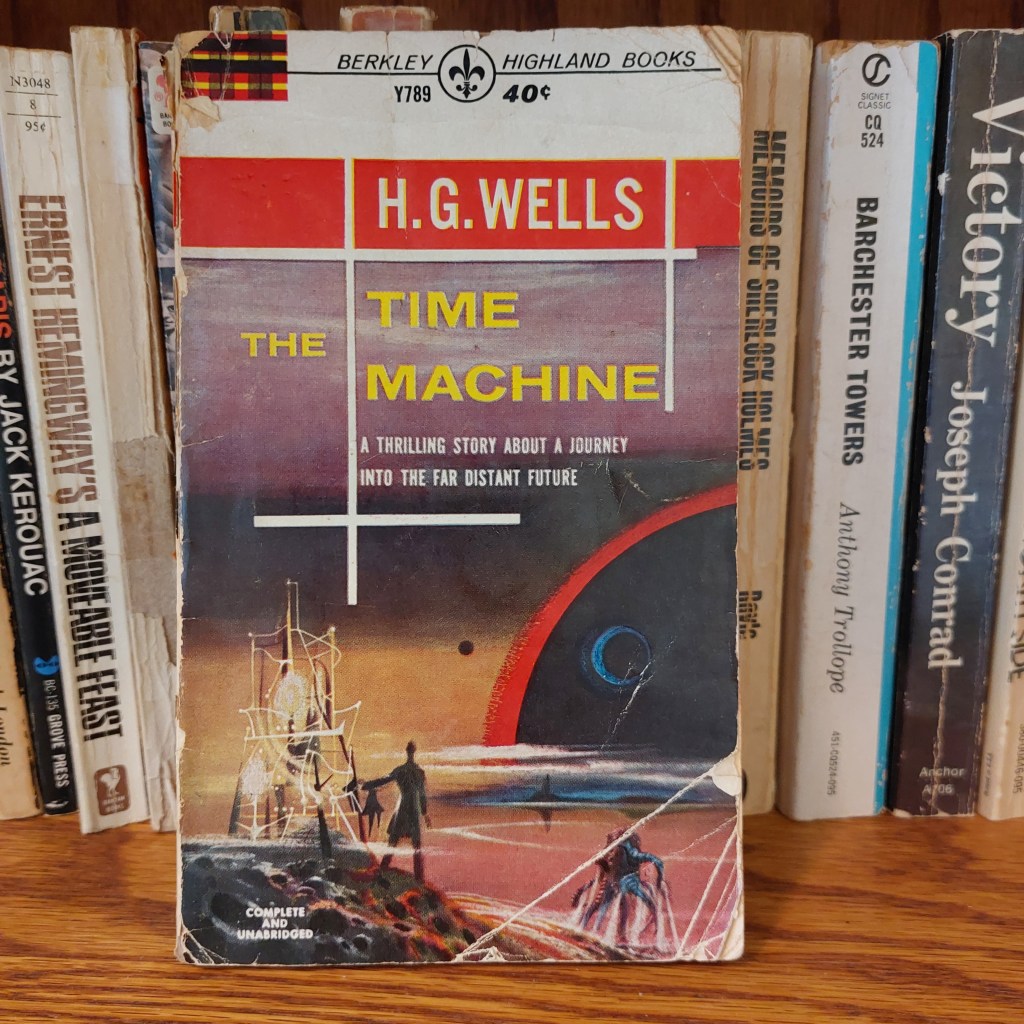
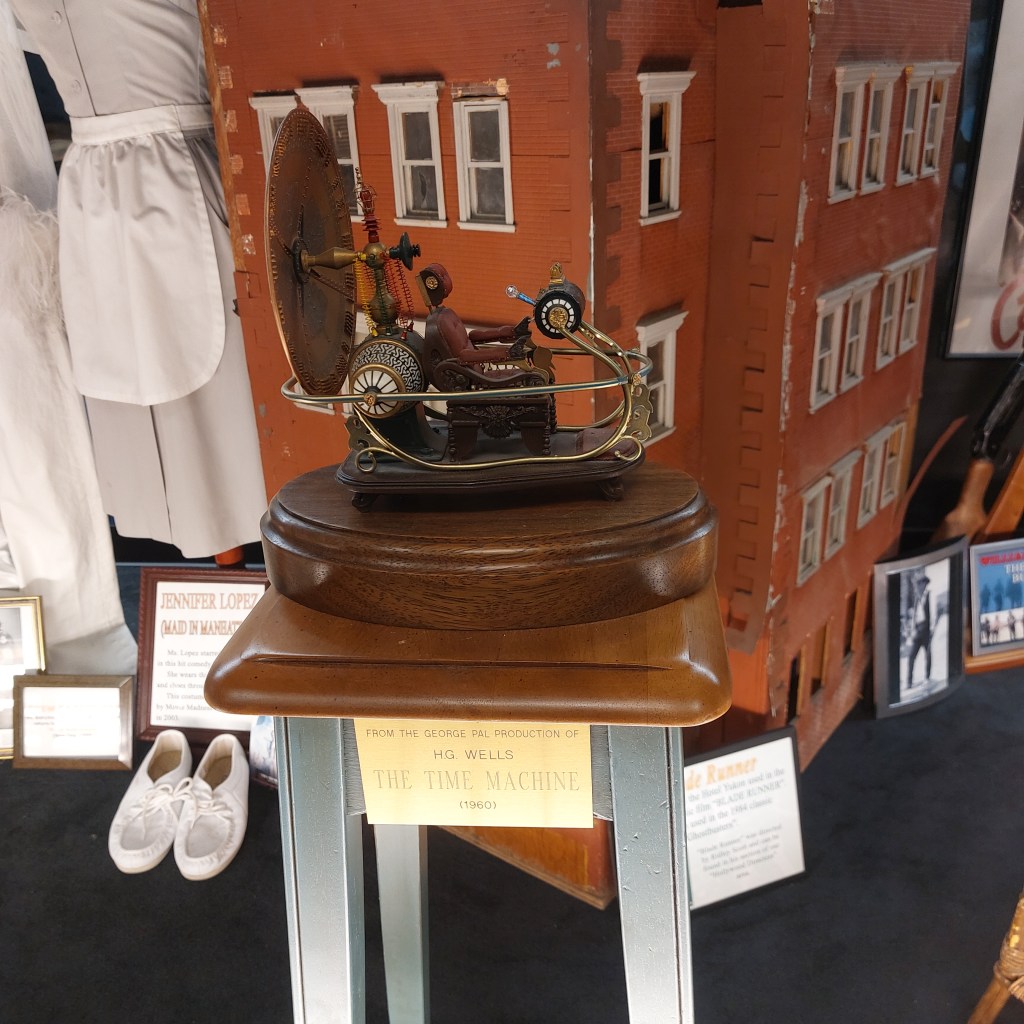
Working on this post, I picked up my copy of “The Time Machine,” by H. G. Wells, and the cover fell off. I was looking for the passage where the Time Traveller finds the library of the future:
“I went out of that gallery and into another and still larger one, which at the first glance reminded me of a military chapel hung with tattered flags. The brown and charred rags that hung from the sides of it, I presently recognized as the decaying vestiges of books. They had long since dropped to pieces, and every semblance of print had left them. But here and there were warped boards and cracked metallic clasps that told the tale well enough.” (103-104).2
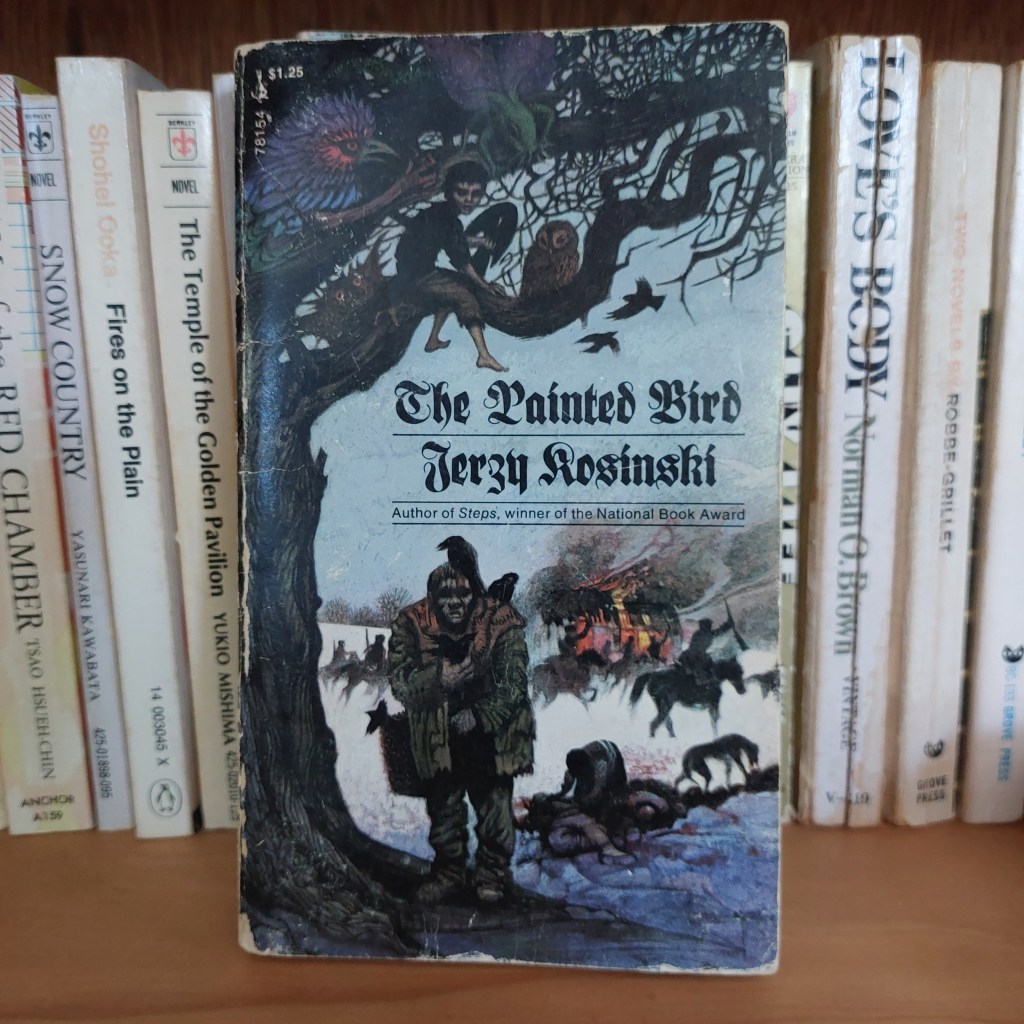
- Jerzy Kosinski, “The Painted Bird,” Houghton Mifflin, October, 1965. My copy, a Pocket Book edition, November, 1966, 5th printing, August, 1971, $1.25. (Not the copy lent me, since that would have had an older print date.) ↩︎
- H. G. Wells, “The Time Machine,” 1895, Berkley Highland Books Y789, New York, Tenth Printing, no date, 40 cents. ↩︎
 The Coming of the Toads