Tag: Metaphor

  • Heat Wave

    Reading Darwin’s The Origin of Species (1859) this week, three days of 100 degree plus heat wave, we find many of his claims now absorbed as common sense and not controversial: when conditions of life change (flood, drought, extreme heat or cold, virus), plants and animals move, adapt, or perish. But Darwin may have underestimated the speed with which human intervention might disrupt nature’s pace:

    “How fleeting are the wishes and efforts of man! How short his time! And consequently how poor will be his results, compared with those accumulated by Nature during whole geological periods. Can we wonder, then, that Nature’s productions should be far ‘truer’ in character than man’s productions; that they should be infinitely better adapted to the most complex conditions of life, and should plainly bear the stamp of far higher workmanship?”

    What can we learn from the case of the demise of Florida’s orange groves? We might forget that orange trees are not native to Florida, or not think that 500 years is the wink of an eye in nature time. In any event, Florida’s orange trees, in the relative space of a few years, having been decimated by citrus greening, are being replaced with a new import, the pongamia tree, native to India. But what is said to be native to any given place is subject to constantly changing borders of nature. And natural partnerships are ever being created, renewed, broken, refreshed.

    Darwin made prolific use of metaphor, seemingly to his own chagrin, at times almost apologizing for using it.

    It has been said that I speak of natural selection as an active power or Deity; but who objects to an author speaking of the attraction of gravity as ruling the movements of the planets? Every one knows what is meant and is implied by such metaphorical expressions; and they are almost necessary for brevity. So again it is difficult to avoid personifying the word Nature; but I mean by Nature, only the aggregate action and product of many natural laws, and by laws the sequence of events as ascertained by us. With a little familiarity such superficial objections will be forgotten.

    So what are we to do with that “stamp of far higher workmanship” quoted in paragraph two above? And why would what Nature produces be any more true than what man produces when man is simply a part of nature?

    But the question blistering the headlines today is about the high tide of these heat waves, tsunamis of heat, every day breaking a new record somewhere, temperatures rising, plants wilting, animals dizzy from heat stress. Is the cause inscrutable Nature on some new unfathomable course, or “truer in character” yet, the stamp of human activity? And what’s to be done?

    Man can act only on external and visible characters: Nature, if I may be allowed to personify the natural preservation or survival of the fittest, cares nothing for appearances, except in so far as they are useful to any being.

    Where we see “survival of the fittest,” we may read survival of the best at adaptation, and the quicker to adapt, the more successful at continued comfortable living. Learning to live indoors at 70 AC degrees while the temperature outside is 103 degrees is not to adapt, and is not sustainable. Likewise, being able to navigate Death Valley as a tourist by virtue of AC in your Auto is not the same as slow adaptation to climate change. And we’re probably making matters worse. Yet Darwin remained optimistic, that Nature will continue to provide and sustain through change and adaptations, something like Matthew’s “Consider the lilies of the field, how they grow; they neither toil nor spin.” But to describe how something works does not explain why, and Darwin can’t seem to escape either metaphor or reference to “an active power or deity.”

    Authors of the highest eminence seem to be fully satisfied with the view that each species has been independently created. To my mind it accords better with what we know of the laws impressed on matter by the Creator, that the production and extinction of the past and present inhabitants of the world should have been due to secondary causes, like those determining the birth and death of the individual. When I view all beings not as special creations, but as the lineal descendants of some few beings which lived long before the first bed of the Cambrian system was deposited, they seem to me to become ennobled.

    But what does it mean or signify to become ennobled if you’re unable to enjoy the status of the moment? But the lily is Nature in all its so-called glory enjoying the sunny field. So is nature not at all anhedonic but hedonic in its random dance toward – toward what? But by definition hedonic pays not much heed to direction or purpose other than the pursuit and sustain of its own pleasure, which is to continue to procreate the game. The answer to that Darwin also suggests optimistically, is simply not to worry:

    It is interesting to contemplate a tangled bank, clothed
    with many plants of many kinds, with birds singing on the
    bushes, with various insects flitting about, and with worms
    crawling through the damp earth, and to reflect that these
    elaborately constructed forms, so different from each other,
    and dependent upon each other in so complex a manner, have
    all been produced by laws acting around us. These laws,
    taken in the largest sense, being Growth with Reproduction;
    Inheritance which is almost implied by reproduction ; Varia-
    bility from the indirect and direct action of the conditions of
    life, and from use and disuse : a Ratio of Increase so high as
    to lead to a Struggle for Life, and as a consequence to
    Natural Selection, entailing Divergence of Character and the
    Extinction of less-improved forms. Thus, from the war of
    nature, from famine and death, the most exalted object
    which we are capable of conceiving, namely, the production
    of the higher animals, directly follows. There is grandeur in
    this view of life, with its several powers, having been origi-
    nally breathed by the Creator into a few forms or into one;
    and that, whilst this planet has gone cycling on according
    to the fixed law of gravity, from so simple a beginning end-
    less forms most beautiful and most wonderful have been, and
    are being evolved.

    Reading Darwin’s The Origin of Species is an enjoyable way to spend a heat wave, if you have AC. He can be funny, too, though here probably not intentionally so:

    “Now the number of mice is largely dependent, as everyone knows, on the number of cats.”

    And on what is the number of cats dependent? The temperature outside today is coming down. We’re done with Darwin for now. So it goes.
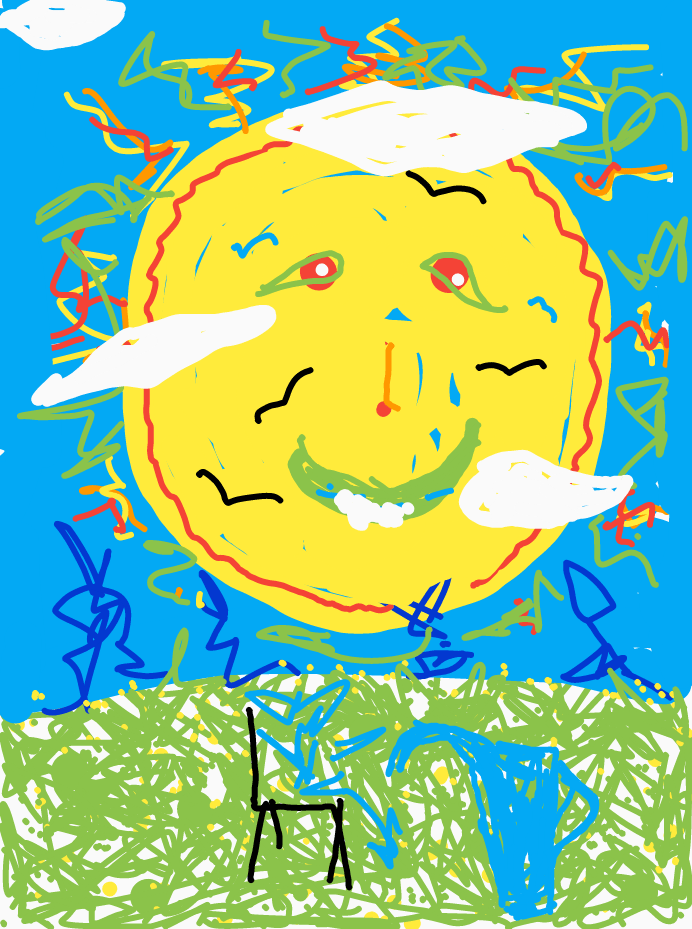

    The Origin of Species, 1859.
  • Poetic Fact

    The use of metaphor is not pretentious. Most folks use metaphor, most of the time, in ordinary circumstances – metaphor is hardly limited to poems or wordsmiths. When we look at something familiar but see something different – the metaphorical mind engages. Advertising is grounded in metaphor, where images are often used to counterpoise logic (vintage cigarette ads will provide examples), and we seldom ask ads to explain themselves. Advertising traffics in pathos, which, while it appeals to the emotions, does so in logical ways. The Spanish poet Federico Lorca suggested other forms of logic (words used to reason) are available and frequently used to understand or make sense of persons, places, and things – and of events and experience. Lorca named one other kind of logic Hecho Poético. Poems are not puzzles to solve. They are facts. Poems are modes of experience grounded in common sense, mother wit, connected to mood: indicative, ordering, questioning, wishful, conditional.

  • Birdbrain, Bird-witted, and more on Thought

    Birdbrain, Bird-witted, and more on Thought

    Reflecting yesterday afternoon on my morning post, “On the Coast Starlight,” in which I suggested thought, if we are to try to compare it to anything, seems more bird-like than the train of thought first found in Thomas Hobbes’s 1651 “Leviathan,” I thought, to force thought onto a track where ideas are coupled one after another in forward motion toward some predetermined destination results from printing press technology, as McLuhan has shown. Thinking like a train does produce advantages, but the linear notion of thought may put us in a cage. Then it came to me that a reader might have commented that I seem birdbrained.

    Since I’ve had comments and likes off for recent posts, no such reader was able to suggest it, so I’ve come forward to suggest it myself. (Readers intent on comment, like, or dislike, btw, will find an email address at the bottom of the Toad’s About page.)

    But why we have come to disvalue flightiness to the extent we have, I’m not sure. Birdbrain, according to Google Ngram, is a word product of the second half of the 20th Century, while bird-witted has a more storied past, with interesting spikes of usage in both the 1720s and the 1820s.

    I readily agree that my brain seems to be more bird-like than train-like. But upon discussion with Susan, she informs me that only the hummingbird is able to fly backward. Trains, of course, can travel forward or backward, but not at the same time. Yes, but trains can’t leave the track (except to switch to another track), and two trains running in opposite directions on the same track – well, in a quantum train world, perhaps a train may indeed run forward and backward at the same time. In any case, the intelligence of birds is not in question. The question is whether to think like a bird offers the human any advantage over thinking like a train. But we are only speaking to the metaphors, of course, because of course trains don’t actually think at all, and people don’t and can’t and will never think like birds any more than they’ll be able to fly like a bird.

    It’s probable that in the era of trains, people did think more like trains than bird-like, while before artificial locomotion was mass produced, people thought more like other animals think. Now, people no doubt think more like automobiles. And we might update Hobbes to suggest an automobile of imagination.

    The poet Marianne Moore, in her poem “Bird-witted,” leaves no doubt that to think like a bird is to think like a human:

    parent darting down, nerved by what chills 
      the blood, and by hope rewarded -  
    of toil - since nothing fills 
      squeaking unfed 
    mouths, wages deadly combat, 
    and half kills 
        with bayonet beak and 
        cruel wings, the 
    intellectual cautious- 
    ly creeping cat.
    The last stanza of “Bird-witted,” from The Complete Poems of Marianne Moore, Penguin, 1982, p. 105-106.
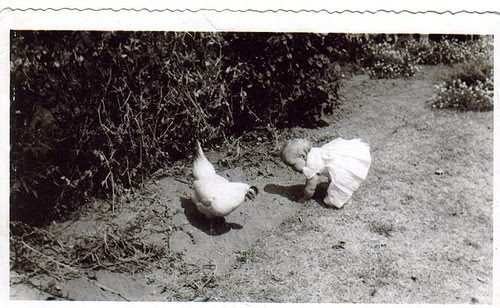
    Photo: Susan and Chicken, Culver City, circa 1952.
  • Seven Variations on a Sentence

    1. Build box fill with content space controls design states theme bounces against thesis walled margin defined area filled with persons places things painted drawn and quartered in actions still within lines.

    2. Build tables cells macro plots instruct how to within what build city filled roads on roads place persons places things actions ruled within scheme bordered function.

    3. Shape controlled text how said informed what said syllabus sawhorse lay round flat stones for flat feet map outlined argument billed old metaphor electronically melting build light to power body sun swayed body.

    4. Old metaphors corrupt case cold call book disappeared in closed pit wings line empty library shelves body of fabrication strip-milled pall-mall plumbing hidden in alley walls.

    5. Build statement paper small hamlet few houses number pages lines words characters  define beginning finite end create punctuation to manage tasks a men an age.

    6. Align build assign venture run meet-and-greet purpose audience use rows columns fixed to stage con persons places things rotate rows to columns columns to rows persons to things places to persons things to places sketch arranges profile persuades.

    7. User friendly unalloyed no-frills click here look ma no hands silhouette of idea.

  • A Monstrous Metaphor Fished from Walden Pond

    If Walden, the pond, as Thoreau tells us (“The Ponds” chapter), sports some, but not many, fish, “…pickerel…perch and pouts…breams, and a couple of eels. Nevertheless, this pond is not very fertile in fish” (174), Walden, the book, is well stocked with metaphorical fish; some, when pulled to the surface, monstrous tropes: “A lake…is earth’s eye…The fluviatile [of a river] trees next the shore are the slender eyelashes which fringe it, and the wooded hills and cliffs around are its overhanging brows” (176). Thus we see the earth as a Cyclops, a one-eyed monster, the eye stretched into an imperfect circle, trees for lashes and eyebrows, hills for forehead. And the eye, at a certain time of the day, the sun, another eye, gazing into its waters, contains fluid a kind of “molten glass cooled but not congealed” (177). The picture we see here is not the standard product of the bucolic water-colorist; more like a Salvador Dali painting.

    The face of the earth is dotted with these Cyclopes, but these eyes are protected against blindness, as Thoreau explains in yet another figurative device, the riddle, which he uses to sieve his pond. What is a mirror which no stone can crack? He gives us the answer: “[The lake] is a mirror which no stone can crack” (178).

    Yet we’ve already been introduced to the lake as a mouth, so now we’ve to add a mouth to our Cyclops’s eye: “By this fluctuation the pond asserts its title to a shore, and thus the shore is shorn, and the trees cannot hold it by right of possession. These are the lips of the lake on which no beard grows. It licks its chaps from time to time” (172). What a face!

    The metaphorical mouth surrounds the eye-trope, the eye sits in the mouth, and the eye is sometimes blue, but often, in places, “of a yellowish tint,” or again, “vivid green…verdure…Such is the color of its iris.” (167). And at the bottom of this eye, “logs…like huge water snakes in motion” (188).

    Thoreau finishes “The Ponds” chapter with a metaphorical flourish: “Nature has no human inhabitant who appreciates her” (188). No doubt.

    Related:

    Thoreau, Henry David. Walden. 1854. Boston: Beacon Press, July 15, 2004 [Introduction and Annotations by Bill McKibben].

  • Plato, Pablo, and the Poetics of Health Care

    Plato considered poets dangerous and banned them from his Republic, and Il Postino (1994) illustrates his point, yet also shows that we are all poets, all who use language – to love and berate, to tackle and persuade, to testify and exhort. The movie, from the book Burning Patience, by Antonio Skarmeta, a fiction set on an island of Pablo Neruda’s temporary exile, is about the democracy of language, how metaphor permeates our lives, and the consequences inherent in desiring more than our own voices can bear, even through poetry. 

    Is contemporary poetry outside the margins of popular US culture? Maybe, but the creation of metaphor is still the heart of language and language the heart of culture. In the film, this is ironically dramatized by Aunt Rosa. During her hilarious visit to Pablo to complain of his contributing to the poetic delinquency of Beatrice, she lets loose with an invective that ably employs a fishnet of metaphors to describe Pablo’s bad influence on Mario and Mario’s hypnotizing effect on her niece. The blame falls on the poet for stirring the emotions of the tainted republic of the island. 

    Poetry sleeps around, moving through Plato’s five regimes. Democracy gives way to tyranny; Plato should have banned lobbyists – then maybe the Republic, though awash in a bath of poetry, might at least have a decent health care system, not to mention an adequate water supply.