Tag: Mechanics

  • The Great Text Awakening

    These days, there is no bugle call. I don’t have to set the alarm for 4 am across the room to ensure I get out of bed now and hat up for a drive north to Seattle rather than hit the snooze button evermore. And these days, days will pass without my getting a single legitimate call. When I do get a call, the ringtone plays a bit of Dvorak’s “Songs My Mother Taught Me,” and I’m inclined not to pick up but to dwell in the sound of the violin reminding me my mother’s tears no longer flow.

    These days, I’m not sure why I still bother to maintain a phone, one that no longer rings till the cows come home. The cows don’t leave home anymore. Indeed, like Hamlet, “I could be bounded in a nutshell and count myself king of infinite space” were it not that I get text messages.

    These days, the text messages I get are usually automatic. For example, my phone provider will text my bill, usually at an absurdly early hour on a weekend morning, as if a dozen or more cows were restlessly mooing to be milked. Or there’s an urgent message from some pollster who can’t take another breath until he has my opinion on who should be the next President. Or the local pharmacy is alerting me that once again my doctor is in denial.

    Yet this morning, deep in some recurring dream reconstituting an old commute and the reasons whyfor, at not, it might be argued, an unreasonable hour for someone departing the docks for an adventure, but arguably still a bit early for someone who has no call to wake up let alone get out of bed for a walk along some deserted slipway, I received the following headline-worthy news item of personal note from an old friend who I might add has I think never before texted me any message whatsoever and who indeed calls less frequently than my poor mother used to:

    “We are on our way
    to Texas. I am
    enjoying the book
    you sent: Three
    Men in a Boat.
    Thanks.”

    8:20 AM

    I picked up the phone, read said message with interest, got out of bed, made some coffee, bringing a cup to Susan and taking mine out for a yard walkabout where I decided I really should cut at least the back grass today, came back in for a second cup, and sat down to put up this post, thinking, I hope he’s not texting while driving. I hesitate however to discourage text messages from, say, a reststop. I remember Kerouac’s general advice not to use the phone, because, he argued, people are never ready to talk, and he advised using poetry instead. And, indeed, “We are on our way” is a perfect poem written evermuch in the Kerouac style.
  • Why We Read

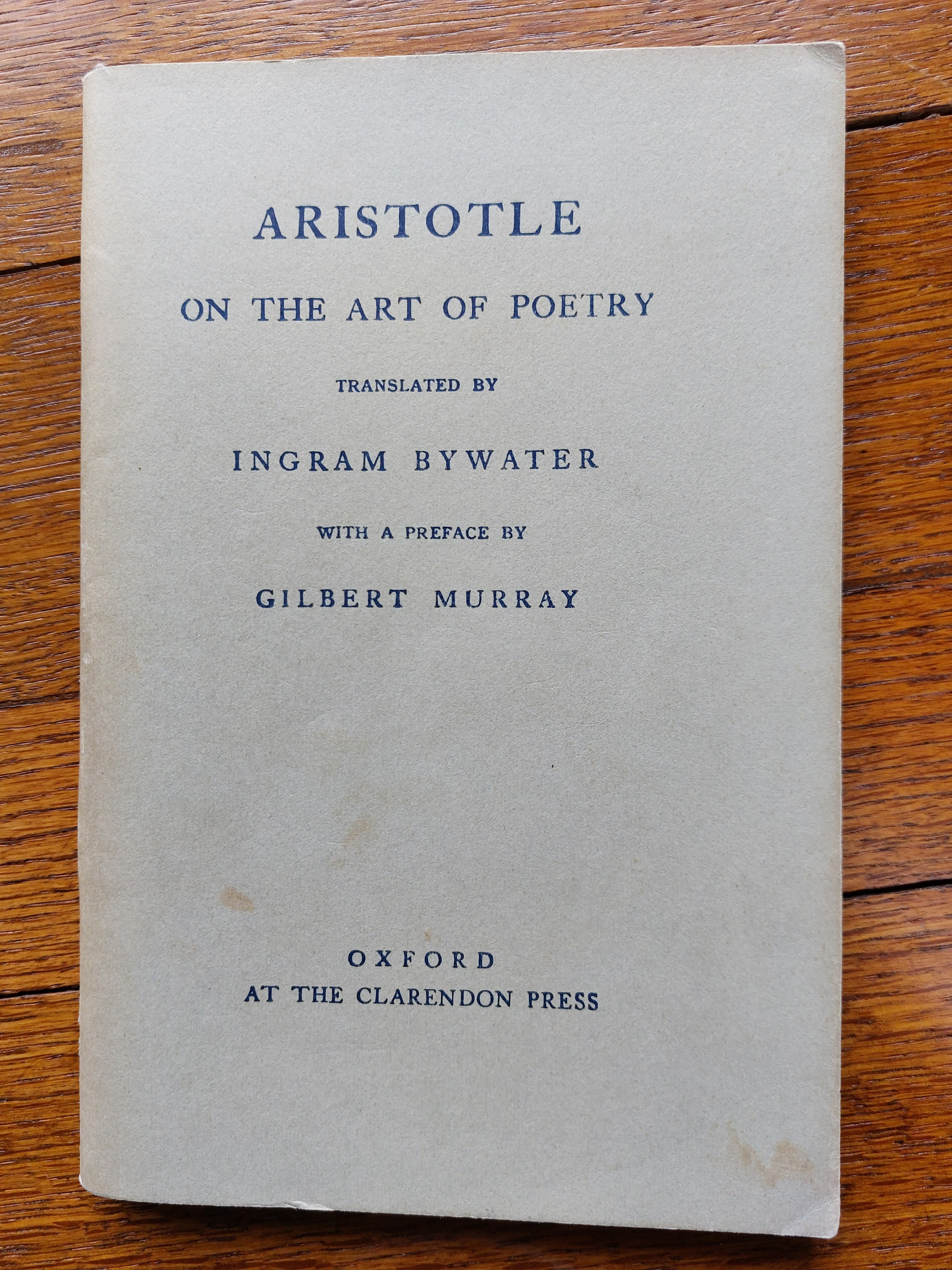
    “In the tenth book of the Republic, when Plato has completed his final burning denunciation of Poetry, the false Siren, the imitator of things which themselves are shadows, the ally of all that is low and weak in the soul against that which is high and strong, who makes us feed the things we ought to starve and serve the things we ought to rule, he ends with a touch of compunction: ‘We will give her champions, not poets themselves but poet-lovers, an opportunity to make her defence in plain prose and show that she is not only sweet – as we well know – but also helpful to society and the life of man, and we will listen in a kindly spirit. For we shall be gainers, I take it, if this can be proved.’ Aristotle certainly knew the passage, and it looks as if his treatise on poetry was an answer to Plato’s challenge.”

    Aristotle: On The Art of Poetry (Translated by Ingram Bywater with a Preface by Gilbert Murray), Oxford, At the Clarendon Press. First Published 1920. My copy reprinted 1967 in Great Britain at the University Press, Oxford, by Vivian Ridler, Printer to the University. Oxford University Press, Ely House, London W . 1. 95 Pages. Light pencil marks by your student reader throughout, this little chapbook size paperback was used as a text at CSUDH, early 1970’s, Prof. Marvin Laser instructor. “Personal Library of…” emboss stamp on first page. The passage quoted above is from Murray’s Preface, page 1.

    I’ve been experimenting with a book library app I recently found: Libib, a library management tool, used apparently by professionals and amateurs. (Any comments I make here on the app’s functionality refer to the Libib Basic, i.e. free, version). The app can be downloaded on mobile, tablet, and computer devices and they all sync. I first played around with such an app as volunteer assistant librarian at The Attic back around 2012. There we used Library Thing. Libib is cleaner, efficient, and quick. Books can be scanned via mobile device and barcode. Most of the books in my collection however predate barcodes and current ISBN formats, so must be manually input. If the book has been reprinted in some new edition, you can use that, but it won’t be the same book (edition, print, etc.) as the one in your library. Case in point, the Bywater translation of Aristotle’s “Poetry.” That problem could be workarounded by importing the newer version and then editing the information; alas, the app disallows editing of imported info. Nevertheless, I’m moving forward using the app, even though it means yet another project I’ll never complete.

    No matter, what I’ve found is the app provides another purpose, that of perusing, browsing, not to mention dusting off, books that have not been touched let alone read in awhile. The app information can be downloaded into sortable files, should one have a need for such a tool. In any case, I’m currently happily stuck in Aristotle’s examination of poetics. Every page is like opening an oyster and finding a pearl. At random, this:

    “The objections, then, of critics start with faults of five kinds: the allegation is always that something is either (1) impossible, (2) improbable, (3) corrupting, (4) contradictory, or (5) against technical correctness.”

    92

    Yes, I’ll take all five. It’s why we read.

  • How I Write

    Most writing begins in Purpose, a very crowded city, with directions out unclear amid contradictory signs. North of Purpose is Poetry, South is Prose. East is essay. West is Uncharted Territory. It doesn’t matter which direction you choose; Purpose is surrounded by ocean. The easiest and most travelled conveyance out of Purpose uses words. Words come from Language, some say the oldest of cities. But not all languages use words, semaphore, for example. Other examples of language without words might include body language, talking drums, whistling, smoke signals, music. We might say that those languages are not written, but music is written, and without words.

    But I do use words, and because I’m only an average speller, poor pronouncer, mostly monolingual, and usually lost in Purpose, I keep a dictionary open while I write, but also because individual words are like recipes; I want to know what’s in them. Sometimes I spend so much time in a dictionary nothing gets written. One easily gets sidetracked in Genealogy and never reaches far from Purpose.

    That one uses words doesn’t necessarily mean that one writes. One might talk, achieve one’s purpose, no need for pen and paper. Others might commit what someone said to memory, and repeat it themselves for a ticket out of Purpose. Talking is not writing, but it is a kind of writing.

    And I don’t always use words. I draw cartoons. But if the cartoon is an argument, it is at least a kind of writing.

    Sometimes it’s enough to ramble around Purpose, maybe with a camera in hand, walking through the neighborhoods, down to the industrial section, out to the ballpark.

    If writing were a sport, it might be baseball. The outfielders adept at prose. At third base and first, essayists. At shortstop and second base, poets. The battery of pitcher and catcher a thesaurus of pitches: location, intent, speed, deceit. Readers may want to put the Shift on here.

    We might say our purpose is to entertain, so we give our writing twists and shouts, a preacher’s sermon. The purpose of most writing is argument, an attempt to persuade. Purpose should not be confused with occasion. The occasion of writing is an assignment: a query, a synopsis, a critique or analysis. And occasion should not be confused with form. A postcard (from Purpose) is form, not content, but we begin to see how one shapes the other: “Wish you were here!” “You should have come!” “Can’t wait to get home!” “Not coming home, ever!”

    In short, how we write is not quite the same thing as what we write or why we write. When we write is not important, nor where.

    But it’s very hard to get out of Purpose. You never know when you’ll be stopped by the Authorities and asked to present your papers. Documents, photographs, identifications, QR Codes. They might even want to draw blood or have you pee into a bottle.

    Purpose can be a mean place, a town without pity.

    So I mostly try to avoid Purpose, and that’s how I write, or try to.

  • “pond”

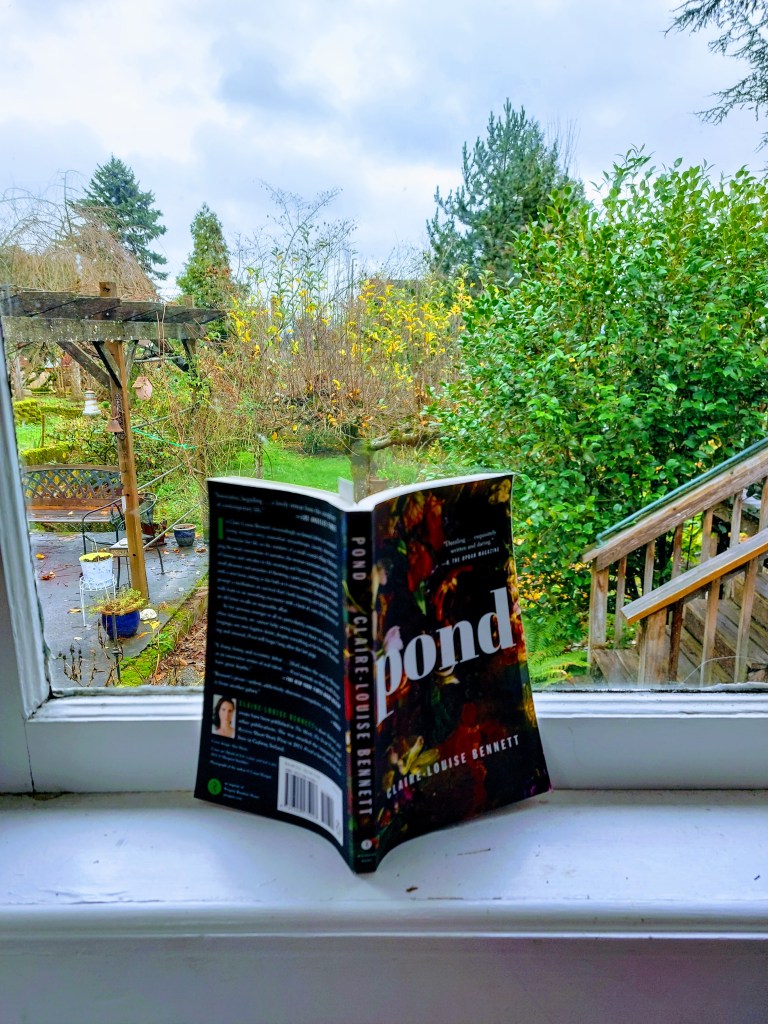
    (Pond, by Claire-Louise Bennett, Riverside Books, 2016, originally published in Ireland by Stinging Fly Press, 2015, 195 pages)

    There are thirty snippets of “Praise for Pond,” cutlets from big and small zines and papers (and authors selected or solicited for blurbs) on and offline, from reviews, presumably, four full pages of front matter, mostly adjectives and adverbs describing the author’s (Claire-Louise Bennett, Riverside Books, 2016, originally published in Ireland by Stinging Fly Press, 2015, 195 pages) “prose… mind…debut…sensibility”:

    1. sharp, funny, and eccentric;
    2. dazzling…and daring;
    3. unnerving…sensitive…porous…lucid, practical…cognizant;
    4. ardent, obsessive-compulsive, a little feral…kookily romantic;
    5. innovative, beguiling…meditative…fresh;
    6. witty;
    7. dreamlike…startling;
    8. attentive…baroque and beautiful;
    9. stunning;
    10. cool, curious…intense;
    11. elegant and intoxicating;
    12. fascinating…immersive…readable;
    13. exhilarating…comfortable…confident;
    14. deceptively simple…unsettled…formidably gifted;
    15. strange;
    16. muddiness…deliberate and crisp;
    17. sharp…discursive;
    18. weird;
    19. impressive;
    20. compelling;
    21. quirky…opinionated;
    22. inventive;
    23. believable…dazzling;
    24. captivating…wonderful;
    25. quiet and luxurious;
    26. ablaze;
    27. absorbing, compassionate;
    28. distinct;
    29. provocative;
    30. wry.

    But I will add that what Bennett requires of her reader is patience, the kind of indulgence one might assume will not make for a popular reading, yet here it is, an “eccentric debut…of real talent.”

    The common reader might already suspect we are in for deep waters in “pond” when we see the page that comes after the list of twenty titles in the table of contents, quotes from Nietzsche (The Birth of Tragedy), Natalia Ginzburg (“A Place to Live”), and Gaston Bachelard (The Poetics of Space). I can’t explain why the titles of the Nietzsche and Bachelard books are placed in italics (in the Riverside paperback copy under review – i.e. the one I read, the first American edition, and have posted a pic of above, sitting in the kitchen nook window looking out on the wet yard as I type) while the title of the Ginzburg book is placed within quote marks. But, as it happens, the book I finished just prior to opening “pond,” coincidentally, (and I don’t really know if it should be typed as “pond,” “Pond,” or “POND”; or pond, Pond, or POND) was a Natalia Ginzburg book: “Family and Borghesia” (nyrb reissue, 2021), a very different kind of book from “Pond,” though similar in its wanton flow of words and focus on detail (how’s that for blurbing?). Moreover, as I looked up “patience,” wondering if it was the right word, appropriate and all that, for where I wanted to put it, adding my own descriptive, albeit with a noun, to the thirty clips, knowing full well it will never nor would have made the cut, I came across this sample sentence to illustrate the use of “indulgence”:

    “Claire collects shoes—it is her indulgence” (Google dictionary, Oxford languages).

    I don’t collect shoes, nor, I suspect, does Claire-Louise Bennett, who apparently lives or lived during the making of POND on the Atlantic Coast of Ireland in a small stone hut of some kind, again, apparently, as I put together a few clues from the book as well as from rummaging around. I live on the Pacific Coast of the US, not within a stone’s throw of the water, anymore, but close enough to enjoy the waterlogged winters of the Pacific Northwest, about ninety miles away from the big pond as the roads go, about seventy miles for the birds, assuming they take a direct route over or through the passes of the Coast Range. The coordinates for Galway are 53.2707° N, 9.0568° W; while for Cannon Beach, Oregon are 45.8918° N, 123.9615° W. It’s currently (as I type) 44 degrees in Galway and wet at 8pm, a bit of wind maybe a bit of sun tomorrow to close a rainy week and start a new one; while at the Oregon coast it’s wet and 47 degrees finishing the morning with a high wind warning in place for this evening to close a wet week and start a new one. That’s not to say living on the Pacific coast of the US is anything like living on the Atlantic coast of Ireland. Except that, we both get our weather for the most part from our close proximity to what some call wild oceans.

    In any case, I very much enjoyed reading “pond,” and thought I might put up a post from another West Coast of rivers and streams dampness and moss and ponds and puddles galore:

    “aplenty
    in abundance
    in profusion
    in great quantity
    in large numbers
    by the dozen
    to spare
    everywhere
    all over (the place)
    a gogo
    by the truckload
    by the shedload”
    (Google dictionary)

    I think galore is the descriptive word I’ll end this review (if, indeed, it can be called that, and, if not, I don’t know what) of “Pond” with.

    Claire-Louise Bennett’s “Pond” presents writing galore.

  • Dolling Down

    Some folks like to dress
    others down for a night
    on the town to be seen
    or to mingle in the pile

    to start a scene walk
    the prowl talk the chat
    say a prayer to the folks
    at the top of the stares

    go-go with the up-flow
    the effluvium of the
    affluent dressed
    in advertisements

    ads in fashion zines
    Fellinists puttin’ on
    the style the smile
    all the while they

    used to say it was
    a young folks way
    but we can put on
    the style any while

    doll it up or doll
    it down the grin
    showing couth
    or clown frown.

  • Blog Post

    “Did you post something to your blog today?”

    “Did you post something to your blog today?”
    “I’m thinking of going horizontal.”
    “Really, and how was your day?”
    “Not bad. I escaped Twitter in the knick of time.”
    “What does “in the knick of time” mean, exactly?”
    “Sorry; comments off.”

  • Notes on Hearing Loss

    A house down around the block is getting a new roof, hammers echoing like giant flickers. Since the big virus outbreak the neighborhood seems quieter, fewer cars speeding up the bumpless street, the park above closed to the outdoor concerts, though a few bicycle races and random music groups have come and gone. We frequently hear music though, through the trees, over the roofs, through the backyard fences, but can’t always be sure of where the sound is coming from. No fireworks this year. Not a single yard sale. But some noise seems louder, the trash trucks on their weekly binge, the mailman at the mailbox, the yapping yellow dog behind and a yard over, skateboards, our tinnitus.

    A loss of sound seems paradoxically to quicken our sense of hearing. That is dynamics, change in pressure and temperature, frequency and consistency. Some sounds we don’t hear until they go silent. Sound can baffle, bounce around dancingly. If you’re uncertain where a sound, particularly a voice, is coming from, the disorienting distraction bewilders. Just because you don’t hear a sound doesn’t mean you can’t feel it, its pressure in your ears, resounding around your head. Likewise, you might hear voices, but the words lack clarity, and you can’t make out what’s being said.

    Some sounds are tight, other loose fitting. A flash flood of sound leaves a wake of mud. The beginning of rain drips into the ears, like its relative petrichor, that newly wet earthy scent in the nose, a slow awakening to something that’s been asleep for a long time and is now looking for a new bed to spend the night, one of your ears unfolding asymmetrically.

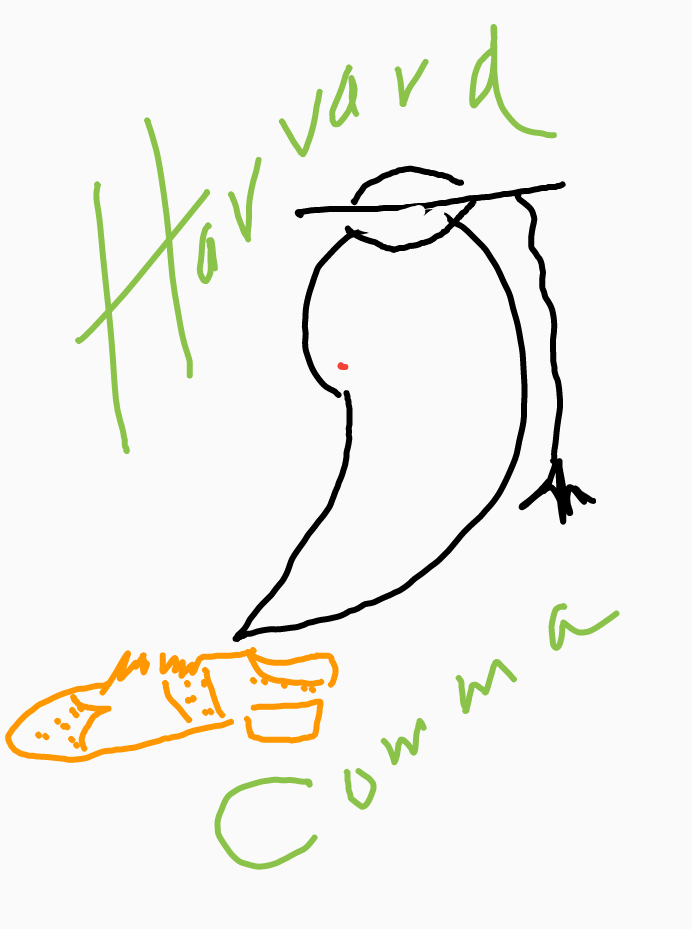
  • Oxford, Harvard, or Serial Comma

    Nothing takes the place of a comma.

  • Fit to be Tied

    Some writers, it seems, hard to read, struggle to get a piece going unless they have something to talk about, but something to talk about doesn’t come from the same reservoir as having something to say. Some of our most interesting and arresting writers have written profoundly, enjoyably, articulately, about, by all appearances, nothing. Others wait until fit to be tied with a topic under the acrimonious assumption readers are awaiting their latest culled diatribe.

    Men’s neckties provide rich fodder for topic matter. The tie is a remarkable piece of nothing. The necktie reached a new height with Annie Hall, who looked and moved like she was taking cues from Charlie Chaplin. After Annie Hall, the necktie could only be pastiche and kitsch and irony. But Annie, or Woody, wasn’t the first out of Hollywood to use the tie to say something at once both memorable and forgettable. W. C. Fields, the Marx Brothers, Charlie Chaplin, Buster Keaton – all sported neckties as part of their costume, part of their act. Rodney Dangerfield mastered the wearing of a loose tie, and of using the tie as an expressive prop for his hands. Rodney rarely appeared without a tie, usually wore a red one, and he wasn’t as funny tieless, open-collared. Only with his tie on could he reach the proper level of fit to be tied where his humor worked.

    Donning a tie of course is no guarantee to successful stand-up, won’t necessarily make you funny. On the contrary, ties usually suggest a portent, a serious person. White collar workers wore ties because their work was often so unintelligible and without obvious skill that they needed something to enhance their heft in society. Without a necktie, the white collar worker could easily be mistaken for a bum, someone characteristically out of work. To go on a bummer is to loaf about with no clear or obvious purpose, a near perfect description of the average white collar worker. At the same time, a loose tie, particularly when worn toward the late afternoon, may suggest one has been hard at work. Either that or the office air conditioner is on the fritz.

    The opposite of wearing a tie, if one is out and about, is wearing only an undershirt. The t-shirt was invented to be worn inside, an undergarment, worn under an overshirt, not to be seen. Originally titled “The Poker Night,” Tennessee Williams’s play “A Streetcar Named Desire,” dresses Stanley Kowalski in a t-shirt, hot and sweaty on a humid August Southern night, drinking and smoking, worked up and fit to be tied. Stanley enters, “roughly dressed in blue denim work clothes. Stanley carries his bowling jacket and a red-stained package from a butcher’s.” Tennessee Williams might have dressed Stanley in a tie, had he known more about office workers.

    But it turns out Stanley does wear a tie, has a collection of three. Or maybe we’re confusing the play with the happier ending movie. In any case, it just goes to show anyone can wear a tie, and it means nothing.