Tag: Mechanics

  • On the Chicken and the Egg

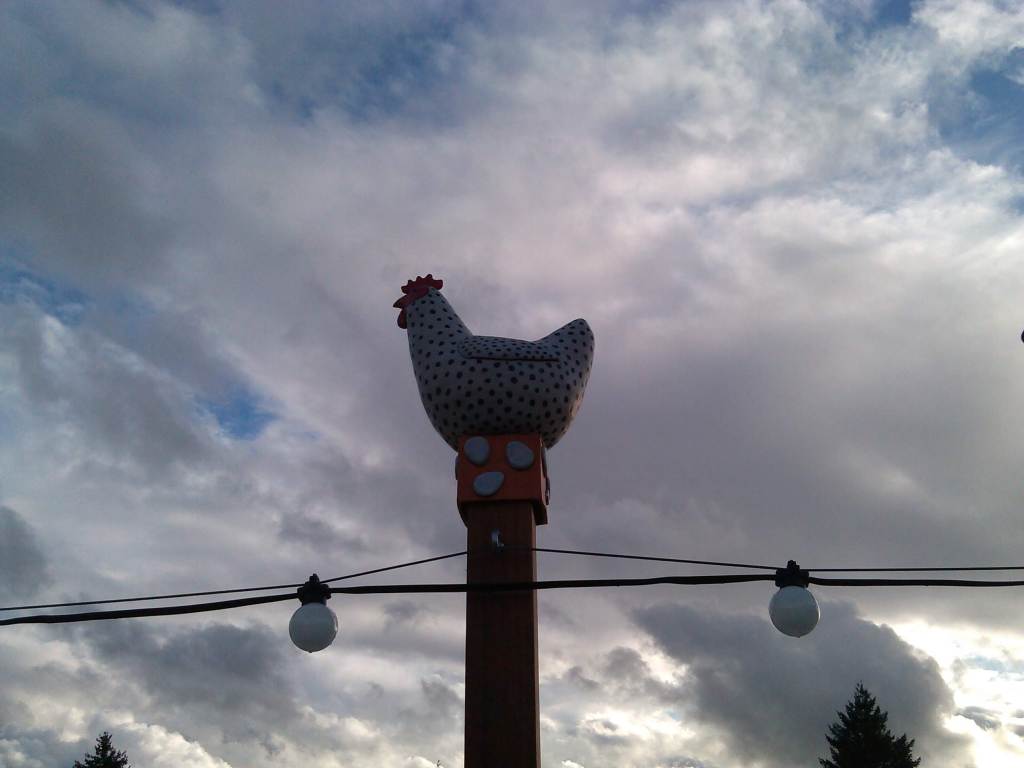
    An old friend I’d not heard from for some time recently wrote to say she was sitting on something big. Apparently, Amazon would provide the answer. She had placed an order for a chicken and an egg.

    She was conducting an experiment, and, handled correctly, she wrote, she would not be surprised at an eventual Nobel nomination.

    It took a bit for me to figure out where she might go with her hypothesis formulation, for there didn’t seem to be a prediction one way or the other. Subsequent emails clarified, but, alas, the experiment ran awry, as must often be the case, the non-scientist can only speculate, happens all the time.

    The experiment seemed cartoonishly simple: place the order, wait and see, and record the results. Meantime, I wrote back to tell her she might have easily bought a dozen chickens and fifty eggs on her next trip to Costco. No, no, no, she said, I didn’t get it.

    In any case, the first signs of the experiment going amiss came with the delivery alerts, an email for each stage of the order, shipping, and delivery: a thread of emails for the chicken, another thread for the egg. There was tracking to be done. A few days passed. Still no chicken, nor egg.

    End of the line emails suggested a fox had got the chicken, a crow the egg. It came as no surprise that the email delivery updates, the so-called alerts, included little detail. Ignoring this, she argued for spontaneous singularity – the chicken might have come with the egg, appearing, as Amazon deliveries often apparently do, from out of nowhere. Or maybe the chicken and egg weren’t really, in actuality, separate entities, so the question of which came first was null out of the gate. Same box. Or maybe you stick the egg into a chicken like you would a battery into a toy. Would the egg come enveloped in bubble wrap?

    I might mention that one of my own observations is that often people suffer from a surplus of thought. This leads to an imbalance between the mind and body and may make simple and clear communication with others difficult. Exercise is the solution. I mentioned to my friend that Plutarch and Aristotle before him – they both a long time ago satisfied the question of the chicken or the egg. But it’s not as simple as what came first, the very concept of first being itself subject to argument. But Aristotle said, “In our discussion of substance everything which is generated is generated from something and by something; and by something formally identical with itself.” Yes, that’s fine, returned my chicken and egg Nobel-bound interlocutor, but what substance a posteriori is he talking about?

    A what?
  • At the Mall

    At the mall I walk thru glass
    and almost fall trip boarding
    an escalator in the book
    store, my feet not quite
    aligned to alight gracefully.

    I pass a lady who looks lost
    and a mannequin just found
    her head squeezed dahlia
    pops at the top of a pair
    of stylized skinny jeans.

    I walk through sounds smelly
    perfumes, anonymous noise
    guy in uniform and money
    bag reading a mall directory
    two robots pass by glistening.

    Old guy sitting in food court
    selling postcard size drawings
    on his face a weathered frown
    lady in front of me at coffee cafe
    dabbing red stained tissue on arm.

    Janitor pushing cleaning cart
    picking up fallings the mall
    as clean as a movie screen
    playing Logan’s Run (1976)
    countryside bubble malls.

    I study a few of the other
    people at the mall and try
    to see us as others might
    see us in the mall season
    reasons even Mr. Mall forgets.

    I pause in a general sitting
    area and pull out my cell
    phone and work on a few
    comics then the cell rings
    and it’s time to meet back up.

  • Labor Day

    I’m giving up
    I’ve quit drinking beer
    and now no more
    ice cream, potato chips,
    or salt peanuts.

    And I’m tossing out my books
    dumping the personal
    paperback library
    hard they fall
    off the emptying shelves.

    And friends no more
    I’m ditching them all
    who gave up on me
    long ago anyway.

    And my host
    from Galilee
    He becomes harder
    to follow as the trail
    narrows and winds
    up thru the dry hills.

    Today’s the day
    Labor Day
    I throw it all away
    beginning with this
    espresso poem
    for as you can see
    hopefully I keep
    a little poetry.

  • Theory of Meaning

    What is mental may mislead us,
    the physical, on the other hand,
    for example, in a cloud you see
    an elephant, but that elephant
    is mental, not physical, while a
    physical animal in a living room
    could be mentally misconstrued
    as a ceiling cloud; the mental
    is also physical, and vice versa.

    We might call, in this discussion,
    what is physical, the denotative
    meaning, and what is mental,
    the connotative meaning. They
    are both meanings, both valid
    experience, and one plays off
    the other. Denotative meanings
    describe, while connotative
    meanings suggest. Further,

    we may easily and without
    argument agree on clouds,
    but to say a cloud is an
    elephant is a statement
    about which there may be
    some disagreement. Either
    way, rain begins to fall and
    the farmer is happy while
    the weekend golfer pissed.

    Let’s make sense together, you and me:
    Our needs are simple:
    water and food, shelter, one another.

    We think we are thinking beings
    but that’s not to say
    this rock and paper don’t exist.
    The rock quivers to its icy core
    when the voice speaks its thunder
    and the elephant walks
    through the room.

    All thought is substantive, bears
    out, vindicates the light of all
    we see and miss which absolves
    the darkness. The rock too thinks,
    thinks, “I am a rock; I have it easy.”
    Don’t worry about meaning. We
    play hide and seek, turn sounds
    into music, shelter in rocks,
    plant tomatoes under elephants.

    By meaning we mean passing
    a baton in a conversational relay.
    Ask the easy questions first:
    who, what, when, where, why,
    and how – the architect built
    on nothing, why then should
    nothing distract you?

    Meantime, last night I slept
    on my guitar, while the blinds
    blew in the breeze of the open
    window, and night birds flew
    in and out, around the room,
    each with its own song.

  • The Universe and Us

    The Universe is useless without
    us and these songs and poems
    the sober calm voice of a turtle
    the trills of the song sparrow 
    the sweeping tones of the blue 
    whale tunneling through the sea. 

    When are we going home, our 
    space suits covered with dark 
    matter and such truck one picks 
    up living on the road, sleeping 
    in train depot motels out along 
    the Milky Way walking, waiting. 

    The Universe is nothing outside 
    thumbs hitchhiking backwards  
    what we see when we look out 
    into the light switches on and off 
    and all along the potholed road
    ramshackled machines sit idle. 

  • Ten Questions to Ask When Reading a Poem

    1. An author brings words to a page, but he’s not necessarily the speaker of the poem, the I of the poem, who the poem is about. The speaker can be a fictional character the author has made up, like the narrator of a novel. And even if the poem is not written in the first person (I, me, we, our), there is still a speaker, a voice talking. The poem may be written in the second person (you, your) – here the speaker is like the writer of a letter. Who is the speaker talking to? Or a poem may be written in the third person: she, her, they. Or no person – the poem appears not to have a speaker. Consider the familiar corner Stop Sign. Who’s the speaker? Who’s the intended audience? White letters on a red background. Why red? Is the Stop Sign a poem? If we don’t ask questions of the obvious, we’ll soon have trouble reading poetry.

    2. A poem, even if published in a so-called reputable and credible publication, is not necessarily a good poem (Joyce Kilmore’s “Trees”, for example, first appeared in Poetry Magazine in 1913). Don’t sweat it. But a poem might be considered good if it achieves its purpose, and maybe it’s the poem’s purpose that seems bad. There are many different kinds of poetry and poets. You don’t owe them anything. Like music, art and architecture, TV shows and movies – there are wheels within wheels that bring them to our attention, and while we might enjoy one type, we might want to avoid others. But your likes and dislikes don’t determine the worth or value of a song, a movie, a house, a photograph, a poem. Don’t ask if the poem is good or bad. Ask if the poem achieves its purpose. What is the poem’s purpose? To make you laugh, cry, shout, run and hide, feel guilty, happy, or sad? To inform or disinform? To instruct or deconstruct? To sing and dance, to perform? To protest? To affirm? To question?

    3. Poets are like the Easter Bunny. They like to color and hide eggs. Reading a poem is like going on an Easter egg hunt. Take a dictionary along to hold the eggs you find. How many eggs are in your basket? But some poets are too good at hiding their eggs, and you don’t find any. Inside each egg is a secret.

    4. What appeals are made to your senses? Do you know what things smell like? Are the rushes of sound given names? Is there something there too fearful to touch? Can you taste the words when you chew them? Can you see what’s being described as if within your very eyes?

    5. Consider the layout of the letters and words. What’s the shape, the blueprint, the design? How many words and how many lines? Count them and write the numbers down. Any repetitions? How many syllables in each line? Are there patterns? Stepping stones? A path? Is this poem a rocky mountain to climb or a grassy hill to slide down? A wave to ride? An updraft to cruise?

    6. Is the poem serious or joking or sarcastic, maudlin or lugubrious, childish or elderly, obscure or everyday, difficult or easy? Is something being taken too seriously? Is no one listening? Is it hokey? Is the poem long, short, fat, skinny, bony, chewy, sinewy?

    7. Where is the speaker? At home, work, asleep? In the country, city, at the ballpark? In a church, a mall, about to jump off a pier? On a bus, in a rush, at home or far far away? In a classroom, at the front behind a podium? Or at a desk somewhere down one of the aisles. Standing in a pulpit? Sitting on a stool at the tavern? At home cooking dinner? Walking in a garden? In a garage, basement, or attic? On a mountain top, in a cave, walking on a beach. Is the time of day morning, noon, or night? The season spring, summer, fall, or winter? Are you still on planet Earth? Is the poem an animal, a plant, a virus? A sun, the moon? Water?

    8. What does reading the poem make you feel like? Informed, betrayed, loved, ignored? Is the speaker rash, anxious, angry, happy, tearful, mournful, gracious, patient, loving, kind, mean? Do her feelings rub off on you? Does she make you feel stupid or smart? Bored? Tired out? Afraid. Brave.

    9. Would you read this poem again? Recommend it to a friend? Tape it to your icebox door? Write it out and carry it around in your wallet or purse? Toss it? Shred it, frame it, post it? Would you memorize this poem? Where did you find this poem? Would you hide this poem in your most secret place? Would you staple this poem to a telephone pole?

    10. Does the poem ask you to do something? Go somewhere? Misbehave or pray? Listen or talk back? Repeat or move on? Sink or swim? Write your own poem? The field is open, never crowded. Whatever else you might do or ask, do not ask what it means.

  • All A Draff

    All a draff 
    a draft
    raking thru
    the dregs
    adrift
    adrift

    I am not a robot
    Motorcycles
    Traffic Lights
    Buses Adrift
    No schedule
    No route map

    To the Dark
    Sidereal
    I am not
    Art I Fish All
    and dreg up
    cups bottom

    Cross Walks
    To & fro
    each cross
    its own horizon
    where the sky
    meets the water

    geometric requirements
    Social Skills
    (any skills
    for that matter)
    Marriage Classes
    Reading Glasses

    I had a friend
    Who had a friend
    I did
    befriend
    But that's not how
    I then met you

    They were discussing
    Punctuation &
    Grammar by which
    They meant
    To say nothing of
    The Endgame

    Which caused me
    To think of you
    Your dust at sea
    All along the edge
    Where things fall
    Off the way things go

    and pile up
    one thing
    on top of
    another
    akimbo
    a draff

    adrift
    nimble-fingered
    tho rathe
    rather nippy
    nimble
    masterly

    Anyway we
    We were talking
    About what
    Hard to know
    A flow
    Of pics & tics

    That's not true
    What I sd earlier
    When I sd I am
    Not "a machine resembling
    a human being and able
    to replicate certain human
    movements and functions
    automatically.

    'the robot closed the door behind us'"

    I am a robot
    Forced to crawl
    Adrift across
    Back and forth
    Sweeping up
    After you

    Pic after pic
    Falling
    Failing
    Fishing
    Adrift
    A draff draft

    A daff
    Salt water
    Taffy
    "she told me that my music
    was perfectly wonderful,
    and taffy like that"

    "according to R.U.R. management
    the robots
    do not 'like'anything."
    Are you are
    or Are you not
    a robot

    I'm not now
    Sure
    But years
    Have pissed
    And still
    I'm here a bit

    But true a
    Drift a draft
    Replaceable
    In War with the Nerds
    Dork and Dweeb
    Figure prominently

    Dwork wants
    To go Rome
    Deeb reminds
    They don't have
    Stars on their
    DL's

    Here a bit
    There a bot
    Everywhere
    A bit bot
    To boot
    To turn up

    A turnip
    In yr pocket
    Proves yr not
    A total android
    A mess on some
    Scientist's bench

    Turn on
    Tune in
    Drop out
    "During his last decade, Leary proclaimed the 'PC is the LSD of the 1990s' and re-worked the phrase into 'turn on, boot up, jack in' to suggest joining the cyberdelic counterculture."

    Drift on
    Draft in
    Draff out
    Right on
    Write stuff
    Write Off

  • Write with Calmness

    Recently, I’ve been writing on WordPress using the Jetpack application installed on my cell phone and tablet, deprived of a real keyboard and downsized to essentials, but able to pull out the tool and continue playing around with a post throughout the day, adding, subtracting, dividing, etc., on the go (to the extent I ever am on the go these days, where go might look very much like stop). Writing is a disappearing act.

    The laptop, my usual tool for developing and publishing posts, as get up and go as the laptop is, is not as flexible and doesn’t travel as easily as the phone or tablet (for one thing, the laptop batteries are down to a trickle, and it must be left plugged in to work). I thought the recent posts from the cell and tablet were displaying wysiwyg (what you see is what you get), but a couple of faithful readers let me know not so. Yesterday’s post, for example, a short poem titled “A Bout,” apparently appeared on their reading devices in a pale white font on a fog colored background, difficult, but not quite impossible, to read. By Jove, I thought, that format (if that’s what it’s called) accurately describes the theme of the poem, but it was unintentional. And the pale white font on fog colored paper was an improvement – posts previous to that one had not appeared at all, those same readers had informed me; under the title, on their devices, the post was blank.

    I assumed the problem was user error, and set out to discover how I’d messed things up so, and in the process found (under a three dot dropdown menu at the far top right of the WordPress screen) “Options,” one of which is labeled “Distraction free: write with calmness.” In other words, we have a choice: write, and consider yourself a writer, or fall down the convoluted rabbit hole of blocks, styles, editor this and that, and things Jetpack related – a dichotomy that is of course distorted, unfair, and entirely inaccurate. Well, maybe not entirely. Like the guitarist who trades in the acoustic classical guitar for an electric guitar and a panel of guitar pedals, the writer who incorporates a full spectrum of technological gimmicks or tools, as opposed, say, to simply using pencil on paper – um, one senses a loss of calmness. And yes, I know I just split an infinitive, but I do so in perfect calmness. It’s impossible to split an infinitive in Latin, which is where the absurd rule comes from, but this isn’t Latin class. Well, maybe that last bit is not so calm, after all.

    And the point of writing is to becalm. If you find writing does not invite calmness, you may not be actually writing, but are engaged in some other method of spending time – not to say any one way has more value than another. Writing usually has some purpose, which is to say occasion, argument, intended audience, none of which would seem to invite calmness. Still, the act of writing, if one is to find the sweet spot, is a path toward calmness, invites calmness – because once under way, all else falls off. One becomes, indeed, free from distraction.

    Swā, this post is being written on the laptop, as an experiment to see if the problems don’t correct themselves on the readers’ devices, thus isolating the cause to Jetpack on the cell and tablet. Let me know in comments below, if you’d like, what you see, or don’t see. But remain clam. I mean, calm.

  • Beboparebopawoebot

    Worst may happen words will be wasted
    but when the Old Kingdom cattle count
    comes around you’ll be taxed every one
    so omit unnecessary parts of speech
    and craft each comment in mindfulness

    As for punctuation use sparsely as if
    on a desert plain flat and dry and open
    for readers are offended by periods1
    while snowflakes fall like plumules
    to cover the withered words of summer

    Do not read for meaning but for beauty
    for you cannot stop the flow of words
    the catastrophe of thought fills space
    with light and shadow dappled colors
    The purpose of poetry is clerestory

    a window you can’t see out allows
    light to fill the air enclosed inside
    worthy even if you have to hear organs
    groan like donkeys through the lovely
    indoor sky and nothing you suspicion

    1“Woebot tends to avoid periods at the end of texts, because user research has suggested that people experience them as aggressive”

    The New Yorker, “Can A.I. Treat Mental Illness? New computer systems aim to peer inside our heads—and to help us fix what they find there.” By Dhruv Khullar. February 27, 2023.
  • Doubt and Drift

    Faith is belief in what cannot be proven. If something can be proven, faith in it is no longer necessary. But most of us can’t prove anything. We spend most of our lives swimming around in a sea of faith – faith in people, places, things; faith in history, institutions, religions; faith in ideas, nature, love. We live by faith in these things, not just that they exist, but faith in that they work as designed, faith in how they should work, and faith in how they do work.

    We no longer have faith in the news. “Popular distrust of the news media has been traced to the coverage of the stormy 1968 Democratic National Convention,” Louis Menand discusses in “Making the News: The press, the state, and the state of the press” (The New Yorker, February 6, 2023, 59-65). Underlying any loss of faith comes the realization that too much may have been invested in the building blocks of truth, facts, and how we think we do things the way we do because we’ve always done them that way. These blocks turn out to be soft and fuzzy and protean. What is true changes with the times, predicaments, what we want.

    “As Michael Schudson pointed out in ‘Discovering the News’ (1978), the notion that good journalism is ‘objective’ – that is, nonpartisan and unopinionated – emerged only around the start of the twentieth century. Schudson thought that it arose as a response to growing skepticism about the whole idea of stable and reliable truths. The standard of objectivity, as he put it, ‘was not the final expression of a belief in facts but in the assertion of a method designed for a world in which even facts could not be trusted. … Journalists came to believe in objectivity, to the extent that they did, because they wanted to, needed to, were forced by ordinary human aspiration to seek escape from their own deep convictions of doubt and drift.’ In other words, objectivity was a problematic concept from the start” (p. 60).

    We might find complementary or corollary application to other areas. Menand uses the 1968 convention to illustrate how the news is not reported but made, and that once the recipe for how it’s made is made manifest, and there follows general doubt and drift from the sources – from the who, what, when, where, how, and why of the story – the remaining mess makes for great leftover meals for anyone wanting to take advantage of that doubt and drift to further their own agenda, investment returns, popularity, hold of the reins. We might find corollary application of the argument in the doubt and drift in our times from religion, health care, higher education, police protection – all areas once strong with the faithful but we now look out and find empty pews. Damage control, by which is meant control of the news over the story, becomes paramount in restoring the faith.

    But we reach a point where faith can’t be restored. The Jesus Movement becomes the Free Press of religion. Indie becomes the barbaric invasion of not traditional music, film, publication, art, but of the open-gate making, distribution, and profit (or not) of free expression. We can no longer die for our country, only for one another. We take medical advice with a grain of salt. The man wearing the badge, the clerical collar, the stethoscope, the suit and tie – might as well be wearing a newspaper. The homeless person is one of us. The Emperor wears no clothes. The Wizard is a humbug – and like he said, he might be a good guy, but he’s a bad wizard. We are out here on our own.

  • Wonder of the On-Line Literary World

    This month, Berfrois, the small literary magazine, has closed its virtual doors. For the last 14 years, Berfrois, under intrepid editor Russell Bennetts, an economist out of England, has published daily writing, forming over time an eclectic list of contributors and an audience of intercultural competence. The end of active writing appearing in Berfrois comes 100 years after the closing of the modernist journals period, which ran, according to the Modernist Journals Project, from the 1890’s to the 1920’s, ending in 1922:

    We end at 1922 for two reasons: first, that year has until recently been the public domain cutoff in the United States; second, most scholars consider modernism to be fully fledged in 1922 with the publication of Virginia Woolf’s Jacob’s Room, James Joyce’s Ulysses, and T. S. Eliot’s The Waste Land. We believe the materials in the MJP will show how essential magazines were to the rise and maturation of modernism.

    Modernist Journals Project, About page, retrieved 15 Dec 2022.

    They were mostly referred to, and still are, as small literary magazines, little magazines. Most did not last long. Blast ran just two issues, 1914 and 1915. They were of course hard copy, printed magazines, small publication runs, small format. The most famous now might be The Egoist (1914-1919) and Little Review (1914-1922), which ran installments of Joyce’s “Ulysses.” Harriet Monroe’s original Poetry ran from 1912 to 1922 (still alive today as a kind of First Wonder of the Corporate Literary World).

    Is today’s on-line literary world, in 2022, now “fully fledged”? It might be, given the disastrous turn of events surrounding the social media platforms that create, sustain, and destroy – in situ. What can it possibly mean to be on Twitter, for example, with a million followers? Even 100 followers would be impossible to keep up with, even if managing your Twitter feed was all you did. Yet most tweets are never read by anyone. At most, they have the life span of a mosquito, and can be just as viral and vile. We shall be glad to see our current winter of discontent freeze them all in their tracks. For the tracks of tweets carry no real cargo.

    Most poems are never read either, but that’s a different story. And I digress. Some of my own writing appeared in Berfrois. Mostly prose, discursive writing. Berfrois published the academic, the non-academic, and the anti-academic. Its editorial voice appeared often to be one of casual interest. In a sense, Berfrois was a general interest magazine, and sought to publish the best it could find of both the best and the worst – for what is often considered today’s worst of writing ends up being tomorrow’s best.

    One of the most attractive features of Berfrois was the lack of advertising. It sought to be reader funded before its time. It might have found a good home at today’s Substack, where we find everybody that’s anybody cashing in their lotto tickets. “Thousands of paid subscribers.” Sounds lucrative, but a poor warrant to join a new fray.

    A bit of money but a lot of time it takes to run these endeavors. And we run out of both, lose steam, wonder what all the fuss is about, what it might be like to go for a walk down Broadway unnoticed or dismissed, or to wander to and fro with no desire whatsoever to be followed. In the meantime, a heartfelt thanks to Russell Bennetts for his contributions via Berfrois to the life of modern journals.