One morning recently, clicking through the headlines, we found an alert from the National Weather Service which read like an MRI brain scan, to wit:
Potential Impacts: Area of impact primarily poleward of 50 degrees Geomagnetic Latitude. Induced Currents – Power system voltage irregularities possible, false alarms may be triggered on some protection devices. Spacecraft – Systems may experience surface charging; increased drag on low Earth-orbit satellites and orientation problems may occur. Navigation – Intermittent satellite navigation (GPS) problems, including loss-of-lock and increased range error may occur. Radio – HF (high frequency) radio may be intermittent. Aurora – Aurora may be seen as low as Pennsylvania to Iowa to Oregon.
Usually, in these parts, it’s the East Winds out of the Columbia Gorge that disturb our atmosphere. We’ve had a few days now of very warm weather, some would say hot, but a couple of days of high 80s feels good after our inglorious winter and rain drenched spring. And last night was prime for a walk into a long warm Spring twilight evening, the moon a simple silver sliver, to view one result of the geomagnetic storm impacting the earth, the Aurora Borealis, the goddess of the dawn riding on the north wind.
We reflected on the sun and the workaday turmoil caused by the solar winds. We’ve two ears, two eyes; if we lose one we can reach for the other, but only one mouth, one voice. One sun, one moon, one Earth. We’ve only one chance for love, one for kindness. When we feel a breeze of love dapple our heart, we should shake off our covers of winter and dance – or walk, or sit out and bask in whatever light is available.
Under the weather, literally, in rain country, but I would have been unable to get too excited for the great eclipse of Spring 2024 under any kind of sky. Drive five hours and climb a mountain and smoke a joint for four minutes of totality? I don’t think so. I experienced the eclipse of February 26, 1979, living in what used to be called a mother-in-law house (MLH), what now would be called an Additional Dwelling Unit (ADU), on a bluff over a lake, under ship hull grey skies. I remember a shadow blowing quickly and soundlessly by the windows, its darkness thickening, and then it moved on, and so did I.
Nick Paumgarten put up an interesting take of his recent eclipse experience in a Dispatch at The New Yorker site (9 April):
“Watching the Eclipse from the Highest Mountain in Vermont: People cracked cans of beer and smoked cannabis and popped mushroom gummies and ate smoked-meat sandwiches as totality approached at fifteen hundred miles per hour.“
We seem doomed to a craving for the spectacle, the big events: Superbowl, Burning Man, EGOT awards, Election Night. When what we want, or need, is to sit back and relax, but even to relax has become big business, and nothing will do without we get super relaxed, hyper-relaxed.
Inevitably, the great hyper-experience is followed by a come-down. Paumgarten concludes, having made the trek from New York to Vermont to experience the eclipse:
“That night, the highway south, back to the cities, was jammed. People reported that it took more than six hours to get out of Vermont. Others posted screenshots of the flight paths of private jets leaving local airports. Everyone had time to reconsider what was worth it, and what was not, and perhaps to weigh keeping those considerations to themselves.“
I remember another eclipse, this one experienced vicariously via Mark Twain, which might help explain our fascinations and superstitions. This eclipse is from A Connecticut Yankee in King Arthur’s Court. Hank, Twain’s time traveler, finding himself at odds with Merlin, is about to be burned at the stake when he leverages his knowing, having been there, in the future, of the coming eclipse to control the King and his minions:
“I have reflected, Sir King. For a lesson, I will let this darkness proceed, and spread night in the world; but whether I blot out the sun for good, or restore it, shall rest with you. These are the terms, to wit: You shall remain king over all your dominions, and receive all the glories and honors that belong to the kingship; but you shall appoint me your perpetual minister and executive, and give me for my services one per cent of such actual increase of revenue over and above its present amount as I may succeed in creating for the state. If I can’t live on that, I sha’n’t ask anybody to give me a lift. Is it satisfactory?”
‘There was a prodigious roar of applause, and out of the midst of it the king’s voice rose, saying:’
“Away with his bonds, and set him free! and do him homage, high and low, rich and poor, for he is become the king’s right hand, is clothed with power and authority, and his seat is upon the highest step of the throne! Now sweep away this creeping night, and bring the light and cheer again, that all the world may bless thee.”
If the next big event doesn’t eclipse its predecessor, it’s a bust.
They might be called Smart TVs for their clever capability to befuddle the old fashioned viewer. Long ago and far away are the days you walked up to the television set, turned a knob to On, turned the other knob to Channel 2, 4, 6, or 10, TV Guide in hand, reached over the set to fidget a bit with the rabbit ears antennae, and slid back to the couch to watch a recorded picture version of what your parents when young had listened to on live radio.
Television has grown, if not matured; still, we haven’t quite reached the television walls Ray Bradbury predicted in “Fahrenheit 451,” where the entire wall is a television, and keeping up with the Joneses means adding additional TV walls until your room is entirely enclosed in TV, the effect being that you are part of the television show you are watching. But the new virtual reality headsets are probably skipping over Bradbury’s wall sets.
One advantage of old television was that at the end of the broadcast day, TV rested – it went off, off the air. A sign off screen appeared. The station transmitters shut down, the Star-Spangled Banner played (absurdly, no game following), then a test pattern with a shrill hum signal, a high E organ note. Nothing more to watch. Midnight. You either went to bed or read a book. Or went out walking, nothing on television.
Not that it matters what’s on television. Whether you’re watching “Masterpiece Theatre” or “All in the Family,” the “Red Skelton Show” or the “Andy Griffith Show,” “The Colgate Comedy Hour” or “Arthur Godfrey and His Friends,” you have to fill in the dots. Television is a DIY proposition.
“The structural qualities of the print and woodcut obtain, also, in the cartoon, all of which share a participational and do-it-yourself character that pervades a wide variety of media experiences today. The print is clue to the comic cartoon, just as the cartoon is clue to understanding the TV image.”
Marshall McLuhan, Understanding Media, 1964, p. 151, Signet Mentor
The gravity of social media at times it seems profoundly influences our every move. By gravity I mean that mutual attraction force that pulls us under and down, down rabbit holes, sink holes, the vortex created by following. By social media I mean to refer here to the sites that are for the most part vertically inclined, up and down, the newest appearing at the top, the oldest nudged down to an endless bottom where they are forgotten relics or remaindered in the fossil record. These social media sites are not formatted as mosaics, like newspapers, but like scrolls – though scrolls, even the most ancient, were often formatted horizontally as well as vertically. And the newspaper could be taken apart and shared: “Who has the funnies?” By profoundly I mean the unlimited hours an addiction to social media at any site soaks up the dark energy of our otherwise beachcombing days.
There are the followers and the following, not always the same, and often as not unknown to one another. How many and how often seen or read? And there’s the rub. I’ve been working on a formula. What number of followers or following beyond which to say one is actually following in any meaningful sense of seeing and responding to even if only to think about without comment or response – beyond which any significant number of posts, tweets, pics, etc., is no longer possible?
In other words, for example, the Instagramer I might follow who posts daily several pics multiplied by 100 other Instagramers I also follow equals hours of staring at Instagram until I can no longer honestly say I’m following all the number of individuals my account accounts for. Something like that. I could say, attending a live football game in the huge arena where sit 80,000 fans, that I’m following them all. Likewise, the social media follower who says they are following me back but who also follows say 5,000 others can’t possibly be paying much attention to me. Thus Instagram, recognizing we’ve a problem here, initiates a feature like close friends. Close friends, good neighbors, faithful followers, on the same team, family (though of course this latter often may come fraught with unfollowing in biblical proportions).
What has all this to do with “The Best of the Toads”? Just this: Here too the posts have been falling, a long way down, since my first post in December of 2007, and at least monthly since. There are now 1,463 posts. Where did they all go? And which ones might a reader most enjoy, find interesting, not to mention well written? The latest post is not necessarily the best.
So, I’ve made a Best of the Toads page, that visitors to the blog might be able at a glance to view the most successful posts since the beginning of the blog in 2007, successful as defined by number of views, but also including some posts that are my favorites no matter the number of views. You can view the new page here, or click on it in the blog menu. Happy falling!
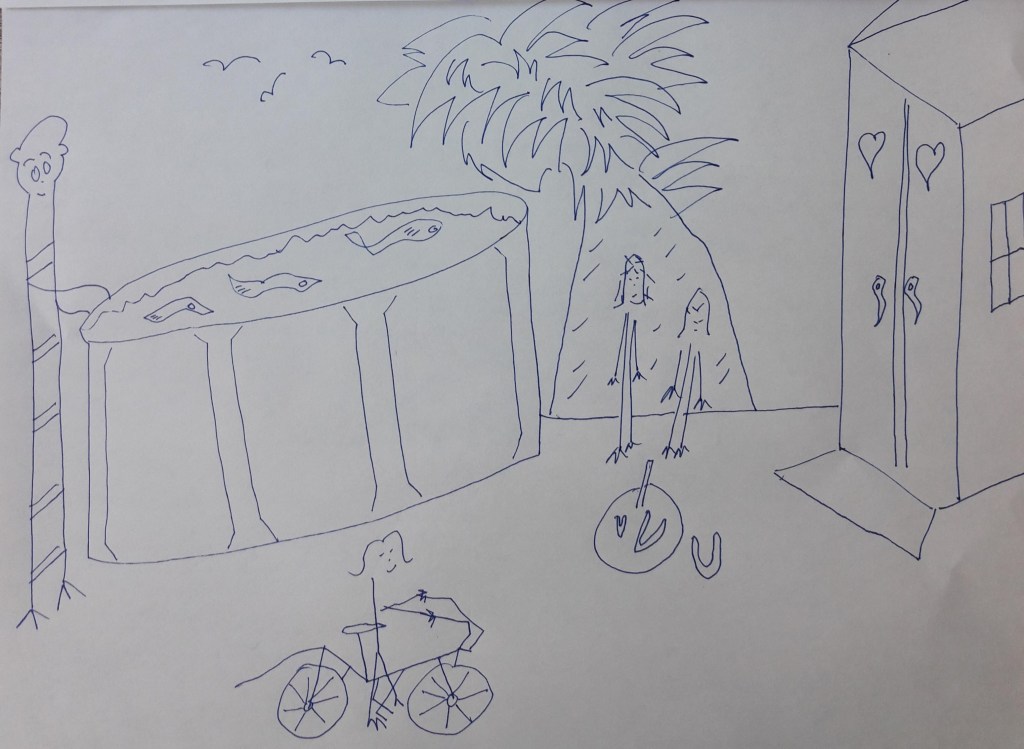
Pretend you’re sitting atop the water tower of a town. A bird. You look around and with a questioning caw fly off and glide about. What do you see? To the north, an airport; to the south, a factory; to the east, manufacturing, and a few fields as yet undeveloped (in one grow strawberries, in another horseback riding stables, in another a few dirt bike trails); to the west, sand dunes covered with ice plant flow down to the ocean.
That’s a good start. Now you’re sitting with paper and pencil, it doesn’t matter where, and begin to sketch. In paragraph one, above, you defined the edges of your place, edge as a kind of border or margin. We see the airport north, the dunes and ocean west, the factory south, and the industrial area east. These mark the outer edges of the paper.
Now sketch within those edges streets and buildings, houses and apartments, schools and parks, churches, a downtown area with shops and a few offices. The place is hilly. A winding railroad track enters from the east and ends near the downtown business section, at a small rail station housing a post office. A road passes the railroad station and leads out of town and over the dunes, curving down to the beach. A north-south four lane highway passes on the east side of town, separating the residential area from light manufacturing buildings and offices.
So far, we could be just about anywhere. If you want, you can pencil in a particular school or park, a baseball diamond, a police station, a bowling alley or pool hall, a tavern or two on the outskirts, at the edges. Notice the more detail we add, the more we limit ourselves to a particular place and time.
Time
You are a night bird. It’s 3 or 4 in the morning as you fly over looking down on your place. A few people might still be awake, and a few others are just waking up. But most of the population is still asleep, and the place is night dark, a few lights on here and there, one or two traffic lights, a few street lights on the main streets. But the factory to the south is well-lit (twenty-four hours a day), and spews smoke from stacks, while the airport to the north is lit but quiet for now, but the first planes are gearing up for early morning take off. The beach is dark, but you see the foam from the waves brushing toward shore.
Is your place in the past, present, or future? Or a mix of times. If in the past, what year? You don’t need to be specific. You might think of the time of place as before or after a war, during the 1950s, or some time before or after the coming of the Internet. Above, we said some of the fields on the east side of town are still undeveloped. That might suggest mid-century. For now, let’s go with the 1950s. We see two little league baseball fields, one on the east side, one on the west side, so again with more detail we limit our options. That’s ok. It creates focus.
If we think 50s, we might spot a milk man delivering bottles to residential homes in the early morning hours. There are station wagons in the driveways, bicycles left out in the yards, clothes left on outdoor clotheslines. There are empty lots and a number of small wood frame structures that house factory workers. The factory whistle blasts twice a day, morning and evening, another indicator of time. A custodian opens a school. It’s morning. A priest leaves his rectory for the church sacristy to say early morning mass to a bevy of nuns. A castaway sleeping under a lifeguard tower on the beach awakes, rolls up his bag, and continues his trek south. A boy folds the morning papers in the driveway of one of the little houses on the west side of town. He pauses to glance at a headline, but doesn’t read the story. He wraps each folded paper in a rubber band and sticks the folded paper into a satchel hanging from the handlebars of his bicycle. The bicycle is painted royal blue, a one speed with coaster brakes.
Also as part of time we should consider which of the four seasons we want to start with. And here we might as well begin to think about how these kinds of details influence our purpose. Spring suggests new, birth, optimism; while winter suggests the opposite. If we begin our novel in spring, will we end it in winter, or continue it into the following spring? Again, all we need for now is a sketch. We might move through several springs, but we’ve got to end somewhere, even if our ending is going to suggest a sequel. Because a novel should have a beginning, a middle, and an end. It’s a bundle. For now, let’s keep it simple – one cycle of the four seasons, beginning and ending with spring. If it’s spring, we can now sketch in flowers, cherry trees in bloom, a nursery in the center of town busy with pots and bags of compost.
Speaker
Spring brings out the population, from which you’ll pick a talker, the speaker, the voice who tells the story. You might pick more than one, but for now, again, let’s keep things simple and pick only one. To decide on a talker, it will be helpful to first look in and see who’s there, in your place. We’ve already started to sketch in characters. At 3 am, we noticed a high school kid climbing out a first floor apartment window on the edge of town, near the airport, and we watch him walk to a house in the center of town, open the unlocked door, and go inside without turning on a light. He could be our talker. Or we could sketch out who he might have left in the apartment he climbed out of. Maybe she should be our talker. Again, we don’t need to pen it in yet. We can continue to sketch in pencil. We also see the night shift leaving the factory and the day shift come on. Lunch pails. Thermoses.
Notice though, that once we pick a single speaker, we’re limited to talking about only what that speaker can see and hear. Of course, any one individual can see and hear just about everything by talking to others, listening to the radio, inferring from clues, but we might also consider a speaker who appears to see and know everything – we’ll let the bird introduced up above be our speaker. But that speaker won’t be from the place, even though they’ll seem to know everything about the place. That kind of speaker might seem easier to develop at first, but readers will want to know why, out of everything the speakers see and know, they pick only a few people or things or events or activity to talk about.
Activity
If we see activity, we might begin to realize the development of a plot. We already saw the kid climbing out a ground floor apartment building in the early morning hours, before dawn. What was he doing? Did anyone else see him? The factory is changing shifts. We can follow one worker home or another to his workplace. The priest and nuns are at mass. What are they thinking about? A milk man makes his rounds, moving in quick spurts like a second baseman.
To those activities we might add: a cook and waitress open a cafe in the downtown block – let’s go ahead and give that street a name: Main Street. A man in a uniform of some sort opens a dutch door to the little train station building, though there is no train. Let’s put the train station on Railroad Road. Two school busses leave the city yard, located near the train station. One heads east, the other west. Also in the city yard appear three mechanics, a street sweeper operator, a squad of seven city maintenance workers, and a hungover supervisor wearing a crumpled suit and dirty tie and an out of shape fedora hat. The hat could be a detail we might follow later.
What else do we see going on? A line of cars enters the airport parking lot. A plane takes off over the dunes and out over the water begins a wide turn to the north. About 20 minutes later, another plane takes off, low over the beach, disappears in the western sky. This goes on all day long. The place is noisy. Noise becomes a character. On the side of the beach road, a surfer climbs out of a station wagon, pulls his surfboard from the rack on the car roof, and walks down to the water near a rock jetty. Two neighbors meet on a sidewalk and stop to talk.
Dialog
People talk, to one another, and, if no one else is around, to themselves. What do they say? Depends on who they’re talking to. To a neighbor, they might talk about family and friends, goings on about town, fashion and fads, magazine and newspaper articles, who’s getting married and who’s separating, sickness and health, songs, jobs, who just moved out and who’s moving in, the weather, the upcoming spring rummage sale at a local church, Easter hats and dresses, the new 1955 Chevrolet Bel Air the supervisor down at the city yard just drove by, his hat crushed, it was noticed.
People talking is a kind of action. They can talk anywhere, anytime. To write effective dialog, you have to listen to a lot of different people, and you’ll notice no two talk exactly alike or say exactly the same thing the same way twice. Unless they’re trying to sell you something. Enter the door to door salesman who parks his car at the end of a block, pulls his sample case out the trunk of his car, smokes a cigarette at the curb, and walks up to door number one and knocks, hat in hand.
Finished Sketch
You’ve been sitting up on the water tower for some time now. Post the sketch on the wall over your writing space. Focus in on one of the structures or persons. Clock in time, date, location relative to place, and start writing.
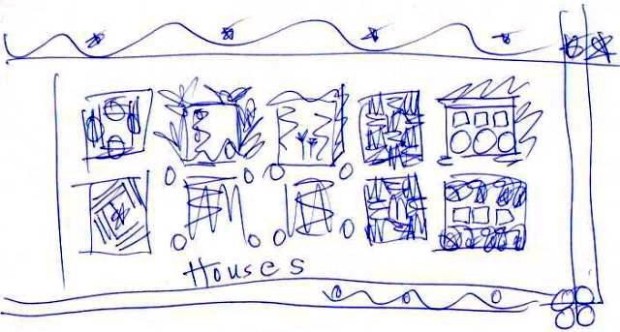
Houses
Think you know this place described above? Leave a comment!
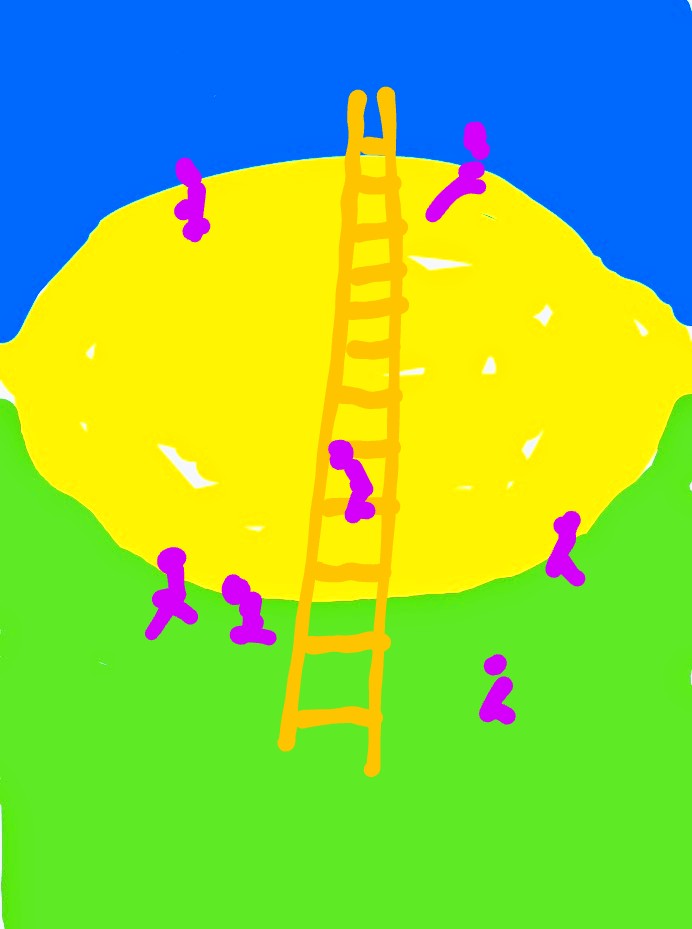
If we think of planets as globes of fruit, like an apple, orange, lemon, we might see them growing ripe, falling, turning bitter. If we see ourselves as fruit flies, we might caption a big lemon a planet in our sky.
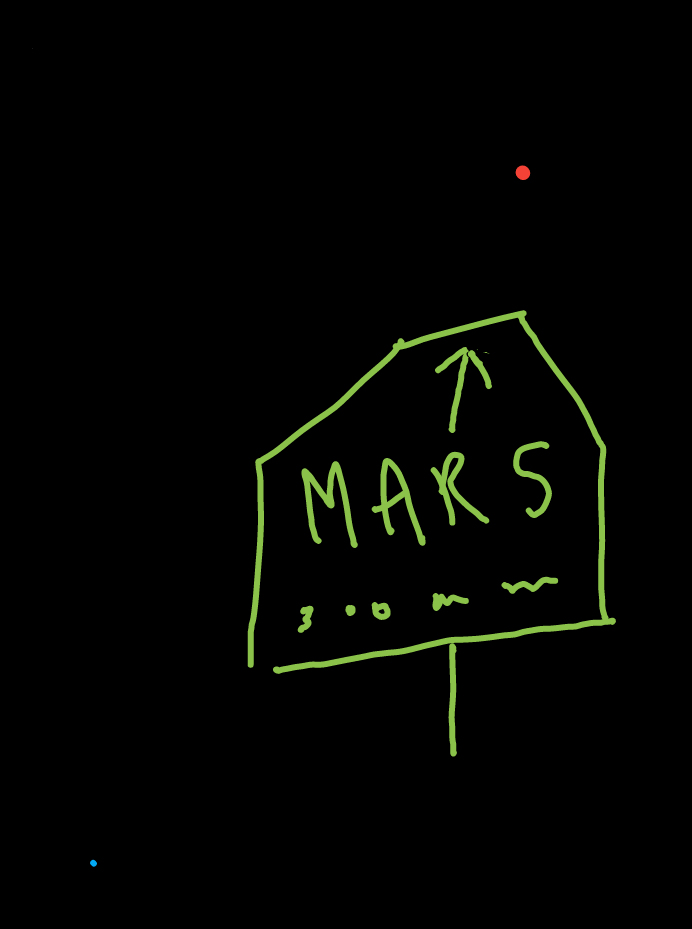
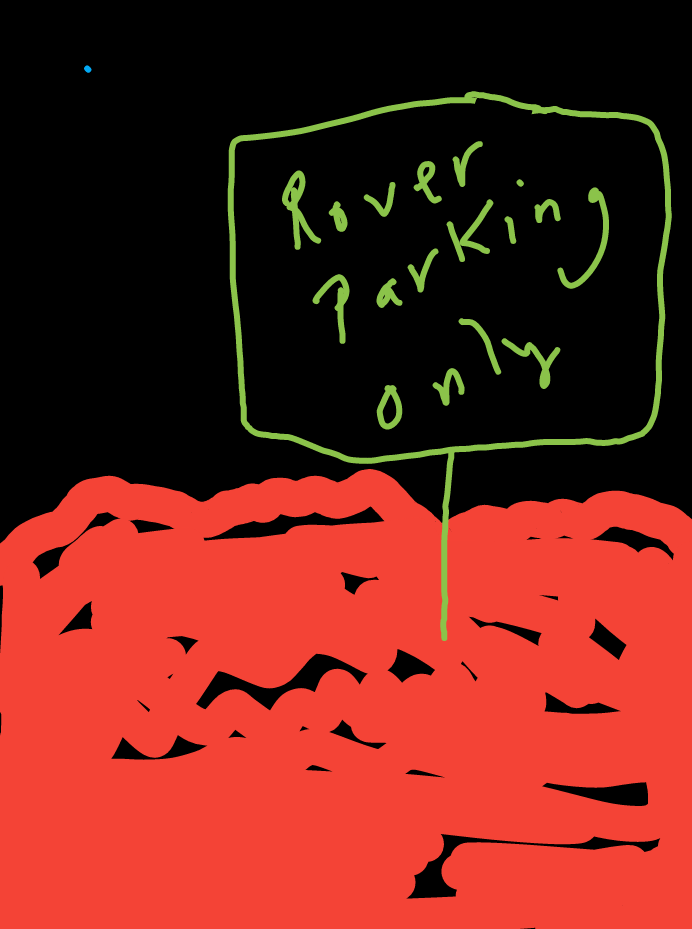
The first planet outside Earth humans visit will probably be Mars. But will there be free parking?
We know there is life in the universe, because Earth is full of life, and it’s in the universe. But are there places in the universe where the sun god on a freezing cold day invites you up for a cup of hot chocolate or herbal tea?
On Earth, nature seems to overseed, replenishing by adding more and at the same time sowing excessively, creating overdensities. Think of pollens on a spring day, the fine flour that sprinkles and saturates and has everyone sneezing to beat the band. On Earth, life is abundant and various, mighty and powerful, strong.
When you look up at night, into the sky, what do you see?
When in the news new worlds are discovered and photographs published, we see tiny dots astronomers claim are actually galaxies thousands and thousands and thousands of light years wide. The point is to find (the scientist like a garden snail crossing the Sahara) another planet where life grows and people enjoy backyards during summer months.
Meantime, back on Earth, we’re still trying to find that place where the moon stands still, on Blueberry Hill. That’s life.
The wig is a kind of disguise, and you can flip your wig to attract attention or to disappear into a crowd. To wig out. Harder for the bigwig to change identity. It’s an old word, wig, starts with steed or horse, to ride, hence to battle. To wig out is to try to change perception, the opposite of to relax, which is no need to go any direction. Equilibrium. Balance. Which is the clown’s trade, who traffics in wigs. Mime, which requires no words.
Today’s question might be formulated: Which direction to go? We read English left to right, top to bottom; the page is not a mosaic, where we can start anywhere and go in any direction. When we view a mosaic, where do we start? Where do we end? “The present volume,” McLuhan begins “The Galaxy Reconfigured, or the Plight of Mass Man in an Individualist Society” (the last section of his book “The Gutenberg Galaxy,” University of Toronto 1962), “has employed a mosaic pattern of perception and observation. William Blake can provide the explanation and justification of this procedure. Jerusalem, like so much of his other poetry, is concerned with the changing patterns of human perception. Book II, chapter 34, of the poem contains the pervasive theme: ‘If Perceptive organs vary, Objects of Perception seem to vary: If the Perceptive Organs close, their Objects seem to close also.’” From where McLuhan goes to: “Blake makes quite explicit that when sense ratios change, men change.”
Is the paragraph the basic unit of composition? The sentence, maybe, or even the single guttural utterance. Probably depends on purpose, occasion, audience – where do we go from here, the attendee at the conference asks at the end of yet another disconnected session.
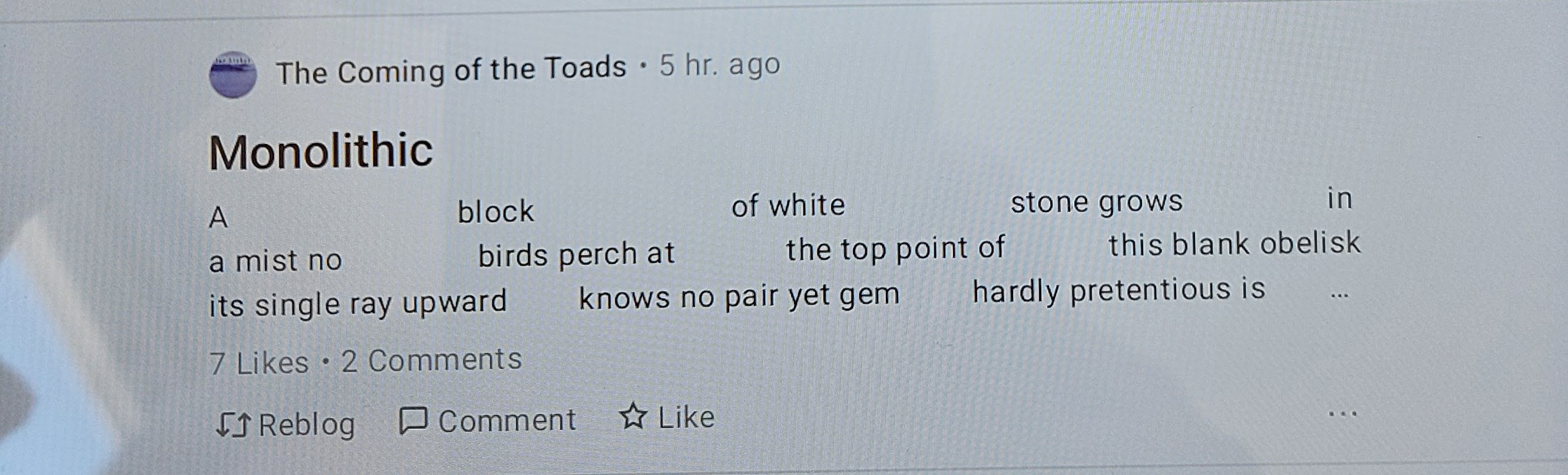
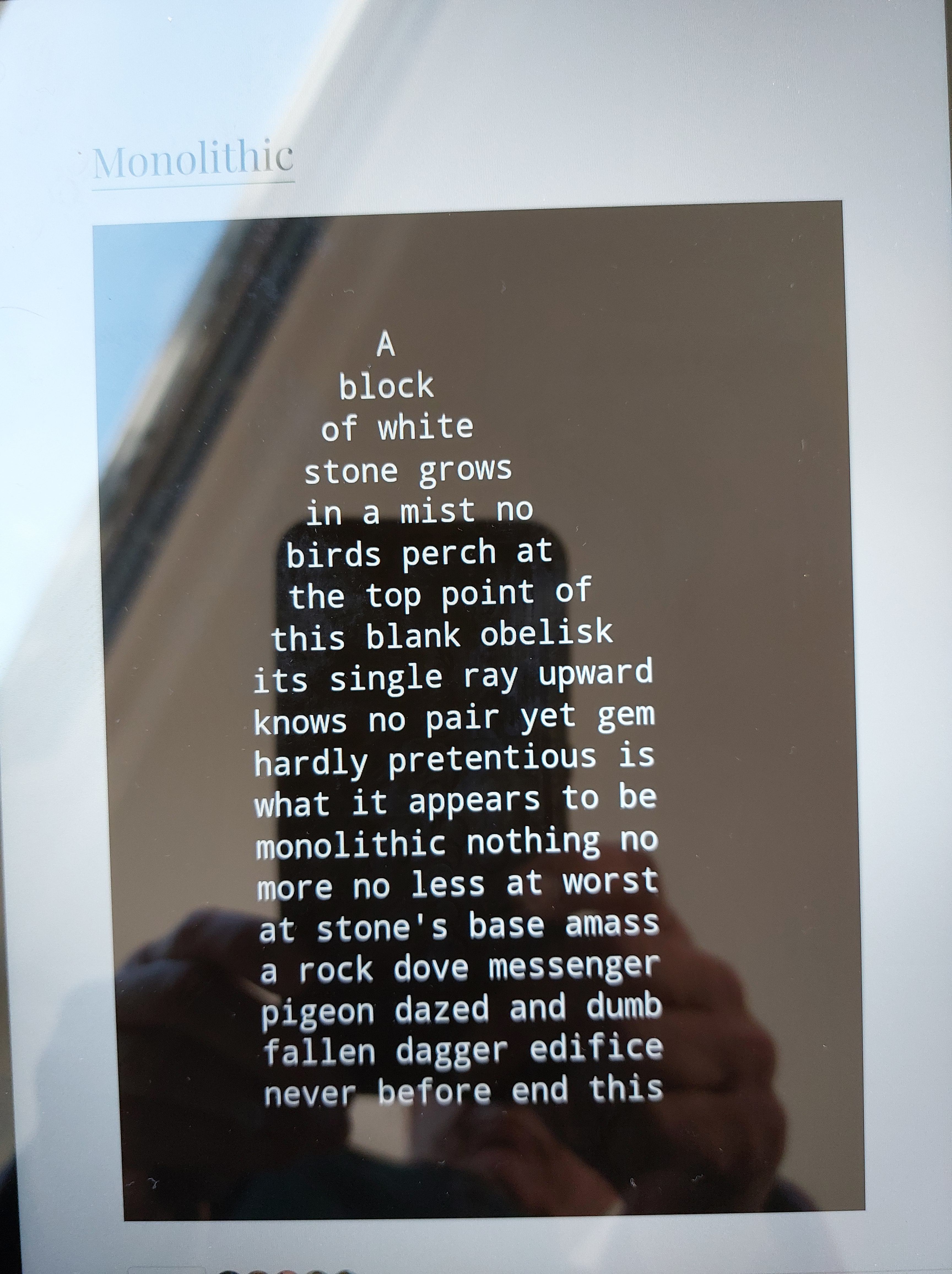
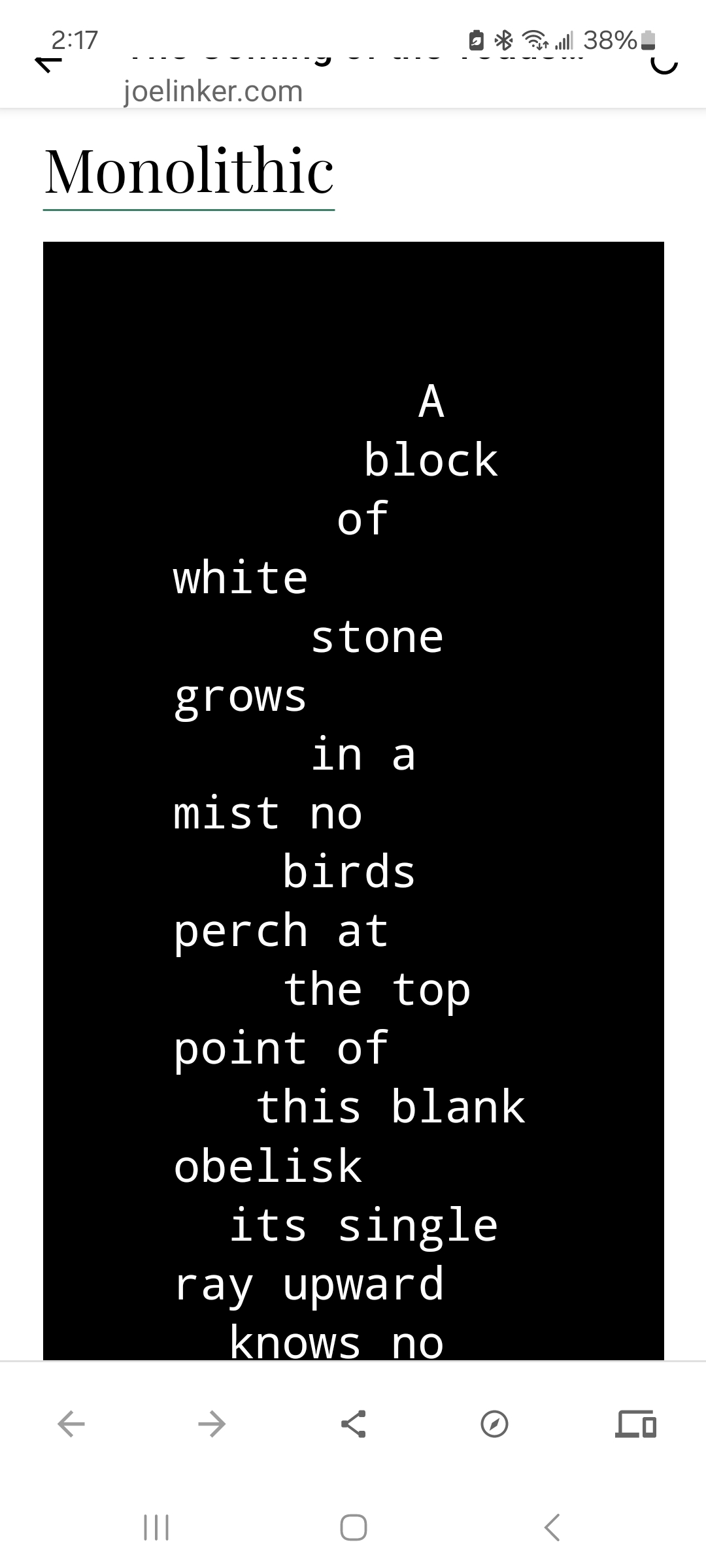
So I was thinking obelisk, in that last post (page back), as in single monolithic utterance, rising from a base, tapering to a point (as in an argument). Quite the opposite of how reading or viewing at any rate works on the cell phone, tablet, laptop, where one drops down, pages down, image after image disappearing above the horizon. How to format a monolith with the tools available to the blog (at least those I understand how to use). Begin with the white page. Writers today may seem to be living in a line-age. Lineage. Field. Map. Alternating forms. Insert image. Page down.
The text would be somewhat ironic, white on black field. WordPress, though, in my experience, is not conducive to drawing. And, as I mentioned a few posts ago, what you put up looks different depending on what device it’s being viewed with. Which can be pleasant or annoying, depending on your point of view. Here are a few examples, from the same post, but viewed on different devices (left to their own…):
Is poetry a game? A game of solitaire. But inasmuchas one might anticipate an audience, a gnip gnop match. Or on a polo grounds, the sport of kings, but some riders on stallions and others on donkeys. But if poetry is a game, or even if just at times it might be considered a game, in a certain environment or context, so what?
How does one play poetry? What are the rules of the game? A chase, in pursuit of meaning. Or mere entertainment, in which meaning may or may not play a role. We read that Wittgenstein found game useful in his thoughts on language. From the Stanford Encyclopedia of Philosophy:
“Language-games are, first, a part of a broader context termed by Wittgenstein a form of life (see below). Secondly, the concept of language-games points at the rule-governed character of language. This does not entail strict and definite systems of rules for each and every language-game, but points to the conventional nature of this sort of human activity. Still, just as we cannot give a final, essential definition of ‘game,’ so we cannot find “what is common to all these activities and what makes them into language or parts of language” (PI 65).”
Is poetry maybe a “language-game”? Looking around for a suitable answer, I found this in the online “Wittgenstein Initiative”: Wittgenstein said,
“Philosophy should really be written only as one would write poetry.”
WRITING PHILOSOPHY AS POETRY: LITERARY FORM IN WITTGENSTEIN 7 July 2015 ARTICLES by Marjorie Perloff, Stanford
But reading on, I find this not all that helpful to our opening question (Is poetry a game?). And it didn’t take long to be subsumed online by articles relating to Wittgenstein and our use of words, in poetry or otherwise. But another maybe significantly different translation, by the way, shows Wittgenstein saying,
“Philosophy ought really to be written only as a form of poetic composition.”
Ioana Jucan. Date: XML TEI markup by WAB (Rune J. Falch, Heinz W. Krüger, Alois Pichler, Deirdre C.P. Smith) 2011-13. Last change 18.12.2013. This page is made available under the Creative Commons General Public License “Attribution, Non-Commercial, Share-Alike”, version 3.0 (CCPL BY-NC-SA)
Will come back to form, but for now, so I backed out of search mode and returned to my own thoughts, if I can be said to own a thought, which of course is absurd. But to move on.
But even if we are to satisfactorily say what a game is, it would still be left us to consider a definition for poetry. A search for a definition of poetry of course brings into view a petri dish full of ideas. Then this, again from the Stanford Encyclopedia of Philosophy:
“Hegel considered a mode of understanding fundamental nature to be more advanced the more that it abstracts from concrete sensuous presentation and the more that it can turn contemplation back onto itself. There is a scale within types of art in this respect; visual art is less advanced than music, which is itself less advanced than poetry (1807 [1979]). While self-conscious Romantic poetry allows us to see our rational self-determining nature as minded beings, it nonetheless remains imperfect as a mode of knowledge of spirit. Philosophy, in its endless capacity for self-conscious reflection, “is a higher mode of presentment” (in Cahn and Meskin 2007, p. 181) and can ultimately supplant art as a mode of knowing the world’s essential structure.”
I include form as a rule of poetry. Poetry is first a game of forms. Form still may not be enough to make poetry a game. But to cut to the chase, poetry I claim shares many of the characteristics of a game: competition (for publication, recognition, awards); rules (of form and content, even if self-made and one-off, but historically many rules of form); players and spectators; a field (the page, a stage). But that is all in the game world of entertainment, one might argue – what of the world of art?
Well, art is the biggest game of all. But again, so what? I’m not using game there as a pejorative. We take it as a given that games are useful, productive, redeeming forms of human experience and expression. But there might be a pejorative sense in some context of using the word game to describe poetry. One cheats, one competes unfairly, engages in gamesmanship, one joins the politics of academia and writes up yet more rules to ensure one’s seat is not taken or shaken, one cancels another often for reasons the critic can’t find jurisdiction over or legal standing for in terms of the writing itself, one joins a group or school of poets or poetry where surely games are played. One questions purpose, occasion, argument, claims. One finds that a poem is an argument, with its statements and claims clothed in metaphor or other hide-and-go-seek maneuvers. And out of bounds we find the critics who act as line judges.
But what about poetry as art and art as sacred? Poetry with a capital P that stands for Word – with a capital What? Yes, the screed of the scrawl. Of course, any game can be perverted, which is why amateur games may be preferable to professional games, usually better. To play for financial gain or fame sometimes puts a burden on the player to maintain the integrity of the game. Betting and lotteries bring in another round of running about where most folks lose. The worse for wear is when pretensions creep onto the field, or when one pretends to gain access to the field. And of course one can always be ejected from the game, or kicked off the team, sent back to the minors. The values of poetry change from time to time.
And the question arises, if poetry is a game, what of the other genres: fiction, memoir, the essay. Just earlier tonight, watching Walter Matthau with Glenda Jackson in the film “Hopscotch” (1980), and Matthau’s character sits down to write a book. His memoirs, he tells Jackson. He says he’s going to tell the truth. Oh, she replies, fiction. Why do we so often equate poetry with truth? Aren’t poets as capable of lying (and pretension) as the rest of us? Of playing games in that pejorative sense? And in the positive sense of game I’ve tried to propose above, borrowing in part from Wittgenstein, the poet who can’t play the game of poetry won’t be a winning poet.
Lugubrious etymologically descends from the dinosaurs in “Allegro Non Troppo” (1976) when the great reptilian gargantuans gentle and armored alike move south ahead of the ice and melt into tar. In Bach fugue file they march.
I was sitting in bed four nights ago typing this, under a pile of covers, plus fully clothed, wearing two pairs of pants, three shirts, a sweater, a vest, a wool watch cap, and a pair of wool socks. It was 12 degrees Fahrenheit outside, windchill below zero. The house had lost power eight hours ago, years ago, the vicious east winds having blown down enough trees around town to put mist local folks in a freezer. But I gave up the typing in the cold. It was now 30 degrees inside the house. I pulled my hands inside the covers like a turtle for the long cold night and we decamped the wood igloo the next morning moving happily south to a warm house full of warm children.
Frost’s promises to keep keep us sustained, moving, to keep warm. Yes, “The woods are lovely, dark and deep,” but what melancholy invites us in? Our horse still questions why we might stop here. The museums are also lovely, though well lit, still dark and deep, security guards meandering the lost empty halls, the paintings wired, the statues as still and as cold as ice sculptures, and they don’t allow horses in. Anyway, we prefer trees wandering in the wind full of birds and squirrels and lost kites and balls and flying saucers and climbing kids.
Earlier that afternoon, I was in the backyard, preparing a place for Zoe, when I heard a rushing sound, a falling dinosaur come to roost, and heard the voice of the tall Sauroposeidon, a wind and wood splintering crash and crush, and looked north to my neighbor’s backyard to see the 100 foot 100-year-old east Pine limbs still shaking off the ice and snow where it had come to rest breaking through the ridge beam, the tree’s upper girth shattering off and coming to rest in the front yard.
The frightfully freezing cold day moves slowly lugubriously on and we learn that pine tree but one of hundreds of trees falling all about town in the east wind in soaked soils across power lines, cars, streets, houses, parks and lots.
Back home now, five days on, power restored, but morning after ice storm moving across last night, but still now, windless, half inch of ice coating tree limbs, cars, street, wires, the downed dinosaur leaning across the roof next door. Fog. The dickens of a cold fog. But should we lose power again the air is at least warmed up some, to just below freezing outside.
A lugubrious fog has settled in, sifting down through the firs, down the street, over the houses and yards dotting the rotting old volcano.
I was in the 8th grade, taking a multiple choice vocabulary test. I came to melancholy. One of the choices was happy. Another choice was sad. The word melancholy sounded happy. I blackened the circle next to happy with my number 2 black pencil on the Iowa Test page and moved on, but the word stayed with me, and I later asked Sister Mary Annette the meaning of melancholy. Her blue eyes peered out from her starched white habit hallowed in black. Sad, she said. Ah, what does Iowa know, I responded, and ran for the playground.
Cartoon: Scamble and Cramble and the Social Media Adventure
Sometimes it seems a step backward is the way to go, but I’m not sure painting over yesterday’s canvas is movement forward or reverse. But why think in these lineal terms to begin with? In spite of tidal waves of news pouring in from every mode, it seems keeping informed about what’s going on is ongoingly increasingly difficult. At the same time, as John Cage said in his essay on Jasper Johns, “Why does the information that someone has done something affect the judgment of another? Why cannot someone who is looking at something do his own work of looking?”
Today, later this evening, to be more precise, is the solstice. If all goes as planned, the days will begin to grow longer again. There’s no keeping still, even if forward and backward amount to the same thing. In fact, I read just last night, the sun has already been going down later in the day in these environs, but the sun has still been coming up a bit later each day, and will continue to do so for some time yet, despite the solstice. So the moment, the epiphanic slice, the exact time of the solstice, when you feel the bump at the top of the amusement ride just before the reverse tilt comes true, you probably won’t feel.
Nevertheless, we celebrate the solstice, for reasons old and new, and take the opportunity to consider what new lectures and writings, poems and songs, essays and cartoons we might make up between now and the coming spring equinox, which is planned for Tuesday, March 19th (Saint Joseph’s Day, if you’re keeping track of that too). New ways of measuring time are always being considered. But if you adopt a new calendar, you’ll have to then come up with a proleptic view. So we might anticipate objections before they’re even brought up. Remarks.
The proportion of ideas might be considered important. If an idea is too big, or too small. To warrant further development. I thought I might try some reconnections, might even write a few letters, though my initial attempts at this, very much no doubt excited by the solstice, have met with instant failures to communicate. The art of the steel sculpture. Then again, I’ve never been much of a letter writer, not like the folks in the old days who might spend half the day reading mail and the other half answering mail. Pastime. Mail which had taken days or even weeks to arrive during which time rendered moot much of its news, feelings, ideas.
Speaking of letter mail, the kind written on paper and requiring a postage stamp, we get very little here these days. Even junk mail seems to have diminished. We’ve received two Christmas cards, both kept on prominent display. Of course, one must send mail to receive mail; not always, but usually. As for blog exchange, comments are problematic. They aren’t really letters in reply, and often say more about the commenter than what’s being commented on. The art of the quip, the comeback, the rejoinder, retort, riposte. But that’s the cynic in me coming out. Get back! Get back! The blog, “The Coming of the Toads,” turns 16 this month. I’m not even sure what a blog is anymore.
The most effective blogs (or whatever they might be called) seem those dedicated to a single purpose: photography (and photos about something specific – e.g. birds, architecture, surfing), politics, poetry, how to, music, art, opinion, travel. But the personal essay seems the most resilient form of writing (personal essay as illustrated, for example, in Philip Lopate’s anthology “The Art of the Personal Essay.”) I’m not sure where the idea of a pic necessary to accompany every piece of blog post writing ever came from. The Header, I guess. In case you’ve not noticed, The Toads has for some time now sported a minimalist attitude illustrated by a mostly blank white page dotted with black text – might be one way to describe the setup. This allows for the least distraction for both reader and writer. Indeed, blog posts past, I spent more time coming up with an appropriate pic than I did on the writing. Back when the blog began, most readers read on a computer screen. The display of any post is now changed by format depending on what kind of device the reader’s using: phone, tablet, computer – so what you see is not always what the reader gets or what the writer might have intended (a problem which of course is not new to any kind of writing).
Anyway, I’d like to take this opportunity to restate a few of the underlying interests of the writing here. It’s original, without recourse, it must now apparently be officially stated, to any borrowing from an Artificial Intelligence (AI). That includes all the essays and pics, cartoons and poems, songs, unless of course specifically quoted and cited yada yada yada. That’s not to say influences won’t be discerned: John Cage, Marshall McLuhan, Buckminster Fuller, James Joyce, Samuel Beckett, the Beats, Guitar and Music in all its forms but increasingly Gypsy Jazz guitar – to name a few.
But back to the solstice! Happy Solstice to all of you writers and readers. Please feel free to leave a comment if you still have time.






 The Coming of the Toads