“Who’re your influences?” Jimmy Rabbitte asks, interviewing applicants responding to his Hot Press ad for members of a new Dublin soul band he’s forming and will manage, in Roddy Doyle’s hilarious “The Commitments.”
He judged on one question: influences. – Who’re your influences? – U2. – Simple Minds. – Led Zeppelin. – No one really. They were the most common answers. They failed.
“The Commitments,” Roddy Doyle, 1987. First Vintage Contemporaries Edition, July 1989, page 21.
I thought of Jimmy while following links from a recent Matt Mullenweg post in which he linked to two apparently well read and seemingly productive and influential workers in the tech industry – Dan Wang and Zhengdong Wang. They both show on their sites their reading, and I’m interested in influences – what have they read, and what not. And what might I list as foundational in my influences. Combining the two, that is, trying to form a kind of Dublin soul band (or book club) with reading suggestions anyone in an influential position in the tech industry might benefit from I present my influences (list limited to what might be relevant to those involved in compute, scaling, A.I., and the future of humanity and machines):
I made the reading list and this post because where Dan and Zhengdong show their reading on their sites, I didn’t see mention of any of these books, and they are deep cuts, and as cuts on a kind of playlist, I think they emerge into a significant whole. I hope the techies don’t, as Jimmy did:
Jimmy shut the door on that one without bothering to get the phone number. He didn’t even open the door to three of them. A look out his parents’ bedroom window at them was enough. (21)
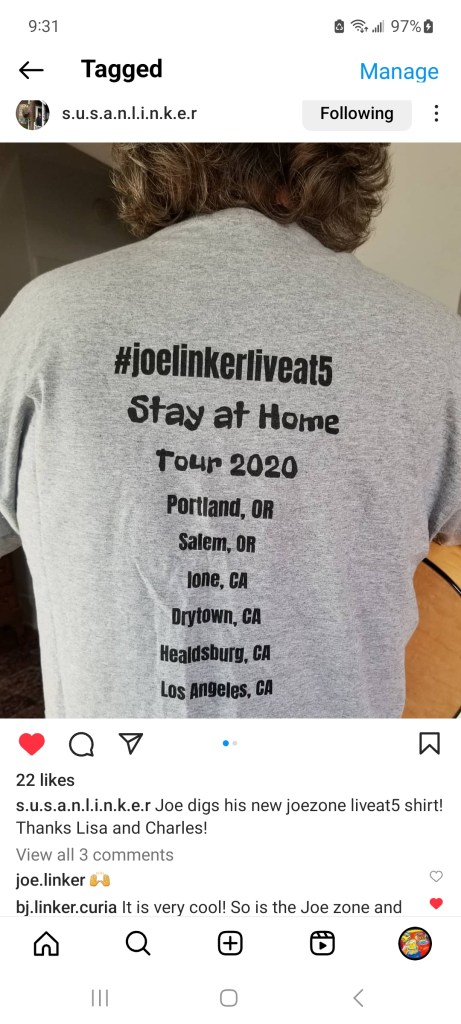
What will we do with Live at 5 in the new year? The shows began at the beginning of the Covid-19 pandemic and at their peak featured a different host player going live most nights of the week, sharing guitar, songs, stories, and readings (live via the Instagram video venue) to an audience of similarly homebound family and friends of family. The shows ran evenings for about an hour starting at 5. The hosts included, on a rotating schedule, myself, my brothers, a nephew, and over time a few guest hosts and visitors – more family and friends. Shows were home-staged from Portland, Salem, Healdsburg, Ione, Drytown, Los Angeles, and Philadelphia. The format was loose and forgiving. Audience clicked on, paused, maybe stayed for the whole show, as people do passing buskers on a sidewalk, and through the Instagram feed anyone tuned in could place comments for the performer and the rest of the audience to read, and many an audience-controlled conversation took off. (Unfortunately, Instagram does not save those conversations – the comments disappear even if the host saves the video to their Instagram feed.) The Live at 5 shows diminished through 2022, timing out as the voluntary pandemic isolations began to lift.
I played guitar in a neighborhood jazz band for the last couple of years. It was fun, I met some new folks, and learned more about music and the guitar – particularly about playing “in the pocket,” a term that means playing in time, in sync with the other musicians, a skill I’ve never satisfactorily mastered. You might think jazz would be more forgiving, but no. I left the band to concentrate on gypsy jazz guitar, renewing my subscription to Robin Nolan’s “Gypsy Jazz Club,” which includes players from all around the world. One of the features of the club is a “Sunday Club Zoom Hangout” – 8 in the morning my time, but I manage to wake up in time most Sundays, for a Gypsy djassreveille. For the most part, the Hangout hour is devoted to live, short performances by club members.
“Step in time, step in time Step in time, step in time Never need a reason, never need a rhyme Step in time, we step in time”
from the song “Step in Time,” lyrics by The Sherman Brothers, in “Mary Poppins,” 1964.
Time waits for nothing, to begin, “to boldy go where no man [which is to say, everyone] has gone before,” pen in hand, splitting infinitives out of time, rubato, robber of time:
“For three years, out of key with his time, He strove to resuscitate the dead art Of poetry; to maintain ‘the sublime’ In the old sense. Wrong from the start—”
from “Hugh Selwyn Mauberley” [Part I], Ezra Pound, 1920.
Anyway, the question I’m entertaining now is whether or not to try to resuscitate an ongoing Live at 5 show. The need for homebound, not to mention amateur, entertainment may have passed for the time being. Still, there developed a core group of loyal listeners, not enough to fill Shea Stadium, or the Ash Grove, for that matter, of course, but would even those few return for a new season? It’s dinner hour, kids are back in school, the work-at-home movement is weakening, and pizza parlors, pubs, and wine bars have reopened, many featuring live entertainment. And the movies are back up and running. But some of us have emerged from the pandemic isolation years eschewing the old forms. We don’t go out anymore. We are aging. We are stepping out of time. We could fill a living room.
Most of the Live at 5 shows were improvisational, maybe the host wrote down a few notes before going live with some intro comments, checking in with the audience, a few songs, some outro comments. Audience requests were popular. The videos remain on their host’s Instagram, where saved, complete with mistakes and random rambles, unedited. I don’t want to overstate, but I think the shows in the various locales were looked forward to and enjoyed. Where they were not joined live, Instagram followers caught up later.
My brother Charles, at the height of the show’s exceptional ratings, had some shirts made:
By the way, none of this post is to espouse Instagram as a preferred tool. But that’s a topic for another post altogether.
I’m now picturing a Live at 5 Never Ending Tour, maybe with a reading list for the audience to keep in tune:
John Cage’s “Silence” Bob Dylan: “The Philosophy of Modern Song” Dunstan Prial: “The Producer – John Hammond and the Soul of American Music” Michael Dregni: “Django – The Life and Music of a Gypsy Legend” Greil Marcus: “Mystery Train” “The Real Frank Zappa Book”: Frank Zappa with Peter Occhiogrosso Alex Ross: “The Rest is Noise” Robin D. G. Kelley: “Thelonious Monk – The Life and Times of An American Original”
But you see how easy it is to get carried away.
Closing this post with a quote from John Cage, “written in response to a request for a manifesto on music, 1952”:
instantaneous       and unpredictable

nothing is accomplished by writing a piece of music
   "  "    "    " hearing "  "  "  "
   "  "    "    " playing "  "  "  "

our ears are now in excellent condition
xii/Silence, John Cage, Wesleyan University Press, 1961 (paperback 1973), reformatted somewhat here to fit block.
Note: This is a Happy Birthday! post for Matt Mullenweg.
 The Coming of the Toads