Old Haunts, all with current links, focused on core subjects: art, technology, music, science, and literature, but first, a brief explanation:
Moving continuously toward more minimalist formats (which if not stopped could result in disappearance altogether), blogs may risk losing some appeal, particularly to readers who enjoy liking, commenting, and linking or sharing – in short, conversing – as well as indulging in pingbacks and reblogging, and who enjoy perusing sidebars, widgets, clicks and plays, slide shows, and sharing up and down the crowded street of social media sites and apps. An example of such minimalist drift, here at the The Coming of the Toads, might be the removal, some time ago now, of listings and links of followed blogs and favorite sites, what I called in the sidebar heading over the list of links: “Back Roads to Far Places,” the title from Ferlinghetti’s book.
I use the WordPress Reader to subscribe to sites, and currently I’m subscribed to 146 – but not many of which post frequently or are still active at all, which sparks the idea behind this post, which might have been subtitled: and Other Broken Links. While I don’t currently post a widget of followed blogs or sites, I do manage my subscribed sites in the WordPress Reader, and I also maintain the “Links” feature in the WordPress Dashboard for my own use. There are currently 33 links. But links don’t always stay current or active, while others click to surprise, a site grown or morphed into other projects or disappeared (Page Not Found), and still others remain useful resources or pleasant places to visit, like old friends. Or the link simply breaks and you get sent who knows where and who knows what’s happened. Sites often change over time, and it can be hard and takes time keeping up with the changes.
Anyway, I thought I’d share an update of just a few of the sites that do continue to work well and that I try to follow and that offer pleasant visits and are creative and resourceful:
Marginalia and Gracia and Louise I first discovered in “High Up in the Trees,” a blog by the Australian artist Gracia Haby. It’s now called “Marginalia.” I like everything about it – font work, photography, text content, collage and other art work, the work Gracia and Louise do with animals. And there’s another site they maintain, called Gracia and Louise, full of things to see and wonder at. The sites probably work best on desktop, but the creativity in doing more with the drop-down necessities of on-line viewing is unparalleled (of that, here is a specific example, called Reel).
McLuhan Galaxy always produces a profoundly puzzling experience in that there seems no end to his ideas and the ramifications of effects of media on society and culture – and yet here we go, linking and following, but where? The Blogroll will keep you occupied for hours of intellectual fun.
I don’t have John Cage ears, but I’ve always enjoyed his writing, and much of his music I do enjoy. Kuhn’s Blog is not often updated, but the site resources remain available and loads of fun, with several interactive features (try Indeterminacy, for example). The John Cage Personal Library is itself a phenomenal work.
The Buckminster Fuller Institute shares hope for the world from a worldwide perspective. The site may provide a new awareness for what’s going on worldwide to improve conditions, predicaments, problems – near and far. If your not familiar with Bucky, here’s a good place to start: Big Ideas.
Words Without Borders features world wide writing in a variety of formats. Browse by country, theme, or genre.
Old Haunts, all with current links, focused on core subjects: art, technology, music, science, and literature.
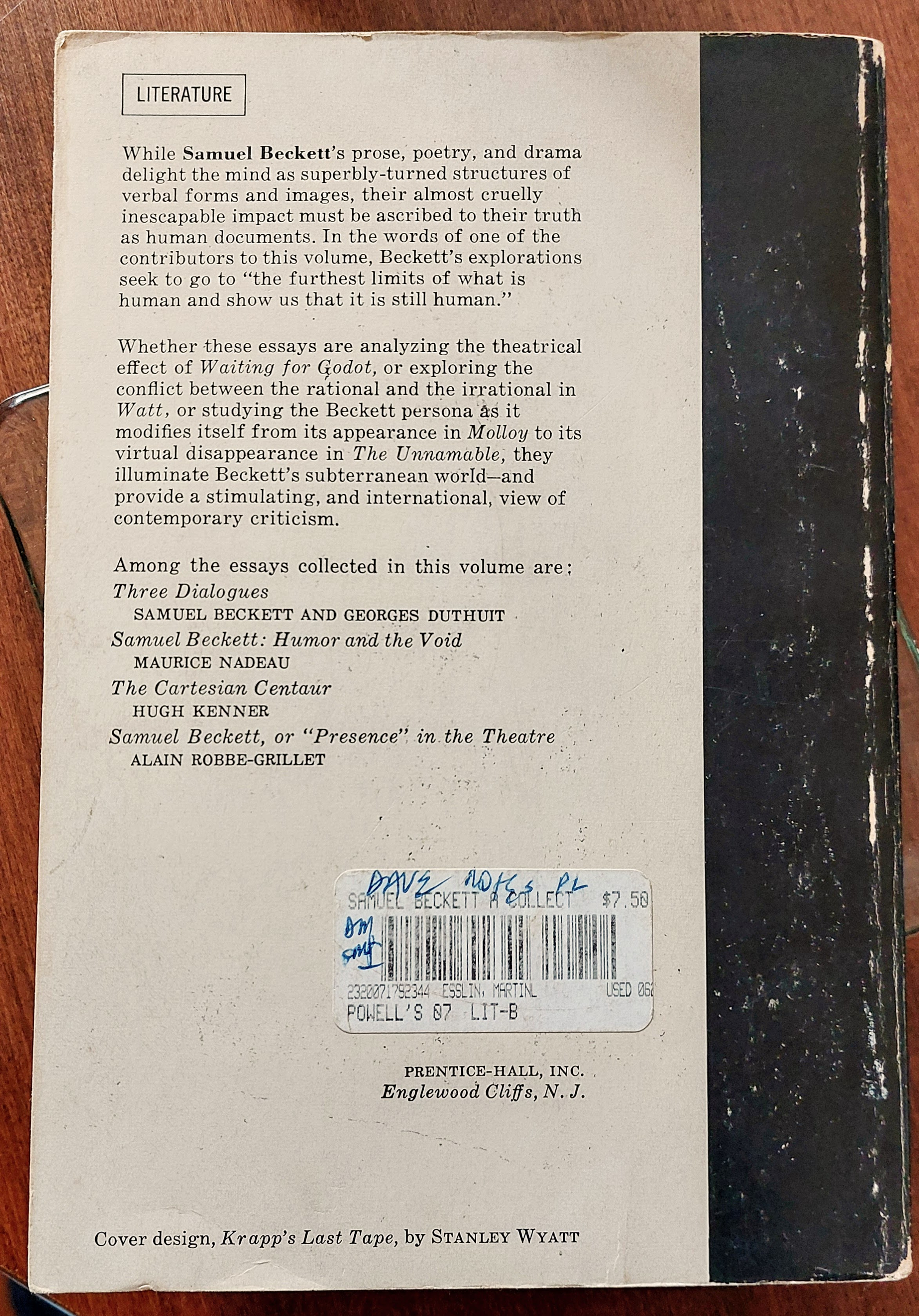
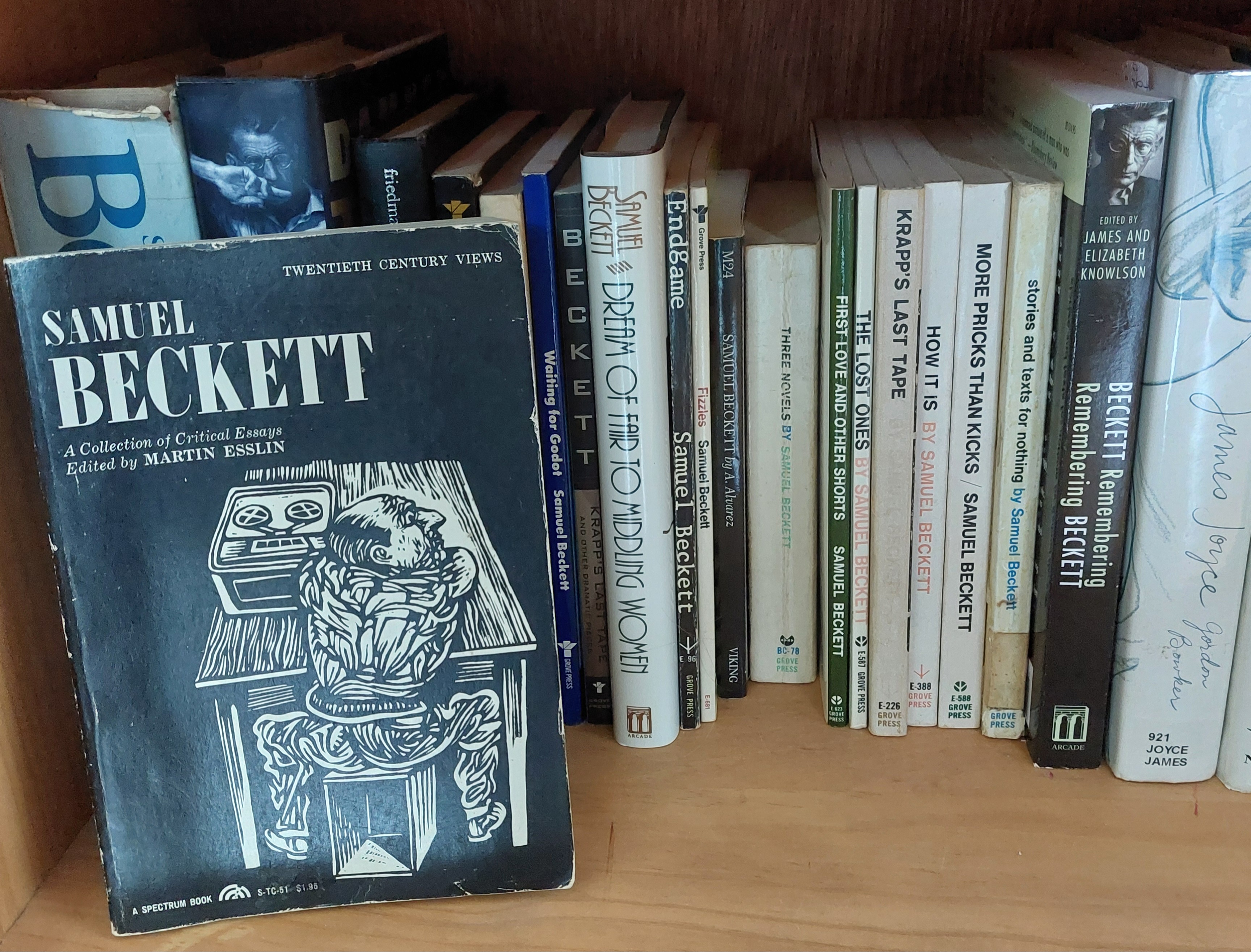
I was browsing through an old paperback of essays on Samuel Beckett (not to mention the why), and landed on this, about the weight of words, found in A. J. Leventhal’s essay titled “The Beckett Hero,” here discussing Beckett’s names:
“If the names are not adventitious (and Beckett weighs all his words) it means that we are asked to think of this play, not as an isolated piece of inaction in a corner of France, or if you like Ireland, but as a cosmic state, a world condition in which all humanity is involved” (49).
What does it mean to weigh a word? Do words have weight? They certainly do in a metaphorical sense. A person whose words are said to carry weight is listened to; whether their opinions are respected or not is a different question, as we hear tell of windy speakers, windbags, by which is meant a person whose talk is full of hot air. Pompous.
Air has weight, expressed in pressure. Does wind have weight? In Shakespeare’s play “King Lear,” we find the weight and pressure of wind and words mixing in the storm:
“Blow, winds, and crack your cheeks! rage! blow! You cataracts and hurricanoes, spout Till you have drench’d our steeples, drown’d the cocks! You sulphurous and thought-executing fires, Vaunt-couriers to oak-cleaving thunderbolts, Singe my white head! And thou, all-shaking thunder, Smite flat the thick rotundity o’ the world! Crack nature’s moulds, all germens spill at once, That make ingrateful man!” (King Lear, Act 3, Scene 2)
Another example of a windy word passage appears to be Beckett’s poem titled “Whoroscope,” judging from John Fletcher’s reading in the same collection of critical essays, this one titled “The Private Pain and the Whey of Words”:
“The fact is that this ‘poem’ is little more than prose monologue chopped into lines of unequal length. No rhythmical pattern can be discerned and the vocabulary is of studied colloquialism. Lame puns like ‘prostisciutto’ (i.e. ‘ham’ / ‘harlot’) and ‘Jesuitasters’ attempt to imitate Joyce. In spite of its wit, the whole poem gives a frivolous impression; genuine poetic richness is lacking, for paradox, esotericism, and verbal pyrotechnics take its place” (25).
Fletcher has already told us, setting the stage, that Beckett’s poem “won the prize (ten pounds), was printed in 300 copies, and led to Beckett’s being invited to contribute to an anthology of poems which Henry Crowder set to music, also published by Nancy Cunard at the Hours Press in 1930.” Beckett had knocked the poem out in one sitting, Fletcher discloses, to enter the contest, which asked for a poem “on the subject of Time.” Continues Fletcher in his critique of the poem: “The poem is not very interesting and certainly seems to have little to do with time.” One wonders now how much one of those original 300 copies might fetch at auction. 100 copies were signed.
Where have we heard whey before?
“Little Miss Muffet Sat on a tuffet, Eating her curds and whey; There came a big spider, Who sat down beside her And frightened Miss Muffet away.”
Clear enough, except what’s a “tuffet”?
Fletcher makes much of Beckett’s feud with nothing. He tells us Beckett stopped writing poetry in 1949, and quotes from Beckett’s “Three Dialogues” of the same year:
“The ‘Three Dialogues’ grant the artist the honor only ‘to fail as no other dare fail,’ failure being ‘his world and the shrink from it desertion, art, and craft, good housekeeping, living.’ We shall see, indeed, that in his poetry as in his other writings Beckett has never shirked the fact ‘that there is nothing to express, nothing with which to express, nothing from which to express, no power to express, no desire to express, together with the obligation to express.’”
“Nothing will come of nothing,” King Lear says, reflecting Shakespeare’s own struggle with nothing. “Speak again.”
~~~
“Samuel Becket: A Collection of Critical Essays,” Edited by Martin Esslin, Prentice-Hall, A Spectrum Book, 1965. Includes “The Beckett Hero” by A. J. Leventhal, a lecture at Trinity College June 1963, and “The Private Pain and the Whey of Words” by John Fletcher, a lecture given at Durham U England November 1964.
The easiest piece to write is sarcasm. The difference between sarcasm and satire is that satire has a point, while sarcasm has none, except maybe to offend, at worst, or rib, at best. Sarcasm is a backbite often confused with humor. “It’s not funny,” the bitten one says, the sarcastic one curling up smiling like Uriah Heep in his sorry ways, heaping more free helpings upon his plate to stowaway for future use.
Irony can be used as a tool to tickle or torture, its mixture of satire with sarcasm effective as a rhetorical device, intended at bottom to persuade, of what, exactly, the audience might remain unaware, this too funny: A muse meant nothing by it. What was meant or not its placement lost can only confuse.
Hemingway utilizes irony in his book “The Sun Also Rises”:
“Show irony and pity.” I started out of the room with the tackle-bag, the nets and the rod-case. “Hey! Come back!” I put my head in the door. “Aren’t you going to show a little irony and pity?” I thumbed my nose. “That’s not irony.” (102)
Later, Bill and Jake replace irony with utility, but it’s the same idea:
“Let us rejoice in our blessings. Let us utilize the fowls of the air. Let us utilize the product of the vine. Will you utilize a little, brother?” “After you, brother.” (109)
Irony is explained by Charlie in Steve Martin’s film “Roxanne,” in the scene where he’s walking with Roxanne back to her place to help her regain entry after she’s locked herself out. Charley pretends not to understand why Roxanne turns down his offer of a coat on such a cold night. She explains she was being ironic, and Charley says he didn’t understand that because they don’t use irony in the town anymore. He was the last one to use it, and he gave it up because people were staring at him. Irony often means the opposite of what’s said. It can be confusing. Martin’s film is a rewrite of “Cyrano de Bergerac,” the 1897 play (which takes place in 1640 France) by Edmond Rostand. I only mention that now should any readers think I was unaware of Martin’s source. “Cyrano” was assigned reading in the 10th grade in the high school I attended. It’s theme is panache, which I doubt I understood in the 10th grade. Not sure I understand it now, ten decades later. More irony there than I care to pursue further at this point.
The so-called dry sense of humor is favored by the higher class comic, whose main focus is to keep out of the pit, where things get wet and muddy. In that sense, the dry humorist is aristocratic, surrounded by the minion followers who protect his repressed emotions with gratuitous likes and guarded comments. The noir detective sometimes makes use of the dry sense of humor, though hardly an aristocrat, but he often finds himself in service to society’s higher-ups. A dry wit seems to suit a hard boiled attitude, and the Dick has many followers, among them many cynics.
The facetious humor accountant will often make fun of himself, pretending, for example, to be stupid – but that’s to show actually his superiority to his target. He will be droll, flirting around with what’s considered serious or not, with what is serious or not. Tongue-in-cheek provides a vivid cartoon illustration opportunity.
Then there’s the wisecrack, the comment, usually shouted but as effectively whispered, croaked anonymously from the audience, which may have come to resent being pandered to, the speaker now a standing joke and nothing further said can mollify or sooth the hurt feelings of failure. But, after all, it was only a sketch. But when does sketch become sketchy? A standalone wisecrack probably won’t qualify as a sketch, more the property of the cartoon.
Charles Dickens wrote sketches, though not necessarily with humorous intent. In his preface to “Sketches by Boz,” written long after the sketches were first published in newspapers and magazines, Dickens almost apologizes for their style or substance, in spite of their obvious popularity. He said the sketches were “sent into the world with all their imperfections (a good many) on their heads,” and that he’s “conscious of their often being extremely crude and ill-considered, and bearing obvious marks of haste and inexperience.” But again a Boz sketch purpose was not primarily humor. They were accompanied by drawings and were essentially goings on about his London parish at the time – the 1830s. The subtitle of the book collection reads “Illustrative of Every-Day Life and Every-Day People.” And within the Dickens sketch anyone indeed could have, probably already did, see or observe the very thing Dickens was writing about. But to see it in print, Illustrated, no less, not as news, by which is meant an edited selection of events to emphasize a certain viewpoint (selection itself – among all the events of a day – being an editing process, and the birth of bias), but as the familiar and close and therefore noteworthy and comment worthy, where one saw oneself or someone one knew and understood but probably with not quite the same focus as found in the sketch. Or one saw a street or alley or place or person one knew about but only as some mystery yet to be solved, which the Boz sketch resolves. The Boz sketches often go indoors.
Mark Twain did much to popularize the humorous sketch as a newspaper feature. It was Twain’s intent to write humor, so we find embellishment and variations on the truth of things, exaggerations. Exaggeration, hyperbole in rhetorical diction, is a comedian’s tool, as is its counterpart, understatement, litotes, first cousin to euphemism. Here is a sample excerpt from a Twain sketch featuring an unexpected subject, titled “Speech on Accident Insurance“:
“Certainly there is no nobler field for human effort than the insurance line of business—especially accident insurance. Ever since I have been a director in an accident-insurance company I have felt that I am a better man. Life has seemed more precious. Accidents have assumed a kindlier aspect. Distressing special providences have lost half their horror. I look upon a cripple now with affectionate interest—as an advertisement. I do not seem to care for poetry any more. I do not care for politics—even agriculture does not excite me. But to me now there is a charm about a railway collision that is unspeakable.”
Insurance for accidents occurring to individuals riding a train was first introduced in England, and insurance as an industry grew expansively in the latter half of the 19th Century, but it wasn’t then nor is it now considered by many to be a subject of humor. Twain was able to find humor in just about any subject. Twain’s use of the word cripple in his context would not be acceptable today, and indeed humorists are inevitably at risk of their word choices landing as offences.
It’s interesting, thinking now of insurance, how some things, like the old saying goes, never change, in spite of what Twain says below, from his visit to a barbershop:
“All things change except barbers, the ways of barbers, and the surroundings of barbers. These never change. What one experiences in a barber’s shop the first time he enters one is what he always experiences in barbers’ shops afterward till the end of his days. I got shaved this morning as usual. A man approached the door from Jones Street as I approached it from Main—a thing that always happens. I hurried up, but it was of no use; he entered the door one little step ahead of me, and I followed in on his heels and saw him take the only vacant chair, the one presided over by the best barber. It always happens so.”
If you want to write a humorous sketch, it might work best to start with something familiar, that any reader should recognize. Otherwise, you might too soon and too easily drift off into a piece redolent of surrealism, which is seldom very funny. If the easiest piece to write is sarcasm, it might be because the only skill required is mean-spiritedness, which probably comes from a deficiency of generosity. There’s also a tradition of vindictiveness associated with some humor, sublimated in the speeches at roasts that ridicule the honored guest. But writing humor is not easy. Not everyone is a wit. Nor wants to be a twit.
References:
“The Sun Also Rises” by Ernest Hemingway (1926). Quotes from 2022 Penguin Classics Deluxe Edition.
Mark Twain Project Online. In discussing what is meant by a written sketch, the editor Edgar Branch, from the Introduction to “Early Tales and Sketches” Volume 1, has this to say:
“The great preponderance of short items, however, are sketches—and these range from ambitious magazine articles several thousand words long to short, hundred-word trifles tossed off by the newspaperman during a working day. The sketches include comic letters to the editor, hoaxes, exaggerated accounts of the author’s personal activities, burlesques of many kinds, comic or satirical feuds with fellow journalists, ingeniously contrived self-advertisements, commentary in a light and personal vein, descriptive reporting, reminiscences of past pleasures and adventures, and so on—but neither this nor any other list can easily be exhaustive.”
And of course it goes without saying but like good poets we’ll say it twice anyway:
We didn’t write anything with purpose to change the lines of global affairs
or even local trists and by that we mean right here now of course in this sadly redundant poem
written while sitting out in the morning cool air when poems part ways
part of the world’s course as off course as all things of course as if a course exists.
But here comes the sun today the temp 101 to be I say of course
It’s still summer of course and we’re on course to break another course.
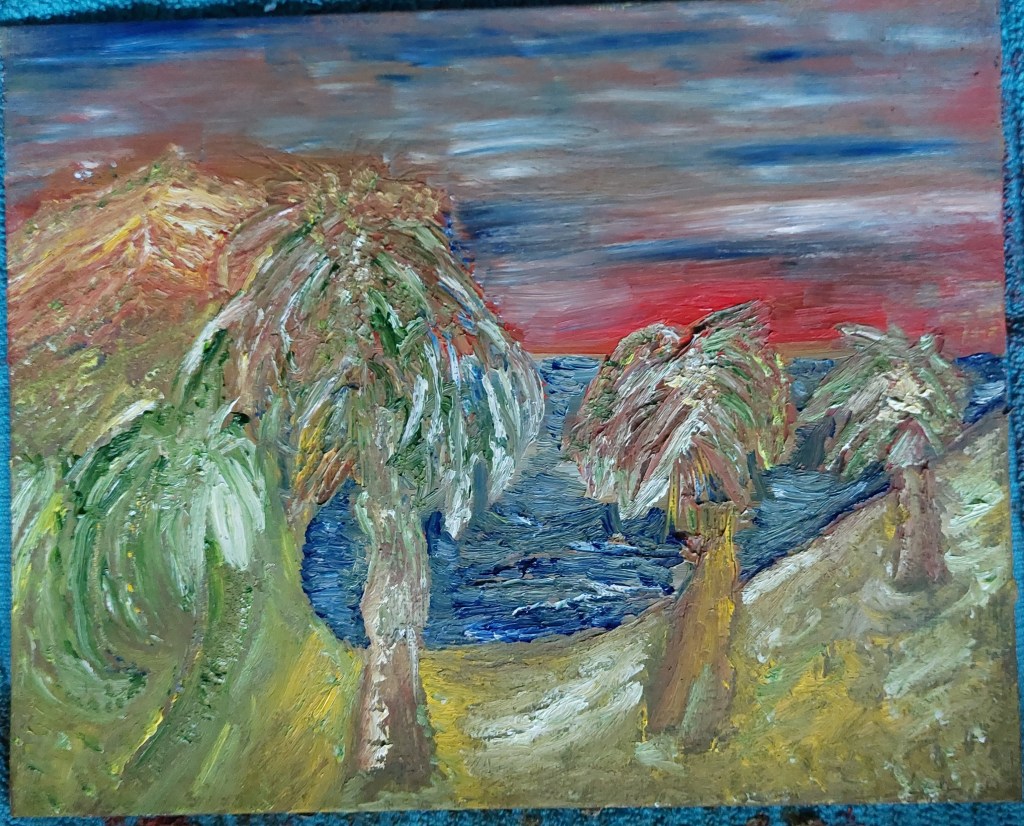
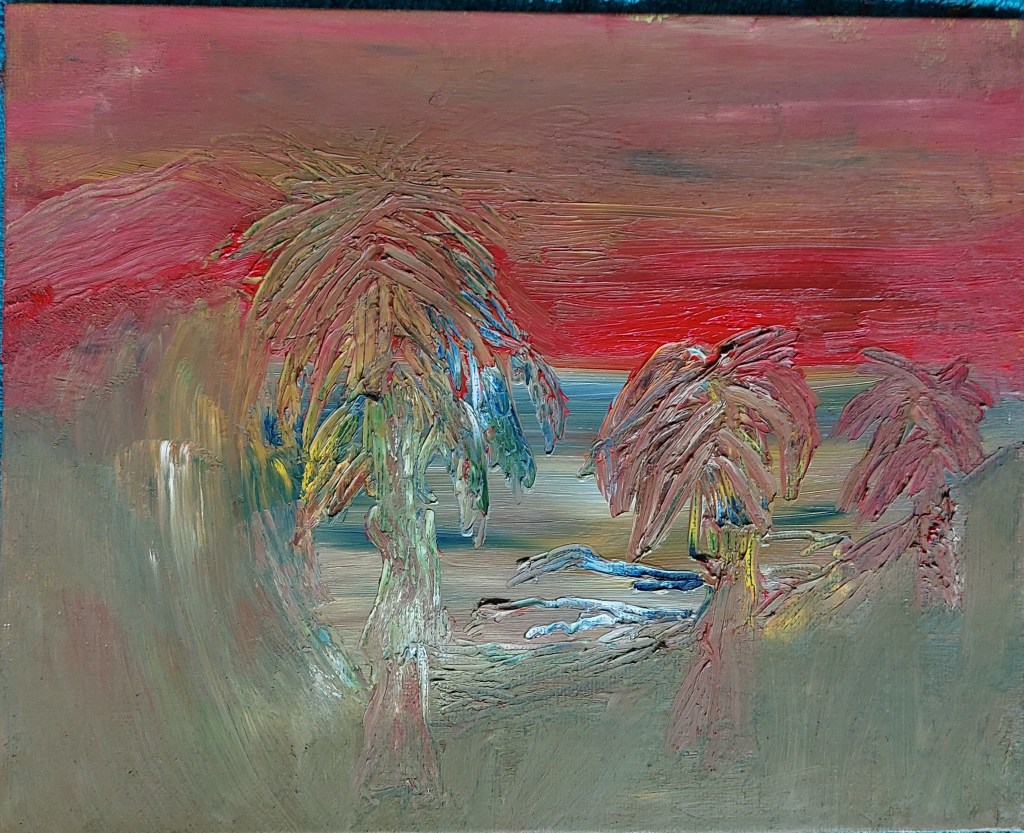
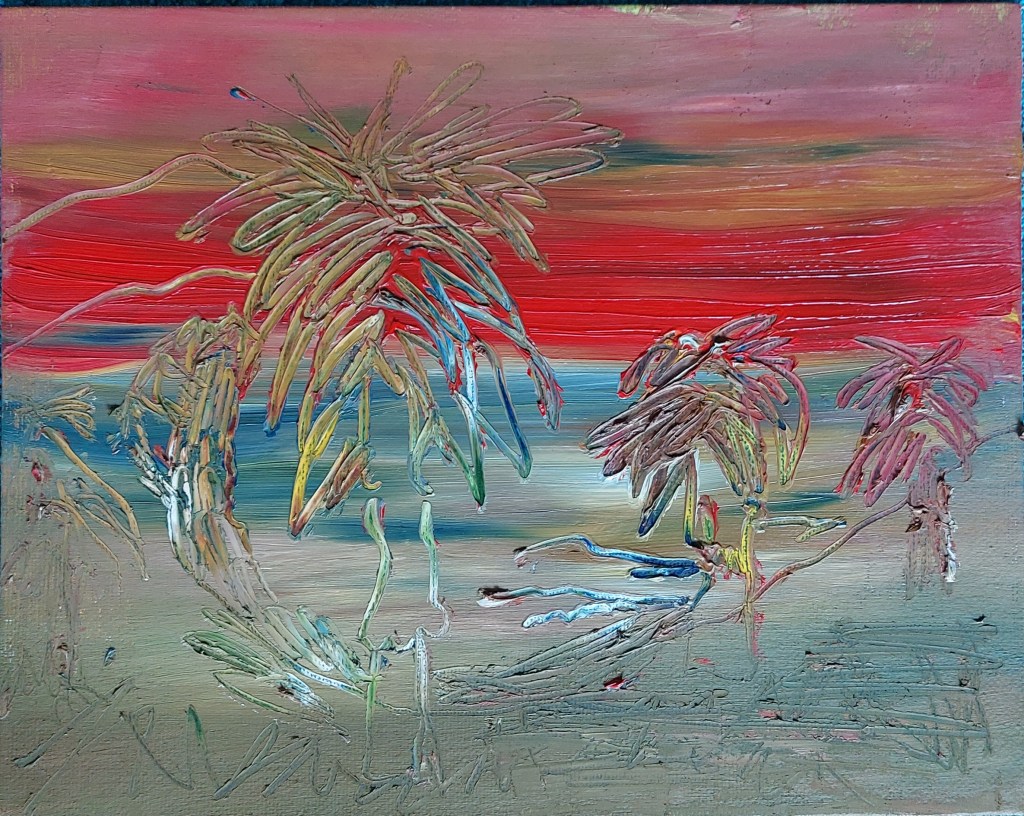
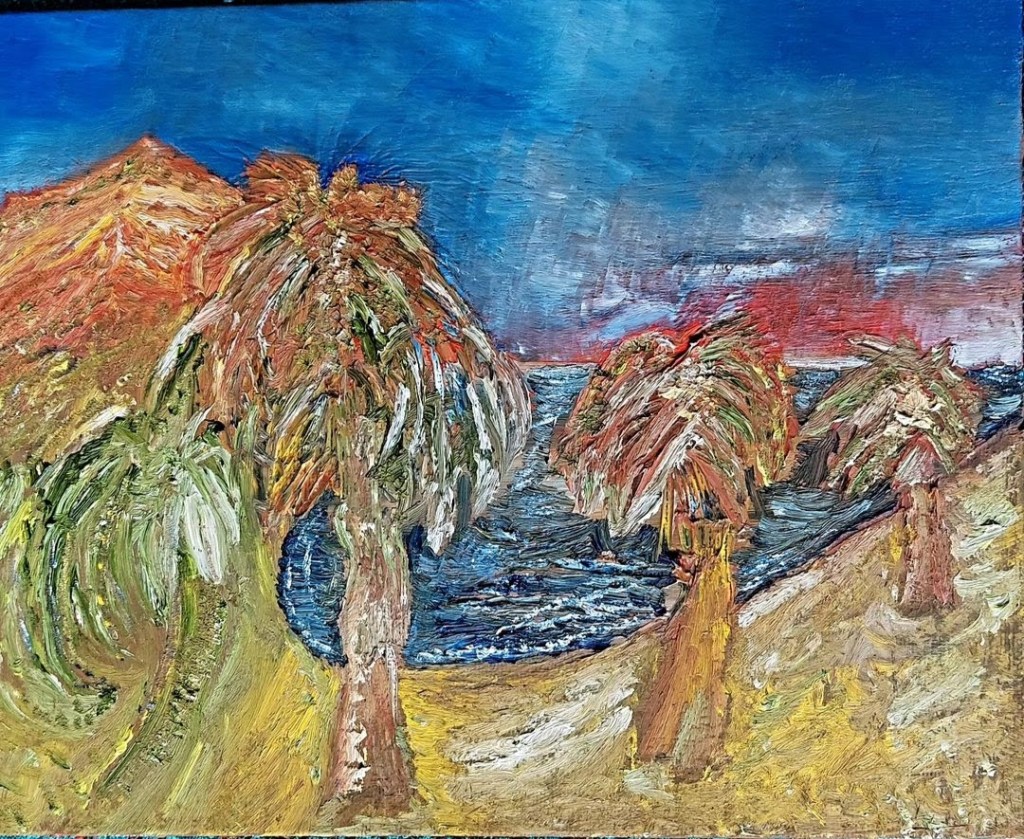
Palm Trees at Refugio
Note: My title, “Someone Told Me,” is the first line from a poem by Patrizia Cavalli. It’s from her first book, “My Poems Won’t Change the World” (1974). Her poem is untitled and only six lines long. I have it in a copy of her selected poems edited by Gini Alhadeff (FS&G 2013), also titled “My Poems Won’t Change the World.”
If you want to read a book, unless you plan on reading it all in one sitting, impossible if you’ve picked a big old obsolete kicker, you’ll need a bookmark to avoid dogeared pages, and a place to store your book while you go about your other business: rucksack, briefcase, purse, table, shelf – an empty pocket, maybe. Books are not nomadic. Reading is a sedentary exercise. As for the argument for obsoleting print books in favor of ebooks, they require a hot reading device with batteries or electricity hookup nearby. A paper book might be simpler, and nothing worse than on the bus ride home and coming to the denouement of your thriller a pop-up appears telling you to plug in your device, you’ve only got 5% battery left, and your screen suddenly turns to an overcast sky, and you don’t know who done it.
Read enough books and you might even think about writing one yourself. But how do you turn that thought into a book? And what kind of book? In Louis Menand’s most recent piece for The New Yorker (August 26, 2024), he says, “Not only is there no settled definition of what counts as a bookstore; there is no settled definition of what counts as a book” (68). But that’s not to say books are not counted. They are, ad infinitum. Suffice to say, however you define or count it, your chances of your book selling off the shelves are worse than finding life on Mars. You’d have a better chance going viral with a reel of your recent garage sale. In any case, again no matter how you define and count them, you’ll always be confronted with the existential theorem that says the number of books sold will never be the same as the number of books read: it will always be more or less – most probably more sold than read. But if you persist in writing your book, try a romance. According to Menand, “The big winner in the pandemic was the romance novel. Eighteen million print copies were sold in 2020; in 2023, more than thirty-nine million copies were sold. Romance is among Amazon’s most popular genres” (72).
But Menand’s piece isn’t so much about books as about bookstores. A “Critic at Large” feature, it’s titled on-line at The New Yorker site, “Are Bookstores Just a Waste of Space? In the online era, brick-and-mortar book retailers have been forced to redefine themselves, but the print issue title is “Remainders: Why do bookstores still exist?” A remainder, in the book industry, is an unsold book, a writer’s doom word. Much to our disappointment, but not really diminishing his article, Menand doesn’t mention Penelope Fitzgerald’s “The Bookshop” (1978, movie version 2017). There you’ll find not the augmented hopes of the would be writer but the diminished hopes of the would be independent bookshop owner. We must read carefully for the antagonist though – there are several, for the odds of a bookstore succeeding may not be much better than the odds of a book being read.
Maybe bookstores still exist, and persist, like public libraries, because they appeal to the painting of a desired cultural landscape that includes a peaceful Main Street lined with shade trees and with ample sidewalk space for browsing the boutique window displays, though without much advertising fanfare but word of mouth. But an industrial setting also works as the cultural landscape: railroad tracks down a block of warehouses, light manufacturing shops of brick walls and metal roofs, building supply stores, a bakery, and a brewery, a National Guard armory – and a poetry reading tonight at the Vacant Lot Bookstore. The most successful bookstore, like the cafe or tavern, will likely be local and, to use Menand’s word, curated, by which he means specialized in a particular genre, the bookseller a trusted critic, the books on hand discussed neither as commodity nor snob fodder but cultural artifact of one’s own time and place.
At the same time, maybe books have nothing to do with bookstores, and the trends are simply part of the overall decrease in interest in offline retail shopping. Bookshops can be of course special places in that they merge the urge to purchase something, anything, with the cultural value, real or perceived, of reading. And many bookstores offer more than a retail outlet. They sponsor readings, art shows, writing classes, lectures, book launches and meet the author opportunities. Some have even added coffee and doughnuts. But as a place to simply go in and buy a book in the window, like going into a phone booth to make a call – well, first you have to find a phone booth. It’s possible that the current decline in retail interest reflects the general current decline in post World War II commercializations, commodifications, standardizations, much of which has moved virtually online, where it’s realized the physical necessity of the thing was never a reality. Why will a person buy something they don’t need?
We two boys stood at the edge of the road at the top of 45th high above the beach, where the slow moving two lane Highland (lined with spots we ignored as kids: vista apartments and curio shops, corner cigarettes and beer market, breakfast cafe and evening bar), turns into Vista del Mar and curves down to Grand, only about a mile away, but still we stuck our thumbs out to hitch a ride. We were on our way home from Junior Lifeguards, which was held on the beach near Marine, down from the big tower. We never caught rides thumbing, so we were surprised when some sporty car with jaunty driver pulled over coming to a stop some twenty yards past us and we ran to hop in but the car revved up and sped off wheels spinning in sandy grit just as we got close.
I’ve been reading “A Time of Gifts,” by Patrick Leigh Fermor (subtitled “On Foot to Constantinople: From the Hook of Holland to the Middle Danube”). First published in 1977, when Fermor was sixty-two, it recounts the time in 1933, when Fermor, then just eighteen, left England for a wintry continent, outfitted with greatcoat, hobnailed boots, and commodious rucksack:
“During the last days, my outfit assembled fast. Most of it came from Millet’s army surplus store in The Strand: an old Army greatcoat, different layers of jersey, grey flannel shirts, a couple of white linen ones for best, a soft leather windbreaker, puttees, nailed boots, a sleeping bag (to be lost within a month and neither missed nor replaced); notebooks and drawing blocks, rubbers, an aluminium cylinder full of Venus and Golden Sovereign pencils; an Oxford Book of English Verse. (Lost likewise, and, to my surprise – it had been a sort of Bible – not missed much more than the sleeping bag.)
In the mornings, when the first-shift lifeguards opened their towers, the beach was grey-white foggy and cool-damp and the yellow sand stuck to your feet, the water dark-grey and the waves glassy and small and the blue of old fruit jars. At my parents’ house, 2 miles inland, walked in under an hour if you took the Devil’s Path shortcut and didn’t dawdle, the morning was open and clear and the air fresh and warm. The town was hilly and you had to cross the dunes to get down to the beach, which meant you had to climb back over them to get home, up the long Grand Avenue hill, but the afternoon breeze would be onshore and pushing as you walked before the wind.
Travel descriptions can be confusing to read, to see the images as they develop on the page. One key to travel writing must be movement – in time and place. Still, how does the reader see the scene unfolding? I’m finding it helpful to pull up the places Fermor talks about in Google Maps, but of course consulting a map is not travel, nor does the map help bring forth the local. Maybe we’ve become too saturated with photographs to understand prose pictures. And while Fermor’s story takes place in 1933, the images I see seem older. I was reminded of scenes like the following, from Penelope Fitzgerald’s “The Blue Flower,” but which takes place in the late 1700s, and concerns Friedrich von Hardenberg, later known as Novalis:
“From the age of seventeen he had been in almost perpetual motion, or the Gaul’s unhurried version of it, back and forth, though not over a wide area. His life was lived in the ‘golden hollow’ in the Holy Roman Empire, bounded by the Harz Mountains and the deep forest, crossed by rivers – the Saale, the Unstrut, the Helme, the Elster, the Wipper – proceeding in gracious though seemingly quite unnecessary bends and sweeps past mine-workings, salt-houses, timber-mills, waterside inns where the customers sat placidly hour after hour, waiting for the fish to be caught from the river and broiled. Scores of miles of rolling country, uncomplainingly bringing forth potatoes and turnips and the great whiteheart pickling cabbages which had to be sliced with a saw, lay between hometown and hometown, each with its ownness, but also its welcome likeness to the last one. The hometowns were reassuring to the traveller, who fixed his sights from a distance on the wooden roof of the old church, the cupola of the new one, and came at length to the streets of small houses drawn up in order, each with its pig sty, its prune oven and bread oven and sometimes its wooden garden-house, where the master, in the cool of the evening, sat smoking in total blankness of mind under a carved motto: ALL HAPPINESS IS HERE or CONTENTMENT IS WEALTH. Sometimes, though not often, a woman, also, found time to sit in the garden-house.” 57
That prose was first published in 1995, when Penelope was seventy-nine, so around 200 years after the scene takes place. And in Patrick Fermor’s “A Time of Gifts” we see this:
“I was plodding across open fields with snow and the night both falling fast. My new goal was a light which soon turned out to be the window of a farmhouse by the edge of a wood. A dog had started barking. When I reached the door a man’s silhouette appeared in the threshold and told the dog to be quiet and shouted: “Wer ist da?” Concluding that I was harmless, he let me in.” 73
That traveller was Fermor, in 1933, writing in the 1970s, but could have been Novalis in 1795, described by Penelope in the early 1990s. And many travellers wanting to save their day’s journey in writing may have shared something like the following experience, here described by Fermor:
“This was the moment I longed for every day. Settling at a heavy inn-table, thawing and tingling, with wine, bread, and cheese handy and my papers, books and diary all laid out; writing up the day’s doings, hunting for words in the dictionary, drawing, struggling with verses, or merely subsiding in a vacuous and contented trance while the snow thawed off my boots.” 66
The title of Fermor’s book comes from a Louis MacNeice poem, “Twelfth Night”. From the last of four stanzas:
“For now the time of gifts is gone – O boys that grow, O snows that melt, O bathos that the years must fill – Here is dull earth to build up on Undecorated; we have reached Twelfth Night or what you will . . . you will.”
I haven’t reached the Abbey of Melk yet, which in Jan Morris’s introduction to “A Time of Gifts” we are told is the “central point of the narrative.” So more on Fermor’s travel’s in a later post. Meantime, I harken back to the time and place of the two boys walking home from the beach. They don’t have maps, nothing to denote, “You are here.” They really haven’t much idea where they are in time or place, nor can they fully grasp the gifts of either.
Richard Henry Dana Jr, in his memoir, “Two Years Before the Mast” (1840), found at least the California weather a gift, and the beaches and waves. The following is from the “First Landing in California” chapter:
“It was a beautiful day, and so warm that we had on straw hats, duck trousers, and all the summer gear; and as this was midwinter, it spoke well for the climate; and we afterwards found that the thermometer never fell to the freezing-point throughout the winter, and that there was very little difference between the seasons, except that during a long period of rainy and south-easterly weather thick clothes were not uncomfortable.”
…
“I shall never forget the impression which our first landing on the beach of California made upon me. The sun had just gone down; it was getting dusky; the damp night-wind was beginning to blow, and the heavy swell of the Pacific was setting in, and breaking in loud and high ‘combers’ up on the beach.”
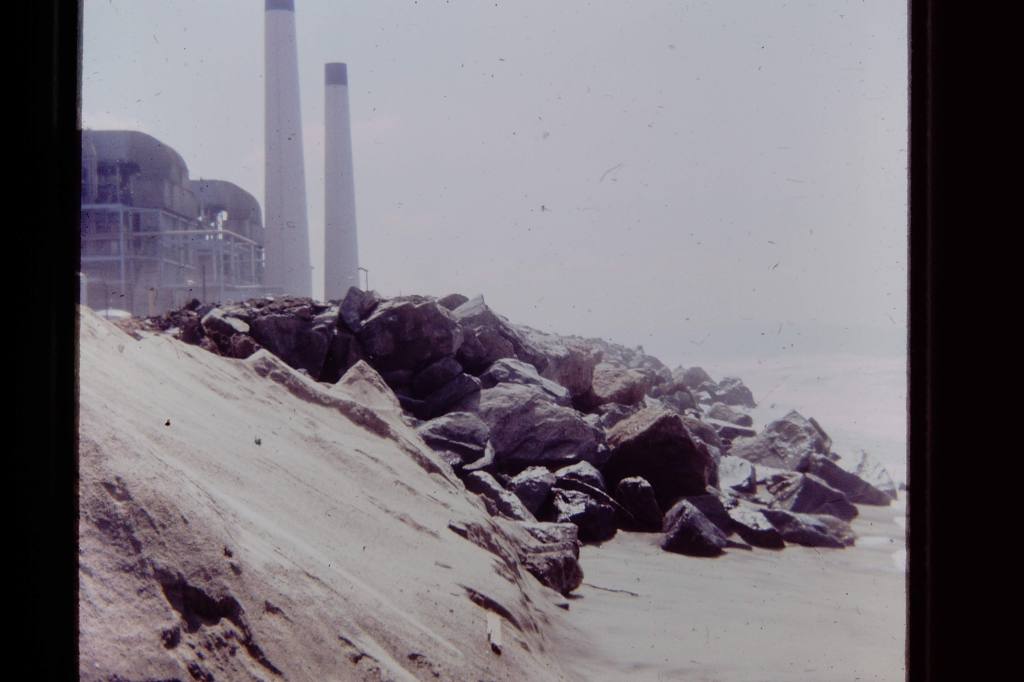
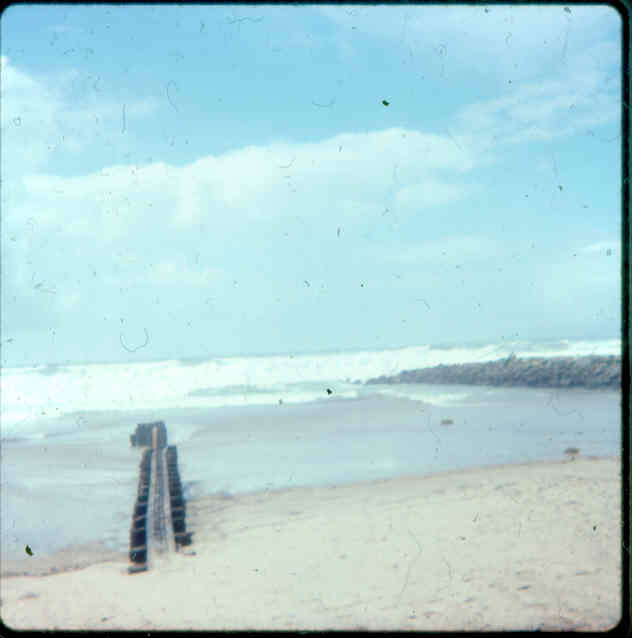
And where was that place? And is it still there today? The Grand Avenue Beach Jetty (it’s now called El Segundo Beach) is located in the middle of Santa Monica Bay. It’s about 10 miles north from the jetty to Sunset Beach (not counting getting around the Marina), where Sunset Boulevard winds down out of the hills to the coast road, and it’s about 10 miles south from the jetty to Malaga Cove, on the north side of Palos Verdes, the cove part of the Haggerty’s surf spots. Santa Monica Bay, the flat Los Angeles Basin surrounded by hills, Palos Verdes to the south and Malibu and the canyons to the north, the beach cities in the south, oceanic stupendous views or at least close enough to the ocean to smell and feel the salt and surf in the air, breach the storms and storm surf, wander down to the beach the day after a “south-easter.” But the South Bay is also full of industry, and all along and up from the beaches from Marina del Rey to El Porto, the dunes are supplanted by pipes and tanks and asphalt grounds surrounded by chain link fences: the airport, the Hyperion sewage treatment plant, the steam plant, the oil refinery, the power plant. It’s a different kind of desolation than what Dana saw when he wrote of Los Angeles:
“I also learned, to my surprise, that the desolate looking place we were in was the best place on the whole coast for hides. It was the only port for a distance of eighty miles, and about thirty miles in the interior was a fine plane country, filled with herds of cattle, in the centre of which was the Pueblo de los Angelos — the largest town in California — and several of the wealthiest missions, to all which San Pedro was the seaport.”
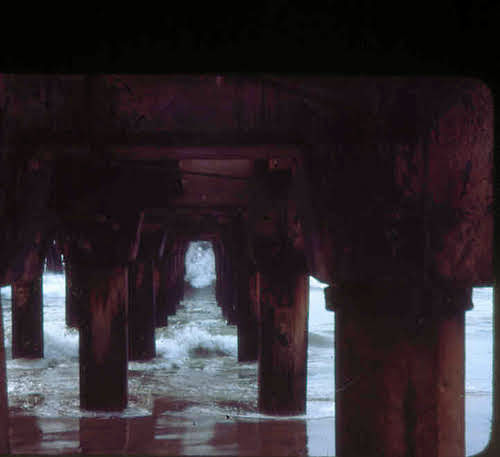
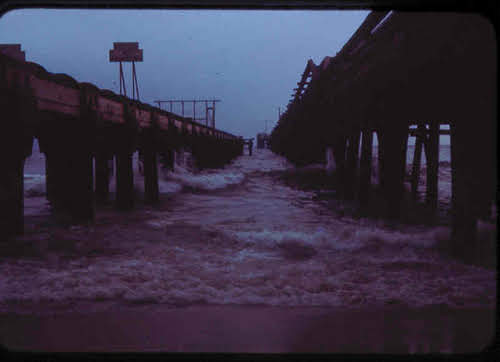
After being tricked by the off and running car, we two boys put our thumbs in our pockets and walked back down 45th to the beach. Just up Highland a few doors, we could see the apartment my oldest sister would rent about eight years into the future, while my future wife lived a block over and down on 44th. At the bottom of 45th, we turned north and walked along the beach at the water’s edge beneath the power and steam plants, all industrial now, the beach path, north of 45th, prime real estate denied the developers, but we didn’t mind that, for here we were in a short stretch of beach able to avoid the tourist crowds and catch a few empty waves on our own. We reached the Standard Oil Pier and crossed under the big pipes and wood beams, kicking through the surf. I was still a year or two from my high school reading of “Two Years Before the Mast.”
From the pier we walked to the jetty at Grand and then up the long hill past the steam plant and ice plant hillside that borders the refinery. We parted ways at Loma Vista and I continued down Grand across Main to the old railroad station then followed the tracks up and through Devil’s Pass to home, where I would find my mom making a watery spaghetti and sauce dinner, having found no time, no doubt, to sit happily in the yard in any place for any length of time.
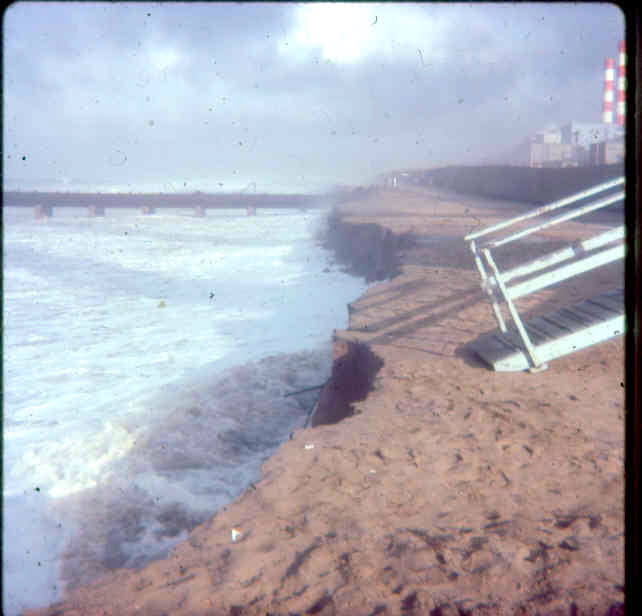
45th Street Lifeguard Tower ramp, north El Porto, circa 1976, looking north. High tides and storm surf have washed out the beach, creating a cliff.
Under the Standard Oil Pier, early 70s.
Standard Oil Piers, early 1970s.
El Segundo Power Plant, mid 1970s. The giant rocks were brought in as riprap.
Grand Jetty with old pilings uncovered by a very low tide, early 70s.
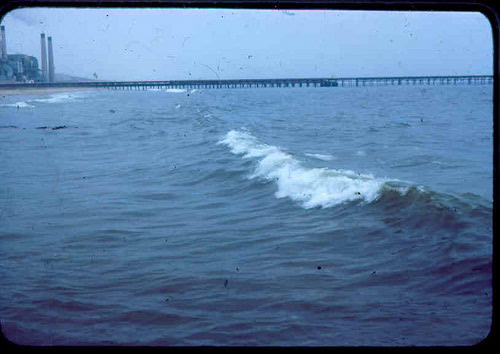
Standard Oil Pier and Power Plant Stacks – looking south from the Grand Jetty, early 1970s.
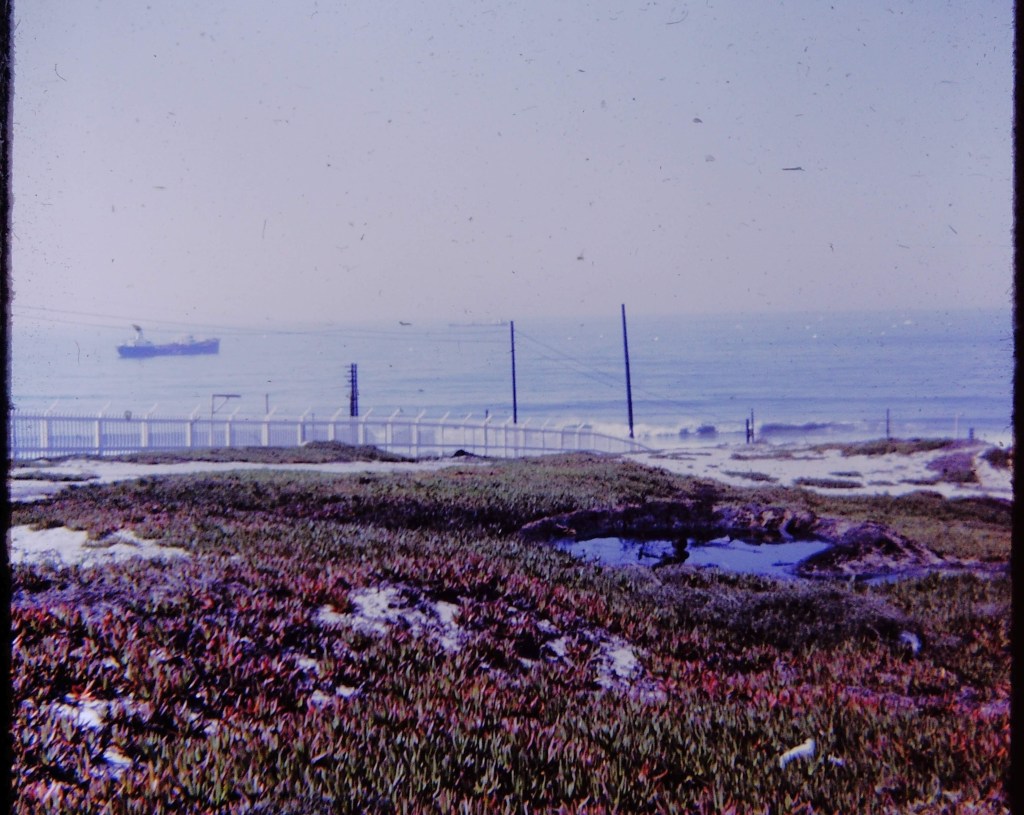
Ice plant covered dune overlooking Grand Ave. Beach, March 1974
.
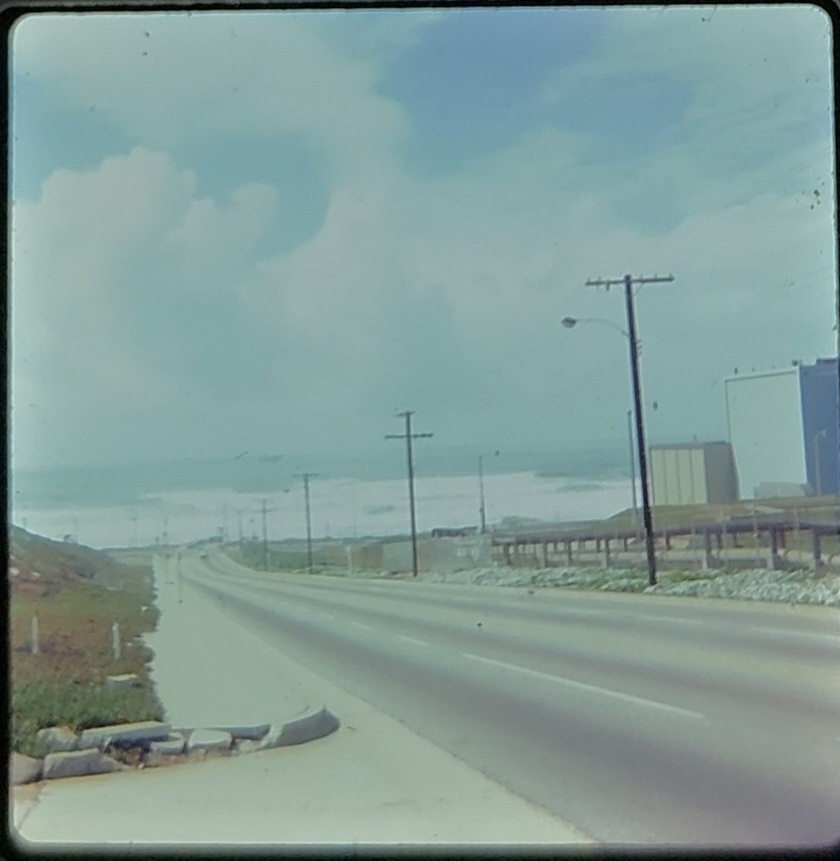
Grand Avenue, 1974.
Above photos taken with my Exakta 500 I used at the time. The exact dates on some of the slides are sometimes so faded I can’t say for sure when they were taken, but likely from 1968, when I purchased the camera used from a camera shop on Main Street, into the mid 70’s, maybe as late as 1977 or 1978 (thinking too of a box of slides most of which are not shown here). The Standard Oil Pier has since been taken out, the pipe now underground, underwater. The pier was located between 45th, the last residential street in El Porto, and Grand, which comes down to Vista del Mar from El Segundo. I’ve posted some of these pics before at The Toads, but in a different context.
Books referenced above include New York Review Books copy of Fermor’s “A Time of Gifts,” 1977, introduction 2005 by Jan Morris; and Second Mariner Books edition, 2014, of Penelope Fitzgerald’s “The Blue Flower” (1995). “Two Years Before the Mast” was published in 1840, just a few years after Dana had made the voyage described in his book.
“Guy needs a friend,” Harriet tells Dobson in Chapter Six of “The Danger Tree,” the first novel in “The Levant Trilogy,” where we find the same characters we met in “The Balkan Trilogy,” while introduced to new ones, too, as Harriet and Guy, a young English couple newlywed at the beginning of World War II, on the run from the invading Nazis, first from Bucharest then Athens, now find themselves in Cairo, in fear of having to run again as Rommel is rumored to be only hours away.
“Needs a friend! But no one has more friends.”
“There are friends and friends. There are those who want something from you and those who will do something for you. Guy has plenty of the first. He’s rather short of the second.”
“Do you mean that?”
“Yes. He collects depressives, neurotics and dotty people who think he’s the answer to their own inadequacy.”
“And is he?”
“No, there is no answer.”
p. 140, NYRB, 2014, first published 1982 as “The Levant Triology” by Penguin.
Later – alone, out of money, apart from Guy and adrift from Cairo into Syria, unable to find work, suspect and strange, following her rash escape, both deliberate and random, Harriet finds friends, and reflects,
“…she, an admirer of wit, intelligence and looks in a man, was beginning to realize that kindness, if you had the luck to find it, was an even more desirable quality” (497).
But is kindness alone enough?
“Lister was kind but, thinking of his fat, pink face, his ridiculous moustache, his wet eyes and baby nose, she told herself that kindness was not enough” (525).
Like Lister, many of Manning’s characters seem to walk on as if just out of a Shakespeare play. The critic Harold Bloom saddled Shakespeare with inventing the human. Shakespeare certainly made ample studies, having created well over a thousand characters in his plays. Manning too produces a host of characters, and while she doesn’t forge the human, she does fashion personality: quirks and tics, foibles and fears, motivations and enthusiasms – ways of being, but not always of one’s own choosing: why are we the way we are, and can we change? How do we make friends? How do we keep them? But none of Manning’s characters stand alone; they are each part of some social imbroglio: a picaresque duo; peasant families forced from their homes into refugee status; government administrators lost in corridors of bureaucracy; bosses and the bossed about; soldiers in lines marching off and stumbling back; colleagues and acquaintances and friends going to work, meeting in cafes for drinks or dinner, attending concerts or lectures, sightseeing, going on walks, always talking. Manning’s friends come together to join up and to disassemble, to get news, to ask questions, to criticize and admire, scold and berate, laugh and cry amid betrayals and sacrifices.
In the first book of the trilogies, “The Great Fortune,” Guy produces and directs a Shakespeare play. The whole enlarged endeavor is a sort of aside, meant to give the locals a respite from their anxiety over the war threatening near, but also to give the novel a subplot to view the interconnections of characters – their relationships, how they get along or not with one another, thrown together by chance and circumstance. The play is “Troilus and Cressida,” its amateur performance played once in Bucharest in 1940 a great success. But while just about everyone Guy knows has some part in the production, Harriett has no role to play but that of an observer.
In “Hamlet,” Shakespeare gives the bumbling Polonius the job of dispensing advice, now responsible for a litany of trite sayings repeated usually without knowing the questionable credibility of the speaker. A favorite of mine:
Those friends thou hast, and their adoption tried, Grapple them to thy soul with hoops of steel;
To grapple is to hook, as a grape plant does with its tendrils. But who wants to be grappled to someone else’s soul?
The second half of Polonius’s advice on friendship is usually dropped from the reference:
But do not dull thy palm with entertainment Of each new hatched unfledged comrade.
To be fledged is to be feathered for flight. How does one prepare for the flight of one’s friends?
Harriet and Guy’s friends jockey for position but more for survival. The loss of friendship becomes so common one seeks to avoid making new friends. This is the case with Simon Boulderstone, a British soldier in Egypt to fight in the desert war. Simon shares in alternating chapters with Harriet protagonist duties. He quickly loses the two Army friends he made on his way to Egypt. But he falls in with the tried and true buddy system, then loses a couple of good buddies. Simon learns one fights and dies not for one’s country but for one’s friends. He also learns friends that glitter often bleed lead.
Entangled in the theme of friendship is the theme of personality, how and why some are attracted to others while others are not, and may even be repelled. How and why relationships that start off so sweet often turn so sour and bitter. How and why some people have certain needs and wants that others readily cast off as useless burdens. How and why we use others in the guise of friendship then rid ourselves of them when the use grows obsolete. At the same time, we find friends who, as the saying goes, stick through the thick and thin, don’t abandon ship at the first sign of taking on water. In the end, we find Harriet and Guy the best of friends, which may mean putting up with one another’s spontaneous and fickle lack of friendship or having to entertain the friendship of others who if alone would not come close.
Thinking back to my earlier days of blogging, when it now sometimes seems writers then often wrote with different purpose, as in sharing a conversation with themselves to which others might be invited to listen in and, if need be, comment. Have we stopped talking to ourselves? Some days these days I’m nearly the only person I talk to, so if I do talk to someone else, some random Q & A with a passerby or on a visit to the grocery, I’m likely to mull over what was said with playback on repeat. Too often I find myself looking for meaning in a bucket of refuse, wanting to rebuff the debris, worried I might have not given someone or something my full attention, mired in muddled memory. Of course my interlocutor is long gone and remembers none of it and would be surprised to know I have it on mental-virtual video. Talking to ourselves is where conversations begin. Where can they end? I suppose many prepare a speech or lecture or opinion or anecdote, or spurn the prep and just go for it, though most rarely press it, but one might in conversation attempt to lecture or tell a story of something that once happened and for some reason the links still work, but not all of them, or the links take you places unexpected, but what’s the purpose of a lecture, a one way conversation, or an anecdote impossible to research? Do casual conversations have purpose, or are they simply a template for one’s personality, a way of spraying one’s mental territory? After a decade and more, a blog full of broken links, difficult to refresh. And we lose purpose, or misplace it, or deleted it by accident.
Olivia Manning’s writing is full of conversations. Characters come and go and return and you feel like you know not so much what they are going to say but how they are going to say it, and after a time there’s no difference. If the conversation contains nothing new, how something is said takes on more importance than what is said. But since it’s fiction, or selective memoir, everything that’s said must have some meaning, some purpose in the whole. Some reason for being said:
“The evening was one of the few that they had spent in their living-room with its comfortless, functional furniture. The electric light was dim. Shut inside by the black-out curtains, Harriet mended clothes while Guy sat over his books, contemplating a lecture on the thesis: ‘A work of art must contain in itself the reason why it is so, and not otherwise.’”
“Who said that?” Harriet asked.
“Coleridge.”
“Does life contain in itself the reason why it is so, and not otherwise?”
“If it doesn’t, nothing does.”
“Fortunes of War: The Balkan Trilogy.” NYRB 2010. Page 872.
But is life a work of art?
Critics have called Manning’s work somehow less than art. A blurb by Howard Moss on the back cover of my NYRB copy says,
“One of those combinations of soap opera and literature that are so rare you’d think it would meet the conditions of two kinds of audiences: those after what the trade calls ‘a good read,’ and those who want something more.”
You’d think that’s what a good conversation ought to purpose for. Why isn’t soap opera considered literature? It is, but one without an end – like a blog. Critics don’t like something that doesn’t come to an end. Someone that goes on and on and on is not considered a good conversationalist. But having enjoyed “The Balkan Trilogy” so much, I’m now on to the second of Manning’s trilogies, “The Levant Trilogy.” I’m only about 50 pages in, but already I think I can say it’s another good read mix of soap and lit. Though I’m not bothered by soap alone. Hemingway is full of soap. Soap and sap. Though the soap is rarely used for its purpose. The blurb was taken from a review of Manning’s Balkan and Levant trilogies Moss wrote for The New York Review, April 25, 1985, titled “Spoils of War.” Moss liked the books, almost in spite of his taste, it seems:
“The way this past world comes to the surface is un-Proustian and non-metaphorical; the thrust of the whole rarely has time to stop for digressions. Manning, who avoids elevations of style as if an ascent were a bog, also evades sentimentality, and although she can handle atmosphere, her main interests are those two staples of realistic fiction, character and action.”
But we do find digressions in the Manning books, mostly in the form of colorful sensory and physical descriptions of the weather and its effects on the streets, parks and gardens, the mountains and valleys and the trains traversing under the sky above and above the people below. But while these descriptions are placed here and there frequently it’s true they are short and appear almost as doilies or tchotchkes arranged to create atmosphere. But in the end, for Howard Moss, the trilogies lack poetry. But a poetry of war might create illusions, and what would be its purpose? Moss has already said of Manning:
“An enemy of illusions, she does not quite see how crucial they are both in love and in war.”
Was it on purpose Manning avoided metaphor and poetry? We can take purpose too seriously, forgetting that mostly what’s said is said in jest, to fill the spaces of silence, or to scratch common itches. We usually proceed without purpose. In Alice, on purpose, we find:
“They were obliged to have him with them,” the Mock Turtle said: “no wise fish would go anywhere without a porpoise.”
“Wouldn’t it really?” said Alice in a tone of great surprise.
“Of course not,” said the Mock Turtle: “why, if a fish came to me, and told me he was going a journey, I should say ‘With what porpoise?’”
“Don’t you mean ‘purpose’?” said Alice.
“I mean what I say,” the Mock Turtle replied in an offended tone. And the Gryphon added “Come, let’s hear some of your adventures.”
“I could tell you my adventures—beginning from this morning,” said Alice a little timidly: “but it’s no use going back to yesterday, because I was a different person then.”
“Explain all that,” said the Mock Turtle.
“No, no! The adventures first,” said the Gryphon in an impatient tone: “explanations take such a dreadful time.”
Indeed they do. Such might be to blog, or to write an epic trilogy or two, but while some explanations seem to require a long form, others can be riffed off in a tweet or two.
We say “on purpose” to explain some experience wasn’t “by accident.” But purpose is confounded by all those imperatives upon us that determine how we feel and experience but are not within our control, like the medulla oblongata stuff. We might try to proceed with purpose to do something purposeful with our day, or at least with our writing, or our blog, but to what purpose other than to show what happened and how our feelings may have changed over time and what ideas if any might accrue from those changes. But if all we can show is pettiness, narrow-minded cheap anecdotes, or soap operatic epic-intended purpose or explanations that go nowhere, why bother wading through the bog of a blog or a trilogy of books, all of which can never ascend but only descend, down as the page rises and disappears, one post after another, more often than not style and sense on repeat, poetry or not? Speak Memory, Nabokov said, while others might say, “Shut up!” Memory is like an upstairs neighbor pounding on the floor.
Memory is the editor-in-chief of experience:
“The Dormouse had closed its eyes by this time, and was going off into a doze; but, on being pinched by the Hatter, it woke up again with a little shriek, and went on: “—that begins with an M, such as mouse-traps, and the moon, and memory, and muchness—you know you say things are ‘much of a muchness’—did you ever see such a thing as a drawing of a muchness?”
Memory is an example of a muchness at work (or play).
“That’s the effect of living backwards,” the Queen said kindly: “it always makes one a little giddy at first—”
“Living backwards!” Alice repeated in great astonishment. “I never heard of such a thing!”
“—but there’s one great advantage in it, that one’s memory works both ways.”
“I’m sure mine only works one way,” Alice remarked. “I can’t remember things before they happen.”
“It’s a poor sort of memory that only works backwards,” the Queen remarked.
If memory only works backwards, what do we call the facility by which we look ahead? Can we imagine a future different from anything that’s contained in our memory? Imagination is muchness at work (and play). But character and action need a place to unfold, and Manning describes dwellings and rooms, bars and cafes, parks and walkways and trails. You can have a conversation anywhere. And her writing while sparse of metaphor is not devoid of poetry:
“The lawn was set with citrus trees that stood about in solitary poses like dancers waiting to open a ballet (695).
The landscape is part of the weather:
“As they rounded the house and came in sight of the sea, the clouds were split by streaks of pink. The sun was setting in a refulgence hidden from human eye. For an instant, the garden was touched with an autumnal glow, then the clouds closed and there was nothing but wintry twilight (695).
For all indents and excursuses, we have run out of purposes, if we ever had any, having relied on the feeling that we might as we sometimes do find our purpose in the act of going forth, but there’s never a guarantee.
There’s a scene in John le Carre’s “The Spy Who Came in from the Cold” (1963) where Leamas, the tough and unsentimental spy, recalls his first experience of what for him was a foreign emotion, the fear and trembling that comes from a near miss. He was speeding down the autobahn late to an appointment and “taking risks to beat the clock” when he nigh collided with a car full of children:
“As he passed the car he saw out of the corner of his eye four children in the back, waving and laughing, and the stupid, frightened face of their father at the wheel. He drove on, cursing, and suddenly it happened; suddenly his hands were shaking feverishly, his face was burning hot, his heart palpitating wildly” (122, Coward-McCann, 1964).
But apart from his sudden shaking of nerves, what happens is that he imagines the scene as if he had actually hit the car, and that too is new, and
“He never drove again without some corner of his memory recalling the tousled children waving to him from the back of that car, and their father grasping the wheel like a farmer at the shafts of a hand plow” (122).
The new emotion is evidence that “He was slowing down. Control was right (121)….Control would call it fever” (122). What has happened to the stouthearted spy that a near miss becomes an obsessive memory that torments him almost as if the resulting imagined outcome really happened?
I thought about the le Carre scene while reading the Roddy Doyle short story, titled “The Buggy,” that appears in this week’s The New Yorker magazine (June 24, 2024). Doyle’s story also contains a near miss. A father is standing with his kids on a train platform:
“He let go of Colm’s hand for a second, to give the button a jab – and Colm was gone. He had tried to step onto the train; his stride fell short of the gap, and he dropped between the train and the platform, under the train” (48).
But what happens in Doyle’s story, unlike the foreign emotion experienced by le Carre’s spy, is the father seems to have lost touch with the reality of the experience:
“He could remember rescuing Colm, but he couldn’t imagine it – he couldn’t feel it. He didn’t believe he’d done it. Or any of the other things he’d done when he was a father” (48).
Like le Carre’s aging and on the wane spy, the father in Doyle’s story begins to experience his memories differently from the reality of their happening. In fact, he simply can’t imagine the experiences are actually his. For example, and this is probably, while reading the Doyle story, where I remembered the scene from “The Spy Who Came in from the Cold,” the father recalls another buggy incident. Another son, Sean, had pushed their buggy out into the road and a passing car hit it. Doyle’s story turns on whether or not the bugggies are carrying babies or are empty.
“He could remember it like a scene from a film. It was a very good film. But he wasn’t in it.
What happened?
Where had his life gone? Not the years – the blood. Where was the life?” (49)
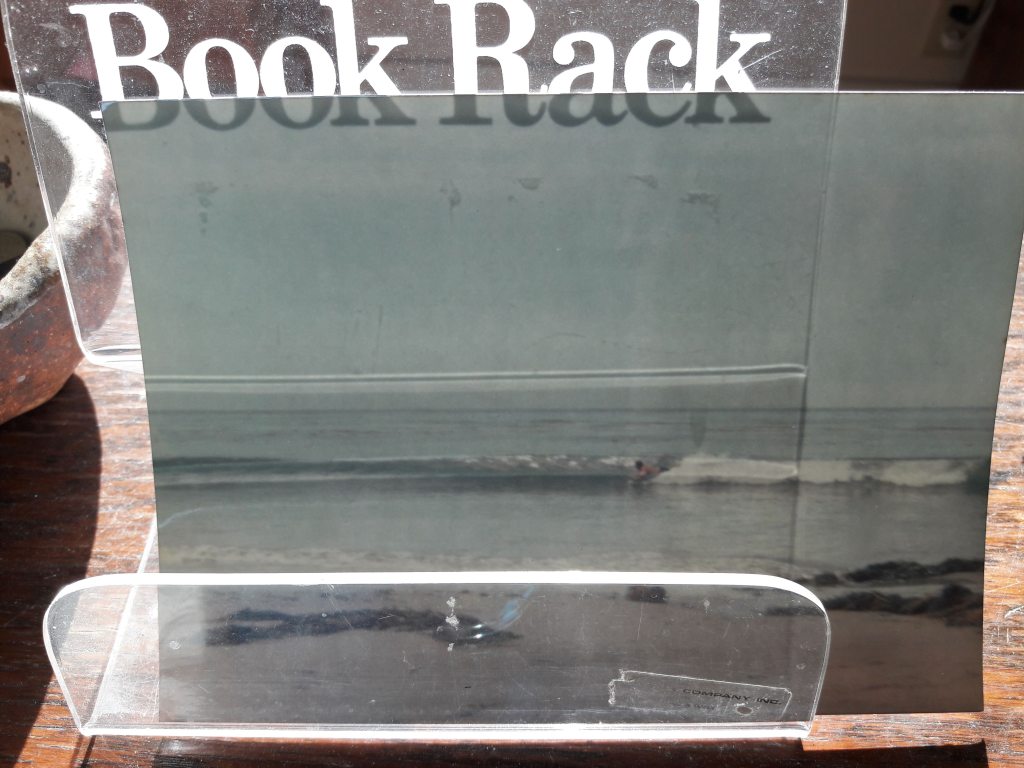
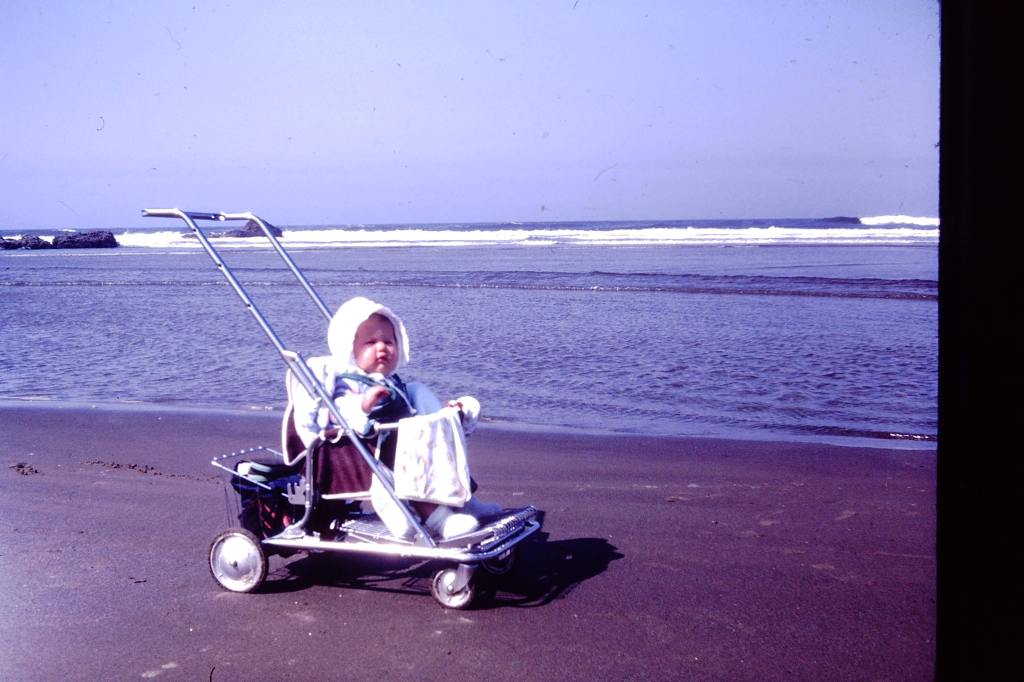
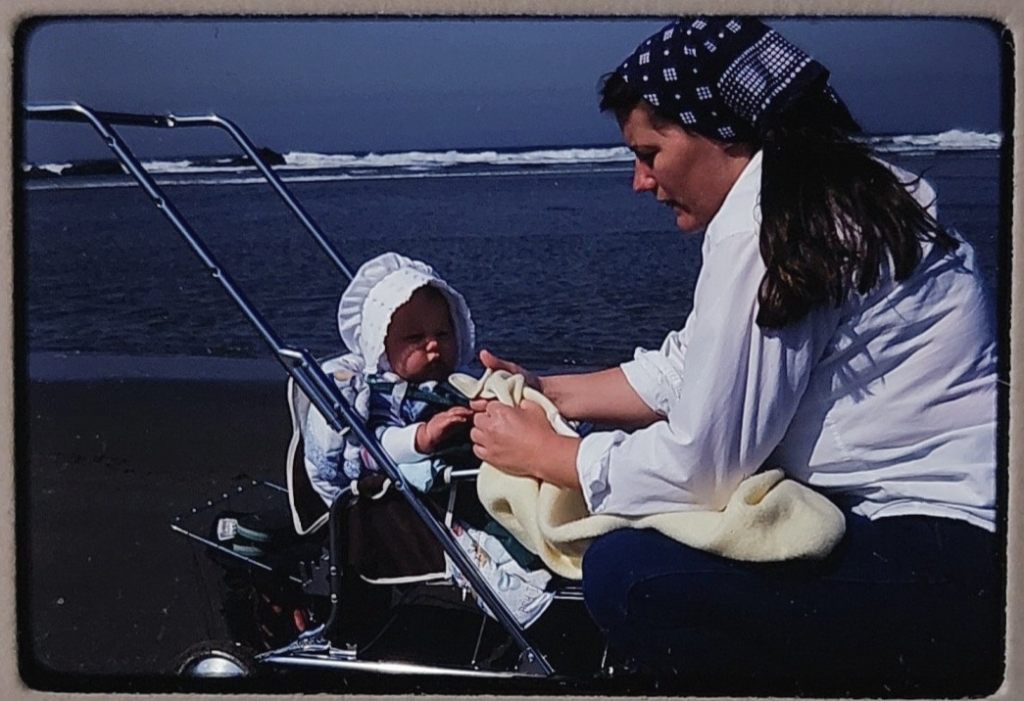
Then there’s another buggy, in the Roddy Doyle story, at the beach, near the incoming tide, and this one reminded me of a couple of old 35mm slide photos I took years ago on a trip to Cannon Beach. There’s definitely a baby in this buggy. The tide is out, and I’m close by, and so is the mother. But why did I say I remembered the photograph and not the actual being there on the beach, the waves breaking far out, the sun still to the east, late morning, the blue steel tones of the sea and sky, the now old fashioned collapsible beach buggy with basket? And that white bonnet frilled lace like the surf foam and that blue bandanna. Is it a memory or a photograph or a short story?
 The Coming of the Toads