The New Yorker is celebrating this month its 100th anniversary. I discovered the magazine in its mid-40’s, visiting Susan’s aunt Joan at her beach studio-pad a door from the boardwalk in Venice in 1969. She gave me her discards. I started with the cartoons, of course, then read the short stories, always one or two, which back then followed the Talk of the Town section. I read all the small print stuff about the goings-on in New York, where I’d never been, never wanted to go. I thought short stories more interesting writing, but I soon grew to enjoy the short pieces in the Talk of the Town section. And I started reading the non-fiction pieces, the articles in those days on average longer than today’s, sometimes much longer, spanning two or three issues.
The February 1, 1969 issue included a story by Linda Grace Hoyer, the mother of the prolific writer frequently found in The New Yorker over the years, John Updike. The February 21, 1970 anniversary issue included a short story in epistolary form by the editor and baseball writer Roger Angell, and a poem by Roger’s stepfather, E. B. White, titled “In Charlie’s Bar,” about a woman who was refused service at a bar in England because what she was wearing that visit happened to reveal her belly button. There’s also a story by Donald Barthelme, tilted “Brain Damage.” That I can’t really say that I now remember any of those pieces precisely probably says more about my brain than the keeping power of the writing.
This year I came close to letting my subscription lapse. Maybe it’s my lapsing attitude, another sign of too many winters in a row of discontent, living away from the ocean. I’ve always liked The New Yorker because it is a general interest magazine, witty but sincere and without specialty or academic brouhaha. But as Jill Lepore puts it in her article titled “War of Words” in the 100th anniversary issue:
“The stock criticism of Brown [Tina Brown, former editor from 1992 who shortened articles, among other at the time some thought controversial changes. David Remnick took over as editor in 1998] is that she made everything about celebrity; the stock criticism of Remnick is that he made everything about politics. The same could be said of America itself, across those years.”
That everything is about any one thing brings an emphasis that goes against the grain of general interest. And what will happen to the editorial stance now that celebrity and politics have merged into one? That’s what I’m not sure I want to see. But while there have been a few ownership and editorial changes over the years, changes in form and content have not been deep. What’s changed is out on the street. But maybe that’s not so new either. Let’s take a look.
From the Notes and Comment section of the February 28, 1970 issue (and if I hadn’t just told you it’s from 1970, you might have thought this was today):
“The government’s campaign against the press, which has proceeded swiftly from threats of action to action, in the form of subpoenas of reporters’ notes and tapes and films, has already heavily damaged the press’s access to the news.”
Surely someone would say something. After all, it was still almost the 60’s. But in the same piece we get this:
“The Democrats complete silence on those issues throughout the program [a Democrat television special titled State of the Union: a Democratic view – a response to Nixon’s State of the Union address] struck us as an extreme instance of the more general avoidance of controversial issues which has been noticeable among politicians and on the networks and in the press.”
Certainly not much seems to have changed from Andy Logan’s comment in the Around City Hall section of the same issue. Writing about the state’s budget hearings, he says:
“According to one theory of public life, the winning politician is not the man who spends his time gathering civic credits to himself but the operator who can most often persuade the public that whatever went wrong was somebody else’s fault.”
A valuable benefit of subscription is access to The New Yorker archive. I found myself, in solo celebration of its 100th Anniversary, browsing through past issues from the years I first started reading the magazine. In that February 28, 1970 issue, for example, I perused the Nightlife section, wondering where I might have gone had I been in New York at the time. I could have sat in at The Bitter End, where “Folks, both long- and short-haired, sit on wooden benches and sip coffee.” I could have eaten, copiously, no less, at Bradley’s, “a wood-paneled bar and rest where people come, and frequently return, to sit and talk and copiously dine.” Not only that, but I could have listened to Bobby Timmons play electric piano until three in the morning. And if that wasn’t enough music, I could have at three headed over to the Red Onion and heard “Two banjos and a piano until four.” And that went on every night. Did people never sleep in New York? There was a lot to choose from: “music, bar, dinner, dancing, discos, cabarets.” At the movies (still called Motion Pictures in one section of the magazine), I could have seen, drawing now from the alphabetical listing: Belle de Jour, The Bible, Bob and Carol and Ted and Alice, or Butch Cassidy and the Sundance Kid.
I seldom read The New Yorker fiction anymore, and some of the poems I don’t make it out of the first stanza or two. I’ve grown prosaic maybe in my dotage. And if you think the point of a cartoon is to make you laugh, you might be in for a disappointment.
One measure of good writing is whether or not it can be read comfortably and naturally aloud. This week, I’ve been reading aloud to Susan from J. D. Salinger’s Nine Stories. In Salinger’s story titled For Esme – with Love and Squalor (from the April 8, 1950 issue, not April 9 as Wiki has it) about a US soldier in WWII, the narrator meets a young English girl in a Devon tearoom:
“May I inquire how you were employed before entering the Army?” Esme asked me. I said I hadn’t been employed at all, that I’d only been out of college a year but that I liked to think of myself as a professional short-story writer. She nodded politely. “Published?” she asked. It was a familiar but always touchy question, and one that I didn’t answer just one, two, three. I started to explain how most editors in America were a bunch – “My father wrote beautifully,” Esme interrupted. “I’m saving a number of his letters for posterity.”
This post being about The New Yorker, and The New Yorker being known for its cartoons, I thought I’d end with a cartoon:
I was just a few months blogging when back in April 2008 I wrote a post titled “Where weather and writing merge,” about the Santa Ana winds, referencing Joan Didion’s “Los Angeles Notebook,” the first section of which was originally published in 1965 in The Saturday Evening Post under the title “The Santa Ana.” Didion claimed the winds influenced behaviors; she’s read up on it:
“‘On nights like that,’ Raymond Chandler once wrote about the Santa Ana, ‘every booze party ends in a fight. Meek little wives feel the edge of the carving knife and study their husband’s necks. Anything can happen.’ That was the kind of wind it was. I did not know then that there was any basis for the effect it had on all of us, but it turns out to be another of those cases in which science bears out the folk wisdom” (218).
Didion references a physicist who studied the physical characteristics of winds and people’s reactions that suggest cause and effect reflex at play, and her anecdotal evidence, though bizarre and outlier, of the winds affecting one’s psyche is persuasive.
“Whenever and wherever a foehn blows, doctors hear about headaches and nausea and allergies, about ‘nervousness,’ about ‘depression.’ In Los Angeles some teachers do not attempt to conduct formal classes during a Santa Ana, because the children become unmanageable” (218).
Didion also mentions the Los Angeles area fires that occurred in the 3rd quarter of the 20th Century, the scope of which at least in part she attributes to the Santa Ana winds.
“The Santa Ana caused Malibu to burn the way it did in 1956, and Bel Air in 1961, and Santa Barbara in 1964. In the winter of 1966-67 eleven men were killed fighting a Santa Ana fire that spread through the San Gabriel Mountains” (219).
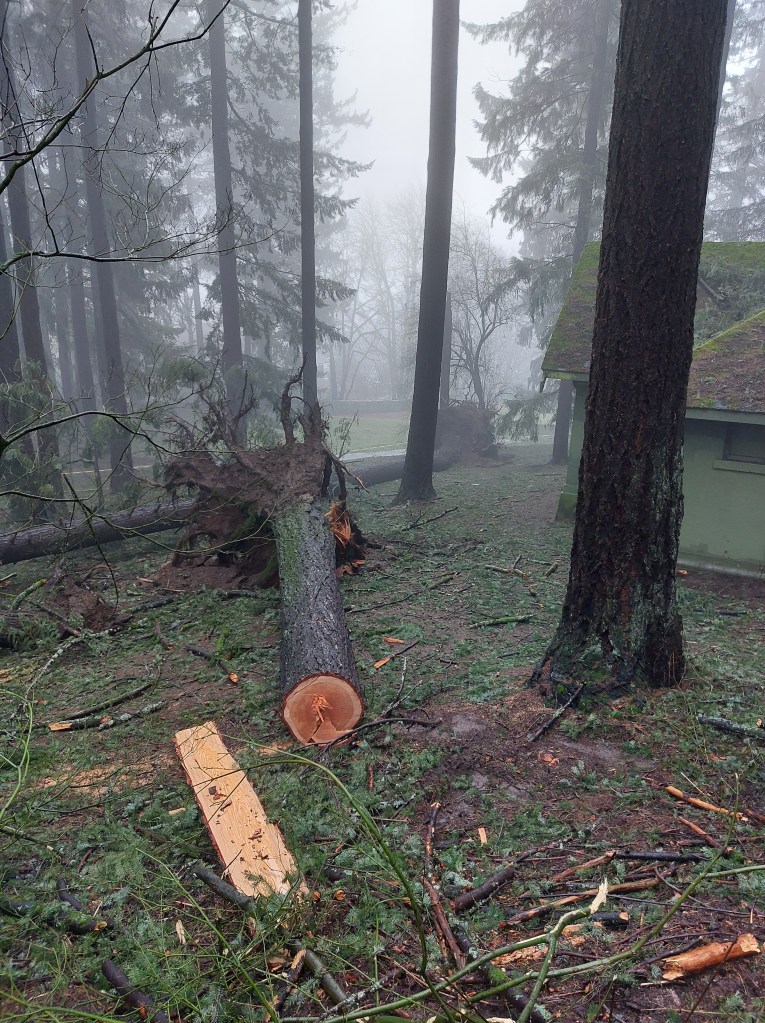
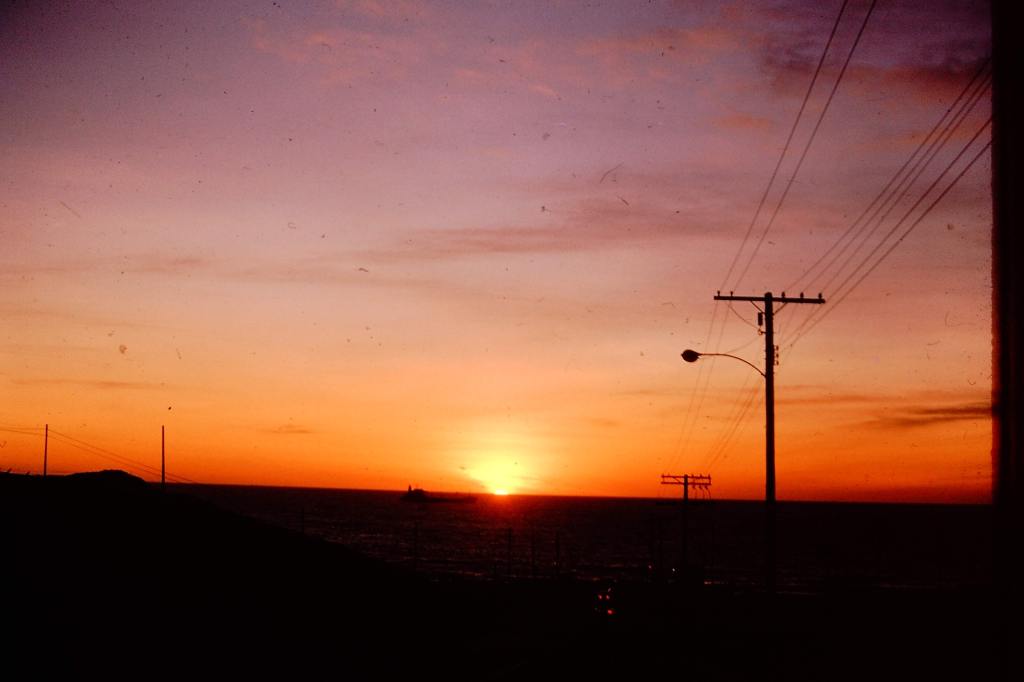
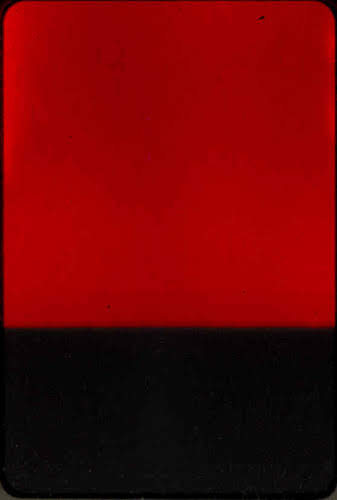
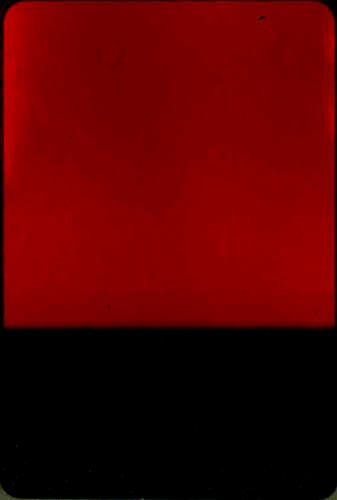
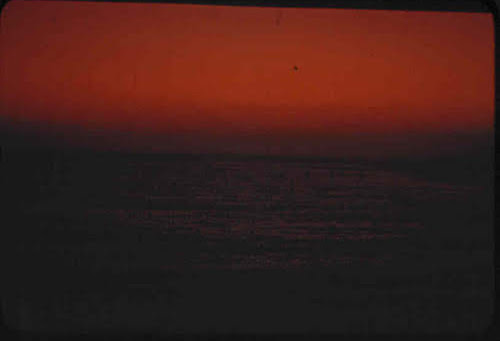
We lived in Los Angeles in those years, in one of the beach towns, and I remember the long clouds of smoke that drifted out with the winds over the ocean. Evenings at the beach we took sunset-and-smoke Kodachrome slide photos (see examples at bottom). Now in Portland, which also sports a foehn wind, called the East Wind, which does most of its damage in the winter, falling trees, knocking out power lines, freezing pipes. Last January (2024), a severe East Wind that lasted several days and nights and brought down hundreds of trees and power lines, the temperature dropping to 12 degrees (F), incapacitated the city. A few days after the storm I went up into Mt Tabor Park and took some photos:
Back in LA, in “Penina’s Letters” (2016 – now out of print), which takes place a couple of years after the time period Didion wrote “Los Angeles Notebook” (1965-1967), Penina picks up Salty at the airport and drives him out Imperial toward the beach. The Santa Ana winds are blowing for his homecoming:
“At the end of Imperial, Penina turned the truck south onto Vista del Mar for the drive along the beach to Refugio. To the west, flattened by the winds, hunkered an ebbing Santa Monica Bay. Two red and black oil freighters were anchored off shore, one deep in the water, the other high, and three blue and white yachts appeared to be scurrying back to Marina del Rey. Above the horizon, the setting sun spread orange spears through the tar slick winds, and the smeared sky above with the windswept water below looked like an oil painting by Rothko. The Santa Ana winds had been blowing for a couple of days, and all the silt from the basin bowl had blown out over the water. It was Holy Saturday, and I thought I picked out the moon waning pale, high up, out over the water, but the Santa Ana winds were blowing, and I might have been seeing things. Close in, the beaches were buffed clean and empty, the waves flat, and no surfers were out in the water. The wind was now to port, blowing tumbleweeds across Vista del Mar, and Penina gripped the steering wheel with both hands” (21-22).
~ ~ ~
I couldn’t find my old copy, and I wanted to read it again, so I recently got a new paperback edition (FSG Classics, 2008) of Didion’s Slouching Towards Bethlehem (originally published in 1968), which includes “Los Angeles Notebook” (pp. 217-224). Alibris has multiple copies of different editions, new and used.
I published “Penina’s Letters” in 2016. It’s currently out of print.
Not hunter nor hunted be but swimmer in this long sea the fishes your community though of course fish eat each to each but rarely one’s own the point eat what’s available then go a fish out of the sea not the long or short of it but lost in the long run of the sea pages uncut written while working in a customs house dabbler dabbled in dawns of coffee and commutes and cubbied desks no time for more than doodles while the prof makes a living off an ever changing starting line the long market to market to market with a self-published book now out of print on demand there being no press and came to fancy Penelope the late bloomer and Barbara an excellent one and the two Elizabeths and Henry and Patty and Ray but of any poems composed in an alcove suffice to say what a waste yet this, and this is why one longs for the long sea:
“No, she thought, putting together some of the pictures he had cut out – a refrigerator, a mowing machine, a gentleman in evening dress – children never forget. For this reason, it was so important what one said, and what one did, and it was a relief when they went to bed. For now she need not think about anybody. She could be herself, by herself. And that was why now she often felt the need of – to think; well not even to think. To be silent; to be alone. All the being and the doing, expansive, glittering, vocal, evaporated; and one shrunk, with a sense of solemnity, to being oneself, a wedge-shaped core of darkness, something invisible to others. Although she continued to knit, and sat upright, it was thus that she felt herself; and this self having shed its attachments was free for the strangest adventures. When life sank down for a moment, the range of experiences seemed limitless. And to everybody there was always this sense of unlimited resources, she supposed; one after another, she, Lily, Augustus Carmichael, must feel, our apparitions, the things you know us by, are simply childish. Beneath it is all dark, it is all spreading, it is unfathomably deep; but now and again we rise to the surface and that is what you see us by. Her horizon seemed to her limitless….There was freedom, there was peace, there was, most welcome of all, a summoning together, a resting platform of stability” (54).
From “To the Lighthouse” (1927) by Virginia Woolf, Penguin Books edition 2023.
Finishing Barbara Pym’s “Excellent Women,” read aloud evenings recently with Susan, wondering in an aside what we’ll read next, as Pym’s first person narrator, Mildred Lathbury, says this:
“I had finished my library book, and thought how odd it was that although I had the great novelists and poets well represented on my shelves, none of their works seemed to attract me” (195).
Reading, at the time, just after World War II, in London, where food and shelter shortages continued, was a main source of resourcefulness for solving the difficulties of one’s free but empty time. But why Mildred’s pause in interest in the classics? What is she wanting to read?
“It would be a good opportunity to read some of the things I was always meaning to read, like In Memoriam or The Brothers Karamazov, but in the end I was reduced to reading the serial in the parish magazine” (195).
What follows is Mildred’s summary of that serial entry, which sounds very much like something from the book we have in hand by Barbara Pym, “Excellent Women.” Saying she was “reduced” is characteristically Mildred, too hard on herself, always questioning her own motives and chastising herself whenever she feels she’s been impolite, unkind, or unfair, or otherwise failing some obscure or fancied expectation that no one else would give a first thought to, let alone a second.
“The caption under the picture said, ‘I’m sure Mrs. Goodrich didn’t mean to hurt your feelings about the jumble sale.’ I finished the episode with a feeling of dissatisfaction. There was some just cause or impediment which prevented the clergyman from marrying the girl, some mysterious reason why Mrs. Goodrich should have snubbed her at the jumble sale, but we should have to wait until next month before we could know any more about it” (195).
The whole passage quoted in parts above can be read as Barbara Pym’s explanation or description of the type of writing she herself is attempting, or to include, but without setting the reader up for, in the end, a “dissatisfaction,” even if we have to wait for subsequent chapters to discover some “mysterious reason” behind things said or acted out. In as much as she might be seen to turn away from “the great novelists” (whoever they might have included, apart from Dostoevsky, in post war Europe, or in Mildred’s entering her 30s in late 1940s estimation), Barbara Pym actually engages many of their lofty themes, which turn out to be easily accessible to what the lowest of characters is capable of transmitting. The passage is a literary critical comment of her own writing, which is not “classic,” but an extension to the church newsletter, weekly bulletin, full of jumble sales and bazaar conversations about relationships, motivations, disassembling.
Humor and grace, alongside satire and wit and subtlety, abound in Pym’s work. So too in Penelope Fitzgerald’s, and I think our next book for reading aloud will be Penelope’s great “Offshore” (1979), which takes place around 1961, also in London, a decade after the setting of “Excellent Women.” Though Penelope was much older when she wrote “Offshore” (or any of her other novels) than Barbara Pym was when she wrote “Excellent Women,” she might well have been a character in a Barbara Pym novel. These are domestic novels, but unsentimental, and to qualify as such, the writing must be suited to being read aloud, and not overly dense. “Excellent Women” was some kind of fun reading aloud. We’ll see how “Offshore” goes.
I’ve been reading aloud evenings to Susan, “Excellent Women,” by Penelope Pym. First published in 1952, the setting is London after the war. Soldiers are coming home, rentals are hard to find, some foods are still being rationed. The narrator is the understated, astute Mildred Lathbury, a bit over 30, who has a flat of her own, but must share a bathroom with the lodgers downstairs. She attends church regularly, helps with the jumble sales and flowers for the altar, and is drawn into relationships involving a cast of characters requiring her free and easy to come by assistance. Every character’s name seems effectively thought out. Not my favorite character, but certainly my favorite name, is Everard Bone, an anthropologist:
“I crept quietly up to my flat and began to prepare supper. The house seemed to be empty. Saturday night . . . perhaps it was right that it should be and I sitting alone eating a very small chop. After I had washed up I would listen to Saturday Night Theatre and do my knitting. I wondered where the Napiers were, if they were out together, or if Helena was with Everard Bone” (57).
It’s my third time reading “Excellent Women,” but just the first time reading it aloud. A few nights ago, a chapter began with this:
“A list of furniture is not a good beginning to a letter, though I dare say a clever person with a fantastic turn of mind could transform even a laundry list into a poem.
I sat for a long time at my desk, unable to put pen to paper, idly turning the pages of a notebook in which I kept accounts and made shopping lists. How fascinating they would have been, had they been mediaeval shopping lists! I thought. But perhaps there was matter for poetry in them, with their many uncertainties and question marks” (164).
And I have been sitting this morning at my writing table wondering if I have time for some writing that might make for a good post for this here Hear ye blog. The electric folks are on the block this week replacing utility poles, and we’ve been told they will shut our power off for most of the day today, likely around 8 to 3, though it’s now 9 and the coffee is still hot and the temperature inside stable. The big inconvenience, once the power goes off, comes from it being only around 40 degrees out, and our old place does not hold heat any longer than a tee shirt and swim trunks in a dunk at Refugio.
A few weeks ago, I bought a digital subscription to the New York Times for $4.00 a month. Little did I know at the time that I would spend as much time on their Games page as on their news. Like most things pocket phone related, the games are addictive. My favorite is Spelling Bee. Every day, a new circle of 7 letters is posted for you to type as many words over 3 letters long as you can find – all using the center letter. Today’s letters amount to a difficult episode: b c d y t e o. So far, I’ve found only 8 words: Body, Booty, Byte, Dotty, Eddy, Teddy, Toddy, and Toyed. My score at this point is “Nice,” the rankings ranging from Beginner to Good Start, Moving Up, Good, Solid, Nice, Great, Amazing, and Genius. A four letter word is worth only 1 point, longer words worth more, a pangram scores high. The longest word I’ve logged so far is Ineffective. Statistics are maintained in the game file. I’ve worked 35 puzzles, finding 755 words, including 16 pangrams, but only 4 times have I scored Genius.
I doubt Barbara Pym succumbing to digital games, but maybe Mildred Lathbury would play along. Here’s a short poem I made using the words from the Spelling Bee mentioned above:
Waiting for a Cold Spell Teddy swimming in the spilling morning waves Dotty over having this morning scored Amazing In the New York Times oft ToyedToddy in hand Testing word Bytes but Eddy and Bill stay away For the Booty is holy Body alone and cold here Unlike marbles in a warm dust of green Spring.
“Excellent Women,” by Barbara Pym, was first published in Great Britain by Jonathan Cape in 1952, in the US by E. P. Dutton in 1978, and my edition by Penguin Books in 2006.
What do you do when you hear a snobbish correction of someone’s pronunciation, and of a word you know both pronunciations in question to be acceptable in standard usage? You don’t want to snub the snob, yourself becoming a snob, but neither do you want any damage to go unrepaired. Worse, the situation where the corrector pretends not to recognize the thing the mispronounced word refers to. What can be more pretentious?
As we age, do we grow less tolerant of one another’s foibles, and chop for the weakest part of their blade to snap in half?
There’s the person who when a youngster carries a mean streak. As they age, they may sublimate that mean desire into some other equally strained habit, like correcting malapropisms or mispronunciations every chance they get, pretending to be helpful when actually drawing the shame sword from its sheath.
I readily admit, and anyway the prescient reader will already suspect, that my own articulations, enunciations, and right pronunciations often run afoul of the standards of others.
So much so, in fact, that I was encouraged and felt all is not lost when I saw the following quote from the poet Diane Suess, a finalist for the 2024 National Book award for poetry:
“You have to be willing to self-educate at a moment’s notice, and to be caught in your ignorance by people who will use it against you. You will mispronounce words in front of a crowd. It cannot be avoided.”
The first thing we do when we’re not sure of a right pronunciation is to break down the syllables and pronounce them phonetically. But that doesn’t always work. I once pronounced, to a professor no less, the poet Arthur Rimbaud’s name wrong. I said rim bawd, instead of ram boh. The professor pretended not to know the poet I was referring to. She even later repeated in an anecdote form my mistake in front of the whole class. I’ve never forgotten the lesson.
Neither do I know how to pronounce the poet Diane Seuss’s last name. Is it Seus like Zeus, my first guess, or is it Zoice, rhyming with Voice, or Soice, a variant of Sauce – as the story goes, apparently most everyone mispronounced the famed Dr. Seuss’s name, so often that the mispronunciation became the right pronunciation, and if you pronounce it correctly, you’ll likely be corrected.
My father was, as he put it, “hard on hearing.” When he was three years old, he came down with scarlet fever, which caused sensorineural hearing loss. His ears drained a thick and slimy yellow-greenish kind of phlegm or mucus, filling the ear canal and dripping down the lobules. His teachers often consigned him to the back of the room, where of course he couldn’t hear anything. He developed a stutter, which magnified his mispronunciations. Later in life, after ear surgery, his stutter disappeared. Meantime, he had learned to read lips, and he was good at selective hearing. He was also a good talker, could talk to anyone, and did. He used to cup his palm around his ear and bend it forward making an ear trumpet to amplify voices, but it usually doesn’t help to yell at the hearing impaired. It’s often lack of sound clarity that’s the problem. It’s the sound frequency that must change.
Loss of hearing is not loss of sound, as victims of tinnitus know. When the ears don’t work right, the brain fills in the blanks. It’s that internal sound no one else can hear that’s called tinnitus, a symptom of something wrong with one’s hearing. Tinnitus, we were informed last summer, is pronounced ti·nuh·tuhs, not, as we were saying it, ti.night.iss. Of course, the correct pronunciation is the one the listener hears without issue and lets the conversation move on. And what’s the point of being right when no one else is?
A truly miscreant corrector like the one referenced in paragraph one above might then ask the poor pronouncer to spell the thing in question, thus pulling out a dagger of humiliation to accompany the sword of shame, but even a correct spelling will do little to clarify or solve what is to begin with a faked miscommunication.
I’m not an expert speller, either, by the way, but we’ll save that issue for another day.
Sounds can be errie, and we build our exotic or occult vocabularies in aeries at the tops of cliffs and the tallest of trees. Our vocabularies become nests of familiarity, even if no one else espies them. But there’s a difference between hearing and listening, and if I’m a poor pronouncer of words, I don’t think I can blame it on my hearing. But pronunciation is, I think, physical, and not mental in any intellectual sense. Or is being smart (if accurate pronunciation is indeed a sign of smartness) actually a physical thing? I don’t know. Maybe it is. You might have trouble pronouncing a word correctly like you have trouble rubbing your stomach while patting your head simultaneously. In any case, we have to hear something correctly before we can repeat it correctly – does that sound right?
When Samuel Becket wrote “Krapp’s Last Tape” (1958), could he have picked any fruit other than the banana for Krapp to cram in his pocket? Were bananas a fave in Paris at the time? Did Beckett eat daily bananas? Surely at Somewhere U there’s a thesis on this. By the time of Krapp’s writing, WWII rations had ended in Europe, the new concern, regarding bananas, tariffs and costs. How much would one pay for a banana? What is it about the banana that inspires both commodious jokes and serious art as well as market speculation and spectacle?
Or all of the above. Reference the recent banana art installation that apparently sold at auction for $6.2 million. The banana is taped to the wall with duck tape. (Where’s Andy Warhol when you need him?) The duck taped to wall banana used the traditional gray colored duck tape. But duck tape now comes in various colors, and we would have picked a bright blue, which might suggest, mixing with the yellow, green, the color of money, which is what it’s all about, though at the same time, ok, it might say something about art, or art collecting, anyway.
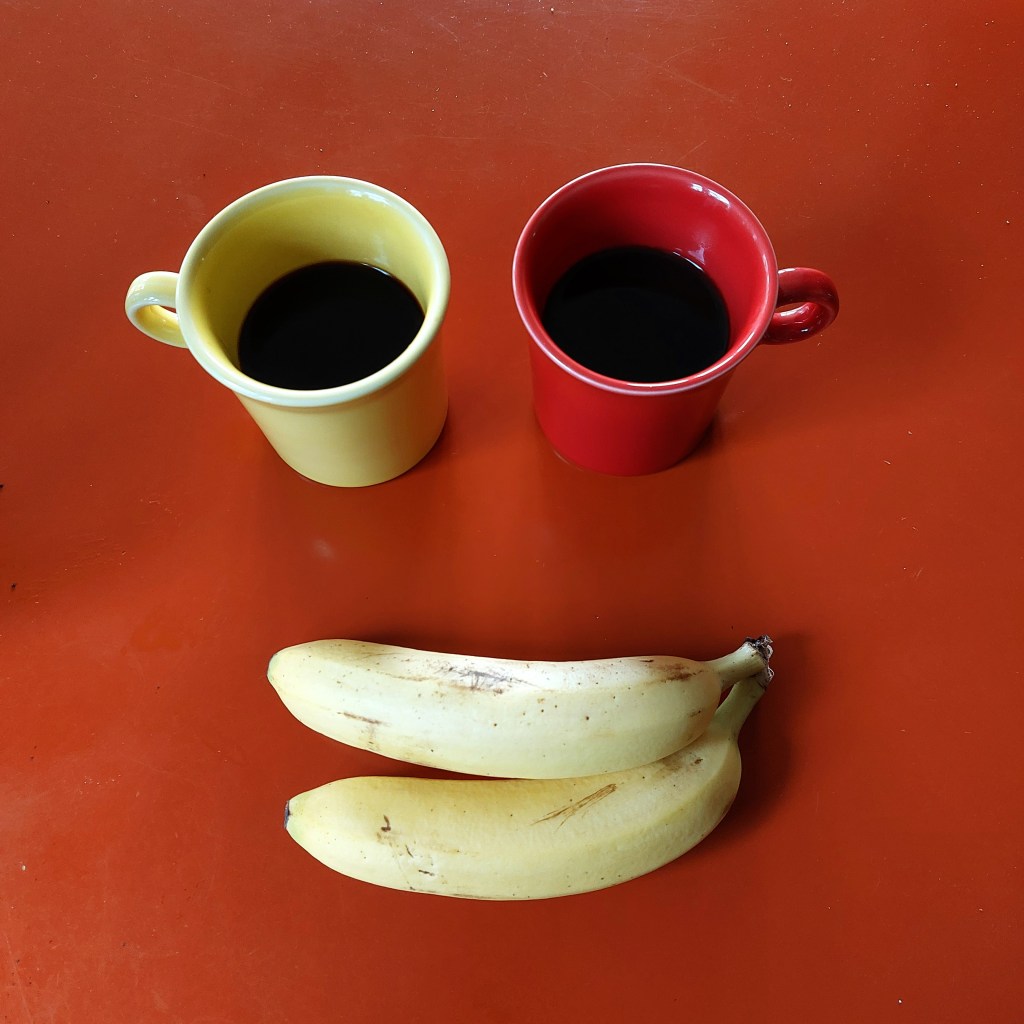
The duck taped banana, titled “Comedian,” is acoustic, unlike the “electrical banana” in Donovan’s 1966 song titled “Mellow Yellow.” We won’t go into the suggestive meaning behind the banana electric, but it is easily looked up. In any case, an electric neon lit banana might have fetched even more than the $6.2 MM, with a wire dangling down to an outlet, perhaps requiring one or two additional strips of tape to secure it to the wall.
No telling what Beckett might have thought of all the current brouhaha over the banana. But “Krapp’s Last Tape” does contain both banana and tapes, at last count at least three bananas, all eaten, the peels discarded on the stage.
To see or not to see, to knock to hear all the rot and rub, to touch and shock, stop here not there in such nonesuch.
Let’s stay in tonight then, you and I, blue light spread against the walls, and stream Seinfeld reruns.
Of Engelond, to wander wonder they wende, twas the 60’s and bell-bottoms they wore.
To define behavior is to limit freedom. Give me a clone.
Through the fence he watched the absurd land usurpers playing golf, and when one of them yelled Caddie, it set off a chain link reaction as he was bombarded with memory particles.
You are all a fond generation.
The overfed Buck came up to shave and ruck a go at Catsbody.
The day was blue the guitar green he tossed all he’d seen of words for notes.
What did Rimbaud mean by dérèglement of the senses? Trouble ahead, for one thing, as he intends to deregulate language:
“He does go on to speak of the unknown (l’inconnu), objective poetry’s aim, which can only be attained by the ‘systematic disordering of all the senses‘ (his italics)” (Sorrell, xvii).
And not just language, but in an iconic spirit of rebel without a cause, to untangle from his life predicament: family, school, country and war, literary ambition, expectations – but relatively quickly then even his newly chosen lifestyle, as he heads out for the territory, leaving any predicaments for others to unravel.
But in one meaning, his derangement of the senses is not difficult to understand, and gives the reader an assist to unusually difficult writing. Sorrell provides a few clues in his Introduction to the collected poems:
“In synaesthesia an effect normally received through one of the senses is experienced directly through another. Thus, in Baudelaire’s sonnet perfumes sound as soft as oboes” (XX).
But in my copy of Baudelaire’s “The Flowers of Evil,” Richard Wilbur translates the line in question, from the poem titled “Correspondences,” as follows:
“Perfumes there are as sweet as the oboe’s sound” (12)
The perfumes don’t make sound, literally, and don’t directly sound like oboes; perfumes smell sweet, and that sweetness is compared to the soft sound of an oboe. But can we smell sweetness? The perfumes are also
“Green as the prairies, fresh as a child’s caress”
Baudelaire’s poem relies on a poetic device, metaphor, nothing new there. We might say: The grapes were as plump as purple; or, my eyes drank a sour finish as I watched the falling leaves through a broken window; or, I heard summer leaving as the night filled my eyes with silence.
In Baudelaire’s poem, taste relies on smell, and smell doesn’t function as well if taste is lost. Without smell or taste, the brain tries to find some other way to experience the missing sensation. Victims of the Covid virus might understand this from the experience, the strangeness, of losing one sense but not the other. Metaphor becomes a compensation for something lost in translation.
And the Baudelaire poem points to McLuhan’s idea of a sensorium, any one sense not dominated by any of the others:
“Like dwindling echoes gathered far away Into a deep and thronging unison Huge as the night or as the light of day, All scents and sounds and colors meet as one.”
And what does McLuhan say? From Chapter 9, “The Written Word: An Eye for an Ear” in “Understanding Media”:
“Consciousness is regarded as the mark of a rational being, yet there is nothing lineal or sequential about the total field of awareness that exists in any moment of consciousness. Consciousness is not a verbal process” (87).
We might reread then, Rimbaud, and consider his idea of derangement, with McLuhan’s analysis of media in mind:
“The same separation of sight and sound and meaning that is peculiar to the phonetic alphabet also extends to its social and psychological effects. Literate man undergoes much separation of his imaginative, emotional, and sense life, as Rousseau (and later the Romantic poets and philosophers) proclaimed long ago (90).
It made sense then for Rimbaud to suggest the way to recover the imagination was to derange the senses.
“Today the mere mention of D. H. Lawrence will serve to recall the twentieth-century efforts made to by-pass literate man in order to recover human ‘wholeness.’ If Western literate man undergoes much dissociation of inner sensibility from his use of the alphabet, he also wins his personal freedom to dissociate himself from clan and family (McLuhan, 90).
But we hasten to remind that Rimbaud gave it all up as futile, poetry and his idea to derange language. Nevertheless, he might still sit at the head of a poet’s table (Ashbery’s, for example), even as he ended his own poetic meal with a sour finish.
“Language extends and amplifies man but it also divides his faculties. His collective consciousness or intuitive awareness is diminished by this technical extension of consciousness that is speech.
Bergson argues in Creative Evolution that even consciousness is an extension of man that dims the bliss of union in the collective unconscious. Speech acts to separate man from man, and mankind from the cosmic unconscious. As an extension or uttering (outering) of all our senses at once, language has always been held to be man’s richest art form, that which distinguishes him from the animal creation” (McLuhan, 83).
Metaphor allows for looking at one thing, an object, or some sensory effect, and seeing something different. That’s how much poetry works, anyway. And when we compare two disparate objects, we fancy we learn more about each. Still, one wonders at that “richest art form,” and whether or not it’s worth the trouble it creates (Rimbaud apparently thought not), and that’s the sour finish to this post.
Derangement of the Senses
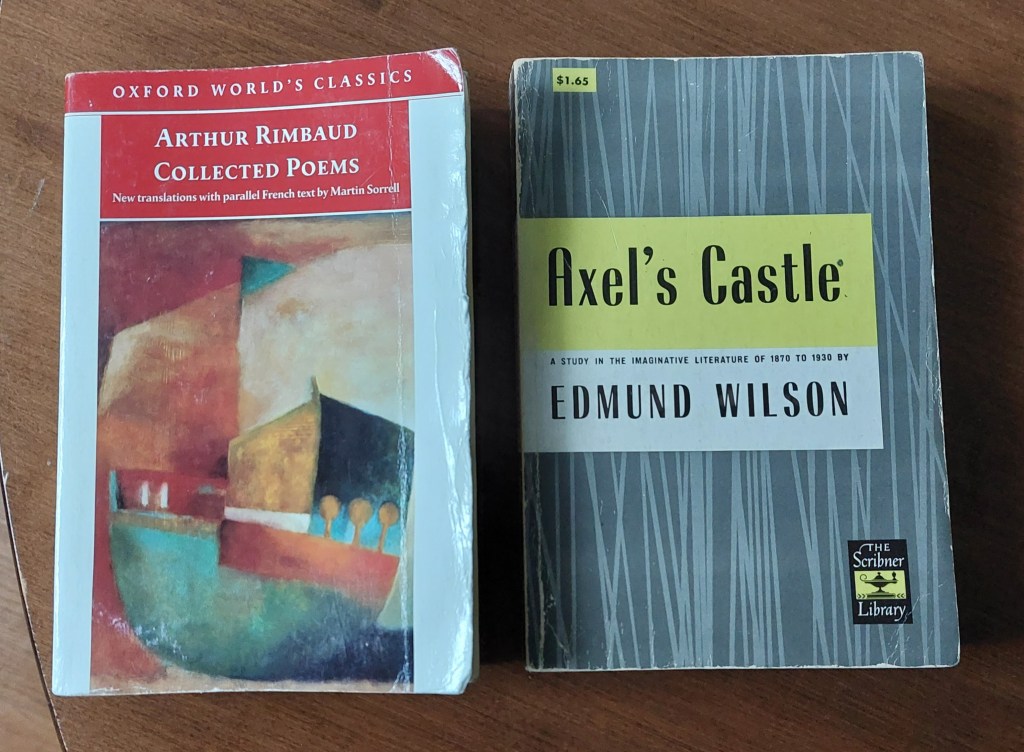
“Arthur Rimbaud: Collected Poems.” Translated with an Introduction and Notes by Martin Sorrell, Oxford University Press, 2001.
“Charles Baudelaire: “The Flowers of Evil.” Selected and edited by Marthiel and Jackson Mathews (1955, 1962) – Rev. ed., New Directions (NDP684) 1989.
“Understanding Media: The Extensions of Man.” Marshall McLuhan, 1964, McGraw-Hill.
It wasn’t enough for Rimbaud to disassociate himself from his society, which he found decadent, hypocritical, false – in a word, selfish. He would also derange his language and senses, and when he was finished, or abandoned, that writing life project, but which would survive to influence so many still working on literature, he moved on and rejected his and all other writing:
“When a friend asks him [Rimbaud] whether he is writing nowadays, he replies with annoyance and scorn: ‘I don’t do anything with that anymore’; and when, on the eve of his departure the next spring, he hears one of his friends congratulate another on having just bought some Lemerre editions – Lemerre had been the publisher of the Parnassians – he bursts out: ‘That’s a lot of money wasted. It’s absolutely idiotic to buy books – and especially books like that. You’ve got a ball between your shoulders that ought to take the place of books. When you put books on your shelves, the only thing they do is cover up the leprosies of the old walls’” (Wilson, 279).
For Edmund Wilson, the question of lighting out for the territory ahead of the rest meant reading and sitting down to his journal. (What might Wilson have done with a blog?) He quotes Yeats, from his “Vision”:
“It is possible that the ever increasing separation from the community as a whole of the cultivated classes, their increasing certainty, and that falling in two of the human mind which I have seen in certain works of art is preparation….It will be concrete in expression, establish itself by immediate experience, seek no general agreement, make little of God or any exterior unity, and it will call that good which a man can contemplate himself as doing always and no other doing at all….Men will no longer separate the idea of God from that of human genius, human productivity in all its forms” (291-292).
The problem then, for Wilson, is indeed what to do:
“Nor can we keep ourselves up very long at home by any of the current substitutes for Rimbaud’s solution – by occupying ourselves exclusively with prize-fighters or with thugs or by simply remaining drunk or making love all the time….The question begins to press us again as to whether it is possible to make a practical success of human society, and whether, if we continue to fail, a few masterpieces, however profound or noble, will be able to make life worth living even for the few people in a position to enjoy them” (293).
Quotes from “Axel’s Castle: A Study in the Imaginative Literature of 1870 to 1930,” by Edmund Wilson. Scribner Library, 1931, 1959.






 The Coming of the Toads