“In the tenth book of the Republic, when Plato has completed his final burning denunciation of Poetry, the false Siren, the imitator of things which themselves are shadows, the ally of all that is low and weak in the soul against that which is high and strong, who makes us feed the things we ought to starve and serve the things we ought to rule, he ends with a touch of compunction: ‘We will give her champions, not poets themselves but poet-lovers, an opportunity to make her defence in plain prose and show that she is not only sweet – as we well know – but also helpful to society and the life of man, and we will listen in a kindly spirit. For we shall be gainers, I take it, if this can be proved.’ Aristotle certainly knew the passage, and it looks as if his treatise on poetry was an answer to Plato’s challenge.”
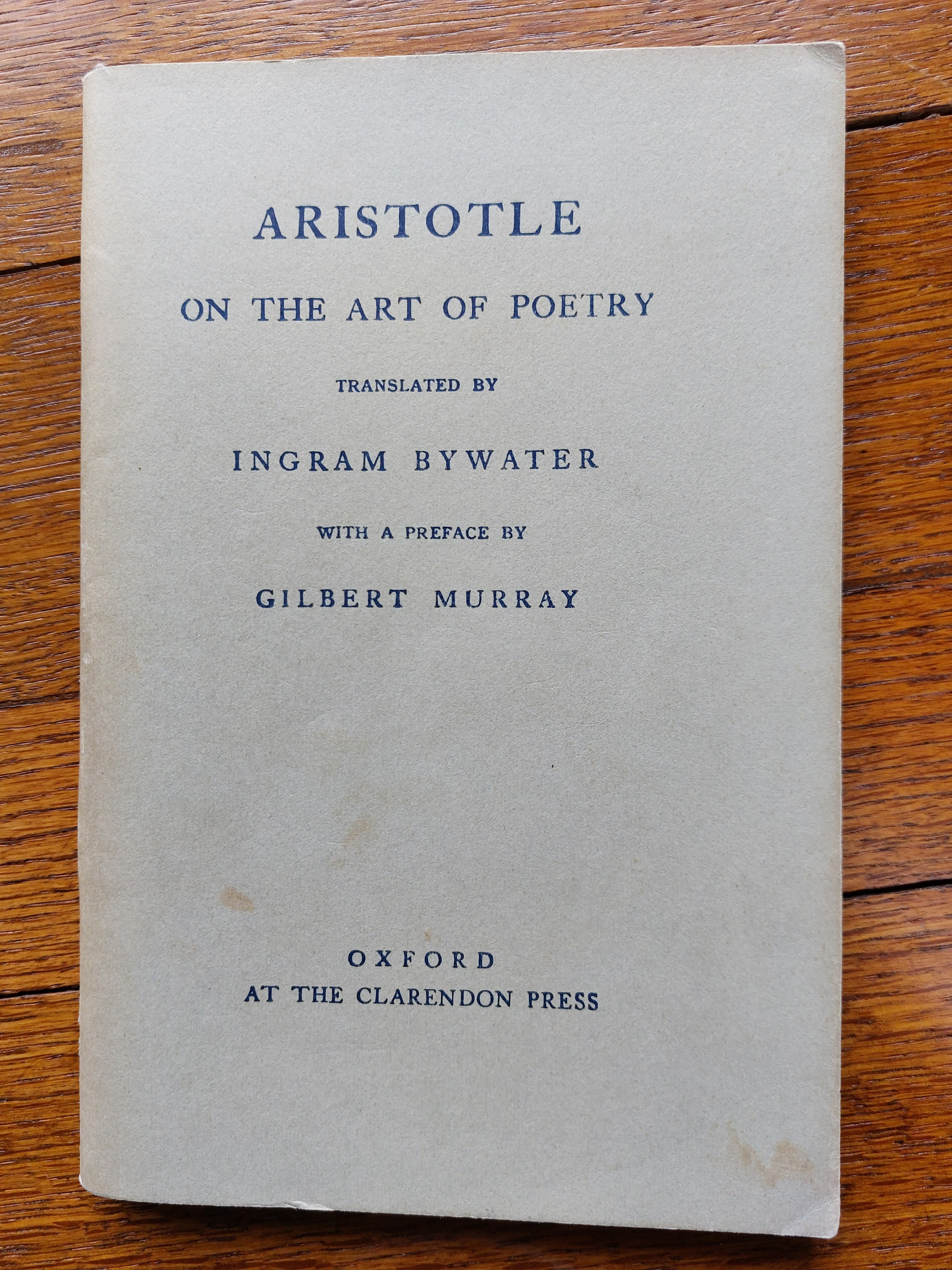
Aristotle: On The Art of Poetry (Translated by Ingram Bywater with a Preface by Gilbert Murray), Oxford, At the Clarendon Press. First Published 1920. My copy reprinted 1967 in Great Britain at the University Press, Oxford, by Vivian Ridler, Printer to the University. Oxford University Press, Ely House, London W . 1. 95 Pages. Light pencil marks by your student reader throughout, this little chapbook size paperback was used as a text at CSUDH, early 1970’s, Prof. Marvin Laser instructor. “Personal Library of…” emboss stamp on first page. The passage quoted above is from Murray’s Preface, page 1.
I’ve been experimenting with a book library app I recently found: Libib, a library management tool, used apparently by professionals and amateurs. (Any comments I make here on the app’s functionality refer to the Libib Basic, i.e. free, version). The app can be downloaded on mobile, tablet, and computer devices and they all sync. I first played around with such an app as volunteer assistant librarian at The Attic back around 2012. There we used Library Thing. Libib is cleaner, efficient, and quick. Books can be scanned via mobile device and barcode. Most of the books in my collection however predate barcodes and current ISBN formats, so must be manually input. If the book has been reprinted in some new edition, you can use that, but it won’t be the same book (edition, print, etc.) as the one in your library. Case in point, the Bywater translation of Aristotle’s “Poetry.” That problem could be workarounded by importing the newer version and then editing the information; alas, the app disallows editing of imported info. Nevertheless, I’m moving forward using the app, even though it means yet another project I’ll never complete.
No matter, what I’ve found is the app provides another purpose, that of perusing, browsing, not to mention dusting off, books that have not been touched let alone read in awhile. The app information can be downloaded into sortable files, should one have a need for such a tool. In any case, I’m currently happily stuck in Aristotle’s examination of poetics. Every page is like opening an oyster and finding a pearl. At random, this:
“The objections, then, of critics start with faults of five kinds: the allegation is always that something is either (1) impossible, (2) improbable, (3) corrupting, (4) contradictory, or (5) against technical correctness.”
92
Yes, I’ll take all five. It’s why we read.

 We try to imagine a world without cars. Given our experience, it’s difficult: our MOS was wheeled and track vehicle mechanic; we parked cars at the old LA International while working our way through college; we underwrote autos for a time. Our first car was a 1956 Chevy, purchased for $75 from our friend Gary leaving for Vietnam – he never returned. Our second car was a 1949 Ford pickup truck, called the “Peace Truck” for a small peace sign decal we put in the center of the rear window – we used the truck for surf trips. Then we went through a series of old Volkswagens, mostly bugs, but we did have a VW van for a time – it blew a rod one night on way home from a Jimmy Hendrix concert. We try to imagine Kerouac’s On the Road without cars: impossible.
 The Coming of the Toads