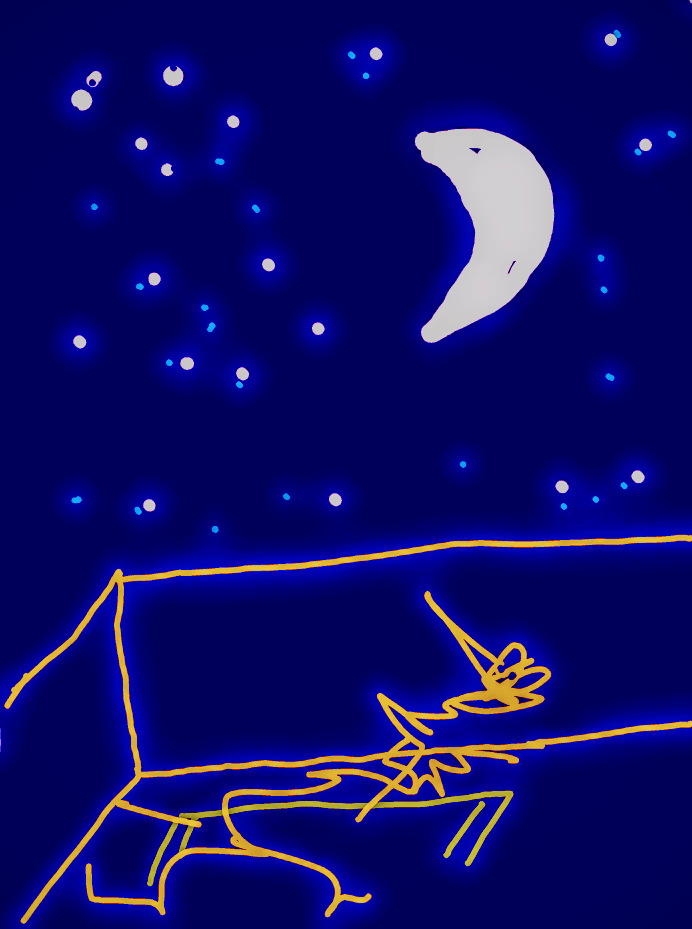
Florence showed me what she called the most famous of Chinese poems. She had made her own translation from a Chinese language newspaper clipping. The poem was accompanied by a cartoon-like drawing of a man lifting up from a cot, the moon in his face and eyes, the moonlight coming through an open window and shining on the cot and a bedroom floor. Florence explained the poem to me, and wanted me to help her work on her translation of the poem into English, and we enjoyed sharing language lessons. For some time after I left the school, I kept in touch with Florence, but it’s been many years now. I used to hear from her every Christmas; she would send me a long, handwritten letter in impeccable penmanship and flawless English grammar, and usage and sentence structure, and ask me to “correct” the writing for her.
I knew the Chinese poet, Li Po, who wrote the original poem. The poem has been variously translated to describe the speaker awake at night, or awakening, thinking, far from home, or perhaps far from the past, thus perhaps rethinking the past, or what we call remembering, or reflecting. The poem might suggest a bittersweet homesickness; a longing. Usually, in translations, there’s moonlight and frost, one mistaken for the other in the night, and a mountain and a moon, a confused awakening at night with thoughts of home. Just as the moonlight is mistaken for frost, the setting is mistaken for home. Or perhaps there is no mistake. The speaker awakes, and then drops back to sleep and dreams of home. Florence said that most Chinese of her generation would recognize the poem. She invited me over to her place. She wanted to present me with a few books. The books were old and travelled. One was titled Chinese Phrase Book, published by the War Department and dated “December 10, 1943.” Another was titled Chinese Military Dictionary, also published by the War Department and dated “26 May 1944.” They were military vocabulary manuals, small enough for a foot soldier to carry in a pocket. The word poem was not included in either one.
I first met Li Po in a Chinese literature in translation class at Cal State Dominguez Hills. One of our texts was the first Evergreen edition (1967) of the 1965 Grove Press Anthology of Chinese Literature: from early times to the fourteenth century, edited by Cyril Birch. I still have this book, but Li Po’s poem about the moonlight and frost and thoughts of home is not included. It is included in Robert Payne’s The White Pony: An Anthology of Chinese Poetry From the Earliest Times to the Present Day, Newly Translated (1947). The translation Payne includes of the Li Po poem is the only one I’m aware of that mentions a “couch,” and the speaker’s thoughts are of the “earth,” not explicitly of home. It’s possible to read that the speaker is sleeping outdoors.
Florence inspired me to begin writing a series of variations on the theme of Li Po’s poem. I called them “improvisations,” to give a more clear idea of the method of composition, and to suggest my interest in jazz and John Cage. I started the variations, or improvisations, after I left my full-time position at the school where I had met Florence for what the Chinese poet Han Shan called the “red dust” of business (see Gary Snyder, below). And during my red dust years, I worked the Li Po theme into over 100 variations, adding to and reworking the lot of them several times over the years. Florence was very interested at the time in my decision to leave teaching. More, she was concerned. She rode the bus over to my place to visit.
Business jobs often take would be poets on the road, on one-night- or long stays in motels, where the travelling businessperson might learn something new about night thoughts and remembrance.
I do not speak or read Chinese, but I remember a few of the insights Florence gave me into the character of Chinese writing. Poetry should be an everyday occurrence, not necessarily a scholarly effort or something for a classroom, but a habit of mind, like a simple melody one might hum to oneself while pulling weeds in the garden, or like random thoughts while drifting off to sleep, the kind that turn into dreams, where memory is mixed with the present, and ordinary happenings, like a blanket slipping off the bed, assume momentous images, like running up a beach to escape a giant wave.
This poetry as a habit of mind might resemble the kind of poetry the Chinese lived with when writing and reading poetry was commonplace. Poems were written, we learn from Gary Snyder’s translation of the Lu-ch’iu Yin preface to the poems of Han-shan, “…on bamboo, wood, stones and cliffs…on the walls of people’s houses.” Li Po is not included in either of Kenneth Rexroth’s One Hundred Poems from the Chinese books. Rexroth seems to have preferred Tu Fu. The Li Po poem Florence taught me is included in Arthur Cooper’s Penguin Li Po and Tu Fu (1973). I also have in my library the Seaton and Cryer Li Po and Tu Fu: Bright Moon, Perching Bird (1987), which includes the Li Po poem; Vikram Seth’s Three Chinese Poets (1992), which includes the poem under the name Li Bai, which may more closely approximate the Chinese pronunciation of Li Po’s name (and Seth’s is the only translation I’ve seen to use the word “hoarfrost”); and Eliot Weinberger’s The New Directions Anthology of Classical Chinese Poetry (2003), which includes two translations of the Li Po poem, one by David Hinton and one by Ezra Pound.
Florence used the newspaper drawing to help explain Li Po’s poem to me, but it seemed that she read the drawing in almost the same way that she read the poem written in Chinese that appeared in the newspaper next to the drawing. The drawing may have been a kind of prose paraphrase of the poem’s Chinese characters. How many poems do we know whose essence can be depicted in a drawing? In any case, Li Po’s poem is clear and concise enough that most of the translations vary from one another only slightly and with little contradiction. This is not true of, for example, the Tu Fu poem also about night thoughts. Rexroth gives us, “My poems have made me famous…”; Hinton, “…How will poems bring honor?”; and Seth, the seemingly contradictory, “Letters have brought no fame.” But if we had only the drawing depicting the Li Po poem, our interpretation would be limited, a different kind of reading experience.
Florence’s reading suggested blending image and cultural artifact. Still, the experience is limited by distance, by the exercise of translation, by the evolution of vocabulary, by forgetfulness, and by the confusion created from metaphor. There are two urging metaphors in Li Po’s poem. One likens moonlight with frost; the other compares a present setting with one absent or past. The relationship of the two metaphors was important to Florence’s reading. Fall term had just begun, and it was clear Florence was thinking of home in a variety of contexts. It was clear she had experienced Li Po’s poem.
How might today’s readers experience the Li Po poem in their own lives, rather than making a study of it as an example of Chinese literature? We might discuss the idea that informs the poem, perhaps an effective and efficient way to both experience and study poetry, as Kenneth Koch suggested in his book Rose, Where Did You Get That Red?, written from his experience teaching what he called “great” poetry to children in New York City schools. After getting the idea of the great poem, Koch’s students then wrote their own poem versions illustrating that idea. One idea that might be found in Li Po’s poem, of an awareness that comes to one in the present time of something experienced in the past, is surely a common occurrence, which might explain the popularity and longevity of Li Po’s poem. Another idea found in Li Po’s poem is the common experience of awakening and initially forgetting that we fell asleep not in our own bed. That we live in an age where many of us have neither the time nor the inclination to be reflective merely accentuates those times when, falling asleep away from home, we are awakened by the illumination of some foreign light, but in our sleepiness, we might easily confuse the light with some other light, or our current bed with some other bed.
My original poems that were variations and improvisations on Li Po’s poem were handwritten in a pocket size, blank book. I reached one hundred handwritten variations, and I started to type them up. I went to one hundred and one. One hundred and one seems excessive, but an excess I fancy Li Po would have approved. I’ve continued to make changes, mostly minor but some major, to date. But I have kept to the order of the original little notebook. The variations do not follow a literal chronology, for the memory knows no order, at least mine doesn’t. My strategy was to write in a way that would be accessible to the general reader, and while the variations are personal, most if not all of them should be as easy to reach as Li Po’s original poem. The Chinese poets were artists in drawing as well as in writing. I have had only to write; yet I hope drawings are suggested. I used the word theme because I like the idea that thesis states and theme explores, and I’m more interested in exploration than statement. And so the variations continue to explore the theme Li Po set up so long ago and that Florence gave to me, long ago, now, also.
But we live in the Late Irony Age now, and the age is collapsing upon itself, and our quiet night thoughts may begin to assume more bizarre variations in forms of remembering home. I now imagine a graphic novel, “Li Po’s Restless Night,” yet another variation. Two characters now occupy the little cot. One, lifting up in the moonlight, in the first panel, says: “Near my bed moonlight spreads silver paint across the bare fir floor. I fall back to sleep, far from the warm dunes of home.”
In the second panel, both characters are now awake, the moon throwing the bed in shadowed relief, the drawing stark, black and white contrasts: “If you had not fallen asleep so drunk, you would know the difference between moonlight on the floor and frost in the grass.”
Third panel: “I awoke with a clear mind, wind through water. This would not have happened were I in my own, sober bed. Listen, it’s the waves rising down in the cove. No! It’s the train rattling across the trestle. No, still, it’s the cold wind in the pine grove.”
Fourth panel: “Go back to sleep. It was your own stupid snoring that awoke you. Quit thinking of home. It’s all gone now.”
Fifth panel: “I’m getting up and going for a walk. It’s what Li Po would have done.”
Sixth panel: “You are not Li Po, nor do you know the first thing about Li Po. Get back into bed before you go out and slip on the ice and crack your stupid skull.”
Seventh panel: “That’s not nice, and that’s not ice! That’s moonlight on the parchment.”
It is early evening, and I hike up into the dunes above the beach that reminds me of yet another time long ago. The surf seen from the silence of the dunes curls over a few surfers still in the water in the evening glass off. What’s become of my brothers and sisters? The house is empty without them. With a flop swish, the blue waves fall below the silence of the dunes. In the back yard, a lost moon throws figures into shadows. Two figures are playing a chess game. A Ping-Pong ball clips and clops back and forth across a net. A plastic ball shuffles high up into a tree. And what of my father, cactus, and my mother, twisted cypress shadow, alone on a hill in California, the sun falling now before them? These images appear and reappear throughout the variations. Drinking beer in the golden air behind the tavern, near the dry creek bed, an old couple sits talking, in the shade of a blossoming plum tree.
Eighth panel: “Why a moon, anyway? And why just one?” Why not two, as I lie awake thinking of Li Po and Tu Fu, of Florence, Son House, and misconstrue.
~ ~ ~
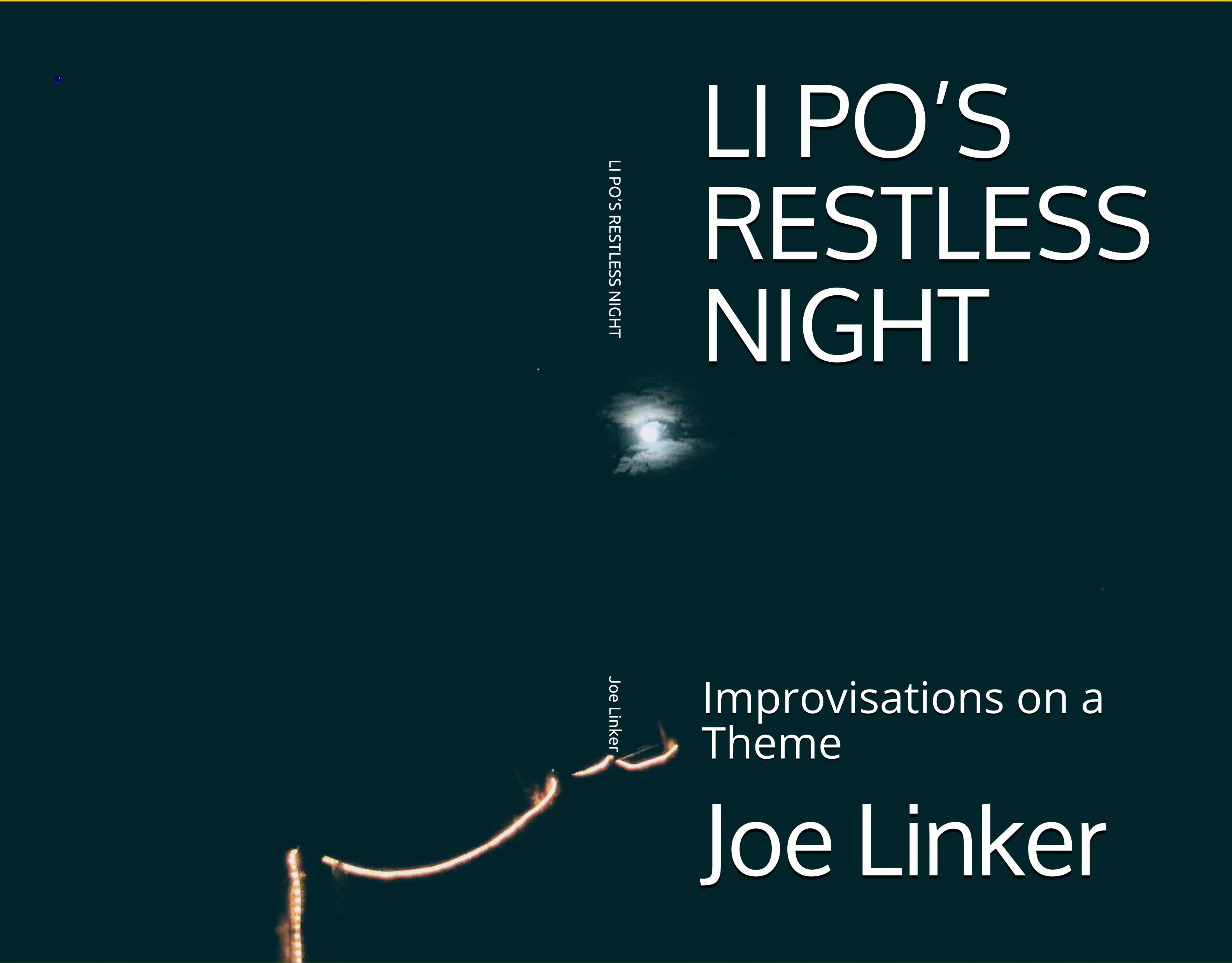
Note: First published at Berfrois on September 29, 2015, "Li Po's Restless Night" was expanded and published in small book format (115 pages) on December 16, 2020: available in ebook or paperback format.


 The Coming of the Toads