This is the fourth blog post in a row about playing the guitar, inspired by one of my sisters, who has asked me for some ideas to further her own playing. The guitar is a folk instrument, by which we mean knowledge of the instrument and techniques for playing it are passed along to others usually orally and informally. When the great guitarist Julian Bream attended the Royal College of Music in the late 1940s, the guitar was not admitted, being considered, well, a folk instrument, and not suitable for classical music study. Bream did much throughout his career to change the reputational plight of the guitar in the conservatoire, as did Segovia. Frederick Noad in the 1960s was another guitar teacher who did much to popularize methods for formal study without losing the folk flavors.
By method, we mean an incremental or developmental approach to learning that follows a purposeful outline. But most people pick up a guitar and learn a riff or two, a chord or three, and try to imitate what they’ve heard on some recording. If they chance to perform, in the living room or garage, the problem of sounding like that recording is overwhelming. If someone requests, for example, “Stairway to Heaven,” you might be able to pull off the first part on your used acoustic Silvertone, but you’ll soon realize you need either to make the song your own or invest in a mountain of electronic and drum equipment to attempt a sound like what folks hear on the radio and would have you replicate in your garage or bedroom.
The guitar for some time now has had the reputation of being the easiest of instruments to play poorly and the most difficult of instruments to play well (a perspective attributed to Segovia). Having not attempted the oboe or French horn, bagpipes or pipe organ, kazoo or spoons, we’re not sure, but about the guitar we know enough to say it’s easy to get to a certain point of technical frustration. When that happens, it’s often useful to, as Thoreau said, “Simplify, simplify, simplify.” Then again, Thoreau didn’t play the guitar. He played the flute.
One way to simplify guitar is to play a melody. Keeping within the C scale of notes will also keep things simple (no sharps or flats). Take, for example, the opening notes to the song “Over the Rainbow.” Position your hand over frets 5 through 8, and play the melody from C (3rd string, 5th fret) to C an octave up (1st string, 8th fret). The next note you’ll find one fret down, a B (1st string, 7th fret). Then a G (2nd string, 8th fret). Then A (1st string, 5th fret), B (1st string, 7th fret), and C again (1st string, 8th fret). See if you can figure out the rest of the melody. You’ll be learning to play the guitar.
What is sound? Tinnitus, from the Latin for ring or tinkle, we hear in our ears, but its source is not external sound. My own tinnitus is louder in my left ear, and if I try to pay attention to it, there are at least two sounds audible, as if an electronic musical duo is playing in my head. The ringing is enveloped under an umbrella of an engine or fan, or the electric rush of a motor, an incessant susurrus, which is balanced between the ears. The quieter my environment, the louder the tinnitus. Tinnitus is noise that is not sound, and it is a common ailment for those with hearing loss.
My hearing loss, in both ears, worse in the left, probably originating from operating the motor pool compressor truck with jackhammers and other pneumatic tools and from firing weapons without adequate ear protection during my Army days and probably made worse playing music too loud over the years, is now augmented through hearing aids. The current pair are state of the art and include Bluetooth capability, which means I can stream an electronic sound source (radio, TV, computer, phone) directly into the hearing aids. But the sound is not quite natural. I hear it in my head, not in the ears, and not precisely where the tinnitus sounds, but when streaming, the tinnitus seems to turn off. It’s a bit like wearing headphones. It can be somewhat disconcerting.
Often, when I think of sound sans sense, I think of John Cage. Cage was a musician and writer. Piano was his instrument, but he became involved in electronic sound and electronic music – experimental music. Cage’s music might sound like tinnitus to some listeners. But any instrument can grate or creak or be made to scream or moan or laugh or guffaw. Some of the early film cartoons used modern music innovations and techniques. “Modern” music is often characterized as atonal or dissonant, and as technology developed as electronically enhanced. An evocation of emotional turmoil. Turbulence and tohubohu is often the sound it conveys, or that I hear, which of course are two different things. In any case, what I’m still calling modern here is actually now quiet old.
What are the differences between noise and music? What is the relationship between sound and hearing? We might spend a few big bucks on music sound reproducing equipment (stereo, speakers, etc.) for home or car. The louder, it seems, the better. But when heard live at a concert, the sound may seem radically altered. And the listener in a front row seat hears a different concert than the listener in the back row, upper level, even if they’re in the same hall at the same time for the same music. In music and in conversation clarity is probably the most important attribute to one hard on hearing. It’s not that I can’t hear, but often that I don’t hear clearly. Increasing volume doesn’t necessarily add clarity. It just adds noise. Cage might say, what difference does it make? Listen to what you hear and disregard the rest. And music is not words.
“Music as discourse (jazz) doesn’t work,” Cage said. “If you’re going to have a discussion, have it and use words. (Dialogue is another matter.)”
John Cage, A Year From Monday, Wesleyan, 1969, page 12, from Cage’s ongoing “Diary: How to Improve the World (You will only Make Matters Worse)” 1965, which was taken from the magazine Joglars (Vol. 1, No. 3, 1966), where it was presented as: “a mosaic of ideas, statements, words, and stories. It is also a diary.”
What did Cage mean by distinguishing dialogue from discourse? Dialogue is conversation, conversational. Discourse is debate, to run away from. Dialogue is theater. Discourse is lecture. Discussion is an investigation. We are using words; no help, no matter how loud.
Some sounds are empty. What does that sound like? Jazz guitarists speak of getting a hollow sound or tone. One of the John Cage books is titled “Empty Words” (Wesleyan, 1981). “Most of the material in this volume has previously appeared elsewhere,” the listener is told. Where? Sound is ubiquitous, everywhere:
“Wherever we are, what we hear is mostly noise. When we ignore it, it disturbs us. When we listen to it, we find it fascinating. The sound of a truck at fifty miles per hour. Static between the stations. Rain. We want to capture and control these sounds, to use them not as sound effects but as musical instruments.”
“The Future of Music: Credo,” from Silence, John Cage, p. 3, Wesleyan 1961, 1973.
Capture this, from the opening section to Thomas Pynchon’s novel Gravity’s Rainbow (Viking, 1973):
“A screaming comes across the sky…He won’t hear the thing come in. It travels faster than the speed of sound. The first news you get of it is the blast. Then, if you’re still around, you hear the sound of it coming in.”
page 3, then 7
The reader is in London where the German V2 rockets, travelling faster than the speed of sound, hit the ground and explode before anyone hears them coming. Before Pynchon’s novel begins, then, an explosion has occurred. Or not, maybe one lands a dud.
In Coleridge’s poem “The Eolian Harp” (1795), the instrument sits on an open window ledge, where an incoming breeze stirs over the strings, making music. How improvised is that! One would need super sensitive ears to pick up such wispy sounds.
…the world so hush’d! The stilly murmur of the distant Sea Tells us of silence.
…Where the breeze warbles, and the mute still air Is Music slumbering on her instrument.
The wind as guitar pick.
I’ve been playing Gypsy-Jazz guitar lately, by which is usually understood playing in the style created or formalized by Django Reinhardt and his peers and followers. The style is characterized by the use of a different kind of guitar from the classical guitar popularized by guitarists like Andrea Segovia and Julian Bream. They played on a 12 fret neck fitted with catgut and then nylon strings in the treble and silk then nylon wound with metal in the bass. Other differences might include a shorter but wider neck, a smaller box, different woods and internal bracing techniques. Different from what? Basically from the all metal, louder string guitars developed later – what has come to be known as the western or folk guitar, and is used in blues, bluegrass, folk, country. But the Gypsy-Jazz guitar is a different instrument still.
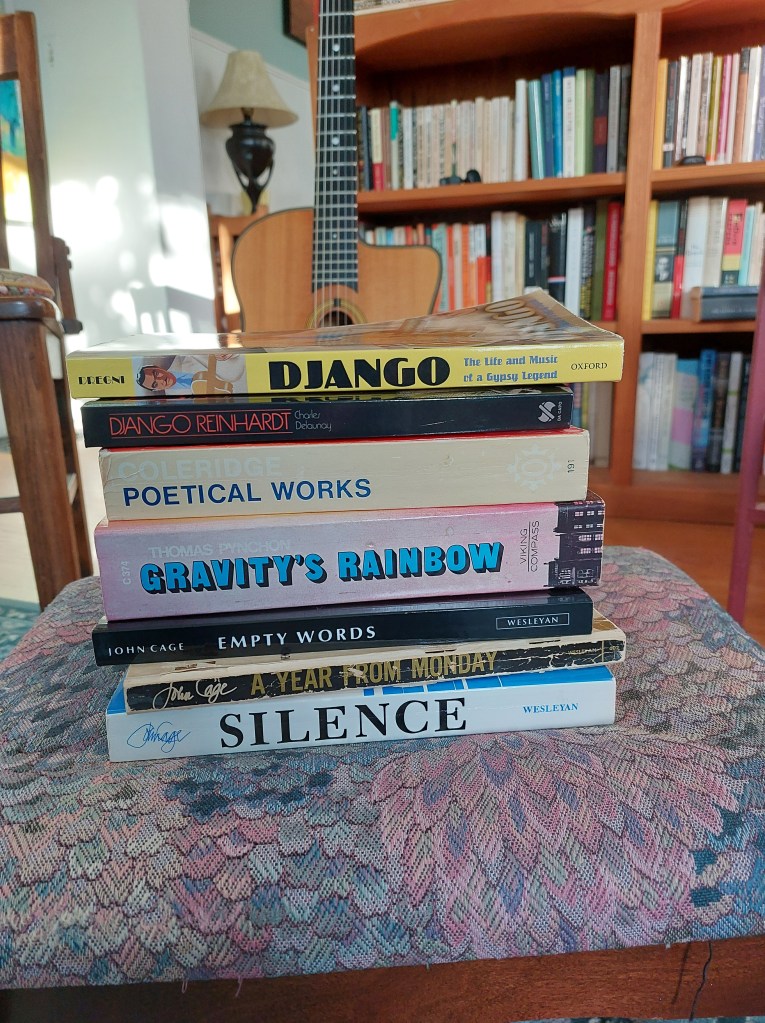
The Gypsy-Jazz (also “jazz manouche”) guitar is louder, played with a guitar pick rather than the fingers with fingernails, has a longer neck, so a longer scale length, and all metal strings. Most importantly, it’s not a solo instrument. It’s designed to be played in a small combo, usually consisting of at minimum two guitars, and often with stand up acoustic bass, violin, clarinet, accordion, and vocalist. Django played in noisy dance clubs before the advent of amplifiers and electric guitars. He needed an acoustic guitar that would project over the racket and clatter and sound in sync with the other instruments. Readers interested in learning more about Django and his music might read Django Reinhardt, by Charles Delaunay, 1961, Da Capo Press, and Django: The Life and Music of a Gypsy Legend, by Michael Dregni, Oxford, 2004. Briefly, it’s told that Django, born in poverty and coming of age without any kind of formal education, learned to play violin, banjo, banjo-guitar, and guitar. By the time he was 18, he was playing in bands in Paris and making money. Then he burnt his left hand badly in a fire in the caravan. Recovering, he taught himself to play the guitar anew, using mainly just two fingers from his left hand to fret the notes and chords, developing an entirely new technique. Thus began a new style of playing guitar that has influenced just about every guitarist of all genres since and still begs to be mastered even by those with all their fingers playable.
When asked if he admired Django Reinhardt, Julian Bream said:
“Oh sure. And I played plectrum guitar up to the age of 21, I played frequently in a dance band in the Army. And, yes, I loved playing jazz guitar, but not as a profession, just for fun. You can’t mix the two. I can remember playing steel-string guitar for dances, and it just ruined the sensitivity of your left hand. And I was playing rhythm guitar with big six-string chords all night long. It was a knucklebender!”
“50 Years on the Planks: Julian Bream Talks About His Life and Work,” Classical Guitar October 1996. Retrieved 4 Mar 24.
I’ve been working to play Gypsy-Jazz style without a plectrum (guitar pick), so fingerstyle, with fingers and fingernails, which some say is not only unorthodox but impossible – to play in the Gypsy-Jazz style of Django. I use a thick gauge string on a Saga Gitane DG-250M model, which I purchased used not long before the pandemic broke out and then had to quit the group workshops I’d been attending. The thicker strings compensate for the lack of pick. I’ve just always played with my fingers, hardly ever flatpicking. And I’m not playing dance halls these days, more like a lute in an open window.
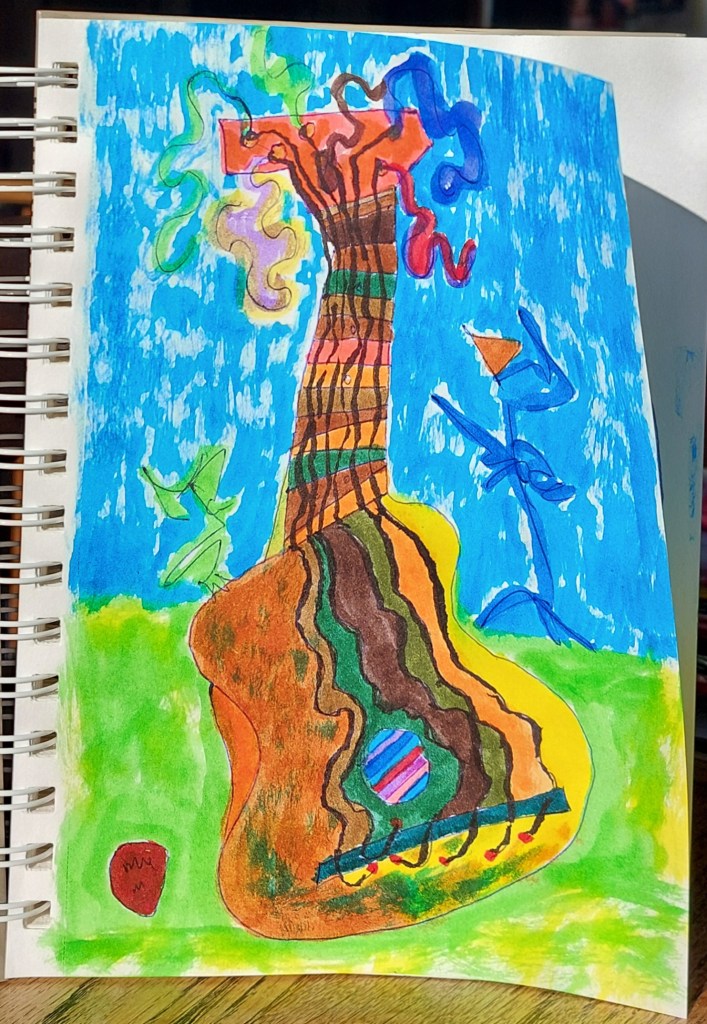
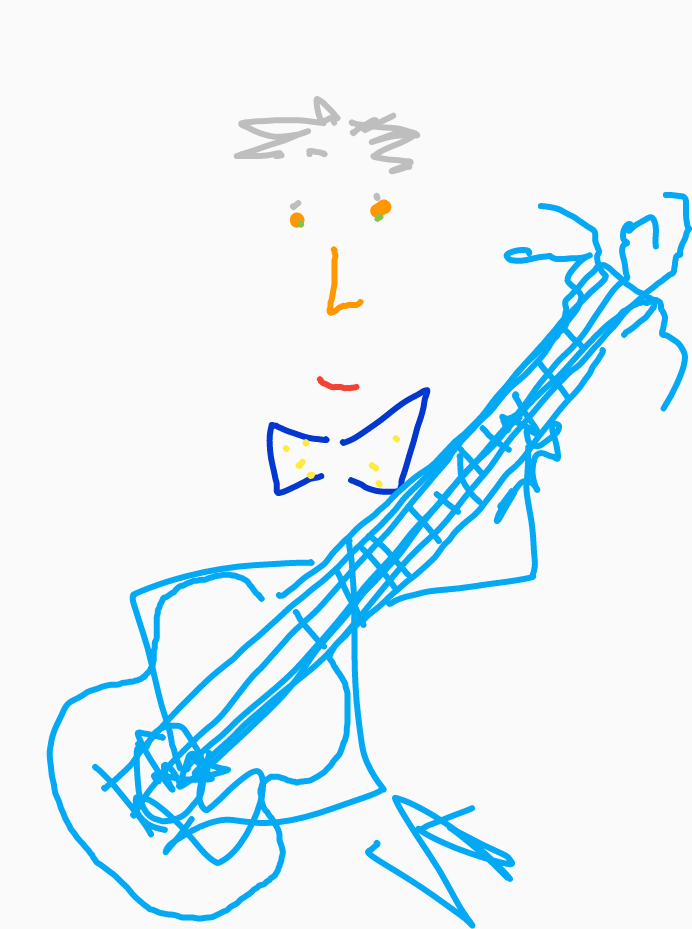
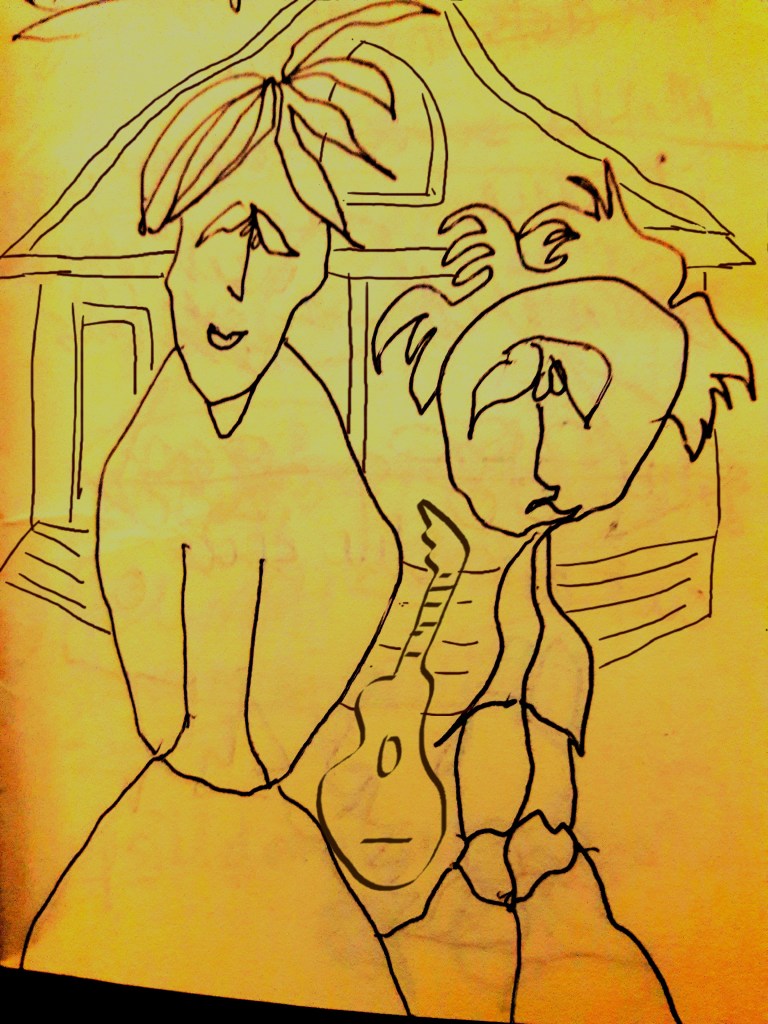
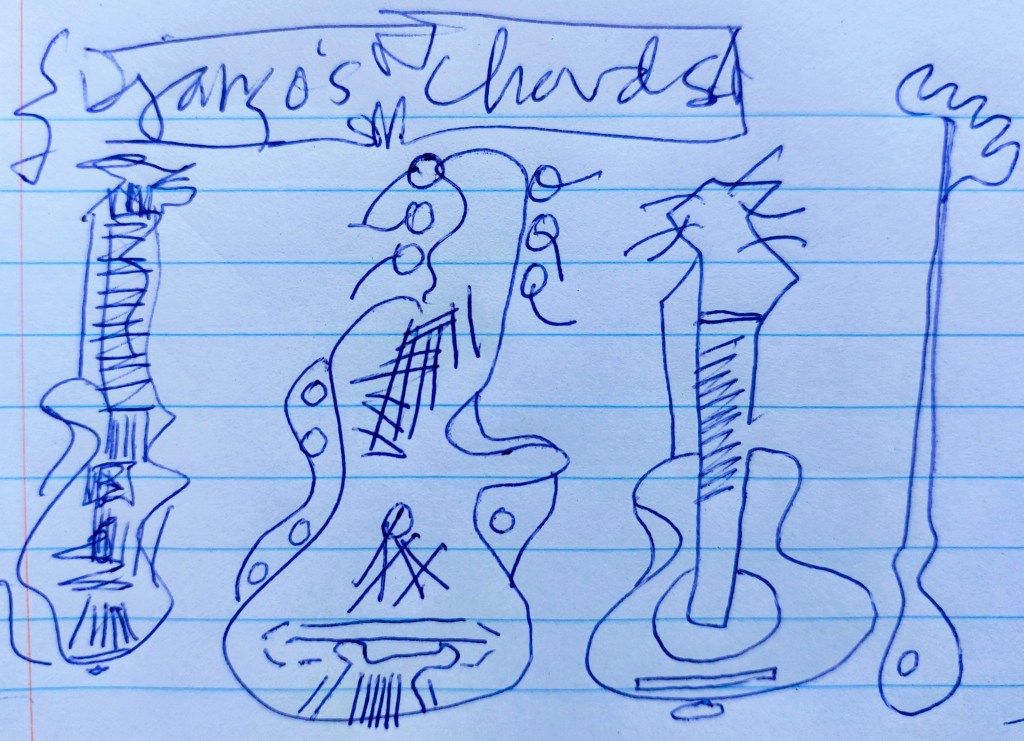
Gitane DG-250MConcert ReadyAmerican GothicDjango’s ChordsGuitar LandBooks referenced in this post.
I recently subscribed to the YouTube Music streaming app, and have been making playlists. There are now many music apps to choose from. I was using Tidal and before that Spotify. To the neophyte, they’re all pretty much the same, click and listen. But for messing around, collecting music, forming playlists, using the app as a reference and research tool, YouTube Music seems to be working well, with one major caveat: lack of performer credits and original recording info easily obtainable while listening – but in that regard, neither Spotify nor Tidal were much better (Prime Music has some info, but lacks detail amid glitzy formatting, while YouTube Music has imported some Wiki discussion). The YouTube Music library is huge, and the search engine responds intuitively, bringing up at least as often as not what I’m looking for, and when not, the discoveries are a pleasure.
I created a YouTube channel to post my playlists. The playlists I’m making are referenced to songs pulled from my music book collection: songs and pieces from readings from books on music, with a special emphasis on guitar.
The first two playlists I made contain pieces adapted from Jerry Silverman instruction manuals, books I’ve managed to keep around me over the years: The Folksinger’s Guitar Guide: An Instruction Manual by Jerry Silverman, Based on the Folkways Record by Pete Seeger (an Oak Publication, New York, 1962), and The Art of the Folk-Blues Guitar: An Instruction Manual by Jerry Silverman (Oak Publications, New York, 1964, Library of Congress # 64-18168). These two books are similar in format, the old black and white pictures alone worth the price of admission, and include notes, tablature, chord diagrams, lyrics, musical analysis, and historical discussion.
In his introduction to his Folk-Blues guitar book, Silverman outlines his predicament at the time: “… there is more information on blues in general in the New York Public Library, for example, in German and French than there is in English!” (11). And Silverman goes on to describe the problem, how, for example, working on his 1955 New York University Master’s Thesis on blues guitar, and his book “Folk Blues” that followed, discussion was limited to piano arrangements, since it was thought that “bona fide guitar arrangements would limit the book’s general usefullness.” This should come as no surprise – Julian Bream, the classical guitarist, when studying music at the Royal College of Music, in the early 1950’s, was told to leave his guitar at home, literally. The school had no guitar classes, no guitar program; the guitar was not considered a viable, virtuous instrument. There was no academically established canon of guitar music available for study or performance. This prejudice against the instrument, in spite of its obvious public popularity, was no doubt also pervasive and included in the States in attitudes opposed to black music, initially of rock and roll music, and of folk music in general, though what is now called the American folk music revival, lasting from the 30’s to the 60’s, did much to mainstream the popularity of the guitar and of blues and folk music.
Silverman also describes his purpose as follows: “Naturally, some basis of what to listen and watch for and whom to imitate must be laid. Throwing the fledgling bluesnik into the turbulent waters of Bluesville without the necessary basic information and technique would render a distinct disservice to the general cause – not to mention the specific aspirant” (11). Of course whole rivers of water have passed under cities of bridges since Silverman’s early 1960’s comments. But the following statement explains something that has not changed: “To get to know how things really are done you must actually observe the player in action. Since there are so many individual styles one never stops learning if one can get to see as well as hear as many guitarists as possible” (Folksinger’s Guitar Guide, p. 5).
The academic bias against the folk guitar may have been somewhat justified considering Woody Guthrie’s description of his method (quoted by Silverman in Folksinger’s Guitar Guide, p. 6): “Leadbelly learnt to play the guitar the same way I did, by ‘ear’, by ‘touch’ by ‘feel’, by ‘bluff’, by ‘guessin”, by ‘fakin’ and by a great crave and drive to keep on playing.”
Well, these were real folks, with real blues. Hearing the lyrics, the stories, of these old tunes one may be surprised to learn or be reminded of how real and how blue. In creating my playlists, I want to stay true to original material but also to benefit from new styles and covers of these old songs.
Give them a listen:
Songlist adapted from Jerry Silverman’s The Art of the Folk-Blues Guitar, 1964
Songlist adapted from Jerry Silverman’s The Folksinger’s Guitar Guide, 1962

 The Coming of the Toads