A few mornings ago, I walked into the kitchen, set about making coffee, and noticed a line of tiny ants climbing up and down a corner edge, starting from a small gap behind a molding where the wall meets the floor, and when the ants reached the countertop, they went meandering to and fro, around the toaster and coffee maker and compost bucket. And two nights ago, out walking, we came across a nest of what appeared to be the same ant species emerging from a crack in the sidewalk, a line of scouts working their way into a neighboring yard. And early yesterday, the weather still clement, in spite of thunderstorms and tornadoes forecasted for the later afternoon hours, I had taken a morning break with my coffee outside in the fine Spring morning, and when I swung the door open to come back in, a fly the size of Rodan nearly knocked me over as she flew into the house and proceeded to spin around and around near the ceilings, cavorting from room to room.
Spring begins with a pile of chores, and one recalls T. S. Eliot’s seemingly anti-intuitive start to his disillusionist poem titled “The Waste Land”:
“April is the cruellest month, breeding
Lilacs out of the dead land, mixing
Memory and desire, stirring
Dull roots with spring rain.”
Not to mention the appearance of ants awaking from their winter diapause.
“Winter kept us warm, covering
Earth in forgetful snow, feeding
A little life with dried tubers.”
Soon April, and signs of spring are breeding and mixing in the kitchen and in the air, inside and out. Across the grass, dandelions are sprouting and even flowering already, and the turf at the edge of the sidewalk needs edging. The list goes on, but never mind – I discovered this week Ruth Stout, whose practice of gardening is summed up in the titles to her mid-century books, notably: “Gardening Without Work: For the Aging, the Busy & the Indolent” (1963); and “The Ruth Stout No-Work Garden Book: Secrets of the year-round mulch method” (1971); and her first, “How to have a Green Thumb without an Aching Back: A New Method of Mulch Gardening” (1955).
It was in a New Yorker article of March 17 that I discovered Ruth Stout, sister, as I learned, of the famous detective fiction writer Rex Stout, best known for his protagonist Nero Wolfe. The subtitle to Jill Lepore’s article tells all: “Ruth Stout didn’t plow, dig, water, or weed.” Suddenly, Spring seemed a happier time than how T. S. Eliot described it.
Still, I had ants in the kitchen to deal with, for I learned to my dismay they had nested inside the coffee maker. I surrounded the coffee maker with a moat of vinegar, and when the ants appeared between the moat and the coffee maker, I knew they had to be coming from within the coffee maker, where they must have set up a new nest. Never one to rush for the can of spray that “kills bugs dead” (ad line attributed to Beat poet Lew Welch, by the way), after a bit of research, I decided to try Dr. Bronner’s peppermint soap, having read that ants don’t like peppermint oil. The soap certainly stops ants on contact, and it seems to slow new scouts from returning to the scene.
Meantime, our kitchen counter is cleaner than ever before. I had to retire the electronic coffee maker. I read ants like water and warmth (who doesn’t?), and they can also detect electric currents, including vibes from computers and cell phones and such – so we won’t be able to charge our devices on the kitchen counter anymore, for fear of ants. Imagine ants in your Chromebook, crawling in and out of the keyboard. And we’ve returned to a French press coffee maker, and while it takes a bit longer with more steps to brew, the coffee is robust. And immediately employing the Ruth Stout method, the yard work is quickly done, leaving more time for writing pieces, well, like this one.
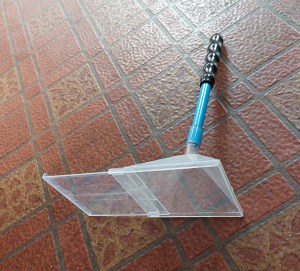
But what of the fly the size of Rodan, the deep reader will be wondering? Advocating a catch and release policy toward all living but unwelcome things, I grabbed the fly catcher and went dancing around the house with the fly. I trapped it in the bathroom, where it had landed on the window screen. To catch a fly with the fly catcher, you have to wait until it lands, approach quickly but stealthily, cover it with the catch door open, then slide the catch door closed with the fly inside the trap. Might sound easy, but it’s often a cat and mouse game as the fly inevitably flickers away at the last second. After several attempts banging around the small bathroom, I caught the fly, then released it into Spring and all wilderness where all Earth life mingles half awake and half asleep.
 The Coming of the Toads