Tag: Jerzy Kosinski

  • A Personal Library Time Machine

    Pausing then to pull a few old paperbacks off the shelf and peruse the notes and underlining (I rarely write in books anymore, but some of the old ones are full of notes – a reading method), and here are a couple more from high school days with passages I somehow thought noteworthy of underlining or circling whole paragraphs.

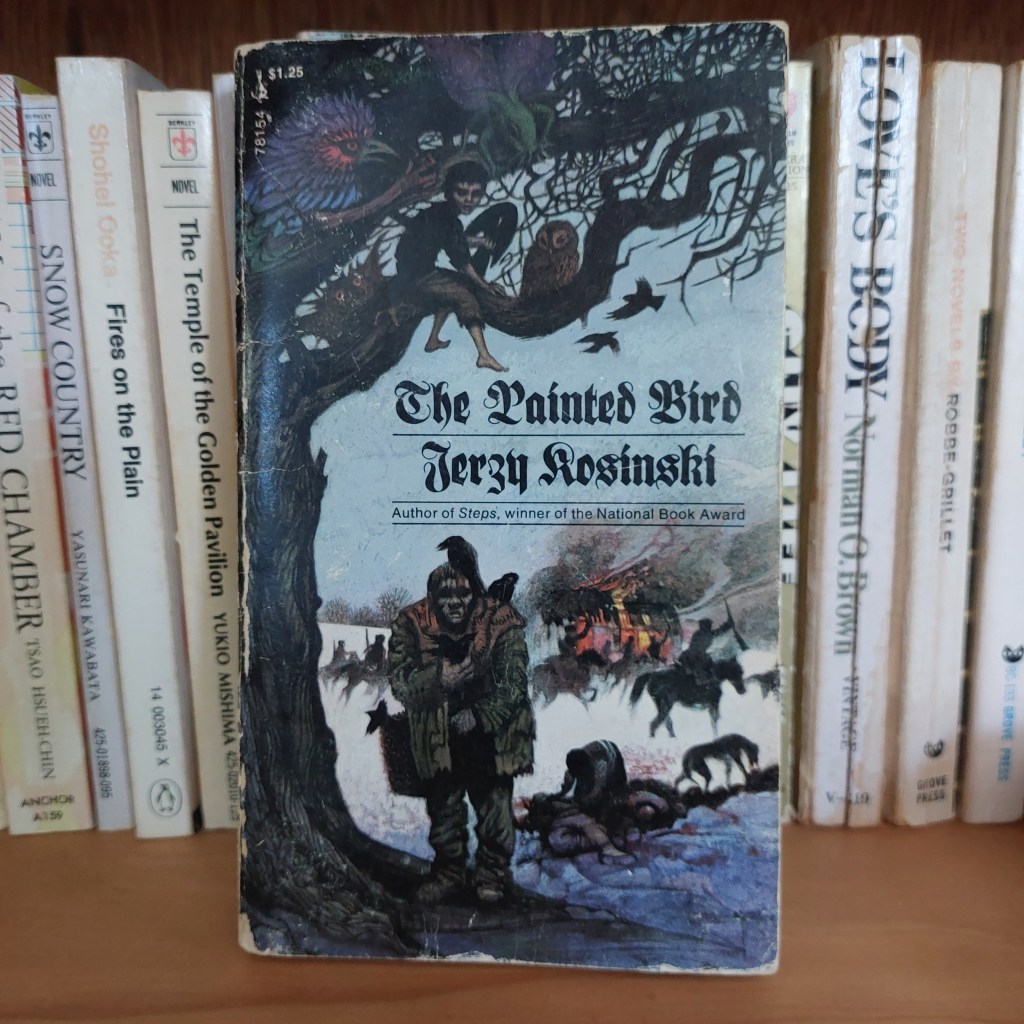
    In my novel “Penina’s Letters,” Henry Killknot finds Salty reading Jerzy Kosinski’s “The Painted Bird, and tells him he should be reading “Mr. Blue” instead:

    “Have you ever heard of a little book titled ‘Mr. Blue’ by Myles Connolly?”

    “Yes, we read it last year in Mr. Ford’s English class.”

    “Well, you should read it again. Read it once a year. That’s how you treat classics. Read them once a year. You should not be reading this crap Kosinski spews out.”

    “Have you read ‘The Painted Bird’?” I asked.

    “No,” he said. “I’ve been re-reading ‘Mr. Blue.’ You should consider falling in love with Our Lady, as Blue did, devoting your life to a worthy cause. This Kosinski fellow is a hack.” (93)

    I was in the 10th grade at Saint Bernard in Playa del Rey. I was getting to know the kid in front of me, whose background and home life was radically different from mine. He was reading a paperback, clandestinely, keeping it close in as he leaned over his desk. Curious, I asked him what he was reading. He ended up lending me the book, “The Painted Bird,” by Jerzy Kosinski, telling me as he passed it back under my desktop: “If you get caught with it, don’t tell where you got it.”

    “Suddenly I realized that something had happened to my voice. I tried to cry out, but my tongue flapped helplessly in my open mouth. I had no voice. I was terrified and, covered with cold sweat, I refused to believe that this was possible and tried to convince myself that my voice would come back. I waited a few moments and tried again. Nothing happened. The silence of the forest was broken only by the buzzing of the flies around me.” (“The Painted Bird” p. 125).1

    We were talking, Susan and my sisters and me, about why keep books, the old musty paperbacks with crackling old pages and covering old themes. Every out of print book adds value to a library. In 1996, folks in San Francisco did not think that: “The S.F.P.L. is now essentially broke, and relies on corporate benefactors. It has sent more than two hundred thousand books to landfills – many of them old, hard to find, out of print, and valuable.” (“The Author VS. The Library,” The New Yorker, by Nicholson Baker, October 14, 1996, p. 50).

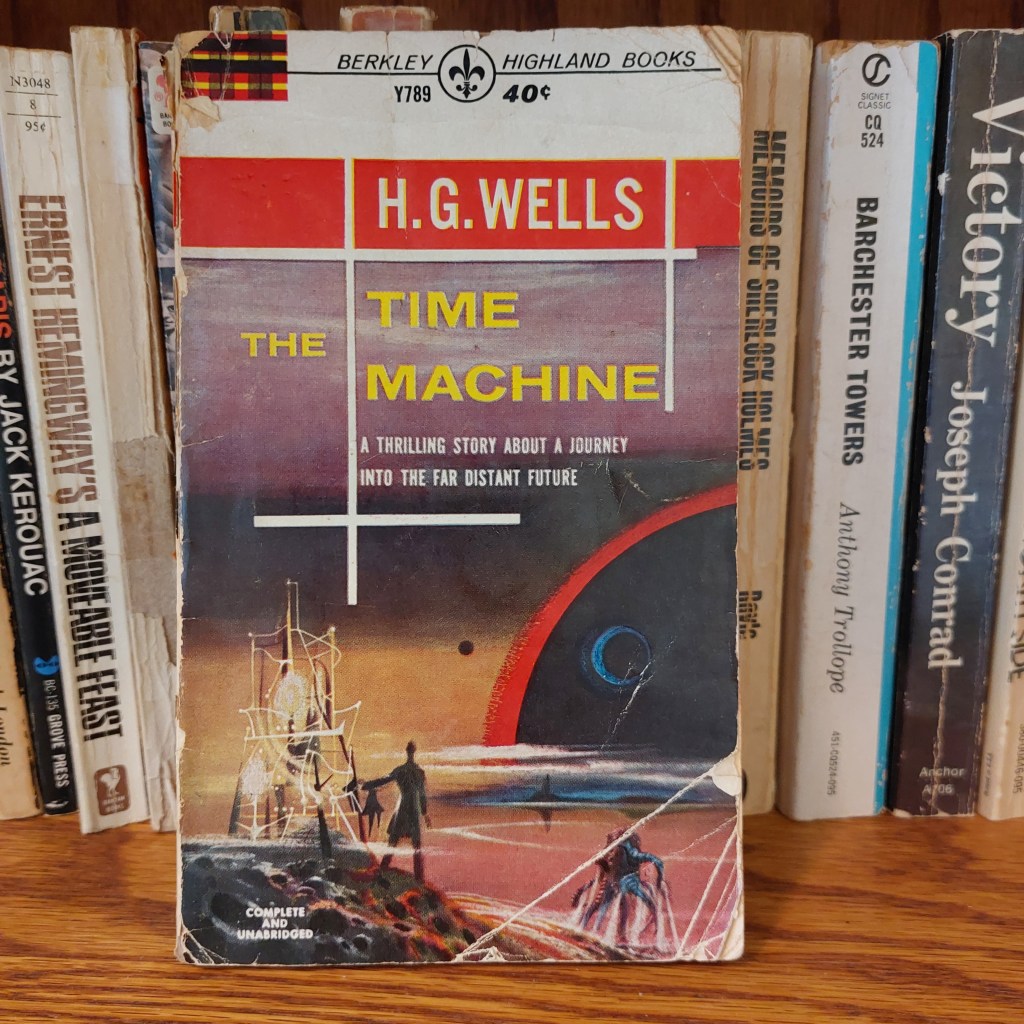
    Working on this post, I picked up my copy of “The Time Machine,” by H. G. Wells, and the cover fell off. I was looking for the passage where the Time Traveller finds the library of the future:

    “I went out of that gallery and into another and still larger one, which at the first glance reminded me of a military chapel hung with tattered flags. The brown and charred rags that hung from the sides of it, I presently recognized as the decaying vestiges of books. They had long since dropped to pieces, and every semblance of print had left them. But here and there were warped boards and cracked metallic clasps that told the tale well enough.” (103-104).2
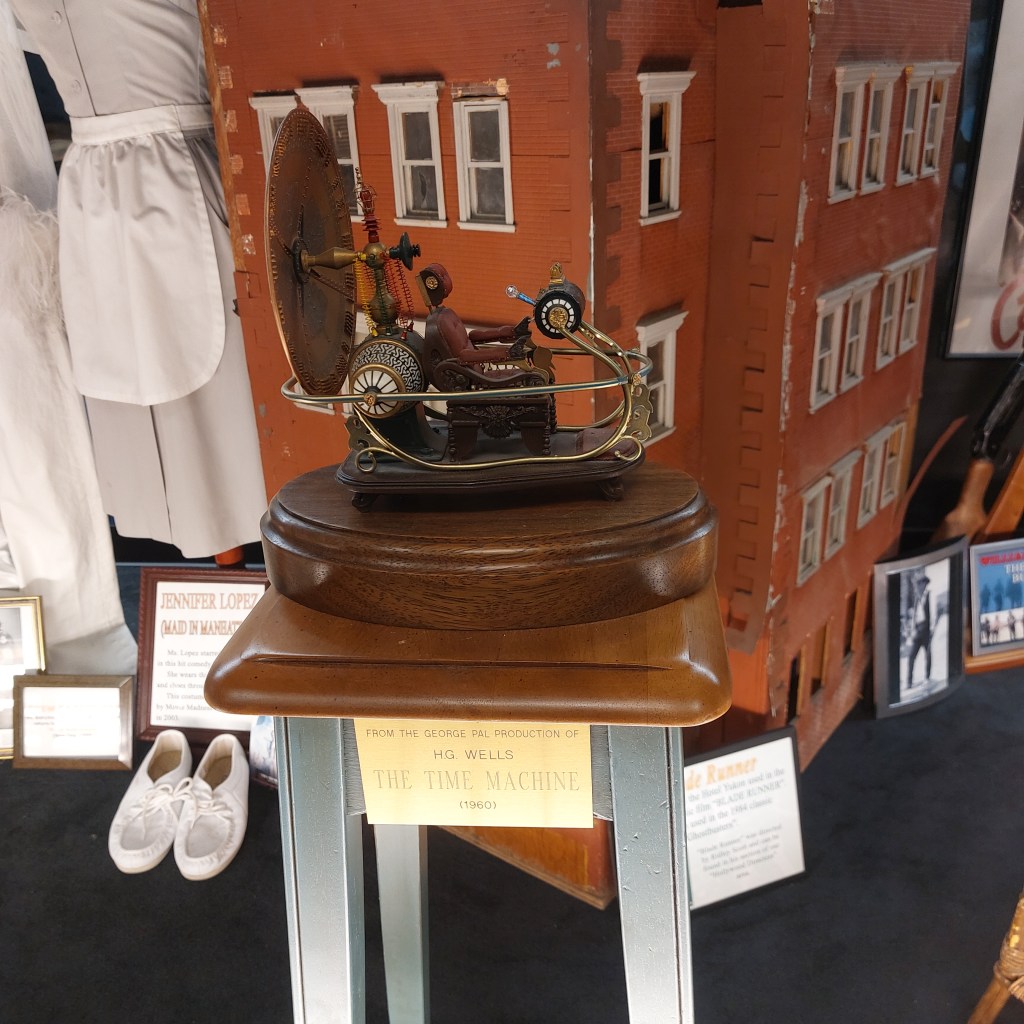
    The Time Machine on display at Movie Madness, from the 1960 film.
    1. Jerzy Kosinski, “The Painted Bird,” Houghton Mifflin, October, 1965. My copy, a Pocket Book edition, November, 1966, 5th printing, August, 1971, $1.25. (Not the copy lent me, since that would have had an older print date.) ↩︎
    2. H. G. Wells, “The Time Machine,” 1895, Berkley Highland Books Y789, New York, Tenth Printing, no date, 40 cents. ↩︎
  • The Elite and the Effete: From Access to Egress

    When did literature become an elitist game? When we started writing? Literature both reflects and influences culture, society, and the individual, but there are many things that reflect our values (what we want; not to be confused with what’s good for us) and influence our thought and action (the automobile; lawns; college), but not everything that reflects and influences our lives is literature. There appears to be an argument afoot, to wit: “I should state up front that I am not a fan of programme fiction. Basically, I feel about it as towards new fiction from a developing nation with no literary tradition: I recognise that it has anthropological interest, and is compelling to those whose experience it describes, but I probably wouldn’t read it for fun.” This from Elif Batuman’s review of Mark McGurl’s The Programme Era, “Get a Real Degree.”

    All cultures experience literature, but only an elitist can afford to read purely for fun. What Elif is talking about when she says “literary tradition” is the tradition of literary criticism, which is a kind of self-consciousness about one’s literature. Part of Elif’s complaint is that the programs (code for the MFA writing programs) lack literary tradition and subscribe to an artificial fabrication called creative writing. But as Eliot said in “Tradition and the Individual Talent,” “It [tradition] cannot be inherited, and if you want it you must obtain it by great labour.” One gets the feeling that Elif does not consider “creative writing” to be literature, and it may not be, in the same sense that painting by numbers is not art. D. G. Myers seems to agree. Myers values writers not on but in location. Using this rubric, Bukowski, who filled the Los Angeles Basin with alcohol, makes the grade, as would Flannery O’Connor, who filled the South with grace, and Joyce, who filled Dublin with Dubliners, giving them a chance to talk to one another unencumbered by the Church’s program. Roddy Doyle’s Barrytown Trilogy is another example rooted in place. But people move, and move on.

    If, as Buckminster Fuller explained, specialization leads to extinction, where does literary elitism lead? Literature from the “programmes” sounds a little like the physicists’ string theories, which Robert B. Laughlin unraveled for us some time ago: criticizing string theory in his book A Different Universe, Laughlin says “A measurement that cannot be done accurately, or that cannot be reproduced even if it is accurate, can never be divorced from politics and must therefore generate mythologies” (p. 215). One problem, as described by Batuman, has to do with the program reverence for what it calls craft. Plumbing is a craft; writing is something else.

    Again we find funding the antagonist: “…people on the West Coast work,” Kenneth Rexroth said. “Ginsberg when he came out here, as he said in interviews, was working as a market researcher, which is just a shit job. It’s like being a floorwalker in a dime store. I said, ‘Why don’t you work? How much are you making? Forty-five dollars? You can’t live on forty-five dollars in San Francisco. That’s not money. Why don’t you go to work, get a job?’ Ginsberg said, ‘What do you mean?’ And I said, ‘Ship out…’ You come back with more bread than you know what to do with!’ In the East people don’t think like that” (Meltzer, 1971, p. 12*).

    Elif’s London Review of Books review would still be going out with the tide were it not for McGurl’s tardy response in the May 11th Los Angeles Review of Books, “The MFA Octopus: Four Questions About Creative Writing.” But what is elite? The truly elite do not go in for literature; they go where the money is, finance, or health care, or both, which is insurance, and surely if we can agree on anything it’s that there’s no money in literature. The elite that do go in for literature we might call the mal-elite, the black sheep of the elite, for as Jerzy Kosinski said, “Reading novels—serious novels, anyhow—is an experience limited to a very small percentage of the so-called enlightened public. Increasingly, it’s going to be a pursuit for those who seek unusual experiences, moral fetishists perhaps, people of heightened imagination, the troubled pursuers of the ambiguous self” (Kosinski, Paris Review Interview, 1972).

    Kosinski was no elitist, nor is Elif’s example of a writer she values, Dave Eggers. His prose is characterized by practical matters; his publication efforts (The Believer, which does not publish fiction, but which has been publishing poetry of late; 826 Valencia) take the word to the street, Samizdat-style. William T. Vollman might be an even better example of the non-elitist, non-programmed writer, engaged in some cross-fertilization of fiction and non-fiction, a new prose for a new time. For the University cannot grant access to literature; it can only grant access to degrees. And the egress of disappearing readers from literature suggests that we must start to look for our literature in unexpected places.

    Follow-up:

    Apr 29, 2013: Seth Abramson at HuffPost: “Contemporary Poetry Reviews.” Intro. continues “Program” discussion.

    May 18: Laura Miller simplifies and suggests much ado about nothing. August 22: Daniel Green reviews The Program Era, including an interesting aside: “…another book considering those writers who resisted the migration of literature and the literary vocation into the academy would be an interesting project.” Yes.

    15 Nov 2012: Fredric Jameson reviews The Programme Era: Postwar Fiction and the Rise of Creative Writing by Mark McGurl (Harvard, 466 pp, £14.95, November [2012], ISBN 978 0 674 06209 2) in LRB (subscribe).

  • Reading declines, unobtrusively

    Caleb Crain’s article in the December 24 issue of the New Yorker reports on a decline in reading, discusses the causes and effects of declining reading skills, and speculates on what a future readerless society might be like. Titled “Twilight of the Books,” the article asks, “What will life be like if people stop reading?”  

    When asked in a Paris Review interview, in 1972, about the future of the written word, Jerzy Kosinski described reading novels as an unusual, masochistic act. Literature, in Kosinski’s view, lacked television’s ability to soothe. He believed television was the enemy of books. But then the lovely E. L. Mayo poem, “The Coming of the Toads,” also about TV, suggests a political outcome, a Marxist marvel:

    “The very rich are not like you and me,”
    Sad Fitzgerald said, who could not guess
    The coming of the vast and gleaming toads
    With precious heads which, at a button’s press,
    The flick of a switch, hop only to convey
    To you and me and even the very rich
    The perfect jewel of equality.  

    Mayo, E. L. (1981). Collected Poems. Kansas City: University of Missouri.

    Kosinski’s code name for his short novel “Being There,” he tells us in the interview, was “Blank Page.” With the internet, Mayo’s equality includes read/write capabilities and potentials. Kosinski describes his own prose as unobtrusive. Today’s younger students are busily texting one another on their cell phones in a sub-text that is certainly unobtrusive.