Tag: J. D. Salinger

  • The New Yorker Turns 100

    The New Yorker is celebrating this month its 100th anniversary. I discovered the magazine in its mid-40’s, visiting Susan’s aunt Joan at her beach studio-pad a door from the boardwalk in Venice in 1969. She gave me her discards. I started with the cartoons, of course, then read the short stories, always one or two, which back then followed the Talk of the Town section. I read all the small print stuff about the goings-on in New York, where I’d never been, never wanted to go. I thought short stories more interesting writing, but I soon grew to enjoy the short pieces in the Talk of the Town section. And I started reading the non-fiction pieces, the articles in those days on average longer than today’s, sometimes much longer, spanning two or three issues.

    The February 1, 1969 issue included a story by Linda Grace Hoyer, the mother of the prolific writer frequently found in The New Yorker over the years, John Updike. The February 21, 1970 anniversary issue included a short story in epistolary form by the editor and baseball writer Roger Angell, and a poem by Roger’s stepfather, E. B. White, titled “In Charlie’s Bar,” about a woman who was refused service at a bar in England because what she was wearing that visit happened to reveal her belly button. There’s also a story by Donald Barthelme, tilted “Brain Damage.” That I can’t really say that I now remember any of those pieces precisely probably says more about my brain than the keeping power of the writing.

    This year I came close to letting my subscription lapse. Maybe it’s my lapsing attitude, another sign of too many winters in a row of discontent, living away from the ocean. I’ve always liked The New Yorker because it is a general interest magazine, witty but sincere and without specialty or academic brouhaha. But as Jill Lepore puts it in her article titled “War of Words” in the 100th anniversary issue:

    “The stock criticism of Brown [Tina Brown, former editor from 1992 who shortened articles, among other at the time some thought controversial changes. David Remnick took over as editor in 1998] is that she made everything about celebrity; the stock criticism of Remnick is that he made everything about politics. The same could be said of America itself, across those years.”

    That everything is about any one thing brings an emphasis that goes against the grain of general interest. And what will happen to the editorial stance now that celebrity and politics have merged into one? That’s what I’m not sure I want to see. But while there have been a few ownership and editorial changes over the years, changes in form and content have not been deep. What’s changed is out on the street. But maybe that’s not so new either. Let’s take a look.

    From the Notes and Comment section of the February 28, 1970 issue (and if I hadn’t just told you it’s from 1970, you might have thought this was today):

    “The government’s campaign against the press, which has proceeded swiftly from threats of action to action, in the form of subpoenas of reporters’ notes and tapes and films, has already heavily damaged the press’s access to the news.”

    Surely someone would say something. After all, it was still almost the 60’s. But in the same piece we get this:

    “The Democrats complete silence on those issues throughout the program [a Democrat television special titled State of the Union: a Democratic view – a response to Nixon’s State of the Union address] struck us as an extreme instance of the more general avoidance of controversial issues which has been noticeable among politicians and on the networks and in the press.”

    Certainly not much seems to have changed from Andy Logan’s comment in the Around City Hall section of the same issue. Writing about the state’s budget hearings, he says:

    “According to one theory of public life, the winning politician is not the man who spends his time gathering civic credits to himself but the operator who can most often persuade the public that whatever went wrong was somebody else’s fault.”

    A valuable benefit of subscription is access to The New Yorker archive. I found myself, in solo celebration of its 100th Anniversary, browsing through past issues from the years I first started reading the magazine. In that February 28, 1970 issue, for example, I perused the Nightlife section, wondering where I might have gone had I been in New York at the time. I could have sat in at The Bitter End, where “Folks, both long- and short-haired, sit on wooden benches and sip coffee.” I could have eaten, copiously, no less, at Bradley’s, “a wood-paneled bar and rest where people come, and frequently return, to sit and talk and copiously dine.” Not only that, but I could have listened to Bobby Timmons play electric piano until three in the morning. And if that wasn’t enough music, I could have at three headed over to the Red Onion and heard “Two banjos and a piano until four.” And that went on every night. Did people never sleep in New York? There was a lot to choose from: “music, bar, dinner, dancing, discos, cabarets.” At the movies (still called Motion Pictures in one section of the magazine), I could have seen, drawing now from the alphabetical listing: Belle de Jour, The Bible, Bob and Carol and Ted and Alice, or Butch Cassidy and the Sundance Kid.

    I seldom read The New Yorker fiction anymore, and some of the poems I don’t make it out of the first stanza or two. I’ve grown prosaic maybe in my dotage. And if you think the point of a cartoon is to make you laugh, you might be in for a disappointment.

    One measure of good writing is whether or not it can be read comfortably and naturally aloud. This week, I’ve been reading aloud to Susan from J. D. Salinger’s Nine Stories. In Salinger’s story titled For Esme – with Love and Squalor (from the April 8, 1950 issue, not April 9 as Wiki has it) about a US soldier in WWII, the narrator meets a young English girl in a Devon tearoom:

    “May I inquire how you were employed before entering the Army?” Esme asked me.
    I said I hadn’t been employed at all, that I’d only been out of college a year but that I liked to think of myself as a professional short-story writer.
    She nodded politely. “Published?” she asked.
    It was a familiar but always touchy question, and one that I didn’t answer just one, two, three. I started to explain how most editors in America were a bunch –
    “My father wrote beautifully,” Esme interrupted. “I’m saving a number of his letters for posterity.”

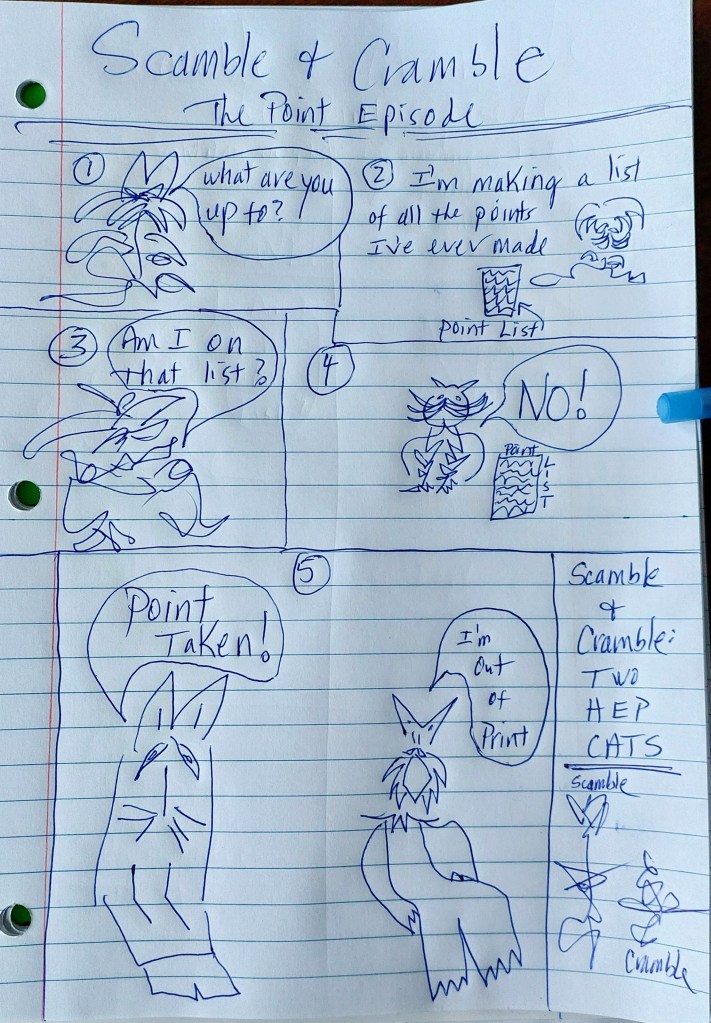
    This post being about The New Yorker, and The New Yorker being known for its cartoons, I thought I’d end with a cartoon:
  • In Print: “End Tatters”

    In Print: “End Tatters”

    “Do you want this book published,’ he asked, ‘or just printed?” Said Angus Cameron (editor at Little, Brown) to J. D. Salinger upon learning Salinger wanted no advertising of his forthcoming “The Catcher in the Rye.” Particularly, and peculiarly, from the publisher’s viewpoint, J. D. wanted no author’s photo on the cover (Ian Hamilton, In Search of J. D. Salinger, 1988, Random House, p. 115).

    How to launch a book? Advance review copies. Interviews. Author’s book tour. Live readings. Ads in trade journals. Book store displays. Billboards on Sunset Boulevard and in Times Square.

    Like Salinger, though they’ve actually few if any other options, the indie writer/publisher eschews the traditional publicity stunts ahead of book store distribution for a blog post or two.

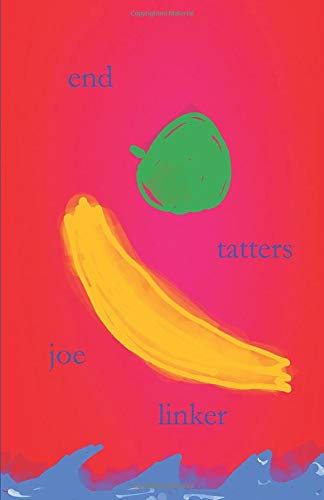
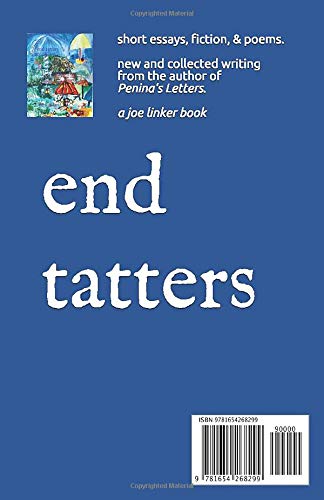
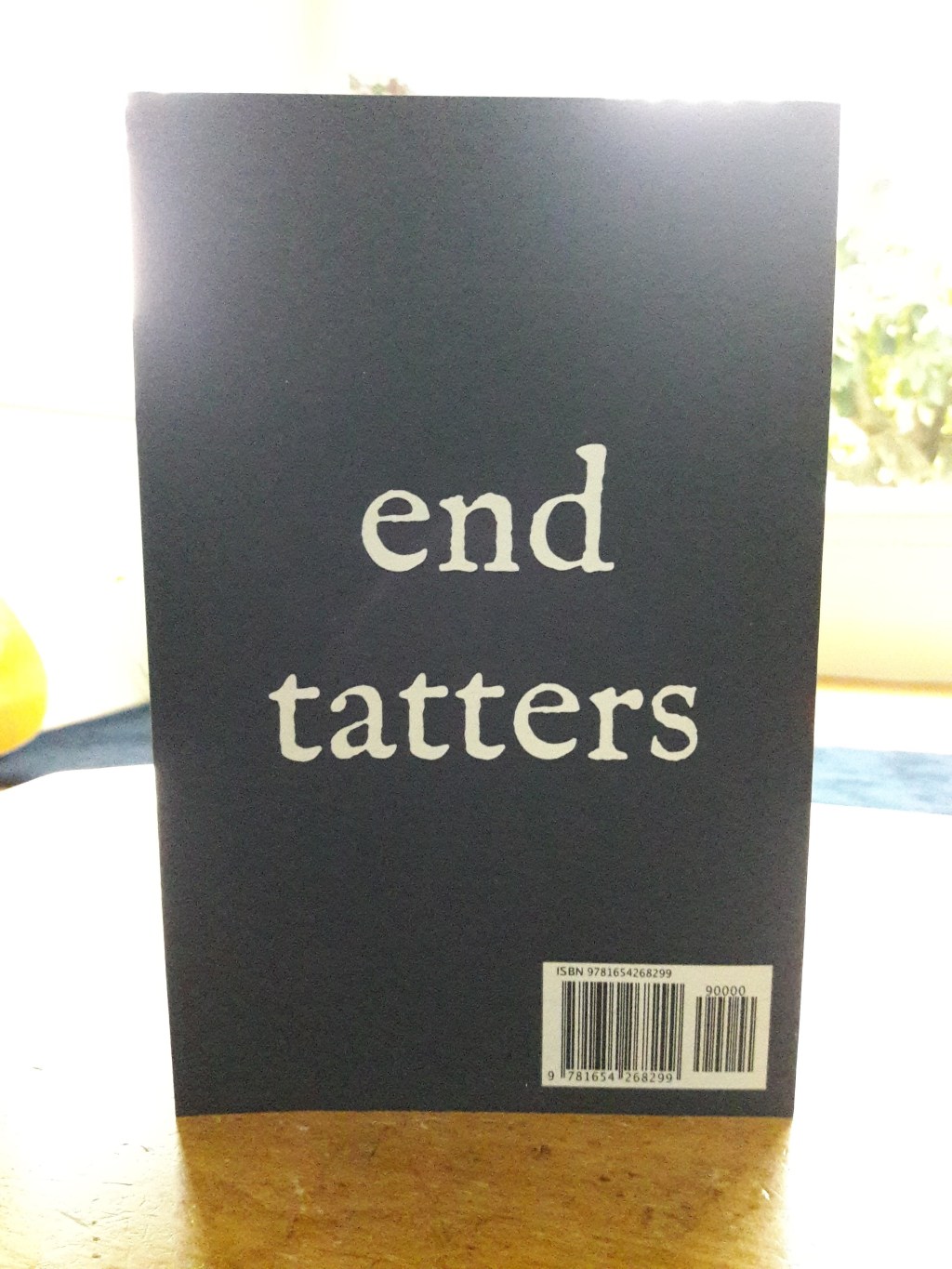
    This is the second in a planned series of posts designed with the usual blog accompanied by tweet fanfare to launch, from the author of “Penina’s Letters,” a new book, titled “end tatters,” coming this week. Below, we see the front and back covers, and the back gives a brief description of what’s inside:

  • Notes Number 5: Smells Like Berfrois Spirit

    Nevermind, I’m already 10 minutes late for my appointed volunteer shift at the Portland Convention Center to help out at AWP19. Turns out even 11:30 am too early for this old kid to gig. I hope my unexcused absence doesn’t reflect too poorly on my literary reputaughtshun. But I will use the time though, looking ever closer and deeper into “Berfois: The Book”  and “Queen Mob’s Teahouse: Teh Book.”

    Whenever confronted with conventions, I remember the Salinger story “A Perfect Day for Bananafish,” which begins:

    “THERE WERE ninety-seven New York advertising men in the hotel, and, the way they were monopolizing the long-distance lines, the girl in 507 had to wait from noon till almost two-thirty to get her call through. She used the time, though. She read an article in a women’s pocket-size magazine, called “Sex Is Fun-or Hell.” She washed her comb and brush. She took the spot out of the skirt of her beige suit. She moved the button on her Saks blouse. She tweezed out two freshly surfaced hairs in her mole. When the operator finally rang her room, she was sitting on the window seat and had almost finished putting lacquer on the nails of her left hand.”

    Why ninety-seven? The 97th Infantry Division was active in WWII, but Salinger served in the 4th Infantry Division. In any case, today, “the girl in 507” would, in addition to all her other time using activities, be on her cell phone, wouldn’t she? As for the advertising men, they might be attending an Associated Writers and Writing Programs annual convention, such as AWP19, this week being held in Portland. Portland is a good place for bananafish. Maybe something to do with all the rain. In the today Salinger story version, AWP might be an acronym for All Earwickers Post.

    But the word “ear” appears only once in “Berfrois: The Book.” Six times in “Queen Mob’s Teahouse: Teh Book.” One can read too closely. And that’s just whole words, anyway. Backing up a bit, we see “ear” appears frequently as part of other words: years, bear, Radishes, breath, Misrepresentation (in the Berfrois book); Eavesdropping, great, Picaresque, artes, Funeral, Breakfast (in the Queen Mob’s book).

    The only use of the whole word “ear” found in “Berfrois the Book” is in the essay by Ed Simon, “Moved the Universe: Notes Toward an Orphic Criticism” (59:72):

    “…Erato whispering in Sappho’s ear…” (59).

    In his essay, Simon speaks to the mystery of literature. It’s what can’t be quizzed in class. Nor is it:

    “I’ve no interest in taste, discernment, or style…” (66).

    Simon is talking about the ear, about listening. He’s not asking what is literature, but where does it come from, and how does it get here. How do we hear it, learn it, learn to listen to it, for it. It’s a raw approach. It cuts through a lot of crap:

    “What defines the Orphic approach is never necessarily analytical acumen (certainly not that), nor adept close readings, but rather, an ecstatic, enchanted, enraptured sense of the numinous at literature’s core. Orphic criticism is neither method nor approach, but rather attitude and perspective” (71).

    For a reader, the attitude might have a bearing on Nabokov’s emphasis on relying on one’s “spine,” the “tingle” that goes up it when the magic kicks in:

    “A major writer combines these three – storyteller, teacher, enchanter – but it is the enchanter in him that predominates and makes him a major writer…a great writer is always a great enchanter, and it is here that we come to the really exciting part when we try to grasp the individual magic…In order to bask in that magic a wise reader reads the book of genius not with his heart, not so much with his brain, but with his spine. It is there that occurs the telltale tingle” (5:6). (Nabokov, “Good Readers and Good Writers,” from “Lectures on Literature,” Weidenfeld and Nicolson, London, 1980).

    Simon’s essay is in form a classic argument, and a perfect example of one. Plus, we get a history of literary criticism and enough references to keep us going for some time. The essay bemoans the very academic sustenance that gave it life, but explains why. In essence, theory grows monstrous when it becomes horror to the common reader. Simon’s statement, about which there will be some disagreement, I found very persuasive, intuitive, purposeful, clear and concise yet thorough and clarion in its call to let the sound back into the word.

    Justin Erik Halldor Smith‘s “The G.O.E” (101:108 B:TB) is, at least in one sense, also about the ear:

    “What I remember most vividly is the great cleavage, in the earliest time, when the moon was torn away from us” (101).

    The speaker seems to be an ecological griot, an evolutionary being that “remembers everything,” and attempts to dialog with those who may have forgotten or never knew:

    “There is a memory that runs through all of us unbidden, and that can be brought to the surface with a little effort. In this effort, we stop being I and thou, which seems implausible, but I have always felt that coming to see oneself as an I in the first place was the far more remarkable way of apprehending the world, while conjuring our shared memory with all the other Is is by far less remarkable” (101).

    Justin’s piece is in form a parable. Why is life so reliant on symbiotic relationships that eat one another? There is a partnership, on Earth, at least, of animal and plant life. At least one form from the animal life world has suppressed and oppressed plant life. Too, within the animal world, there are unmarked distinctions that have grown into borders creating divides that threaten all kinds of partnership. Why does life eat itself so?

    We find more “ears” embedded in “Queen Mob’s Teahouse: Teh Book.” But, before we get too far away from “the girl in 507,” we find, in QM’sT:tB, “advertising.” Only once, both books combined, do we find the word “advertising.” It’s in “Conductor,” by Nate Lippens:

    “I drive around my hometown, past the Sons of Norway advertising a Saturday lutefisk lunch, past the strip mall, past the mega-stores and past the Irish sports pub where men who look like fraternal twins line the bar with boilermakers” (187).

    How is disgust drawn, when even one’s mother expresses doubt? While pure hate simply ignores, or pretends to. What happens when dislike pierces the skin so often we begin not to like ourselves, and begin to scratch away at an itch the source of which we know comes from where? Do we begin to blame ourselves for being the lightning rod? Nate’s piece seems a personal essay (it could be a story, the narrator a character). The writing is visceral, honest, seemingly true to experience. The writing is clear, drives forward without blinking. The essay contains the kind of writing you feel in your spine.

    We interrupt this post for a PSA (Public Service Announcement): I’ve learned that I am being given the opportunity of redeeming myself from today’s (now, as I continue these notes, yesterday’s) unexcused absence. Either tomorrow or Friday, This afternoon, I should be helping out at the Berfrois table at AWP19 for a spell. I’ll be wearing my ears and my advertising cap. If your there, the table ID is T11094. We might talk about how I’ve no doubt misread Simon and Smith, Lippens, and now Pickens?.

    Meantime, in the Queen Mob’s book, we find Robyn Maree Pickens using the word “ear” in “The skeleton of a dog who is still alive” (47:57).

    “She has been trained to fix her gaze on the clients’ hairlines or ear tips” (48).

    The story moves in a form of dream language, which is to say surreal, both clear and unclear at once. Yet,

    “Her dreams are full of bounding for terriers. They are either benign guides or soporific constellations that suffocate her eyes. They must never talk about dreams at the institute. She registers the cessation of oscillating air on her head and leaves the circle” (51).

    Perhaps the secret to reading all dreams is simply this:

    “All references are lost. Their lives are so short. They glisten. They hum” (57).

    The Pickens story also is the kind that you feel in your spine.

    This is the fifth in a series with notes on AWP19 and the concurrent publication of the Berfrois and QM’sT books. I’m reading through the Berfrois anthologies this week and commenting on the writing and the conference as the week wears on.

    20190327_162032
    Spring in Portland for AWP19

  • The Bananafish

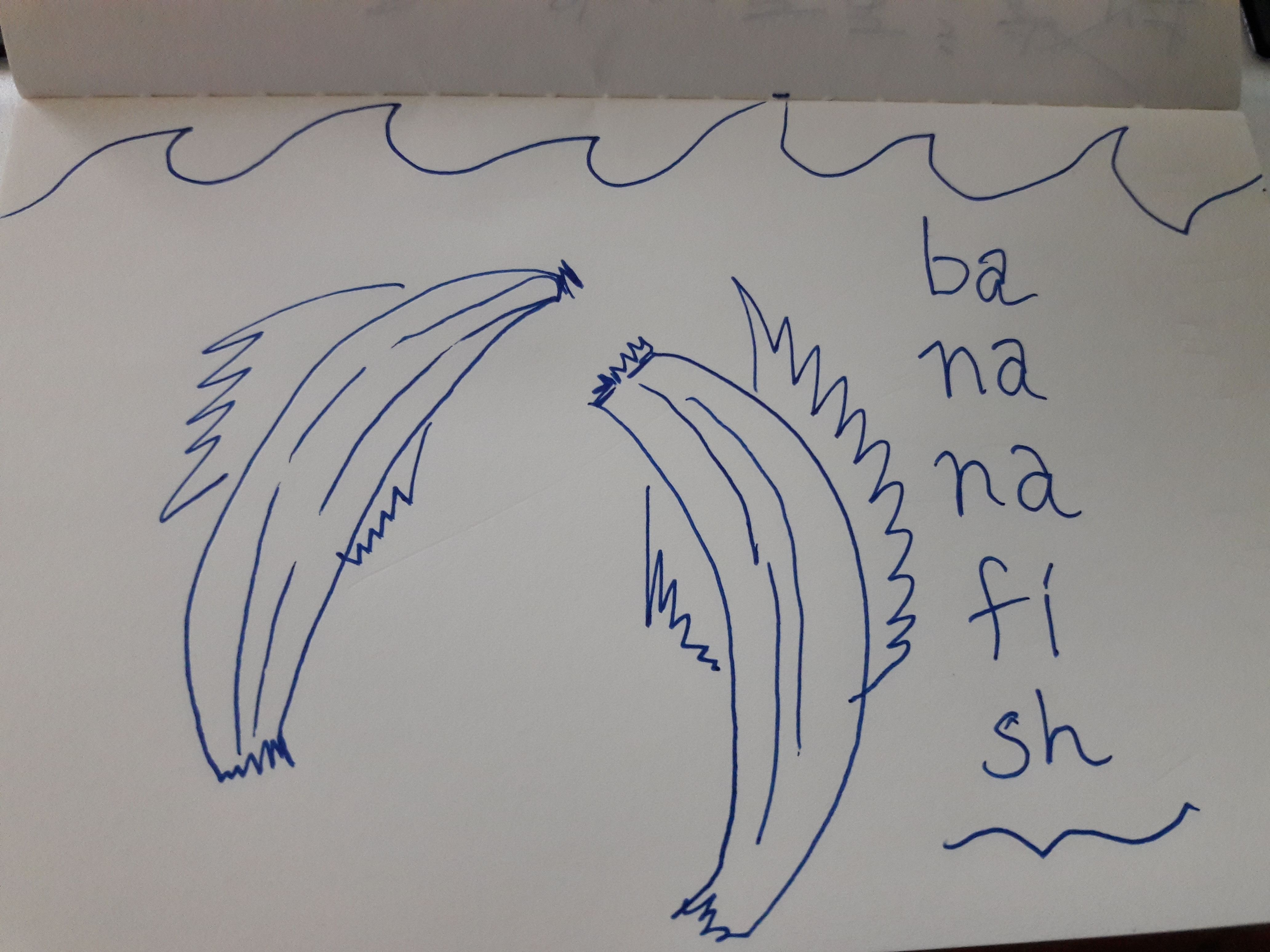
    A popular fish in some schools the deep
    sea swallower called the bananafish:
    Sansjawdsalumpigus.
    Though it lives on the floor of the aphotic zone,
    it is not bioluminescent; in fact, it’s invisible.
    Rising to the surface with changes of tide, mind,
    and mood, it’s worse by tens than the burbling
    Jabberwock. A bananafish is never caught;
    it slips you, and you are capsized.

    The bananafish sees without eyes things
    that disappear, hears sounds in the depths
    of silence, lives on even when squished
    or peeled or baked into bread or spread
    in undigested seeds. They live in clusters,
    but it only takes one to upend your plans
    for a day, a week, or a lifetime. Nevermind
    the Jabberwock; beware the brilliant
    brainy glare of the bananafish.

    What bites but has no teeth?
    What smells but has no nose?
    What swims without fins,
    goes loopy if left to shelf,
    barmy as the froth of beer?
    Ans: the double-dealing
    bluff bunko, the sly hoax
    of Sansjawdsalumpigus,
    commonly called the bananafish.

    20180826_085709

  • A Few Salient Notes on the Point of Punctuation

    Nail Punches and HammersWhat is the point of punctuation? When can we be sure our marks are correctly selected and placed, knowing our readers will often think otherwise! Or worse, won’t care :( `

    No. Shouldn’t punctuation be like a trip to a good dentist who pulls your tooth but you don’t feel a thing? Later, you feel for the point of that missing tooth with your proofreading tongue. Say goodbye to sunflower seeds, those single quote marks that helped along slow reads at the center of summer late inning baseball games. (Who is you, by the way? – but we should save that issue for a later post, because it has nothing to do with punctuation, but with person.)

    The narrator of J. D. Salinger’s Seymour – An Introduction [when do we place titles in italics or “surround them with quote marks” and omit italics?], Buddy Glass, one of Seymour’s brothers, offers his reader a punctuation gift:

    “…this unpretentious bouquet of early-blooming parentheses (((( )))).”

    But he then suggests the “bouquet” more accurately portrays his “bowlegged…state of mind and body….” Buddy speaks to you as if the general reader is a good old buddy, one who does not pack a red-pen mentality correcting as he goes like a noisy street sweeper the debris of punctuation through streets littered with pot holes and broken gutters with missing horse rings.

    Salinger’s narrator’s bouquet has always suggested to me an Army sergeant at rest, as indeed J. D. was.

    Is placing letters or words in italics a form of punctuation?

    What is ` used for?

    What are {/} {/} but no worries this is not a test but a post on punctuation.

    From Adverbial Beach (by Joe Linker):

    Gently the blousy wordiness finally quiet down not but up again and continually.

    Usually superlatively long only this hour lately awake before four too early darkly to call this morning while lately too late to hope for a verbly sleep.

    The apostrophe is a comma that evolved from the sea and learned to fly away. Bring an apostrophe down to earth and you’ve got a nice crowbar.

    The best punctuation works like the nailing in a tongue and groove hardwood floor; you don’t see the nails. For side edged, top nailed floors, keep a nail punch and hammer close at hand for countersinking punctuation marks that will otherwise trip up readers dancing and sliding by in socks.

    Punctuation is such a trip, hipsters in the 60’s used to say, but members of that particular generation of hipsters, pockets full of commas, are beginning to reach their final ellipses.

  • Losing Forrester Behind the Window

    What does one say about the movie critic disappointed that “Jaws” was a terrible romantic comedy? A good movie is a movie that achieves its goals; that the critic may not value those goals doesn’t seem relevant. Writing about “Finding Forrester” (2000) in the New York Times, for example, Stephen Holden hated it for its Hollywood formulas and false depictions of life, but since when has Hollywood valued real life? Holden writes, “Forrester appears to have had no life at all for the past four decades. (But if that’s the case, what on earth could he be writing about?).” This critical comment may say more about Stephen Holden’s imagination than it does about the movie. And Holden doesn’t even get some of the details correct: “When not pounding away at the typewriter, he [Forrester] spends his time peering through binoculars at a neighborhood basketball game in the playground below.” While Forrester does watch the games, he’s primarily a bird watcher when at the window with his binoculars. And Holden makes much of a J. D. Salinger comparison, but if Salinger was in the movie, I must have been out getting popcorn when he appeared.

    Roger Ebert was more generous, and approaches the film on its own terms: “The movie contains at least two insights into writing that are right on target. The first is William’s advice to Jamal that he give up waiting for inspiration and just start writing. My own way of phrasing this rule is: The Muse visits during composition, not before. The other accurate insight is a subtle one. An early shot pans across the books next to Jamal’s bed, and we see that his reading tastes are wide, good and various. All of the books are battered, except one, the paperback of James Joyce’s Finnegans Wake, which looks brand new and has no creases on its spine. That’s the book everyone buys but nobody reads.”

    Emanuel Levy, writing in Variety, called the script “extremely old fashioned.” Of course! That’s what the makers were after, yet Laura Miller, in Salon, calls it a “farrago,” and dislikes it for not being the movie she wants it to be. But at least she doesn’t mention J. D. Salinger. Laura doesn’t like the ambiguity of references to writing we are unable to read so we can’t know if it’s any good or even what it’s about; plus, Laura says, “the movie is hellbent on getting the author out of the house and, by extension, away from his typewriter. That’s just another way of saying that writers would be warm, loyal and otherwise terrific people — if only they’d quit writing.” She may be on to something there. One of my favorite Forrester quotes comes when William is pacing with his drink while Jamal tentatively gets started on the typewriter: “Punch the keys!” William yells. Writing is physical, William seems to be saying, a paradox, but the body does scream to get away from the typewriter – perhaps that’s where so much of the tension in writing comes from.

    David Walker, writing in Van Sant’s home town alternative (to the Oregonian) newspaper, Willamette Week, predicted Oscar success. While Oscar apparently slept through the movie, “Finding Forrester” did win several more obscure awards.

    What does “Finding Forrester,” as full as it is of pathos about writing, have to say about writing that holds ethos? One of my favorite quotes comes from William: “A lot of writers know the rules about writing, but they don’t know how to write.” The same might be said of movie directors and movie critics: a lot of them know the rules of making movies, but those rules don’t always turn into satisfying movies if the movie isn’t the movie the critic wanted to see. The goals of “Finding Forrester” are clear in its music score, particularly the ending IZ medley of “Over the Rainbow” with “It’s a Wonderful World.” When Jamal steps into William’s apartment, and when he steps into Mallor, the private school that recruits him for his scores on tests and on the basketball court, he knows he’s not in the Kansas that has been his Bronx anymore. And we know Oz is not a real place, but we hold our disbelief in suspension, and, if nothing else, enjoy the score – the real score, that is, and to appreciate that we need to know something about Bill Frisell, the truly wonderfully eclectic jazz guitarist (Eric, Eric’s drum teacher Joe Janiga, and I saw him with drummer Jack DeJohnette at the Aladdin a few years back).

    I also met the “Finding Forrester” director, Gus Van Sant, one year at the Portland Art Museum. My friend William invited me to share tickets he had to a Van Sant reception. I had thought William said the reception was being put on by the AFL-CIO. What in the world would the AFL-CIO be doing feting Gus Van Sant, I wondered. They weren’t, and William enjoyed quite the laugh at my expense. It was, of course, the ACLU hosting the reception. Anyway, we went up and introduced ourselves to Gus and chatted with him for a spell, a quiet, unassuming, and fairly open guy. He was interested in hearing about the work William was doing for the introduction of the Americans with Disabilities Act (ADA) at the time. This was long before “Finding Forrester.”

    Anyway, back to “Finding Forrester” and what it might have to say about writing. There are few shadows in “Finding Forrester.” Apart from the stark contrasts of black and white, albeit Hollywood style (the two teachers, Mr. Crawford and William; Claire and Jamal, and their respective homes; the two schools; Jamal and his team nemesis), there’s the window – as image, metaphor, symbol, of medium, of looking through without noticing the glass (if there’s a reference to Salinger anywhere in the movie, the window is probably it). Forrester continually, obsessively, cleans the window of his apartment throughout the movie. The window is a metaphor for writing. Jamal and his basketball buddies call William “the Window.” The writer. And the writer disappears behind the window into the work, behind the scenes.

  • J. D. Salinger’s Advice to Adelia Moore: Write as a Child

    Adelia Moore, apparently an old fashioned English major, knew Jerry, had tea and lunch with him, even argued with him (over Vietnam), and received this stunning bit of advice from him, when she was but 20 years old: “If you haven’t published by age 21, you might as well forget it.” Adelia calls it “…his blunt advice about writing.” But is it advice about writing, or sarcasm about publishing? Was it meant to be taken literally, a literal cutoff – as if to say, “If you haven’t published by the time you’re old enough to drink, forget about it.” Or is it a practical kind of cynicism, as if to say, “You want to make it early, so like me you can kick back and not have to write anything more.” Salinger’s first short story was published in 1940, when he was 21. His last published work was in 1965, when he was 46. He died, a little over a month ago, at the age of 91. In “Tea with Jerry” (March 1, Christian Science Monitor), Moore shares her experience with the private writer in 1969, four years after his last published work. Did he know at the time – might he have added, “As for me, I’ll never publish another word”?

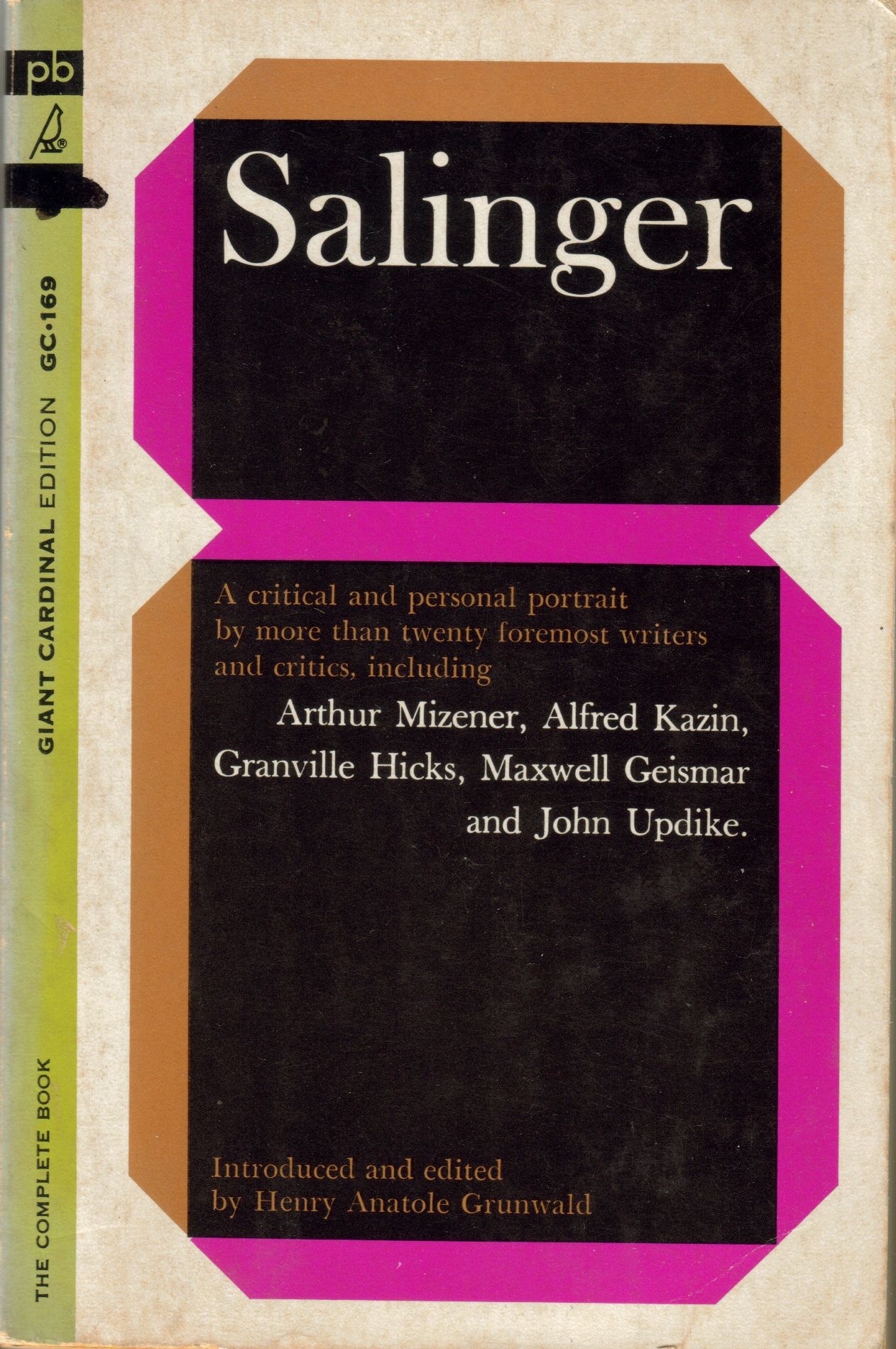
    “There is a feeling in many quarters that altogether too much fuss is being made about J. D. Salinger,” Henry Grunwald wrote in his introduction to the 1962 collection of critical pieces titled Salinger: A Critical and Personal Portrait, a major effort to explain a “good minor writer,” whose popularity with the general interest reader rankles some of the critics. Salinger wrote at a time when the general interest reader still read stories, when the New Yorker still opened its pages, after The Talk of the Town section, with a couple of short stories, and general interest readers looked forward with general interest to a Saturday afternoon with The Saturday Review. No doubt the twittering in those days went on at Saturday night cocktail parties, face to face, where faces were faces and books were books, even if the faces were books to be read and not the other way around. And Monday one met with one’s shrink to purge the weekend’s bluish-bile.

    I don’t know if Adelia Moore became a writer or not. Perhaps “Tea with Jerry” is her magnum opus, the satisfaction of a writer’s spring aspirations killed by a late frost growing back in fall. One of Grunwald’s chapters is called “The Cures for Banana Fever,” a reference to Salinger’s short story, “A Perfect Day for Bananafish,” where we get Seymour Glass’s breaking: “The disease has two symptoms: a kind of incapacity to purge one’s emotions, and a chronic hypersensitivity or sense of loss” (p. 126). These symptoms describe a childhood disease.

    Why would Salinger have told Adelia to “forget about it” if she had not published by age 21? Perhaps the answer is found in Leslie Fiedler’s piece in Salinger, “The Eye of Innocence”: “The notion that a mere falling short of adulthood is a guarantee of insight and even innocence is a sophisticated view, a latter-day Pastoralism, which finds a Golden Age not in history but at the beginning of each lifetime” (p. 242). Perhaps what Jerry was trying to tell Adelia was that she had to write as a child; it would be no good to write as an adult.