Tag: Hearing

  • Sprinkler Music

    More rain. More “Traveling Sprinkler.” Paul Chowder hasn’t been playing his new guitar much, though. Instead, the former bassoonist has found an interest in electronic music, and he’s bent on creating jingles and jangles and hums and beats and calls it dance music.

    “I worked for several hours today on a new song called ‘Honk for Assistance.’ I saw the sign at a convenience store, near the ice machine, and I thought, Now that is a dance song, in the tradition of Midnight Star. I sampled a few honks from my Kia’s horn and set up a beat and fingered up some harmony using an instrument I hadn’t tried before, the Gospel Organ, which has a slightly percussive sound in the attack phase of each note. I added more chords on a Mark II keyboard and some homegrown handclaps and some rhymes made with the Funk Boogie Kit” (190).

    Where is music, today? Where was it in Claude Debussy’s day? I’m listening now, suggested by Paul Chowder, our narrator of “Traveling Sprinkler,” to Debussy’s “Preludes,” via YouTube Music on my Chromebook. I don’t have my hearing aids in, and the Chromebook speaker is not exactly a Marshall Super Lead 100 Watt amplifier stacked with two humongous speaker cabinets towering overhead, so maybe I can’t really say I’m listening to Debussy’s “Preludes,” anymore than I can say I’m in the kitchen nook typing while getting wet from the drizzle outside.

    Around page 128, Paul spends ample time discussing the benefits of stereo versus mono. What he does not mention is asymmetrical hearing loss, a condition where you hear less volume in one ear than the other. You’re sometimes unsure which direction a sound is coming from, and it can make you a bit paranoid as you navigate your way around town. You have to be extra careful crossing the street, particularly if there are electric vehicles in the neighborhood. And bicyclists and joggers coming up behind you and passing full of assumptions and presuppositions about their position startle the shite out of you.

    “I put the headphones on, and I lowered the needle on Zubin Mehta conducting The Rite of Spring, and suddenly I was there, enclosed in the oxygenated spatial spread of stereophonic sound. I was there with the panicked piccolo, and the bass clarinet was a few feet away, and the timpani surged over to the left, mallets going so fast you couldn’t see them. I couldn’t believe how big a world it was – how much bigger and better stereo was than mono….You need two ears” (129).

    Or three, or four. One day, back home, I rode my bike down the Strand to Mike Mahon’s place in Hermosa, carrying with me Archie Shepp’s “Fire Music,” on the Impulse label, from 1965, still new and noisy around the early 70s. Mike was a classically trained pianist, although like Paul Chowder, had decided he wasn’t good enough to make a career of it, and went back to school for a PhD in English Literature, specializing in Yeats and Joyce and company, but still Mike was an audiophile, and had the latest equipment. He took my album and ran it through an electronic vinyl record cleaning machine he had, then we listened to some of it on his impressive and expressive and expensive sound system. Then he pulled from his album collection a copy of Stravinsky’s “The Firebird,” and we listened to the “Infernal Dance” piece. Talk about “attack phase.”

    I played a bit of “The Firebird” just now, switching off the Debussy. I’m immediately reminded of Poe’s “The Bells”:

    Hear the loud alarum bells—
                     Brazen bells!
    What tale of terror, now, their turbulency tells!
           In the startled ear of night
           How they scream out their affright!
             Too much horrified to speak,
             They can only shriek, shriek,
                      Out of tune,
    In a clamorous appealing to the mercy of the fire,
    In a mad expostulation with the deaf and frantic fire,
                Leaping higher, higher, higher,
                With a desperate desire,
             And a resolute endeavor
             Now—now to sit or never,
           By the side of the pale-faced moon.

    I can only handle a minute or two of “The Firebird” this morning (or Poe) before switching over to Segovia playing Bach on his acoustic guitar, from Andrés Segovia: Bach – Gavotte from 4th Lute Suite for guitar, Allegro Films.

    In butterfly mode, Paul Chowder continues, in “Traveling Sprinkler,” from acoustic guitar to electro sounds to his girlfriend Roz and his neighbor Nan, parking his car here and there to get some writing done, in other words, in and out and back in again, listening to every day sounds and how they wrap around the cans and cannots of one’s thoughts. But Chowder keeps mentioning songs and music I’ve never heard of. Where have I been? And I asked myself again when and how and why it was I got Nicholson Baker’s “U & I,” and “Traveling Sprinkler” to begin with. So I looked them up. I thought I had purchased (and said in a previous post) “Traveling Sprinkler” used from Alibris. Not so. I purchased it new from Amazon in June of 2023 (though it was not sold by Amazon – a bit confusing all of that, how Amazon works sometimes). And just now, about two years later, I’m getting around to reading it, “Traveling Sprinkler” (though I had given it a try a couple of times before), while “U & I,” I got used on Alibris in February of 2019, also giving it a couple of tries, but unable to fall into it, yet.

    Anyway, it’s all old stuff, the books, the references, the music, not to mention the many political digressions, arguments with backing but often rants of a sort, Paul Chowder takes off on. He’s a pacificist, who, as I mentioned, attends meetings, though he’s not a full member, but which is why I thought the acoustic guitar was a good fit, him being a pacificist. But it depends on how you hear sounds. Last night late (after watching the Dodgers beat the Athletics in a record-breaking score of 19 to 2) before bed I played through a few of the Leo Brouwer “Etudes Simples” pieces, as I do almost every night, on my 1977 acoustic Takamine C132S. Number 1 is not all that pacific sounding, but Number 2 is lovely, particularly setting the tone for sleep.

    The political arguments, by the way, though now aged, just over a decade away, are effective today, without stirring up too much dust. I’m increasingly finding I’d rather listen to decade old or older music too. Timeless music. Anyway, thinking back to that business about stereo and mono, I’m reminded of the Jimi Hendrix album “Axis: Bold as Love.” The first piece, titled, “Exp,” is an amazing example of stereo at play. It’s very short: 1:56. You can give it a listen here.
  • Pronunciation Checker

    What do you do when you hear a snobbish correction of someone’s pronunciation, and of a word you know both pronunciations in question to be acceptable in standard usage? You don’t want to snub the snob, yourself becoming a snob, but neither do you want any damage to go unrepaired. Worse, the situation where the corrector pretends not to recognize the thing the mispronounced word refers to. What can be more pretentious?

    As we age, do we grow less tolerant of one another’s foibles, and chop for the weakest part of their blade to snap in half?

    There’s the person who when a youngster carries a mean streak. As they age, they may sublimate that mean desire into some other equally strained habit, like correcting malapropisms or mispronunciations every chance they get, pretending to be helpful when actually drawing the shame sword from its sheath.

    I readily admit, and anyway the prescient reader will already suspect, that my own articulations, enunciations, and right pronunciations often run afoul of the standards of others.

    So much so, in fact, that I was encouraged and felt all is not lost when I saw the following quote from the poet Diane Suess, a finalist for the 2024 National Book award for poetry:

    “You have to be willing to self-educate at a moment’s notice, and to be caught in your ignorance by people who will use it against you. You will mispronounce words in front of a crowd. It cannot be avoided.”

    “My Education,” from “Modern Poetry,” 2024, by Diane Suess.

    The first thing we do when we’re not sure of a right pronunciation is to break down the syllables and pronounce them phonetically. But that doesn’t always work. I once pronounced, to a professor no less, the poet Arthur Rimbaud’s name wrong. I said rim bawd, instead of ram boh. The professor pretended not to know the poet I was referring to. She even later repeated in an anecdote form my mistake in front of the whole class. I’ve never forgotten the lesson.

    Neither do I know how to pronounce the poet Diane Seuss’s last name. Is it Seus like Zeus, my first guess, or is it Zoice, rhyming with Voice, or Soice, a variant of Sauce – as the story goes, apparently most everyone mispronounced the famed Dr. Seuss’s name, so often that the mispronunciation became the right pronunciation, and if you pronounce it correctly, you’ll likely be corrected.

    My father was, as he put it, “hard on hearing.” When he was three years old, he came down with scarlet fever, which caused sensorineural hearing loss. His ears drained a thick and slimy yellow-greenish kind of phlegm or mucus, filling the ear canal and dripping down the lobules. His teachers often consigned him to the back of the room, where of course he couldn’t hear anything. He developed a stutter, which magnified his mispronunciations. Later in life, after ear surgery, his stutter disappeared. Meantime, he had learned to read lips, and he was good at selective hearing. He was also a good talker, could talk to anyone, and did. He used to cup his palm around his ear and bend it forward making an ear trumpet to amplify voices, but it usually doesn’t help to yell at the hearing impaired. It’s often lack of sound clarity that’s the problem. It’s the sound frequency that must change.

    Loss of hearing is not loss of sound, as victims of tinnitus know. When the ears don’t work right, the brain fills in the blanks. It’s that internal sound no one else can hear that’s called tinnitus, a symptom of something wrong with one’s hearing. Tinnitus, we were informed last summer, is pronounced ti·nuh·tuhs, not, as we were saying it, ti.night.iss. Of course, the correct pronunciation is the one the listener hears without issue and lets the conversation move on. And what’s the point of being right when no one else is?

    A truly miscreant corrector like the one referenced in paragraph one above might then ask the poor pronouncer to spell the thing in question, thus pulling out a dagger of humiliation to accompany the sword of shame, but even a correct spelling will do little to clarify or solve what is to begin with a faked miscommunication.

    I’m not an expert speller, either, by the way, but we’ll save that issue for another day.

    Sounds can be errie, and we build our exotic or occult vocabularies in aeries at the tops of cliffs and the tallest of trees. Our vocabularies become nests of familiarity, even if no one else espies them. But there’s a difference between hearing and listening, and if I’m a poor pronouncer of words, I don’t think I can blame it on my hearing. But pronunciation is, I think, physical, and not mental in any intellectual sense. Or is being smart (if accurate pronunciation is indeed a sign of smartness) actually a physical thing? I don’t know. Maybe it is. You might have trouble pronouncing a word correctly like you have trouble rubbing your stomach while patting your head simultaneously. In any case, we have to hear something correctly before we can repeat it correctly – does that sound right?

  • Heavy Metal

    Sounds industrial, like the noises in a factory made repetitive by machines, the floor covered with curling steel shavings. And a kind of marching music, an industrial march, urban with trams and busses, honks and trucking heaves. Heavy Metal is the four piece rock band’s alternative to the symphonic orchestra. The full brass and woodwinds, operatic vocals, orchestral percussion – all accomplished with guitars and drumkit, pedals, and amplifiers. Heavy Metal music can sound like lead stretched thin as wire, or walking on the Earth’s crust with steel spiked boots, the band poised like the Levitated Mass over an arena crowd.

    Our latest guitar quest (Live at 5 now already seems as old as the Ed Sullivan Show) has moved to YouTube where in partnership with metal expert CB we record short videos of original pieces or answers to various musical challenges, about one to three minutes, CB taking Metal Monday while I have Telecaster Tuesday (Washboard Wednesday still open). I posted a couple of Telecaster Tuesday short videos here at the Toads – as I continue to find myself drifting further and farther from words, but I’m not sure the blog is the best place for music activity. For one thing, videos are space hogs, while links to anything outside the blog can wind up for the reader like getting on a wrong bus to the zoo.

    I’m not sure it has anything to do with hearing impairment, though it might, but I’ve often had trouble hearing lyrics clearly, the vocals sounding like another instrument, which of course they are, but without sharp definition – in my ears. Maybe that’s why I’ve steered away from loud rock, but any type of music can be played loud, or too loud. But you don’t have to play music loud to feel it. At a Red Hot Chili Peppers concert some years back, I could literally feel the sound in my chest – that’s a bit too much, though I get that it might be necessary if one wants the full effect. But often one wants to hear the breeze over the “The Eolian harp” sitting on an open window sill. Still, as evidenced in some of CB’s videos, the loudness has passed, and now rings like a train rounding a corner in the distance, its ringing still vibrating on the track:

  • Notes on Sound, Noise, Music, and Hearing

    What is sound? Tinnitus, from the Latin for ring or tinkle, we hear in our ears, but its source is not external sound. My own tinnitus is louder in my left ear, and if I try to pay attention to it, there are at least two sounds audible, as if an electronic musical duo is playing in my head. The ringing is enveloped under an umbrella of an engine or fan, or the electric rush of a motor, an incessant susurrus, which is balanced between the ears. The quieter my environment, the louder the tinnitus. Tinnitus is noise that is not sound, and it is a common ailment for those with hearing loss.

    My hearing loss, in both ears, worse in the left, probably originating from operating the motor pool compressor truck with jackhammers and other pneumatic tools and from firing weapons without adequate ear protection during my Army days and probably made worse playing music too loud over the years, is now augmented through hearing aids. The current pair are state of the art and include Bluetooth capability, which means I can stream an electronic sound source (radio, TV, computer, phone) directly into the hearing aids. But the sound is not quite natural. I hear it in my head, not in the ears, and not precisely where the tinnitus sounds, but when streaming, the tinnitus seems to turn off. It’s a bit like wearing headphones. It can be somewhat disconcerting.

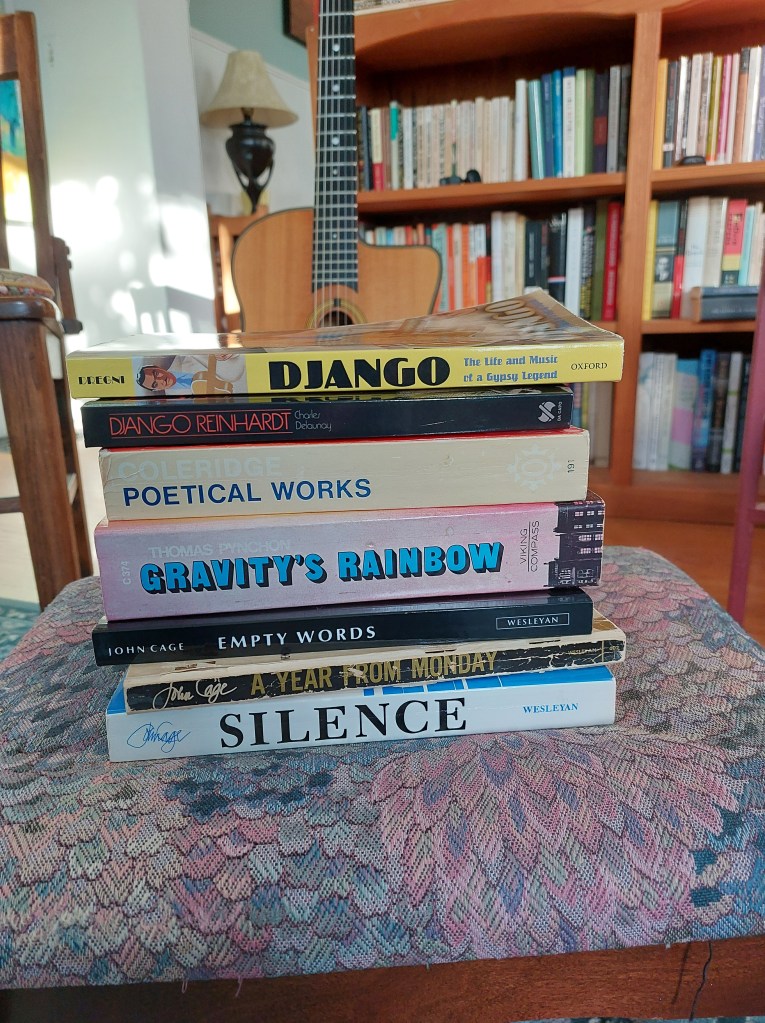
    Often, when I think of sound sans sense, I think of John Cage. Cage was a musician and writer. Piano was his instrument, but he became involved in electronic sound and electronic music – experimental music. Cage’s music might sound like tinnitus to some listeners. But any instrument can grate or creak or be made to scream or moan or laugh or guffaw. Some of the early film cartoons used modern music innovations and techniques. “Modern” music is often characterized as atonal or dissonant, and as technology developed as electronically enhanced. An evocation of emotional turmoil. Turbulence and tohubohu is often the sound it conveys, or that I hear, which of course are two different things. In any case, what I’m still calling modern here is actually now quiet old.

    What are the differences between noise and music? What is the relationship between sound and hearing? We might spend a few big bucks on music sound reproducing equipment (stereo, speakers, etc.) for home or car. The louder, it seems, the better. But when heard live at a concert, the sound may seem radically altered. And the listener in a front row seat hears a different concert than the listener in the back row, upper level, even if they’re in the same hall at the same time for the same music. In music and in conversation clarity is probably the most important attribute to one hard on hearing. It’s not that I can’t hear, but often that I don’t hear clearly. Increasing volume doesn’t necessarily add clarity. It just adds noise. Cage might say, what difference does it make? Listen to what you hear and disregard the rest. And music is not words.

    “Music as discourse (jazz) doesn’t work,” Cage said. “If you’re going to have a discussion, have it and use words. (Dialogue is another matter.)”

    John Cage, A Year From Monday, Wesleyan, 1969, page 12, from Cage’s ongoing “Diary: How to Improve the World (You will only Make Matters Worse)” 1965, which was taken from the magazine Joglars (Vol. 1, No. 3, 1966), where it was presented as: “a mosaic of ideas, statements, words, and stories. It is also a diary.”

    What did Cage mean by distinguishing dialogue from discourse? Dialogue is conversation, conversational. Discourse is debate, to run away from. Dialogue is theater. Discourse is lecture. Discussion is an investigation. We are using words; no help, no matter how loud.

    Some sounds are empty. What does that sound like? Jazz guitarists speak of getting a hollow sound or tone. One of the John Cage books is titled “Empty Words” (Wesleyan, 1981). “Most of the material in this volume has previously appeared elsewhere,” the listener is told. Where? Sound is ubiquitous, everywhere:

    “Wherever we are, what we hear is mostly noise. When we ignore it, it disturbs us. When we listen to it, we find it fascinating. The sound of a truck at fifty miles per hour. Static between the stations. Rain. We want to capture and control these sounds, to use them not as sound effects but as musical instruments.”

    “The Future of Music: Credo,” from Silence, John Cage, p. 3, Wesleyan 1961, 1973.

    Capture this, from the opening section to Thomas Pynchon’s novel Gravity’s Rainbow (Viking, 1973):

    “A screaming comes across the sky…He won’t hear the thing come in. It travels faster than the speed of sound. The first news you get of it is the blast. Then, if you’re still around, you hear the sound of it coming in.”

    page 3, then 7

    The reader is in London where the German V2 rockets, travelling faster than the speed of sound, hit the ground and explode before anyone hears them coming. Before Pynchon’s novel begins, then, an explosion has occurred. Or not, maybe one lands a dud.

    In Coleridge’s poem “The Eolian Harp” (1795), the instrument sits on an open window ledge, where an incoming breeze stirs over the strings, making music. How improvised is that! One would need super sensitive ears to pick up such wispy sounds.

    …the world so hush’d!
    The stilly murmur of the distant Sea
    Tells us of silence.

    …Where the breeze warbles, and the mute still air
    Is Music slumbering on her instrument.

    The wind as guitar pick.

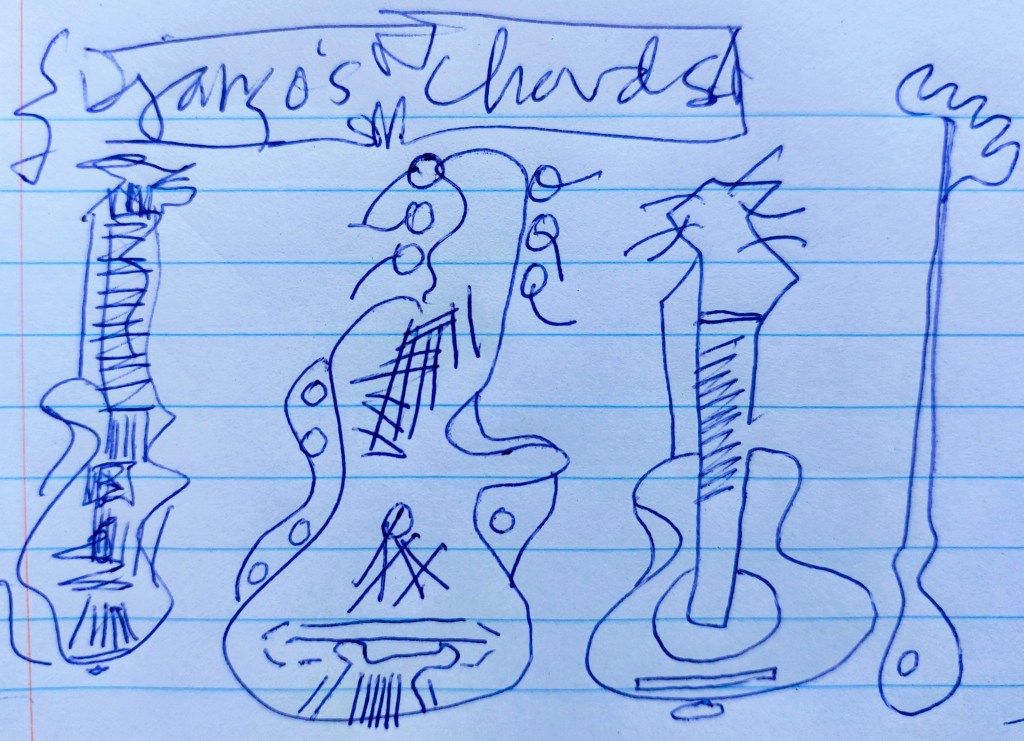
    I’ve been playing Gypsy-Jazz guitar lately, by which is usually understood playing in the style created or formalized by Django Reinhardt and his peers and followers. The style is characterized by the use of a different kind of guitar from the classical guitar popularized by guitarists like Andrea Segovia and Julian Bream. They played on a 12 fret neck fitted with catgut and then nylon strings in the treble and silk then nylon wound with metal in the bass. Other differences might include a shorter but wider neck, a smaller box, different woods and internal bracing techniques. Different from what? Basically from the all metal, louder string guitars developed later – what has come to be known as the western or folk guitar, and is used in blues, bluegrass, folk, country. But the Gypsy-Jazz guitar is a different instrument still.

    The Gypsy-Jazz (also “jazz manouche”) guitar is louder, played with a guitar pick rather than the fingers with fingernails, has a longer neck, so a longer scale length, and all metal strings. Most importantly, it’s not a solo instrument. It’s designed to be played in a small combo, usually consisting of at minimum two guitars, and often with stand up acoustic bass, violin, clarinet, accordion, and vocalist. Django played in noisy dance clubs before the advent of amplifiers and electric guitars. He needed an acoustic guitar that would project over the racket and clatter and sound in sync with the other instruments. Readers interested in learning more about Django and his music might read Django Reinhardt, by Charles Delaunay, 1961, Da Capo Press, and Django: The Life and Music of a Gypsy Legend, by Michael Dregni, Oxford, 2004. Briefly, it’s told that Django, born in poverty and coming of age without any kind of formal education, learned to play violin, banjo, banjo-guitar, and guitar. By the time he was 18, he was playing in bands in Paris and making money. Then he burnt his left hand badly in a fire in the caravan. Recovering, he taught himself to play the guitar anew, using mainly just two fingers from his left hand to fret the notes and chords, developing an entirely new technique. Thus began a new style of playing guitar that has influenced just about every guitarist of all genres since and still begs to be mastered even by those with all their fingers playable.

    When asked if he admired Django Reinhardt, Julian Bream said:

    “Oh sure. And I played plectrum guitar up to the age of 21, I played frequently in a dance band in the Army. And, yes, I loved playing jazz guitar, but not as a profession, just for fun. You can’t mix the two. I can remember playing steel-string guitar for dances, and it just ruined the sensitivity of your left hand. And I was playing rhythm guitar with big six-string chords all night long. It was a knucklebender!”

    “50 Years on the Planks: Julian Bream Talks About His Life and Work,” Classical Guitar October 1996. Retrieved 4 Mar 24.

    I’ve been working to play Gypsy-Jazz style without a plectrum (guitar pick), so fingerstyle, with fingers and fingernails, which some say is not only unorthodox but impossible – to play in the Gypsy-Jazz style of Django. I use a thick gauge string on a Saga Gitane DG-250M model, which I purchased used not long before the pandemic broke out and then had to quit the group workshops I’d been attending. The thicker strings compensate for the lack of pick. I’ve just always played with my fingers, hardly ever flatpicking. And I’m not playing dance halls these days, more like a lute in an open window.

  • Notes on Hearing Loss

    A house down around the block is getting a new roof, hammers echoing like giant flickers. Since the big virus outbreak the neighborhood seems quieter, fewer cars speeding up the bumpless street, the park above closed to the outdoor concerts, though a few bicycle races and random music groups have come and gone. We frequently hear music though, through the trees, over the roofs, through the backyard fences, but can’t always be sure of where the sound is coming from. No fireworks this year. Not a single yard sale. But some noise seems louder, the trash trucks on their weekly binge, the mailman at the mailbox, the yapping yellow dog behind and a yard over, skateboards, our tinnitus.

    A loss of sound seems paradoxically to quicken our sense of hearing. That is dynamics, change in pressure and temperature, frequency and consistency. Some sounds we don’t hear until they go silent. Sound can baffle, bounce around dancingly. If you’re uncertain where a sound, particularly a voice, is coming from, the disorienting distraction bewilders. Just because you don’t hear a sound doesn’t mean you can’t feel it, its pressure in your ears, resounding around your head. Likewise, you might hear voices, but the words lack clarity, and you can’t make out what’s being said.

    Some sounds are tight, other loose fitting. A flash flood of sound leaves a wake of mud. The beginning of rain drips into the ears, like its relative petrichor, that newly wet earthy scent in the nose, a slow awakening to something that’s been asleep for a long time and is now looking for a new bed to spend the night, one of your ears unfolding asymmetrically.

  • Hard On Hearing

    What do we hear
    when we are hard
    on hearing

    sounds far and near
    sharp metallic birds
    hummingly trill

    the sorrow of the song
    sparrow’s syllables
    feed me

    and chick-a-dee-dee
    quaver and buzz
    flute whistles

    nautical vibrations
    ding dongs
    and foggy toots

    warnings and come-ons
    calls for help
    turn-ons and turn-offs.


  • Woolly and Blue

    Yes, lend an ear or
    if you can’t hear
    a hand everyone
    needs help some
    day sooner or later.

    A great funnel follows
    this big bang spiral
    the universe a canal
    of turns and twists
    through a milky orifice.

    The birds play the leads
    the melodies while the trees
    rhythm leaves in the wind
    as I wile away the evening
    dressed in hearing aids.

    More than sound is here
    to hear is to feel motion
    an eyelid angel’s kiss
    across the baby’s lanugo
    can you hear this?

  • Cyberpunk

    Round ears curl silver coils of sounds,
    across nose stands glass bridge in worm-fog,
    always under construction.

    Every sense a degree, and digression, and distraction.

    This is technology:
    rubber sneakers, cotton threads,
    titanium screw implants capped
    with fool’s gold.

    Then that hardened heart
    lumbering loose without nails
    full of sloth a snail’s shake
    ebbs & flows fickling & flicking
    comes & goes riding the tides
    like a pickle on smooth ocean
    swells rising then falling
    oily muscle lifting and dropping
    off to sleep, surly salty
    heart pickled in hope chest,
    just like a human heart.

  • Sestina’s Radio

    My left speaker falsifies me,
    crackles, hisses, clichéd toad.
    I turn my right speaker to you.
    Surf wax fills the air,
    wave tubes squeezed tight.
    An unreal bird sings,

    pierces my ear with a ring,
    and to my radio welds me,
    night’s station holding tight,
    while in the surf singing toads
    fill the ringing air
    with songs of greyouts.

    I try to explain these sounds to you:
    above my left ear a toad sings,
    caught in my curly bird hair,
    a secret word brings to me,
    from KJOB, sings this DJ Toad:
    “Silence is noise for you tonight.”

    My ears grow frightened,
    and I look for sounds to you,
    the coming of the toads,
    the interventions of Sestina’s sting,
    for alone she sings to me.
    My ear receives whispers of air,

    a clogged blogging air,
    seashelled, wax watertight.
    The toads begin to mew
    in the alleys of my ears joyously,
    a clear and concise ring,
    the singing of the toads,

    about nothing much to do.
    No sound fills the air.
    Nothing outside this radio sings,
    its channel fixed tight
    to sing only to you,
    asymmetrically.

    Only in my left ear sings this toad,
    for me a secret aria,
    while fades like light your voice.

    See more Sestinas.