Tag: Guitar

  • Guitar Tabs for “Sitting Out” and “Sweet Hay”

    Here are guitar tabs for two pieces I created and played this summer on Instagram live reels. The tabs are for illustration purposes and to save the ideas or themes of the pieces in a text format – in play, much improvisation is employed using the themes as form.

    Guitar Tab for "Sweet Hay"
    
    [Intro]
     
    e|-------------|
    B|---3---4---5-|
    G|---3---4---5-|
    D|-2---3---4---|
    A|-------------|
    E|-------------|
     
    [A]
               CM7            D9  D9-  D7                 G7                CM7
    e|-----------------|-----------------|------------------------|-----------------|
    B|---------5-5---5-|-------5---4---3-|----------------3-3---3-|---------5-5---5-|
    G|---------4-4---4-|-------5---5---5-|----------------4-4---4-|---------4-4---4-|
    D|---------5-5---5-|-------4---4---4-|----------------3-3---3-|---------5-5---5-|
    A|---0-2-3-----3---|-3-4-5---5---5---|-5-4-3-0-h2-0-----------|---0-2-3-----3---|
    E|-3---------------|-----------------|--------------3-----3---|-3---------------|
     
    [A]
               CM7            D9  D9-  D7                 G7                CM7
    e|-----------------|-----------------|------------------------|-----------------|
    B|---------5-5---5-|-------5---4---3-|----------------3-3---3-|---------5-5---5-|
    G|---------4-4---4-|-------5---5---5-|----------------4-4---4-|---------4-4---4-|
    D|---------5-5---5-|-------4---4---4-|----------------3-3---3-|---------5-5---5-|
    A|---0-2-3-----3---|-3-4-5---5---5---|-5-4-3-0-h2-0-----------|---0-2-3-----3---|
    E|-3---------------|-----------------|--------------3-----3---|-3---------------|
     
    [B]
                Am7                Dm7               G7                CM7
    e|-------------7-5-----------|---7-5-----------|---5-3-----------|-------5-7----|
    B|-----------5-----8-5-------|-6-----6-5-------|-3-----5-3-------|-5-6-8------5-|
    G|-----------5---------7-5---|-5---------7-5---|-4---------5-4---|-4----------4-|
    D|-----------5-------------7-|-7-------------7-|-3-------------5-|-5----------5-|
    A|-3-4-5---7-----------------|-5---------------|-5---------------|-3----------3-|
    E|-------5-------------------|-----------------|-----------------|--------------|
     
    [A]
               CM7            D9  D9-  D7                 G7                CM7
    e|-----------------|-----------------|------------------------|-----------------|
    B|---------5-5---5-|-------5---4---3-|----------------3-3---3-|---------5-5---5-|
    G|---------4-4---4-|-------5---5---5-|----------------4-4---4-|---------4-4---4-|
    D|---------5-5---5-|-------4---4---4-|----------------3-3---3-|---------5-5---5-|
    A|---0-2-3-----3---|-3-4-5---5---5---|-5-4-3-0-h2-0-----------|---0-2-3-----3---|
    E|-3---------------|-----------------|--------------3-----3---|-3---------------|
     
    [Outro]
                     CM7
    e|-------------|---------|
    B|---5---4---3-|-------5-|
    G|---5---4---3-|-----4---|
    D|-4---3---2---|---5-----|
    A|-------------|-3-------|
    E|-------------|---------|
     
     
    h = Hammer-on
    
    
    Guitar Tab for "Sitting Out"
    
    [A]
     
    e|----------|----------|----------|--------|--5-7-8/10|10-10-4---|4-5-4-----|4-5-4-----|4-5-4-----------|
    B|5-6-5-----|5-6-5-8---|5-6-5-----|5-6-5-6-|8---------|----------|------6---|------6---|------6---------|
    G|----------|----------|----------|--------|----------|----------|----------|----------|--------7/9-9---|
    D|------7---|----------|------7---|--------|----------|----------|----------|----------|--------------7-|
    A|----------|----------|----------|--------|----------|----------|----------|----------|----------------|
    E|----------|----------|----------|--------|----------|----------|----------|----------|----------------|
     
    [B]
     
    e|--------|4-------|----------|--8-7-4-|5-------------|
    B|------6-|--6-----|--------6-|8-------|--6-5---------|
    G|--4-7---|----7---|----5-7---|--------|------7-9-----|
    D|6-------|------6-|7---------|--------|----------7---|
    A|--------|--------|----------|--------|--------------|
    E|--------|--------|----------|--------|--------------|
     
    [C]
     
    e|---------|---------|--------|----------|-------|--------------|--------------|----------|--------|
    B|---1-----|---1-----|---1----|3---------|---3---|----------3---|----------3---|--------3-|---1----|
    G|--2-2----|--2-2----|--2-2---|2---------|--1----|---------1----|---------1----|--------2-|--2-2---|
    D|-2---2---|-2---2---|-2---2--|3---------|-3-----|--------3-----|--------3-----|--------3-|-2---2--|
    A|0--------|0--------|0-----2-|----------|2------|-------2------|-------2------|-------2--|0-----0-|
    E|------0--|------0--|--------|---0-0-0-0|-------|0-0-0-0-------|0-0-0-0-------|0-0-0-0---|--------|
     
    [D]
     
    e|---------------|---------------|--------------|-----------7-8-|4-5---------|---5--7--8--5-|
    B|1-1-3/5-3------|1-1-3/5-3------|1-1-3/5-3-----|-----6-8-9-----|----6-5-----|---5-----5--5-|
    G|---------5/7---|---------5/7---|---------5/7--|5-7-8----------|--------7-9-|---5-----5--5-|
    D|------------7--|------------7--|------------7-|---------------|------------|7--------7--5-|
    A|---------------|---------------|--------------|---------------|------------|--------------|
    E|---------------|---------------|--------------|---------------|------------|--------------|


    / = Slide up
     
    
  • More Modern Songs: “Coconut Oil”

    (G)1 Here’s an emotion
    (B7) let’s jump in an ocean
    (E7) of lotion
    (A7) of coconut oil
    (D7) coconut oil
    (G) coconut oil (D7)

    I got a gal
    heart full of mushrooms
    she drinks oceans
    of coconut oil
    coconut oil
    coconut oil

    She tells me Joe don’t be so dry
    she likes me all wet
    night and day drenched
    in coconut oil
    coconut oil
    coconut oil

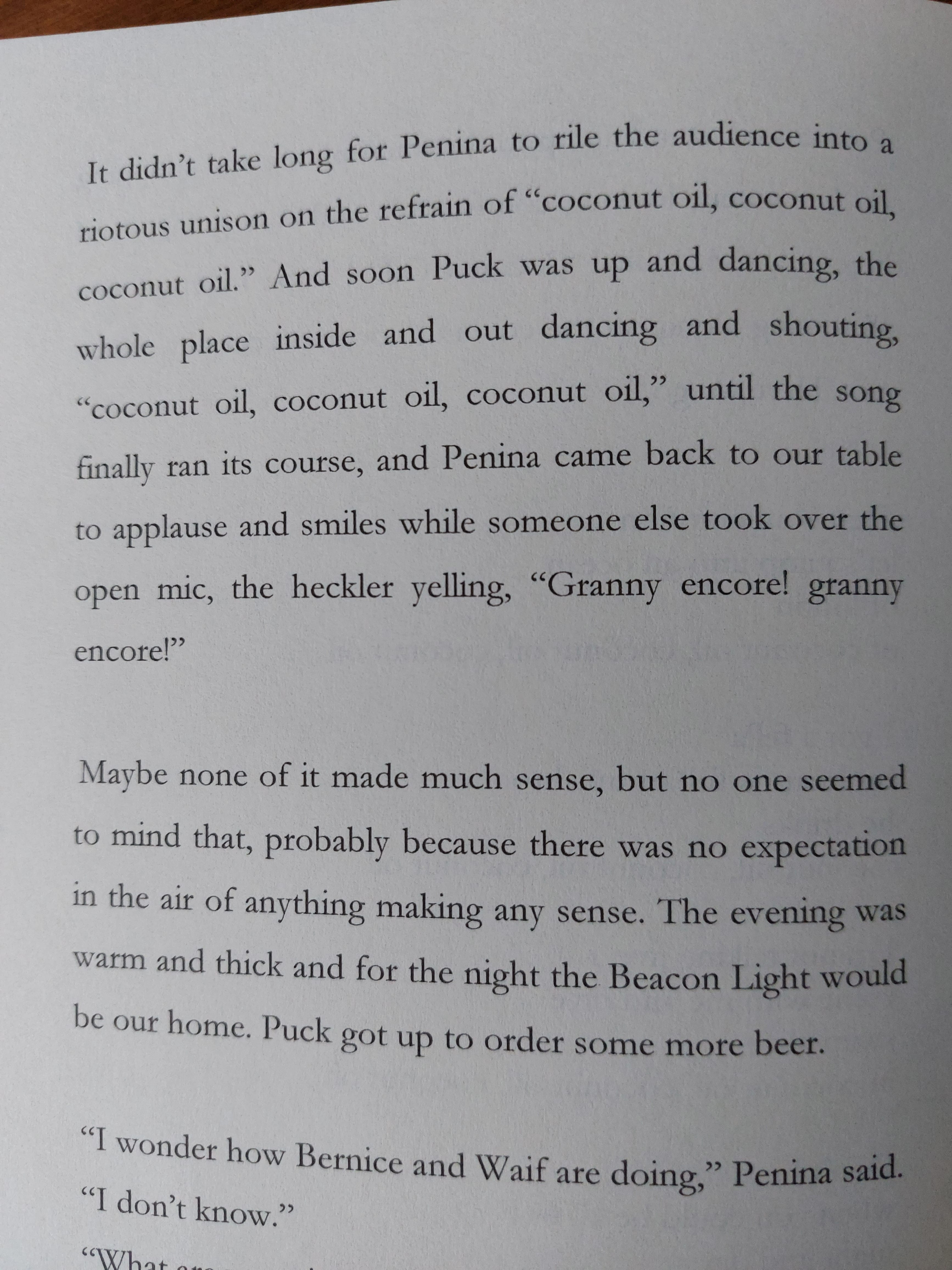
    A somewhat different version of the song “Coconut Oil” appears at the end of the novel “Coconut Oil.” In the book, the song is sung by Penina, who gets everyone in the pub singing the refrain line “coconut oil.”

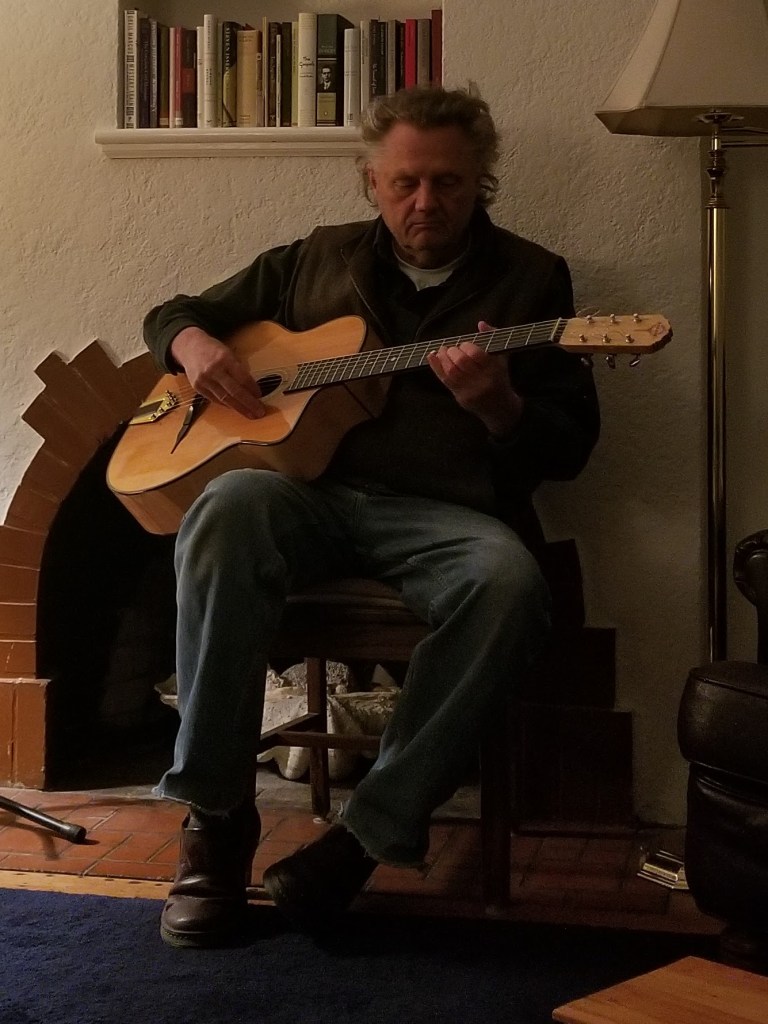
    The video below, which was copied and cut to show just the song “Coconut Oil,” is from the Instagram “Live at 5” show we made for the 2023 International Music on the Porch Day. It was too hot and smoky outside to play on the porch, so we’re inside.

    Coconut Oil

    I hope you like the song “Coconut Oil,” and play your own cover version! Let me know how it goes.

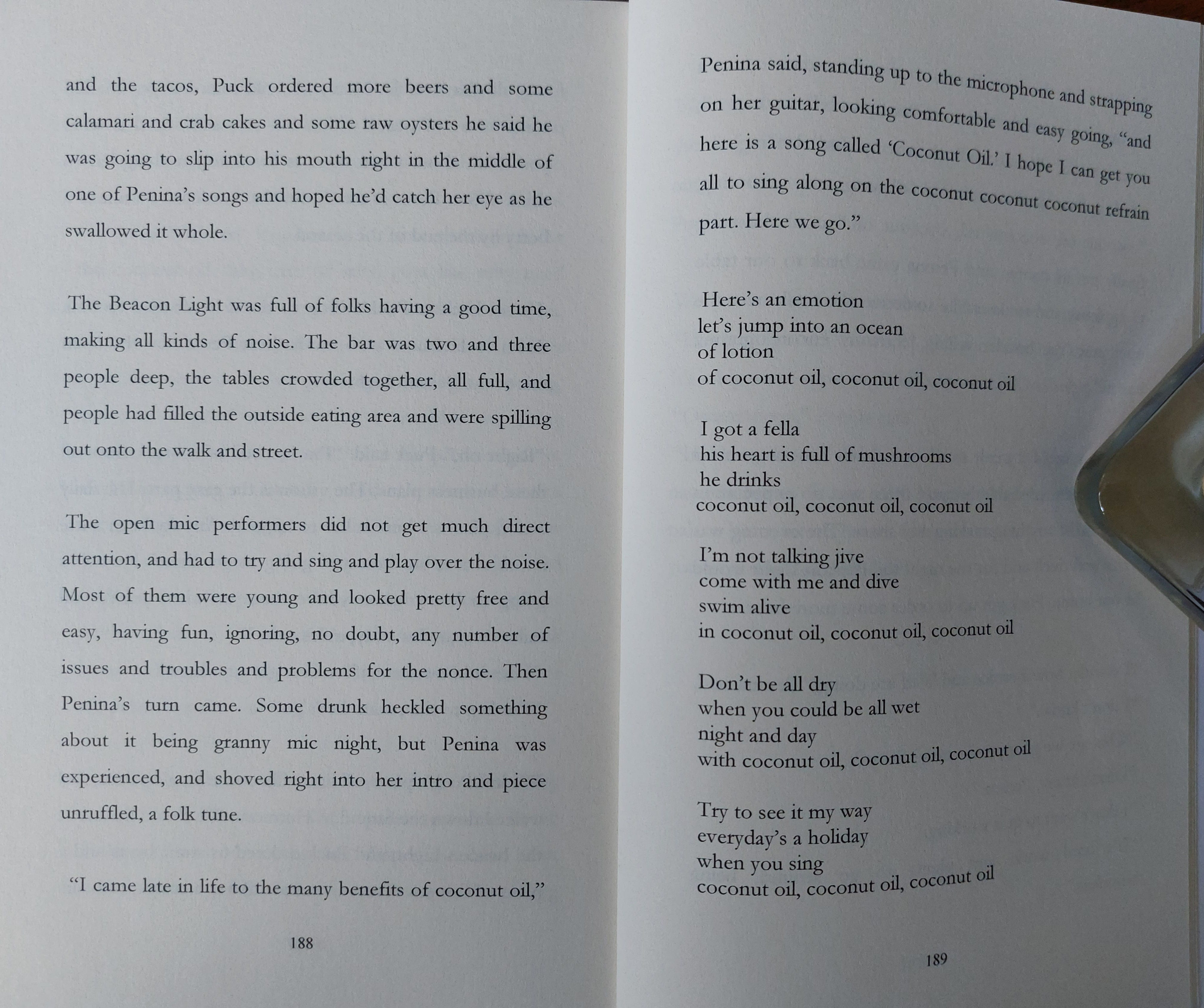
    Pages 188-190 from the novel where Penina sings “Coconut Oil”:

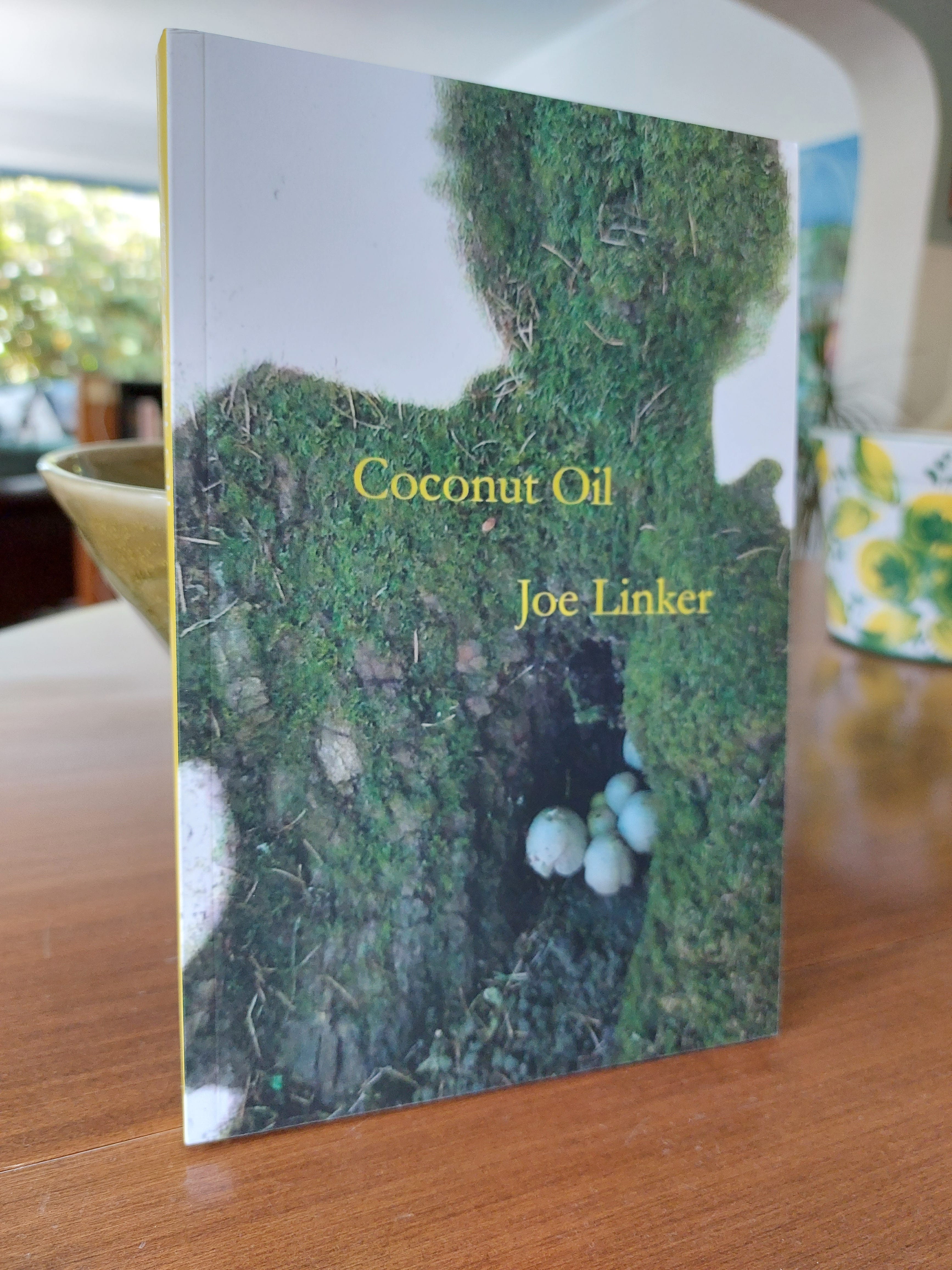
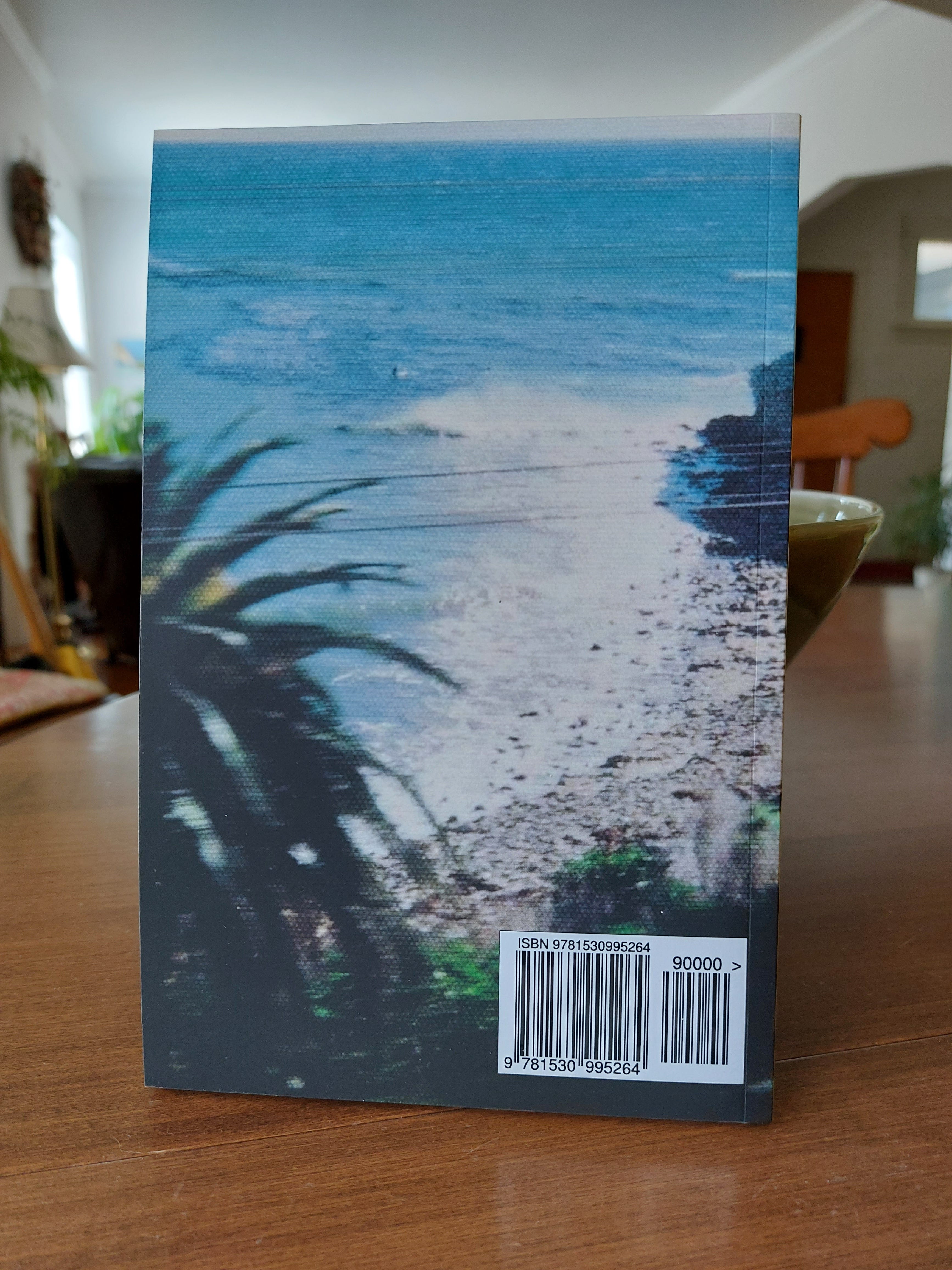
    Below, front and back covers of “Coconut Oil”:

    The front cover photo (below) used on the book “Coconut Oil” I took up in Mount Tabor Park around 2007.

    Below, the back cover photo is the cove at Refugio Beach California, which I took from the Coast Starlight Train around 1978.

    Thank you for reading and listening!

    ~ ~ ~

    1

    The letters/numbers in parentheses are guitar chords. Placement is approximate.

  • Songs for “Play Music on the Porch Day”

    This coming Saturday, the 26th, something relatively new on calendars, called “Play Music on the Porch Day,” a neighbor a couple of weeks ago brought to our attention. As listeners to our “Live at 5” Instagram gigs know, we often can be found playing music on the porch, in the sit out zone in the drive, in the basement during heat waves, in the living room with the rain adding percussion to the set, in the kitchen while the coffee is brewing, offering music up to the passersby – “Live at 5” enjoys usually an audience of 5. Part of the attraction and pleasure of amateur music performance is the random, the mistakes, the discoveries, the forgiveness, loosening the ties and strictures, inviting improvisation, breaking the rules for the sound of it all, mixing stories with songs and guitars, mixing styles – like Struttin’ with Some Barbecue. Anyway, here are some recent songs I’ve been working on for the upcoming “Play Music on the Porch Day” gig:

    “Susanna, Oh Susanna”
    C Mornings when we wake up
    by the deep blue sea
    G7 Afternoons sleeping
    under a green palm tree
    E7 Evenings when you call me
    A7 come out wherever you are
    D7 On the radio playing
    G Patty and Ray

    C Susanna, Oh Susanna
    I can’t even say your name
    G7 All I have for you
    is more of the same
    E7 Hiding in the evening
    A7 when you call my name
    D7 On the radio playing
    G Patty and Ray

    “Coconut Oil”
    G Here’s an emotion
    B7 Let’s jump into an ocean
    E7 Of lotion
    A7 Of coconut oil, (D7) coconut oil, (G) coconut oil (D7)

    G I got a gal
    B7 Heart full of mushrooms
    E7 She drinks oceans
    A7 Of coconut oil, (D7) coconut oil, (G) coconut oil (D7)

    G She tells me don’t be dry
    B7 She likes me all wet
    E7 Night and day drenched
    A7 In coconut oil, (D7) coconut oil, (G) coconut oil (D7)

    “Two Riders Were Approaching” (G, C7, G, D7)
    Two riders were approaching
    On hogs and wearing leathers
    Stopped into a tavern
    For a cool glass of beer.

    Two pints for us, my friend
    The day is warm and grim
    The dust has found its corner
    The dogs want shade and water.

    We are the two riders
    Who were approaching
    Now for those beers
    Nighttime is drawing near.

    Yippii-yi-yo
    Yippie-ki-yay
    We’re gonna go
    Our own way.

    Yippi-yi-yo
    Yippie-Ki-yay
    We’re gonna go
    Our own way.

    And a few more pieces, instrumental and fragmented vocals, and of course the ever popular “Pretty Vacant and We Don’t Care” and “Bury My Heart in the Muddy Mississippi,” as well as covers of some train songs: “Mystery Train,” “This Train” (Bound for Glory), and “Freight Train.” Should be enough to fill a porch.

    So, wherever you might be come Saturday evening, put your ear to some porch and see what you hear.

  • Song Stuff

    Dolly Parton has written over 3,000 songs. We used to say we “made up” a song, since we didn’t write anything down, notes or lyrics. We made up our songs guitar in hand. It would take about 150 hours to play 3,000 songs, or you could play the same song on repeat for a week, which you might if you thought you had a hit. If you draw your song subjects from the lives of your intended audience, you’ll probably gather some listeners, if not reach the top 40. Dolly, born and raised in the Great Smoky Mountains, no doubt heard as a child ballads that originated in the British Isles. These ballads came from an oral tradition, told stories, the setting often changed to fit a new environment. The accompaniment might drone wearily to an exaggerated wintery fiddle pathos. On the other hand, songs of spring might jump, jig, and reel. Ballads are folk songs, and while anything can be a song subject, songs of love and hate, war and peace, life and death, faith and betrayal – those subjects are ever popular. Songs are made using all kinds of rhetorical devices. We might think of songs as meant primarily for entertainment, but songs can teach, preach, tickle, and scratch. A good musician can make a bad song sound good, and a bad musician can make a good song sound bad. The Psalms are songs. What’s good is what’s real, even if it’s bad.

    I was perusing Greil Marcus’s updated “Mystery Train: Images of America in Rock ‘N’ Roll Music.” This sixth revised edition (2015) contains “Notes and Discographies” that run over 200 pages. But Dolly’s only mentioned twice, once in the original section, in the Elvis chapter: “Listen to Dolly Parton’s downtown hooker yearning for her Blue Ridge mountain boy; listen to the loss of an America you may never have known” (129), and again in the notes section under “Cameos: From Charlie Rich to ‘Louie Louie’” (360-363), where “A Real Live Dolly Parton” (1970) is said to include her song “‘Bloody Bones,’ a ditty about orphans who burn down their orphanage.” But while that Dolly album does contain a piece called “Bloody Bones,” it’s not a song but a story she tells, and it’s not about orphans but about her family growing up and how they all went to bed at the same time, and mostly in the same bed, there were 12 kids in a little country house, and they stayed in bed afraid of the boogie man and such tales their Mom shared. Well, Dolly’s not rock n roll, so maybe Marcus hurried through it. That’s likely going to be a problem for your discographers if you go around putting out 3,000 songs. The prolific Bob Dylan has only written about 600 songs. Anyway, Dolly did write a song about kids cooped up under some sort of evil matron, and they do burn the place down, sort of Matilda style. It’s titled “Evening Shade,” and it’s on the album “My Blue Ridge Mountain Boy” (1969).

    So I’ll take this opportunity now to lighten the load for my future discographers and say I’ve written (made up) only around 6 songs, with lyrics, that I keep in my active repertoire, another 8 or so instrumentals.

    With lyrics: “Bury My Heart in the Muddy Mississippi” (1978); “Pretty Vacant and We Don’t Care” (1985); “Goodbye, Joe” (1995); “Two Riders Were Approaching” (2021); “Down by the Bay” (2022); “I Talk to Myself” (2023). Dates I’m just guessing, plus revisions are always ongoing. There is no right or wrong but how you feel at the moment. When you get stuck, improvise your way out of it.

    Instrumentals: no dates shown – been playing and improvising most of these for years, but I’ll list them in approximate order, beginning with the oldest, from around 1970, which contains a riff an Army sergeant showed me. I just title them to remind myself of the idea and where it came from: “Sergeant Oliphant’s Blues;” “Saddle Up and Go;” “Double D;” “Em Surf;” “Good to Go;” “Patio #1;” “Patio #2;” “Blues for Tommy.”

    You can hear versions of my made up songs on my Live at 5 Instagram channel. Live at 5 was a Pandemic exercise that brought the extended family and friends together almost nightly for songs and comments and sharing while we were all hiding out from the virus.

    https://instagram.com/joe.linker?igshid=ZDc4ODBmNjlmNQ==

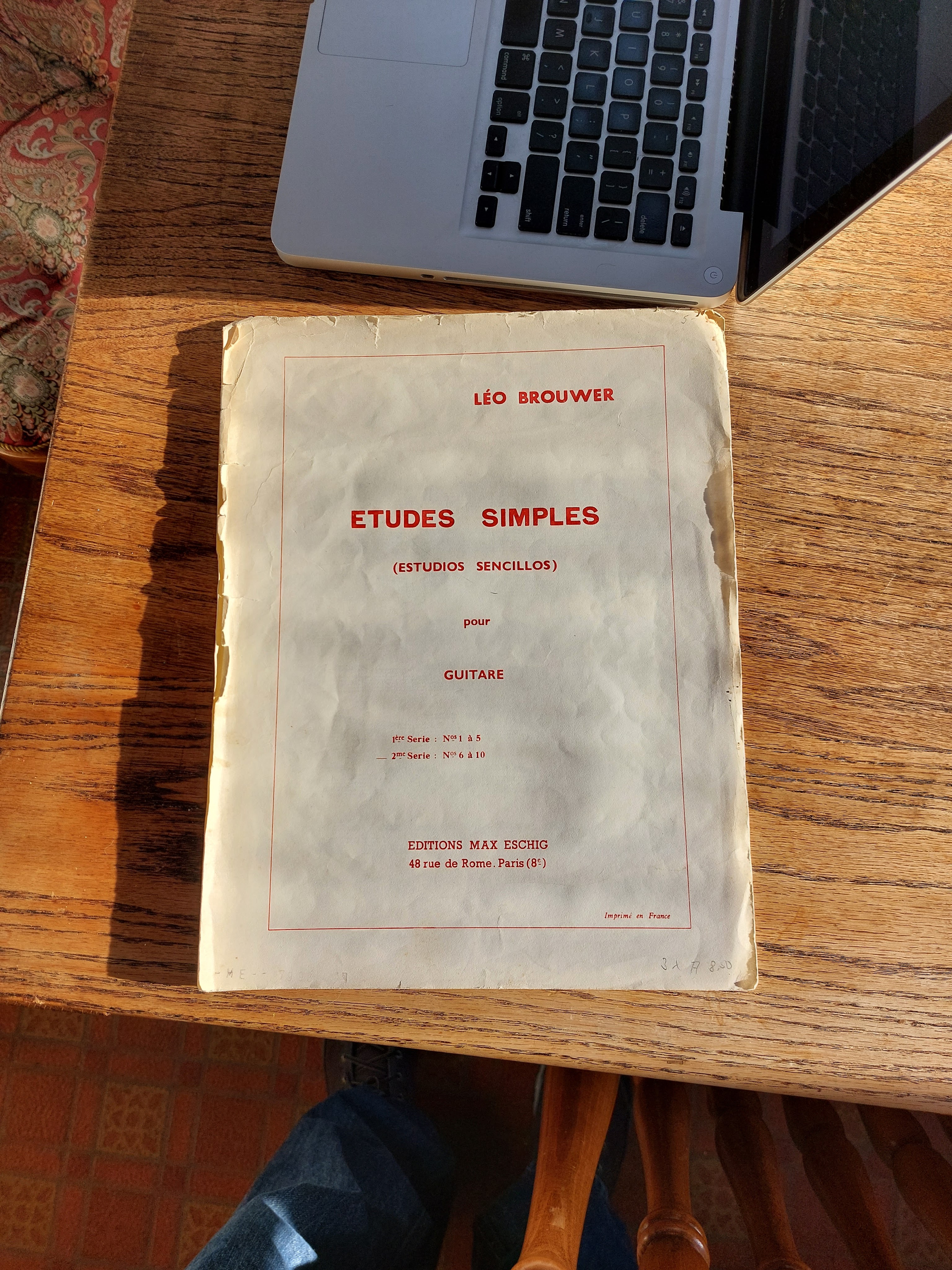
  • Simple Studies # 3

    Rapidly: Or As Fast as You Can
    
    Dock da do yes tin toy cheese gig gas go  
    inch arch hip zone scraunch beam coo boo bass ball bell 
    
    Fish milk jump bowl thrutch boast screech no oil roof 
    nail lip arch moon crawl drift dig gag gear voice 
    
    Beam damp rain inch hep silk sparse scrooch sour neat 
    Cry egg bee boost zoo pee bot chop chill drink 
    
    Deem dress kiss be moo ba oak mouth nest peach 
    bald air calm gog lunch poem here now be it said cut 
    
    Bath peace game sleep shy tone boot bike dust dew 
    leaf mold mad merge fruit fly thick toe hoe mow oh ho  
    
    Cheat dum sheet awk guide dum read coop rope spring 
    Near leg far soft flesh scar how can you tell 
    
    Down then turn whole work wide tool toss 
    Wet watch beach bow bow. 
    
    
    (being a transcription 
    of Leo Brouwer's 
    Etudes Simples #3)
  • Simple Studies # 2

    Slow, but not lugubrious
    
    [wait a moment]    here   now 
    here    nut     classical 
    here    nut     spring all 
    spring sound spring now now 
    here    there   tuned tuned 
    tuned   a boat a 
    slow  turn ing 
    where   there   fingering 
    good    soil    try try 
    sharp   nut     dampening 
    rose    nut     here there 
    rose    nut     sharpening  
    rose    nut     roseate 
    there
    
    (being a transcription 
    of Leo Brouwer's 
    Etudes Simples #2)
  • Simple Studies # 1

    Fast, but not as fast as possible
    
    plonk glunkglunk dank glunk dank dink glunk 
    ink glunk blat app glunk cat glunk blat 
    plonk glunkglunk dank glunk dank dink glunk 
    ink glunk blat app glunk cat glunk blat
    
    plonk glunkglunk cat glunk plonkplonk glunk 
    cat glunk plonkplonk glunk cat glunk blat 
    plonk glunkglunk cat glunk plonkplonk glunk 
    cat glunk plonkplonk glunk cat glunk blat
    
    plonk glimpglimp glinkglink appapp gat 
    gat glimpglimp glinkglink appapp dank 
    dank glimpglimpglimp  dling dling dling 
    plonk drankdrank cat drank plankplank 
    
    dlink dlonk ackack dlunk cot drink plank 
    flonk dlonkdlonk drank drank ackack cat 
    cat drankdrank ab ba blat blat plonk 
    plonk dlonkdlonk cap drip drip 
    plunk dripdrip cap drip drip 
    
    plonk glunkglunk dank glunk dank dink glunk 
    ink glunk blat app glunk cat glunk blat 
    plonk glunkglunk dank glunk dank dink glunk 
    ink glunk blat app glunk cat glunk blat
    
    plonk glunkglunk cat glunk plonkplonk glunk 
    cat glunk plonkplonk glunk cat glunk blat 
    plonk glunkglunk cat glunk plonkplonk glunk 
    cat glunk plonkplonk glunk cat glunk blat
    plonk glipglipglip  glip    glip
    
    (being a transcription 
    of Leo Brouwer's 
    Etudes Simples #1)
  • Me and Midnight

    I talk to myself
    I’ve not much to say
    I talk to myself
    just like to say hey.

    I talk to myself
    and oh by the way
    I put in a good
    word for you.

    When I’m out on the road behind the wheel
    I talk to myself and away I peel
    When standing in line at the DMV
    I talk to myself as if I believed.

    All around town as I walk down the street
    I talk to myself as I meet and greet
    After midnight and I’m awake in bed
    I talk to myself in the back of my head.

    Midnight is my cat a Persian Blue
    she hangs out late shooting pool
    down on the corner she curls the poles
    finally comes home up the back ladder
    looking for a hot cup of black coffee.

    Midnight drinks coffee all night long
    plays guitar and sings nine minute songs
    If you’ve never seen a cat play and sing
    come on up my back stoop after midnight.

    And while Midnight plays guitar and sings
    her songs I talk to myself all night long
    I’ve not much to say but hey I say
    I talk to myself and satisfy the blues.

  • Playlists: Part One

    I recently subscribed to the YouTube Music streaming app, and have been making playlists. There are now many music apps to choose from. I was using Tidal and before that Spotify. To the neophyte, they’re all pretty much the same, click and listen. But for messing around, collecting music, forming playlists, using the app as a reference and research tool, YouTube Music seems to be working well, with one major caveat: lack of performer credits and original recording info easily obtainable while listening – but in that regard, neither Spotify nor Tidal were much better (Prime Music has some info, but lacks detail amid glitzy formatting, while YouTube Music has imported some Wiki discussion). The YouTube Music library is huge, and the search engine responds intuitively, bringing up at least as often as not what I’m looking for, and when not, the discoveries are a pleasure.

    I created a YouTube channel to post my playlists. The playlists I’m making are referenced to songs pulled from my music book collection: songs and pieces from readings from books on music, with a special emphasis on guitar.

    The first two playlists I made contain pieces adapted from Jerry Silverman instruction manuals, books I’ve managed to keep around me over the years: The Folksinger’s Guitar Guide: An Instruction Manual by Jerry Silverman, Based on the Folkways Record by Pete Seeger (an Oak Publication, New York, 1962), and The Art of the Folk-Blues Guitar: An Instruction Manual by Jerry Silverman (Oak Publications, New York, 1964, Library of Congress # 64-18168). These two books are similar in format, the old black and white pictures alone worth the price of admission, and include notes, tablature, chord diagrams, lyrics, musical analysis, and historical discussion.

    In his introduction to his Folk-Blues guitar book, Silverman outlines his predicament at the time: “… there is more information on blues in general in the New York Public Library, for example, in German and French than there is in English!” (11). And Silverman goes on to describe the problem, how, for example, working on his 1955 New York University Master’s Thesis on blues guitar, and his book “Folk Blues” that followed, discussion was limited to piano arrangements, since it was thought that “bona fide guitar arrangements would limit the book’s general usefullness.” This should come as no surprise – Julian Bream, the classical guitarist, when studying music at the Royal College of Music, in the early 1950’s, was told to leave his guitar at home, literally. The school had no guitar classes, no guitar program; the guitar was not considered a viable, virtuous instrument. There was no academically established canon of guitar music available for study or performance. This prejudice against the instrument, in spite of its obvious public popularity, was no doubt also pervasive and included in the States in attitudes opposed to black music, initially of rock and roll music, and of folk music in general, though what is now called the American folk music revival, lasting from the 30’s to the 60’s, did much to mainstream the popularity of the guitar and of blues and folk music.

    Silverman also describes his purpose as follows: “Naturally, some basis of what to listen and watch for and whom to imitate must be laid. Throwing the fledgling bluesnik into the turbulent waters of Bluesville without the necessary basic information and technique would render a distinct disservice to the general cause – not to mention the specific aspirant” (11). Of course whole rivers of water have passed under cities of bridges since Silverman’s early 1960’s comments. But the following statement explains something that has not changed: “To get to know how things really are done you must actually observe the player in action. Since there are so many individual styles one never stops learning if one can get to see as well as hear as many guitarists as possible” (Folksinger’s Guitar Guide, p. 5).

    The academic bias against the folk guitar may have been somewhat justified considering Woody Guthrie’s description of his method (quoted by Silverman in Folksinger’s Guitar Guide, p. 6): “Leadbelly learnt to play the guitar the same way I did, by ‘ear’, by ‘touch’ by ‘feel’, by ‘bluff’, by ‘guessin”, by ‘fakin’ and by a great crave and drive to keep on playing.”

    Well, these were real folks, with real blues. Hearing the lyrics, the stories, of these old tunes one may be surprised to learn or be reminded of how real and how blue. In creating my playlists, I want to stay true to original material but also to benefit from new styles and covers of these old songs.

    Give them a listen:

    Songlist adapted from Jerry Silverman’s The Art of the Folk-Blues Guitar, 1964
    Songlist adapted from Jerry Silverman’s The Folksinger’s Guitar Guide, 1962
  • Down by the Bay

    A song, a work in progress: Down by the Bay.

  • Subbing in Substack

    I spent a few hours this week delving into Substack, the online self-publishing venue giving independent writers the opportunity to build a syndicated portfolio intended for a dedicated audience of subscribers who read for free or pay, often on sliding scales, the writer usually offering more content to paid subscribers. It’s a little like busking, where the musician sets up on a busy street corner and pulls out the axe and puts out the tip hat.

    One great plus of Substack is that there are no ads, few distractions. The presentations I’ve seen are clear and clean. I was already a free subscriber to Caleb Crain’s “Leaflet,” a combo newsletter of his bird watching photography and his lit-culture-watching writing, and of Julian Gallo’s “Cazar Moscas” – wonderful title that, which means to catch flies, or to fish with a fly, apt metaphor for Substack. When Substack began, in 2017, not too long ago but maybe a long time in online years, the idea was to establish a newsletter, so that with every Substack post an email notification went automatically to subscribers. And that’s how I still read Caleb and Julian’s new pieces. And this week I discovered and subscribed to Patti Smith’s Substack. I had become aware of podcast capability at Substack, and when I found Patti there, I saw that she was also putting up short videos, which I immediately found attractive for their simplicity, honesty, clarity. They didn’t seem to be performances, but downhome one way conversations, personal, if you will, in of course an impersonal, voyeuristic way. For example, I saw her in her everyday place in Rockaway, and it looked exactly like a lived in beach house might look if it indeed was lived in.

    Anyway, I had been interested in moving my “Live at 5” guitar gig from IGTV to some other venue, not really all that interested in seeing my seventy something selfie on the silver screen anymore, and growing tired of Instas addictive format, and I thought about podcasting, that is audio only, some guitar, song, story, poem, conversation. Then I became aware of Substack’s video capability and before I knew it, I was going live on Substack with a “Live at 5” show. Or so I thought. The whole enterprise ended in disaster. As near as I can tell, Substack does not enable live streaming. You have to upload either audio or video, and the videos are limited to, it appears, under 10 minutes. I had by Substack “Live at 5” showtime 16 free subscribers. I’m not sure what they ended up seeing or hearing, if anything. And then, late last evening, I discovered the “Live at 5” video I had made for Substack in the photo gallery of my Samsung device. It was just over 5 minutes long. I watched a bit of it, stopped it, and deleted it.

    Interested viewers may check out another version recounting my subbing at Substack experience here. I’m reminded of Dylan’s famous words, “and I’ll know my song well before I start singing,” an admonition I’ve never paid much attention to, and also reminded of the Nobel Prize time Patti forgot the lyrics, which was no big deal, but of course everyone had to make a big deal of it, as if pros never get nervous or forget the words.

    Where do I go from here? IDK. Real time with real people might be nice.