This is the fourth blog post in a row about playing the guitar, inspired by one of my sisters, who has asked me for some ideas to further her own playing. The guitar is a folk instrument, by which we mean knowledge of the instrument and techniques for playing it are passed along to others usually orally and informally. When the great guitarist Julian Bream attended the Royal College of Music in the late 1940s, the guitar was not admitted, being considered, well, a folk instrument, and not suitable for classical music study. Bream did much throughout his career to change the reputational plight of the guitar in the conservatoire, as did Segovia. Frederick Noad in the 1960s was another guitar teacher who did much to popularize methods for formal study without losing the folk flavors.
By method, we mean an incremental or developmental approach to learning that follows a purposeful outline. But most people pick up a guitar and learn a riff or two, a chord or three, and try to imitate what they’ve heard on some recording. If they chance to perform, in the living room or garage, the problem of sounding like that recording is overwhelming. If someone requests, for example, “Stairway to Heaven,” you might be able to pull off the first part on your used acoustic Silvertone, but you’ll soon realize you need either to make the song your own or invest in a mountain of electronic and drum equipment to attempt a sound like what folks hear on the radio and would have you replicate in your garage or bedroom.
The guitar for some time now has had the reputation of being the easiest of instruments to play poorly and the most difficult of instruments to play well (a perspective attributed to Segovia). Having not attempted the oboe or French horn, bagpipes or pipe organ, kazoo or spoons, we’re not sure, but about the guitar we know enough to say it’s easy to get to a certain point of technical frustration. When that happens, it’s often useful to, as Thoreau said, “Simplify, simplify, simplify.” Then again, Thoreau didn’t play the guitar. He played the flute.
One way to simplify guitar is to play a melody. Keeping within the C scale of notes will also keep things simple (no sharps or flats). Take, for example, the opening notes to the song “Over the Rainbow.” Position your hand over frets 5 through 8, and play the melody from C (3rd string, 5th fret) to C an octave up (1st string, 8th fret). The next note you’ll find one fret down, a B (1st string, 7th fret). Then a G (2nd string, 8th fret). Then A (1st string, 5th fret), B (1st string, 7th fret), and C again (1st string, 8th fret). See if you can figure out the rest of the melody. You’ll be learning to play the guitar.
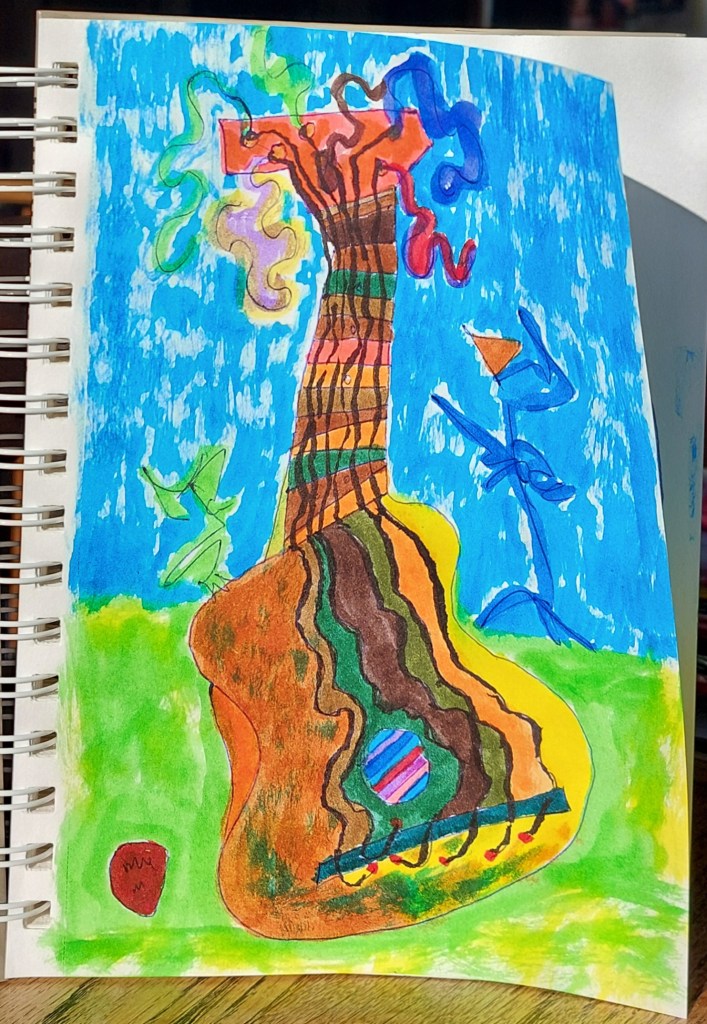
 The Coming of the Toads