Tag: Goodreads

  • On Goodreads

    Books. Shelved books. Backs to the world. Musty, dusty, pages that crackle when opened. Do I want to live in a library, surrounded by a labyrinth of shelves of my own making, impossible to find my way out, the books aging and shrinking as things alive, spine colors fading, hairlines receding, skins foxing, books sleeping in their den?

    On-line, books do not sleep. And why not clear the house of the fossilizing, dusty creatures? In 1996, the San Francisco Library started a grand plan to replace its paper books with the new fandangled electronic stuff:

    “In an apparent attempt at secrecy, Dowlin arranged for 200,000 more books to be completely discarded: Over nine months and despite protests and even outright sabotage by the library staff, San Francisco Department of Public Works dump trucks carted away these books to landfills.”

    From Baker, Nicholson. ‘The Author vs. The Librarian,’ The New Yorker 72 (Oct. 14, 1996): 50-62 and Basbanes, Nicholas, Patience and Fortitude. New York: Random House, 2001.

    Organizing, shelving, cataloging books, building cradles, bookcases, shelves to hold them, often an enjoyable if obsessive evening’s occupation. Borges, from “The Library of Babel”:

    “The universe (which others call the Library) is composed of an indefinite and perhaps infinite number of hexagonal galleries, with vast air shafts between, surrounded by very low railings….Twenty shelves, five long shelves per side, cover all the sides except two; their height, which is the distance from floor to ceiling, scarcely exceeds that of a normal bookcase. One of the free sides leads to a narrow hallway which opens onto another gallery, identical to the first and to all the rest.

    “The Library of Babel,” from Labyrinths, Selected Stories & Other Writings, by Jorge Louis Borges, A New Directions Paperbook – NDP186, 1964, p. 51.

    I recently joined Goodreads. No, that isn’t stop the press headline news. I wanted to catalog my library. I tried Libib, but always wondering what I was missing without the “Upgrade,” left for Library Thing, maybe too frantic for a library, but I’m still working with Thing. Finding books on Goodreads is both easy and difficult. Easy to find any book, or any version of the book you might be looking for, difficult, at times, to find an exact match (of the many versions often shown) to the book you have in hand. Still, not a big deal, unless you obsessively want or need to ensure every brick in the wall of your collection is designed in color coded Flemish brickwork, in which case you want your books on course.

    Perusing the various versions though can be a pleasure. Discovering, for example, the bright yellow banana on the cover of an e-book version of Beckett’s “Krapp’s Last Tape.” And pulling books I’ve not looked at for some time from the home shelves, I’ve a chance to reconsider what a particular book has meant to my reading life. Not that I’m a constant reader, one who is going to post hundreds of reviews weekly to Goodreads. Egads! I’m still gobsmacked to see readers doing that. And I think I’m a slow reader, though I’ve never ran a reading marathon – would probably finish somewhere in the middle of the pack.

    Not too long ago, at around 4,000 books in my library, I decided to winnow the bunch down to those books I feel a special affinity for, usually gained from my predicament when first acquired and read. I now have about 1,500 books, and I thought I might use Goodreads to catalog some of those with brief notes and comments, beginning with collections of my favorite authors. Not that any book is not important. To have read even a single book in one’s life is noteworthy. To have discovered a writer and read all their books is to become a fan of literature – without which a writer’s books fade away. And when you pull an old book away from its crusty place, you might find it crystallized like an old bottle of honey lost high on a pantry shelf. But you can warm it up and it’ll come back to flowing.

    On second thought, maybe I’ll just go for a walk.
  • Edna O’Brien’s “The Country Girls”

    Edna O’Brien’s “The Country Girls”

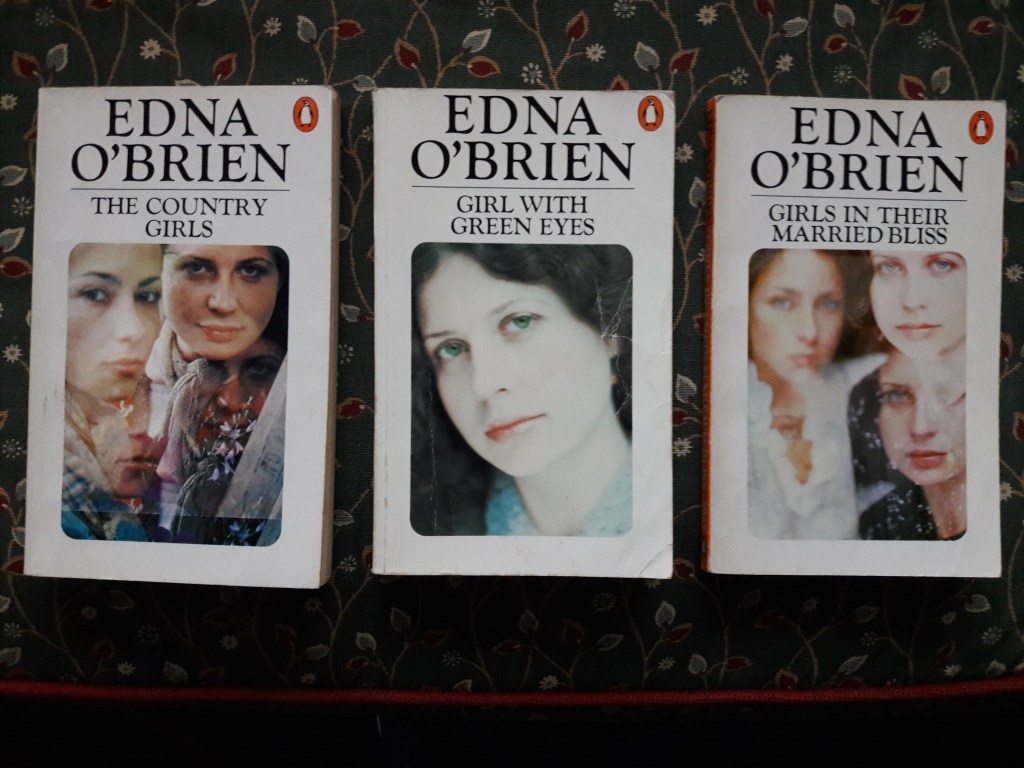
    Edna O’Brien’s “The Country Girls” is the first in the trilogy telling the life and times of Kate and Baba, two girlfriends from country situations who get to the city trying to move away from the tangled mores of Irish family, church, education, and politics of the mid twentieth century. The second in the trilogy is “Girl with Green Eyes,” first published as “The Lonely Girl.” The third, received by critics at the time with the least enthusiasm, is “Girls in Their Married Bliss.”

    Kate and Baba must work jobs, find a place to live, take care of themselves, all on their own. So what, we might ask. Those might be good problems to have. Indeed they are, and even better if the girls survive – the attempts to shame, the gentlemen who come into their lives, the petty but deep economic exploitations, trusts and distrusts of one another and their trysts.

    “I work in a delicatessen shop in Bayswater and go to London University at night to study English. Baba works in Soho, but not in a strip-tease club, as she had hoped. She’s learning to be a receptionist in a big hotel. We share a small bed-sitting room, and my aunt sends a parcel of butter every other week” (212, “Girl with Green Eyes”).

    At the time of their publications, in the early 1960’s, O’Brien’s books were banned, her family shamed. “The Country Girls” is dedicated to her mother, though it’s doubtful her mother ever read it. It wasn’t enough for the Irish censor board to simply ban the books – people burnt them in public shamings, and priests denounced them from the pulpit. It’s doubtful any of them read any of it, except maybe the pages someone said were rife with you know what, and God bless and keep you if you don’t know.

    But O’Brien persisted, her work redeemed itself and a generation of girls. “My whole body was impatient now. I couldn’t sit still. My body was wild from waiting” (186, “The Country Girls”).

    But redemption might not be sufficient for those who want to write their own lives, who want to be reborn every day: “Not long ago Kate Brady and I were having a few gloomy gin fizzes up London, bemoaning the fact that nothing would ever improve, that we’d die the way we were – enough to eat, married, dissatisfied” (7, “Girls in Their Married Bliss”).

    My Penguin paperback copies are all three editions from 1981 (they were originally published in 1960, 1962, and 1964). Many editions have been printed, some with maybe better cover designs.

    …from my Goodreads “short reviews of old personal library books.”

  • Henry Miller’s “Tropic of Cancer”

    Henry Miller’s “Tropic of Cancer”

    Henry Miller’s “Tropic of Cancer” contains everything Hemingway left out of “The Sun Also Rises,” which had left Ernest with the tincture of  a refined sentiment. That is one difference between the Jazz Age and the Great Depression. Turned out, we didn’t always have Paris; most of us never had it. From page 1 of Miller: “I have no money, no resources, no hopes. I am the happiest man alive.”

    I don’t remember when I first read “Tropic of Cancer,” probably ’68 or ’69. From my notes written on the back of the last page and inside the back book cover:

    art sing 1
    Liby 36
    whore – Germaine 40-43
    Popini 58
    artist 60
    America 86
    change 87-90
    room dream 114-116
    woman want 117 (45, 26)
    pimp & whore 143-144
    Matisse 146-149
    Russia America 154
    working with boss 158
    mona 160-166 (smile)
    Paris 162-188
    book 163
    moon 167
    paragraph (style) 167, 202, 216
    converse 171
    army 200
    Whitman 216
    gold standard 219
    writer 224
    what’s in the hole 225
    earth 225, 226
    idols 228
    task of artist 228
    inhuman 230
    art 229-280
    human 231-259 (view on goodreads)

    “Tropic of Cancer” was first published in France, 1934, Obelisk Press.
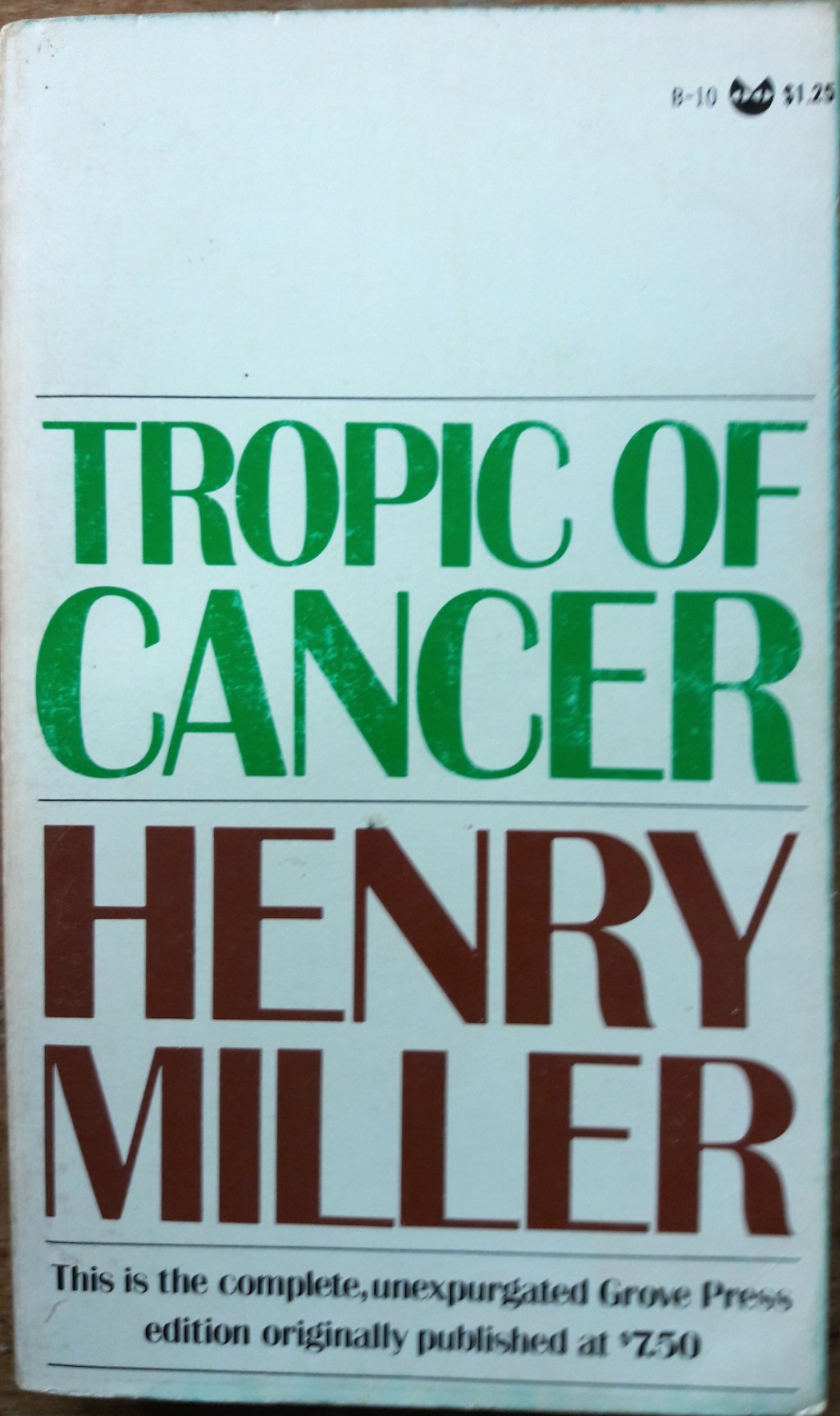
    My edition is First Black Cat Edition 1961 Fifteenth Printing B-10, $1.25.
    Introduction c 1959 by Karl Shapiro first appeared in “Two Cities” Paris, France.
    Preface by Anais Nin, 1934.
    No ISBN appears in the book, but the number “394-17760-6” appears on the bottom right of back cover.

    Yes, trying to do something with Goodreads for the new year. I’ll be putting up short reviews like the one above from some of my old reads.