Tag: Film

  • Plato, Pablo, and the Poetics of Health Care

    Plato considered poets dangerous and banned them from his Republic, and Il Postino (1994) illustrates his point, yet also shows that we are all poets, all who use language – to love and berate, to tackle and persuade, to testify and exhort. The movie, from the book Burning Patience, by Antonio Skarmeta, a fiction set on an island of Pablo Neruda’s temporary exile, is about the democracy of language, how metaphor permeates our lives, and the consequences inherent in desiring more than our own voices can bear, even through poetry. 

    Is contemporary poetry outside the margins of popular US culture? Maybe, but the creation of metaphor is still the heart of language and language the heart of culture. In the film, this is ironically dramatized by Aunt Rosa. During her hilarious visit to Pablo to complain of his contributing to the poetic delinquency of Beatrice, she lets loose with an invective that ably employs a fishnet of metaphors to describe Pablo’s bad influence on Mario and Mario’s hypnotizing effect on her niece. The blame falls on the poet for stirring the emotions of the tainted republic of the island. 

    Poetry sleeps around, moving through Plato’s five regimes. Democracy gives way to tyranny; Plato should have banned lobbyists – then maybe the Republic, though awash in a bath of poetry, might at least have a decent health care system, not to mention an adequate water supply.

  • Breakfast at Beckett’s

    In their engagement of the studies referenced on the declining level of happiness of Americans, Becker-Posner begin to wrestle with the difficulty of quantifying for economics study human behavior as a market influence.

    Late last night, after class, happy with a bowl of homemade chocolate ice cream, I flipped on Breakfast at Tiffany’s, on the Sundance Channel, and it occurred to me that perhaps the unhappiness of Americans has something to do with its writers, for a culture can only be as happy as its artists. We have, of course, come to confuse celebrity with art, and anyone can achieve celebrity status. Our ballplayers might be considered artists. But our insistence that they be heroes both on the field and in the museum results in a collusion of unhappiness.

    Where our novelists are concerned, where the great American novel remains an elusive grail, the unhappy string of strikeouts has all but emptied the stands. Consider the Lost Generation hopefuls, Hemingway, Faulkner, and Fitzgerald; substituted with the failed promises of Vidal, Mailer, and Capote; and the newest crop, including Vollmann and now Keith Gessen, whose All the Sad Young Literary Men imagines nothing less than the success of unhappy celebration, yet at least does so without the usual self-delusion of greatness.

    I flipped the movie off and headed to bed but first grabbed an old copy of Breakfast at Tiffany’s off the shelf. In the book, unlike the movie, Holly has already gone lightly, leaving a heavy absence in her wake – the rest is flashback, beginning with “Her dispraising eyes surveyed the room again. ‘What do you do here all day?’ I motioned toward a table tall with books and paper. ‘Write things.’…‘Tell me, are you a real writer?’ ‘It depends on what you mean by real.’ ‘Well, darling, does anyone buy what you write?’ ‘Not yet.’”

    And so on, until this morning when I pulled Samuel Beckett’s Molloy off a shelf. Too many think Beckett a despairing, desperate, depressing writer, but I’ve never thought that. He’s nothing of course like Capote, who, nevertheless, as Beckett commented on his own fate upon receiving the Nobel, was also “Damned to Fame.” But we must remember not to confuse narrators with authors; in those cases where the narrator is the author, yet the book is still called fiction, I think of the self-conscious infielder who can’t get his mind off his last throwing error.

    Turn to any page in Molloy and count the number of times the word “I” appears. It’s extraordinary, each page, held at a distance, so that the I’s stand out, like some iconic, Concrete poem.

  • Walt Whitman, McTeague, and We Go to the Movies

    Having established our ethos to write film reviews (prior experience in the film industry as an usher for a few weeks at the Paradise Theatre in Los Angeles), and having surveyed the literature (from reviewers and neuroscientists), and synthesizing the results (two thumbs up; two down) on the most recent blockbuster, “Avatar,” and dispatching our own contribution (thumb down), we turn now our attention to the theatre itself, the room in which we sit and watch the movie.

    In “Song of Myself,” Whitman moves from the grass outdoors to rooms: “Houses and rooms are full of perfumes….the shelves are crowded with perfumes, I breathe the fragrance myself, and know it and like it. The distillation would intoxicate me also, but I shall not let it.”

    Were he writing today, Whitman might have mentioned the smell of buttered popcorn, the greasy, creamy butter already all over his fingers and lips as he makes his way down the aisle toward his favorite seat (perhaps Jonah Lehrer, also now taking up film reviewing, could next explain why it is the brain always wants the same seat), his hands full of popcorn box and semi-toxic coke spilling and bubbling over the butter on his fingers. Hard to not let this intoxicate you, and the movie hasn’t even started yet.

    Our brain always goes for the first row in the balcony, or some other seat with an unobstructed view; if one isn’t available, we sit behind an empty seat, but it’s often our fate that a late arriver with a Jimi-do sits in front of us. Once, at the Paradise, in a packed house, the movie was about to begin when a guy the size of the Hulk with an afro like a Banyan tree found the last seat in the house, in front of us. To see around this obstruction we had to sit in Susan’s lap.

    It is our habit to arrive early to movies, the better to find a good seat, settle in with the popcorn and coke, and not miss the previews (these days, the previews can be so long and engaging we often forget what movie we came to see), and as we sit, particularly if we have arrived ridiculously early, we are reminded of Frank Norris’s masterpiece, McTeague, and Mac and Trina’s night at the theatre. After his panic thinking he has lost the tickets, then remembering he’d stored them in his hat for safekeeping, “The [McTeague] party entered and took their places. It was absurdly early…the ushers stood under the galleries in groups…McTeague was excited, dazzled…he beheld himself inviting his ‘girl’ and her mother to accompany him. He began to feel that he was a man of the world. He ordered a cigar.” Later, during the show, “McTeague was stupefied with admiration…Think of that! Art could go no farther.”

    Such is the parentage of our prefrontal cortex in the darkened but illuminated and intoxicating halls called theatres, originally natural spaces in the open air, where Whitman, McTeague, and we might have enjoyed a show taking our ease on some summer grass.

  • Jerry Lewis at the Paradise

    I was working in the film industry; I had a job as an usher at the Paradise theatre in the South Bay area of Los Angeles. The Paradise lobby swept up and curved away from the entrance and concession bar with deep, plush carpet. On the curved, floor-to-ceiling, wood-paneled wall hung commemorative Oscar plaques. In the single-screen hall, three sections of long-rowed seats angled down to a large screen, edged with maroon velvet curtains. With its high ceilings, faux boxes, and loge seats in the rear, the Paradise was a swank place.

    The Paradise still featured sneak previews, where most tickets were gifted to ensure a full house. The previewed films were not yet released, were still being edited. The previews helped build hype and advertising while giving the editors a live-audience reaction to think about before a final edit.

    One spectacular South Bay evening we were showing a new Jerry Lewis film. We rolled the red carpet out the door and across the broad sidewalk all the way to the curb, and Jerry Lewis emerged slim from a shiny black stretch limo, wearing flat-black tuxedo pants with enamel-black stripes down each leg, and a blinding white shirt under a candy-apple red, button-down sweater. His shiny, thin, black loafers matched the jet-black sheen of his short hair, spiked just above the forehead.

    After the standard brouhaha welcoming him and his entourage, Jerry was seated in the last seat in the last row in the middle section of the hall. The lights went down and the movie began to a quiet, full house, and ShaZAM!

    When the movie came on I was standing at attention, my flashlight in hand, at the end of a far aisle, and I rocked back on my feet when the first wave of sound hit me. Jerry had requested he be specially wired in his seat to control the volume, but something must have gone wrong. I hurried out the door for the lobby where I met the manager and two other ushers. It didn’t take long for patrons from the first few rows to come back complaining. They wanted the volume turned down. All we could offer was a complimentary ticket to a future show; Jerry Lewis was controlling the sound, and he wanted it loud.

    About half way through the movie, the first few rows having thinned out but the remaining audience seemingly satisfied, I stood in the back of the lobby against the Oscar wall, and Jerry came out to smoke a cigarette. He stood about twelve feet away from me. We were the only ones in the lobby at the moment. He smoked, relaxed, inscrutable. The sound of the movie occasionally seeped out of the hall into the usually quiet lobby. I watched him smoke. I had just returned from active duty; in fact, I was wearing my low-quarters, my name and military ID number sewn under the tongues. I was surfing my days away, waiting for the new semester to start at school, and ushering nights at the Paradise. I could have said something to Jerry. He was a nice guy. I could have asked him why so loud, but I knew the answer to that, and I left him to his smoke.

    I had been at the Paradise only a couple of weeks. The next day, Sunday, I arrived early to work the matinee. The manager gave me the job of scraping chewing gum off the bottom of the seats, before the doors opened. I stood in the back row, at the seat Jerry had sat in the night before. I looked across the long row. I looked down the formation of empty seats to the white screen. I walked out of the hall up to the usher dressing room, changed back into my street clothes, leaving my low-quarters behind, and walked back out into the solid gold South Bay weekend. I never went back to the Paradise, never recovered my low-quarters. I heard one of the other ushers was wearing them. A few years later the theatre was closed and converted into office space.

  • Theo Jansen and Advanced “Avatar”

    Caleb Crain, we learned yesterday, prefers movies that are true to nature, acoustic. He’s more interested in the Carny than the ride, while David Denby prefers the roller coaster, ignoring the Carny, and if he doesn’t have to leave the theatre for the ride, even better. Johnny Meah’s act wouldn’t make much of a movie for Denby. Yet it may not matter what the professional critics think because as their ranks dwindle thanks to the disappearance of newspapers we may find the neuroscientists filling the gap.

    Jonah Lehrer, who writes from a neuroscience perspective and explains things like why we stop at red and go at green and why some of us slam the brakes at yellow while others hit the gas, suggests in his Avatar review that there might be something wrong with the prefrontal cortex that prefers the acoustic; for some reason, the brain responds negatively to the film drug. Not to worry, though, whatever your brain seems to prefer, for Jonah’s commenter number eleven, David Dobbs, also a scientist, rebuts Jonah’s scientific argument and calls Avatar “impoverished.” As it turns out, the neuroscientists, like the critics Crain and Denby, also find different values in the film and the brain.

    I remember when the first Star Wars movie was released; I finally saw it a decade later. I’m sure there must be something wrong with my prefrontal cortex, judging from my taste in movies. In Bradbury’s Fahrenheit 451, television technology has evolved from the little toads sitting front and center of the mid-twentieth century living room to screens that fill entire walls, and the best TV for one’s home fills all four walls, and the viewer literally interacts with the TV characters, becomes part of the show. Avatar encourages viewers to imagine a time when the film technology of Avatar seems as dated as the first Star Wars movie, and to imagine that that time is now – the fix must be for increased immersion, guaranteeing a string of sequels.

    In the 1960’s, during the height of the psychedelic craze, someone asked Salvador Dali if he took drugs when he painted. No, he said. Why would I take the drug; I am the drug. And when the scare was that rockers were putting secret messages in their recordings, some of which could be understood by playing the record backwards, someone asked Alice Cooper if he spiked his records with secret messages. No, he said, I don’t know how to do that, but if I did, the message would be to buy more records.

    If we are to be controlled by technology, what’s the point? We still have to contend with nature, our nature, the nature of others, and mother nature. Jonah, in his “review,” argues “why the Avatar plot is so effective: it’s really a metaphor for the act of movie-watching.” Exactly, it’s consumerism about consuming, about being eaten alive by technology, and it’s yummy.

    And what of acoustic technology? Is there anyone out there creating creatures more fantastic than those virtually real ones we see via 3D in Avatar? There is. Check out this video. It’s Dutch artist Theo Jansen with his creatures, and they are more fascinating than anything you will experience in Avatar because while they are virtually non-tech, they are real; they have become part of nature, and you don’t need special glasses to view them.

  • Crain, Denby, Dylan and the Avatar of Health Care

    “Now there’s nothing wrong with technology per se, and there’s nothing wrong with fantasy, either,” Caleb Crain offers at the end of his Avatar movie review (posted both on his blog and at n+1). And there’s nothing wrong with corporations, per se, either, he might have added, for, in any case, are not many of the “smug anti-corporate” critics, plotted or plotless, plugged in via their 401K’s, or their public employee pension funds? Caleb more than disliked Avatar; it gave him a migraine, attributed to “the movie’s moral corruptness.”

    While Caleb was nursing his headache, over at the New Yorker David Denby must have seen a different Avatar. For Denby, “James Cameron’s ‘Avatar’ is the most beautiful film I’ve seen in years.”

    It’s a classic case of compare and contrast.

    Crain: “The audacity of Cameron’s movie is to make believe that the artificial world of computer-generated graphics offers a truer realm of nature than our own. The compromised, damaged world we live in—the one with wars, wounds, and price-benefit calculations—can and should be abandoned. All you need is a big heart, like Jake Sully (Sam Worthington), the movie’s war-veteran hero, and the luck of being given a chance to fall in love.”

    Sounds like vintage Hollywood.

    Denby: “Amid the hoopla over the new power of 3-D as a narrative form, and the excitement about the complicated mix of digital animation and live action that made the movie possible, no one should ignore how lovely ‘Avatar’ looks, how luscious yet freewheeling, bounteous yet strange.”

    Sounds like vintage Hollywood.

    Avatar cost, according to Denby, “nearly two hundred and fifty million dollars to produce,” but he advises that “there’s not much point in lingering over the irony,” for “the movie is striking enough to make [claims of alternative values] irrelevant.”

    Movie making has become like health care: hypercosts, waste, unnecessary tricks, and expensive tickets – but no one’s any healthier, but one’s health is irrelevant; the show must go on.

    Crain: “Once you upload yourself, you don’t really have to worry about crashing your hard drive. Your soul is safe in Google Docs. In a climactic scene, rings of natives chant and sway, ecstatically connected, while the protagonists in the center plug into the glowing tree, and I muttered silently to myself, The church of Facebook. You too can be reborn there.”

    Last night we were watching “Inglorious Bastards” at home on DVD and there was a brief power outage. A power outage is when the city suffers a stroke. We’ve made doctors and directors our new gods, but like the old gods, they make mistakes. Nothing like a power outage to remind us that, as Bob Dylan said, “You shouldn’t let other people get your kicks for you” (“Like A Rolling Stone,” Highway 61 Revisited, 1965).

  • Small Wave Riders 2009 annual surf trip video

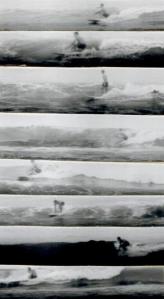
    Joe Waves at El Porto circa 1969
    El Porto waves, circa 1969, riding a modified Jacobs.

    Gregg Noll, the first of the modern big wave surfers, never lost sight of the fun to be found in small waves. In the early-60s, still in the original Gregg Noll surfboard shop, in Hermosa, when asked if he found small waves boring after having surfed the giants, he replied not at all, he would always have fun in the South Bay slop. I know that because I was there, a local kid dreaming of a new board, and I asked him.

    Having fun in small surf is the sentiment that fuels Small Wave Riders. There are other reasons – as we get older, paddling out gets harder. And there is the pulling archetype of the surf trip (on the west coast, this means a long cruise on Highways 1 and 101, and Pacific Coast Highway, and Highland Ave., checking out the surf spots along the way); and community, always local, throwing off the work clothes (if necessary) for jeans, t shirt, and sandals – trunks and a surfboard (for “Jesus was a [surfer] when he walked upon the water,” sang Leonard Cohen, or might have sang, had he been a surfer; he sang “…sailor…only drowning men could see him”) – living out of the surf rig, a tent, the occasional old friend’s place up from the beach, eating out of bags, or at the best (discovered word of mouth) local dives, body sticky with sand, wax, and salt; and the blue green grey lure of the ocean, of men going down to the sea.

    Of course, over time, conditions change. Jesus now wears a wet suit, including booties, hands, and hood, and every spot is crowded, even the spots where the waves are so small they can hardly be called waves. The locals are even more protective of their spots, so the surfer on safari is sometimes well-advised to select a less crowded spot, even if it means yet smaller waves. But “just get in [the water]” is brother John Linker’s mantra. Once in, once the glass is broken, there’s no closer union with nature, physically and mentally. One doesn’t think on waves, not in the normal sense of thinking; once in, one is guided almost by pure instinct, and the Cartesian split is temporarily taped.

    So we were delighted to receive in the mail this past week the 2009 Small Wave Riders annual surf trip video, this year titled 5 Point 5. The film technology continues to improve, as does the technique. The sound track is blended with the waves and action, and the sequences of driving, stopping to check out a spot, paddling out, catching waves, then kicking back after the set, create a structure that feels natural, allowing for hightened viewer engagement. Some of the technique is reminiscent of the best of the old surf films, the ones we used to see in the Hermosa Beach High School auditorium, the independent, locally filmed surf movies, and there are also reminders of the great, original Endless Summer. Of course, these days, the summers get shorter, not longer, let alone endless, and the trip comes to an end, again in the old surf film manner, too soon, after only 35 minutes of small wave surfing. But it’s enough. Our appetite for a wave is soaking wet.

  • A word of one’s own

    Comfortably ensconced in our reading lair, hidden behind the arras of the Dec. 8 New Yorker, perusing the cartoons, time passing easily, and find our Eric has been at work on his French, annotating the Mankoff cartoon caption “A la Recherche des Cheveux Perdus” (p. 68) with the translation “Remember Hair Lost.”

    What is past is lost, but still we recall – writing is a lure; reading, a way of walking.

    Menand, Jan. 5: “Feiffer’s strips are about borrowed ways of talking, about the lack of fit between people and words, about the way that clichés take over” (p. 43).

    Blake: “No bird soars too high, if he soars with his own wings” (The Marriage of Heaven and Hell, “Proverbs of Hell”).

    Nabokov: “…minor readers like to recognize their own ideas in a pleasing disguise” (Lectures on Literature, “Good Writers and Good Readers,” p. 2).

    In Nabokov’s teaching copies, his annotations include his own translations; in his copy of  “The Metamorphosis,” for example, he substitutes the Muirs’s “uneasy dreams” with “a troubled dream,” and “a gigantic insect” with “a monstrous insect” (p. 250). Monstrous means marvelous and strange, and Nabokov starts his students off with a different view of Gregor, beginning with Kafka’s first sentence.

    Woody Allen: “Honey, there’s a spider in your bathroom the size of a Buick” (Annie Hall).

    For Nabokov, reading meant rereading in excruciating detail, never straying from the text, bringing to exact light and color the watermarks of the text, like working a coloring book.

    As for the uneasy, or troubled, dreams, Kafka reveals in the second paragraph that “It was no dream.”

    But one’s own words? Where does one find them? Sometimes a word of one’s own seems no more possible than a room of one’s own. For some answers, we might turn again to E. B. White’s Elements of Style, where we are warned to “Write in a way that comes naturally”; “Avoid fancy words”; and “Avoid foreign languages” (Chapter V).

    As for using words of one’s own to find lost time, Nabokov says: “…to recreate the past something other than the operation of memory must happen: there must be a combination of a present sensation (especially taste, smell, touch, sound) with a recollection, a remembrance, of the sensuous past” (p. 249). It took Proust 1.5 million words to illustrate that we are “…not free…to choose memories from the past for scrutiny” (Nabokov, p. 248).

  • The weightlessness of existentialism

    Early yesterday, reading Nick Paumgarten on “The lives of elevators” (New Yorker, April 21), about a person stuck in one for forty-one hours, we were reminded of the weightlessness of reading and writing. The video, from the Kafkaesque security tape, is a work of art Warhol could have made; or Becket might have written a one-act play, but would have omitted the piano score, though the tempo is perfectly counterpointed to the Chaplinesque speed of the fast forwarded film. Of course, we also thought of John Cage: “It is not irritating to be where one is. It is only irritating to think one would like to be somewhere else” (“Lecture on Nothing,” Silence, p. 119).

    Later, at the Triple-A baseball game in a cold, near empty ballpark, a woman in the row in front of us turned around and asked if we had a pen. She seemed surprised when we said yes, and pulled the pen out of our jacket pocket, handing it out to her. She was a few seats away, down the row in front of us. There was no one else around. She was bundled up for the cold day of the game, in wool cap, and she had brought a full pack of incidentals to the game, to help pass the time, the way some people do at a ballgame, but no pen. She got up and walked over, smiling, and took the pen.

    The person stuck alone in the elevator is essentially weightless, can neither rise nor fall, cannot change seats. There is no exit. He pries open the doors to find a cement wall. He is a character in Sartre’s No Exit, sans the other people.  

    Take a piece of blank typing paper. Fold it in half, then in thirds. Place the folded paper in a pocket with a pen. You never know when you might get stuck – in a station at the metro, waiting anywhere – and it will not be nearly so irritating thinking you might like to be somewhere else. Pen and paper provide one with a play against the angst of any existential waiting game.

  • Our Believer book award choices

    Still reading the March/April 08 issue of the Believer, the “Film Issue.” Slavoj Zizek DVD included; have watched just the first part of it – a few ugly scenes from some lousy old horror films came too early in the DVD and we had to turn it off. That just means we are not fully committed to the values of the film community, which we knew – doesn’t say anything about Zizek.

    We were reminded that Zizek was interviewed in the Believer July 04 issue, where we found his comments on Christianity interesting. The Mary Midgley interview in the February 08 issue was interesting on moral philosophy and imagination (anyone who can wrestle Dawkins down and pin him to the mat in seconds deserves more attention), so now we have a couple more books on our reading list. But the list is already so long, not sure when we’ll get to them. But we’re moving Mary up; we’ve just decided.

    Anyway, the current issue includes the annual “…short readers’ survey” postcard, allowing one to “…participate in the forthcoming Believer Book Awards,” now in its fourth year, but only the second year they’ve invited readers to participate. We sent in our postcard. Here are our picks for fiction published in 2007 (three slots only): The Deportees, by Roddy Doyle (more reality of experience forged in the smithy of an Irish soul ); Inglorious, by Joanna Kavenna (don’t remember what brought this our way, an advance reader’s edition – but remarkable effort, probably does not achieve all of its goals, but very funny, sad, and deeper than most readers deserve); and No One Belongs Here More than You, by Miranda July (written in part while walking and watching locally – which most of us don’t take time for).

    What’s the point, of the Believer awards? Don’t know, but not too concerned with that question. We took the opportunity to take stock of what we read last year, fiction and non-fiction and journals and magazines and blogs and eZines and papers, and to look at the reading year ahead, continuing the long journey, getting on a train, leaving one city of books, and reading to another.

  • What we will miss when newspapers disappear

    Watching “Irma La Douce” last night, after reading “Out of Print,” Eric Alterman’s New Yorker piece, on newspapers dying, we realized that Eric omitted what we will miss when discarded newspaper can no longer be found lying around the house. 

    In “Irma La Douce,” Jack Lemmon, playing Nestor, the defrocked, now homeless policeman, spending the night with Irma, hangs curtains, improvised from newspaper, across her bare windows to shield her from the possibility of being seen from the Paris street below. He has already described to Irma how he often inserted a folded newspaper under his uniform jacket to help keep warm on rainy beats. Dramatizing the practical uses of newspaper, Nestor reminded us of Red Skelton’s sleeping on the park bench skits, under and on blankets and mattresses of newspaper.  

    What else is throwaway newspaper good for? Wrapping for fish, and rolled newspapers, soaked in a tub of water, then dried, make efficient fireplace logs. The logs burn slowly and evenly with minimal smoke, stack and store neatly, and pack easily for camping trips. When we were kids, we copied the colorful Sunday comics onto pancakes of Silly Putty. Nowadays, we post our favorite comics, cut from the newspaper, onto the icebox. We rely on newspaper for kitty and puppy mishaps, bird cage lining, and party spills. Newspaper is an effective window wipe, for car and house, makes good fly swatters and fans, and comes in handy for arts and crafts, and for masking and painting jobs. We had an uncle who taught us how to make pirate hats from newspaper. Our spouse makes sensible use of newspaper coupons. The Op-Ed page, slipped unceremoniously under the commode door – bereft in a TP shortage, one wouldn’t treat even a week old New Yorker like that. In elementary school we used newspaper to cover our text books. Gone too, after newspapers die, the paper drive fundraiser. 

    Finally, we will miss the frap of the morning paper tossed onto the front porch, a reliable alarm clock, or sometimes we hear the paper sliding across the pavement of the drive, announcing rain (splat) or sun (long, dry skid). No doubt, others can add to our list of what will be missed with the dying of the newspaper, more mere memories added to the detritus of 20th century anthropological curiosities.

    But newspaper is organic. It can be added to the compost bin, and after breaking down can be used as mulch to spread around the Web garden.