Tag: Edgar Allan Poe

  • More On A Personal Library

    We were talking about books, not the content of books, but why keep them, as they stack up, one after another, placed then a few on a bedroom window ledge, the book’s fore-edge facing out, the row then expanding, one after another, paperbacks, written in, too, the worse for wear, then the need for a bookcase, and the inevitable question: why all the books, probably won’t read them again, any one, maybe, but not all of them? And, of course, why not just get them from the library?

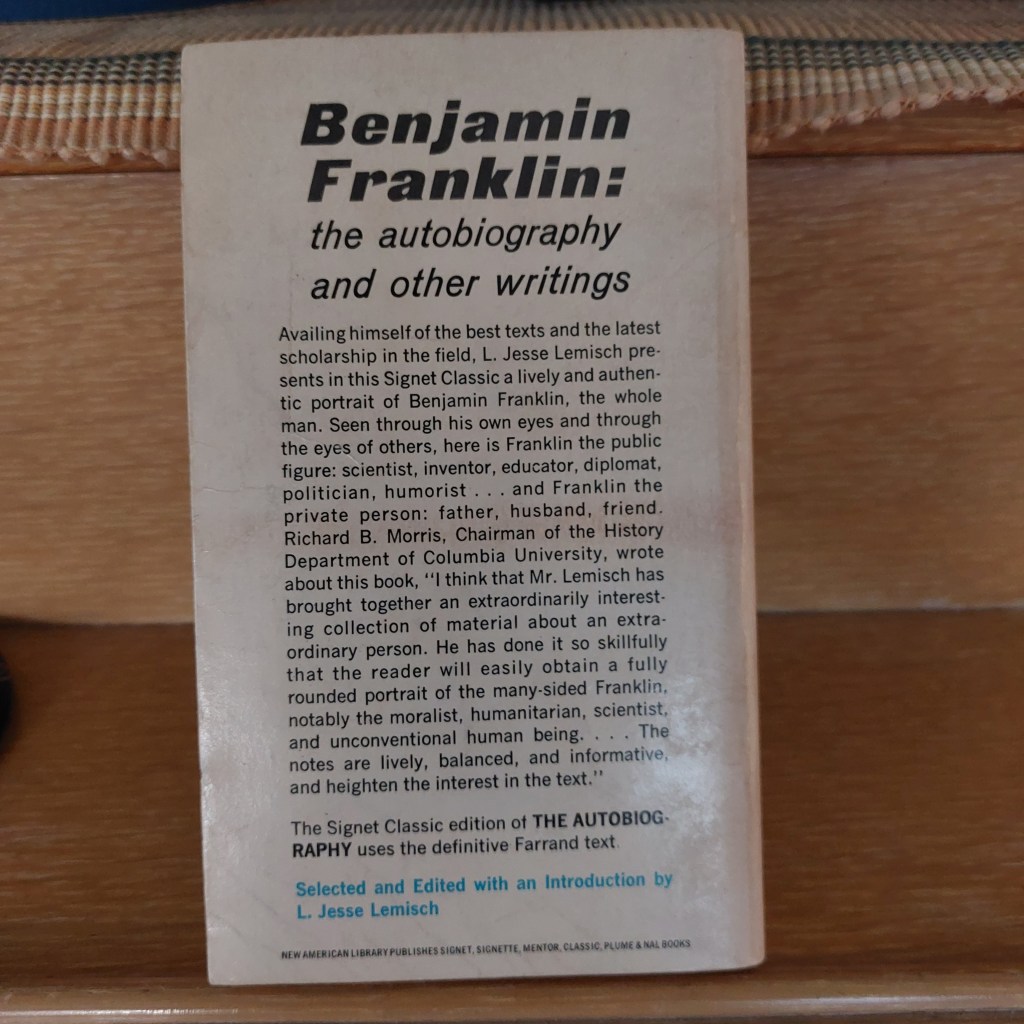
    In his autobiography, Benjamin Franklin talks about individual libraries, and knowing the friends in his reading group all have personal libraries, he suggests pooling them together, and thus the first subscription library is launched. Where did he get his calling to read books? He mentions his early enjoyment of reading and his father’s library:

    From my infancy I was passionately fond of reading, and all the little money that came into my hands was laid out in the purchasing of books. I was very fond of voyages. My first acquisition was Bunyan’s works in separate little volumes. I afterwards sold them to enable me to buy R. Burton’s historical collections; they were small chapmen’s books and cheap, forty or fifty in all. My father’s little library consisted chiefly of books in polemic divinity, most of which I read. I have since often regretted that at a time when I had such a thirst for knowledge, more proper books had not fallen in my way, since it was now resolved I should not be bred to divinity (26).1

    Doubtful I was destined for the divinity, nor did my father own any books. It was my Confirmation sponsor who encouraged me to read. He found me reading a comic book and suggested I read Classics Illustrated. We walked across the street to the Village Liquor Store to browse through their rack and he bought me copies of “Kidnapped” and “Moby-Dick.” Alas, I did not save those. Introduction to Saint Bernard High School in Playa del Rey included summer reading prior to entering the 9th grade – a reading list was sent, and I duly read, collected, and displayed the books on my bedroom window shelf, perfect size for paperbacks.

    Reasons for maintaining a personal library might include nostalgia that grows new rings with each reading year, sentimental journey, collecting books as a hobby or investment, or books close by used for reference and research, and the aesthetics of books and bookcases, or of course simply a hoarding impulse.

    With a personal library comes personal borrowers, many who consider a borrowed book a given. And indeed I have given books away. A couple of years ago, I posted that at around 3,000 books I gave away half. One should have an affinity of some sort for a book to keep it. And I do reread books. And some books are read through again and again, never finished, it seems, the James Joyce books, for example. Barbara Pym’s “Excellent Women” and Penelope Fitzgerald’s “Offshore” I’ve read several times in the last few years, and read them aloud to Susan.

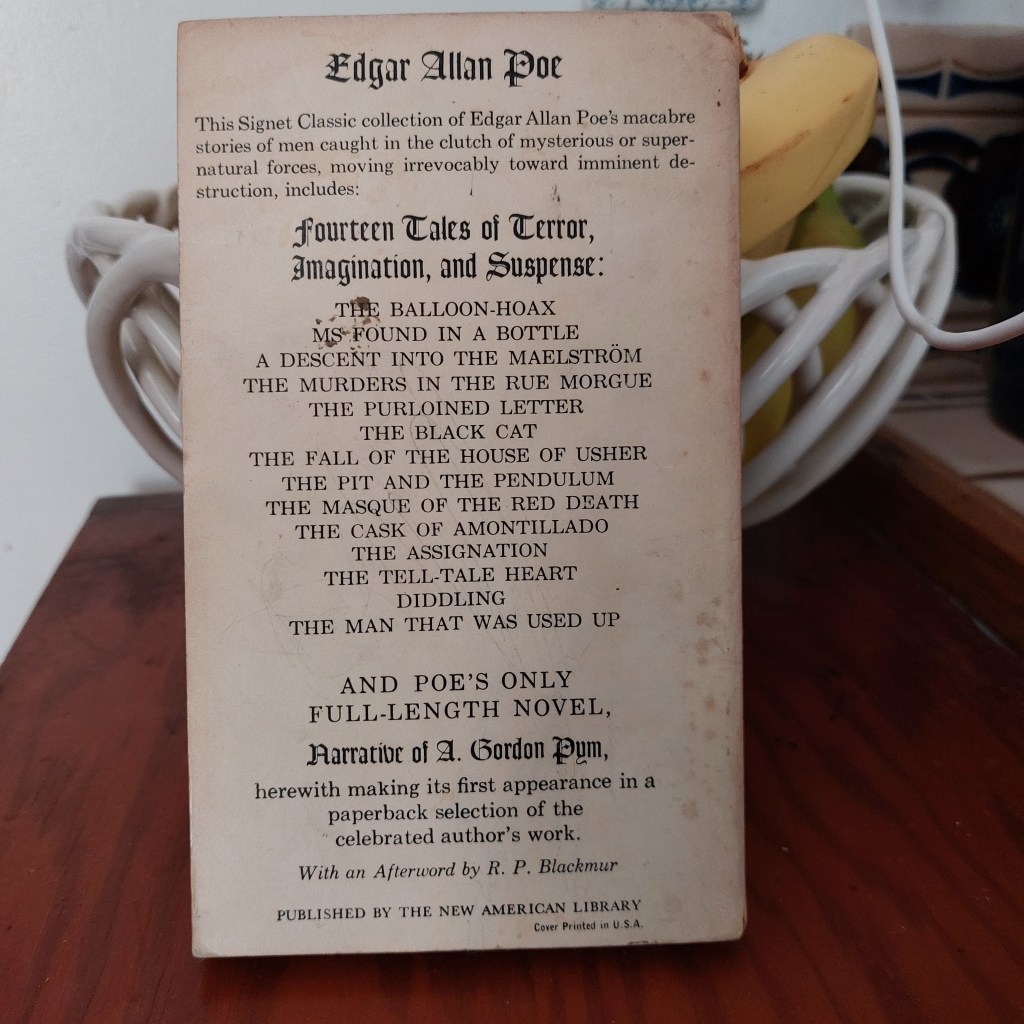
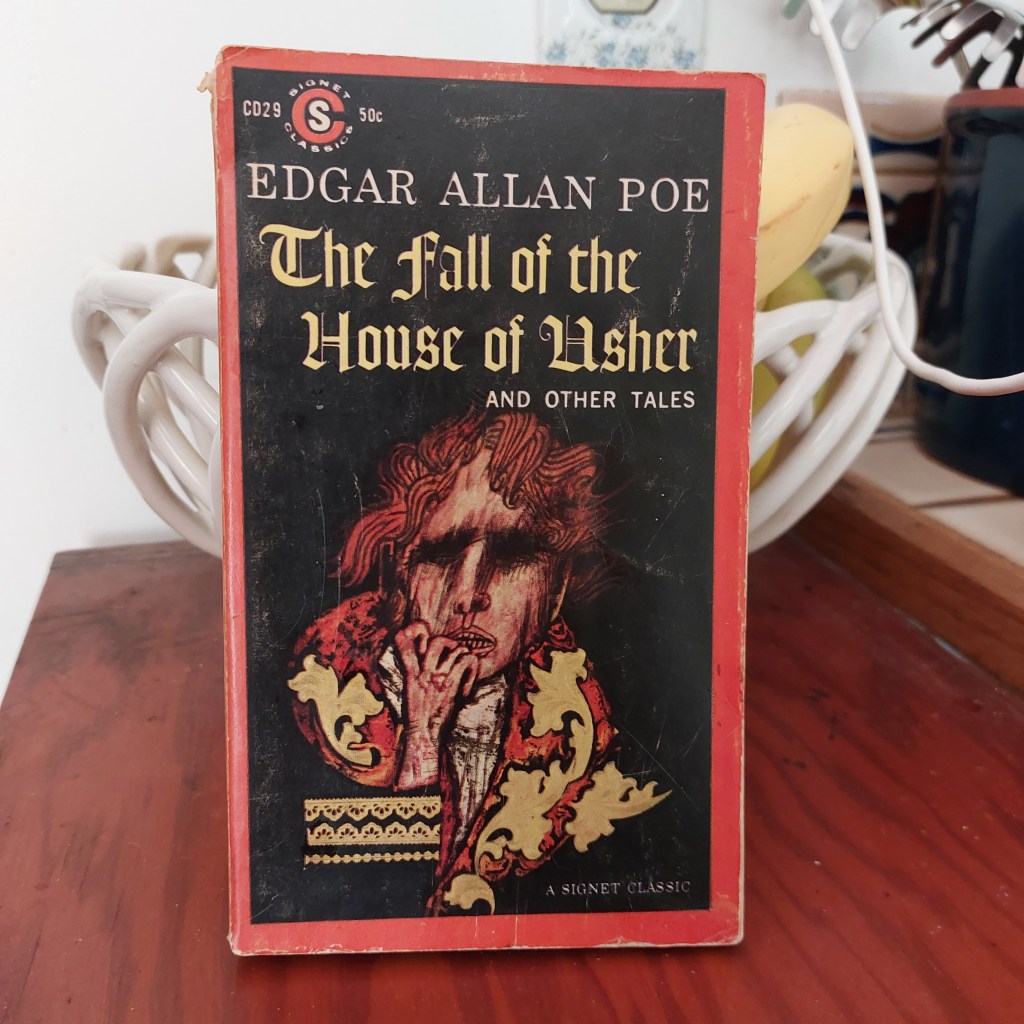
    One of the oldest books in my library is Edgar Allan Poe’s “The Fall of the House of Usher And Other Tales,”2 read in the 9th grade at St Bernard. I forget what we did that so annoyed Mr. Subiando one day, but I remember copying longhand “The Pit and the Pendulum” one long weekend, a class penance.

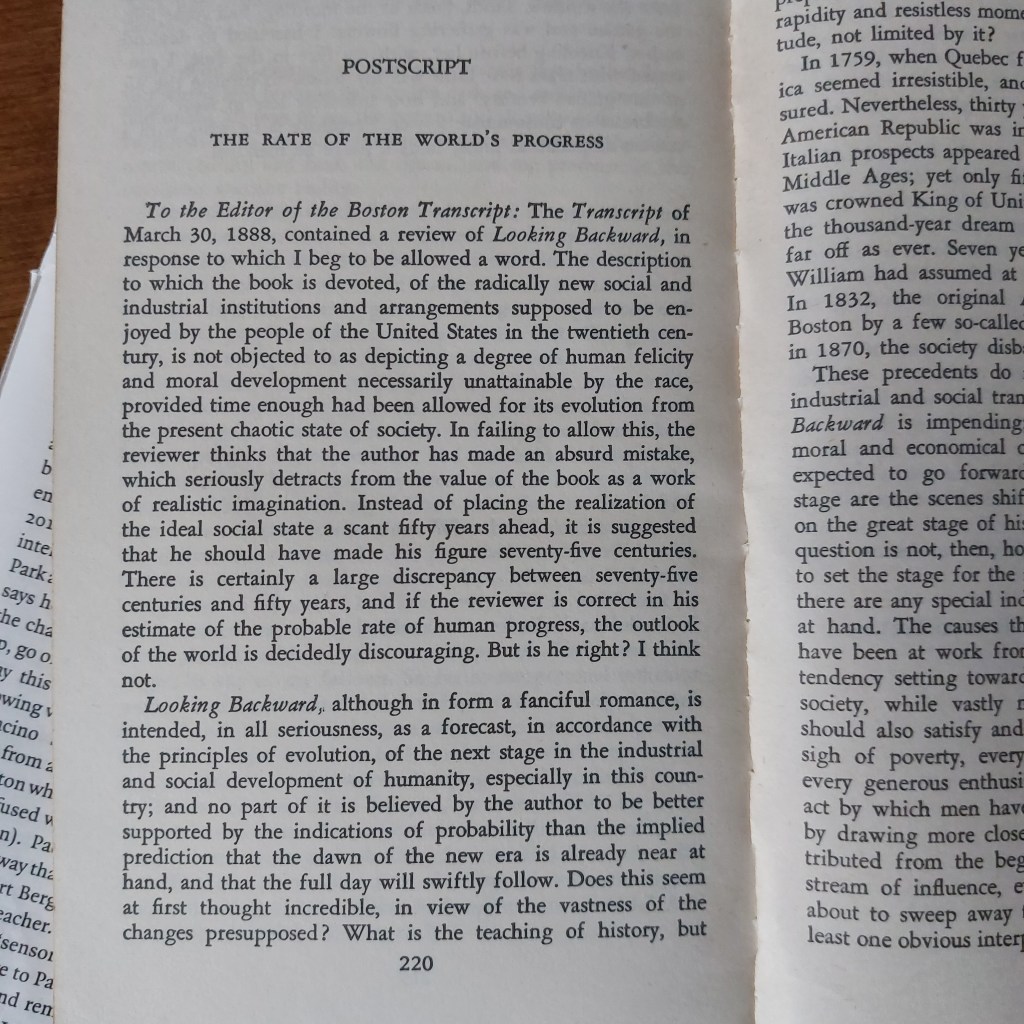
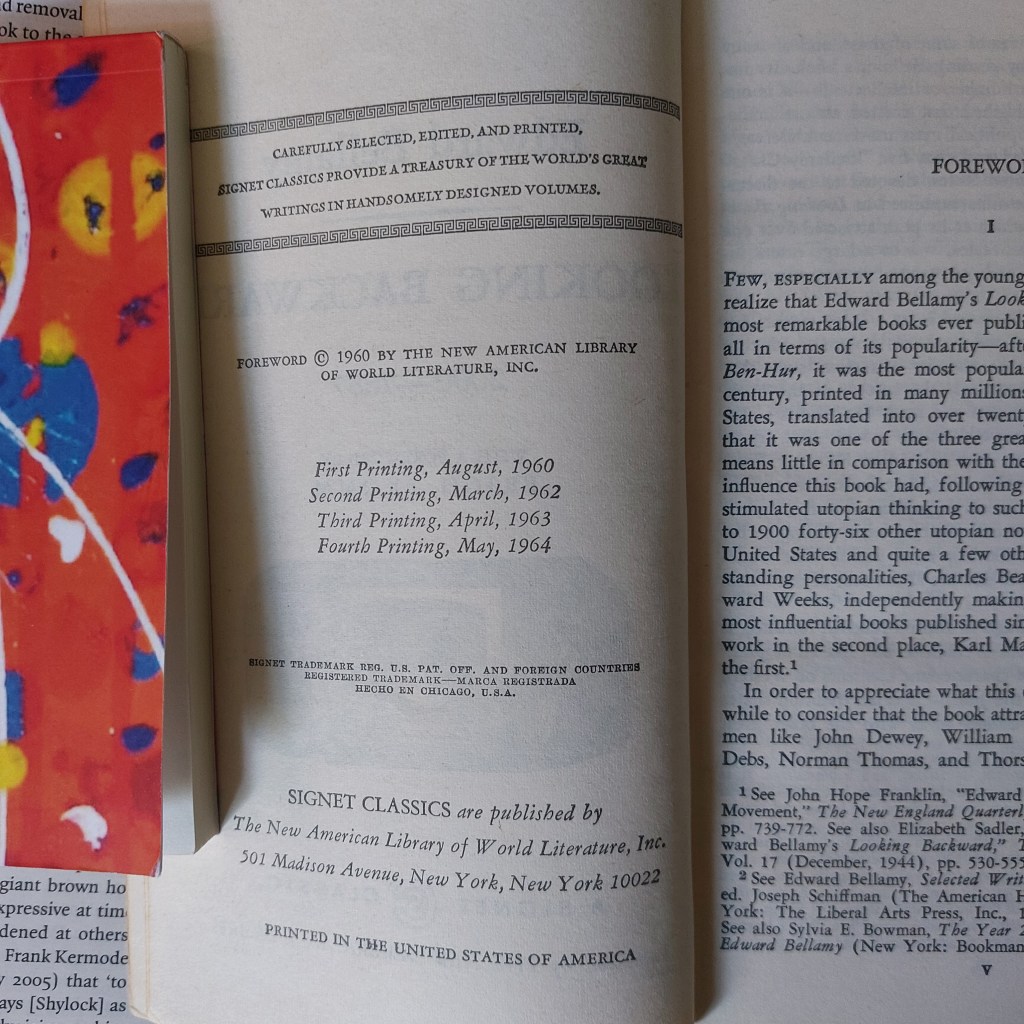
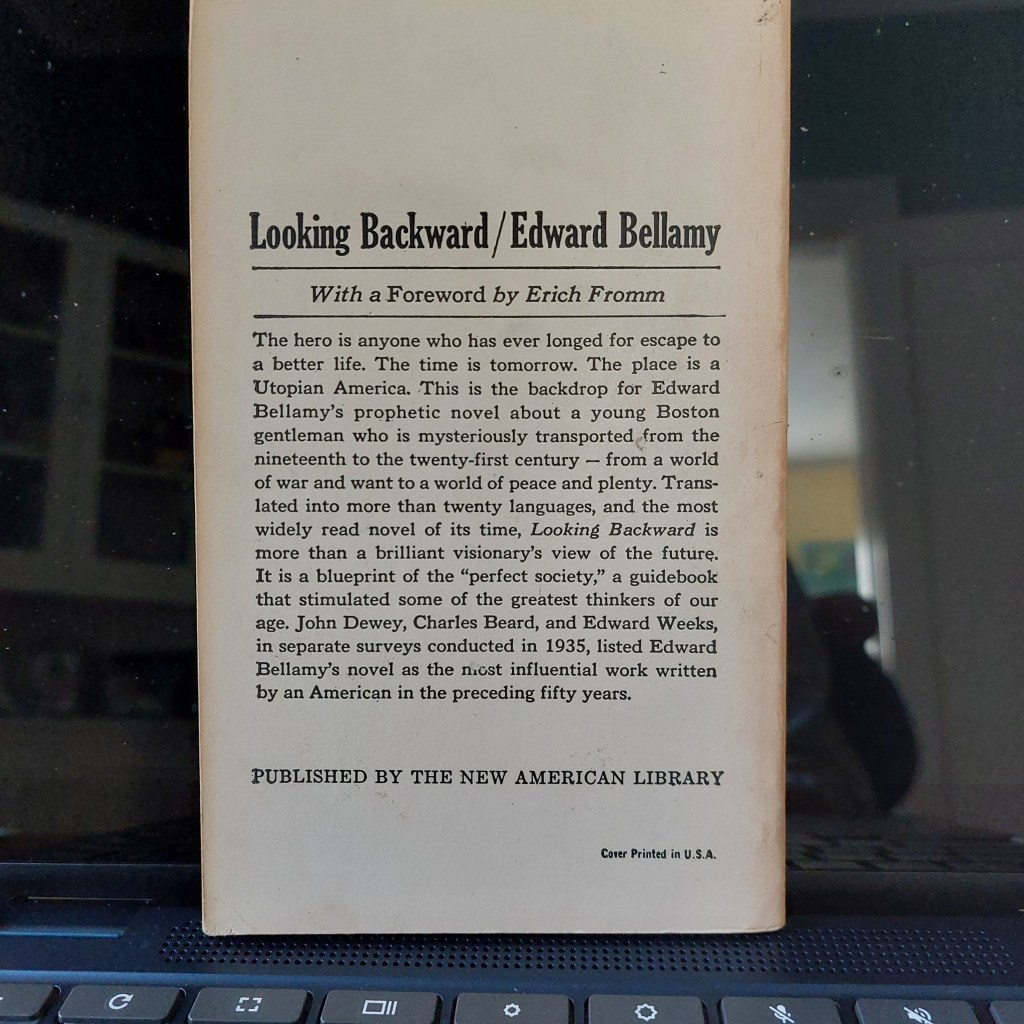
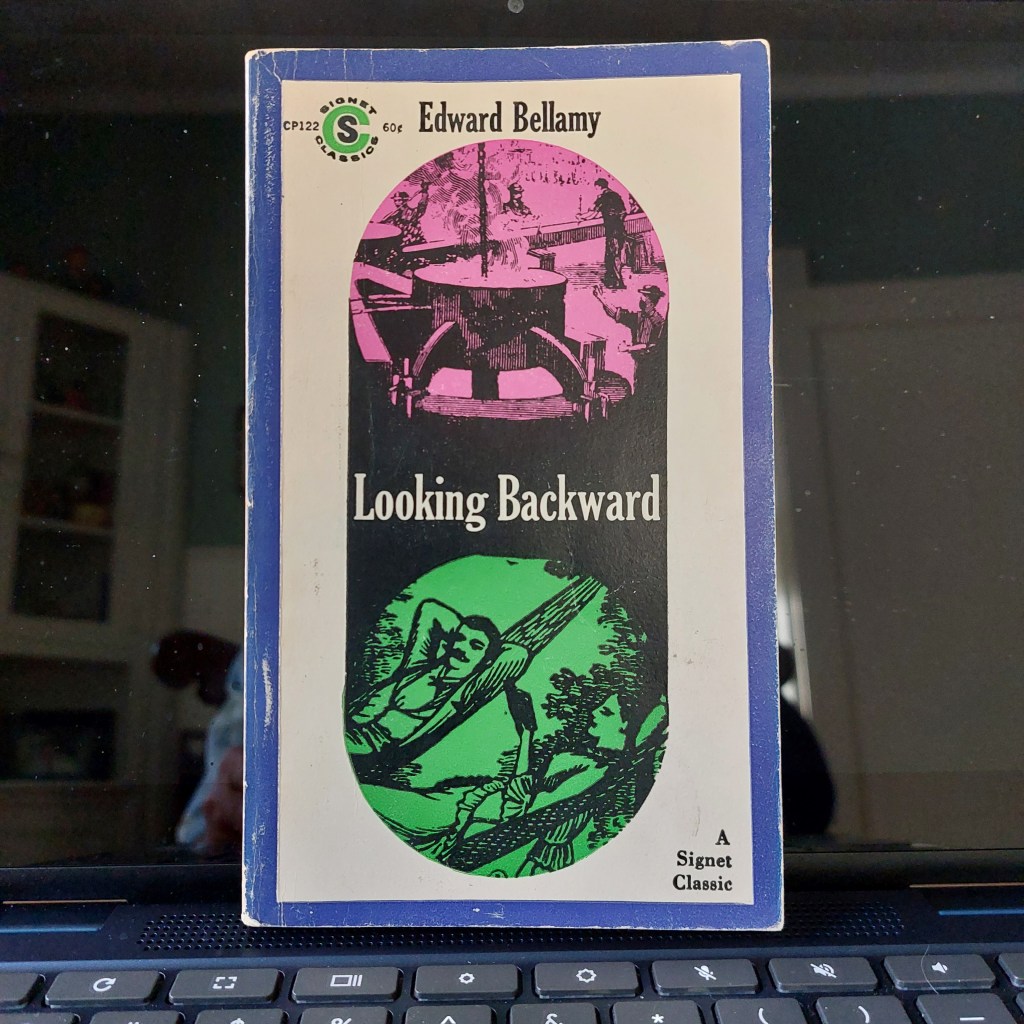
    Another book from that bygone bedroom window shelf, “Looking Backward,” by Edward Bellamy.3 The year is 2000 when Julian West awakes from the year 1887. Things have changed, of course, but for the better, and there is no need for a personal library:

    “Under the present organization of society, accumulations of personal property are merely burdensome the moment they exceed what adds to the real comfort” (89).

    Books in a collection can be burdensome, particularly when having to move abodes or rearrange a room. And old pages grow musty, stiff, spines arthritic. Books of the number I own suggest a sedentary lifestyle as well as a preference for private ownership unnecessary in Bellamy’s year 2000 and certainly obsolete, antiquated, old hat in 2025’s era of e-books:

    “I cannot sufficiently celebrate the glorious liberty that reigns in the public libraries of the twentieth century as compared with the intolerable management of those of the nineteenth century, in which the books were jealously railed away from the people, and obtainable only at an expenditure of time and red tape calculated to discourage any ordinary taste for literature” (115).

    Which brings me to Bluesky. I’ve opened a Bluesky account4 with the intent to use it to build a kind of catalog of my library. As such projects of mine go, cartoons on Substack, for example, now twice defunct, I don’t know how long I’ll keep up adding to and maintaining the catalog. And Bluesky is probably not the best place for such a project. I do prefer a simple life, free from adornment and tackle and stuff. Maybe I should concentrate on getting rid of the books rather than spending time cataloging them. But already the Bluesky project has proved useful in giving me pause to open and enjoy a few old paperbacks I’d not looked at for some time.

    A Bluesky personal library catalog? A personal library at all? What do you think?
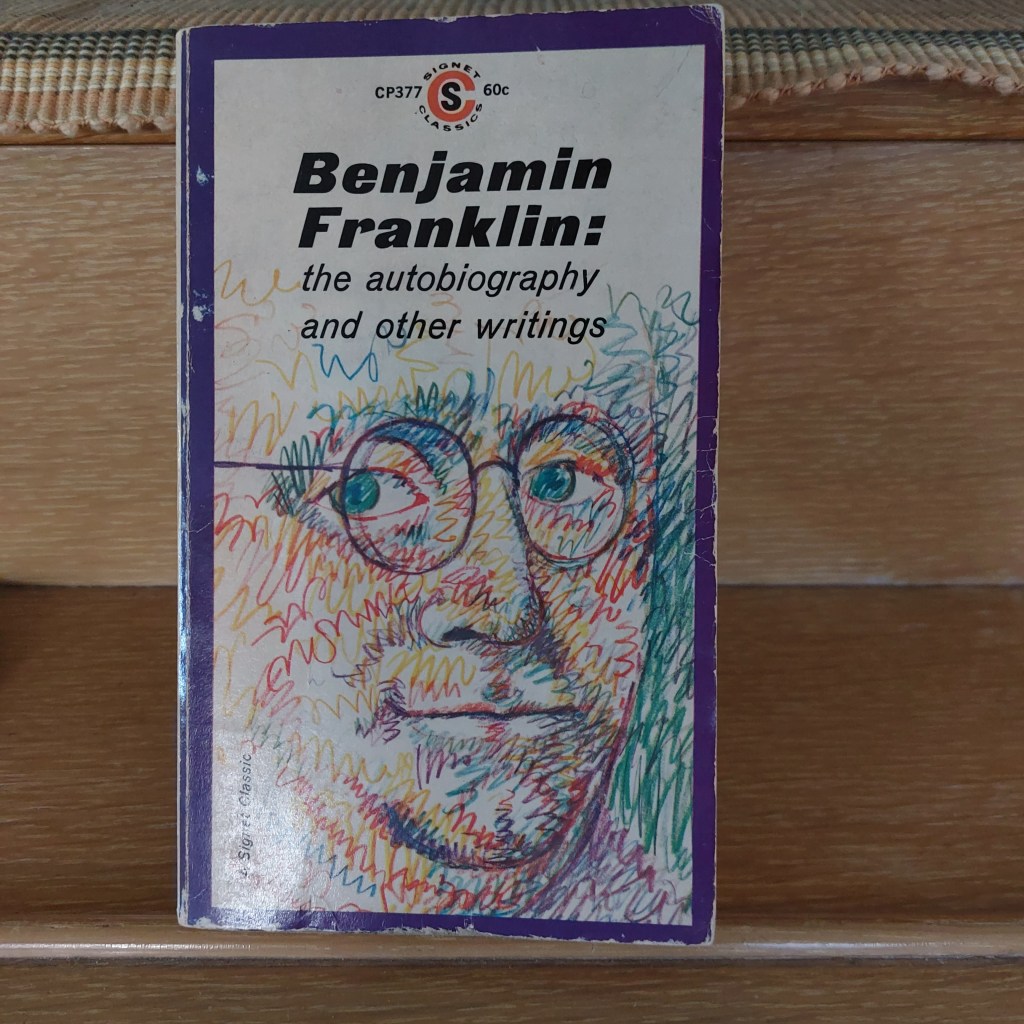
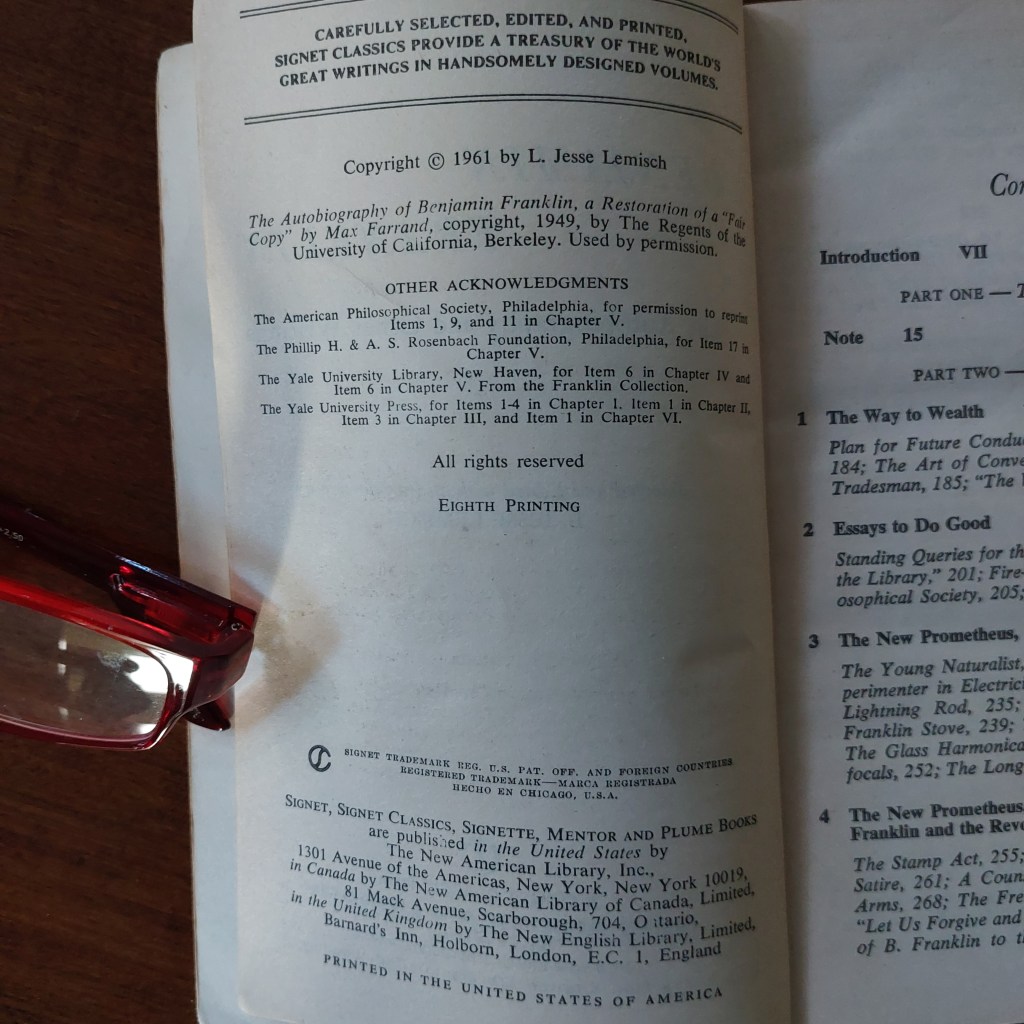
    1. Benjamin Franklin, “The Autobiography and Other Writings,” Signet Classics, 1961, CP377, Eighth Printing. From the copyright page: The Autobiography of Benjamin Franklin, a Restoration of a ‘Fair Copy’ by Max Farrand, copyright 1949.” ↩︎
    2. Edgar Allan Poe, “The Fall of the House of Usher and Other Tales,” Signet Classics, 1960, CD29, 50 cents. Afterward by R. P. Blackmur. ↩︎
    3. Edward Bellamy, “Looking Backward,” Signet Classics, First Printing, August, 1960; Fourth Printing, May, 1964. CP122, 60 cents. ↩︎
    4. ‪@joelinker.bsky.social https://bsky.app/profile/joelinker.bsky.social↩︎
  • Sprinkler Music

    More rain. More “Traveling Sprinkler.” Paul Chowder hasn’t been playing his new guitar much, though. Instead, the former bassoonist has found an interest in electronic music, and he’s bent on creating jingles and jangles and hums and beats and calls it dance music.

    “I worked for several hours today on a new song called ‘Honk for Assistance.’ I saw the sign at a convenience store, near the ice machine, and I thought, Now that is a dance song, in the tradition of Midnight Star. I sampled a few honks from my Kia’s horn and set up a beat and fingered up some harmony using an instrument I hadn’t tried before, the Gospel Organ, which has a slightly percussive sound in the attack phase of each note. I added more chords on a Mark II keyboard and some homegrown handclaps and some rhymes made with the Funk Boogie Kit” (190).

    Where is music, today? Where was it in Claude Debussy’s day? I’m listening now, suggested by Paul Chowder, our narrator of “Traveling Sprinkler,” to Debussy’s “Preludes,” via YouTube Music on my Chromebook. I don’t have my hearing aids in, and the Chromebook speaker is not exactly a Marshall Super Lead 100 Watt amplifier stacked with two humongous speaker cabinets towering overhead, so maybe I can’t really say I’m listening to Debussy’s “Preludes,” anymore than I can say I’m in the kitchen nook typing while getting wet from the drizzle outside.

    Around page 128, Paul spends ample time discussing the benefits of stereo versus mono. What he does not mention is asymmetrical hearing loss, a condition where you hear less volume in one ear than the other. You’re sometimes unsure which direction a sound is coming from, and it can make you a bit paranoid as you navigate your way around town. You have to be extra careful crossing the street, particularly if there are electric vehicles in the neighborhood. And bicyclists and joggers coming up behind you and passing full of assumptions and presuppositions about their position startle the shite out of you.

    “I put the headphones on, and I lowered the needle on Zubin Mehta conducting The Rite of Spring, and suddenly I was there, enclosed in the oxygenated spatial spread of stereophonic sound. I was there with the panicked piccolo, and the bass clarinet was a few feet away, and the timpani surged over to the left, mallets going so fast you couldn’t see them. I couldn’t believe how big a world it was – how much bigger and better stereo was than mono….You need two ears” (129).

    Or three, or four. One day, back home, I rode my bike down the Strand to Mike Mahon’s place in Hermosa, carrying with me Archie Shepp’s “Fire Music,” on the Impulse label, from 1965, still new and noisy around the early 70s. Mike was a classically trained pianist, although like Paul Chowder, had decided he wasn’t good enough to make a career of it, and went back to school for a PhD in English Literature, specializing in Yeats and Joyce and company, but still Mike was an audiophile, and had the latest equipment. He took my album and ran it through an electronic vinyl record cleaning machine he had, then we listened to some of it on his impressive and expressive and expensive sound system. Then he pulled from his album collection a copy of Stravinsky’s “The Firebird,” and we listened to the “Infernal Dance” piece. Talk about “attack phase.”

    I played a bit of “The Firebird” just now, switching off the Debussy. I’m immediately reminded of Poe’s “The Bells”:

    Hear the loud alarum bells—
                     Brazen bells!
    What tale of terror, now, their turbulency tells!
           In the startled ear of night
           How they scream out their affright!
             Too much horrified to speak,
             They can only shriek, shriek,
                      Out of tune,
    In a clamorous appealing to the mercy of the fire,
    In a mad expostulation with the deaf and frantic fire,
                Leaping higher, higher, higher,
                With a desperate desire,
             And a resolute endeavor
             Now—now to sit or never,
           By the side of the pale-faced moon.

    I can only handle a minute or two of “The Firebird” this morning (or Poe) before switching over to Segovia playing Bach on his acoustic guitar, from Andrés Segovia: Bach – Gavotte from 4th Lute Suite for guitar, Allegro Films.

    In butterfly mode, Paul Chowder continues, in “Traveling Sprinkler,” from acoustic guitar to electro sounds to his girlfriend Roz and his neighbor Nan, parking his car here and there to get some writing done, in other words, in and out and back in again, listening to every day sounds and how they wrap around the cans and cannots of one’s thoughts. But Chowder keeps mentioning songs and music I’ve never heard of. Where have I been? And I asked myself again when and how and why it was I got Nicholson Baker’s “U & I,” and “Traveling Sprinkler” to begin with. So I looked them up. I thought I had purchased (and said in a previous post) “Traveling Sprinkler” used from Alibris. Not so. I purchased it new from Amazon in June of 2023 (though it was not sold by Amazon – a bit confusing all of that, how Amazon works sometimes). And just now, about two years later, I’m getting around to reading it, “Traveling Sprinkler” (though I had given it a try a couple of times before), while “U & I,” I got used on Alibris in February of 2019, also giving it a couple of tries, but unable to fall into it, yet.

    Anyway, it’s all old stuff, the books, the references, the music, not to mention the many political digressions, arguments with backing but often rants of a sort, Paul Chowder takes off on. He’s a pacificist, who, as I mentioned, attends meetings, though he’s not a full member, but which is why I thought the acoustic guitar was a good fit, him being a pacificist. But it depends on how you hear sounds. Last night late (after watching the Dodgers beat the Athletics in a record-breaking score of 19 to 2) before bed I played through a few of the Leo Brouwer “Etudes Simples” pieces, as I do almost every night, on my 1977 acoustic Takamine C132S. Number 1 is not all that pacific sounding, but Number 2 is lovely, particularly setting the tone for sleep.

    The political arguments, by the way, though now aged, just over a decade away, are effective today, without stirring up too much dust. I’m increasingly finding I’d rather listen to decade old or older music too. Timeless music. Anyway, thinking back to that business about stereo and mono, I’m reminded of the Jimi Hendrix album “Axis: Bold as Love.” The first piece, titled, “Exp,” is an amazing example of stereo at play. It’s very short: 1:56. You can give it a listen here.