Tag: Discuss

  • Bugging Out

    In “Through the Looking Glass,” Alice converses with a gnat:

    “I know you are a friend,” the little voice went on; a dear friend and an old friend. And you won’t hurt me, though I am an insect.”
    “What kind of insect?” Alice inquired a little anxiously. What she really wanted to know was, whether it could sting or not, but she thought this wouldn’t be quite a civil question to ask.

    A gnat is a small fly, but this one seems huge, as gnats go:

    She found herself sitting quietly under a tree — while the Gnat (for that was the insect she had been talking to) was balancing itself on a twig just over her head, and fanning her with its wings. It certainly was a very large Gnat: “about the size of a chicken,” Alice thought. Still, she couldn’t feel nervous with it, after they had been talking together so long.

    Alice tells the gnat she’s not overjoyed when she sees an insect, because she’s afraid of them, particularly the larger ones.

    I’m not fearful of bugs, spiders and such. It’s the season here though when I’ll run into an orb-weaver spider web spread across the walkway between tree branches, face level, too, but invisible unless backlit with the rising sun, and I feel the sticky web as it envelops my face. I shake my shirt and comb through my hair with my fingers and watch a little reddish bug falling to the ground.

    Then came another of those melancholy little sighs, and this time the poor Gnat really seemed to have sighed itself away, for, when Alice looked up, there was nothing whatever to be seen on the twig, and, as she was getting quite chilly with sitting still so long, she got up and walked on.

    A problem with bugs is not that they are gigantic, but that they are small, and they are quick, and usually invisible to us. If you allow yourself, you might get all obsessive about bugs hiding behind baseboards, in the yard, or in your hair. But most bugs we never see, and they don’t bother us, in spite of the fact that about 10 quintillion bugs are living on Earth at any given moment.

    I enjoy reading blogs foreign to me, made possible by Google Translate. I recently read a blog post by a Japanese woman about centipedes. I was curious, having myself come across a couple of centipedes in our humble abode this summer. But this woman was nonrationally fearful and sprayed her unfortunate centipedes with excessive amounts of insecticide. She even posted a word of caution to potential readers at the top of her post, concerned some might be scared out of their wits reading about bugs, and she posted a deliciously horrible photo of a centipede slightly curled. Maybe something was lost in translation.

    Not too long ago I posted a piece on ants in our coffee maker. The infestation was so severe we had to abandon the electric coffee maker, and I went back to using a manual French press. I was reminded of E. O. Wilson, who changed his mind about how evolution works, as he found group altruism at work in ant colonies. He said that cooperative workers were more successful than competitive ones. Thus he favored altruism as a collective trait. His reversal of his prior position on the matter greatly upset his scientific community; many stuck in the web of their old position.

    As if real bugs aren’t enough, we find in Kafka’s story “The Metamorphosis” a metaphorical bug. A human awakens one perfectly normal morning to find himself turned into a true liking of his image, for he’s already living the life of a bug, a small bug-like creature working a menial job for the hive. Not all bugs are insects, but for our purposes here, I’m calling them all bugs. Bugs may seem a far fetched idea for an anthropomorphic story, but E. B. White wrote a very successful book with “Charlotte’s Web,” about a pig, a spider, and a little girl living on a farm. When walking outdoors this time of year, and watchful of walking into a web, always be sure to check for web messages.

    Science Lesson: I once knew a bug who for a short time kept a blog. Bugs don’t leave likes or comments; they leave bites and itches. Why are there so many insects living here on Mother Earth? Bugs have had a long time to adapt. Nature tends to overseed tiny organisms. Elsewhere no doubt there are planets full of bugs, oceans where none have yet decided to leave their salty paradise, tiny and invisible even to our new space telescopes. They don’t send messages and have no need for technology other than their own three part harmonies. Bugs are not picky eaters. Bugs are good pollinators and some, centipedes, for example, feed on other bugs perhaps dangerous to humans. Centipedes are not particularly harmful to humans. They are masters of the 100 yard dash.

    Theory: I had a friend in high school I admired for he was fearless and loved snakes. Then I discovered he was afraid of spiders. Whenever a spider was at hand, he called me in to deal with it. Over time, I developed a theory: people afraid of spiders are not afraid of snakes, while people afraid of snakes are not afraid of spiders. Occasionally, as the topic may arise, I’ll ask the question in conversation – below I’ve created a “poll” to test my theory (and to test the format of a poll, which for this blogger is a first). Please feel free to answer the poll, or leave a comment below to the post, or simply enjoy the cartoons I’ve added at the end. Time now to bug out.

    Update: I’ve already been advised my poll block didn’t work, so I’ve removed it. Not sure what I did wrong. But please feel free to answer the question (Snakes or Spiders) in a comment to the post below. And enjoy the cartoons!
  • Manual for Intuition

    Buckminster Fuller was the most optimistic of scientists. He believed synergy solves the problem of entropy. Synergy, simply put, is working together to achieve more. Synergy is sometimes defined as a whole unpredictable from the sum of its parts (1+1 = 3). And Fuller thought there is enough to go around:

    “Once man comprehended that any tree would serve as a lever his intellectual advantages accelerated. Man freed of special-case superstition by intellect has had his survival potentials multiplied millions fold. By virtue of the leverage principles in gears, pulleys, transistors, and so forth, it is literally possible to do more with less in a multitude of physio-chemical ways. Possibly it was this intellectual augmentation of humanity’s survival and success through the metaphysical perception of generalized principles which may be objectively employed that Christ was trying to teach in the obscurely told story of the loaves and the fishes.1

    Dostoevsky said the same thing in his “Notes from Underground” (1864):

    “I admit that two times two makes four is an excellent thing, but if we are to give everything its due, two times two makes five is sometimes a very charming thing too.”

    Though Orwell in “1984” (1949) suggested we be careful with arithmetic and keep an eye on who’s controlling the data. William Blake also reasoned reason could be a tyranny (“The Book of Urizen,” 1794).

    For my own alone little part of the network, I’ve been wondering about the popularity of Doors, Wordless Wednesdays, and other prompts, and have opted to contribute a little poem on the subject of synergy and entropy:

    Loves and Fishes

    Planets like cauliflower
    heads can’t go it alone;
    entropy a flat bald universe,
    produces no combs.

    Love like the neutrino
    difficult to detect,
    plentiful and invisible,
    with no electrical net.

    1. “Operating Manual for Spaceship Earth,” R. Buckminster Fuller. First published 1969, new edition 2008/2011, edited by Jaime Snyder. Lars Muller Publishers. ↩︎
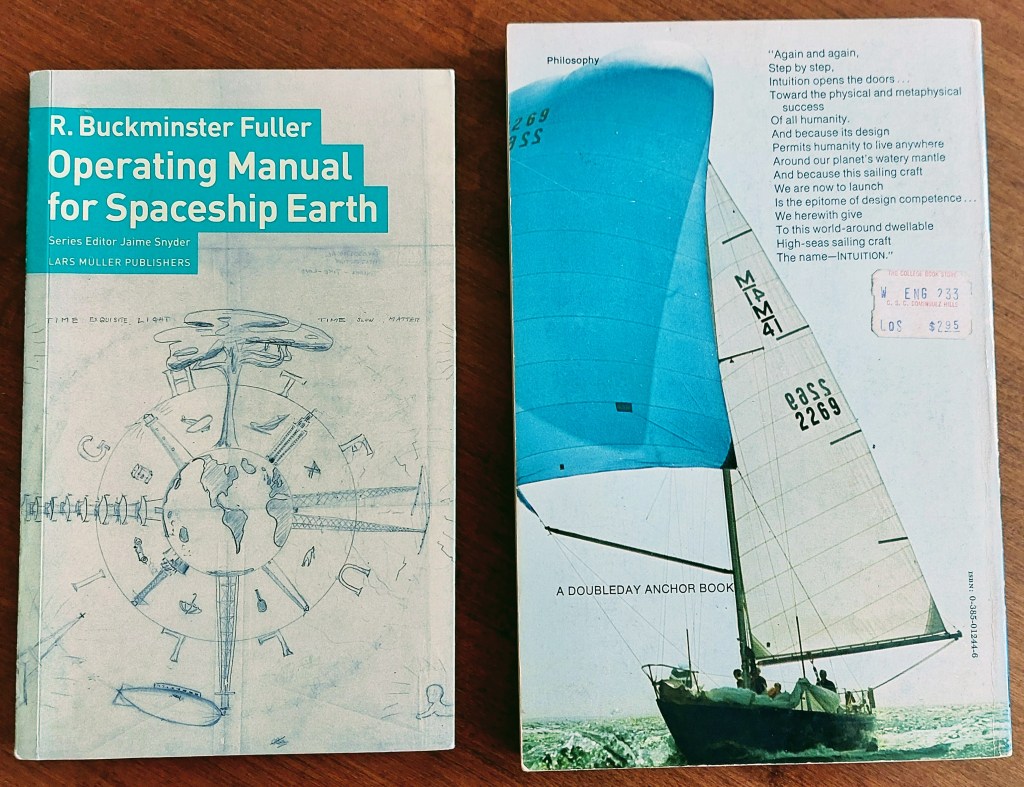
    Operating Manual for Spaceship Earth (1969) and Intuition (1972) – books by Buckminster Fuller
  • The Art of the Blog

    Is blogging an art form? We might talk about art and craft and trade. Crafts and trades are necessities as cultures move from survival mode to commercialization and commodification and eventually to increasingly artificial realms; art is not necessary, and its very lack of necessity is what gives it integrity. Art is innate and therefore authentic. It can be faked; when it is, it becomes precious. You might reply that art is necessary for the soul, but you won’t find the soul in a museum. Visitors to the Louvre spend about 15 seconds viewing da Vinci’s “Mona Lisa,” during which time their attention is diverted as they snap a few pics. But I’m actually not all that driven by such pronouncements as Art is whatever. Or whatever is art, or not. Art is a verb, as in the Buckminster Fuller sense, when he said, “I seem to be a verb.” A to be verb. If blogging is an art form, surely it must be part of the to be genre.

    All bloggers confront the same form, the template or layout, and one can spend forever and a day figuring it out, while one’s content sits waiting for something to happen. For the writer, the question arises, do you want to write or become a programmer? The photograph on a blog is not a photograph, in the same sense that Magritte’s pipe is not a pipe. For the poet who thinks poetry is about sound as much as sense, the phrase “mouth watering” might not wet a reader’s lips. Likewise, pics of food don’t always do much for the appetite. As for argument, the use of ALL CAPS quickly tires the eyes.

    Of course there are all kinds of blogs, evidenced in ongoing varieties of designs and templates and categories and tags. And almost any pursuit can be used as a unifying topic: photography or painting, travel and sightseeing, nature and gardening, music or poetry, fiction and memoir, literature or linguistics, criticism and notes and comments, politics and religion, comics and cartoons, news and history, advice and cooking, do it yourself and repair work, sports and leisure. Opinion and argument. The makers behind most blogs probably are not concerned with whether or not they are engaged in some sort of art form. But if a blogger is serious at all about being taken seriously, even if their theme is satire or sarcasm or humor, they will want to set up their blog as efficiently and effectively as possible to ensure an appropriate welcome to their target audience. If they have a target; that’s not a requirement for a successful blog. What is a successful blog?

    Without further Ado, I give you my Top 10 list of the characteristics of a successful blog, a site I can appreciate and that I’ll come back to. In other words, here is a list, limited to ten items, of some attributes of a blog that might warrant repeated visits:

    1. Original Content: I prefer original content rather than seeing copying and pasting from some third party source. I’d rather see an original photo of any quality, an original poem, an original sketch. I suppose there is an art to curating, selecting and collecting together pieces for a show, but too often these shows are too long or overwhelming or redundant to what one’s already experienced elsewhere. There are also issues of copyright, the use of Artificial Intelligence, and other forms of spam, quackery, or hoaxes which corrupt one’s reading.
    2. Identified Source: I tend not to read a blog the author of which is completely anonymous. There are no doubt valid reasons any individual blogger may have for remaining anonymous, privacy concerns or insecurity; those same concerns in turn make me want to know enough about sources to guarantee both originality and reliability.
    3. No Ads. This is a tough one, since to remove ads usually requires a subscription or premium of some kind, which some bloggers can’t afford. But ads are intrusive and distracting, often way off target, and sometimes aesthetically ugly, designed to raise a welt. Of course there’s also opportunity for bloggers to earn money from ads. I recently read that Substack is experimenting with ads, and of course there is one kind of blog that is an ad, promotional material, a link to elsewhere.
    4. Frequent Posting: I prefer blogs that post frequently, but not too often. Frequently could mean daily, weekly, or bi-weekly, depending on the length and complexity of the post, while too often might mean multiple postings per hour or day.
    5. Most of the blogs I read, I view via the WordPress “Reader.” There are advantages and disadvantages to the Reader. One disadvantage is you don’t see the blogger’s actual site, with all its bells and whistles, and formats appear differently depending on what device you’re using (which is one reason I keep moving more toward a minimalist format at the Toads). If there’s a way to view the whole blog in a reader, I’ve not discovered it. Some bloggers simply use excerpts in the Reader, and you must go to the full site to view the whole post, which can be rewarding because you get the full meal deal, not the à la carte entry. I don’t know what the answer is to using or not a reader. To subscribe via email, to a newsletter or alert, is an opening of a floodgate. Were I better organized and satisfied with having found ten or so of the best blogs in the world, blogs that answered every aesthetic and practical need, I would simply bookmark them and check them manually daily. Fickleness appears on both sides of the viewing platform. And by the way, the Reader does not contain ads, even if ads do appear on the actual blog.
    6. I prefer writing that is quirky, that ignores style guides, that is not fashionable, but presents a good fit for its subject. At the same time, I often enjoy the rants of the rule bound, the arguments over what tie goes with what shirt, even when, or especially when, it’s obvious no one wears ties anymore except for costume, uniform, or kitsch. “At no time,” Jeeves tells Bertie, “are ties unimportant.” But where’s Jeeves when you need one?
    7. Some blogs venture toward becoming full-blown sites, multiple pages and interactive tools, like the old TV variety shows. But the bed of the blog is the individual post, a diary entry, about experience rooted and grounded outside the blog. But the mirror blog is also interesting. It’s not about itself, but about you, its reader, without being intrusive; it’s subtle, seductive. A post starts off being about jam and ends up a preserve.
    8. I like learning how to do things, seeing how things are done. So if I see a photograph, some explanation of where and how and with what it was taken adds value to the blog post visit. Not that I only value the professional photo, quite the opposite; the amateur unposed snapshot often captures the most moving light. And of course descriptions take time and effort and might spoil a photo’s effect by focusing too much on technicality. There are times when sources should be revealed, footnotes added, links provided, though these can also ruin a visit with too much pomp and falderal.
    9. I enjoy arts and crafts blogs, particularly when they illustrate and track the process. These bloggers of course would be hard-pressed to post daily. It’s a lot of work, blogging, or can be, and posts are often obviously cut short or abandoned for lack of time or inability to get things right, whatever that might be. Which brings up the question of length. How long should a successful blog post be? I don’t know, but reading back over this one, it’s beginning to look too long, and I wonder what readers will have made it this far.
    10. I’m a general interest reader. I don’t have favorite or niche needs. But I do enjoy blogs dedicated to a particular mode or form. The original blog was called a weblog, a log posted to the web, like a ship’s log or an economic diary, updated frequently. Often a community evolved and comments or discussion ensued. I’m not myself these days given to commenting. It’s enough to do a post. Likewise, the blog or post dedicated to sending me elsewhere in the form of links galore can overdo it. I’m not sure how many bloggers remain that spend all day working on their blogs.
    Template
  • Signs of Spring and All

    A few mornings ago, I walked into the kitchen, set about making coffee, and noticed a line of tiny ants climbing up and down a corner edge, starting from a small gap behind a molding where the wall meets the floor, and when the ants reached the countertop, they went meandering to and fro, around the toaster and coffee maker and compost bucket. And two nights ago, out walking, we came across a nest of what appeared to be the same ant species emerging from a crack in the sidewalk, a line of scouts working their way into a neighboring yard. And early yesterday, the weather still clement, in spite of thunderstorms and tornadoes forecasted for the later afternoon hours, I had taken a morning break with my coffee outside in the fine Spring morning, and when I swung the door open to come back in, a fly the size of Rodan nearly knocked me over as she flew into the house and proceeded to spin around and around near the ceilings, cavorting from room to room.

    Spring begins with a pile of chores, and one recalls T. S. Eliot’s seemingly anti-intuitive start to his disillusionist poem titled “The Waste Land”:

    “April is the cruellest month, breeding
    Lilacs out of the dead land, mixing
    Memory and desire, stirring
    Dull roots with spring rain.”

    Not to mention the appearance of ants awaking from their winter diapause.

    “Winter kept us warm, covering
    Earth in forgetful snow, feeding
    A little life with dried tubers.”

    Soon April, and signs of spring are breeding and mixing in the kitchen and in the air, inside and out. Across the grass, dandelions are sprouting and even flowering already, and the turf at the edge of the sidewalk needs edging. The list goes on, but never mind – I discovered this week Ruth Stout, whose practice of gardening is summed up in the titles to her mid-century books, notably: “Gardening Without Work: For the Aging, the Busy & the Indolent” (1963); and “The Ruth Stout No-Work Garden Book: Secrets of the year-round mulch method” (1971); and her first, “How to have a Green Thumb without an Aching Back: A New Method of Mulch Gardening” (1955).

    It was in a New Yorker article of March 17 that I discovered Ruth Stout, sister, as I learned, of the famous detective fiction writer Rex Stout, best known for his protagonist Nero Wolfe. The subtitle to Jill Lepore’s article tells all: “Ruth Stout didn’t plow, dig, water, or weed.” Suddenly, Spring seemed a happier time than how T. S. Eliot described it.

    Still, I had ants in the kitchen to deal with, for I learned to my dismay they had nested inside the coffee maker. I surrounded the coffee maker with a moat of vinegar, and when the ants appeared between the moat and the coffee maker, I knew they had to be coming from within the coffee maker, where they must have set up a new nest. Never one to rush for the can of spray that “kills bugs dead” (ad line attributed to Beat poet Lew Welch, by the way), after a bit of research, I decided to try Dr. Bronner’s peppermint soap, having read that ants don’t like peppermint oil. The soap certainly stops ants on contact, and it seems to slow new scouts from returning to the scene.

    Meantime, our kitchen counter is cleaner than ever before. I had to retire the electronic coffee maker. I read ants like water and warmth (who doesn’t?), and they can also detect electric currents, including vibes from computers and cell phones and such – so we won’t be able to charge our devices on the kitchen counter anymore, for fear of ants. Imagine ants in your Chromebook, crawling in and out of the keyboard. And we’ve returned to a French press coffee maker, and while it takes a bit longer with more steps to brew, the coffee is robust. And immediately employing the Ruth Stout method, the yard work is quickly done, leaving more time for writing pieces, well, like this one.

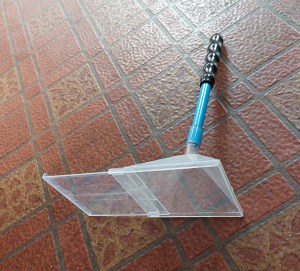
    But what of the fly the size of Rodan, the deep reader will be wondering? Advocating a catch and release policy toward all living but unwelcome things, I grabbed the fly catcher and went dancing around the house with the fly. I trapped it in the bathroom, where it had landed on the window screen. To catch a fly with the fly catcher, you have to wait until it lands, approach quickly but stealthily, cover it with the catch door open, then slide the catch door closed with the fly inside the trap. Might sound easy, but it’s often a cat and mouse game as the fly inevitably flickers away at the last second. After several attempts banging around the small bathroom, I caught the fly, then released it into Spring and all wilderness where all Earth life mingles half awake and half asleep.

    Catch and Release Fly Catcher
  • The Coming of the Toads

    “The Coming of the Toads” is the title of a short poem by E. L. Mayo:

    “‘The very rich are not like you and me,’
    Sad Fitzgerald said, who could not guess
    The coming of the vast and gleaming toads
    With precious heads which, at a button’s press,
    The flick of a switch, hop only to convey
    To you and me and even the very rich
    The perfect jewel of equality.”

    E. L. Mayo. Summer Unbound and Other Poems, the University of Minnesota Press, 1958 (58-7929). Also, E. L. Mayo. Collected Poems. New Letters, University of Missouri – Kansas City. Volume 47, Nos. 2 & 3, Winter-Spring, 1980-81.

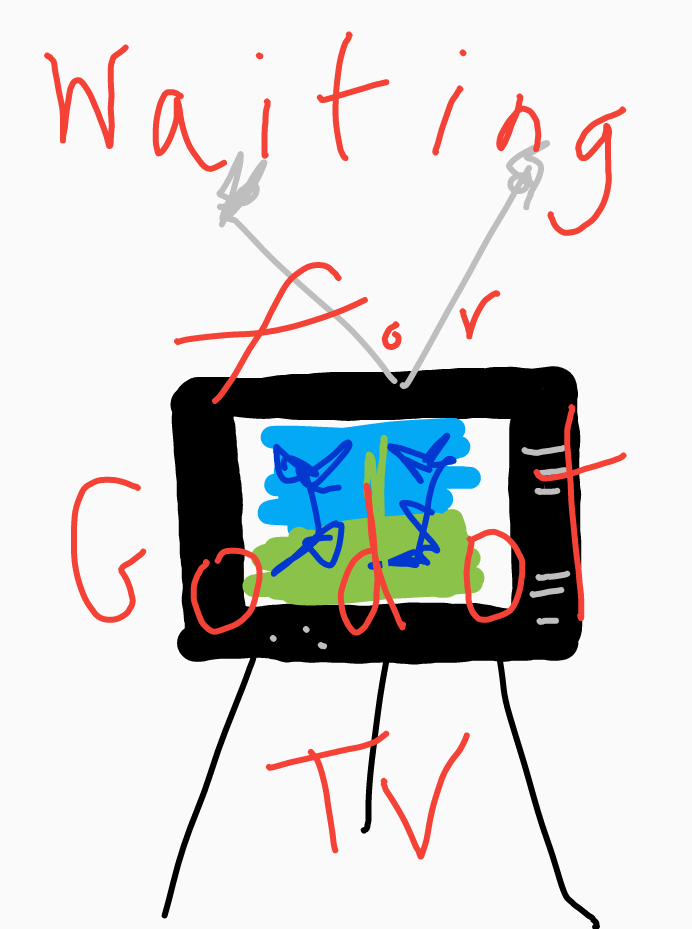
    The young toads were ugly televisions, but those eerily glowing tubes contained a lovely irony. The toads invaded indiscriminately. The bluish-green light emitted from the eyes of the toads emerged from every class of home, all experiencing the same medium for their evening massage. Mayo’s poem is a figurative evaluation of the effects of media on class and culture.

    In Fitzgerald’s short story “The Rich Boy” (1926), the narrator says, “Let me tell you about the very rich. They are different from you and me.” But Mayo doesn’t seem to be quoting from Fitzgerald’s story. He seems to be referencing the famous, rumored exchange by the two rich-obsessed, repartee aficionados Hemingway and Fitzgerald. Hemingway wrote, in his short story “The Snows of Kilimanjaro” (1936):

    “He remembered poor Julian and his romantic awe of them and how he had started a story once that began, ‘The very rich are different from you and me.’ And how some one had said to Julian, Yes, they have more money. But that was not humorous to Julian. He thought they were a special glamourous race and when he found they weren’t it wrecked him just as much as any other thing that wrecked him.”

    Did TV have a democratizing effect, or are its effects numbing? In Act 2, Scene 1, of Shakespeare’s “As You Like It,” Duke Senior, just sent to the woods without TV, mentions the toad’s jewel:

    “Now, my co-mates and brothers in exile, hath not old custom made this life more sweet than that of painted pomp? Are not these woods more free from peril than the envious court? Here feel we but the penalty of Adam, the seasons’ difference, as the icy fang and churlish chiding of the winter’s wind, which, when it bites and blows upon my body, even till I shrink with cold, I smile and say ‘This is no flattery: these are counselors that feelingly persuade me what I am.’ Sweet are the uses of adversity, which, like the toad, ugly and venomous, wears yet a precious jewel in his head; and this our life exempt from public haunt finds tongues in trees, books in the running brooks, sermons in stones and good in every thing. I would not change it.”

    Fitzgerald didn’t embrace television, but today he might cradle a metamorph tadpole in his lap. What would it convey? The toad’s jewel is more than a metaphor; the churlish shows of television are today the Duke’s counselors. We enter the space of the light box, and the toad’s jewel poisons us to the paradox of staying put, to electronic exile, but does it contain its own antidote, the toadstone?

  • The New Yorker Turns 100

    The New Yorker is celebrating this month its 100th anniversary. I discovered the magazine in its mid-40’s, visiting Susan’s aunt Joan at her beach studio-pad a door from the boardwalk in Venice in 1969. She gave me her discards. I started with the cartoons, of course, then read the short stories, always one or two, which back then followed the Talk of the Town section. I read all the small print stuff about the goings-on in New York, where I’d never been, never wanted to go. I thought short stories more interesting writing, but I soon grew to enjoy the short pieces in the Talk of the Town section. And I started reading the non-fiction pieces, the articles in those days on average longer than today’s, sometimes much longer, spanning two or three issues.

    The February 1, 1969 issue included a story by Linda Grace Hoyer, the mother of the prolific writer frequently found in The New Yorker over the years, John Updike. The February 21, 1970 anniversary issue included a short story in epistolary form by the editor and baseball writer Roger Angell, and a poem by Roger’s stepfather, E. B. White, titled “In Charlie’s Bar,” about a woman who was refused service at a bar in England because what she was wearing that visit happened to reveal her belly button. There’s also a story by Donald Barthelme, tilted “Brain Damage.” That I can’t really say that I now remember any of those pieces precisely probably says more about my brain than the keeping power of the writing.

    This year I came close to letting my subscription lapse. Maybe it’s my lapsing attitude, another sign of too many winters in a row of discontent, living away from the ocean. I’ve always liked The New Yorker because it is a general interest magazine, witty but sincere and without specialty or academic brouhaha. But as Jill Lepore puts it in her article titled “War of Words” in the 100th anniversary issue:

    “The stock criticism of Brown [Tina Brown, former editor from 1992 who shortened articles, among other at the time some thought controversial changes. David Remnick took over as editor in 1998] is that she made everything about celebrity; the stock criticism of Remnick is that he made everything about politics. The same could be said of America itself, across those years.”

    That everything is about any one thing brings an emphasis that goes against the grain of general interest. And what will happen to the editorial stance now that celebrity and politics have merged into one? That’s what I’m not sure I want to see. But while there have been a few ownership and editorial changes over the years, changes in form and content have not been deep. What’s changed is out on the street. But maybe that’s not so new either. Let’s take a look.

    From the Notes and Comment section of the February 28, 1970 issue (and if I hadn’t just told you it’s from 1970, you might have thought this was today):

    “The government’s campaign against the press, which has proceeded swiftly from threats of action to action, in the form of subpoenas of reporters’ notes and tapes and films, has already heavily damaged the press’s access to the news.”

    Surely someone would say something. After all, it was still almost the 60’s. But in the same piece we get this:

    “The Democrats complete silence on those issues throughout the program [a Democrat television special titled State of the Union: a Democratic view – a response to Nixon’s State of the Union address] struck us as an extreme instance of the more general avoidance of controversial issues which has been noticeable among politicians and on the networks and in the press.”

    Certainly not much seems to have changed from Andy Logan’s comment in the Around City Hall section of the same issue. Writing about the state’s budget hearings, he says:

    “According to one theory of public life, the winning politician is not the man who spends his time gathering civic credits to himself but the operator who can most often persuade the public that whatever went wrong was somebody else’s fault.”

    A valuable benefit of subscription is access to The New Yorker archive. I found myself, in solo celebration of its 100th Anniversary, browsing through past issues from the years I first started reading the magazine. In that February 28, 1970 issue, for example, I perused the Nightlife section, wondering where I might have gone had I been in New York at the time. I could have sat in at The Bitter End, where “Folks, both long- and short-haired, sit on wooden benches and sip coffee.” I could have eaten, copiously, no less, at Bradley’s, “a wood-paneled bar and rest where people come, and frequently return, to sit and talk and copiously dine.” Not only that, but I could have listened to Bobby Timmons play electric piano until three in the morning. And if that wasn’t enough music, I could have at three headed over to the Red Onion and heard “Two banjos and a piano until four.” And that went on every night. Did people never sleep in New York? There was a lot to choose from: “music, bar, dinner, dancing, discos, cabarets.” At the movies (still called Motion Pictures in one section of the magazine), I could have seen, drawing now from the alphabetical listing: Belle de Jour, The Bible, Bob and Carol and Ted and Alice, or Butch Cassidy and the Sundance Kid.

    I seldom read The New Yorker fiction anymore, and some of the poems I don’t make it out of the first stanza or two. I’ve grown prosaic maybe in my dotage. And if you think the point of a cartoon is to make you laugh, you might be in for a disappointment.

    One measure of good writing is whether or not it can be read comfortably and naturally aloud. This week, I’ve been reading aloud to Susan from J. D. Salinger’s Nine Stories. In Salinger’s story titled For Esme – with Love and Squalor (from the April 8, 1950 issue, not April 9 as Wiki has it) about a US soldier in WWII, the narrator meets a young English girl in a Devon tearoom:

    “May I inquire how you were employed before entering the Army?” Esme asked me.
    I said I hadn’t been employed at all, that I’d only been out of college a year but that I liked to think of myself as a professional short-story writer.
    She nodded politely. “Published?” she asked.
    It was a familiar but always touchy question, and one that I didn’t answer just one, two, three. I started to explain how most editors in America were a bunch –
    “My father wrote beautifully,” Esme interrupted. “I’m saving a number of his letters for posterity.”

    This post being about The New Yorker, and The New Yorker being known for its cartoons, I thought I’d end with a cartoon:

  • Profile of a Portrait

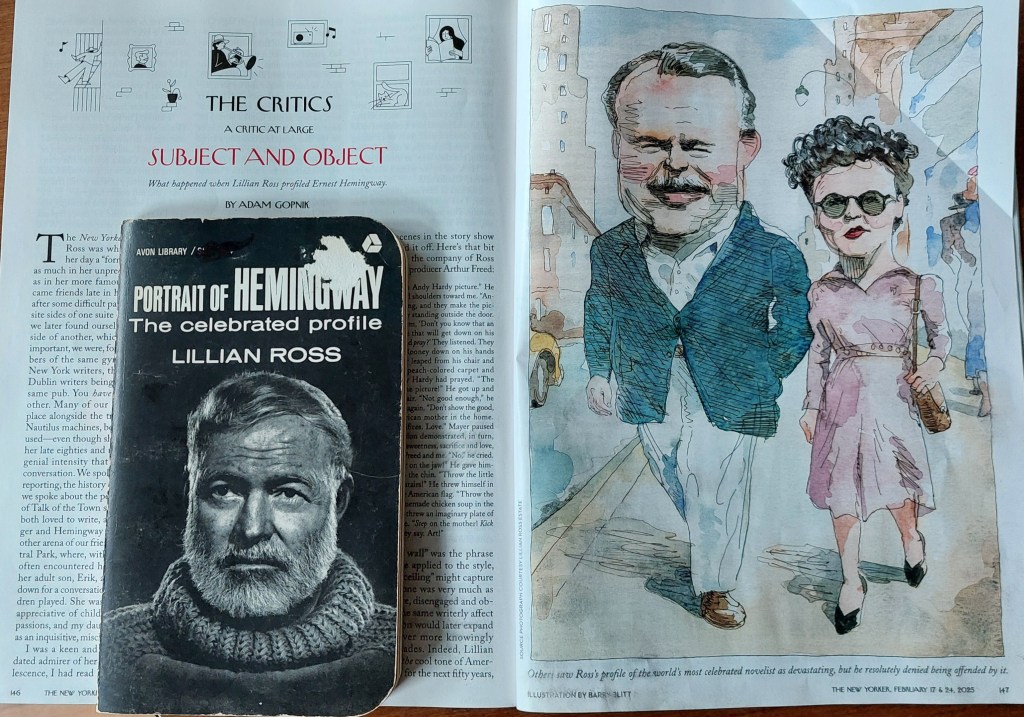
    In the 100th anniversary issue of The New Yorker (February 17 & 24, 2025), we find Adam Gopnik’s Profile of a Portrait, titled “Subject and Object: What happened when Lillian Ross profiled Ernest Hemingway.” The subtitle is not a question, but maybe it should be. Gopnik holds that Hemingway’s reputation was devastated by the Lillian Ross 1950 Profile article, but that he insisted on not being bothered by it, but maybe Hemingway’s response to the article, and more to the reaction to it, was in character of his own value which he described in a different context as “grace under pressure.” In any case, while Gopnik does mention that the Profile was later published in book form (Portrait of Hemingway: The Celebrated Profile, 1961*), he ignores Lillian Ross’s preface to that book, written a decade after the brouhaha had unfolded:

    “Hemingway said that he had found the Profile funny and good, and that he had suggested only one deletion. Then a strange and mysterious thing happened. Nothing like it had ever happened before in my writing experience, or has happened since. To the complete surprise of Hemingway and the editors of The New Yorker and myself, it turned out, when the Profile appeared, that what I had written was extremely controversial. Most readers took the piece for just what it was, and I trust that they enjoyed it in an uncomplicated fashion. However, a certain number of readers reacted violently, and in a very complicated fashion. Among these were people who objected strongly to Hemingway’s personality, assumed I did the same, and admired the piece for the wrong reasons; that is, they thought that in describing that personality accurately I was ridiculing or attacking it. Other people simply didn’t like the way Hemingway talked (they even objected to the playful way he sometimes dropped his articles and spoke a kind of joke Indian language); they didn’t like his freedom; they didn’t like his not taking himself seriously; they didn’t like his wasting his time on going to boxing matches, going to the zoo, talking to friends, going fishing, enjoying people, celebrating his approach to the finish of a book by splurging on caviar and champagne; they didn’t like this and they didn’t like that. In fact, they didn’t like Hemingway to be Hemingway. They wanted him to be somebody else – probably themselves. So they came to the conclusion that either Hemingway had not been portrayed as he was or, if he was that way, I shouldn’t have written about him at all. Either they had dreary, small-minded preconceptions about how a great writer should behave and preferred their preconceptions to the facts or they attributed to me their own pious disapproval of Hemingway and then berated me for it. Some of the more devastation-minded among them called the Profile ‘devastating’” (17-18).

    Adam Gopnik appears in his critical article about the Ross Profile to be one of those people. He does reference as support for his argument (that the Ross Profile is devastating) the back and forth letters between Hemingway and Ross that followed the publication of the original Profile, but I didn’t find enough in those letters (what Gopnik shares of them) to offset what Ross says above or to prove that she was dissembling in some way.

    A Profile, as Gopnik points out, is more than a Q & A, particularly more than those interviews of today that are carefully controlled by agents and protectors of reputations and public reactions, damage control specialists. There’s also more to Gopnik’s profile of a Profile that gives insight to the writing and reading of one, the editorial process, and what informs intents and results. But why do we expect would-be heroes to have good character, or not to enjoy the simple and ordinary? Gopnik points out that the Profile as written by Ross was a new form, in which the reporter follows and observes and records just about everything, including the mundane and ordinary or trivial and everyday. Going to a store and buying a new coat for example. Is there some special way a famous novelist should behave in a coat store? Gopnik says:

    “The Hemingway in the piece is a comic figure – self-dramatizing, repetitive, marooned within his own monologues, and sometimes ridiculously affected.”

    Why? Because “The novelist, now fifty, complains of a sore throat,” but won’t see a doctor? Or because “His wife had suggested that he look for a coat at Abercrombie & Fitch, and after he buys one there he decides he’d like to look at a belt,” and while picking out the belt he jokes with the belt clerk about his belt size, and affects happiness when the clerk suggests he must work out to be so fit. But he doesn’t appear to be cross.

    *Portrait of Hemingway: The Celebrated Profile. Avon Books, 1961. 94 pages, paperback.

  • Penina and the Santa Ana Winds

    I was just a few months blogging when back in April 2008 I wrote a post titled “Where weather and writing merge,” about the Santa Ana winds, referencing Joan Didion’s “Los Angeles Notebook,” the first section of which was originally published in 1965 in The Saturday Evening Post under the title “The Santa Ana.” Didion claimed the winds influenced behaviors; she’s read up on it:

    “‘On nights like that,’ Raymond Chandler once wrote about the Santa Ana, ‘every booze party ends in a fight. Meek little wives feel the edge of the carving knife and study their husband’s necks. Anything can happen.’ That was the kind of wind it was. I did not know then that there was any basis for the effect it had on all of us, but it turns out to be another of those cases in which science bears out the folk wisdom” (218).

    Didion references a physicist who studied the physical characteristics of winds and people’s reactions that suggest cause and effect reflex at play, and her anecdotal evidence, though bizarre and outlier, of the winds affecting one’s psyche is persuasive.

    “Whenever and wherever a foehn blows, doctors hear about headaches and nausea and allergies, about ‘nervousness,’ about ‘depression.’ In Los Angeles some teachers do not attempt to conduct formal classes during a Santa Ana, because the children become unmanageable” (218).

    Didion also mentions the Los Angeles area fires that occurred in the 3rd quarter of the 20th Century, the scope of which at least in part she attributes to the Santa Ana winds.

    “The Santa Ana caused Malibu to burn the way it did in 1956, and Bel Air in 1961, and Santa Barbara in 1964. In the winter of 1966-67 eleven men were killed fighting a Santa Ana fire that spread through the San Gabriel Mountains” (219).

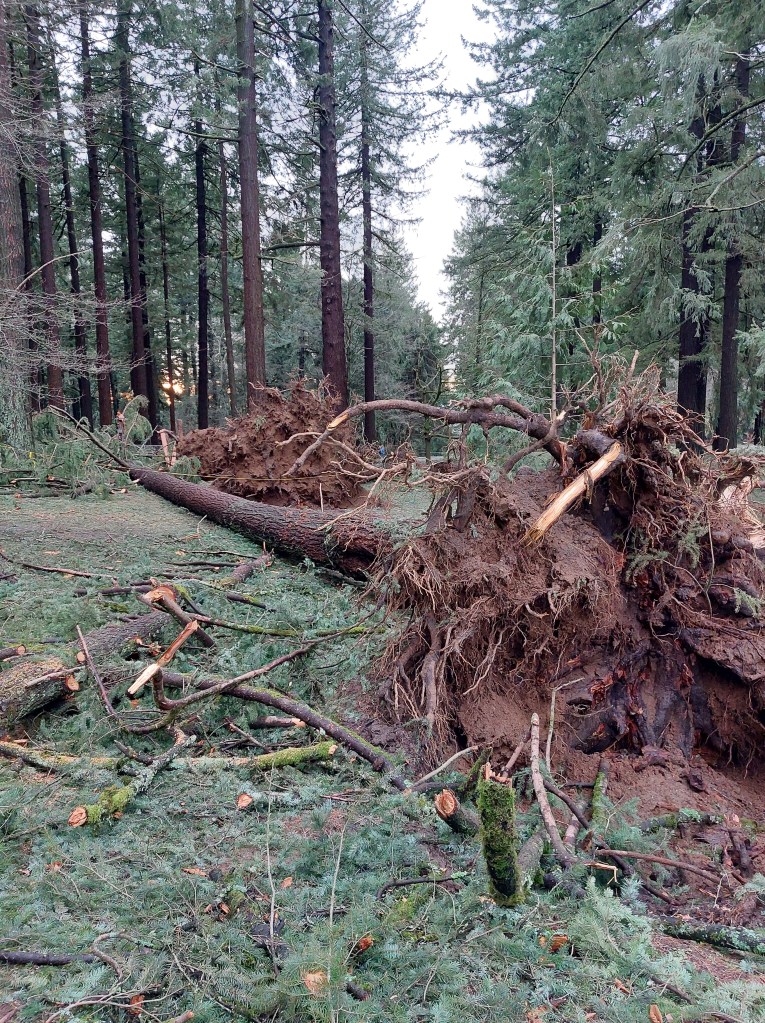
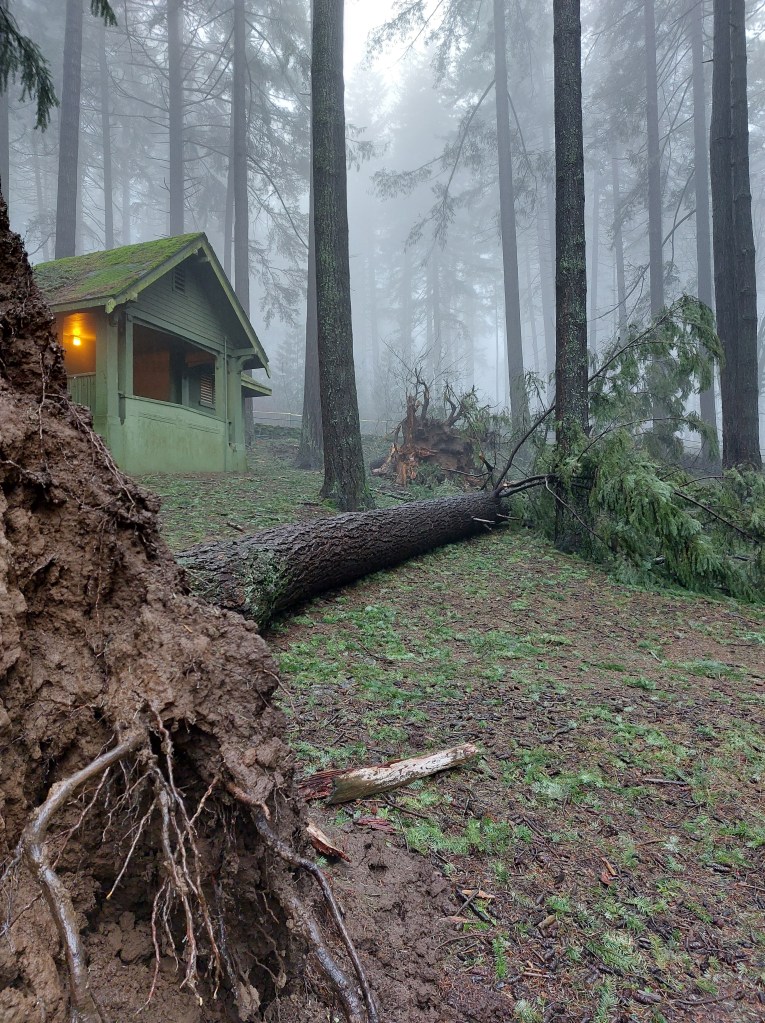
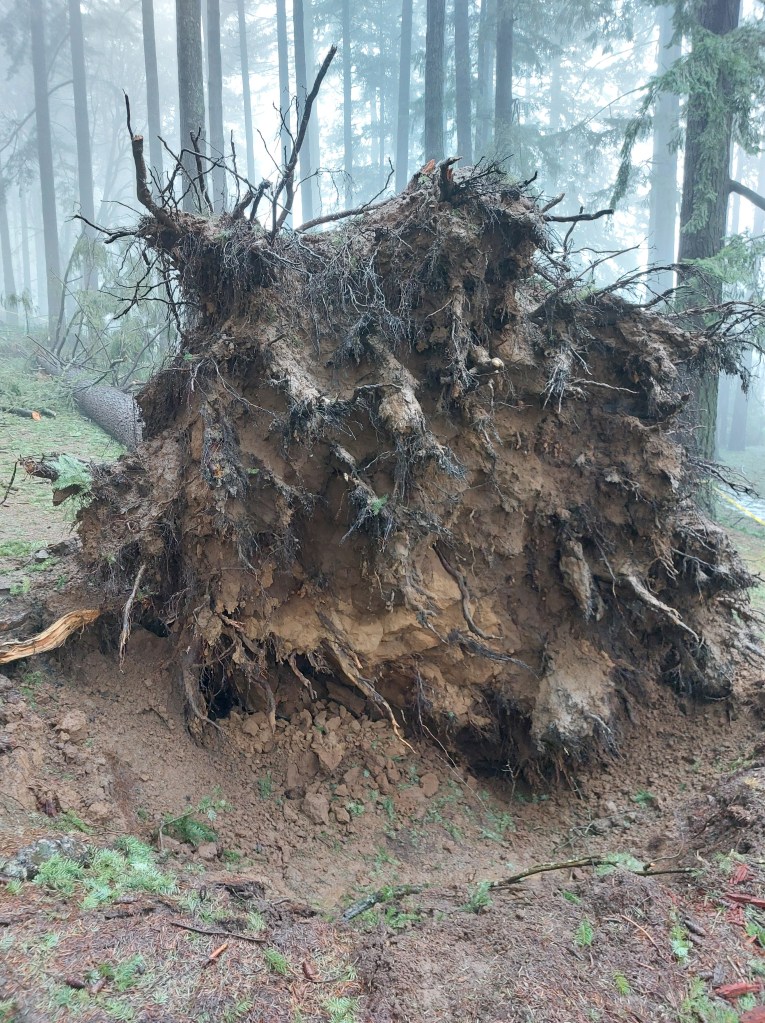
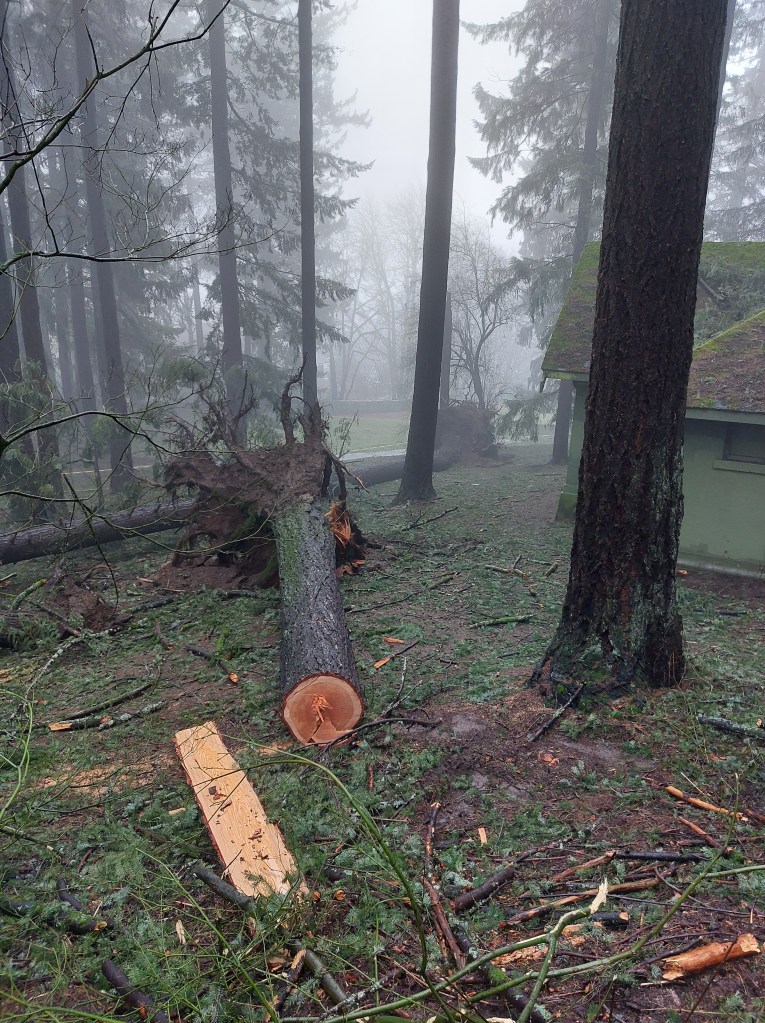
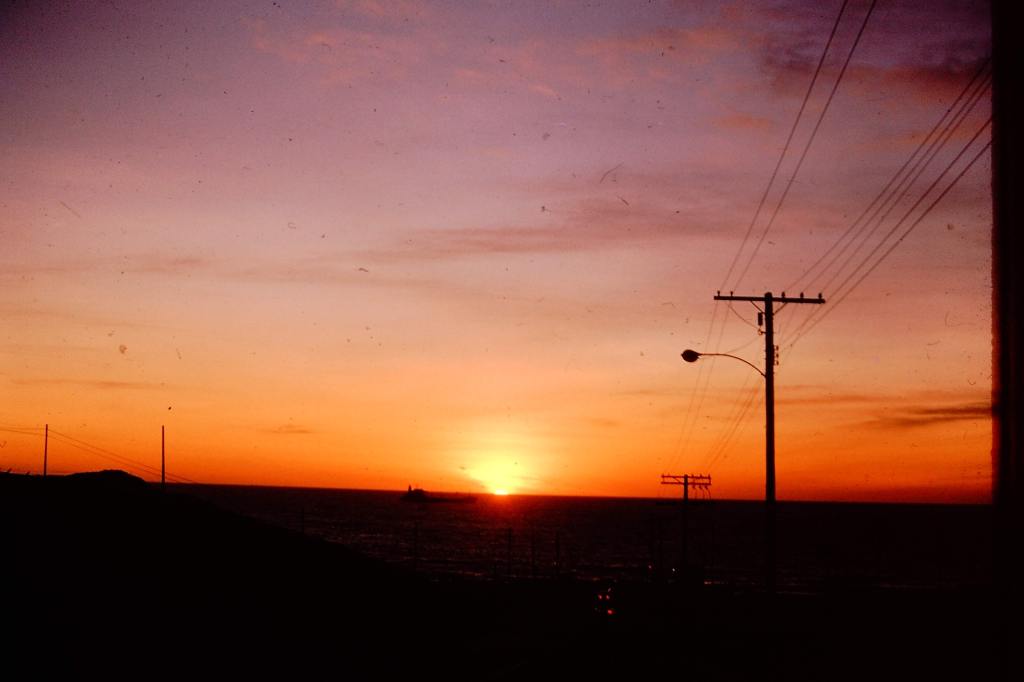
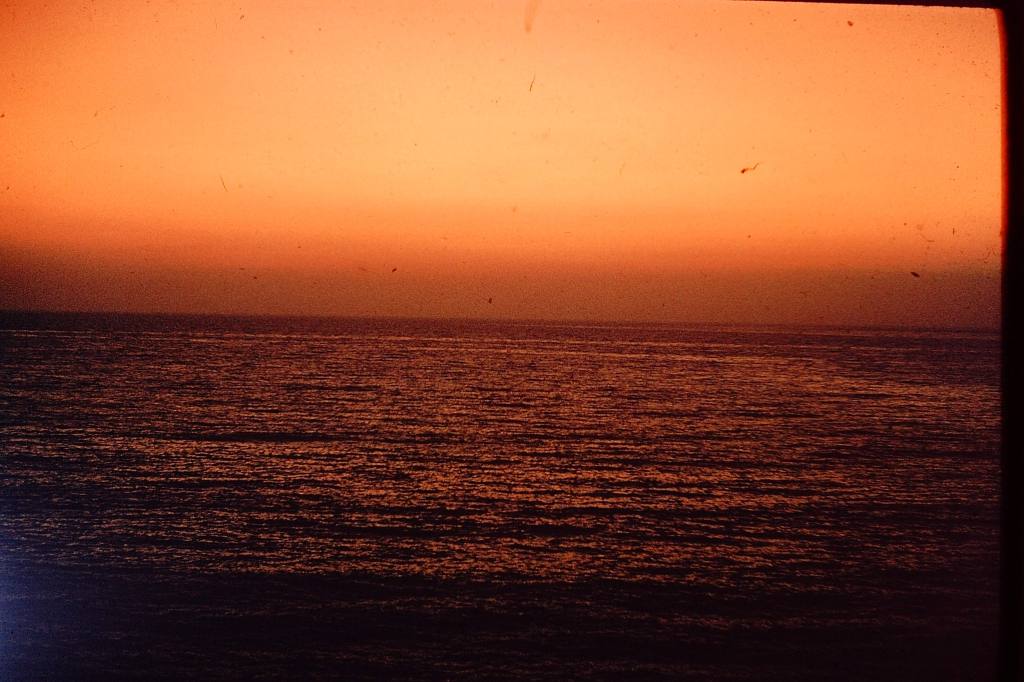
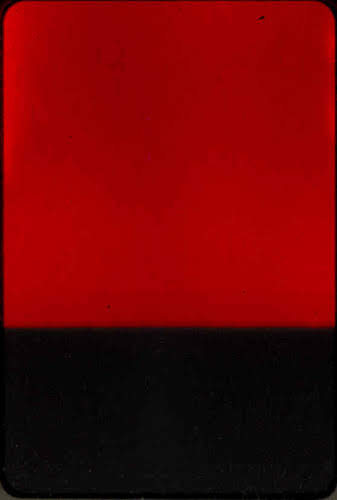
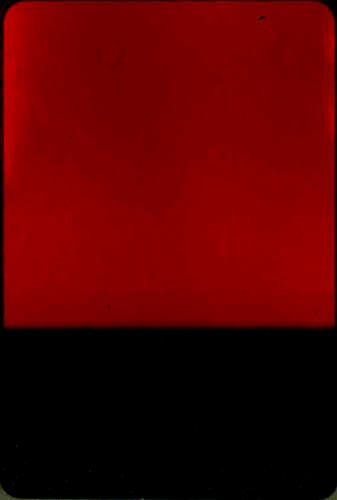
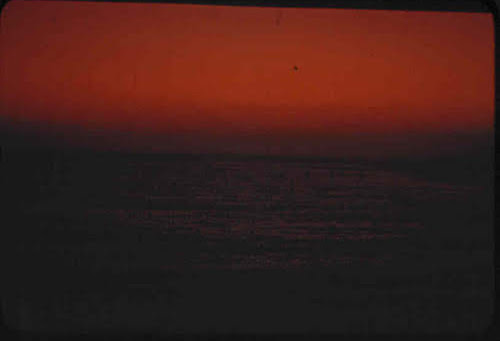
    We lived in Los Angeles in those years, in one of the beach towns, and I remember the long clouds of smoke that drifted out with the winds over the ocean. Evenings at the beach we took sunset-and-smoke Kodachrome slide photos (see examples at bottom). Now in Portland, which also sports a foehn wind, called the East Wind, which does most of its damage in the winter, falling trees, knocking out power lines, freezing pipes. Last January (2024), a severe East Wind that lasted several days and nights and brought down hundreds of trees and power lines, the temperature dropping to 12 degrees (F), incapacitated the city. A few days after the storm I went up into Mt Tabor Park and took some photos:

    Back in LA, in “Penina’s Letters” (2016 – now out of print), which takes place a couple of years after the time period Didion wrote “Los Angeles Notebook” (1965-1967), Penina picks up Salty at the airport and drives him out Imperial toward the beach. The Santa Ana winds are blowing for his homecoming:

    “At the end of Imperial, Penina turned the truck south onto Vista del Mar for the drive along the beach to Refugio. To the west, flattened by the winds, hunkered an ebbing Santa Monica Bay. Two red and black oil freighters were anchored off shore, one deep in the water, the other high, and three blue and white yachts appeared to be scurrying back to Marina del Rey. Above the horizon, the setting sun spread orange spears through the tar slick winds, and the smeared sky above with the windswept water below looked like an oil painting by Rothko. The Santa Ana winds had been blowing for a couple of days, and all the silt from the basin bowl had blown out over the water. It was Holy Saturday, and I thought I picked out the moon waning pale, high up, out over the water, but the Santa Ana winds were blowing, and I might have been seeing things. Close in, the beaches were buffed clean and empty, the waves flat, and no surfers were out in the water. The wind was now to port, blowing tumbleweeds across Vista del Mar, and Penina gripped the steering wheel with both hands” (21-22).


    ~ ~ ~

    I couldn’t find my old copy, and I wanted to read it again, so I recently got a new paperback edition (FSG Classics, 2008) of Didion’s Slouching Towards Bethlehem (originally published in 1968), which includes “Los Angeles Notebook” (pp. 217-224). Alibris has multiple copies of different editions, new and used.

    I published “Penina’s Letters” in 2016. It’s currently out of print.

  • Heavy Metal

    Sounds industrial, like the noises in a factory made repetitive by machines, the floor covered with curling steel shavings. And a kind of marching music, an industrial march, urban with trams and busses, honks and trucking heaves. Heavy Metal is the four piece rock band’s alternative to the symphonic orchestra. The full brass and woodwinds, operatic vocals, orchestral percussion – all accomplished with guitars and drumkit, pedals, and amplifiers. Heavy Metal music can sound like lead stretched thin as wire, or walking on the Earth’s crust with steel spiked boots, the band poised like the Levitated Mass over an arena crowd.

    Our latest guitar quest (Live at 5 now already seems as old as the Ed Sullivan Show) has moved to YouTube where in partnership with metal expert CB we record short videos of original pieces or answers to various musical challenges, about one to three minutes, CB taking Metal Monday while I have Telecaster Tuesday (Washboard Wednesday still open). I posted a couple of Telecaster Tuesday short videos here at the Toads – as I continue to find myself drifting further and farther from words, but I’m not sure the blog is the best place for music activity. For one thing, videos are space hogs, while links to anything outside the blog can wind up for the reader like getting on a wrong bus to the zoo.

    I’m not sure it has anything to do with hearing impairment, though it might, but I’ve often had trouble hearing lyrics clearly, the vocals sounding like another instrument, which of course they are, but without sharp definition – in my ears. Maybe that’s why I’ve steered away from loud rock, but any type of music can be played loud, or too loud. But you don’t have to play music loud to feel it. At a Red Hot Chili Peppers concert some years back, I could literally feel the sound in my chest – that’s a bit too much, though I get that it might be necessary if one wants the full effect. But often one wants to hear the breeze over the “The Eolian harp” sitting on an open window sill. Still, as evidenced in some of CB’s videos, the loudness has passed, and now rings like a train rounding a corner in the distance, its ringing still vibrating on the track:

  • Bananas

    When Samuel Becket wrote “Krapp’s Last Tape” (1958), could he have picked any fruit other than the banana for Krapp to cram in his pocket? Were bananas a fave in Paris at the time? Did Beckett eat daily bananas? Surely at Somewhere U there’s a thesis on this. By the time of Krapp’s writing, WWII rations had ended in Europe, the new concern, regarding bananas, tariffs and costs. How much would one pay for a banana? What is it about the banana that inspires both commodious jokes and serious art as well as market speculation and spectacle?

    Or all of the above. Reference the recent banana art installation that apparently sold at auction for $6.2 million. The banana is taped to the wall with duck tape. (Where’s Andy Warhol when you need him?) The duck taped to wall banana used the traditional gray colored duck tape. But duck tape now comes in various colors, and we would have picked a bright blue, which might suggest, mixing with the yellow, green, the color of money, which is what it’s all about, though at the same time, ok, it might say something about art, or art collecting, anyway.

    The duck taped banana, titled “Comedian,” is acoustic, unlike the “electrical banana” in Donovan’s 1966 song titled “Mellow Yellow.” We won’t go into the suggestive meaning behind the banana electric, but it is easily looked up. In any case, an electric neon lit banana might have fetched even more than the $6.2 MM, with a wire dangling down to an outlet, perhaps requiring one or two additional strips of tape to secure it to the wall.

    No telling what Beckett might have thought of all the current brouhaha over the banana. But “Krapp’s Last Tape” does contain both banana and tapes, at last count at least three bananas, all eaten, the peels discarded on the stage.

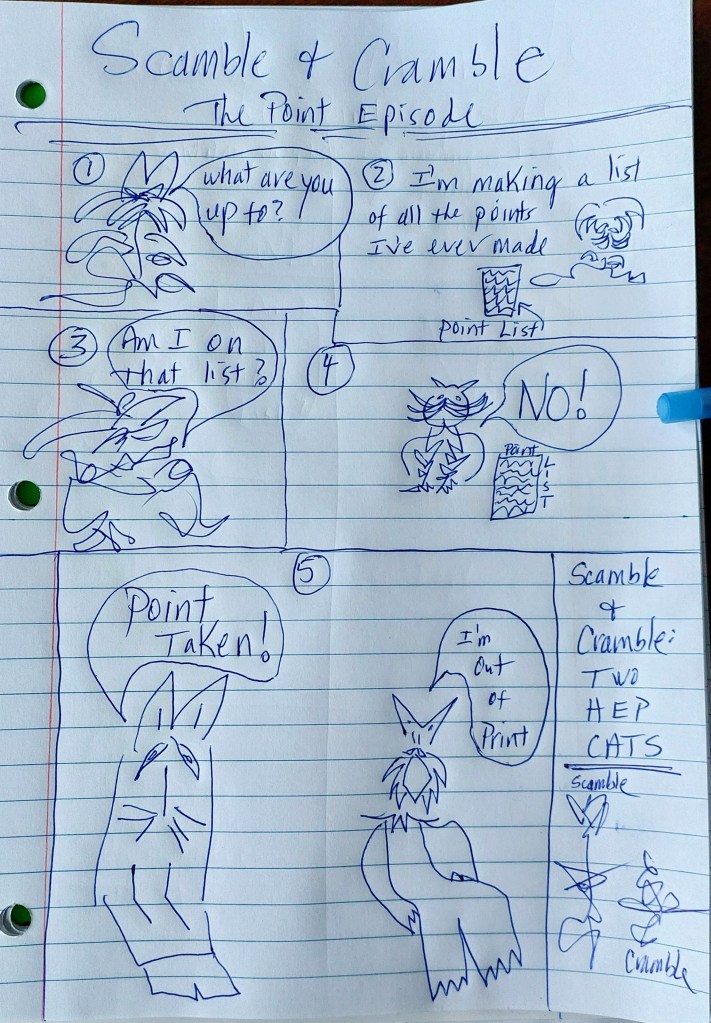
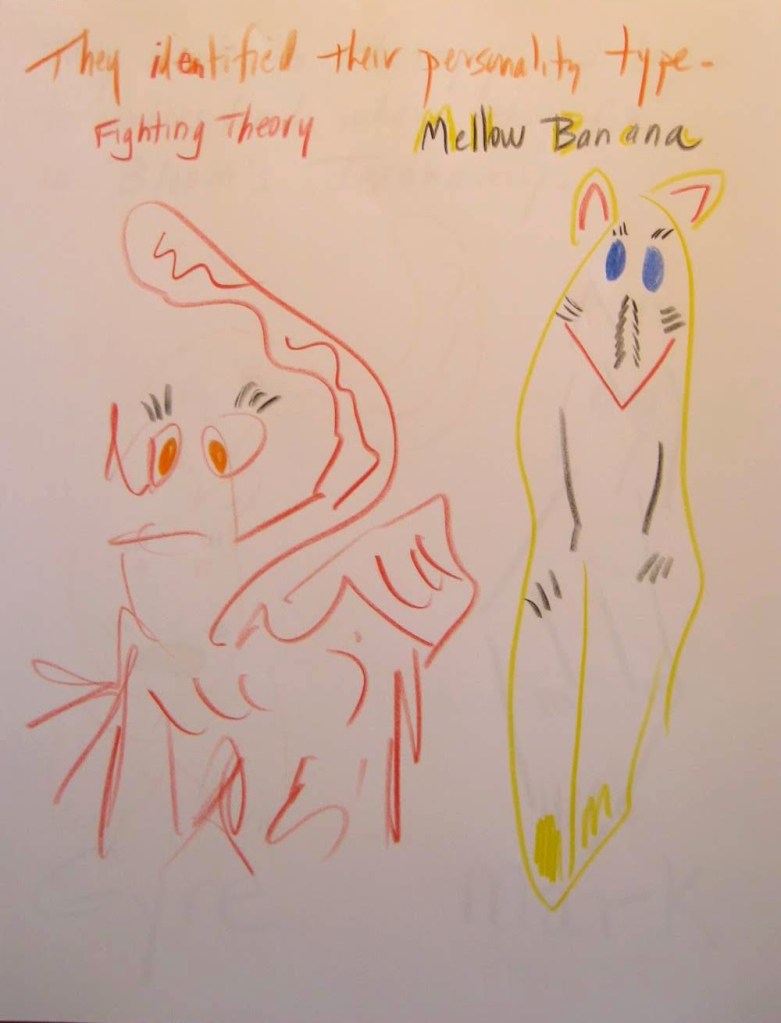
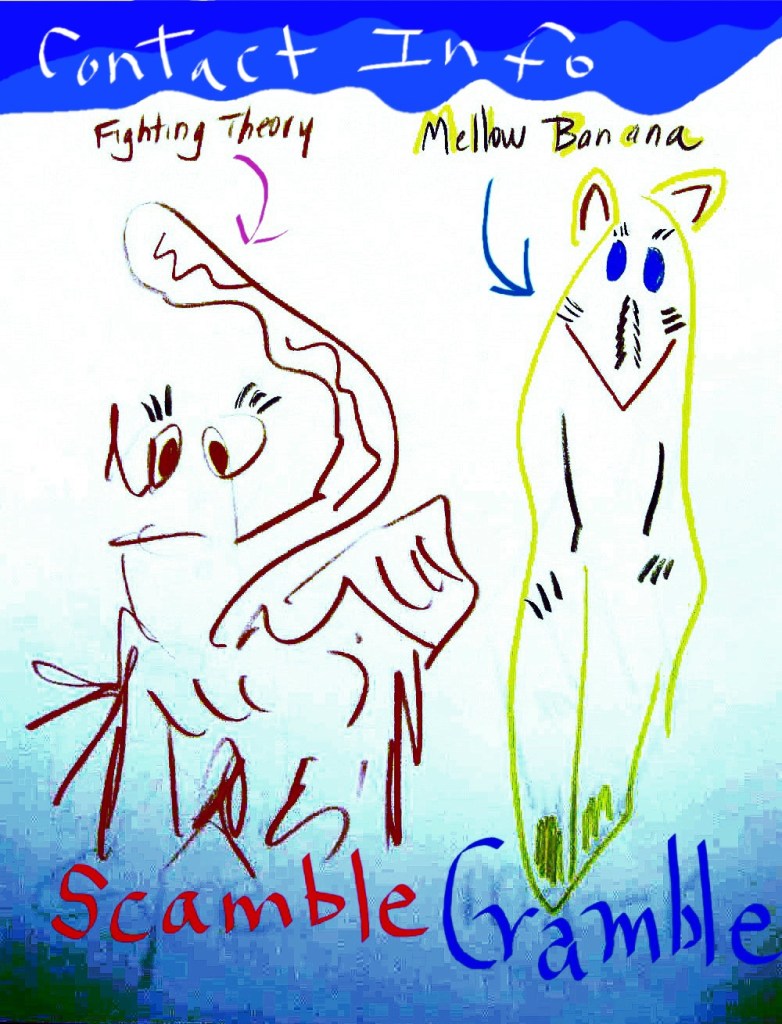
    Speaking of bananas, below is a page from a draft sequel to “Scamble & Cramble: Two Hep Cats and Other Tall Tales.”

    And below, a newer draft, in which the cats get hep to social media:

    And this morning, bananas and coffees with Susan:

  • Old Haunts

    Old Haunts, all with current links, focused on core subjects: art, technology, music, science, and literature, but first, a brief explanation:

    Moving continuously toward more minimalist formats (which if not stopped could result in disappearance altogether), blogs may risk losing some appeal, particularly to readers who enjoy liking, commenting, and linking or sharing – in short, conversing – as well as indulging in pingbacks and reblogging, and who enjoy perusing sidebars, widgets, clicks and plays, slide shows, and sharing up and down the crowded street of social media sites and apps. An example of such minimalist drift, here at the The Coming of the Toads, might be the removal, some time ago now, of listings and links of followed blogs and favorite sites, what I called in the sidebar heading over the list of links: “Back Roads to Far Places,” the title from Ferlinghetti’s book.

    I use the WordPress Reader to subscribe to sites, and currently I’m subscribed to 146 – but not many of which post frequently or are still active at all, which sparks the idea behind this post, which might have been subtitled: and Other Broken Links. While I don’t currently post a widget of followed blogs or sites, I do manage my subscribed sites in the WordPress Reader, and I also maintain the “Links” feature in the WordPress Dashboard for my own use. There are currently 33 links. But links don’t always stay current or active, while others click to surprise, a site grown or morphed into other projects or disappeared (Page Not Found), and still others remain useful resources or pleasant places to visit, like old friends. Or the link simply breaks and you get sent who knows where and who knows what’s happened. Sites often change over time, and it can be hard and takes time keeping up with the changes.

    Anyway, I thought I’d share an update of just a few of the sites that do continue to work well and that I try to follow and that offer pleasant visits and are creative and resourceful:

    Marginalia and Gracia and Louise I first discovered in “High Up in the Trees,” a blog by the Australian artist Gracia Haby. It’s now called “Marginalia.” I like everything about it – font work, photography, text content, collage and other art work, the work Gracia and Louise do with animals. And there’s another site they maintain, called Gracia and Louise, full of things to see and wonder at. The sites probably work best on desktop, but the creativity in doing more with the drop-down necessities of on-line viewing is unparalleled (of that, here is a specific example, called Reel).

    McLuhan Galaxy always produces a profoundly puzzling experience in that there seems no end to his ideas and the ramifications of effects of media on society and culture – and yet here we go, linking and following, but where? The Blogroll will keep you occupied for hours of intellectual fun.

    I don’t have John Cage ears, but I’ve always enjoyed his writing, and much of his music I do enjoy. Kuhn’s Blog is not often updated, but the site resources remain available and loads of fun, with several interactive features (try Indeterminacy, for example). The John Cage Personal Library is itself a phenomenal work.

    The Buckminster Fuller Institute shares hope for the world from a worldwide perspective. The site may provide a new awareness for what’s going on worldwide to improve conditions, predicaments, problems – near and far. If your not familiar with Bucky, here’s a good place to start: Big Ideas.

    Words Without Borders features world wide writing in a variety of formats. Browse by country, theme, or genre.

    Old Haunts, all with current links, focused on core subjects: art, technology, music, science, and literature.