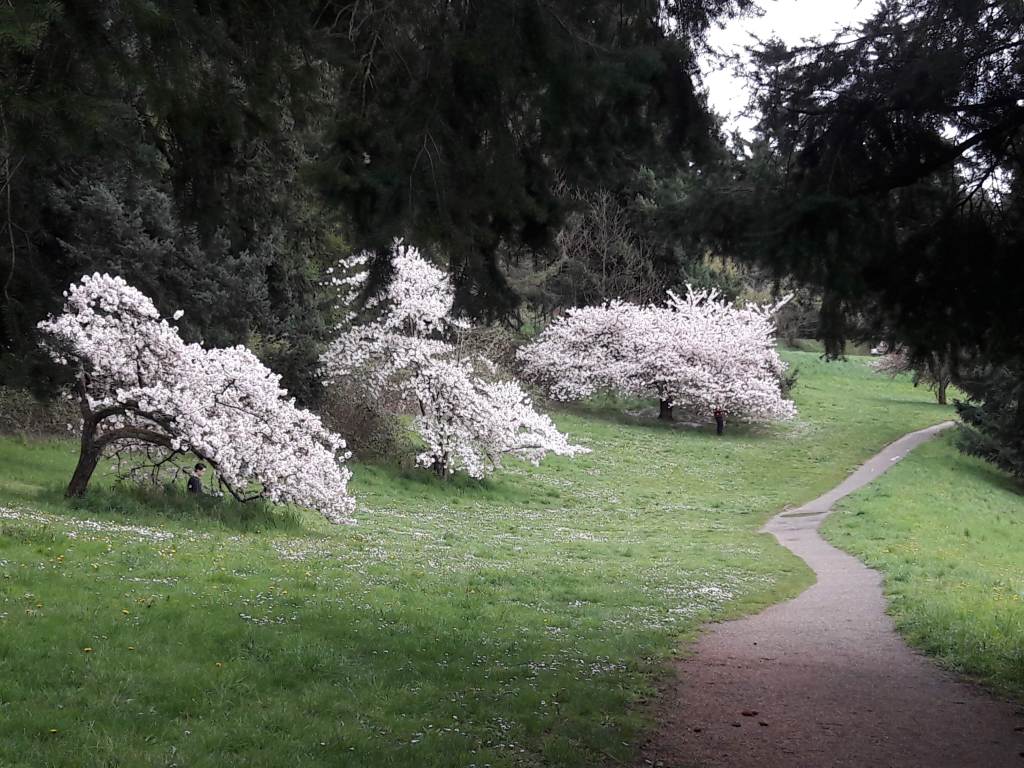
Tag: Descartes

  • The Cherry Trees

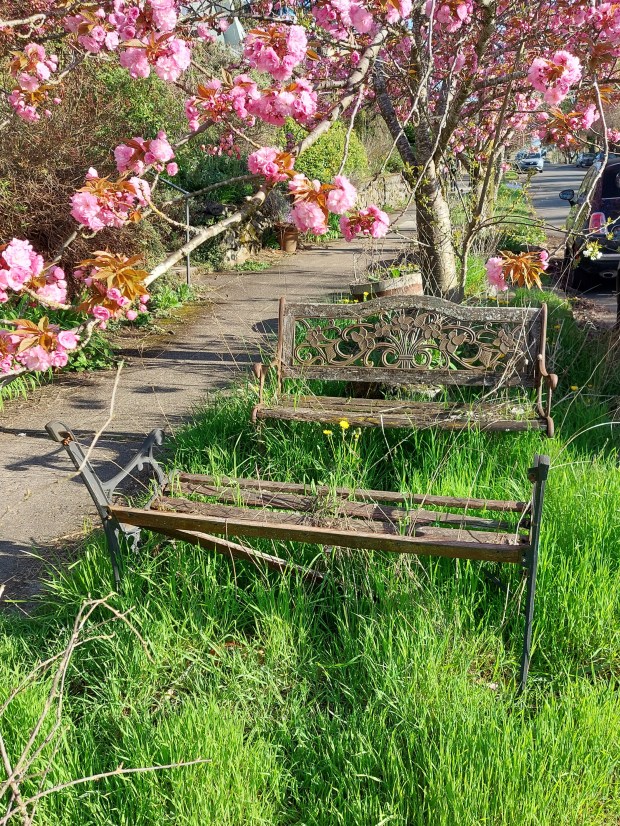
    Winter passes when the cherry trees blossom. Passersby frequently pause to view the blooms from various angles and take photos with their phones. I wonder what the viewers feel or if they make a note to come back summer to pick some cherries. Of course these street trees across from our place are ornamental flowering cherry trees that don’t bear fruit. Some consider the ornamental a waste; others think it’s art. Here’s a photo of flowering cherry branches across the street, above a set of nonfunctional benches – some consider those art, too:
    Just before leaving England for France, where he would die in the Battle of Arras (1917), the British writer Edward Thomas turned from prose to poetry. Here is his short poem titled “The Cherry Trees”:

    “The cherry trees bend over and are shedding
    On the old road where all that passed are dead,
    Their petals, strewing the grass as for a wedding
    This early May morn when there is none to wed.”

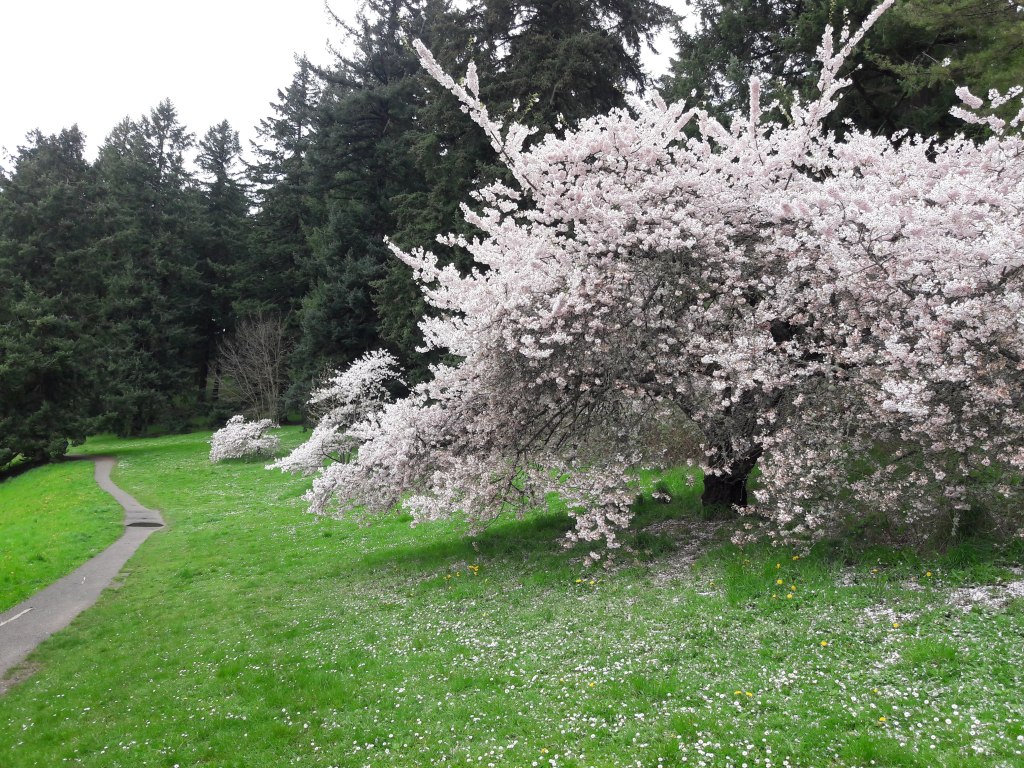
    Here are two photos of cherry trees near an old path in Mt Tabor Park:
    The Minnesota poet Robert Bly talked about nature’s capacity to send and receive images in transference from object to subject back and forth. The cherry tree in blossom might leave its image resonant in focus in the viewer’s consciousness. Not only the image, but what it felt like in the moment of sending and receiving, and Bly talked about how poetry might reconvey that image and feeling.

    “Descartes’ ideas act so as to withdraw consciousness from the non-human area, isolating the human being in his house, until, seen from the window, rocks, sky, trees, crows seem empty of energy, but especially of divine energy….

    As people begin again to invest some of their trust in objects, handmade or wild, and physicists begin to suspect that objects, even down to the tiniest molecular particles, may have awareness of each other as well as ‘intention,’ things once more become interesting.”

    “News of the Universe: poems of twofold consciousness,” 1980, Sierra Club Books, San Francisco, pp 4-5.

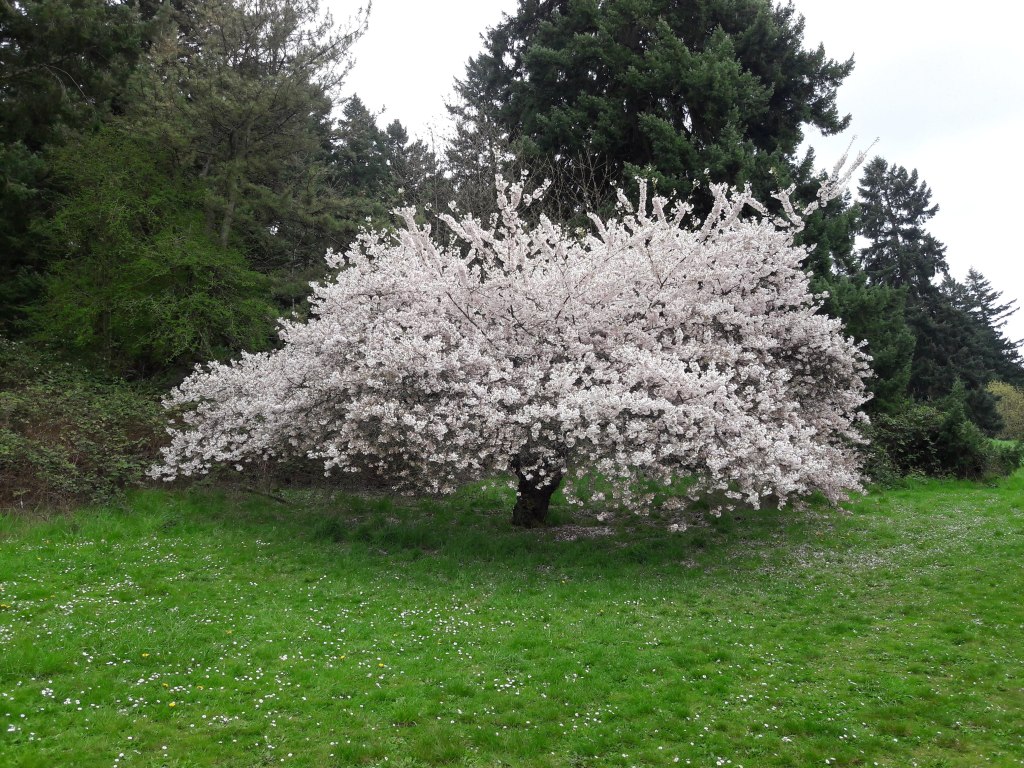
    Bly referred to the transference of consciousness idea using the poetic term deep image. Some might consider the ability to so access such images an affliction of the imagination. However it works, the cherry trees in spring seem to attract more than bees, and the pollinators are certainly responsible for more than honey. Here is another photo of one of the cherry trees in Mt Tabor Park, this one accentuated by the surrounding shades of green:
    Walter de la Mare chipped in on the cherry tree theme with his poem “The Three Cherry Trees.” He reflects on the passing of both blossoms and viewers. Here is the last stanza:

    “Moss and lichen the green branches deck;
    Weeds nod in its paths green and shady:
    Yet a light footstep seems there to wander in dreams,
    The ghost of that beautiful lady,
    That happy and beautiful lady.”
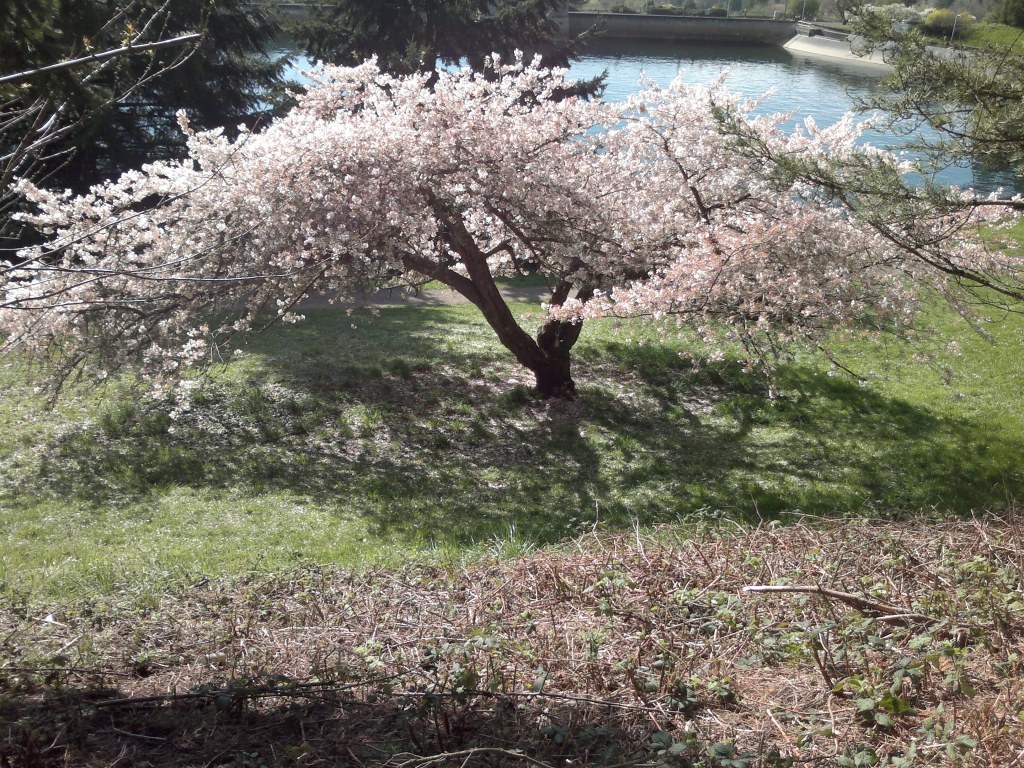
    Cherry Tree above Reservoir #5 in Mt Tabor Park

    A. E. Housman seemed to conclude waiting for a tree to blossom one might miss the ongoing opportunity to catch other images of that tree. From his poem about the cherry tree titled “Loveliest of Trees”:

    “And since to look at things in bloom
    Fifty springs are little room,
    About the woodlands I will go
    To see the cherry hung with snow.”

    Images don’t always come with sound. Here is a four second video of cherry blossoms in a wind:

    Cherry blossoms in a wind, Mt Tabor Park
  • Trick Photography and Trees

    There are, some argue, two forms of life on our planet: animal and plant. It’s generally conceived that only animals have consciousness, but not all of them. When Descartes said, “I think; therefore I am,” he may have ruined possibilities for a lot of potential ams.

    “The unconscious passes into the object and returns,” Robert Bly says (213), discussing Francis Ponge’s prose poem, “Trees Lose Parts of Themselves Inside a Circle of Fog” (217).

    Yet Joyce (XXXIII) says:

    A rogue in red and yellow dress
    Is knocking, knocking at the tree;
    And all around our loneliness
    The wind is whistling merrily.
    The leaves – they do not sigh at all
    When the year takes them in the fall.

    The “rogue” is nature, nature falling, falling kicking, yet the wind “merrily” whistles, anticipating the irony of winter’s undressing summer, when the leaves can no longer feel. Bly would argue that the leaves do sigh, and that we can hear them sigh, if we learn to listen. But earlier, Joyce had already (XV) said:

    From dewy dreams, my soul, arise,
    From love’s deep slumber and from death,
    For lo! the treees are full of sighs
    Whose leaves the morn admonisheth.

    The tree of the avenue, particularly at night, dressed in dappling neon or enamored moonlight, suggests another kind of consciousness for Joyce’s (II) trees:

    The twilight turns from amethyst
    To deep and deeper blue,
    The lamp fills with a pale green glow
    The trees of the avenue.

    For in the catechism of Episode 17, “Ithaca,” in Joyce’s Ulysses, Bloom and Stephen are apparently discussing the ability of trees, or leaves, to turn toward or away from light (paraheliotropism, or tropism):

    “Was there one point on which their views were equal and negative?
    The influence of gaslight or electric light on the growth of adjoining paraheliotropic trees.”

    The ideal photograph captures not necessarily the object, though the object must at least be attracted, or the light, which the photo must also catch, but the perfect photo snaps Bly’s passing and returning “into the object,” the epiphanic journey. This is the trick of photography, the lure.

    Bly says Ponge doesn’t “exploit things [objects], either as symbols or as beings of a lower class.” Yet the desert creeps closer and closer. “The union of the object with the psyche moves slowly, and the poem may take four of five years to write,” Bly says.

    Pieter Hoff, talking to Burkhard Bilger in “The Great Oasis” (New Yorker, Dec. 19 & 26, 2011), says, “A seed can afford to wait. Encased in dung from a passing bird or other animal, it can survive for months without rain. If the soil is dry, it can put all its energy into sending a single taproot in search of groundwater…It can worm itself into the tiniest crack, then expand a few cells at a time, generating pressures of up to seven hundred and twenty-five pounds per square inch – enough to split paving stones or punch holes through brick walls” (114).

    The desert of the human imagination also creeps, reasoning against its very nature that it is the only perspective that matters, that is aware of itself. Bly says: “Descartes’ ideas act so as to withdraw consciousness from the non-human area, isolating the human being in his house, until, seen from the window, rocks, sky, trees, crows seem empty of energy, but especially empty of divine energy” (4).

    Bly, Robert. News of the Universe: poems of twofold consciousness. [Chosen and introduced by Robert Bly] San Francisco: Sierra Club Books, 1980.

    Joyce, James. Collected Poems [Chamber Music]. New York: Viking Press, Compass Book Edition, 1957 [eighth printing, July 1967].

    Photos in this post were taken this week in Mt. Tabor Park, in SE Portland, with a Canon PowerShot A560, set on Auto – no tricks, but the top photo was “enhanced” using iPhoto.