I was given the exercises to practice by my first classical guitar instructor. After many years of carrying them around in my three-ring binder guitar workbook, I’ve taken photos of the two pages, from which I’ve copied below, adding just a few edits and a short glossary of terms. In addition to being useful developmental exercises, the lines can be used for warmup in any setting. While the exercises were written with classical guitar in mind, they work for any guitar genre. The basic idea is that you don’t want your fingers to simply remember riffs, because then they fall into forced habits, often limiting and hard to change, but the exercises encourage a flexible, ambidextrous capability, each finger able to move independent of the others.
EXERCISES (1 thru 24 - see Instructions below Line 24):

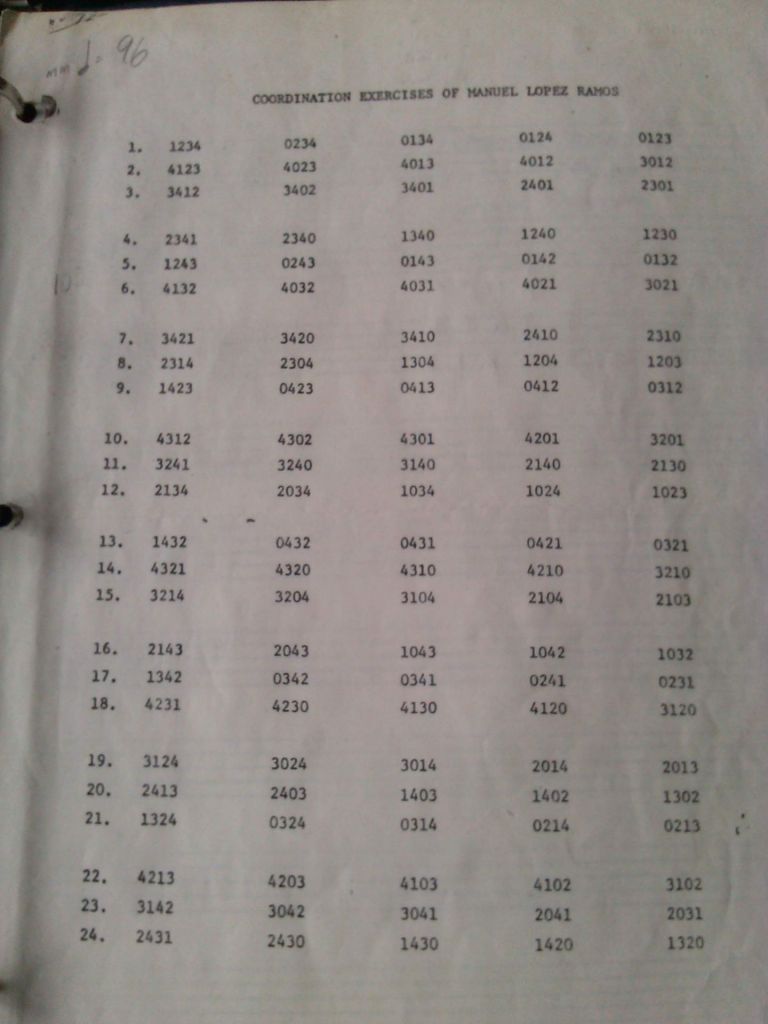
1.1234 0234 0134 0124 0123

2.4123 4023 4013 4012 3012

3.3412 3402 3401 2401 2301

4.2341 2340 1340 1240 1230

5.1243 0243 0143 0142 0132

6.4132 4032 4031 4021 3021

7.3421 3420 3410 2410 2310

8.2314 2304 1304 1204 1203

9.1423 0423 0413 0412 0312

10.4312 4302 4301 4201 3201

11.3241 3240 3140 2140 2130

12.2134 2034 1034 1024 1023

13.1432 0432 0431 0421 0321

14.4321 4320 4310 4210 3210

15.3214 3204 3104 2104 2103

16.2143 2043 1043 1042 1032

17.1342 0342 0341 0241 0231

18.4231 4230 4130 4120 3120

19.3124 3024 3014 2014 2013

20.2413 2403 1403 1402 1302

21.1324 0324 0314 0214 0213

22.4213 4203 4103 4102 3102

23.3142 3042 3041 2041 2031

24.2431 2430 1430 1420 1320
Instructions
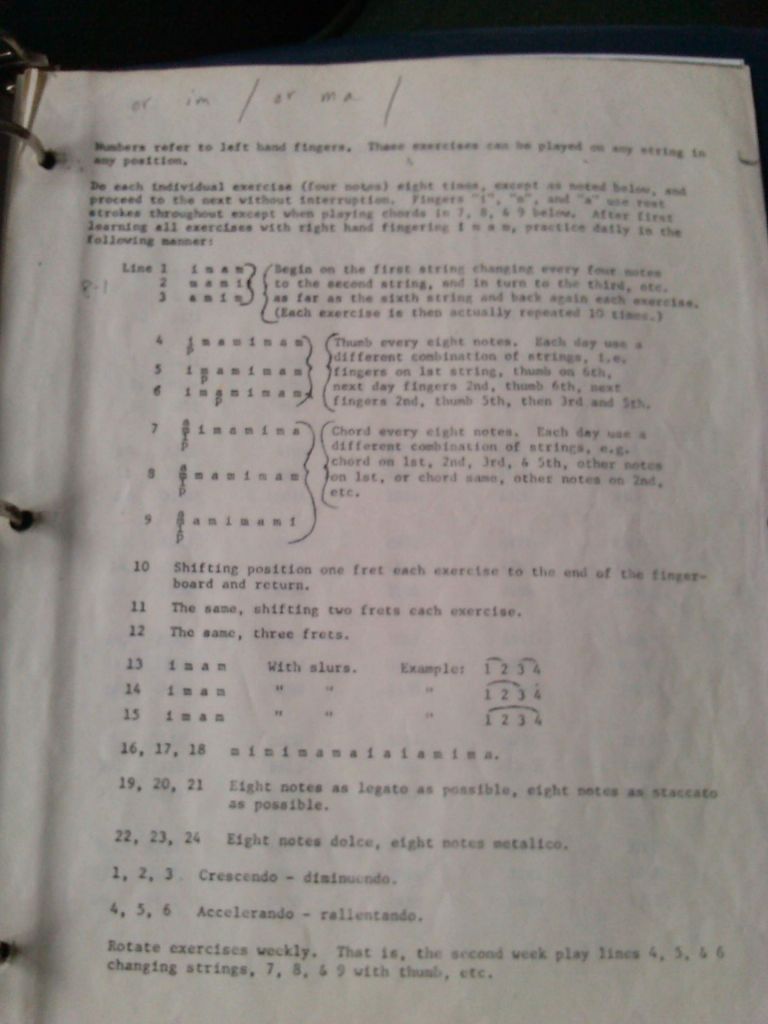
Numbers refer to left hand fingers (index is 1, middle 2, ring 3, little 4). The exercises can be played on any string in any position (i. e. beginning at any fret). An “0” in lines above, e.g. 1320, means play string open (un-fretted).
Do each individual exercise (four notes) eight times, except as noted below, and proceed to the next without interruption. Fingers “i”, “m”, and “a” use rest strokes1 throughout except when playing chords in 7, 8, 9 below. After first learning all exercises with right hand fingering i m a m, practice daily in the following manner:
Begin on the first string changing every four notes to the second string, and in turn to the third, etc. as far as the sixth string and back again each exercise. Each exercise is then actually repeated 10 times. The “Lines” below refer to the rows or exercises in the section above.
Line 1: i m a m
Line 2: m a m i
Line 3: a m i m
Thumb (indicated with p) every eight notes. Each day use a different combination of strings, i. e. fingers on 1st string, thumb on 6th, next day fingers 2nd, thumb 6th, next fingers 2nd, thumb 5th, then 3rd and 5th.
Line 4: i&p m a m i m a m
Line 5: i m&p a m i m a m
Line 6: i m a&p m i m a m
Chord (a&m&i&p) every eight notes. Each day use a different combination of strings, e.g. chord on 1st, 2nd, 3rd, & 5th, other notes on 1st, or chord same, other notes on 2nd, etc.
Line 7: a&m&i&p i m a m i m a
Line 8: a&m&i&p m a m i m a m
Line 9: a&m&i&p a m i m a m i
Line 10: Shifting position one fret each exercise to the end of the finger-board and return.
Line 11: The same, shifting two frets each exercise.
Line 12: The same, three frets.
Line 13: i m a m – With slurs2. Example: 1~2 3~4
Line 14: i m a m – With slurs. Example: 1~3 2~4
Line 15: i m a m – With slurs. Example: 1~4 2~3
Lines 16, 17, 18: m i m i m a m a i a i a m i m a
Lines 19, 20, 21: Eight notes as legato3 as possible, eight notes as staccato as possible.
Lines 22, 23, 24: Eight notes dolce4, eight notes metalico.
Lines 1, 2, 3: Crescendo5 – diminuendo.
Lines 4, 5, 6: Accelerando, rallentando.
Rotate exercises weekly. That is, the second week play lines 4, 5, & 6 changing strings, 7, 8, & 9 with thumb, etc.
- The finger of a rest stroke, or apoyando, after plucking a string, comes to rest on the string above it, thus allowing for a more controlled stroke that can produce more volume. While the instructions call for all rest strokes, the player may prefer also practicing with free strokes (where the finger does not come to rest but plays through). ↩︎
- There are two kinds of slurs, the hammer-on and the pull-off. In each, the note is sounded with the left hand finger by hitting a higher fret on the same string after a stroke (ascending slur) or pulling quickly off a string to an lower fret of the same string (descending slur). ↩︎
- Legato is playing smoothly and continuously from one note to another; staccato is playing each note with a stop between notes. ↩︎
- Dolce is soft or hollow; metalico is bright or electric. To play dolce, move the right hand forward of the sound hole; to play metalico, move the right hand back toward the bridge. ↩︎
- Crescendo gradually increases loudness; diminuendo decreases loudness. Accelerando speeds up, while rallentando slows down. ↩︎
 The Coming of the Toads