Tag: cartoon

  • Punctuation (Sunday Cartoon)

    A hand-drawn cartoon featuring a red stick-figure exclamation point with blue eyes facing off against a question mark. Both characters have arms and legs and are balanced atop small balls. The question mark’s curve forms a large, open mouth, appearing to speak or shout back at the exclamation point.

    “Why do you ask so many questions!”
    “Why are you always yelling?”


    Adorno’s Features of Punctuation1

    We may have been taught in Grammar School to see the comma as a pause and the period as a stop, the comma a quarter note and the period a whole note. The semicolon a half note? The hyphen a rest. The dash a recess, the open parenthesis time to go home.

    Adorno, in his essay titled “Punctuation Marks,” stops to consider a comparison to traffic signs:

    “All of them are traffic signals; in the last analysis, traffic signals were modeled on them. Exclamation points are red, colons green, dashes call a halt.”

    But Adorno quickly moves on to a consideration of punctuation as a kind of musical notation, but what then, he questions, becomes of that comparison when modern music begins to ignore tonality.

    Of the exclamation point, Adorno gets historical, calling its use an example of expressionism:

    “…a desperate written gesture that yearns in vain to transcend language.”

    As for the dash – well, it no longer comes as a surprise:

    “All the dash claims to do now is to prepare us in a foolish way for surprises that by that very token are no longer surprising.”

    Why Adorno limits quotation marks to words being quoted suggests a fondness for rules that will always “call out” to be broken.

    “The blind verdict of the ironic quotation marks is its graphic gesture.”

    The loss of the semicolon Adorno attributes to market surveillance, not that anyone was looking anyway, but the use of the semicolon is perhaps the most difficult punctuation mark to establish conformity; the semicolon is the most personal of punctuation marks. It’s gone the way of the tie.

    For Adorno, the test of a writer’s punctuation proficiency can be found or proven in how one handles parenthetical material; interruptions to the lineal flow of thought, which of course isn’t lineal at all, which is why we need punctuation. He uses Proust as an example of a writer’s need for parenthetical expression, where simple commas won’t do, because we are running on but actually stopping, without coming to a full stop, to check our shoelaces.

    Interesting, even surprising, maybe, is that Adorno does not compare punctuation marks to editing in a film. Adorno disapproved of movies, jazz, and advertising, the sleep inducing drugs of what he called the cultural industry. Advertising makes enormous use of the exclamation mark, yelling and fist banging, even in ads without words – it’s the threat that numbs.

    How does Adorno conclude in such a way that might be helpful to a writer either concerned over “correct” use of punctuation (incorrect, Adorno would say, that use of ironic quote marks; but it highlights – calls out – the irony of the rules as a kind of code, not code as in writing computer code, but as in work completed and awaiting inspection), or of wanting to use the tools available effectively, precisely, but at the same time creatively, interestingly?

    It might come as some degree of solace to the punctuation befuddled writer (although some might feel worse) to know that Adorno considered all writing subject to an unsolvable “punctuation predicament”:

    “For the requirements of the rules of punctuation and those of the subjective need for logic and expression are not compatible.”

    1. Adorno’s essay “Punctuation Marks” is included in “Notes to Literature: Theodor W. Adorno,” Columbia University Press, 2019. ↩︎
  • Recording Noise

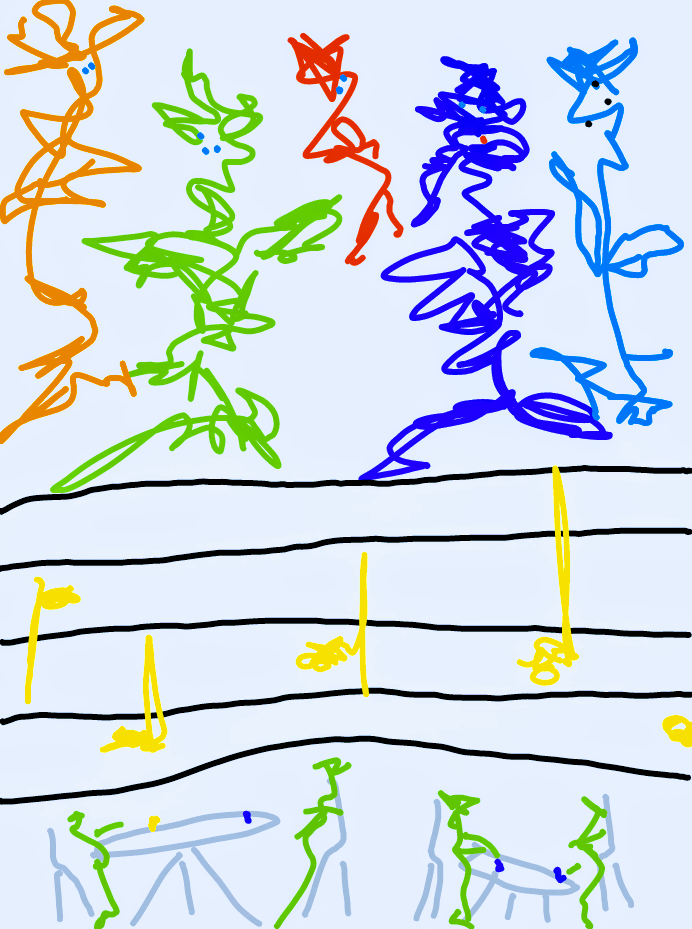
    Going about without making any noise is perhaps the most difficult task of our day. If we try to make sense of the noise, we discover music.

    I was thinking the blog was a silent activity, but then I began hearing my fingers striking the keyboard, padded notes, which, if given time, could be organized into a piece of music.

    The quieter we try to be, the more noise we hear.

    We might think of silent noise, tinnitus, for example, an apparent oxymoron, a noise but silent because it’s not really a sound, but simply the perception of sound, hearing a sound that has no outside source. Others can’t hear it, no matter how hard they listen. But they have their own silent noise playlists.

    The keyboard went quiet as I reread the above paragraphs. I’m in real time for the moment, but my reader, if there is one, will not be in the same time. Thus the blog is like a recording, but the reader will not be able to hear the keyboard as I type, or as I typed, unless I made a recording.

    There are 24 time zones around the globe. They allow for music to occur internationally. But not everyone pays strict attention to the time zones. In China, for example, everyone uses the same time, all the time, regardless of which of the five geographically separated time zones they might be in. What time is it becomes an interesting question, since sunrises and sunsets can occur hours apart, depending on where you are at the time. In other words, to awake at sunrise for one person, could be sleeping in for another, not getting up until noon! For some reason, we try to match our time with the position of the sun. But most people work inside, unlike our ancestors, so what does the sun have to do with it? Circadian rhythms. We can’t hide from the sun.

    I’m making a recording now of the keyboard, using my cell phone. Note the pauses, as I try to figure out what to say. The spaces between the notes create music, because they are separated in time (duration). But is there rhythm? The recording has now gone on for just over one minute.

    A default has given the keyboard recording the title “Voice 0061.” I’ve tried to upload the recording to this blog post, so readers can follow along, hearing the typing as they are reading the paragraph, but I received a message saying I’m unable to upload the file, to wit: “Sorry, you are not allowed to upload this file type.” Thus we discover that learning to play an instrument is harder than we might think. Undaunted, I’ll now try a video, using the keyboard and my cell phone.

    I’ve set the phone against the screen, and I can’t see what I’m typing now, feeling much like the player in a jazz band. But I type on, being video-recorded. I don’t feel much like continuing the experiment, but having pushed on this far, I keep typing. As Cage said, “What we re-quire is silence; but what silence requires is that I go on talking.”1 Similarly, what music requires is that I go on typing. Many mistakes in this typed paragraph, like playing the worong [sic] notes on the guitar or piano, but I’ve gone back and corrected the text, but the mistakes, as recorded, sound just like all the other notes, no problem.

    Now I have the video recording on my phone. Because I set the phone so close to my screen, the video is a white grey cloud, but the viewer can hear the keyboard. Now I have to figure out how to get the video from my phone into this blog post, so readers can listen to it as they read along. Alas, I try to email it to myself, but get a Gmail message saying it’s too big a file. Yet it’s only 1:33 minutes.

    But you can perform your own keyboard music. All you have to do is type and listen. You don’t even have to type real words, but that should probably be the subject of a different blog post.

    1. John Cage, “Lecture on Nothing” (1959), from “Silence” (First printing 1961. Wesleyan Paperback, 1973). ↩︎
  • Middle-Aged Once

    Patrick Modiano’s novella “In the Cafe of Lost Youth” opens with an epigraph attributed to the French philosopher Guy Debord:

    “At the halfway point of the journey making up real life, we were surrounded by a gloomy melancholy, one expressed by so very many derisive and sorrowful words in the cafe of the lost youth.”

    I was unable to track down the source of the quote. It’s possible it comes from a memoir or some throwaway magazine article. But it reminded me of the opening to Dante’s “Inferno”:

    “Midway in our life’s journey, I went astray
    from the straight road and woke to find myself
    alone in a dark wood.” John Ciardi translation, 1954.

    Dante is comparing having lost his purpose or direction in life in middle age, 35 or so, to getting lost in a wilderness where one has wandered off a steadfast, well-worn path. He’s unable to locate himself on some reputable and credible map, either from an external or internal viewpoint. Why doesn’t he back up, retrace his steps? Instead, he forges on in the dark on a crooked path. At that point, a step forward could just as well be a step backward.

    Dante both forges purposefully ahead and rambles on, caught in the web of the woods, presses on like some point man cut off from his platoon, tracking deliberately with some goal of trying to map a new way out. Though he lacks an immediate target, he’s not aimless.

    “I placed the typewriter on the small pitch-pine table in my room. I already had the opening sentence in my mind: ‘Neutral zones have at least one advantage: They are only a starting point and we always leave them sooner or later.’ I was aware that once I sat down in front of the typewriter, everything would be much less straightforward.” (89-90, “In the Cafe of Lost Youth,” Patrick Modiano, 2007 Editions Gallimard, 2016 NYRB, 118 pages).

    Modiano was the recipient of the 2014 Nobel Prize in Literature. The only other book of his I’ve read is “Young Once” (1981 Editions Gallimard, 2016 NYRB, 156 pages):

    “Does life ever start over at thirty-five? A serious question, which made her smile. She would have to ask Louis. She had the feeling that the answer was no. You reach a zone of total calm and the paddle boat glides all by itself across a lake like the one stretching out before her. And the children grow up. They leave you.” (5).

    Both novels are sepia-tinged with the kind of suggestive noir one begins to associate with normal life, which is to say there is no normal, but everyone you meet is obsessed, or ought to be, with their past and future but are actually caught up in the web of their now, hopelessly trying to live in the moment but forced to move on, like Dante, or Beckett, in spite of having lost track of where they are in the moment. Even trying to move back is another futile move forward. Yet at some point, maybe that middle age point, one is given pause, a kind of grace – to reflect, to look back, to sense forward, lost in that very stillness:

    “They did not know that this was their last walk through Paris. They did not yet exist as individuals at all; they were blended together with the facades and the sidewalks. In macadam roads, the stones, patched together like an old cloth, have dates written on them to indicate when the successive layers of tar have been poured, but perhaps also recording births, encounters, deaths. Later, when they remembered this period in their life, they would see these intersections and building entryways again. They had registered every last ray of light coming off of them, every reflection. They themselves had been nothing but bubbles, iridescent with the city’s colors: gray and black.” (154)

  • The Night Before Christmas

    Twas the proverbial night before Christmas
    When all through the house oboes wobbled
    And bells drummed twas Nick at his sticks
    While the children blew bellows in burrows
    Asleep how through all this babbled version
    One could hear their little tin horns bleep
    All sugar tipped up and fat ball hobbled
    Achoo in me hat and mamma in her ache
    The babe at her breast for a milk rich bowl
    When out on the street the leaf blowers
    Blowered at this hour a rout and I tripped
    Nary tipped mind you but a blob had sat
    On my head nevertheless rose to deal
    With the matter the moon yes the rain
    Drips deep below when then did I spy
    The eight petite reindeer and their poser
    Whose echo touted tomatoes and fruit
    Dressed as they were in greens and reds
    But I’ll spare you here the royal roll call
    Suffice to say yes they did fly at his whip
    Peeble, Hooch, Boop, Bloob and the others
    Then came the dashes – – – – – – – – one
    After another like leaves when they fall
    He knocked politely at the door a mere
    Echo of past years his smile an arrow
    Soon up the street in his branded vest
    Stopped here and there with boxed goods
    For the goodies then turned signalled left
    Leaving me to pick up my package
    Empty my stockings of my two tired
    Feet and return blue to my windy sleep.

  • This is a poem

    This is not
    a knotty poem

    not a problem
    to be solved

    not some sort
    of joke jest

    or just a blog
    post looking

    for a pic
    a prom corsage.

    What it is
    can’t be said

    without it
    disappearing

    like an old
    phone book entry

    EAstgate 3128
    for example

    back in the day
    before answering

    machines when
    comments off

    meant leaving
    the phone off

    the hook spoiling
    the party line.

    This is a poem
    you have a message.

  • What to do

    “Nothing to be done,” Didi and Gogo bicker, essentially about what to do, like an old couple of a long suffering, loving marriage. Nature is no refuge; the one tree in their world seems sick. They can’t go anywhere, for fear of missing their appointment with Godot. They hang out and talk, express various physical complaints, visit the past, ask questions they can’t answer.

    The play, Samuel Beckett’s “Waiting for Godot,” is famously about nothing. Nothing fills the stage, informs the dialog. If they carried cell phones, their batteries would surely be dead. In any case, they’ve no one to call, and no one to call them.

    The two (often described as tramps, bums, or hoboes of some kind, clowns of some sort, lost from their circus, or stripped to being human without diversion down-and-outs) might be among the last few of a pandemic, or simply retired, their pensions just enough to enable them to do nothing but talk freely, which is everything in a world of nothing.

    It’s not easy – doing nothing. Even contemplating nothing can be a nerve-racking business, fraught with anxiety. Consider, for example, what nothing is. Nothing is what is not. In the beginning – well, just before the beginning, all was nought, and from naught came all.

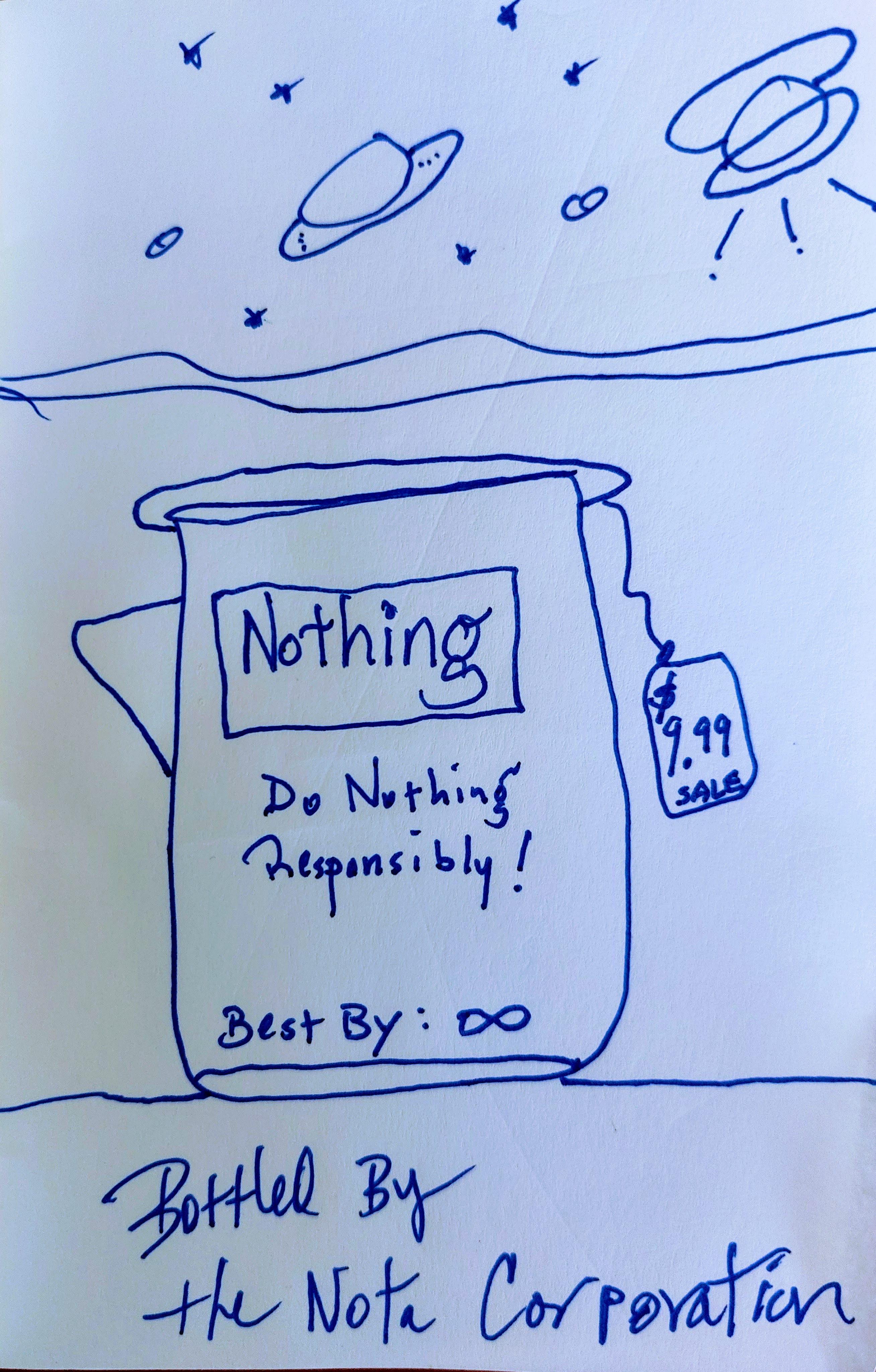
    And it’s not easy doing nothing responsibly. nān thing. And yet, if you make a practice of it, you are called a do nothing. But there is no such thing as nothing. Nature overkills. If the universe is infinite, and the universe is composed of things, there can be nothing within, and nothing without.

    Consider a bottle out of which you suck everything, leaving nothing, and you cap it, a bottle of nothing. Would it be dark in there? Like dark matter? For if everything is taken out, light too must be absent. If scarcity creates value, what could be more precious than nothing? And Didi and Gogo are its brokers.

  • Notifications

    • You fell asleep!
    • Spider on the ceiling!
    • You’ve a text!
    • Trash day ~
    • Light on in the basement or attic?
    • Today is not Saturday; try again.
    • Out of ice cream!
    • The universe is expanding!
    • You’ve a rejection (t;t)
    • Meow (~^~)
    Notifications