Tag: Caleb Crain

  • caMels, whEN to caPITalize, & concrEte POEMS

    Over at Steamboats, Caleb Crain has lately expressed a concern over the use of camel case letters.

    We are not opposed to the use of camel case in a corporate logo, particularly where Concrete poetry might find a place in commerce.

    We went to An Anthology of Concrete Poetry (Emmett Williams, ed., 1967, Something Else Press), remembering some camel casing there, but spacing is a more prevalent tool. Remember that most of the old Concrete poems were chiseled out on manual typewriters.

    The John J. Sharkey poem, “Schoenberg” (1963), is shown in the Anthology in two versions. The first (left) was rejected “…because the publisher does not use upper-case letters in his graphic production style.”

    The second version was “interpreted typographically by Simon Lord…,” and Sharkey apparently liked it less than his original.

    There’s often a reason for things like spacing, capitalization, reading silently – and then the reason becomes the rule, and remains the rule, even after we’ve forgotten the reason; then we might invent a new reason to support what we now don’t want to change.

    Note: The title to this post is a Concrete poem, created with camels:

    MEN PIT & Ete POEMS.

  • Caleb Crain and Becker-Posner Print Their Blogs

    As we watch the coming of the end of books and the disappearance of newspapers, we note an increase in electronic self-publishing, blogs the obvious pedestrian example, but then, in an interesting twist, we see blogs subsequently published in more traditional print copy format. Two recent and noteworthy examples illustrate: Caleb Crain’s The Wreck of the Henry Clay (Lulu, 438 pages, $14.95), selections from his blog Steamboats are Ruining Everything, covering blog years 2003-2009, and Uncommon Sense: Economic Insights, from Marriage to Terrorism, a “best of” The Becker-Posner Blog (University of Chicago Press, 384 pages, $29.00).

    Caleb Crain is a 19th century scholar and freelance writer with degrees from Columbia and Harvard who has written scholarly papers, a book, American Sympathy, and a novella, Sweet Grafton, as well as general interest articles and book reviews for the New Yorker and other prestigious publications. Richard Posner is a federal judge, Becker a Nobel Prize winning economist at the University of Chicago. The ethos that Crain and Becker-Posner bring to their blogs adds validity to what some consider to be an environment rife with charlatanism and chicanery – the world of the blog. But their blogs improve the potential of the art of blogging by setting a high standard of quality and quantity, by elevating and advancing the long-term potential of self-publishing, and by engaging readers in the possibility for a democratic, egalitarian, and interactive conversation that is not available elsewhere to general readers, students, or others whose interest in the discussion of ideas may go beyond skimming the mosaic of the daily newspaper or the weekly magazine.

    Crain and Becker-Posner have long lists of traditional publication credits. They don’t have to blog, nor do they have to self-publish. Crain’s blog performs a service to the reading community, so call it pro bono publico. Of particular interest are those posts that follow the print publication of his longer articles and that discuss his research; these posts have value for both the general reader and students. The links he provides are purposeful and meaningful, interesting and useful. Crain’s blog often generates civil comments and discussion, unlike some blogs that seem to foister the awry warrant. The Becker-Posner blog no longer accepts comments. Readers may miss the discussion, but the more popular a blog becomes, the less likely its founding readers will be able to follow the discussion – the traffic and the drive-by comments may become too distracting, the volley of retorts from the obsessive commenter tiresome.

    Blogs like Crain’s and Becker-Posner’s are not without criticism from within their professional writing communities (it took the n+1 blog six months to finally review Crain’s blogbook). Why would a professional writer blog, thereby giving away content, setting a bad precedent? But no writer’s every word is going to see print, and the ones that come closest, the syndicated, the featured, the columnists, frequently suffer from a paucity of ideas, quality, and freshness (consider George Will and Stanley Fish). Bloggers are under no compunction to blog daily or weekly, but blog regularly enough to maintain a loyal readership, blog when they actually have something to say and the energy to say it.

    Becker-Posner introduced their blog in December of 2004. In their first post, they said “Blogging is a major new social, political, and economic phenomenon. It is a fresh and striking exemplification of Friedrich Hayek’s thesis that knowledge is widely distributed among people and that the challenge to society is to create mechanisms for pooling that knowledge…The internet enables the instantaneous pooling (and hence correction, refinement, and amplification) of the ideas and opinions, facts and images, reportage and scholarship, generated by bloggers.” Five years later, the Becker-Posner blog posted a notice announcing their blog’s print publication.

    Crain, on his blog, explains that his blogbook comes with “six years of essays, which many of you will already have read, about dogs, torture, etymology, American history, gay marriage, political rhetoric, movies, tree climbing, indie rock, Mars, peak oil, anarchism, and literary criticism.” Crain’s blog is more personal and eclectic than the Becker-Posner blog, and the general interest reader may prefer it.

    While some writers may wonder why some bloggers give away content, readers may wonder, now that the blogs are available in print form, why they would purchase a blogbook when the content is available free on-line. The answer is simple: because the general interest readers who follow blogs like Crain’s and Becker-Posner’s for any length of time value books. Books are what they want. But it’s that book interest that sparks the interest in the blog – following such a blog allows a reader to watch a professional writer writing a book, and more, to participate in that writing by interactively watching the work develop. The last time this happened was when magazines still serialized books in progress (Dickens, for example; or the New Yorker’s serialization of Capote or John McPhee, or its publication of Hersey’s Hiroshima – these were all followed by books). The difference is the initial self-publishing aspect of the blog. While the Becker-Posner blog is an example of self-publishing, their blogbook is not, while Crain’s blog and book are both self-published. Either way, the loyal reader will look forward to sitting down with a hard copy, like spending time with an old friend, reminiscing.

    12-19-09 update: The  Becker Posner site has moved to Typepad and updated their site, citing technical problems with the old location. Comments are turned back on at the new site.

  • Back to the Futurism – What’s new in Poetryland: Flarf, Conceptual Writing, and Concrete Poetry

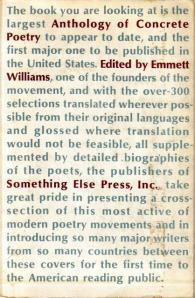
    An Anthology of Concrete PoetryWe cross the border into Poetryland. At the crossing the guards confiscate our miner’s helmet and swim fins, and ask the purpose of our visit. On holiday, sightseeing, see what’s new, we reply.

    We head to the old haunts, and what do we find? Flarf, a portmanteau word that identifies a poem created from electronic detritus, a collage of bits of the web, a kind of Webarf, and Conceptual Writing, a back to the Futurism replay of Concrete Poetry.

    While neither new form appears all that new, the infusion of humor, anti-seriousness, and wordplay are welcome (we wish a Poem Painting or two had been included). But we’re not sure if Flarf is a poetry of the Web, if the Web has found its poetic form, “…poetry that is native to that environment, written with the intention of being read there” (Crain, 17 June 2008).

    A fickle subscriber for some years, our renewed subscription just arrived, and we were delighted to learn of Flarf and Conceptual poetry (July/August 2009).

    Welcome back! Where have you been? the waitress at the Refugio Café asks. At the point the tide is out and the waves shoulder into the cove.

    Williams, E. (Ed.). (1967). An Anthology of Concrete Poetry. Something Else Press: New York.

  • How Do Professors Think? More Crisis in the Humanities

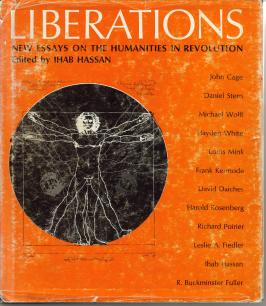
    LiberationsAt the bottom of her n+1 review of Michele Lamont’s How Professors Think, Amanda Claybaugh laments that Lamont “fails” to answer the promise of her book’s title. Claybaugh appears to buy into the title’s assumption, that professors think differently than others. But why would professors think any differently than anyone else? Indeed, from the professor quotes offered in the review, they appear to think exactly like everyone else: “so sick [of hearing]”; “it’s hard to articulate”; “nothing is perfect”; “just still didn’t get it”; and the ubiquitous “[don’t] be an asshole.” 

    Claybaugh reads in the field of English; Lamont, sociology. It’s assumed one’s discipline amounts to a special pair of spectacles, and only through the lenses of the discipline can one fully appreciate, or aspire to, or do at all. Specialty is the extreme license: “…disciplines make a strong case for themselves when they unify around a shared method….” And to the extent that “English is seen as having no method of its own,” it also has no discipline, and its “…proposals …are seen as wandering into territory claimed by other disciplines.” Blame it on the essay, on Montaigne, all that wandering, those long trials. One English professor advances that close reading is a method, but in an apparent lack of self-confidence worries “…whether historians might not ‘know how to do this better’ after all.” Too bad; she might have mentioned Louis Menand and his American Studies or his The Metaphysical Club, or Caleb Crain’s American Sympathy, examples of English folks wandering afield successfully.

    Consider the end of Bradbury’s Fahrenheit 451. Montag, on the run and under the influence of the former English professor Faber, joins the radicals living outside the city, memorizing books. They become the book they digest, the ultimate specialist. That’s a cool ending, but for a professor, why wouldn’t, as Buckminster Fuller gives us, specialization lead to extinction?

    In his preface to Liberations: New Essays on the Humanities in Revolution, Ihab Hassan asserts the professors have climbed out of their boxes: “The discomforts of the academy are already too much in the public eye. Yet how many see, I wonder, that we now strike past the college administration and campus guard, past the curriculum, past scholarship itself, at an older idea of man? The famous drawing of Leonardo, arms spread and legs apart, giving the human measure to circle, square, and universe, no longer takes our breath away. A post-humanism is in the making. What will be its shape?” Alas, that was 1971; the revolution is now in crisis.

    “For if the lingo gasped between kicksheets, however basically English, were to be preached from the mouths of wickerchurchwardens and metaphysicians in the row and advokaatoes, allvoyous, demivoyelles, languoaths, lesbiels, dentelles, gutterhowls and furtz, where would their practice be or where the human race itself were the Pythagorean sesquipedalia of the panepistemion, however apically Volapucky, grunted and gromwelled, ichabod, habakuk, opanoff, uggamyg, hapaxle, gomenon, ppppfff, over country stiles, behind slated dwellinghouses, down blind lanes, or, when all the fruit fails, under some sacking left on a coarse cart?” (Joyce, Finnegans Wake, p. 116).

    Where, indeed.

  • From Iran: “Don’t send me no more letters no,” not unless you Twitter them.

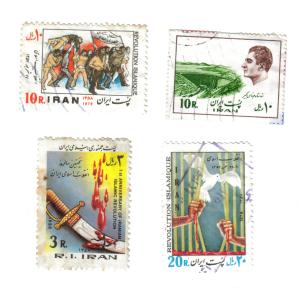
    Iranian StampsOn 7 December 2006, the informative and engaging blog Steamboats Are Ruining Everything posted on scholarly journal offprints and stamps. I recently read the post in a book version of the blog titled The Wreck of the Henry Clay: Posts and Essays, 2003-2009, published by the blog’s author, Caleb Crain, and which I recently purchased at Lulu (now a regular reader of the blog, I didn’t discover it until sometime in 2007). Part of Caleb’s 2006 post reminded me of my own stamp collection, which I had not looked at in some time.

    I am not a philatelist. I saved the stamps more than collected them; they were given to me, each a small gift, by my students at the time, English as a foreign language students in the late 1970s and early 1980s. The saving of stamps began when a couple of students asked me to help them with translations of letters – they wanted to reply in English, or to gain more English by translating letters from home into English – and I commented on the stamps I was seeing. A rumor seemed to circulate that I collected stamps, and before long indeed I did, my students, for the most part dispossessed, disarrayed, and sometimes disappeared, happy for an opportunity to easily give their teacher something in return (though what I gained from my students, stamps or no, was more than anything I gave to them).

    A number of my stamps are from Iran around the time of the fall of the Shah, and several were given me by Zahra, an Iranian doctor who stayed briefly in the US after one of her sons was killed in the revolution. When I first met her, another of her sons introducing us, she reached out, looking deeply into my eyes, and held my face in her hands, to her son’s embarrassment, though I did not mind, and she said that I looked like and reminded her of her lost son. Later I learned that she had spent days looking for him, wandering around Tehran, searching through stacks of body bags in freezers. Zahra returned to Iran and wrote to me of the war on the Iraq front, where she had gone to doctor the injured. She talked of the age of the soldiers, the waves of certain casualties as the boys ran hopelessly across the desert battlefield (but I can’t find this letter; it’s possible my memory fails here, and that this impression is from another Iranian student from whom I probably asked for news of Zahra).

    But I have other letters from Zahra. In one, she wrote that rumors of shortages were unfounded. In February of 1981, she wrote: “Joe I didn’t write letter as an american or an iranian this is an outlaw letter, it is just as I feel like to write….” She asked that I “please write me letter in print with typewriter.” I grew reticent though, fearful the letters might put her at some kind of risk, and our correspondence ended. Her last letter to me closed with “…I miss you and I am looking forward to have letter from you and hear some thing about you.” She had written, “I think the people of Iran are big they’r tolerant and patient people. They can get along with all situation NO NO Joe all people are the same and all are in situation as iranian.” (I have copied from Zahra’s letters exactly as she wrote them, though she always asked me to send them back to her with corrections.)

    Now of course, the revolution, a dormant volcano, erupts again, but Twitter and other e-tools may make stamps and letters, like Caleb’s offprints, obsolete.