There’s a scene in John le Carre’s “The Spy Who Came in from the Cold” (1963) where Leamas, the tough and unsentimental spy, recalls his first experience of what for him was a foreign emotion, the fear and trembling that comes from a near miss. He was speeding down the autobahn late to an appointment and “taking risks to beat the clock” when he nigh collided with a car full of children:
“As he passed the car he saw out of the corner of his eye four children in the back, waving and laughing, and the stupid, frightened face of their father at the wheel. He drove on, cursing, and suddenly it happened; suddenly his hands were shaking feverishly, his face was burning hot, his heart palpitating wildly” (122, Coward-McCann, 1964).
But apart from his sudden shaking of nerves, what happens is that he imagines the scene as if he had actually hit the car, and that too is new, and
“He never drove again without some corner of his memory recalling the tousled children waving to him from the back of that car, and their father grasping the wheel like a farmer at the shafts of a hand plow” (122).
The new emotion is evidence that “He was slowing down. Control was right (121)….Control would call it fever” (122). What has happened to the stouthearted spy that a near miss becomes an obsessive memory that torments him almost as if the resulting imagined outcome really happened?
I thought about the le Carre scene while reading the Roddy Doyle short story, titled “The Buggy,” that appears in this week’s The New Yorker magazine (June 24, 2024). Doyle’s story also contains a near miss. A father is standing with his kids on a train platform:
“He let go of Colm’s hand for a second, to give the button a jab – and Colm was gone. He had tried to step onto the train; his stride fell short of the gap, and he dropped between the train and the platform, under the train” (48).
But what happens in Doyle’s story, unlike the foreign emotion experienced by le Carre’s spy, is the father seems to have lost touch with the reality of the experience:
“He could remember rescuing Colm, but he couldn’t imagine it – he couldn’t feel it. He didn’t believe he’d done it. Or any of the other things he’d done when he was a father” (48).
Like le Carre’s aging and on the wane spy, the father in Doyle’s story begins to experience his memories differently from the reality of their happening. In fact, he simply can’t imagine the experiences are actually his. For example, and this is probably, while reading the Doyle story, where I remembered the scene from “The Spy Who Came in from the Cold,” the father recalls another buggy incident. Another son, Sean, had pushed their buggy out into the road and a passing car hit it. Doyle’s story turns on whether or not the bugggies are carrying babies or are empty.
“He could remember it like a scene from a film. It was a very good film. But he wasn’t in it.
What happened?
Where had his life gone? Not the years – the blood. Where was the life?” (49)
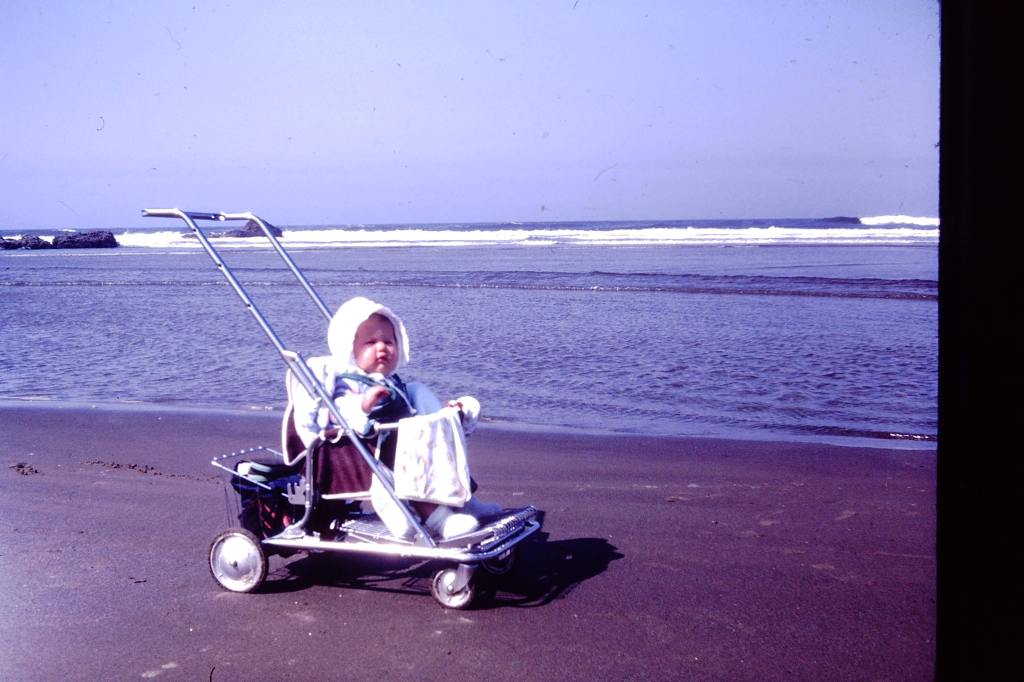
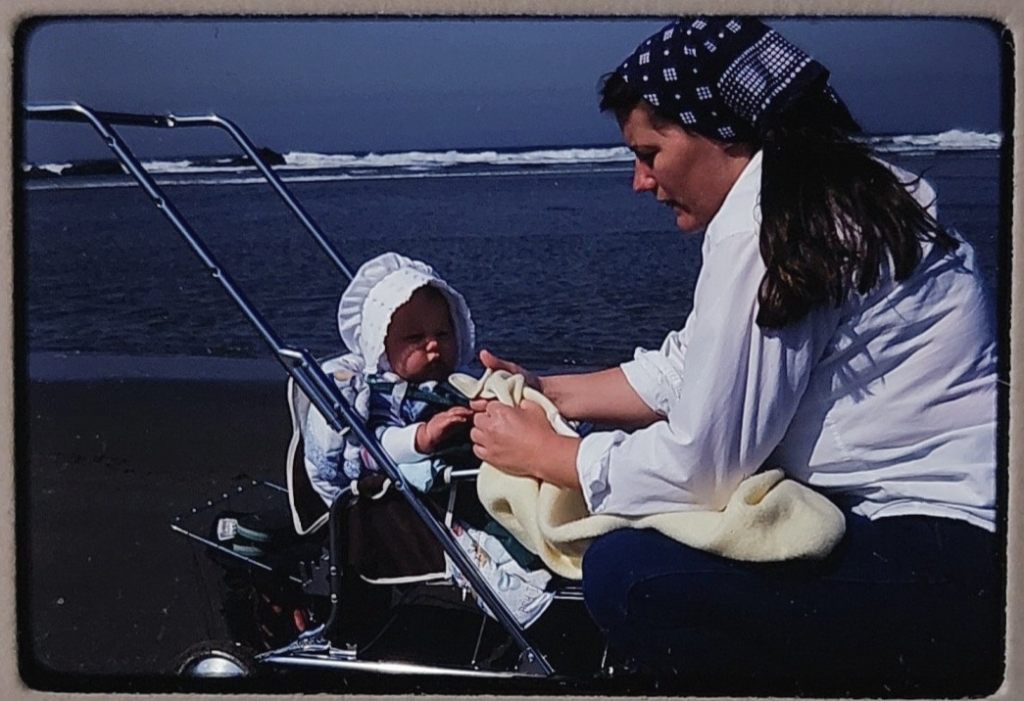
Then there’s another buggy, in the Roddy Doyle story, at the beach, near the incoming tide, and this one reminded me of a couple of old 35mm slide photos I took years ago on a trip to Cannon Beach. There’s definitely a baby in this buggy. The tide is out, and I’m close by, and so is the mother. But why did I say I remembered the photograph and not the actual being there on the beach, the waves breaking far out, the sun still to the east, late morning, the blue steel tones of the sea and sky, the now old fashioned collapsible beach buggy with basket? And that white bonnet frilled lace like the surf foam and that blue bandanna. Is it a memory or a photograph or a short story?
 The Coming of the Toads